


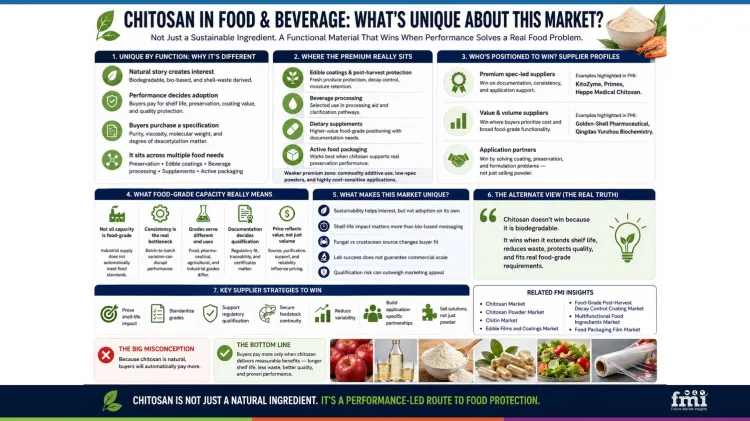
- Food-grade chitosan capacity is not equal to total capacity of chitosan. Just because an industrial-grade supplier exists, it does not necessarily mean that it can also be used in food and beverages applications.
- The real limitation is consistency in specifications: purity, molecular weight, viscosity, degree of deacetylation, solubility, microbial content, odor, color, and traceability.
- There are several grades of chitosan, including pharmaceutical, food, agricultural, and industrial, but every grade fulfills a specific market requirement and pricing model.
- At the same time, surplus capacity is created when using technical-grade product, while there is still shortage of food-grade chitosan for food and beverage applications.
- Price levels are influenced by raw materials source, quality grade, processing technology, consistency, and technical support, rather than waste shells capacity only.
- The most common misstep on the part of users is comparing technical-grade chitosan powder and validated food-grade chitosan on a one-to-one basis.
The capacity for food-grade chitosan production is often misperceived. There are instances when the availability of seafood shell waste in the marketplace is seen as tantamount to the existence of ample food-grade chitosan. This may be somewhat true but still far from complete. Food-grade chitosan can be derived from the shells of shrimps, crabs, lobsters, krill, and squids.
FMI’s Chitosan Powder Market defines chitosan powder as a deacetylated derivative of chitin produced from crustacean shells through alkaline deacetylation processing. The same FMI coverage notes that chitosan is commercially available in pharmaceutical, food, agricultural, and industrial grades with varying molecular weight and degree of deacetylation specifications. This is the key point for food buyers: grades are not interchangeable.
A supplier that can produce industrial-grade material for water treatment may not automatically meet the requirements of a food processor. Food-grade buyers need tighter impurity control, better sensory profile, reliable certificates of analysis, contaminant testing, traceability, and documentation for intended use. Pharmaceutical-grade producers may offer even stricter purity and batch-control standards, but their cost structure may be too high for broad food applications. This creates a layered market rather than one simple supply pool.
The capacity problem lies in specification. There is no generic chitosan available in the market. Consumers analyze factors such as degree of deacetylation, molecular weight, viscosity, solubility, ash content, protein content, moisture content, presence of heavy metals, microbial limitations, particle size, smell, and color. For example, for use as a food coating, beverage, dietary supplement, or preservative, one might require a very particular type of chitosan.
In food preservation and edible coatings, viscosity and molecular weight affect film formation, coating behavior, coverage, and handling. If viscosity changes too much, the coating may not perform consistently. In beverages, solubility, clarity, processing behavior, and regulatory status can matter more than simple antimicrobial potential. In dietary supplements, purity, powder consistency, and documentation are central. In active packaging or coating systems, chitosan must work with other polymers, acids, plasticizers, or antimicrobial blends.
This is why capacity must be judged by qualified output, not nameplate tonnage. A producer may have excess capacity in low-spec technical grades, but that does not help a multinational food company looking for validated, application-ready material. Another supplier may have excellent high-purity grades, but insufficient volume or pricing flexibility for broad food use. The most useful capacity is the material that can be qualified and repeated.
FMI’s Chitosan Market segments the market by form, source, end use, and distribution channel. That structure matters because powder, liquid, shrimp-derived, crab-derived, food additive, dietary supplement, and direct B2B supply routes do not follow the same qualification logic. A buyer sourcing food-grade chitosan for preservation may not use the same supplier criteria as a buyer sourcing chitosan for supplements or industrial applications.
Regulatory qualification also influences the level of capacity. Chitosan derived from white button mushrooms is used for antimicrobial purposes in various categories of foods, according to FDA GRAS Notice GRN 997. The second example is FDA GRAS Notice GRN 397, where chitosan derived from Aspergillus niger is indicated as being used in making alcoholic beverages. This example indicates that commercialization of food grade materials is highly dependent on their source, intended purpose, quantity, and safety profile.
Pricing follows the same logic. Low-priced chitosan powder is not the same as qualified food-grade chitosan. Price depends on feedstock source, processing intensity, purification requirements, molecular weight range, degree of deacetylation, particle size, microbial controls, testing frequency, documentation, packaging, order volume, and technical service. Buyers comparing quotes need to ask whether the materials are truly equivalent.
It is critical, especially in moving chitosan from experimental stages to commercial manufacturing. The research and development division of a company might conduct tests on one sample, observing the antimicrobial properties or the coating capabilities of chitosan. When producing commercially, the same company must achieve reliable dissolution, consistent viscosity, effective coating, without any offensive odor or colors, and consistency from batch to batch. There are many cases where commercial products fail not due to scientific flaws but due to inconsistency in supply.
The best suppliers of food grade chitosan minimize the risks associated with procurement and application for food applications. These suppliers provide specifications, usage guidelines, certificates, safety data sheets, traceability and consistency in batches. Such suppliers have the ability to inform you about what grade of chitosan can be used for food applications and what cannot.
The misconception to avoid is that chitosan is easy to source because it comes from seafood waste. Raw material availability is only the starting point. Food-grade commercialization depends on conversion quality, specification discipline, documentation, regulatory confidence, and application support.
Bottom line: Chitosan capacity is not just about how much material suppliers can produce. It is about how much qualified, food-grade, application-ready chitosan can be delivered consistently at a price that food manufacturers can justify.
Reference
- Chitosan Market
- Chitosan Powder Market
- Chitin Market
- Edible Films and Coatings Market
- Food-Grade Post-Harvest Decay Control Coating Market
- Multifunctional Food Ingredients Market
- Food Packaging Film Market

