


- Starch derivatives are moving beyond commodity thickening and sweetening because buyers now want precise functionality: texture control, viscosity stability, binding, emulsification, film formation, controlled digestibility, prebiotic fiber support, and bio-based material performance.
- Modified starch, clean-label starch, resistant starch, glucose syrups, maltodextrin, cationic starch, and film-forming starches are competing on application performance rather than only price per kilogram.
- The strongest value migration is happening in processed foods, sauces, bakery, dairy alternatives, plant-based foods, sports nutrition, pharmaceutical excipients, paper bonding, biodegradable packaging, and fermentation-based industrial applications.
- Buyers are paying more when starch derivatives solve formulation problems: poor mouthfeel, syneresis, texture breakdown, freeze-thaw failure, sugar reduction challenges, weak film strength, oil uptake, poor binding, unstable coatings, and synthetic ingredient replacement.
- The biggest risk is treating starch derivatives as interchangeable commodities. In the next phase, suppliers win when they prove application-specific functionality, not when they only offer volume and low cost.
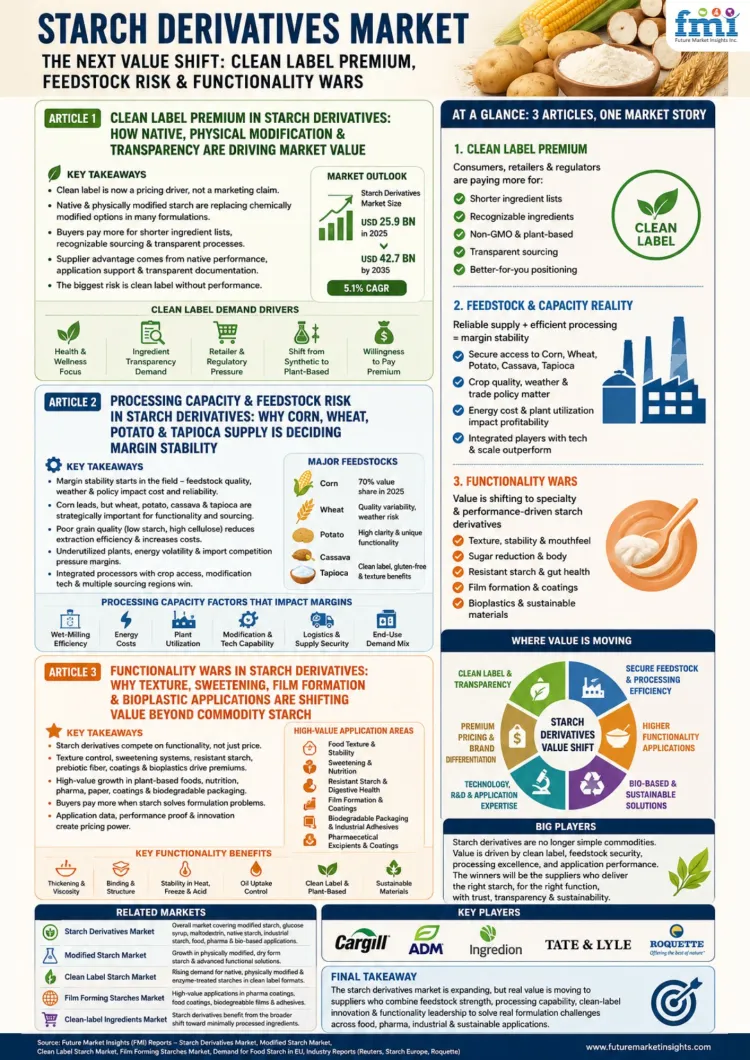
The starch derivatives market is entering a functionality-led phase. For years, starch derivatives were often purchased as basic thickeners, sweeteners, binders, and bulking agents. That view is now too narrow. FMI projects the starch derivatives market to grow from USD 25.9 billion in 2025 to USD 42.7 billion by 2035 at a 5.1% CAGR, with growth supported by food and drinks, biotechnology, bioplastics, industrial applications, clean-label formulations, plant-based alternatives, resistant starch, and prebiotic fiber-enhancing derivatives. This means value is shifting from commodity starch volume to problem-solving starch functionality.
The first functionality battle is in texture. Food manufacturers need starch derivatives that can control thickness, creaminess, suspension, gel strength, freeze-thaw stability, shelf-life texture, and mouthfeel. FMI notes that industrial users in food and pharmaceutical markets prioritize functional benefits such as texture, stability, and shelf life. In sauces, soups, dressings, dairy alternatives, bakery fillings, frozen meals, confectionery, and plant-based foods, starch is not just an ingredient line item. It is part of the product experience. A weak starch system can make a sauce separate, a dairy alternative feel thin, a frozen meal release water, or a plant-based product lose structure.
Modified starch remains central to this texture battle because it is built for performance under processing stress. FMI projects the modified starch market to grow from USD 9.4 billion in 2025 to USD 14.2 billion by 2036 at a 3.8% CAGR. Dry form is projected to hold 66.8% share in 2026, while physically modified starch is forecast to secure 52.1% share in 2026 as food manufacturers seek texture control with cleaner label wording. This shows that buyers are not simply shifting away from modified starch. They are shifting toward modified starch systems that balance functionality, process tolerance, and label acceptability.
The move toward physically modified and enzyme-treated starch is important because it changes how suppliers defend value. Traditional chemically modified starch can deliver strong performance, but clean-label pressure is pushing buyers to ask whether similar stability can be achieved through physical or enzymatic routes. FMI notes that clean-label recipe work is shifting trials toward physical and enzyme-based modification methods, while processed food manufacturers are using modified starch to control texture across sauces and ready meals. This creates a supplier race around heat stability, shear tolerance, acid resistance, freeze-thaw durability, and consistent viscosity.
Clean-label starch is another front in the functionality war. FMI estimates the clean-label starch market at USD 1.3 billion in 2026 and USD 2.4 billion by 2036, expanding at a 6.5% CAGR. Native starch is projected to hold 50.0% product share in 2026, and powder starch is projected to hold 70.0% form share. Food and beverages account for 75.0% of application demand, with sauces, soups, bakery, dairy, and convenience food identified as primary procurement categories. These numbers show that clean-label starch is not only a marketing trend. It is becoming a mainstream formulation requirement.
However, clean label alone does not win unless functionality holds. FMI states that native starch adoption is constrained by lower process tolerance and viscosity stability compared with chemically modified alternatives, especially in retorted sauces, frozen convenience foods, and other demanding applications. At the same time, advances in heat-moisture treatment, annealing, and controlled enzyme processes are improving freeze-thaw stability, shear resistance, and acid tolerance. This is where the premium opportunity sits: starch systems that let brands simplify ingredient declarations without sacrificing processing performance.
The second functionality battle is in sweetening and carbohydrate systems. Starch derivatives such as glucose syrup, maltodextrin, resistant dextrins, and slowly digestible carbohydrates are important because they influence sweetness, body, bulking, energy release, and digestive positioning. FMI identifies maltodextrin and glucose syrups as widely used product segments in starch derivatives, with applications across food and beverages, pharmaceuticals, and personal care. In beverages, confectionery, bakery, powdered mixes, sports nutrition, and supplements, starch-derived sweeteners and bulking systems are competing against sugar reduction pressure, clean-label expectations, and functional nutrition claims.
Resistant starch is a higher-value part of this shift because it connects starch derivatives with gut health, prebiotic properties, blood sugar regulation, low-glycemic products, and functional foods. FMI notes that resistant starch is gaining use in bakery products, cereals, snacks, bars, dietary supplements, diabetic-friendly formulations, sports nutrition protein bars, and recovery drinks. Producers are using corn, potato, and green banana starches to manufacture resistant starch while improving processes to support clean-label positioning. This moves starch from a hidden formulation aid into a functional nutrition ingredient.
The third functionality battle is in plant-based and alternative foods. Starch derivatives are used to improve texture, binding, juiciness, stability, and eating quality in plant-based products and dairy alternatives. FMI specifically links starch derivatives with clean-label formulations and plant-based alternatives, while the clean-label starch report identifies plant-based food as a growing application area. This matters because plant-based foods often need starch systems to rebuild the texture that fat, dairy protein, egg, gelatin, or meat protein would normally provide. A starch supplier that can improve bite, body, creaminess, or reheating stability has more pricing power than a supplier selling generic starch.
The fourth functionality battle is in film formation. Film-forming starches show how far starch value can move beyond commodity thickening. FMI estimates the film-forming starches market at USD 1.17 billion in 2026 and USD 2.13 billion by 2036, growing at a 6.2% CAGR. The market includes native and modified starches from potato, wheat, corn, cassava, tapioca, maize, and rice sources engineered for pharmaceutical tablet and capsule coatings, confectionery and food coatings, biodegradable flexible packaging, and industrial adhesive film applications.
Film-forming starches are functionally different from standard food starches because they must deliver controlled gelatinization, film tensile strength, moisture barrier properties, and compatibility with plasticizers. FMI states that the market is at an inflection point in a bio-based polymer substitution cycle, where starch-based films are being developed to improve moisture resistance, tensile strength, and high-speed line processability in pharmaceutical coatings, food packaging, and biodegradable industrial applications. This shows that starch is becoming part of the broader competition against fossil-derived synthetic polymers.
Pharmaceutical applications create another higher-value opportunity. Film-forming starches are used in tablet and capsule coatings where buyers need clean-label, plant-based alternatives to synthetic polymer coatings. FMI identifies pharmaceuticals as the primary end-use segment for film-forming starches and notes that regulatory compliance, botanical sourcing, GRAS status, and pharmacopoeia requirements can shape procurement. In this part of the market, buyers are not purchasing starch for low cost. They are purchasing coating integrity, regulatory acceptability, stability, and controlled performance.
Food coatings also create value. FMI notes that film-forming starch solutions can create a starch-based barrier during processing, reducing oil pick-up in coated and fried products while maintaining crunch. This is important because food companies are under pressure to improve nutrition profiles without weakening sensory experience. A starch derivative that helps reduce oil uptake, protect crispness, support coating adhesion, or improve appearance can be worth more than a basic thickener.
The fifth functionality battle is in industrial and packaging applications. FMI states that starch derivatives are seeing higher adoption in biodegradable packaging, bio-based polymers, sustainable bioplastics, starch-based adhesives, fermentation-based applications, and green packaging. India’s market outlook is linked to starch-based adhesives for corrugated boards, paper coatings, food packaging, and textile stiffeners, while global growth is expected to benefit from bio-based plastics and sustainable packaging applications. This creates a major non-food value path for starch suppliers.
Paper and corrugated packaging also remain important because starch derivatives provide bonding, surface sizing, and strength. FMI’s modified starch report notes that paper converters buy cationic and oxidized starch grades for fiber bonding, surface sizing, and corrugated board strength. This means starch derivatives compete not only in food texture but also in packaging performance. As e-commerce, paperboard, and sustainable packaging demand evolve, starch-based binders and coatings can gain relevance where petroleum-based adhesives or synthetic polymers face sustainability pressure.
For suppliers, the strategic implication is clear: the market is segmenting by functionality. One buyer may need a clean-label thickener for soup. Another may need a physically modified starch for freeze-thaw stability. A third may need maltodextrin for body in a powdered beverage. A fourth may need resistant starch for fiber enrichment. A fifth may need cationic starch for paper strength. A sixth may need film-forming starch for pharmaceutical coatings or biodegradable packaging. These are not the same purchasing decisions, even if they all sit inside the starch derivatives universe.
This is why application labs are becoming more important. A supplier that can show viscosity curves, freeze-thaw data, heat and shear stability, sensory performance, coating strength, film flexibility, oil uptake reduction, fiber functionality, and processing guidance can defend a better price. A supplier that only sells starch by crop source and price per tonne risks being treated as interchangeable. FMI identifies Cargill, ADM, Ingredion, Tate & Lyle, and Roquette as major players with strong supply chain networks, R&D capabilities, and diversified starch portfolios. These capabilities matter because the market is moving toward customized starch systems, not only bulk starch sales.
Large companies are positioning around this shift. FMI states that major manufacturers are emphasizing clean-label starches, resistant starches for digestive health, and bio-based applications for green packaging. It also notes that Ingredion has launched clean-label dairy starch Novation Indulge 2940 and that Tate & Lyle is developing additional non-GMO starch products. In film-forming starches, FMI highlights Roquette’s label-friendly pea starch launch for confectionery and food coatings and Tate & Lyle’s hydrocolloid integration with specialty starch portfolios for biodegradable film applications.
The risk for smaller or less specialized suppliers is that they may be trapped in low-margin commodity positions. If they cannot prove performance in high-value applications, buyers will compare them mainly on price. This is dangerous because feedstock volatility, energy costs, freight disruption, and import competition can quickly erode margins. The suppliers with stronger futures will be those that can connect starch chemistry, crop sourcing, formulation support, and customer-specific performance data.
For buyers, the risk is over-standardizing starch procurement. A procurement team may see two starch derivatives as equivalent because they share a similar description, but real performance can differ sharply by source, modification route, granule behavior, moisture profile, viscosity profile, and processing tolerance. In finished products, those differences can affect mouthfeel, shelf life, coating quality, digestibility, binding strength, and consumer acceptance. In performance applications, the wrong starch can cost more through failure than the right starch costs through premium pricing.
The highest-value pockets in starch derivatives will therefore be application-specific. In food, value will sit in clean-label texture systems, plant-based products, frozen meals, sauces, bakery, confectionery, and reduced-fat or sugar-reduction support. In nutrition, value will sit in resistant starch, prebiotic fibers, low-glycemic formulations, sports nutrition, and digestive wellness products. In pharmaceuticals, value will sit in excipients, coatings, encapsulation, and controlled delivery systems. In industrial markets, value will sit in adhesives, paper bonding, biodegradable films, and bio-based packaging materials.
The starch derivatives market is not becoming less competitive. It is becoming more technical. Volume still matters, especially in corn-based starch, glucose syrups, maltodextrin, and industrial grades. However, pricing power is moving toward suppliers that can solve specific manufacturing and consumer problems. The future winners will not be those that simply produce more starch. They will be those that make starch perform better, label cleaner, digest smarter, coat stronger, bind better, and replace synthetic materials where performance and sustainability must work together.
Related Markets
- Starch Derivatives Market: Parent market covering modified starch, sweeteners, native starch, cationic starch, corn, potato, cassava, food and beverage, pharmaceuticals, paper, textiles, and bio-based applications.
- Modified Starch Market: Relevant because modified starch is the core functionality platform for texture control, stability, binding, emulsifying, paper bonding, and cleaner-label physical modification.
- Clean Label Starch Market: Relevant because clean-label reformulation is pushing demand for native, physically modified, and enzyme-treated starches that can replace chemically modified options.
- Film Forming Starches Market: Relevant because film-forming starches show the higher-value shift into pharmaceutical coatings, food coatings, biodegradable flexible packaging, and industrial adhesive films.
- Clean-label Ingredients Market: Relevant because starch derivatives are benefiting from the broader shift toward recognizable, minimally processed, and label-friendly food ingredients.

