


- Connecting rod demand appears likely to remain resilient through 2036 because internal combustion engines still support most passenger vehicles, commercial vehicles, two-wheelers, three-wheelers, and off-highway equipment.
- Fully electric vehicles remove connecting rods, but hybrids retain combustion engines and continue to require precision-engineered rods.
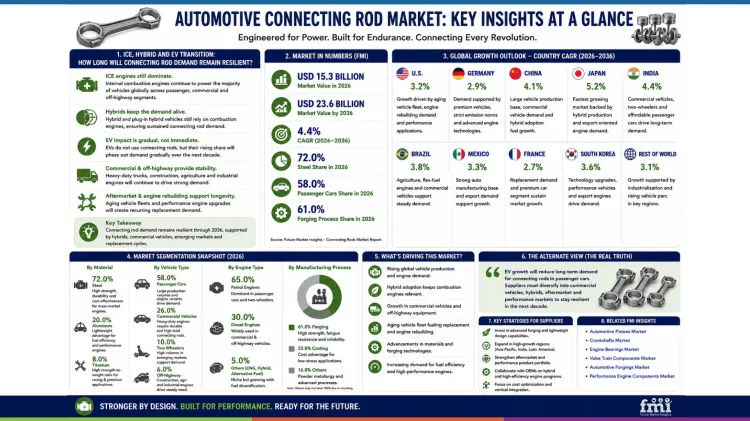
- FMI forecasts the automotive connecting rod market to grow from USD 15.3 billion in 2026 to USD 23.6 billion by 2036 at a 4.4% CAGR.
- Steel connecting rods retain a 72.0% share in 2026, while passenger cars account for 58.0% of demand, showing that mass-production engine platforms remain the market foundation.
- Commercial vehicles, off-highway machinery, two-wheelers, aging vehicle fleets, and engine rebuilding appear likely to offset part of the demand loss from battery-electric passenger cars.
- The key observation is that connecting rod demand is not disappearing in one step. It is becoming more concentrated in hybrids, commercial engines, emerging markets, older fleets, and high-performance applications.
The transition from internal combustion engines to electrified powertrains is often presented as a direct threat to connecting rods. The mechanical logic is clear. A battery-electric vehicle does not use pistons, crankshafts, or connecting rods. Yet the commercial transition is less immediate than the technical difference suggests.
The global vehicle market is moving through several powertrain pathways at the same time. Battery-electric vehicles are expanding, but hybrids, plug-in hybrids, petrol vehicles, diesel commercial vehicles, two-wheelers, three-wheelers, and off-highway machines continue to use reciprocating engines. Connecting rod suppliers are not facing the disappearance of demand across the entire market. They are facing a gradual redistribution of demand between vehicle classes, regions, engine types, and sales channels.
FMI’s Automotive Connecting Rod Market places the market at USD 14.7 billion in 2025, rising to USD 15.3 billion in 2026 and USD 23.6 billion by 2036. The resulting 4.4% CAGR and USD 8.3 billion absolute opportunity indicate that the market is expected to expand during the forecast period rather than contract. This outlook suggests that electrification pressure is being balanced by continuing engine production, hybridization, replacement demand, and growth in regions where internal combustion platforms remain commercially important.
The starting point is the scale of the wider vehicle industry. Global motor vehicle production reached 96.4 million units in 2025, according to OICA, rising 3.9% from 2024. Global vehicle sales reached 99.8 million units. This production base includes a broad mix of combustion, hybrid, and electric platforms. Even as electrification grows, tens of millions of newly produced vehicles still use internal combustion engines or hybrid engines that require connecting rods.
Electric car sales exceeded 20 million globally in 2025, representing about one in four new cars sold. This is a major structural shift. Yet it also means roughly three out of four new cars sold were not fully electric. The remaining market includes conventional internal combustion vehicles, hybrid-electric vehicles, and plug-in hybrids. Hybrids are especially important for connecting rod demand because they reduce fuel consumption without removing the engine.
This makes hybridization a demand bridge rather than a direct substitute for connecting rods. A hybrid vehicle still needs pistons, crankshafts, bearings, connecting rods, lubrication, and combustion management. The engine may operate differently, start and stop more frequently, or work within a more efficient duty cycle, but the connecting rod remains essential. In some hybrid platforms, repeated engine restarts and thermal cycling can create new durability and material requirements.
The transition therefore has three different effects. Battery-electric vehicles eliminate connecting rod demand. Conventional ICE vehicles sustain established demand. Hybrids preserve demand while changing the performance specification. Suppliers need to distinguish between these pathways instead of treating electrification as one uniform market trend.
Passenger cars remain the largest vehicle segment. FMI projects passenger cars to account for 58.0% of connecting rod demand in 2026. This makes passenger vehicle electrification the largest long-term risk to the component category. Yet passenger car demand is not changing evenly across markets. China and Europe are moving more quickly toward electric cars, while many emerging economies continue to rely on affordable petrol vehicles, hybrids, two-wheelers, and small commercial vehicles.
Japan provides an interesting counterpoint. FMI identifies Japan as the fastest-growing connecting rod market, with a 5.2% CAGR through 2036. Japan is also a major hybrid vehicle market with deep precision forging and engine component expertise. This suggests that electrification does not automatically reduce connecting rod opportunity when hybrid production, efficient combustion engines, export platforms, and lightweight component development remain active.
India is expected to grow at 4.4% through 2036. Its passenger vehicle, two-wheeler, and commercial vehicle production base creates sustained demand for cost-efficient steel and aluminum connecting rods. Two-wheelers are especially relevant because commuter motorcycles and scooters continue to use small internal combustion engines at high volumes. Electrification is advancing in Indian two-wheelers, but the installed base and continuing ICE production remain substantial.
China is projected to grow at 4.1% through 2036. China has the world’s largest electric car market, but it also has a large commercial vehicle, off-highway, hybrid, and export-oriented engine manufacturing base. This means connecting rod demand in China is likely to become more concentrated in commercial applications, export engines, plug-in hybrids, off-highway equipment, and replacement channels.
Commercial vehicles are a primary source of market resilience. Heavy trucks and construction equipment still rely on diesel engines. Electric adoption in this sector faces significant barriers. These include range limits and high vehicle costs. Charging time and payload capacity also slow down the transition. Connecting rods in these engines must handle high loads. This requires high-quality forged steel. These factors ensure long-term demand for specialized engine components.
FMI specifically states that expansion of internal combustion engine platforms for commercial vehicles and off-highway equipment is expected to maintain demand for forged connecting rods through 2036. This suggests that suppliers serving heavy-duty, agricultural, construction, and industrial vehicle engines may face less immediate electrification pressure than suppliers focused mainly on passenger car ICE platforms.
Off-highway equipment adds another source of resilience. Tractors, harvesters, earthmoving machines, mining equipment, and construction machinery operate in demanding environments where combustion engines remain practical. These applications prioritize torque, durability, serviceability, fuel availability, and uptime. Electrification may enter selected compact or urban equipment categories, but heavy-duty off-highway engines are likely to retain connecting rods for longer.
ACEA data shows that vehicles in the EU are getting older. Passenger cars now average 12.7 years. Heavy-duty trucks average 14 years. Older engines require more repairs and full rebuilds. Connecting rods are durable parts. They are not replaced as often as filters or bearings. Demand mainly comes from engine failures and high-mileage maintenance. Remanufacturing and performance upgrades also support the market. This creates a stable secondary market. It keeps demand steady even when new car sales decline.
The active fleet provides a vital cushion as the industry shifts away from ICE in new vehicle registrations. Given that millions of combustion vehicles will remain in operation for over a decade, the aftermarket effectively decouples connecting rod demand from new-vehicle sales cycles. This ensures a prolonged commercial runway for manufacturers, even as the primary market transitions.
Material and design upgrades also support value growth. Even if the number of combustion engines grows more slowly, higher combustion pressures, turbocharging, downsizing, hybrid operating cycles, and fuel-efficiency targets can raise the specification value of each connecting rod. Suppliers may earn more from advanced steel grades, lighter aluminum designs, precision forging, fracture splitting, hollow rods, coatings, and tighter machining tolerances.
The strongest risk sits with suppliers that depend heavily on standard passenger car ICE programs in markets where battery-electric penetration is rising quickly. Market resilience, however, is being demonstrated by firms with diversified portfolios spanning hybrids, commercial equipment, and niche performance segments, which are less susceptible to immediate displacement by pure battery-electric technology.
Contrary to the assumption that electrification signals the weakening of connecting rod demand, the impact varies significantly by platform. While BEVs eliminate the need for reciprocating components, HEVs, PHEVs, and range-extenders do not. This shift represents a redistribution of market demand rather than a total obsolescence, with certain platforms preserving long-term component requirements.
For connecting rod manufacturers, the strategic imperative is portfolio diversification. Suppliers must adopt a dual-track approach: defending legacy high-volume steel forging programs while aggressively expanding their footprint in lightweight hybrid architectures, commercial vehicle platforms, and off-highway applications. As engine programs consolidate, the primary competitive advantage is shifting from economies of scale to specialized precision engineering.
Bottom line: connecting rod demand appears resilient through 2036, but the source of demand is changing. Battery-electric vehicles create a structural headwind, while hybrids, commercial vehicles, two-wheelers, off-highway machinery, aging fleets, and engine rebuilding extend the market’s commercial life. The opportunity is likely to shift away from undifferentiated passenger car volume and toward durable, lightweight, qualified, and application-specific engine components.

