


- Capacity selection is shaping end suction pump demand because building HVAC, water supply, industrial process, and municipal applications each require different flow bands.
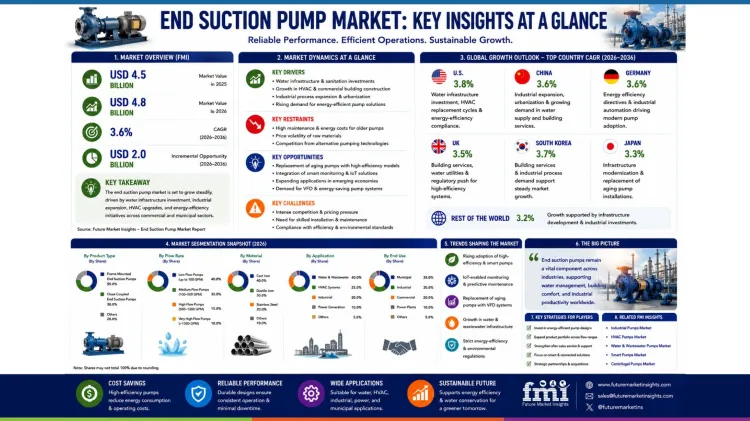
- The FMI visible report page lists low flow pumps as a leading flow category with 40.0% share in one section, while also noting medium flow pumps at 35.0% as the broadest application range.
- Low flow pumps are strongest in small commercial, residential-adjacent, light-duty utility, and compact building-service applications.
- Medium flow pumps appear to be the practical workhorse for HVAC systems, water supply, and light industrial processes.
- High flow and very high flow pumps are more tied to municipal water systems, large industrial applications, power plants, and utility-scale infrastructure.
- The clearest demand pattern is not low flow replacing high flow. It is a split between high-unit-volume smaller pumps and higher-value large-capacity pumps.
Flow rate is one of the first technical questions in pump selection. A pump that is too small cannot deliver the required system output. A pump that is too large may waste energy, operate away from its best efficiency point, require throttling, or increase wear. For end suction pumps, capacity requirements are therefore central to market demand.
FMI segments the end suction pump market by low flow, medium flow, high flow, and very high flow pumps. Low flow pumps are defined as up to 100 GPM, medium flow pumps as 100 to 500 GPM, high flow pumps as 500 to 1300 GPM, and very high flow pumps as above 1300 GPM. The visible FMI page states in one section that low flow pumps will lead with 40.0% share, while another section notes that medium flow pumps hold 35.0% share and serve the widest spread of building HVAC, water supply, and light industrial applications. This should be read carefully, since low flow may lead by share while medium flow appears to occupy the broadest practical application range.
The low flow segment benefits from unit volume. Small commercial facilities, local water boosting, residential-adjacent services, small HVAC loops, light-duty utility transfer, small treatment systems, and compact mechanical systems all require modest pump capacities. These pumps may not carry the highest unit value, and they are numerous and widely distributed through contractors and wholesalers.
Low flow pumps also benefit from standardization. A small building-service pump may be selected from catalogues, stocked by distributors, and installed by local contractors without extensive engineering. This makes procurement faster and supports replacement demand. When a small pump fails, the buyer often wants a reliable equivalent quickly rather than a custom engineered solution.
Medium flow pumps are where many commercial and light industrial systems converge. FMI describes medium flow pumps as serving HVAC systems, light industrial use, general building HVAC, and water supply. This flow band can cover chilled water circulation, hot water circulation, pressure boosting, process water transfer, cooling systems, and utility water services in mid-sized facilities. The commercial relevance is strong because the pump is often large enough to influence energy cost, and still standardized enough to be broadly available.
Energy efficiency becomes especially visible in this middle band. A pump running many hours per year in an HVAC or water circulation system can create meaningful electricity consumption. A better-selected pump, high-efficiency motor, or variable frequency drive can reduce lifecycle cost. FMI states that energy-efficiency standards for building mechanical systems are pushing replacement of constant-speed pumps with variable speed and high-efficiency motor configurations.
The DOE guidance on adjustable speed drives supports the technical logic. It explains that variable frequency drives adjust motor speed to meet process requirements by controlling the frequency and voltage supplied to the motor. This is particularly relevant to pumps and fans because many systems do not need full flow at all times. Matching pump speed to demand can reduce wasted energy compared with constant-speed operation.
High flow pumps enter a more engineered market. Municipal water systems, larger industrial cooling circuits, power plants, process industries, and utility infrastructure require higher capacities. These pumps may be fewer in number, and they usually carry higher unit value and more demanding engineering requirements. The buyer may evaluate hydraulic performance, NPSH margin, pump curve, motor power, material compatibility, seal design, system controls, vibration, and service access.
Very high flow pumps above 1300 GPM are associated by FMI with power plants and large utility-scale applications. These are not typically impulse purchases through distribution channels. They are engineered assets, often linked to capital projects, facility expansions, or infrastructure upgrades. Sales cycles can be longer, and suppliers can differentiate through application engineering and lifecycle support.
The demand split can be understood through three economic layers.
Unit volume is the first layer. Low flow pumps win here because many small systems need compact pump solutions.
Application breadth is the second layer. Medium flow pumps are strong because they serve a wide range of HVAC, commercial water, and light industrial processes.
Project value is the third layer. High flow and very high flow pumps are attractive because each installation carries higher value, more engineering content, and greater service potential.
This has direct supplier implications. A company targeting low flow demand needs broad distribution, price competitiveness, quick availability, and simple selection tools. A supplier targeting medium flow demand needs contractor trust, energy-efficient options, VFD compatibility, and reliable service. A supplier targeting high flow demand needs engineering support, municipal or industrial references, materials expertise, and the ability to support commissioning and maintenance.
Capacity also determines material choice. FMI identifies cast iron as the leading material at 40.0% share because it provides cost-effective performance for clean water and HVAC applications. Low and medium flow pumps used in clean water and building services often fit cast iron well. High flow industrial or corrosive applications may require ductile iron, stainless steel, or specialty alloys. A pump moving clean chilled water in a building is very different from a pump moving chemically aggressive process fluid.
End-use sector affects the flow mix. Municipal utilities may require high flow and very high flow pumps for treatment, distribution, and boosting. Commercial building operators may buy more low and medium flow pumps for HVAC and pressure boosting. Industrial users may require every band, depending on whether the pump supports cooling water, process transfer, washdown, boiler feed support, or utility service.
Replacement demand also varies by flow band. Small low flow pumps may be replaced quickly through distributor channels. Medium flow pumps may be replaced during mechanical-system upgrades or energy-efficiency projects. High flow pumps may be rebuilt, repaired, or upgraded rather than replaced immediately because downtime and capital cost are higher.
The USA market is a useful demand example. FMI projects the USA end suction pump market at 3.8% CAGR through 2036, supported by water infrastructure investment, commercial building HVAC, energy-efficiency compliance, and established pump distribution. The EPA water infrastructure investment programme also supports upgrades to drinking water, wastewater, and stormwater infrastructure. These projects can create demand across flow bands, from smaller booster applications to high-flow municipal systems.
In South Korea, building services and industrial process demand support the 3.7% CAGR outlook. That mix likely favours medium flow pumps in commercial HVAC and industrial utility services, along with higher-flow units in manufacturing operations. In the EU, ecodesign and building renovation programmes support energy-efficient pump replacement, particularly where older pumps operate continuously.
Pump capacity selection is becoming more data-led. Building operators and utilities increasingly want pumps sized to actual demand, not outdated design assumptions. Oversized pumps can operate inefficiently, particularly when throttled. Smart pumps and monitoring systems can help operators understand flow, pressure, energy use, and maintenance condition. FMI identifies integrated monitoring, condition-based maintenance, and building management system connectivity as differentiation opportunities.
This matters because flow demand is not always constant. HVAC loads change throughout the day and season. Water demand fluctuates by occupancy and usage pattern. Industrial processes may cycle between operating states. Variable speed drives and smart controls allow a pump to serve variable demand without running at full capacity continuously. This is especially relevant in medium and high flow installations where energy cost is material.
Low flow pumps are likely to remain strong by unit share because small systems are numerous. Medium flow pumps may remain the most strategically important for building services and light industrial efficiency upgrades. High flow and very high flow pumps will continue to be value-rich in water utilities, industrial infrastructure, and power applications.
The capacity story is therefore not a single winner. Low flow pumps carry scale. Medium flow pumps carry application breadth. High flow pumps carry engineered value. Suppliers that can serve all three with efficient motors, VFD compatibility, smart monitoring, and material options will be better positioned than suppliers tied to one capacity band.

