

- Market Size (2026)
- USD 640.6 Mn
- Forecast (2036)
- USD 1147.2 Mn
- CAGR (2026 to 2036)
- 6.0%
How big is Sports Drainage Mats Market in 2026?
USD 640.6 million in 2026 and USD 1147.2 million by 2036 at a 6.0% CAGR.
Demand for sports drainage mats is projected to expand at 6.0% CAGR between 2026 and 2036, increasing valuation from USD 640.6 million in 2026 to USD 1147.2 million by 2036. School districts concentrate athletic programs on shared fields during short seasonal schedules with limited recovery time. In September 2025, NFHS reported 8,266,244 high school sports participants nationwide for the 2024-25 school year. Dense use compresses maintenance windows and increases the value of dependable drainage following heavy rainfall.
Surface certification cannot correct blocked outlets or uneven grading within a faulty sports field base assembly. Geocomposite layers reduce excavation across geosynthetic systems as installers match flow with slope and discharge capacity. Comparable synthetic turf systems require predictable recovery following rainfall prior to field release for scheduled play.
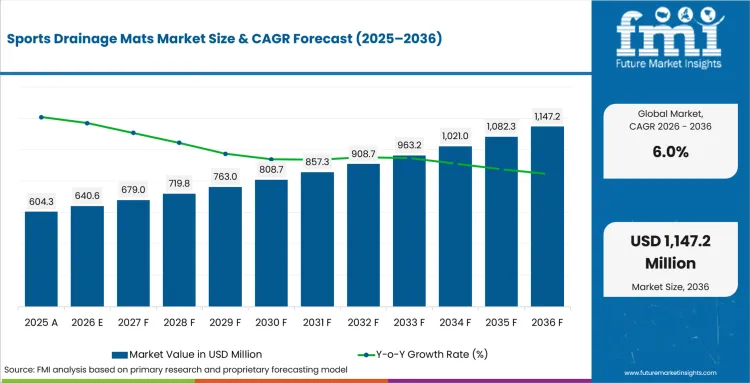
Key Takeaways of Sports Drainage Mats Market
- Intensive field schedules increase demand for drainage layers that restore playable conditions without extensive aggregate excavation.
- Geocomposite drainage mats are projected to represent 31.0% share in 2026 due to combined drainage and separation.
- Below turf layers are estimated to hold 42.0% share in 2026 owing to established field construction sequences.
- Synthetic turf fields are forecast to capture 38.0% share in 2026 driven by intensive public facility use.
- Poor grading remains a material restraint as published flow ratings cannot compensate for incomplete discharge routes beneath finished fields.
- Solmax, ABG Geosynthetics, NAUE, Maccaferri, FieldTurf, Brock USA, Tensar and Presto Geosystems compete through distinct drainage or base-support capabilities.
Analyst Perspective
"Drainage mat specifications should begin with field grades and outlet capacity rather than isolated laboratory flow ratings. Teams that verify the complete base assembly can prevent concealed ponding and avoid opening finished turf for corrective work."
- Nikhil Kaitwade, Principal Consultant, Future Market Insights
How is the Sports Drainage Mats Market segmented?
The sports drainage mats industry is segmented by mat type, installation, sport surface, flow capacity, end use, sales channel and region.
The sports drainage mats market is segmented by mat type, installation, sport surface, flow capacity, end use, sales channel and region. Mat type covers geocomposite, shock pad, synthetic turf, rubber and modular panels and installation covers below turf, below track, perimeter and sub-base stabilization. Sport surface includes synthetic turf fields, running tracks, courts, playgrounds and equestrian surfaces and flow capacity covers low, medium and high flow. End use covers schools, sports complexes, parks and stadiums and sales channels include turf installers, distributors, manufacturers and contractors.
Why do geocomposite drainage mats lead the mat type category?
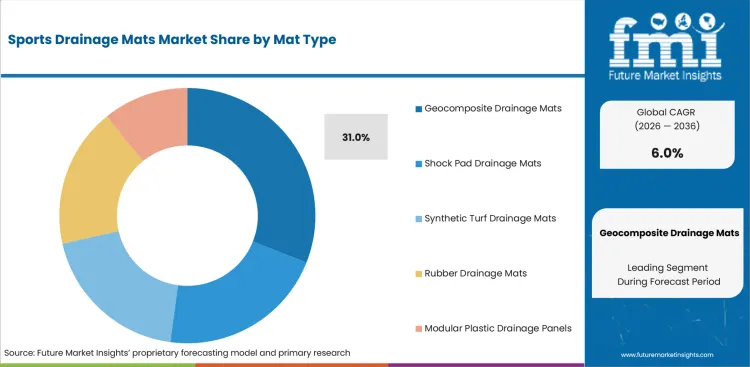
Geocomposite drainage mats combine a polymer drainage core with filter layers that collect water across the entire field footprint. Their planar form reduces aggregate depth across geocomposite drainage layers and limits deeper excavation across constrained urban sports sites.
- Geocomposite drainage mats are set to lead the mat type category with 31.0% share in 2026 due to combined drainage and separation within one installed layer.
- Sports contractors compare in-plane flow and filter retention against cavity drainage membranes then set outlet spacing for each complete base assembly.
Why does below turf layer lead the installation category?
Below turf layers intercept water ahead of aggregate saturation and protect moisture-sensitive subgrades beneath heavily used outdoor playing surfaces. Their placement gives installers direct access to grades and outlets during construction and preserves drainage continuity beneath the finished surface across the complete field footprint.
- By installation, below turf layers are estimated to hold 42.0% in 2026 owing to direct alignment with artificial turf systems and established construction sequences.
- Field builders use construction textiles beneath turf to protect membranes and separate base materials across rooftop or constrained retrofit projects.
How do synthetic turf fields shape the sport surface category?
Synthetic turf fields apply repeated concentrated loads across fixed surfaces and expose weak drainage design following intensive rainfall events. Every layer within these base assemblies must preserve consistent surface tolerances and manage moisture beneath specialized flooring systems through intensive seasonal use.
- By sport surface, synthetic turf fields are forecast to represent 38.0% in 2026 driven by intensive scheduling across school and community facilities.
- Installers combine drainage mats with reinforcement geosynthetics to limit aggregate migration and preserve uniform long-term support across seams and high-traffic zones.
What makes schools and universities central to the end use category?
Schools and universities schedule several sports across shared fields through dense academic calendars with limited recovery time following storms or maintenance closures. Campus facility teams coordinate athletic grounds with landscaping services that cover routine outlet cleaning and surrounding runoff control across each site.
- The schools and universities segment is likely to capture 33.0% share in 2026 attributable to multi-sport use and recurring field maintenance cycles.
- Campus projects use geocell stabilization across weak soils that require added confinement beneath drainage layers and aggregate bases supporting repeated seasonal traffic.
What are the drivers, restraints and opportunities in the Sports Drainage Mats Market?
Field schedules increase drainage demand although poor grading limits performance and coordinated base testing reduces commissioning failures.
- Driver: Repeated field use increases demand for drainage layers that restore playability following heavy rainfall and traffic.
- Restraint: Incorrect slopes or blocked outlets negate mat flow ratings and cause costly ponding beneath completed athletic surfaces.
- Opportunity: Joint base design and field testing reduce rework by aligning mat capacity with site discharge conditions.
Field operators lose scheduled playing time if rainfall remains trapped beneath turf or track surfaces. Planar drainage gives sports contractors a continuous discharge route without deep stone trenches across the full field footprint.
Drainage capacity depends on continuous grades and clean outlets across the complete installed assembly onsite. Sediment intrusion or installation damage can reduce hydraulic performance early in the surface service cycle and raise corrective costs.
Manufacturers and turf contractors can combine hydraulic design with installation inspection and documented maintenance guidance. One accountable service plan reduces bid uncertainty and clarifies responsibility for the complete drainage assembly throughout its operating life.
Which country CAGRs are profiled in the Sports Drainage Mats Market?
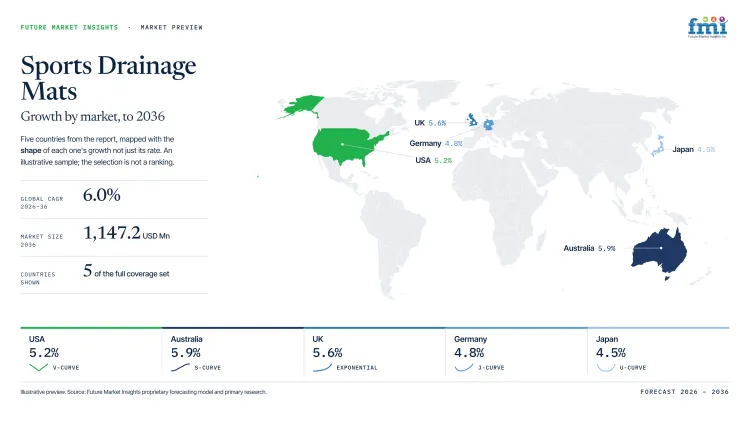
| Country | CAGR |
|---|---|
| United States | 5.2% |
| Germany | 4.8% |
| Japan | 4.5% |
| United Kingdom | 5.6% |
| Australia | 5.9% |
How do country-level CAGRs compare in the Sports Drainage Mats Market?
The country range spans 1.4 percentage points and forms two practical growth groups across the forecast period. The spacing reflects facility investment and local approval routes rather than current market size alone.
- Australia’s forecast reflects weather-exposed community facilities that require recurring drainage upgrades across expanding synthetic-surface programs.
- United Kingdom projects depend on registered testing and replacement planning across grant-supported 3G pitch networks.
- United States demand combines broad school participation with fragmented municipal capital approvals and local design standards.
- German renovation programs offer federal funding visibility but impose material documentation that lengthens tender preparation.
- Japanese adoption follows formal pitch authorization and detailed product testing across tightly managed facility programs.
Comparable CAGRs can produce different market entry conditions. The full report provides country-level CAGR analysis across North America, Latin America, Europe, East Asia, South Asia and Pacific, and the Middle East and Africa.
Country-wise Analysis
- Massachusetts schools increasingly combine field drainage with stormwater capture across dense campuses that need playable surfaces and runoff control inside one project boundary. FieldTurf reported in June 2025 that Tabor Academy installed a custom drainage system beneath artificial turf to mitigate flooding and reuse captured rainwater through campus irrigation systems. The United States is estimated to post 5.2% CAGR over the forecast period, aided by experienced sports contractors despite fragmented municipal approvals that require contracts to assign outlet inspection and cleaning responsibility across funded facilities with separate capital budgets and short seasonal construction windows during school breaks each year.
- German municipalities assess outdoor sports renovations through federal funding rules that define eligible synthetic-pitch materials and long-term environmental requirements. Germany’s sports drainage mats outlook is anticipated to advance at 4.8% CAGR over the assessment period, supported by experienced civil contractors despite material documentation that extends tender preparation. The federal ministry confirmed support for 314 municipal sports facilities in April 2026 and required recyclable materials for renewed synthetic pitches, so project teams must align drainage systems with approved material lists and disposal planning across publicly funded sites to protect grant eligibility during local review and tender evaluation each year.
- Japanese football facilities use a formal long-pile synthetic turf authorization process that covers new pitch approvals and recurring renewals across managed competition networks. JFA recorded another long-pile pitch authorization renewal during its June 2025 executive committee meeting, giving specialist installers a defined documentation route for surface use and later reviews. The Japanese sports drainage mats sector is projected to record 4.5% CAGR during the assessment period, reinforced by organized qualification despite imported systems requiring bilingual base-design support and dependable domestic service across prefectural renewal programs with narrow construction windows during school and community competition seasons and restricted annual field closures.
- England’s 3G Pitch Register determines whether tested fields can host FA-affiliated matches and records status across national competition routes with fixed renewal deadlines. Sports drainage mat sales in the United Kingdom are forecast to expand at 5.6% CAGR by 2036, driven by accredited testing access despite clubs needing coordinated inspections and outlet maintenance across limited closure windows. The Football Foundation reported processing delays from high test volumes in May 2026 and the backlog reinforces early planning among clubs, testing bodies and installation contractors across grant-funded facilities with fixed seasonal competition calendars during renewal programs and fixed replacement budgets.
- Victorian school designs must consider regional rainfall and winter drainage during synthetic turf approval across climate-exposed education sites. The Department of Education confirmed in January 2026 that synthetic turf must be well drained and limited to sites with natural grass that remains difficult to maintain. Adoption of sports drainage mats in Australia is estimated to expand at 5.9% CAGR through 2036, influenced by capable regional contractors although natural-grass preferences require narrow use-case positioning with documented runoff controls plus heat-management plans and lifecycle costs across exposed campuses facing variable storm intensity during local capital planning and tightly scheduled seasonal installation windows.
Who are the notable companies in the Sports Drainage Mats Market?
Solmax, ABG Geosynthetics, NAUE, Maccaferri, FieldTurf, Brock USA, Tensar and Presto Geosystems are profiled in this market.
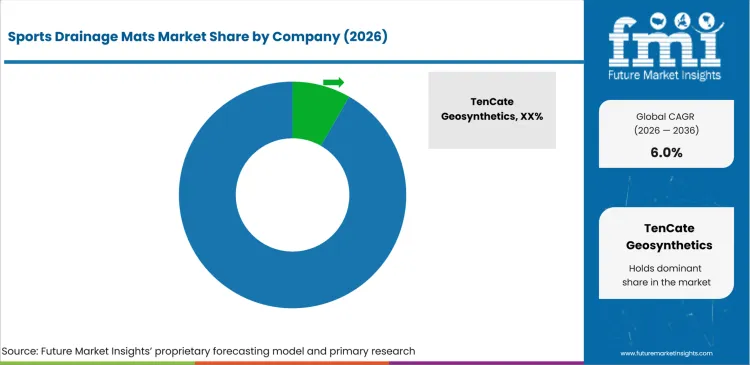
The competitive field remains fragmented across drainage specialists, synthetic turf integrators and subgrade reinforcement companies serving athletic-field projects. Entry depends on verified hydraulic performance and local installation support within complete athletic-field base designs.
- Solmax, ABG Geosynthetics, NAUE and Maccaferri provide drainage or separation layers for complete athletic-field base assemblies.
- FieldTurf and Brock USA integrate drainage layers with complete synthetic field systems and installation support.
- Tensar and Presto Geosystems stabilize weak soils beneath drainage layers across constrained athletic-field base sections.
Competitive Benchmarking: Sports Drainage Mats Market
| Company | Planar Drainage | Base Reinforcement | Field-System Support | Geographic Reach |
|---|---|---|---|---|
| Solmax | High | High | Medium | Global |
| ABG Geosynthetics | High | High | Medium | Europe and selected exports |
| NAUE | High | Medium | Medium | Global |
| Maccaferri | High | Medium | Medium | Global |
| FieldTurf | Medium | Medium | High | Global |
| Brock USA | High | Medium | High | North America |
| Tensar | Low | High | Medium | Global |
| Presto Geosystems | Low | High | Medium | North America and selected exports |
Key Developments in the Sports Drainage Mats Market
- In September 2025, Maccaferri France published guidance on drainage solutions for sports grounds (Drainage pour sols sportifs), covering geocomposite systems used to manage rainfall beneath synthetic turf.
- In July 2025, FIFA named FieldTurf among eight preferred providers for football turf under its quality programme covering products and installed pitches.
- In May 2025, Solmax documented a rooftop athletic field at Worcester Polytechnic Institute that used geotextiles and a lightweight drainboard above the waterproofing membrane.
Sports Drainage Mats Market - Report Scope
| Coverage field | Report scope |
|---|---|
| Market breakdown | By mat type, installation, sport surface, flow capacity, end use, sales channel and region. |
| Quantitative Units | Revenue in USD million and CAGR in %. |
| Market Definition | The market covers sports drainage mats used within commercial athletic-field construction, renewal and subsurface water-management systems. |
| Regions Covered | North America, Latin America, Western Europe, Eastern Europe, East Asia, South Asia and Pacific, Middle East and Africa. |
| Countries Covered | United States, Germany, Japan, United Kingdom, Australia and 20+ countries included in the full report. |
| Key Companies Profiled | Solmax, ABG Geosynthetics, NAUE, Maccaferri, FieldTurf, Brock USA, Tensar and Presto Geosystems. |
| Forecast Period | 2026 to 2036. |
| Approach | Primary and secondary research with market triangulation. |
Sports Drainage Mats Market - Research Methodology
| Method | Approach |
|---|---|
| Primary Research | FMI analysts gathered input from manufacturers, service providers, technology developers, distributors, end users, procurement teams, and subject-matter experts. Interviews examined purchasing decisions, product or service evaluation, adoption barriers, approval requirements, pricing considerations, and expectations for technical or commercial support. Respondents were also asked what evidence is required before a trial, pilot, or initial order develops into regular purchasing. |
| Desk Research | Desk research covered government statistics, regulatory publications, trade data, industry associations, technical literature, standards, company filings, product information, and official corporate announcements. Sources were reviewed for relevance, publication date, geographic coverage, and consistency with the defined market scope. Claims relating to performance, applications, approvals, capacity, investment, and commercial activity were retained only when supported by credible public evidence. |
| Market Sizing and Forecasting | The market model combined the baseline value with historical performance, segment structure, pricing and volume indicators, adoption levels, company participation, and country-level demand conditions. Forecast assumptions considered economic activity, investment trends, regulatory developments, technology adoption, purchasing cycles, supply availability, and barriers to wider market use. Segment and regional estimates were reconciled before the final market total was calculated. |
| Data Validation | Estimates were checked against multiple independent indicators, including public data, company activity, trade patterns, industry developments, and findings from primary interviews. Validation also tested whether products, services, applications, and company revenues fell within the defined market boundaries. Adjacent categories, unsupported claims, overlapping revenues, and activities without direct market relevance were excluded to reduce double counting and maintain consistency across segments and countries. |
Sports Drainage Mats Market by Segments
Sports Drainage Mats Market segmented by Mat Type:
- Geocomposite Drainage Mats
- Shock Pad Drainage Mats
- Synthetic Turf Drainage Mats
- Rubber Drainage Mats
- Modular Plastic Drainage Panels
Sports Drainage Mats Market segmented by Installation:
- Below Turf Layer
- Below Running Track Surface
- Perimeter Drainage Layer
- Sub-base Stabilization
Sports Drainage Mats Market segmented by Sport Surface:
- Synthetic Turf Fields
- Running Tracks
- Multi-sport Courts
- Playgrounds
- Equestrian / Specialty Surfaces
Sports Drainage Mats Market segmented by Flow Capacity:
- Medium Flow
- Low Flow
- High Flow
Sports Drainage Mats Market segmented by End Use:
- Schools - Universities
- Sports Complexes
- Municipal Parks
- Professional Stadiums
Sports Drainage Mats Market segmented by Sales Channel:
- Sports Turf Installers
- Drainage Product Distributors
- Direct Manufacturer
- Civil Contractors
Sports Drainage Mats Market by Region:
- North America
- United States
- Canada
- Latin America
- Brazil
- Mexico
- Argentina
- Chile
- Western Europe
- Germany
- France
- United Kingdom
- Italy
- Spain
- Benelux
- Nordics
- Eastern Europe
- Poland
- Czech Republic
- Romania
- Hungary
- East Asia
- China
- Japan
- South Korea
- South Asia and Pacific
- India
- ASEAN
- Australia and New Zealand
- Middle East and Africa
- GCC Countries
- South Africa
- Türkiye
- Israel
Research Sources and Bibliography
- National Federation of State High School Associations. (2025, September 9). Participation in High School Sports Hits Record High with Sizable Increase in 2024-25.
- Solmax. (2025, October 16). Integrating geotextile reinforcement and erosion control at Claxton Field.
- Bundesministerium für Wohnen, Stadtentwicklung und Bauwesen. (2026, April 23). Bund fördert Sanierung von 314 kommunalen Sportstätten.
- Japan Football Association. (2025, June 19). Board of Councillors / Executive Committee.
- Football Foundation. (2026, May). 3G Pitch Register.
- Department of Education, Victoria. (2026, January 9). Sustainable and Climate Resilient Facilities: Use of synthetic turf.
- ABG Geosynthetics. (n.d.). Sports Pitch Drainage.
- Naue. (2026, April 1). Secudrain® drainage system ensures reliable sports performance.
- Maccaferri France. (2025, September 9). Drainage pour sols sportifs.
- FIFA. (2025, July 22). FIFA Quality Programme announces companies as FIFA Preferred Providers for Football Turf.
- Solmax. (2025, May). Rooftop athletic field built at WPI with MIRAFI.
- FieldTurf. (2025, June 17). FieldTurf Leading Surge of Enhanced Water Capture and Conservation Efforts.
- Brock USA. (2025, October 27). Athletes Matter - PowerbaseYSR.
- Tensar. (2025, May 9). Beneath the Build: Choosing the Best Geogrid.
- Presto Geosystems. (2026, April 22). GEOWEB® Geocell Installation: Answers to Common Field Questions.
This bibliography is provided for reader reference and is not exhaustive. The full report contains the complete reference list and detailed citations
This Report Answers
- What is the size of the sports drainage mats market during 2026 and at the 2036 forecast endpoint?
- Which operating conditions support demand for sports drainage mats across heavily used athletic facilities?
- Why do geocomposite drainage mats lead demand within the mat type category?
- How does below turf layer placement influence installation decisions for sports fields?
- Why do synthetic turf fields shape sport-surface demand across public athletic facilities?
- How do country growth rates differ across the five profiled national markets?
- Which companies provide the main sports drainage and base-support capabilities globally?
- Which technical conditions limit adoption across sports drainage mat installation projects?
Frequently Asked Questions
What drives the sports drainage mats market?
Intensive schedules and heavy rainfall increase water loads beneath shared athletic fields, making continuous discharge routes essential for restoring playable conditions.
Which companies serve the sports drainage mats market?
Solmax, ABG Geosynthetics, NAUE, Maccaferri, FieldTurf, Brock USA, Tensar and Presto Geosystems provide drainage, stabilization or complete field-system capabilities worldwide.
What restrains the sports drainage mats market?
Incorrect grades and blocked outlets can negate published flow ratings, causing concealed ponding that requires expensive access through completed athletic surfaces.
Why should executives track the sports drainage mats market?
The market growth is expected to rise as facility managers prioritize field availability and installation support alongside maintenance accountability across long-life assets.
What business problem does the sports drainage mats market address?
Sports drainage mats remove subsurface water and protect base stability, shortening recovery following rainfall without extensive aggregate trenches across the field footprint.
What should facility owners evaluate during sports drainage mat purchasing?
Facility owners should compare outlet capacity, field grades, filter retention and maintenance responsibility across the complete drainage assembly during installation approval.
What limits return on investment in sports drainage mat projects?
Project returns weaken if installation damage or neglected outlet cleaning reduces flow, forcing corrective work beneath completed turf or track surfaces.
What supports long-term confidence in the sports drainage mats market?
Verified hydraulic performance, trained installers and defined maintenance routes support dependable drainage across multi-field programs and future surface replacement decisions throughout service life.
Preview the report firsthand - request a free sample
Get SampleGet the brochure for pricing and purchase details.
Get PDFTable of Content
- Key Takeaways
- Market Size and CAGR
- Top Growth Driver
- Fastest Growing Segment
- Leading Region
- Key Companies
- Emerging Opportunities
- Executive Summary
- Global Market Outlook
- Demand-side Trends
- Supply-side Trends
- Technology Roadmap Analysis
- Analysis and Recommendations
- Analyst Perspective (What is happening? Why now? What should investors know?)
- Key Questions Answered
- How large is the market?
- What is the CAGR?
- What are key trends?
- Which region dominates?
- Who are the leaders?
- Market Overview
- Market Coverage / Taxonomy
- Market Definition / Scope / Limitations
- Research Methodology
- Chapter Orientation
- Analytical Lens and Working Hypotheses
- Market Structure, Signals, and Trend Drivers
- Benchmarking and Cross-market Comparability
- Market Sizing, Forecasting, and Opportunity Mapping
- Research Design and Evidence Framework
- Desk Research Programme (Secondary Evidence)
- Expert Input and Fieldwork (Primary Evidence)
- Tooling, Models, and Reference Databases
- Data Engineering and Model Build
- Quality Assurance and Audit Trail
- Market Background
- Market Dynamics (Drivers, Restraints, Opportunity, Trends)
- Scenario Forecast (Optimistic, Likely, Conservative)
- Impact Analysis
- AI Impact
- Sustainability Impact
- Regulatory Impact
- Technology Impact
- Consumer / Buyer Analysis
- Purchase Drivers
- Adoption Barriers
- Buyer Journey
- Opportunity Map Analysis
- Product Life Cycle Analysis
- Supply Chain Analysis
- Investment Feasibility Matrix
- Value Chain Analysis
- PESTLE and Porter's Analysis
- Regulatory Landscape
- Regional Parent Market Outlook
- Production and Consumption Statistics
- Import and Export Statistics
- Global Market Analysis and Forecast, 2021 to 2036
- Historical Market Size Value (USD Million) Analysis, 2021 to 2025
- Current and Future Market Size Value (USD Million) Projections, 2026 to 2036
- Y-o-Y Growth Trend Analysis
- Absolute $ Opportunity Analysis
- Global Market Pricing Analysis, 2021 to 2036
- Global Market Analysis and Forecast, By Mat Type, 2021 to 2036
- Introduction / Key Findings
- Historical Market Size Value (USD Million) Analysis By Mat Type, 2021 to 2025
- Current and Future Market Size Value (USD Million) Analysis and Forecast By Mat Type, 2026 to 2036
- Geocomposite Drainage Mats
- Shock Pad Drainage Mats
- Synthetic Turf Drainage Mats
- Rubber Drainage Mats
- Modular Plastic Drainage Panels
- Geocomposite Drainage Mats
- Y-o-Y Growth Trend Analysis By Mat Type, 2021 to 2025
- Absolute $ Opportunity Analysis By Mat Type, 2026 to 2036
- Global Market Analysis and Forecast, By Installation, 2021 to 2036
- Introduction / Key Findings
- Historical Market Size Value (USD Million) Analysis By Installation, 2021 to 2025
- Current and Future Market Size Value (USD Million) Analysis and Forecast By Installation, 2026 to 2036
- Below Turf Layer
- Below Running Track Surface
- Perimeter Drainage Layer
- Sub-base Stabilization
- Below Turf Layer
- Y-o-Y Growth Trend Analysis By Installation, 2021 to 2025
- Absolute $ Opportunity Analysis By Installation, 2026 to 2036
- Global Market Analysis and Forecast, By Sport Surface, 2021 to 2036
- Introduction / Key Findings
- Historical Market Size Value (USD Million) Analysis By Sport Surface, 2021 to 2025
- Current and Future Market Size Value (USD Million) Analysis and Forecast By Sport Surface, 2026 to 2036
- Synthetic Turf Fields
- Running Tracks
- Multi-sport Courts
- Playgrounds
- Equestrian / Specialty Surfaces
- Synthetic Turf Fields
- Y-o-Y Growth Trend Analysis By Sport Surface, 2021 to 2025
- Absolute $ Opportunity Analysis By Sport Surface, 2026 to 2036
- Global Market Analysis and Forecast, By Flow Capacity, 2021 to 2036
- Introduction / Key Findings
- Historical Market Size Value (USD Million) Analysis By Flow Capacity, 2021 to 2025
- Current and Future Market Size Value (USD Million) Analysis and Forecast By Flow Capacity, 2026 to 2036
- Medium Flow
- Low Flow
- High Flow
- Medium Flow
- Y-o-Y Growth Trend Analysis By Flow Capacity, 2021 to 2025
- Absolute $ Opportunity Analysis By Flow Capacity, 2026 to 2036
- Global Market Analysis and Forecast, By End Use, 2021 to 2036
- Introduction / Key Findings
- Historical Market Size Value (USD Million) Analysis By End Use, 2021 to 2025
- Current and Future Market Size Value (USD Million) Analysis and Forecast By End Use, 2026 to 2036
- Schools / Universities
- Sports Complexes
- Municipal Parks
- Professional Stadiums
- Schools / Universities
- Y-o-Y Growth Trend Analysis By End Use, 2021 to 2025
- Absolute $ Opportunity Analysis By End Use, 2026 to 2036
- Global Market Analysis and Forecast, By Sales Channel
- Introduction / Key Findings
- Historical Market Size Value (USD Million) Analysis By Sales Channel, 2021 to 2025
- Current and Future Market Size Value (USD Million) Analysis and Forecast By Sales Channel, 2026 to 2036
- Sports Turf Installers
- Drainage Product Distributors
- Direct Manufacturer
- Civil Contractors
- Sports Turf Installers
- Y-o-Y Growth Trend Analysis By Sales Channel, 2021 to 2025
- Absolute $ Opportunity Analysis By Sales Channel, 2026 to 2036
- Global Market Analysis and Forecast, By Region, 2021 to 2036
- Introduction
- Historical Market Size Value (USD Million) Analysis By Region, 2021 to 2025
- Current Market Size Value (USD Million) Analysis and Forecast By Region, 2026 to 2036
- North America
- Latin America
- Western Europe
- Eastern Europe
- East Asia
- South Asia and Pacific
- Middle East & Africa
- Market Attractiveness Analysis By Region
- North America Market Analysis and Forecast, By Country, 2021 to 2036
- Historical Market Size Value (USD Million) Trend Analysis By Market Taxonomy, 2021 to 2025
- Market Size Value (USD Million) Forecast By Market Taxonomy, 2026 to 2036
- By Country
- USA
- Canada
- By Mat Type
- By Installation
- By Sport Surface
- By Flow Capacity
- By End Use
- By Sales Channel
- By Country
- Market Attractiveness Analysis
- By Country
- By Mat Type
- By Installation
- By Sport Surface
- By Flow Capacity
- By End Use
- By Sales Channel
- Key Takeaways
- Latin America Market Analysis and Forecast, By Country
- Historical Market Size Value (USD Million) Trend Analysis By Market Taxonomy, 2021 to 2025
- Market Size Value (USD Million) Forecast By Market Taxonomy, 2026 to 2036
- By Country
- Brazil
- Mexico
- Chile
- Rest of Latin America
- By Mat Type
- By Installation
- By Sport Surface
- By Flow Capacity
- By End Use
- By Sales Channel
- By Country
- Market Attractiveness Analysis
- By Country
- By Mat Type
- By Installation
- By Sport Surface
- By Flow Capacity
- By End Use
- By Sales Channel
- Key Takeaways
- Western Europe Market Analysis and Forecast, By Country
- Historical Market Size Value (USD Million) Trend Analysis By Market Taxonomy, 2021 to 2025
- Market Size Value (USD Million) Forecast By Market Taxonomy, 2026 to 2036
- By Country
- Germany
- UK
- Italy
- Spain
- France
- Nordic
- BENELUX
- Rest of Western Europe
- By Mat Type
- By Installation
- By Sport Surface
- By Flow Capacity
- By End Use
- By Sales Channel
- By Country
- Market Attractiveness Analysis
- By Country
- By Mat Type
- By Installation
- By Sport Surface
- By Flow Capacity
- By End Use
- By Sales Channel
- Key Takeaways
- Eastern Europe Market Analysis and Forecast, By Country
- Historical Market Size Value (USD Million) Trend Analysis By Market Taxonomy, 2021 to 2025
- Market Size Value (USD Million) Forecast By Market Taxonomy, 2026 to 2036
- By Country
- Russia
- Poland
- Hungary
- Balkan & Baltic
- Rest of Eastern Europe
- By Mat Type
- By Installation
- By Sport Surface
- By Flow Capacity
- By End Use
- By Sales Channel
- By Country
- Market Attractiveness Analysis
- By Country
- By Mat Type
- By Installation
- By Sport Surface
- By Flow Capacity
- By End Use
- By Sales Channel
- Key Takeaways
- East Asia Market Analysis and Forecast, By Country
- Historical Market Size Value (USD Million) Trend Analysis By Market Taxonomy, 2021 to 2025
- Market Size Value (USD Million) Forecast By Market Taxonomy, 2026 to 2036
- By Country
- China
- Japan
- South Korea
- By Mat Type
- By Installation
- By Sport Surface
- By Flow Capacity
- By End Use
- By Sales Channel
- By Country
- Market Attractiveness Analysis
- By Country
- By Mat Type
- By Installation
- By Sport Surface
- By Flow Capacity
- By End Use
- By Sales Channel
- Key Takeaways
- South Asia and Pacific Market Analysis and Forecast, By Country
- Historical Market Size Value (USD Million) Trend Analysis By Market Taxonomy, 2021 to 2025
- Market Size Value (USD Million) Forecast By Market Taxonomy, 2026 to 2036
- By Country
- India
- ASEAN
- Australia & New Zealand
- Rest of South Asia and Pacific
- By Mat Type
- By Installation
- By Sport Surface
- By Flow Capacity
- By End Use
- By Sales Channel
- By Country
- Market Attractiveness Analysis
- By Country
- By Mat Type
- By Installation
- By Sport Surface
- By Flow Capacity
- By End Use
- By Sales Channel
- Key Takeaways
- Middle East & Africa Market Analysis and Forecast, By Country
- Historical Market Size Value (USD Million) Trend Analysis By Market Taxonomy, 2021 to 2025
- Market Size Value (USD Million) Forecast By Market Taxonomy, 2026 to 2036
- By Country
- Kingdom of Saudi Arabia
- Other GCC Countries
- Türkiye
- South Africa
- Other African Union
- Rest of Middle East & Africa
- By Mat Type
- By Installation
- By Sport Surface
- By Flow Capacity
- By End Use
- By Sales Channel
- By Country
- Market Attractiveness Analysis
- By Country
- By Mat Type
- By Installation
- By Sport Surface
- By Flow Capacity
- By End Use
- By Sales Channel
- Key Takeaways
- Key Countries Market Analysis
- USA
- Pricing Analysis
- Market Share Analysis, 2025
- By Mat Type
- By Installation
- By Sport Surface
- By Flow Capacity
- By End Use
- By Sales Channel
- Canada
- Pricing Analysis
- Market Share Analysis, 2025
- By Mat Type
- By Installation
- By Sport Surface
- By Flow Capacity
- By End Use
- By Sales Channel
- Mexico
- Pricing Analysis
- Market Share Analysis, 2025
- By Mat Type
- By Installation
- By Sport Surface
- By Flow Capacity
- By End Use
- By Sales Channel
- Brazil
- Pricing Analysis
- Market Share Analysis, 2025
- By Mat Type
- By Installation
- By Sport Surface
- By Flow Capacity
- By End Use
- By Sales Channel
- Chile
- Pricing Analysis
- Market Share Analysis, 2025
- By Mat Type
- By Installation
- By Sport Surface
- By Flow Capacity
- By End Use
- By Sales Channel
- Germany
- Pricing Analysis
- Market Share Analysis, 2025
- By Mat Type
- By Installation
- By Sport Surface
- By Flow Capacity
- By End Use
- By Sales Channel
- UK
- Pricing Analysis
- Market Share Analysis, 2025
- By Mat Type
- By Installation
- By Sport Surface
- By Flow Capacity
- By End Use
- By Sales Channel
- Italy
- Pricing Analysis
- Market Share Analysis, 2025
- By Mat Type
- By Installation
- By Sport Surface
- By Flow Capacity
- By End Use
- By Sales Channel
- Spain
- Pricing Analysis
- Market Share Analysis, 2025
- By Mat Type
- By Installation
- By Sport Surface
- By Flow Capacity
- By End Use
- By Sales Channel
- France
- Pricing Analysis
- Market Share Analysis, 2025
- By Mat Type
- By Installation
- By Sport Surface
- By Flow Capacity
- By End Use
- By Sales Channel
- India
- Pricing Analysis
- Market Share Analysis, 2025
- By Mat Type
- By Installation
- By Sport Surface
- By Flow Capacity
- By End Use
- By Sales Channel
- ASEAN
- Pricing Analysis
- Market Share Analysis, 2025
- By Mat Type
- By Installation
- By Sport Surface
- By Flow Capacity
- By End Use
- By Sales Channel
- Australia & New Zealand
- Pricing Analysis
- Market Share Analysis, 2025
- By Mat Type
- By Installation
- By Sport Surface
- By Flow Capacity
- By End Use
- By Sales Channel
- China
- Pricing Analysis
- Market Share Analysis, 2025
- By Mat Type
- By Installation
- By Sport Surface
- By Flow Capacity
- By End Use
- By Sales Channel
- Japan
- Pricing Analysis
- Market Share Analysis, 2025
- By Mat Type
- By Installation
- By Sport Surface
- By Flow Capacity
- By End Use
- By Sales Channel
- South Korea
- Pricing Analysis
- Market Share Analysis, 2025
- By Mat Type
- By Installation
- By Sport Surface
- By Flow Capacity
- By End Use
- By Sales Channel
- Russia
- Pricing Analysis
- Market Share Analysis, 2025
- By Mat Type
- By Installation
- By Sport Surface
- By Flow Capacity
- By End Use
- By Sales Channel
- Poland
- Pricing Analysis
- Market Share Analysis, 2025
- By Mat Type
- By Installation
- By Sport Surface
- By Flow Capacity
- By End Use
- By Sales Channel
- Hungary
- Pricing Analysis
- Market Share Analysis, 2025
- By Mat Type
- By Installation
- By Sport Surface
- By Flow Capacity
- By End Use
- By Sales Channel
- Kingdom of Saudi Arabia
- Pricing Analysis
- Market Share Analysis, 2025
- By Mat Type
- By Installation
- By Sport Surface
- By Flow Capacity
- By End Use
- By Sales Channel
- Türkiye
- Pricing Analysis
- Market Share Analysis, 2025
- By Mat Type
- By Installation
- By Sport Surface
- By Flow Capacity
- By End Use
- By Sales Channel
- South Africa
- Pricing Analysis
- Market Share Analysis, 2025
- By Mat Type
- By Installation
- By Sport Surface
- By Flow Capacity
- By End Use
- By Sales Channel
- USA
- Market Structure Analysis
- Competition Dashboard
- Competition Benchmarking
- Market Share Analysis of Top Players
- By Regional
- By Mat Type
- By Installation
- By Sport Surface
- By Flow Capacity
- By End Use
- By Sales Channel
- Emerging Startups
- Innovation Benchmarking
- Competition Analysis
- Competition Deep Dive
- TenCate Geosynthetics
- Overview
- Product Portfolio
- Profitability by Market Segments
- Sales Footprint
- Strategy Overview
- Marketing Strategy
- Product Strategy
- Channel Strategy
- Tensar
- Huesker
- ABG Geosynthetics
- NAUE
- Presto Geosystems
- Maccaferri
- FieldTurf
- Brock USA
- Nilex
- TenCate Geosynthetics
- Case Studies
- Success Stories
- Recent Developments
- Competition Deep Dive
- Assumptions & Acronyms Used


