


- Margin pressure in high barrier pharmaceutical packaging films is not spread evenly across the value chain.
- Resin, aluminum, coating, adhesive, and energy costs squeeze converters first, but pharma buyers often resist full pass-through.
- Standard metallized films and commodity blister structures face the highest margin compression because Chinese and regional converters can price aggressively.
- EU converters face higher energy and compliance-cost pressure, while US converters face labor, validation, and domestic service-cost pressure.
- The best protected margins sit in ultra-high barrier films, validated blister materials, specialty oxide-coated films, and packaging tied to drug stability files.
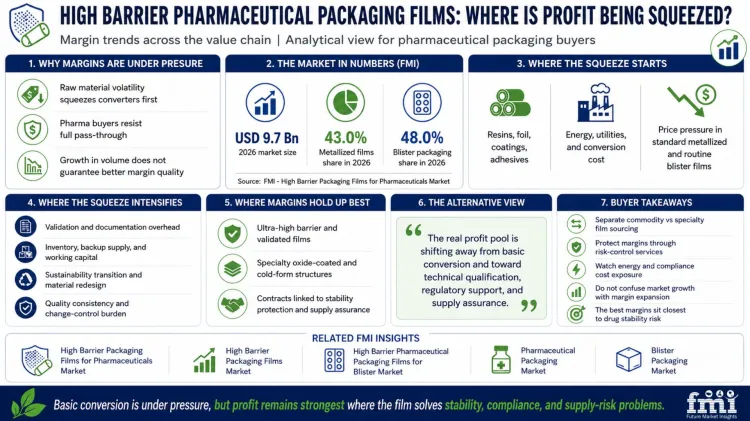
- The real profit pool is shifting from basic conversion to technical qualification, regulatory support, stability protection, and supply assurance.
The high barrier packaging films for pharmaceuticals market is growing, but growth does not by itself mean better margins. This is the part of the market that is often misunderstood. Demand for pharmaceutical barrier films is rising because drug manufacturers need better moisture, oxygen, and light protection. Yet many converters are finding that higher demand comes with tougher cost pass-through, stricter specifications, and more procurement pressure. high barrier packaging films for pharmaceuticals market
The margin squeeze starts upstream. High barrier pharmaceutical films depend on polymers, aluminum, specialty coatings, adhesives, solvents, energy, cleanroom-compatible processes, and quality documentation. When resin, foil, coating chemistry, or electricity costs move up, converters feel the impact quickly. But pharmaceutical buyers do not always accept immediate price increases, especially when products are already validated and procurement teams are under cost-control pressure.
This creates a structural problem: converters carry inflation risk, while pharma buyers control approval risk.
FMI places the high barrier packaging films for pharmaceuticals market at USD 9.7 billion in 2026. Metallized films are expected to account for 43.0% of material demand, and blister packaging is expected to hold 48.0% of application demand. These two figures show where margin pressure is most visible. Metallized and blister-related films are large, competitive, and heavily specification-driven. They offer volume, but they also attract price comparison.
The first margin squeeze is in standard conversion. Converters producing routine metallized films, strip-pack films, sachet films, and mid-barrier pouch structures face the toughest competition. Buyers can compare barrier level, thickness, machinability, seal performance, and price with relative clarity. In these segments, Chinese converters and cost-efficient regional suppliers create downward price pressure. The converter may still win volume, but the margin per square meter becomes harder to defend.
The second squeeze is in regulatory and documentation workload. Pharmaceutical packaging is not normal flexible packaging. Film changes can affect stability data, drug shelf life, packaging validation, and regulatory submissions. That should give established converters pricing power. But in practice, the same requirement also raises their internal cost. Quality systems, batch traceability, change-control processes, audit readiness, and customer-specific documentation all add overhead. When the buyer treats these services as expected rather than premium, margin gets absorbed inside the converter’s operating cost.
The third squeeze is energy and utilities. This is especially relevant for EU converters. Coating, laminating, metallizing, drying, slitting, and controlled manufacturing environments require reliable energy. European converters may have technical credibility, but elevated industrial electricity costs weaken their ability to compete on price-sensitive barrier films. That does not remove Europe from the market. It pushes EU converters toward higher-value structures, recyclable barrier films, PVDC alternatives, and pharmaceutical customers that pay for compliance depth.
The high barrier packaging films market shows why this shift matters. Multilayer films are expected to hold 56.0% of film structure demand in 2026, and EVOH is expected to capture 38.0% of material demand across barrier-film formulations. These are not simple commodity structures. They require formulation control, layer performance, and customer qualification. Margins are more defensible when the converter is selling performance and validation, not film area. high barrier packaging films market
The fourth squeeze is in inventory and supply assurance. Pharmaceutical customers expect continuity. They want backup supply, consistent lots, stable lead times, and limited change disruption. Converters therefore hold more working capital in raw materials, finished rolls, quality testing, and contingency planning. That cost is often invisible in headline pricing. A converter may look profitable on gross conversion spread but lose margin through inventory financing, rejected batches, freight urgency, and customer-specific service expectations.
The fifth squeeze is in sustainability transition. Pharma buyers are asking for lower material use, PVDC-free alternatives, recyclable structures, and better environmental positioning. These are necessary shifts, but they are not free. R&D, trials, testing, line adjustments, and regulatory reassurance all cost money before volume is secured. The converter carries development cost while the buyer waits for proof.
Margin protection is clearest in applications where switching risk is high. Ultra-high barrier films, aluminum oxide coated films, silicon oxide coated films, cold-form blister applications, and validated blister structures are less exposed to simple price comparison. The closer the film is to drug stability, moisture sensitivity, oxygen sensitivity, and shelf-life assurance, the more difficult it becomes for buyers to switch purely on price.
That makes the high barrier pharmaceutical packaging films for blister market strategically important. Blister materials sit close to drug protection and patient safety. When a film is embedded in stability data, the converter gains more leverage. The buyer may still push for savings, but the cost of failure is higher than the cost of a modest price premium. high barrier pharmaceutical packaging films for blister market
The weakest margin position sits in the middle of the value chain: converters that are not low-cost enough to beat Chinese pricing, but not specialized enough to command technical premiums. These firms get squeezed from both sides. Upstream suppliers push through input costs. Pharma buyers push back on price. Specialist competitors win the high-value work. Low-cost competitors win the commodity work.
Sharper read: margin is no longer protected by being a converter. Margin is protected by controlling a risk point. The supplier that protects drug stability, simplifies regulatory documentation, reduces revalidation burden, or guarantees supply continuity has pricing power. The supplier that only converts film has exposure.
Common misread: market growth protects converter profitability. It does not. In high barrier pharmaceutical packaging films, growth can increase volume while reducing margin quality if the converter is trapped in standardized structures.

