


- New construction creates large-volume joint compound demand because every drywall board seam needs taping, filling, finishing, sanding, and preparation before paint.
- Renovation and repair create recurring demand as older walls develop cracks, dents, fastener marks, water damage, and surface defects.
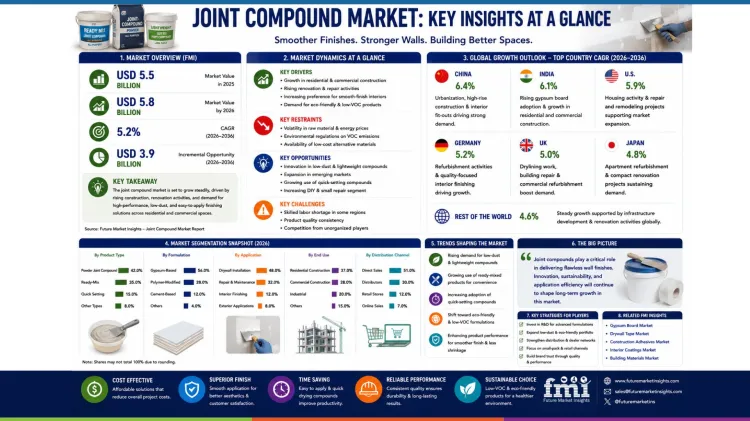
- FMI projects drywall installation to represent 48.0% of application demand in 2026, while residential construction accounts for 37.0% of end-use demand.
- The USA remains a strong example of both demand pools, with April 2026 housing starts at 1.465 million and housing completions at 1.449 million at seasonally adjusted annual rates.
- Mature markets such as Germany, the UK, and Japan rely more visibly on refurbishment and repair quality, while China and India are supported by urban interiors and new board-based construction.
- The practical finding is that new construction drives batch volume, while renovation improves demand resilience.
Joint compound is consumed at two very different moments in a building life. The first is during original drywall installation, when boards are hung and every joint, corner, and fastener mark needs treatment before the wall can move to paint. The second occurs years later, when walls crack, dent, stain, shift, or need surface improvement during renovation.
A market that serves both cycles is more resilient than one tied only to new building starts.
FMI expects the joint compound market to rise from USD 5.8 billion in 2026 to USD 9.7 billion by 2036 at a 5.2% CAGR. Drywall installation is forecast to represent 48.0% of application demand in 2026. Residential construction holds 37.0% of end-use demand. These two shares show that new board installation remains a major consumption driver. At the same time, FMI repeatedly points to repair, renovation, crack filling, and surface leveling as sources of repeat demand.
New construction provides volume because joint compound use is built into the drywall workflow. A building using gypsum board partitions, ceilings, or interior linings must treat board joints before finishing. That means compound is consumed across taping, bedding, filling, finishing, and touch-up. The more board area installed, the more compound is required.
This makes housing completions and commercial fit-outs important demand signals. In the USA, Census and HUD data for April 2026 reported housing starts at a seasonally adjusted annual rate of 1.465 million and housing completions at 1.449 million. These figures indicate active residential construction, and completed units are especially relevant because drywall finishing occurs closer to the later stages of construction.
FMI similarly notes that USA housing completions keep taping and finishing crews active across new homes and multifamily projects. It projects the USA joint compound market to grow at 5.9% CAGR through 2036. Texas and Florida are identified as support markets because housing activity keeps drywall finishing crews active. This reflects the direct link between homebuilding and compound consumption.
China and India represent another new-construction-driven pattern. FMI forecasts China at 6.4% CAGR and India at 6.1%, both ahead of the global market rate. China demand is tied to high-rise interiors, apartment repair, office fit-outs, and large urban buildings that use drywall finishing materials. India demand is driven by wider use of gypsum board partitions in urban buildings, office fit-outs, apartment interiors, and organized construction. In both countries, new interior construction and drywall adoption create important volume growth.
The new construction pool has one limitation, since it is cyclical. Housing starts, commercial real estate investment, office development, interest rates, material costs, and builder confidence can all affect near-term demand. A slowdown in construction can delay drywall work. Compound demand may then soften in project channels even when repair demand continues.
Renovation behaves differently. It is more fragmented and more recurring. Older buildings need crack repair, patching, dent filling, surface leveling, repainting preparation, and replacement of damaged drywall areas. Renovation work may be smaller in batch size, and it happens across a larger installed building base and can continue even when new construction slows.
FMI states that repair work adds repeat sales because cracks and fastener marks appear over time in older buildings. It also notes that renovation projects support the market because property owners often improve interiors without replacing full wall systems. This is the important commercial difference. A renovation contractor may not consume as much compound as a new tower project, and the demand is spread across many homes, offices, shops, schools, apartments, and institutional buildings.
Renovation also changes product preference. Smaller repair jobs often favour ready-mix because applicators can start without site mixing. Quick-setting compounds suit patching work because shorter cycles help contractors finish faster. Low-dust and lightweight compounds gain value in occupied spaces because sanding dust and cleanup become more visible to the customer.
That is why renovation can support premium products. A contractor repairing walls in an occupied office or home may care more about dust, drying time, smooth finish, and easy sanding than the lowest unit price. FMI identifies low-dust products as a better-value opportunity and notes that cleaner sanding reduces cleanup work in occupied spaces.
Mature markets appear more renovation-sensitive. Germany is projected to grow at 5.2% CAGR, with FMI linking demand to refurbishment, quality-focused interiors, and low-emission documentation. The UK is forecast at 5.0%, supported by drylining work, building repair, commercial refurbishment, and repair-and-maintenance activity. Japan is projected at 4.8%, with apartment refurbishment, office upgrades, compact work areas, and aging housing stock supporting steady compound demand.
The UK example is particularly clear. FMI notes that repair and maintenance rose 0.8% in March 2026, supporting compound demand outside new construction. Renovation work gives suppliers repeat sales because walls must be patched, smoothed, and prepared before repainting. In this type of market, trade distributors become important because staged renovation work needs local stock.
Commercial renovation creates a separate demand stream. Offices are reconfigured, retail interiors are refreshed, hotels upgrade rooms and corridors, schools modernize classrooms, and healthcare facilities repair or refurbish interior spaces. Joint compound is used wherever drywall surfaces need to be restored or finished. The value may not appear in new housing statistics, and it keeps compound moving through contractors and distributors.
The renovation pool also benefits from aesthetics. Modern paint, lighting, and wall finishes can expose surface defects more clearly. Premium offices and apartments need smoother wall finishes because defects show under bright lighting and flat paints. FMI highlights this point for India office and apartment demand. Better finish expectations can increase use of topping compounds, polymer-modified products, and repeated finishing passes.
New construction and renovation also affect distribution differently. Large new construction projects may buy through direct sales, which FMI estimates at 51.0% of distribution demand. Project buyers need consistent quality and scheduled delivery. Renovation often moves through distributors, trade stores, hardware stores, and retail packs because jobs are smaller and more local. A supplier needs both project supply capability and local channel depth.
The question of which demand pool is driving consumption has two answers.
By application share, new drywall installation is the largest identifiable demand pool. The FMI 48.0% drywall installation share confirms that new board work remains the core volume driver. Every new wall system creates a compound requirement, and large projects can consume significant quantities.
By market resilience, renovation and repair are equally important. They create repeat demand from the existing building stock and support higher-value products tied to convenience, low dust, quick setting, and smoother finishing. Renovation is less dependent on a single construction cycle and more linked to the age, occupancy, and maintenance of the building base.
The balance differs by country. China and India appear more growth-oriented through urban interiors and board-system expansion. The USA benefits from both housing activity and repair and remodeling channels. Germany, the UK, and Japan show stronger renovation and refurbishment signals. Brazil benefits from housing repair and commercial interior work.
For suppliers, the market strategy should separate the two pools.
New construction requires bulk formats, powder products, direct supply, contractor trust, system compatibility, and consistent quality across large wall areas.
Renovation requires ready-mix, quick-setting products, small packs, low-dust compounds, local availability, and finishing products that reduce disruption in occupied spaces.
The strongest companies will not depend only on new construction volume. They will use new projects to build scale and renovation channels to build stability. Joint compound is consumed when walls are built, and it is also consumed every time those walls age, crack, change tenants, or need a cleaner finish before the next coat of paint.

