


- OEM channels dominate connecting rod volume, with FMI estimating that original equipment supply accounts for 83.0% of market demand.
- OEM contracts offer scale, production visibility, and long platform cycles, but strict annual cost reduction, qualification, warranty, and tooling requirements can compress supplier margins.
- The aftermarket is smaller by volume but appears capable of generating stronger unit margins through engine rebuilding, performance tuning, custom specifications, and branded distribution.
- Aging vehicle fleets in North America, Europe, and Japan support replacement demand even as new vehicle powertrains become more electrified.
- Performance aftermarket suppliers can earn premiums on forged steel, aluminum, titanium, H-beam, I-beam, and custom connecting rods.
- The key observation is that OEMs offer revenue stability, while aftermarket and performance channels may offer better margin quality when suppliers control branding, specification, and distribution.
The connecting rod market is heavily weighted toward original equipment supply. FMI estimates that OEM channels account for 83.0% of total volume. This reflects the nature of the component. Connecting rods are installed inside engines during assembly, and every combustion or hybrid engine requires a matched set. Vehicle and engine manufacturers therefore account for most initial demand.
Supplying connecting rods for high-volume automotive production does not guarantee high profits. Contracts with car manufacturers involve long approval cycles and competitive bidding. Suppliers must commit to heavy tooling costs and strict quality audits. Car makers also demand annual price reductions and strict warranty performance. These contracts provide long-term visibility for the production line where the supplier also assumes significant financial and operational risks.
The aftermarket has a different business structure. Sales volumes are lower and harder to predict. Suppliers have more control over pricing and branding. Customers like racing teams and engine rebuilders pay more for specialized parts. They value strength and custom designs. This market prioritizes performance over volume. It offers higher profit margins than mass-market production.
FMI notes that aftermarket margins are typically higher than OEM supply contracts. This attracts smaller manufacturers and specialist forging companies. The report identifies CP Carrillo, Wiseco, MGP Connecting Rods, Pauter Machine, and other specialists as participants in performance and motorsport markets, while Mahle, Linamar, Gohsyu, and Yasunaga maintain broader OEM positions.
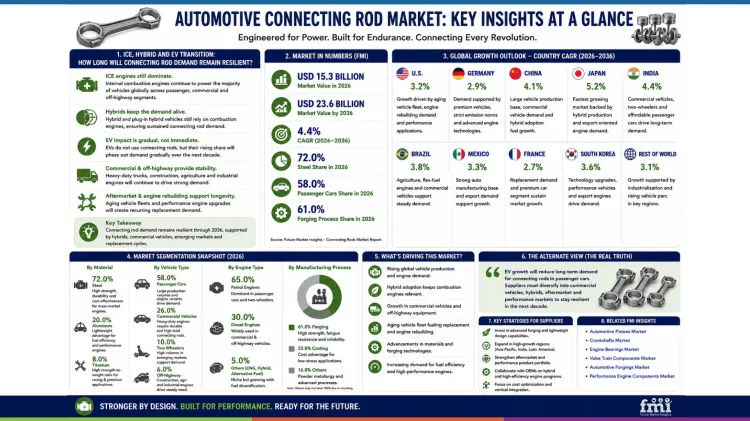
The OEM business model begins with scale. Passenger cars account for 58.0% of connecting rod demand, while steel represents 72.0% of material demand. This creates large procurement programs for forged steel rods used across multiple engine families. A supplier that wins an OEM platform may ship hundreds of thousands or millions of rods over the program lifecycle.
This volume supports factory utilization and revenue visibility. It can justify investment in forging presses, heat treatment, machining centers, fracture-splitting equipment, automation, inspection systems, and material procurement. OEM contracts may also help suppliers build technical credibility that can be used to win other programs.
The cost of this stability is pricing pressure. OEMs typically expect continuous productivity improvement and annual cost reductions. Suppliers may need to absorb steel price changes, labor inflation, energy costs, scrap, quality issues, and logistics pressure unless contract escalation clauses provide protection. Platform consolidation can also increase the bargaining power of major automakers because fewer engine families concentrate higher volumes among fewer suppliers.
Winning OEM business involves high qualification costs. Connecting rods are critical for engine safety and durability. Suppliers must prove consistent material quality and machining accuracy. They must also demonstrate long-term part fatigue life and strict process control. A single quality failure can lead to massive warranty costs or recalls. These requirements create a high barrier to entry. They also make maintaining the business very expensive.
Aftermarket suppliers manage a unique set of operational costs. They must maintain broad application coverage and high inventory levels. Success depends on strong distributor relationships and accurate catalogs. Marketing and technical support are also essential. Demand is highly fragmented by engine code and vehicle model year. Suppliers in this category face less pressure from annual price reduction mandates common in the OEM sector.
The replacement aftermarket is supported by aging vehicles. Older vehicles remain in service longer and are more likely to require engine overhaul, remanufacturing, or replacement components. The USA also has a mature engine rebuilding and performance ecosystem. FMI projects USA connecting rod demand to grow at 3.2% through 2036, supported partly by aging fleets and independent rebuilders.
The aftermarket is not one homogeneous channel. Standard replacement rods compete on fitment, availability, and price. Remanufacturing suppliers focus on OE-equivalent durability and engine restoration. Performance aftermarket suppliers sell upgraded materials, stronger beam designs, lower rotating mass, and custom specifications. Motorsport suppliers may provide small production runs with significantly higher unit prices.
Performance applications offer distinct margin potential. A customer building a turbocharged, racing, or high-revolution engine is less likely to select a rod only on price. The buyer may value tensile strength, fatigue performance, weight matching, bolt quality, dimensional precision, and brand reputation. Titanium, forged aluminum, hollow rods, and premium forged steel designs can command strong premiums.
Aftermarket sales are not always highly profitable. Standard parts face competition from low-cost imports and used engines. Keeping too many slow-moving parts in stock can hurt financial returns. Distributor discounts and product returns also lower profit margins. The best profits come from strong brands and specialized parts. A generic part sold through independent sales channel has low margins. A branded, high-performance part creates more value because the supplier controls the design and brand image.
Market characteristics vary significantly by region. North America has a well-developed engine rebuilding and performance sector. Western Europe is defined by an aging vehicle fleet and high demand for motorsport parts. Japan combines an aging vehicle parc with a focus on high-precision engineering. India and China show rapid growth in both new production and replacement parts.
Hybridization may support OEM demand while also creating future aftermarket opportunity. Hybrid engines still use connecting rods, and these vehicles will eventually require rebuilding or repair. Battery-electric vehicles reduce future connecting rod installation, but they do not remove the existing ICE and hybrid fleet. This allows the aftermarket to remain active long after new vehicle mix begins to change.
OEM and aftermarket margins should also be evaluated through capital efficiency. An OEM supplier may generate lower margins but high asset utilization and predictable cash flow. A performance aftermarket supplier may generate higher gross margin per unit but operate at lower volumes, carry more SKUs, and spend more on customer acquisition. The commercially attractive model depends on the supplier’s scale, brand, equipment, and distribution capability.
Some suppliers can use a dual-channel strategy. OEM contracts provide volume and manufacturing credibility. Aftermarket products use the same forging and machining expertise to capture higher-margin replacement or performance demand. This model requires channel separation because OEM customers may object to direct competition or unauthorized use of specifications.
Aftermarket sales do not automatically yield higher profits. Stronger margins require a combination of brand recognition, specialized products, and efficient distribution. Standard replacement parts often face intense price competition that limits financial returns. Conversely, OEM contracts can be highly profitable when factories run efficiently and contract terms effectively balance production volume against cost and risk.
The aftermarket is the most accessible path for smaller manufacturers. OEM contracts require high investment and long approval times. Niche suppliers can grow by serving specialized markets like racing and engine restoration. They also find success with regional repair shops. Larger companies still depend on high-volume OEM programs for most of their revenue. This creates a clear split in the industry based on company size.
The strongest supplier position may be a balanced one. OEM business creates scale and long-term production visibility. Aftermarket business creates pricing flexibility, customer diversity, and higher-value specialty demand. Suppliers that can manage both without creating channel conflict may improve margin stability.
Bottom line: OEM channels offer the largest connecting rod volumes and the most stable program visibility, but they also carry strong cost-down, quality, and capital pressures. Aftermarket and performance channels appear capable of producing higher unit margins, especially in engine rebuilding, motorsport, custom, and premium-material applications. The better channel depends on whether the supplier is optimized for scale or differentiation.

