


- OEM service divisions retain an advantage in warranty-linked repairs, proprietary motor designs, original documentation, high-voltage equipment, and customers that require direct manufacturer backing.
- Independent repair providers often win where response time, multi-brand coverage, local field service, emergency support, and competitive pricing matter most.
- FMI describes the motor winding repair market as highly fragmented, with thousands of independent repair shops operating alongside OEM service divisions and regional service chains.
- Integrated Power Services is estimated by FMI to hold 12.0% market share, supported by its large independent repair network and full-service capability across motors and generators.
- The strongest industrial maintenance contracts increasingly reward providers that combine certified repair, diagnostics, site coverage, digital reporting, and planned-maintenance support.
- The likely market outcome is not OEM displacement or independent dominance. It is a segmented market where each provider type wins different asset classes and customer situations.
Industrial maintenance contracts are rarely decided by the repair price alone. A motor repair buyer may need a provider that can respond within hours, collect a failed motor, supply a spare, rewind a high-voltage stator, diagnose a recurring vibration issue, document efficiency preservation, support a shutdown, and remain available across several facilities.
That requirement creates room for both OEM service divisions and independent repair providers.
The OEM route is attractive when equipment is proprietary, covered by warranty, technically complex, or linked to a customer that prefers original manufacturer procedures. The independent route is attractive when the fleet includes multiple brands, response time matters, local workshop access is important, or the customer wants one provider to manage motors, generators, gearboxes, drives, pumps, and related rotating equipment.
The FMI Motor Winding Repair Service Market reflects this split. The report segments service providers into OEM services and independent providers. It describes the market as highly fragmented, with thousands of independent repair shops competing alongside OEM divisions and regional service chains. It also identifies Integrated Power Services as the largest independent motor repair network in North America, with an estimated 12.0% market share.
This structure matters because the market is not dominated by a few global motor manufacturers. Local response capability remains commercially important.
OEM service providers begin with a technical credibility advantage. They may have original drawings, material specifications, winding data, repair procedures, software access, application knowledge, and approved spare parts. For certain motors, particularly high-voltage units, specialized generator systems, explosion-proof motors, or motors integrated with proprietary controls, that access can reduce technical uncertainty.
OEM service can also be preferred when the customer needs warranty alignment. A motor still under warranty, recently installed, or covered by a long-term service agreement may need OEM-authorized repair to preserve contractual protections. In critical applications, the customer may also prefer manufacturer-backed repair documentation for insurance, compliance, or internal risk management.
The OEM advantage is strongest in four situations.
The first is proprietary or highly engineered motor designs, meaning motors with specialized cooling, insulation, bearings, rotor construction, controls integration, or hazardous-area requirements.
The second is warranty and contractual obligations, covering assets where unauthorized repair could affect warranty or service commitments.
The third is high-voltage and generator-class equipment, where original design knowledge and test capabilities reduce risk.
The fourth is global customer accounts, where multinational industrial users want harmonized procedures across several sites.
Independent providers compete differently. Their strongest advantage is multi-brand service. A refinery, mine, cement plant, food processor, water utility, steel mill, or manufacturing campus may operate motors from several OEMs installed over decades. It may not want separate repair contracts for each brand. An independent provider can become the single point of contact for the full motor fleet.
This is one reason independent repair networks remain relevant. They can repair AC motors, DC motors, generators, rotor assemblies, bearings, pumps, drives, and related rotating assets across many manufacturers. They may also provide field service, on-site diagnostics, emergency response, machining, balancing, vibration analysis, and spare-motor management.
FMI notes that IPS supports full-service repair across AC, DC, and generator equipment. It also cites regional providers such as Continental Group, Delba Electrical, Whelco Industrial, Smith Services, EMW Productions, Lloyd Electric, and others serving specialized or local industrial markets. The company list itself illustrates the market's layered structure, with large networks, regional service chains, specialist workshops, and local repair providers all coexisting.
Response time is often the most important independent-provider advantage. A local repair company may be able to send technicians to a plant within hours. It may already know the customer's asset history, site conditions, spare inventory, and maintenance team. In a breakdown situation, that familiarity can outweigh the theoretical benefit of OEM-only service.
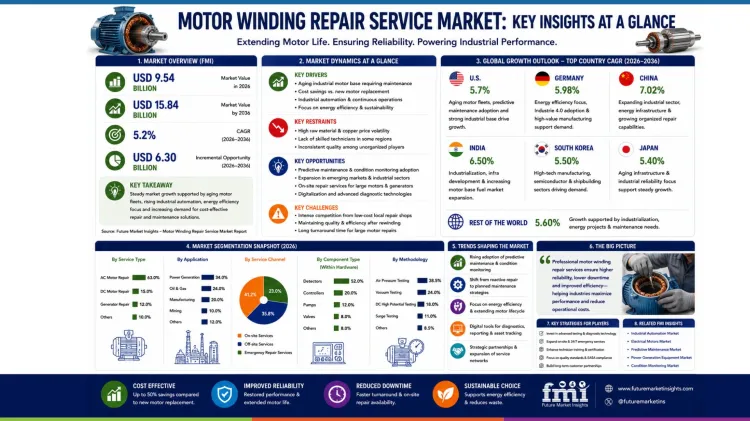
On-site service is particularly important for large motors and generators. FMI estimates that on-site services account for 41.2% of the market because some equipment cannot be transported economically. Turbine generators, compressor drives, process-critical pumps, large fans, and high-voltage motors may require field assessment, bearing work, alignment, insulation testing, or controlled repair support at the customer site.
An independent provider with strong field capability can win contracts by reducing downtime. It may not need to outperform the OEM in every technical metric. It needs to offer reliable response, appropriate quality, and clear documentation at the moment the customer needs it.
Pricing is another differentiator, and it should be interpreted carefully. Independent providers can often offer lower costs because they have leaner overheads, local labor pools, and multi-brand operations. Some independent repair shops also compete by cutting quality, using lower-grade materials, or reducing testing. That creates risk for customers. FMI specifically identifies price competition from uncertified repair shops as a restraint because low-cost rewinding without efficiency-preservation documentation can undermine quality service providers.
The market is therefore separating into at least three provider groups.
The first group is OEM-authorized service, focused on original procedures, warranty alignment, proprietary equipment, and premium technical support.
The second group is quality-certified independents, focused on multi-brand coverage, field service, diagnostics, documented repair, and regional reach.
The third group is low-cost local repair shops, focused primarily on price and speed but often with less formal documentation, testing, or quality assurance.
Industrial buyers are increasingly moving away from the simple OEM-versus-independent choice. They are asking which provider can meet the required quality level for a specific asset category. A small non-critical motor may be sent to a local shop. A large process motor may go to an EASA-AR-aligned independent provider. A proprietary high-voltage motor may require OEM authorization.
Quality certification is becoming a more important dividing line. The EASA AR100 recommended practice provides guidance for the repair of rotating electrical apparatus, while its rewind studies emphasize that proper repair procedures can preserve motor efficiency. A provider that can document its procedures, materials, testing, and final performance holds a stronger position than one competing only on quotation price.
This matters because energy costs are changing contract economics. A poor rewind can create a small but persistent efficiency penalty. For a motor that operates continuously, that penalty can cost more than the initial repair-price difference. Customers with energy-management programs are therefore more likely to ask about core-loss testing, controlled stripping methods, insulation systems, winding data, balancing, and final electrical checks.
Predictive maintenance is also changing the contract landscape. A provider that offers vibration analysis, thermal monitoring, motor current signature analysis, root-cause assessment, and planned rewinds can become part of the customer's reliability program. OEMs may offer such services, and independents can compete effectively if they have trained technicians, monitoring tools, software capability, and strong reporting.
The service contract becomes less transactional. Instead of waiting for breakdowns, the provider may monitor critical motors, identify deteriorating condition, recommend shutdown timing, repair equipment, and validate the result after installation. This model creates recurring revenue and reduces the importance of the original motor brand.
The power generation sector is particularly relevant because it accounts for 34.0% of application demand in the FMI market view. Generator stator and rotor repairs, exciter work, high-voltage insulation, and turbine-generator maintenance require deep technical capability. OEM providers can hold a strong advantage where machine design is proprietary. Large independent specialists can compete where they have generator-class expertise, test facilities, and field-service capacity.
Oil and gas, mining, paper, cement, and process manufacturing create a different buying pattern. These sectors often operate mixed fleets, remote sites, and continuous-duty equipment. They value local response, multi-brand service, field capability, and emergency coverage. Independent providers can be especially competitive if they can maintain quality standards in difficult operating environments.
Regional patterns matter as well. FMI projects China to grow at 7.0% CAGR, India at 6.5%, Germany at 6.0%, the USA at 5.7%, South Korea at 5.5%, and Japan at 5.4%. China and India are expanding industrial motor fleets and organized repair capabilities. Germany and the USA have aging fleets, energy efficiency focus, and established quality-certified repair infrastructure. This creates room for both OEM and independent service models.
The USA is likely to remain one of the stronger markets for independent repair networks because of its large installed base, multi-brand industrial fleets, and established regional service culture. Germany is likely to reward quality-certified providers that combine efficiency preservation with predictive maintenance. China and India may see growing competition between large service organizations and local repair shops as industrial standards rise.
A smaller independent provider can remain competitive, and it needs a clear position. It may specialize in high-voltage motors, hazardous-area equipment, generator repair, oil and gas work, mining motors, rapid-response field service, or regional multi-brand contracts. A generic repair shop without testing capability, documentation, or service differentiation may face more pressure as customers become more focused on efficiency and reliability.
The stronger independent providers are likely to build around six capabilities:
- Multi-brand repair competence
- EASA-AR or equivalent quality processes
- Field diagnostics and emergency response
- Planned-maintenance and condition-monitoring services
- Workshop capacity for larger motors and generators
- Regional coverage with faster turnaround than centralized OEM networks
OEM providers are likely to retain leadership where warranty, proprietary design, high-voltage engineering, and original equipment documentation matter most. Independents are likely to retain and expand share where mixed fleets, local service, response speed, and integrated maintenance support matter more.
The market is not moving toward a single winner. It is becoming more selective. Industrial maintenance contracts will increasingly go to providers that can prove they preserve motor efficiency, reduce downtime, document repair quality, and support the customer before and after the motor fails.

