


By Sabyasachi Ghosh
Paraffin therapy remains relevant because it solves a very ordinary clinical problem well. It delivers simple heat therapy for painful or stiff joints without requiring complex equipment or a specialist setting.
That modest profile is part of the market's strength. The category benefits from chronic joint conditions, a growing rehabilitation base, and a secondary demand stream from spas and wellness providers that keeps volume broader than many therapy niches.
Why the market still has dependable demand
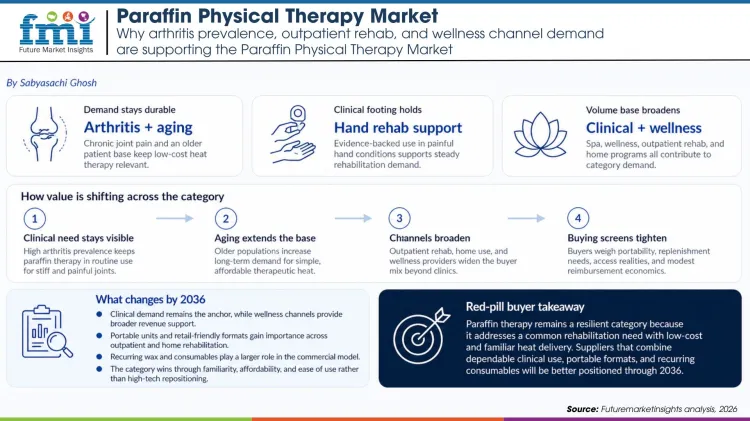
- Arthritis prevalence keeps the clinical need for low-cost heat modalities firmly in place.
- Population aging is extending the treatment base over a much longer horizon.
CDC estimates on arthritis prevalence make the commercial case straightforward. Tens of millions of adults already live with diagnosed arthritis, and many experience activity limitations that support regular therapeutic intervention. Paraffin baths remain attractive because they are familiar, affordable, and easy to integrate into hand-focused rehab routines.
Aging adds another layer of durability. UN population projections show the 65-plus share rising steadily, and that matters because joint stiffness, chronic pain, and rehabilitation needs all become more common with age. The market therefore benefits from a demographic trend that is structural rather than cyclical.
Where additional volume is coming from
- Clinical evidence continues to support paraffin use in painful hand conditions and related rehabilitation settings.
- Spa and wellness channels add non-clinical volume that helps stabilize the category.
Systematic review work and earlier evidence on rheumatoid arthritis support paraffin therapy as a useful adjunct in hand care, especially for pain, grip, and range-of-motion outcomes. That gives the market a credible clinical footing rather than leaving it dependent on anecdotal use.
Outside healthcare settings, the category also benefits from spa and wellness services that continue to use paraffin for hand and foot treatments. This does not replace the clinical market, but it broadens the revenue base and supports recurring demand for both devices and consumables.
| Market dimension | 2015-2025 | 2026-2036 |
|---|---|---|
| Primary demand source | Clinic and rehab use anchored most commercial demand. | Clinical demand remains central, with wellness channels adding more visible support. |
| Clinical narrative | Paraffin therapy was often viewed as a basic adjunct modality. | Evidence-backed hand therapy use receives more attention. |
| Buyer mix | Therapy providers led most purchasing decisions. | Outpatient rehab, home programs, and spas all contribute more meaningfully. |
| Commercial driver | Low equipment cost and familiarity supported adoption. | Aging populations and chronic joint care keep baseline demand stronger. |
| Product focus | Basic bath units and consumables dominated. | Portable formats and recurring wax sales become more important. |
What buyers should weigh carefully
- Reimbursement can support use, but it is rarely rich enough to justify sloppy purchasing assumptions.
- Demand remains durable, yet access and copay sensitivity can affect utilization at the margin.
Coverage references for paraffin therapy show that the code exists, but direct reimbursement is often modest or shaped by facility policy. Buyers should therefore view the category as part of bundled rehab value rather than a standalone profit center with strong reimbursement economics.
The epidemiology is favorable, but utilization still depends on patient access. Older adults and patients with comorbidities may need therapy, yet attendance and frequency can still be shaped by transport, copays, and overall care coordination. The market benefits from need, but conversion still requires reachable care settings.
What may define the next decade
- Ambulatory and home-based rehabilitation should support more portable and retail-friendly product formats.
- The category's strength will continue to come from simplicity, not from high-tech repositioning.
As rehabilitation continues to spread across outpatient and home settings, paraffin products that are easier to place, maintain, and replenish should perform well. This supports a broader channel mix than a purely clinic-based therapy market would allow.
The underlying commercial logic is unlikely to change much. Paraffin therapy succeeds because it is familiar, inexpensive, and clinically useful in the right situations. For the 2026-2036 market outlook and deeper segmentation, see the Future Market Insights report: Paraffin Physical Therapy Market (2026 - 2036) - https://www.futuremarketinsights.com/reports/paraffin-physical-therapy-market
Bibliography
- CDC MMWR. Prevalence of Diagnosed Arthritis - United States, 2019-2021. Https://www.cdc.gov/mmwr/volumes/72/wr/mm7241a1.htm
- CDC MMWR. Prevalence of Arthritis and Arthritis-Attributable Activity Limitation - United States, 2016-2018. Https://www.cdc.gov/mmwr/volumes/70/wr/mm7040a2.htm
- ACR/Arthritis Foundation Osteoarthritis Guideline summary. Https://www.aafp.org/pubs/afp/issues/2021/0115/p120.html
- Systematic review and meta-analysis of paraffin bath therapy for hand diseases (2023). Https://pubmed.ncbi.nlm.nih.gov/36914488/
- Cochrane Review. Thermotherapy for rheumatoid arthritis. Https://www.cochrane.org/evidence/CD002826_thermotherapy-heat-treatment-treating-rheumatoid-arthritis
- ISPA press release and study extracts on US spa revenues. Https://experienceispa.com/press-releases/big-news-for-u-s-spa-revenue-growth/ and https://www.spahandbook.com/detail.cfm?featureid=37950&linktype=story&mag=Spa+Business+Handbook&pagetype=featuresonline
- FDA. 21 CFR 890.5110 Paraffin bath; Physical Medicine Devices. Https://www.law.cornell.edu/cfr/text/21/890.5110 and https://ecfr.io/Title-21/Part-890
- CMS and payer references on CPT 97018 recognition and setting. Https://www.medfeeschedule.com/code/97018 and https://dam.assets.ohio.gov/image/upload/medicaid.ohio.gov/Providers/FeeScheduleRates/OutpatientHospital/Covered_List_OPH_ASC_revised_11.20.2023.pdf and https://www.cms.gov/medicare/billing/snfconsolidatedbilling/downloads/05annualsnfcbhcpcs1.pdf
- OECD. Health at a Glance 2025 demographic trends. Https://www.oecd.org/en/publications/2025/11/health-at-a-glance-2025_a894f72e/full-report/demographic-trends_257a22c9.html
- UN DESA. World Population Prospects 2022, Summary of Results. Https://www.un.org/development/desa/pd/sites/www.un.org.development.desa.pd/files/wpp2022_summary_of_results.pdf

