

- Market Size (2026)
- USD 70.5 Mn
- Forecast (2036)
- USD 194.8 Mn
- CAGR (2026 to 2036)
- 10.7%
How big is Intratympanic Drug Microcatheters Market in 2026?
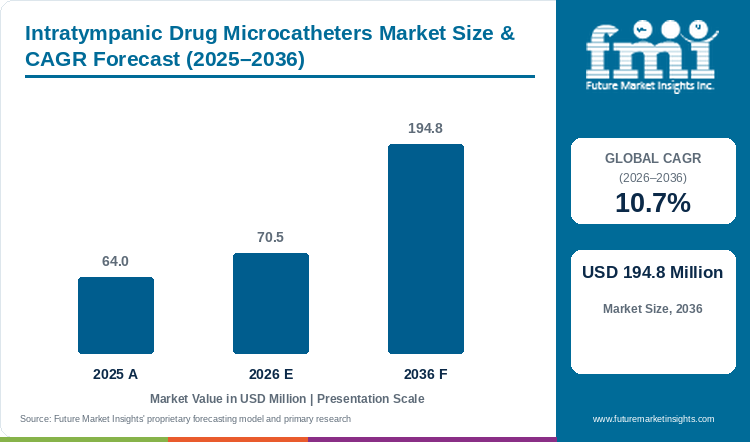
Starting from USD 64.0 million in 2025, the intratympanic drug microcatheters market valuation advanced to USD 70.5 million in 2026, with projections pointing toward USD 194.8 million by 2036 at a CAGR of 10.7%.
Reliable retention of liquid steroid medication against the inner ear membrane during sudden hearing loss treatment has become a central purchasing priority for outpatient ear clinics. Standard eardrum needle injections often drain down the throat within minutes, a problem confirmed by a June 2025 clinical study of 251 sudden deafness patients in Acta Oto-Laryngologica showing that passive throat drainage removes 1.90 mg of a 5.0 mg dexamethasone dose before absorption finishes [1]. To stop this drug loss and avoid repeat eardrum punctures, ear doctors are switching to indwelling polyurethane microcatheters, which represent 57.2% of 2026 delivery architecture demand. Global intratympanic drug microcatheters market value is projected to grow from USD 64.0 million in 2025 to USD 70.5 million in 2026 and reach USD 194.8 million by 2036, advancing at a 10.7% CAGR to add USD 124.3 million in industry expansion. Demand for these inner ear tubes is rising much faster than micro guide catheters at a 6.3% CAGR as children's hospitals adopt leak-free catheters for hearing gene therapies, a pipeline strengthened in April 2026 when Spiral Therapeutics raised USD 27.0 million in Series B funding. Still, scar tissue over the inner ear window and flat clinic procedure fees slow wider adoption.
Key Market Trends & Insights
- By delivery architecture: Indwelling polyurethane microcatheters are projected to capture 57.2% in 2026 because seated inner-ear wicks stop liquid medicine from draining down the throat.
- By delivered therapeutic: Corticosteroid formulations account for an estimated 54.6% in 2026 as ear doctors start fast local steroid rescue for sudden hearing loss.
- By care setting: Outpatient ENT clinics hold an expected 62.8% share in 2026 since numbing ear drops allow 15-minute office placement without hospital operating room scheduling.
- By clinical indication: Sudden sensorineural deafness makes up 52.4% of 2026 demand due to strict 18-day rescue windows after hearing loss begins.
- By guidance modality: Binocular otomicroscopy guidance secures 58.4% in 2026 through hands-free magnified depth control during eardrum placement.
Regional Highlights
- Top national expansion: South Korea leads major ear-care markets at a 12.3% CAGR through 2036 under university hospital steroid and gel catheter treatment programs.
- Broader country progression: Australia advances at an 11.7% CAGR ahead of the UK at 11.2% and the USA at 10.4%, whereas France progresses at a 9.4% CAGR.
Market Size & Forecast
Table 1: Market Size and Forecast for the Intratympanic Drug Microcatheters Market (USD million and CAGR percentage), 2025 to 2036
| Metric | Value |
|---|---|
| 2025 Market Size | USD 64.0 million |
| Estimated Market Size in 2026 | USD 70.5 million |
| Projected Market Size by 2036 | USD 194.8 million |
| CAGR, 2026 to 2036 | 10.7% |
| Added Market Value, 2026 to 2036 | USD 124.3 million |
Ear clinics and hospital surgical departments face wide dosing swings when doctors rely on standard single-channel needles to inject drugs across the eardrum. Fluid buildup inside the tiny inner ear chamber during unvented injections can damage delicate hearing membranes and push expensive gene therapies back into the middle ear. In June 2025, biomedical engineers at Columbia University Medical Center published animal validation in Biomedical Microdevices showing that a 3D-printed dual-channel microneedle infused 5 microliters of viral vector while drawing out 5 microliters of inner ear fluid without harming hearing thresholds [2]. Surgical buyers across the pharmaceutical drug delivery sector are therefore ordering precision microcatheters and vented needles to keep inner ear drug doses consistent.
Patient-Pool and Catheter-Placement Sizing
Table 2: Patient-Pool and Catheter-Placement Sizing for the Intratympanic Drug Microcatheters Market (USD million and operational ranges), 2025 to 2036
| Metric | 2025 | 2026 | 2036 |
|---|---|---|---|
| Market size (USD million) | 64.0 | 70.5 | 194.8 |
| Eligible inner-ear patient pool (million) | 1.4 to 1.6 | 1.5 to 1.7 | 2.3 to 2.6 |
| Catheter and microneedle kits (thousand) | 365.0 to 410.0 | 395.0 to 445.0 | 890.0 to 980.0 |
| Average device spend per procedure (USD) | 156.0 to 175.0 | 158.0 to 178.0 | 198.0 to 218.0 |
Operational note: Patient-pool estimates map sudden hearing loss and severe Meniere vertigo groups as well as chemotherapy ear-protection cases against documented multi-dose inner ear catheter placement rates.
Outpatient ear clinics need predictable drug contact times across 14-day steroid treatment courses to save inner ear hair cells before permanent hearing damage sets in. Specialty device distributors work with controlled-release drug delivery technology developers to supply pre-sterilized catheter trays that eliminate repeat eardrum needle pokes.
Per Capita & Healthcare Facility Sizing
Table 3: Per Capita and Facility Spending Indicators for the Intratympanic Drug Microcatheters Market (USD), 2025 to 2036
| Metric | 2025 | 2026 | 2036 |
|---|---|---|---|
| Global population (million) | 8,200.0 | 8,300.0 | 9,000.0 |
| Spend per 1,000 people (USD) | 7.8 | 8.5 | 21.6 |
| Annual spend per otology clinic (USD) | 1,420.0 to 1,680.0 | 1,560.0 to 1,840.0 | 3,850.0 to 4,420.0 |
| Outpatient ENT procedure share (%) | 61.0% to 63.0% | 62.0% to 64.0% | 65.0% to 68.0% |
Table 4: Facility & Institutional Otology Spending Indicators for the Intratympanic Drug Microcatheters Market (USD and percentages), 2026
| Metric | Value | Institutional Reference Basis |
|---|---|---|
| Market size, 2026 | USD 70.5 million | 2026 global market valuation baseline |
| Otology & ENT clinics globally | 42,500 | Global outpatient ENT and hospital otology registry |
| Market spend per facility | USD 1,658.8 | Annualized otologic microcatheter expenditure |
| Outpatient ENT clinic allocation, 2026 | USD 44.3 million | 62.8% care-setting segment allocation |
Protection of remaining hearing cells depends on holding concentrated steroids and gene treatments right against the inner ear window without causing whole-body steroid side effects. Hospital ear centers pair soft delivery tubes with hearing implants to reduce internal scarring around implant electrodes and improve speech clarity.
Analyst Perspective
"Ear surgeons and office ENT doctors no longer accept losing nearly forty percent of a liquid ear injection down the patient's throat within minutes of the visit. Catheter makers that combine gentle inner-ear seating with built-in pressure venting will win both high-volume outpatient steroid clinics and hospital gene-therapy suites."
- Anurag Sharma, Principal Consultant, Future Market Insights.
How is the intratympanic drug microcatheters market segmented?
The intratympanic drug microcatheters market is segmented by delivery architecture, delivered therapeutic, care setting, clinical indication, and guidance modality. In 2026, indwelling polyurethane microcatheters are projected at 57.2%, corticosteroid formulations at 54.6%, outpatient ENT clinics at 62.8%, sudden sensorineural deafness at 52.4%, and binocular otomicroscopy guidance at 58.4%.
By delivery architecture: Indwelling polyurethane microcatheters, dual-lumen coaxial microneedles, thermoreversible hydrogel cannulas, and fenestrated round-window wicks.
By delivered therapeutic: Corticosteroid formulations, gentamicin vestibular ablation, and gene and otoprotectant payloads.
By care setting: Outpatient ENT clinics, hospital operating suites, and academic neurotology centers.
By clinical indication: Sudden sensorineural deafness, refractory Meniere disease, cisplatin ototoxicity prevention, and genetic otoferlin deafness.
By guidance modality: Binocular otomicroscopy guidance, transcanal endoscopic visualization, optical coherence tomography, fluoroscopic microcatheter tracking, and image-guided robotic cannulation.
Why do Indwelling Polyurethane Microcatheters lead the delivery architecture category?
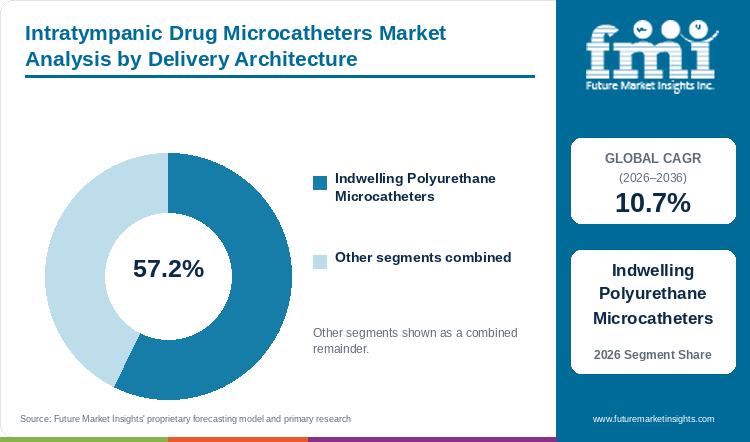
Indwelling polyurethane microcatheters are projected to capture 57.2% of delivery architecture demand in 2026, supported by sustained round-window drug contact.
Table 5: Delivery Architecture Share for the Intratympanic Drug Microcatheters Market (percentage share), 2026
| Delivery Architecture | Share (2026) |
|---|---|
| Indwelling Polyurethane Microcatheters | 57.2% |
| Other Segments Combined | 42.8%* |
| Total | 100.0% |
*Note: Remaining delivery architecture categories sum to 100.0% of 2026 otologic microcatheter demand.
Table 6: Delivery Architecture Leadership and Market Growth for the Intratympanic Drug Microcatheters Market (segment and CAGR percentage), 2026 to 2036
| Metric | Value |
|---|---|
| Global CAGR (2026 to 2036) | 10.7% |
| Leading Segment | Indwelling Polyurethane Microcatheters |
Ear surgeons and outpatient ENT doctors choose indwelling polyurethane microcatheters and Silverstein MicroWick sponges because steady capillary wicking keeps medication against the inner ear window for 14 to 28 days. Seated eardrum tubes spare patients the pain and eardrum scarring of four to six separate needle injections while complementing microneedle drug delivery systems in specialty ear clinics.
- Indwelling polyurethane microcatheters are projected to secure 57.2% of delivery architecture market value in 2026 because patients can place follow-up ear drops at home directly into the seated tube.
- A randomized Phase IIIB clinical trial published in Ear and Hearing in April 2026 evaluated 46 ears across cancer patients receiving an average cisplatin dose of 444.87 mg and confirmed that steady delivery via an indwelling MicroWick giving 8 mg of dexamethasone per 24 hours completely prevented chemotherapy ringing in the ears [3].
Why do Corticosteroid Formulations define the largest delivered therapeutic segment?
Corticosteroid formulations are estimated to secure 54.6% of the delivered therapeutic category in 2026, driven by first-line rescue protocols for sudden hearing loss.
Effective rescue of sudden nerve hearing loss and inner ear inflammation requires placing concentrated dexamethasone or methylprednisolone directly against the inner ear membrane within days of symptom onset. Direct catheter delivery bypasses the inner-ear fluid barrier to reach local drug levels that oral steroid pills cannot match while supporting dissolving microneedles research across university hearing programs.
- Corticosteroid formulations command an estimated 54.6% of the delivered therapeutic segment in 2026 as diabetic and high-blood-pressure patients avoid the blood-sugar spikes caused by oral steroid pills.
- A systematic review and meta-analysis of 11 clinical studies published in European Archives of Oto-Rhino-Laryngology in October 2025 analyzed 498 sudden hearing loss patients and showed a 1.32 risk ratio for satisfactory hearing recovery using targeted intratympanic methylprednisolone compared to standard dexamethasone [4].
What keeps Outpatient ENT Clinics ahead by care setting?
Outpatient ENT clinics are expected to command 62.8% of care setting volume in 2026, driven by quick office-based eardrum catheter placement under numbing drops.
Office ear clinics handle the majority of sudden hearing loss and severe vertigo cases because numbing ear drops allow a 15-minute chairside catheter placement. This shift of multi-week steroid and gentamicin treatments out of hospital operating rooms lowers insurer procedure bills and speeds up adoption of hydrogel-based drug delivery systems in walk-in ear centers.
- Outpatient ENT clinics hold an expected 62.8% of care setting market value in 2026 because urgent hearing rescue cannot wait for hospital operating room scheduling.
- Clinical practice guidance updated in StatPearls at the National Library of Medicine in August 2026 confirmed that outpatient intratympanic steroid placement under topical anesthesia achieves much higher inner-ear drug levels than oral pills with very low complication rates [5].
Why does Sudden Sensorineural Deafness lead the clinical indication category?
Sudden sensorineural deafness is forecast to generate 52.4% of clinical indication market value in 2026, owing to urgent 18-day post-onset rescue windows.
Sudden nerve deafness is a high-volume ear emergency marked by a 30-decibel or greater hearing drop across three connected frequencies within 72 hours. Because recovery rates fall sharply if local steroid treatment starts more than 18 days after symptoms begin, doctors prioritize immediate inner-ear catheter placement while treating severe Meniere vertigo with low-dose gentamicin.
- Sudden sensorineural deafness accounts for a projected 52.4% of clinical indication demand in 2026 as primary-care clinics refer sudden one-sided hearing loss directly to ENT specialists.
- A May 2025 systematic review and meta-analysis of randomized controlled trials from Odense University Hospital published in Acta Oto-Laryngologica confirmed that targeted intratympanic gentamicin markedly reduces spinning vertigo attacks in Meniere disease patients [6].
What gives Binocular Otomicroscopy Guidance the leading position in guidance modality?
Binocular otomicroscopy guidance is anticipated to account for 58.4% of guidance modality demand in 2026, reinforced by hands-free depth viewing in exam rooms.
Two-eyed surgical microscopes remain the primary viewing tool in outpatient ENT exam rooms because hands-free magnification lets the doctor make a tiny eardrum opening and seat the catheter with both hands free. While slender ear endoscopes are growing fast for looking around bony overhangs, standard office microscopes handle everyday steroid catheter placements.
- Binocular otomicroscopy guidance captures an anticipated 58.4% of guidance modality market value in 2026 because nearly every ear clinic already owns wall- or floor-mounted exam microscopes.
- An October 2025 clinical review in Current Opinion in Otolaryngology & Head and Neck Surgery documented that extra tissue membranes block direct access to the inner ear window in up to 28% of ears, requiring microscopic or endoscopic clearing before seating a catheter [7].
What are the drivers, restraints, and opportunities in the intratympanic drug microcatheters market?
In the intratympanic drug microcatheters market, inner-ear gene-therapy approvals and chemotherapy ear-protection rules are projected to expand procedure volumes whereas extra round-window tissue blocks even dosing and dual-channel gel cannulas create single-visit depot opportunities.
- Driver: FDA approvals for pediatric inner-ear gene therapy and routine chemotherapy ear-protection rules turn precision microcatheters into standard surgical supplies.
- Restraint: Extra tissue blocking the inner ear window and fast throat drainage of thin liquid drops limit even drug absorption across patients.
- Opportunity: Combining dual-channel vented microneedles with body-heat-thickening gels creates single-visit inner-ear drug depots.
Growth Analysis and Future Potential: Qualitative Demand Catalysts
Hospital ear centers and children's hospitals are upgrading their inner-ear delivery tools as viral gene therapies move from small clinical trials into FDA-approved hospital care. Safe infusion of concentrated gene treatments to inner ear hair cells without pressure damage requires microcatheters and dual-channel needles built for microliter flow control. Cancer centers are also adding pre-chemotherapy ear catheter placement in coordination with tinnitus management programs to protect patient hearing. In January 2026, a clinical review in European Archives of Oto-Rhino-Laryngology confirmed that two independent human AAV-OTOF gene therapy trials restored natural hearing in children born with otoferlin deafness while noting that precise round-window catheter delivery determined treatment success [8]. Hospital purchasing teams are therefore stocking specialized ear delivery kits for both genetic hearing repair and chemotherapy ear protection.
Risk Assessment of the Intratympanic Drug Microcatheters Market: Operational and Formulation Friction
Inner-ear nerve damage from excess gentamicin spread and unhealed eardrum holes remain the main clinical risks slowing wider catheter use. When gentamicin balance-nerve treatment spreads too far into the hearing snail, inner ear hair cells suffer permanent damage that weakens future cochlear implant clarity. In June 2025, a study of 36 cochlear implant patients with Meniere disease at University Hospital Schleswig-Holstein published in Otology & Neurotology found that patients with prior intratympanic gentamicin scored 57.5% on 65-decibel word recognition versus 72.5% in control patients [9]. Ear doctors therefore limit gentamicin ablation to non-hearing ears or use gentle steroid catheters before considering infusion pumps for continuous inner-ear dosing. Flat outpatient clinic reimbursement fees also squeeze clinic margins when follow-up visits are bundled into a single payment.
Commercial Opportunity Analysis: Formulation Differentiation and Value-Add Formats
Ear device makers and drug formulators win higher hospital pricing by pairing soft-tip delivery cannulas with liquid gels that thicken at body temperature. Plain liquid steroid drops drain down the Eustachian tube within 30 minutes when a patient sits upright, forcing patients to return for four to six repeat clinic injections. Suppliers that pre-package blunt-tip inner-ear cannulas with warming poloxamer gels turn a multi-visit schedule into one 10-minute office visit within the drug delivery solutions sector. In October 2025, hearing biomaterials researchers published an analysis in Bioactive Materials confirming that heat-thickening nano-hydrogels and microneedle gel depots extend inner-ear drug residence time and protect hearing nerve connections across preclinical models [10]. Jointly packaged catheter-and-gel kits for pharmaceutical partners give device makers recurring clinical trial and commercial supply income.
Intratympanic Drug Microcatheters Market by Country (2026 to 2036)
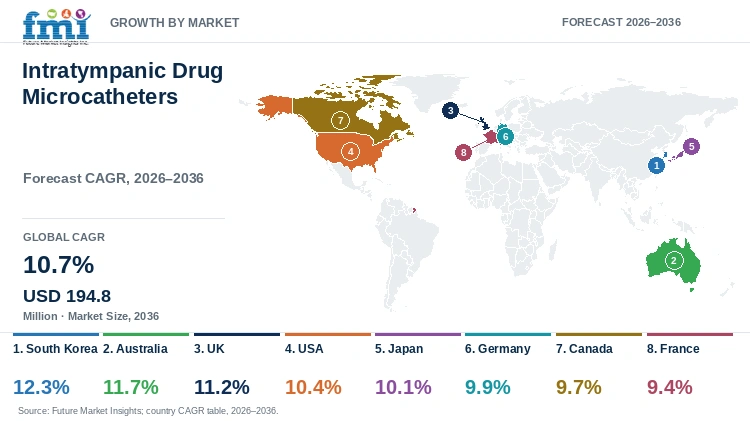
As per FMI, South Korea is projected to lead intratympanic drug microcatheter expansion across major healthcare systems at a 12.3% CAGR through 2036, whereas France is forecast to progress at a 9.4% CAGR. Commercial uptake across East Asian and European university ear centers as well as North American specialty clinics depends on office endoscopic ear surgery adoption and insurance coverage for long-acting ear drugs.
Table 7: Country CAGR and Primary Growth Levers for the Intratympanic Drug Microcatheters Market (CAGR percentage and operational drivers), 2026 to 2036
| Country | CAGR (2026 to 2036) | Primary Growth Lever |
|---|---|---|
| South Korea | 12.3% | Fast university hospital sudden-deafness walk-in access and lipid-soluble steroid cannulation |
| Australia | 11.7% | Multicenter oncology ear-protection trials and rural travel distances favoring single-visit wicks |
| UK | 11.2% | NHS ENT outpatient waiting-list backlogs driving home-drop indwelling MicroWick adoption |
| USA | 10.4% | Zero-day Medicare CPT 69801 office billing and commercial AAV-OTOF pediatric gene-therapy launches |
| Japan | 10.1% | Inpatient antioxidant edaravone rescue and high older-adult Meniere vertigo prevalence |
| Germany | 9.9% | University ear-clinic two-steroid rescue protocols and cochlear-implant drug catheterization |
| Canada | 9.7% | Clinical proof favoring standalone outpatient steroid catheters over expensive oxygen chamber dives |
| France | 9.4% | Public university hospital pediatric otoferlin gene-therapy trials and stepwise ear-care pathways |
Source: Future Market Insights analysis
South Korea Intratympanic Drug Microcatheters Market Outlook (2026 to 2036)
Direct patient walk-in access to city ear clinics allows South Korea to start sudden hearing loss rescue within 48 hours of symptom onset. In December 2025, clinical researchers in American Journal of Otolaryngology reported that six sessions of lipid-soluble intratympanic dexamethasone palmitate paired with oral steroids and oxygen therapy restored hearing thresholds and speech clarity within three months in early-stage severe sudden deafness patients with zero eardrum complications [11]. Market value in South Korea is projected to expand at a leading 12.3% CAGR through 2036 across Seoul and regional university hospitals. Although National Health Insurance fee schedules cap basic needle injection fees, strong patient out-of-pocket demand for thick steroid gel cannulas supports higher-priced catheter sales.
Key takeaway: In South Korea, fast university hospital walk-in access and clinical use of lipid-soluble steroid cannulas are projected to drive the fastest national market expansion.
Australia Intratympanic Drug Microcatheters Market Outlook (2026 to 2036)
Demand for intratympanic drug microcatheters in Australia is projected to advance at an 11.7% CAGR over the 2026 to 2036 period. Australia is the main Southern Hemisphere clinical trial hub for sustained-release inner-ear gels and chemotherapy ear protectants. In May 2025, a randomized Phase Ib clinical trial across five cancer centers in Australia and the USA published in the Journal of Clinical Oncology evaluated 22 adults receiving cisplatin chemotherapy averaging 255 mg/m2 and confirmed that intratympanic DB-020 sodium thiosulfate injections given within three hours before treatment reduced hearing damage [12]. Because long travel distances from country towns to Sydney and Melbourne ear clinics make six-visit needle courses impractical, ear specialists prefer single-visit indwelling wicks and gel cannulas.
Key takeaway: In Australia, clinical trial leadership in cancer ear protection and long rural patient travel distances are expected to speed up single-visit catheter adoption.
UK Intratympanic Drug Microcatheters Market Outlook (2026 to 2036)
National Health Service hospital ear departments manage inner-ear drug therapy across the UK under regional hospital purchasing budgets. A June 2025 national survey of 86 UK ENT consultants led by Canterbury Christ Church University published in the Annals of the Royal College of Surgeons of England found that while 88% expressed high confidence in diagnosing Meniere disease, only 34.9% followed American Academy of Otolaryngology criteria and 34.9% chose intratympanic steroids as their main second-line treatment [13]. As a result, the UK intratympanic drug microcatheters market is estimated to expand at an 11.2% CAGR through 2036. Long NHS outpatient waiting lists make six-visit needle courses hard to schedule, prompting hospital buyers to approve indwelling MicroWick catheters so patients can apply follow-up ear drops at home.
Key takeaway: In the UK, NHS outpatient clinic appointment bottlenecks are estimated to favor indwelling catheters that let patients apply follow-up ear drops at home.
USA Intratympanic Drug Microcatheters Market Outlook (2026 to 2036)
Private outpatient ENT group practices billing Medicare code CPT 69801 and children's hospitals launching FDA-approved AAV-OTOF gene therapy surgeries drive demand across the USA. An October 2025 study of 231 sudden hearing loss patients at the University of Miami Miller School of Medicine published in PLOS ONE showed that hearing recovery dropped sharply when local steroid treatment started more than 18 days after symptoms began [14]. Commercial demand in the USA is forecast to grow at a 10.4% CAGR through 2036 across walk-in clinics and hospital operating suites. Because Medicare removed the multi-day billing lock on CPT 69801, office ear doctors can bill separately for follow-up visits while children's hospitals buy specialized gene-delivery microcatheters.
Key takeaway: In the USA, zero-day Medicare office billing and FDA approval of pediatric inner-ear gene therapy are forecast to support global market value.
Japan Intratympanic Drug Microcatheters Market Outlook (2026 to 2036)
Japan stands apart from Western ear markets through its large older-adult population with age-related hearing loss and Meniere vertigo paired with domestic hospital trials of antioxidant ear drugs and gelatin-hydrogel depots. In May 2025, researchers at Kitasato University School of Medicine reported in The Journal of International Advanced Otology that 17 severe sudden hearing loss patients (90 dB or worse) treated with intratympanic edaravone achieved much better low-frequency hearing recovery across 250 to 1,000 Hz than 14 control patients given standard steroids [15]. Although strict national device reviews slow imported catheter approvals, universal health insurance coverage for inpatient sudden deafness rescue supports steady hospital ordering. The Japan market is slated to register a 10.1% CAGR from 2026 to 2036.
Key takeaway: In Japan, hospital antioxidant rescue protocols for severe sudden deafness are slated to sustain demand for precision inner-ear infusion catheters.
Germany Intratympanic Drug Microcatheters Market Outlook (2026 to 2036)
The Germany intratympanic drug microcatheters market is projected to progress at a 9.9% CAGR between 2026 and 2036. University hospital ear clinics across Germany lead European inner-ear drug delivery by combining cochlear implant surgery with drug-eluting catheters and two-steroid rescue protocols. An April 2025 study of 118 adults with one-sided sudden hearing loss at University Hospital Regensburg published in European Archives of Oto-Rhino-Laryngology found a 53.0% recovery response rate and 10.0 dB median hearing gain with intratympanic triamcinolone acetonide versus 43.5% and 6.2 dB with dexamethasone phosphate [16]. Tight statutory outpatient fee caps still limit office catheter margins, keeping specialized microcatheter use concentrated in university medical centers.
Key takeaway: In Germany, university ear clinic leadership in steroid rescue and cochlear-implant drug delivery is projected to support European hardware demand.
Canada Intratympanic Drug Microcatheters Market Outlook (2026 to 2036)
Provincial hospital budgets and long waiting lists for hyperbaric oxygen chambers shape ear care across Canada, making office steroid catheterization the main sudden deafness treatment. A December 2025 study of 119 sudden hearing loss patients at the University of Toronto Sunnybrook Health Sciences Centre published in The Laryngoscope compared 73 patients receiving intratympanic steroids alone against 46 receiving both hyperbaric oxygen and intratympanic steroids, finding strong hearing and word-recognition recovery in both groups with zero extra benefit from expensive oxygen chamber sessions [17]. Market value in Canada is anticipated to expand at a 9.7% CAGR through 2036. Because provincial hospital buyers limit expensive hyperbaric referrals, ENT departments favor lower-cost outpatient steroid microcatheter kits.
Key takeaway: In Canada, clinical proof favoring standalone intratympanic steroids over expensive oxygen chambers is anticipated to strengthen outpatient catheter buying.
France Intratympanic Drug Microcatheters Market Outlook (2026 to 2036)
Public university hospital ear departments in France follow a step-by-step treatment plan before approving inner-ear catheter placement. A June 2026 review of 24 clinical studies covering 986 patients led by Universite Paris Cite and Necker-Enfants Malades Hospital in European Archives of Oto-Rhino-Laryngology confirmed stepwise progression from ear drops to targeted intratympanic steroid placement for middle and inner ear disorders [18]. Demand in France is projected to grow at a 9.4% CAGR through 2036 as domestic gene-therapy trials for congenital deafness expand across university hospitals in Paris and Montpellier. Strict national health authority reimbursement reviews still require clear hearing-gain proof before granting separate catheter billing codes.
Key takeaway: In France, domestic inner-ear gene-therapy clinical trials at public university hospitals are projected to drive specialized microcatheter demand.
Full report country CAGRs cover: North America; Latin America; Western Europe; Eastern Europe; East Asia; South Asia and Pacific; Middle East and Africa.
Who are the notable companies in the intratympanic drug microcatheters market?
Grace Medical, Inc., Spiggle & Theis Medizintechnik GmbH, Spiral Therapeutics, Inc., Sensorion SA, Cilcare SAS, Akouos, Inc. (Eli Lilly and Company), Regeneron Pharmaceuticals, Inc., and Medtronic plc are the notable companies in the intratympanic drug microcatheters market.
FMI analysis indicates that the competitive sector divides between established ear surgical device makers and inner-ear biotech companies building dedicated delivery catheters. Traditional ENT instrument suppliers sell indwelling sponge wicks and soft polyurethane microcatheters to walk-in ear clinics. At the same time, clinical-stage drug developers build dual-channel microneedles and inner-ear infusion tubes to protect delicate gene-therapy doses.
- Otologic Catheter and Wick Specialists: Grace Medical, Inc. and Spiggle & Theis Medizintechnik GmbH supply indwelling MicroWick sponges and eardrum delivery tubes across outpatient ENT clinics.
- Sustained-Release Inner-Ear Delivery Platforms: Spiral Therapeutics, Inc. and Sensorion SA as well as Cilcare SAS develop heat-thickening gel cannulas and inner-ear drug testing systems.
- Genetic Hearing and Multinational Medtech Platforms: Akouos, Inc. (Eli Lilly and Company) and Regeneron Pharmaceuticals, Inc. as well as Medtronic plc build precision inner-ear gene-therapy catheters and powered ear surgery instruments.
Competitive Benchmarking: Intratympanic Drug Microcatheters Market
Table 8: Competitive Benchmarking for the Intratympanic Drug Microcatheters Market (qualitative capability ratings), 2026
| Company | Round-Window Catheter Breadth | Hydrogel & Biologic Compatibility | Outpatient ENT / OR Access | Geographic Reach |
|---|---|---|---|---|
| Grace Medical, Inc. | High | Medium | High | High |
| Spiggle & Theis Medizintechnik GmbH | High | Medium | High | High |
| Spiral Therapeutics, Inc. | Medium | High | Medium | Medium |
| Sensorion SA | Medium | High | Medium | Medium |
| Cilcare SAS | Medium | High | Medium | Medium |
| Akouos, Inc. (Eli Lilly and Company) | Medium | High | High | High |
| Regeneron Pharmaceuticals, Inc. | Medium | High | High | High |
| Medtronic plc | High | Medium | High | High |
Scoring basis: Capability tiers evaluate documented inner-ear catheter and microneedle product breadth as well as compatibility with warming hydrogels and viral gene vectors. Outpatient ENT clinic reach and multi-country regulatory approvals are also weighted.
Key Developments in the Intratympanic Drug Microcatheters Market
- Spiral Therapeutics, Inc. secured USD 27.0 million in Series B financing and formed an inner-ear drug delivery partnership with Advanced Bionics (Sonova Group) in April 2026 to advance its SPT-2101 dexamethasone gel and MICS catheter system [19].
- Regeneron Pharmaceuticals, Inc. received U.S. FDA approval in April 2026 for Otarmeni (lunsotogene parvec-cwha) as the first gene therapy for otoferlin-related genetic hearing loss, delivered through a specialized inner-ear round-window catheter infusion [20].
- The Netherlands Cancer Institute and European hospital partners started the Phase III randomized SOUND clinical trial in December 2025 to test pre-chemotherapy transtympanic sodium thiosulfate injections across 100 head-and-neck cancer patients receiving high-dose cisplatin [21].
Key Players in the Intratympanic Drug Microcatheters Market
Otologic Catheter and Wick Specialists
- Grace Medical, Inc.
- Spiggle & Theis Medizintechnik GmbH
- Medtronic plc
Sustained-Release Inner-Ear Delivery Platforms
- Spiral Therapeutics, Inc.
- Sensorion SA
- Cilcare SAS
Genetic Hearing Restoration Delivery Platforms
- Akouos, Inc. (Eli Lilly and Company)
- Regeneron Pharmaceuticals, Inc.
Intratympanic Drug Microcatheters Market - Report Scope
Table 9: Report Scope for the Intratympanic Drug Microcatheters Market (coverage fields and definitions), 2026 to 2036
| Coverage field | Report scope |
|---|---|
| Market breakdown | Delivery Architecture; Delivered Therapeutic; Care Setting; Clinical Indication; Guidance Modality |
| Quantitative Units | USD Million |
| Market Definition | Includes commercial supplier market value from indwelling intratympanic polyurethane microcatheters, Silverstein MicroWick diffusion sponges, dual-lumen coaxial otologic microneedles, and thermoreversible hydrogel delivery cannulas. Category Scope Note: Excludes oral systemic corticosteroids, standard middle-ear ventilation tubes without drug-wicking inserts, and external hearing aids. |
| Regions Covered | North America; Latin America; Western Europe; Eastern Europe; East Asia; South Asia and Pacific; Middle East and Africa |
| Countries Covered | South Korea, Australia, UK, USA, Japan, Germany, Canada, France, and additional countries in the full report |
| Key Companies Covered | Grace Medical, Inc., Spiggle & Theis Medizintechnik GmbH, Spiral Therapeutics, Inc., Sensorion SA, Cilcare SAS, Akouos, Inc. (Eli Lilly and Company), Regeneron Pharmaceuticals, Inc., Medtronic plc |
| Forecast Period | 2026 to 2036 |
| Approach | Primary and secondary research with top-down and bottom-up market triangulation. |
Intratympanic Drug Microcatheters Market - Research Methodology
Table 10: Research Methodology for the Intratympanic Drug Microcatheters Market (research methods and approach), 2026 edition
| Method | Approach |
|---|---|
| Primary Research | Structured interviews with ear surgeons, outpatient ENT clinic directors, hospital oncology audiologists, and catheter R&D engineers to verify inner-ear placement workflows and kit pricing. |
| Secondary Research | Analysis of corporate investor releases, FDA 510(k) and BLA filings, PubMed and PMC clinical ear trials, and European and American Academy of Otolaryngology practice guidelines. |
| Market Sizing and Forecasting | Top-down hospital and walk-in ENT consumable budgets cross-checked against bottom-up sudden hearing loss, Meniere disease, and cisplatin or OTOF procedure counts from 2026 to 2036. |
| Country Forecasting Model | Econometric national projections weight sudden deafness incidence, university ENT endoscopic adoption, Medicare CPT 69801 and European hospital tariffs, and gene-therapy center activations across eight healthcare systems. |
| Operational Benchmark Traceability | Patient-pool and clinic spending indicators in Tables 2, 3, and 4 trace to Acta Oto-Laryngologica throat-drainage cohorts, Ear and Hearing MicroWick trials, and Biomedical Microdevices dual-lumen microneedle studies. |
| Data Triangulation and Validation | Demand estimates are cross-checked against specialty ENT distributor unit shipments and clinical-trial catheter kit allocations without double counting oral drug vials or plain ear tubes. |
Intratympanic Drug Microcatheters Market by Segments
Intratympanic Drug Microcatheters Market segmented by Delivery Architecture:
- Indwelling Polyurethane Microcatheters
- Dual-Lumen Coaxial Microneedles
- Thermoreversible Hydrogel Cannulas
- Fenestrated Round-Window Wicks
Intratympanic Drug Microcatheters Market segmented by Delivered Therapeutic:
- Corticosteroid Formulations
- Gentamicin Vestibular Ablation
- Gene and Otoprotectant Payloads
Intratympanic Drug Microcatheters Market segmented by Care Setting:
- Outpatient ENT Clinics
- Hospital Operating Suites
- Academic Neurotology Centers
Intratympanic Drug Microcatheters Market segmented by Clinical Indication:
- Sudden Sensorineural Deafness
- Refractory Meniere Disease
- Cisplatin Ototoxicity Prevention
- Genetic Otoferlin Deafness
Intratympanic Drug Microcatheters Market segmented by Guidance Modality:
- Binocular Otomicroscopy Guidance
- Transcanal Endoscopic Visualization
- Optical Coherence Tomography
- Fluoroscopic Microcatheter Tracking
- Image-Guided Robotic Cannulation
Intratympanic Drug Microcatheters Market by Region
- North America
- United States
- Canada
- Latin America
- Brazil
- Mexico
- Argentina
- Chile
- Western Europe
- Germany
- France
- United Kingdom
- Italy
- Spain
- Benelux
- Nordics
- Eastern Europe
- Poland
- Czech Republic
- Romania
- Hungary
- East Asia
- China
- Japan
- South Korea
- South Asia and Pacific
- India
- ASEAN
- Australia and New Zealand
- Middle East and Africa
- GCC Countries
- South Africa
- Türkiye
- Israel
Research Sources and Bibliography
- [1] Zhu, Z., Wang, H., Chen, L., & Zhang, Y. (2025, June 26). Analysis of factors influencing the effective dose of intratympanic steroid injection of dexamethasone in idiopathic sudden sensorineural hearing loss. Acta Oto-Laryngologica, 145(9), 811-819 (PubMed PMID 40566972).
- [2] Hammer, D. R., Aksit, A., Olson, E. S., & Kysar, J. W. (2025, June 10). Novel dual-lumen microneedle delivers adeno-associated viral vectors in the guinea pig inner ear via the round window membrane. Biomedical Microdevices, 27(2), 27 (PubMed PMID 40493265).
- [3] Moreno, I., Garcia, M., Lopez, R., & Sanchez, P. (2026, April 6). Intratympanic Dexamethasone Efficacy in Preventing Cisplatin-induced Tinnitus: A Randomized Controlled Phase IIIB Clinical Trial. Ear and Hearing, 47(5), 1212-1218 (PubMed PMID 41940636).
- [4] Alharbi, S. M., Alqahtani, A., & Alzahrani, M. (2025, October 24). Comparison of the efficacy and safety of intratympanic application of different corticosteroids: a systematic review and meta-analysis. European Archives of Oto-Rhino-Laryngology, 283(2), 641-652 (PubMed PMID 41136563).
- [5] StatPearls Author Group. (2026, August 8). Intratympanic Steroid Injection - StatPearls - NCBI Bookshelf. National Library of Medicine (NBK567708).
- [6] Devantier, L., Callesen, H. E., Hougaard, D. D., Djurhuus, B. D., & Mirz, F. (2025, May 27). A systematic review and meta-analysis of intratympanic gentamicin for patients with Ménières disease. Acta Oto-Laryngologica, 145(8), 669-675 (PubMed PMID 40421807).
- [7] McRackan, T. R., Nguyen, S. A., & Meyer, T. A. (2025, October 1). Surgical approaches to inner ear therapies. Current Opinion in Otolaryngology & Head and Neck Surgery, 33(5), 312-318 (PubMed PMID 40833678).
- [8] Baghi, M., Wagenblast, J., & Gstoettner, W. (2026, January 6). Stem cell-based and gene editing strategies in the treatment of congenital and acquired sensorineural hearing loss: a narrative review. European Archives of Oto-Rhino-Laryngology, 283(5), 2815-2826 (PubMed PMID 41495521).
- [9] Böscke, R., Hoffmeyer, J., & Bruchhage, K. L. (2025, June 1). Impact of Intratympanic Gentamicin on Cochlear Implant Outcomes. Otology & Neurotology, 46(5), 494-498 (PubMed PMID 40210224).
- [10] Li, X., Chen, W., & Chai, R. (2025, October 17). Bioactive hydrogels for the reconstruction of sensorineural hearing loss. Bioactive Materials, 56, 160-180 (PubMed PMID 41158516).
- [11] Kim, J. H., Park, S. Y., & Lee, K. Y. (2025, December 4). Dexamethasone palmitate: A promising intratympanic treatment option for severe sudden hearing loss. American Journal of Otolaryngology, 47(1), 104766 (PubMed PMID 41406884).
- [12] Panizza, B. J., Michael, M., & Cooper, A. (2025, May 22). Randomized Phase Ib Clinical Trial of DB-020 Intratympanic Injections to Reduce High-Dose Cisplatin Ototoxicity. Journal of Clinical Oncology, 43(19), 2155-2163 (PubMed PMID 40403227).
- [13] Parihar, S., Viktoria, K., & Rea, P. (2025, June 17). A national survey of the diagnosis and management of Ménière's disease among ENT consultants, UK. Annals of the Royal College of Surgeons of England, 108(1), 62-67 (PubMed PMID 40525902).
- [14] Hoffer, M. E., Balaban, C., & Szczupak, M. (2025, October 9). Intratympanic steroid administration and predictors of recovery in sudden sensorineural hearing loss. PLOS ONE, 20(10), e0332809 (PubMed PMID 41066339).
- [15] Yamamoto, K., Yamashita, T., & Kanzaki, S. (2025, May 22). Intratympanic Injection of Edaravone for Idiopathic Sudden Sensorineural Hearing Loss with Profound Hearing Loss. The Journal of International Advanced Otology, 21(3), 1-7 (PubMed PMID 40415448).
- [16] Weitgasser, L., Tschani, S., & Kogler, M. (2025, April 21). Choice of steroids for intratympanic therapy- a retrospective comparison. European Archives of Oto-Rhino-Laryngology, 282(9), 4579-4588 (PubMed PMID 40258994).
- [17] Spiegel, J. L., Biasio, L., & Lin, V. Y. (2025, December 23). Adjunctive Hyperbaric Oxygen Therapy or Intratympanic Steroids in Sudden Sensorineural Hearing Loss?. The Laryngoscope, 136(6), 2708-2718 (PubMed PMID 41431852).
- [18] Henderson, D., Cassandre, M., & Loundon, N. (2026, June 1). Conservative management of functional middle ear disorders: a systematic review with narrative synthesis and conceptual clinical framework. European Archives of Oto-Rhino-Laryngology, 283(8), 4110-4124 (PubMed PMID 42223612).
- [19] Spiral Therapeutics, Inc. (2026, April 14). Spiral Therapeutics Announces $27 Million Series B Financing and Strategic Partnership with Advanced Bionics. Spiral Therapeutics Official Corporate Release.
- [20] Regeneron Pharmaceuticals, Inc. (2026, April 23). Otarmeni (lunsotogene parvec-cwha) Approved by FDA as First and Only Gene Therapy for Genetic Hearing Loss. Regeneron Pharmaceuticals Investor Relations Release.
- [21] Burger, A. V. M., Duinkerken, C. W., & Zuur, C. L. (2025, December 3). Transtympanic sodium thiosulphate to prevent cisplatin-related hearing loss: a protocol for randomised controlled multicentre phase III trial, the SOUND trial. BMJ Open, 15(12), e107101 (PubMed PMID 41338634).
- [22] Patel, N. S., & Carlson, M. L. (2026, July 18). Restoration, Not Bypass: Otoferlin Gene Therapy and a New Era in Hearing Loss Treatment. Otolaryngology-Head and Neck Surgery, 175(3), 501-506 (PubMed PMID 42470357).
- [23] Jia, Y., Kou, Z., & Li, H. (2026, August 26). Mapping the global trends and hotspots of research on gene therapy and hair cell regeneration for hearing loss: a comprehensive data-mining-based study. Gene Therapy, 33(9), 412-425 (PubMed PMID 42649271).
This bibliography is provided for reader reference and is not exhaustive. The full report contains the complete reference list and detailed citations.
This Report Answers
- How large is the intratympanic drug microcatheters market in 2026 and what is forecast for 2036?
- Which clinical and operational pressures support demand for intratympanic drug microcatheters?
- Why do indwelling polyurethane microcatheters lead the delivery architecture category?
- Why do corticosteroid formulations lead the delivered therapeutic category globally?
- How do growth rates differ across South Korea, Australia, the UK, and the USA?
- Which leading companies supply otologic microcatheters and gene-delivery cannulas today?
- What limits adoption or supplier switching in the intratympanic drug microcatheters market?
- What should buyers evaluate before purchasing an intratympanic drug microcatheter?
Frequently Asked Questions
How big is the intratympanic drug microcatheters market in 2026, and what is forecast for 2036?
According to FMI, global intratympanic drug microcatheters market value is estimated to reach USD 70.5 million in 2026 from USD 64.0 million in 2025. The market is forecast to reach USD 194.8 million by 2036 as ENT clinics replace single needle pokes with seated inner-ear catheters and dual-channel microneedles.
What is the CAGR for the intratympanic drug microcatheters market from 2026 to 2036?
Future Market Insights projects a 10.7% compound annual growth rate between 2026 and 2036, generating an anticipated USD 124.3 million in added market value across outpatient ear clinics and hospital surgical suites.
Which delivery architecture segment leads the intratympanic drug microcatheters market?
Indwelling polyurethane microcatheters are projected to capture 57.2% of delivery architecture demand in 2026 because seated inner-ear tubes keep steroid drops in contact with the round window for weeks without repeat needle pokes.
Which delivered therapeutic segment leads the intratympanic drug microcatheters market?
Corticosteroid formulations are estimated to secure 54.6% of the delivered therapeutic category in 2026 as ear doctors deliver concentrated dexamethasone and methylprednisolone for sudden hearing loss rescue.
Which country has a notable growth outlook during the assessment period?
South Korea is projected to lead national growth at a 12.3% CAGR through 2036, supported by fast university hospital walk-in access and clinical use of lipid-soluble steroid depots.
Who are the key players in the market?
Grace Medical, Inc., Spiggle & Theis Medizintechnik GmbH, Spiral Therapeutics, Inc., Sensorion SA, Cilcare SAS, Akouos, Inc. (Eli Lilly and Company), Regeneron Pharmaceuticals, Inc., and Medtronic plc lead commercial supply and device development.
Preview the report firsthand - request a free sample
Get SampleGet the brochure for pricing and purchase details.
Get PDFTable of Content
- Key Takeaways
- Market Size and CAGR
- Top Growth Driver
- Fastest Growing Segment
- Leading Region
- Key Companies
- Emerging Opportunities
- Executive Summary
- Global Market Outlook
- Demand-side Trends
- Supply-side Trends
- Technology Roadmap Analysis
- Analysis and Recommendations
- Analyst Perspective (What is happening? Why now? What should investors know?)
- Key Questions Answered
- How large is the market?
- What is the CAGR?
- What are key trends?
- Which region dominates?
- Who are the leaders?
- Market Overview
- Market Coverage / Taxonomy
- Market Definition / Scope / Limitations
- Research Methodology
- Chapter Orientation
- Analytical Lens and Working Hypotheses
- Market Structure, Signals, and Trend Drivers
- Benchmarking and Cross-market Comparability
- Market Sizing, Forecasting, and Opportunity Mapping
- Research Design and Evidence Framework
- Desk Research Programme (Secondary Evidence)
- Expert Input and Fieldwork (Primary Evidence)
- Tooling, Models, and Reference Databases
- Data Engineering and Model Build
- Quality Assurance and Audit Trail
- Market Background
- Market Dynamics (Drivers, Restraints, Opportunity, Trends)
- Scenario Forecast (Optimistic, Likely, Conservative)
- Impact Analysis
- AI Impact
- Sustainability Impact
- Regulatory Impact
- Technology Impact
- Consumer / Buyer Analysis
- Purchase Drivers
- Adoption Barriers
- Buyer Journey
- Opportunity Map Analysis
- Product Life Cycle Analysis
- Supply Chain Analysis
- Investment Feasibility Matrix
- Value Chain Analysis
- PESTLE and Porter's Analysis
- Regulatory Landscape
- Regional Parent Market Outlook
- Production and Consumption Statistics
- Import and Export Statistics
- Global Market Analysis and Forecast, 2021 to 2036
- Historical Market Size Value (USD Million) Analysis, 2021 to 2025
- Current and Future Market Size Value (USD Million) Projections, 2026 to 2036
- Y-o-Y Growth Trend Analysis
- Absolute $ Opportunity Analysis
- Global Market Pricing Analysis, 2021 to 2036
- Global Market Analysis and Forecast, By Delivery Architecture, 2021 to 2036
- Introduction / Key Findings
- Historical Market Size Value (USD Million) Analysis By Delivery Architecture, 2021 to 2025
- Current and Future Market Size Value (USD Million) Analysis and Forecast By Delivery Architecture, 2026 to 2036
- Indwelling Polyurethane Microcatheters
- Dual-Lumen Coaxial Microneedles
- Thermoreversible Hydrogel Cannulas
- Fenestrated Round-Window Wicks
- Y-o-Y Growth Trend Analysis By Delivery Architecture, 2021 to 2025
- Absolute $ Opportunity Analysis By Delivery Architecture, 2026 to 2036
- Global Market Analysis and Forecast, By Delivered Therapeutic, 2021 to 2036
- Introduction / Key Findings
- Historical Market Size Value (USD Million) Analysis By Delivered Therapeutic, 2021 to 2025
- Current and Future Market Size Value (USD Million) Analysis and Forecast By Delivered Therapeutic, 2026 to 2036
- Corticosteroid Formulations
- Gentamicin Vestibular Ablation
- Gene and Otoprotectant Payloads
- Y-o-Y Growth Trend Analysis By Delivered Therapeutic, 2021 to 2025
- Absolute $ Opportunity Analysis By Delivered Therapeutic, 2026 to 2036
- Global Market Analysis and Forecast, By Care Setting, 2021 to 2036
- Introduction / Key Findings
- Historical Market Size Value (USD Million) Analysis By Care Setting, 2021 to 2025
- Current and Future Market Size Value (USD Million) Analysis and Forecast By Care Setting, 2026 to 2036
- Outpatient ENT Clinics
- Hospital Operating Suites
- Academic Neurotology Centers
- Y-o-Y Growth Trend Analysis By Care Setting, 2021 to 2025
- Absolute $ Opportunity Analysis By Care Setting, 2026 to 2036
- Global Market Analysis and Forecast, By Clinical Indication, 2021 to 2036
- Introduction / Key Findings
- Historical Market Size Value (USD Million) Analysis By Clinical Indication, 2021 to 2025
- Current and Future Market Size Value (USD Million) Analysis and Forecast By Clinical Indication, 2026 to 2036
- Sudden Sensorineural Deafness
- Refractory Meniere Disease
- Cisplatin Ototoxicity Prevention
- Genetic Otoferlin Deafness
- Y-o-Y Growth Trend Analysis By Clinical Indication, 2021 to 2025
- Absolute $ Opportunity Analysis By Clinical Indication, 2026 to 2036
- Global Market Analysis and Forecast, By Guidance Modality, 2021 to 2036
- Introduction / Key Findings
- Historical Market Size Value (USD Million) Analysis By Guidance Modality, 2021 to 2025
- Current and Future Market Size Value (USD Million) Analysis and Forecast By Guidance Modality, 2026 to 2036
- Binocular Otomicroscopy Guidance
- Transcanal Endoscopic Visualization
- Optical Coherence Tomography
- Fluoroscopic Microcatheter Tracking
- Image-Guided Robotic Cannulation
- Y-o-Y Growth Trend Analysis By Guidance Modality, 2021 to 2025
- Absolute $ Opportunity Analysis By Guidance Modality, 2026 to 2036
- Global Market Analysis and Forecast, By Region, 2021 to 2036
- Introduction
- Historical Market Size Value (USD Million) Analysis By Region, 2021 to 2025
- Current Market Size Value (USD Million) Analysis and Forecast By Region, 2026 to 2036
- North America
- Latin America
- Western Europe
- Eastern Europe
- East Asia
- South Asia and Pacific
- Middle East and Africa
- Market Attractiveness Analysis By Region
- North America Market Analysis and Forecast, By Country, 2021 to 2036
- Historical Market Size Value (USD Million) Trend Analysis By Market Taxonomy, 2021 to 2025
- Market Size Value (USD Million) Forecast By Market Taxonomy, 2026 to 2036
- By Country
- United States
- Canada
- By Delivery Architecture
- By Delivered Therapeutic
- By Care Setting
- By Clinical Indication
- By Guidance Modality
- By Country
- Market Attractiveness Analysis
- By Country
- By Delivery Architecture
- By Delivered Therapeutic
- By Care Setting
- By Clinical Indication
- By Guidance Modality
- Key Takeaways
- Latin America Market Analysis and Forecast, By Country
- Historical Market Size Value (USD Million) Trend Analysis By Market Taxonomy, 2021 to 2025
- Market Size Value (USD Million) Forecast By Market Taxonomy, 2026 to 2036
- By Country
- Brazil
- Mexico
- Argentina
- Chile
- By Delivery Architecture
- By Delivered Therapeutic
- By Care Setting
- By Clinical Indication
- By Guidance Modality
- By Country
- Market Attractiveness Analysis
- By Country
- By Delivery Architecture
- By Delivered Therapeutic
- By Care Setting
- By Clinical Indication
- By Guidance Modality
- Key Takeaways
- Western Europe Market Analysis and Forecast, By Country
- Historical Market Size Value (USD Million) Trend Analysis By Market Taxonomy, 2021 to 2025
- Market Size Value (USD Million) Forecast By Market Taxonomy, 2026 to 2036
- By Country
- Germany
- France
- United Kingdom
- Italy
- Spain
- Benelux
- Nordics
- By Delivery Architecture
- By Delivered Therapeutic
- By Care Setting
- By Clinical Indication
- By Guidance Modality
- By Country
- Market Attractiveness Analysis
- By Country
- By Delivery Architecture
- By Delivered Therapeutic
- By Care Setting
- By Clinical Indication
- By Guidance Modality
- Key Takeaways
- Eastern Europe Market Analysis and Forecast, By Country
- Historical Market Size Value (USD Million) Trend Analysis By Market Taxonomy, 2021 to 2025
- Market Size Value (USD Million) Forecast By Market Taxonomy, 2026 to 2036
- By Country
- Poland
- Czech Republic
- Romania
- Hungary
- By Delivery Architecture
- By Delivered Therapeutic
- By Care Setting
- By Clinical Indication
- By Guidance Modality
- By Country
- Market Attractiveness Analysis
- By Country
- By Delivery Architecture
- By Delivered Therapeutic
- By Care Setting
- By Clinical Indication
- By Guidance Modality
- Key Takeaways
- East Asia Market Analysis and Forecast, By Country
- Historical Market Size Value (USD Million) Trend Analysis By Market Taxonomy, 2021 to 2025
- Market Size Value (USD Million) Forecast By Market Taxonomy, 2026 to 2036
- By Country
- China
- Japan
- South Korea
- By Delivery Architecture
- By Delivered Therapeutic
- By Care Setting
- By Clinical Indication
- By Guidance Modality
- By Country
- Market Attractiveness Analysis
- By Country
- By Delivery Architecture
- By Delivered Therapeutic
- By Care Setting
- By Clinical Indication
- By Guidance Modality
- Key Takeaways
- South Asia and Pacific Market Analysis and Forecast, By Country
- Historical Market Size Value (USD Million) Trend Analysis By Market Taxonomy, 2021 to 2025
- Market Size Value (USD Million) Forecast By Market Taxonomy, 2026 to 2036
- By Country
- India
- ASEAN
- Australia and New Zealand
- By Delivery Architecture
- By Delivered Therapeutic
- By Care Setting
- By Clinical Indication
- By Guidance Modality
- By Country
- Market Attractiveness Analysis
- By Country
- By Delivery Architecture
- By Delivered Therapeutic
- By Care Setting
- By Clinical Indication
- By Guidance Modality
- Key Takeaways
- Middle East and Africa Market Analysis and Forecast, By Country
- Historical Market Size Value (USD Million) Trend Analysis By Market Taxonomy, 2021 to 2025
- Market Size Value (USD Million) Forecast By Market Taxonomy, 2026 to 2036
- By Country
- GCC Countries
- South Africa
- Türkiye
- Israel
- By Delivery Architecture
- By Delivered Therapeutic
- By Care Setting
- By Clinical Indication
- By Guidance Modality
- By Country
- Market Attractiveness Analysis
- By Country
- By Delivery Architecture
- By Delivered Therapeutic
- By Care Setting
- By Clinical Indication
- By Guidance Modality
- Key Takeaways
- Key Countries Market Analysis
- United States
- Pricing Analysis
- Market Share Analysis, 2025
- By Delivery Architecture
- By Delivered Therapeutic
- By Care Setting
- By Clinical Indication
- By Guidance Modality
- Canada
- Pricing Analysis
- Market Share Analysis, 2025
- By Delivery Architecture
- By Delivered Therapeutic
- By Care Setting
- By Clinical Indication
- By Guidance Modality
- Mexico
- Pricing Analysis
- Market Share Analysis, 2025
- By Delivery Architecture
- By Delivered Therapeutic
- By Care Setting
- By Clinical Indication
- By Guidance Modality
- Brazil
- Pricing Analysis
- Market Share Analysis, 2025
- By Delivery Architecture
- By Delivered Therapeutic
- By Care Setting
- By Clinical Indication
- By Guidance Modality
- Chile
- Pricing Analysis
- Market Share Analysis, 2025
- By Delivery Architecture
- By Delivered Therapeutic
- By Care Setting
- By Clinical Indication
- By Guidance Modality
- Germany
- Pricing Analysis
- Market Share Analysis, 2025
- By Delivery Architecture
- By Delivered Therapeutic
- By Care Setting
- By Clinical Indication
- By Guidance Modality
- United Kingdom
- Pricing Analysis
- Market Share Analysis, 2025
- By Delivery Architecture
- By Delivered Therapeutic
- By Care Setting
- By Clinical Indication
- By Guidance Modality
- Italy
- Pricing Analysis
- Market Share Analysis, 2025
- By Delivery Architecture
- By Delivered Therapeutic
- By Care Setting
- By Clinical Indication
- By Guidance Modality
- Spain
- Pricing Analysis
- Market Share Analysis, 2025
- By Delivery Architecture
- By Delivered Therapeutic
- By Care Setting
- By Clinical Indication
- By Guidance Modality
- France
- Pricing Analysis
- Market Share Analysis, 2025
- By Delivery Architecture
- By Delivered Therapeutic
- By Care Setting
- By Clinical Indication
- By Guidance Modality
- India
- Pricing Analysis
- Market Share Analysis, 2025
- By Delivery Architecture
- By Delivered Therapeutic
- By Care Setting
- By Clinical Indication
- By Guidance Modality
- ASEAN
- Pricing Analysis
- Market Share Analysis, 2025
- By Delivery Architecture
- By Delivered Therapeutic
- By Care Setting
- By Clinical Indication
- By Guidance Modality
- Australia and New Zealand
- Pricing Analysis
- Market Share Analysis, 2025
- By Delivery Architecture
- By Delivered Therapeutic
- By Care Setting
- By Clinical Indication
- By Guidance Modality
- China
- Pricing Analysis
- Market Share Analysis, 2025
- By Delivery Architecture
- By Delivered Therapeutic
- By Care Setting
- By Clinical Indication
- By Guidance Modality
- Japan
- Pricing Analysis
- Market Share Analysis, 2025
- By Delivery Architecture
- By Delivered Therapeutic
- By Care Setting
- By Clinical Indication
- By Guidance Modality
- South Korea
- Pricing Analysis
- Market Share Analysis, 2025
- By Delivery Architecture
- By Delivered Therapeutic
- By Care Setting
- By Clinical Indication
- By Guidance Modality
- Poland
- Pricing Analysis
- Market Share Analysis, 2025
- By Delivery Architecture
- By Delivered Therapeutic
- By Care Setting
- By Clinical Indication
- By Guidance Modality
- Hungary
- Pricing Analysis
- Market Share Analysis, 2025
- By Delivery Architecture
- By Delivered Therapeutic
- By Care Setting
- By Clinical Indication
- By Guidance Modality
- Türkiye
- Pricing Analysis
- Market Share Analysis, 2025
- By Delivery Architecture
- By Delivered Therapeutic
- By Care Setting
- By Clinical Indication
- By Guidance Modality
- South Africa
- Pricing Analysis
- Market Share Analysis, 2025
- By Delivery Architecture
- By Delivered Therapeutic
- By Care Setting
- By Clinical Indication
- By Guidance Modality
- Australia
- Pricing Analysis
- Market Share Analysis, 2025
- By Delivery Architecture
- By Delivered Therapeutic
- By Care Setting
- By Clinical Indication
- By Guidance Modality
- United States
- Market Structure Analysis
- Competition Dashboard
- Competition Benchmarking
- Market Share Analysis of Top Players
- By Regional
- By Delivery Architecture
- By Delivered Therapeutic
- By Care Setting
- By Clinical Indication
- By Guidance Modality
- Emerging Startups
- Innovation Benchmarking
- Competition Analysis
- Competition Deep Dive
- Grace Medical, Inc.
- Overview
- Product Portfolio
- Profitability by Market Segments
- Sales Footprint
- Strategy Overview
- Marketing Strategy
- Product Strategy
- Channel Strategy
- Spiggle & Theis Medizintechnik GmbH
- Spiral Therapeutics, Inc.
- Sensorion SA
- Cilcare SAS
- Akouos, Inc. (Eli Lilly and Company)
- Regeneron Pharmaceuticals, Inc.
- Medtronic plc
- Grace Medical, Inc.
- Case Studies
- Success Stories
- Recent Developments
- Competition Deep Dive
- Assumptions & Acronyms Used


