


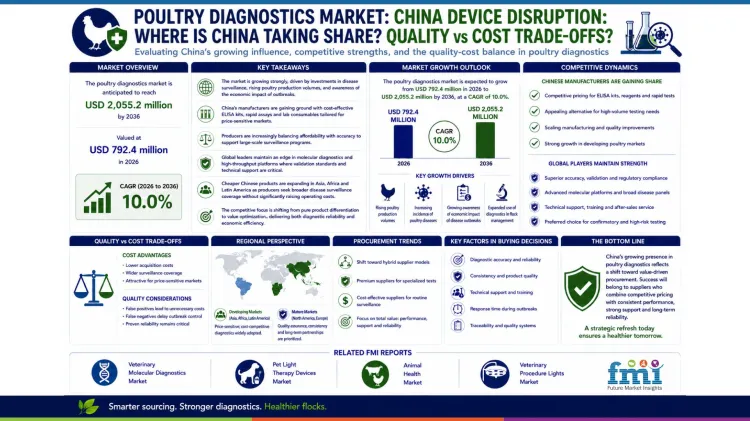
- The poultry diagnostics market is anticipated to reach USD 2,055.2 million by 2036 and is valued at USD 792.4 million in 2026, growing at a 10.0% CAGR during the forecast period.
- China’s diagnostic manufacturers are making headway in testing for poultry diseases with cost-effective ELISA kits, rapid assays and lab consumables for price-sensitive markets.
- Commercial poultry producers are increasingly weighing affordability against accuracy in their choice of testing solutions for large-scale surveillance programs.
- Leading global suppliers continue to have a competitive edge in molecular diagnostics and high-throughput laboratory platforms where validation standards and technical support remain important procurement considerations.
- Cheaper Chinese diagnostic products are increasingly being used in emerging poultry markets in Asia, Africa and Latin America as producers seek to improve disease surveillance coverage without significantly increasing operating costs.
- The competitive sector is moving from pure product differentiation to value optimization, where manufacturers must demonstrate diagnostic reliability as well as economic efficiency.
The poultry diagnostics market is getting more competitive with Chinese manufacturers gaining market share in the veterinary diagnostics areas. Historically, the poultry diagnostics market has been dominated by multinational suppliers with their wide product portfolios, established distribution networks and reputation for accuracy and reliability. At the same time, evolving purchasing priorities are opening doors for cost-competitive alternatives.
The market is estimated to grow from USD 792.4 million in 2026 to USD 2,055.2 million by 2036, at a CAGR of 10.0%. Growth in investments in disease surveillance, increasing poultry production volumes, and increasing awareness of the economic impact of disease outbreaks are driving the growth of the market.
In this environment, procurement behavior is slowly changing.
The strain on large-scale commercial poultry operations is increasing as pressure builds to increase flock productivity and control costs. Disease outbreaks with avian influenza, Newcastle disease and infectious bronchitis can lead to significant economic losses through mortality, production losses and trade disruptions. Routine diagnostics are thus increasingly integrated into management strategies of the flock.
This naturally raises affordability concerns with more frequent testing.
Chinese manufacturers have responded by offering ELISA kits, reagents and rapid diagnostic products at competitive prices that appeal to producers seeking wider surveillance coverage at lower per-test costs. These options provide an attractive alternative to premium-priced solutions given the continuing squeeze on testing budgets in many markets.
The allure of lowered acquisition costs is especially apparent in high-volume testing environments.
Commercial poultry integrators with routine monitoring programs often place a premium on the ability to scale up and keep costs down. Even minor savings in diagnostic costs can translate into big operational savings when you're talking about millions of birds per year.
But pricing advantages do not necessarily result in market leadership.
Diagnostic reliability remains a key buying consideration. False-positive results can lead to unnecessary interventions and economic losses, while false-negative results can lead to a delay in outbreak containment efforts with potentially devastating consequences.
As a result, many poultry producers still prefer suppliers with proven track records, especially for confirmatory testing and high-consequence diseases.
The quality versus cost debate is therefore extremely nuanced.
In routine screening applications, low-cost diagnostic products may meet operational needs, especially when internal validation protocols are in place. But, sophisticated molecular platforms and broad panels of diseases to test for still tend to favor traditional players with deep technical know-how and regulatory know-how.
Regional differences are possible in these dynamics.
In developing poultry markets, which are growing rapidly and becoming more price-sensitive, cost-competitive diagnostic alternatives are likely to be more readily accepted. In mature markets, where quality assurance is rigorous, consistency, traceability and long-term supplier relationships may be more important than immediate cost-savings.
The procurement models are changing in line with this.
Some poultry companies are now sourcing from hybrid suppliers rather than one supplier. Premium diagnostic providers can keep specialized testing while lower-cost suppliers can perform routine surveillance.
This method permits the optimal budgeting of producers without significant loss of diagnostic confidence.
Manufacturers operating in this environment must understand that affordability alone is unlikely to lead to long-term differentiation.
Purchasing decisions are more and more influenced by the availability of technical support, the consistency of the product, training resources and responsiveness during disease outbreaks. Suppliers that can provide competitive prices and consistent performance will probably take market share.
The myth to bust is that Chinese manufacturers compete only on price.
Many organizations continue to pour large investments into manufacturing capabilities, quality systems, and technological advancement. The quality of the product is expected to further increase the competitive intensity in the poultry diagnostics market.
Bottom line
The growing importance of China in poultry diagnostics is a reflection of broader shifts in global sourcing priorities. Cost considerations are driving adoption in many markets, but diagnostic accuracy and supplier credibility remain fundamental to purchasing decisions. The competitive sector is therefore moving towards a more balanced value assessment, with success determined by economic efficiency and clinical performance.

