


- Private label is a serious threat in frozen ready meals because retailers control freezer space, promotions, price gaps, and online grocery visibility.
- Store-brand strength in frozen food creates a structural warning for branded frozen ready meal players.
- In frozen ready meals, private label is most threatening in routine, comparable formats such as pasta, rice bowls, lasagna, family trays, basic chicken meals, and value entrées.
- Premium cuisine-led, high-protein, plant-based, diet-specific, and chef-style frozen meals are safer when they offer clear differentiation.
- National brands stuck between premium and value are most exposed because they are too expensive for value shoppers and not distinctive enough for premium shoppers.
- The biggest misconception is that brand awareness protects frozen ready meals. In the freezer aisle, retailer control can be as powerful as brand loyalty.
Private label is becoming a sharper threat in the Frozen Ready Meals Market, but the threat is not evenly spread. Retailer brands will not take share from every product type in the same way. They are most dangerous where the product is routine, repeatable, easy to compare, and weakly differentiated.
The broader Frozen Food Market provides the right context for this risk. Frozen ready meals sit inside a freezer category where shoppers are already used to comparing national brands, retailer brands, promotional packs, and value ranges. This does not mean private label already dominates frozen ready meals. It means the category operates in a retail environment where private label can scale quickly once consumers accept the product experience.
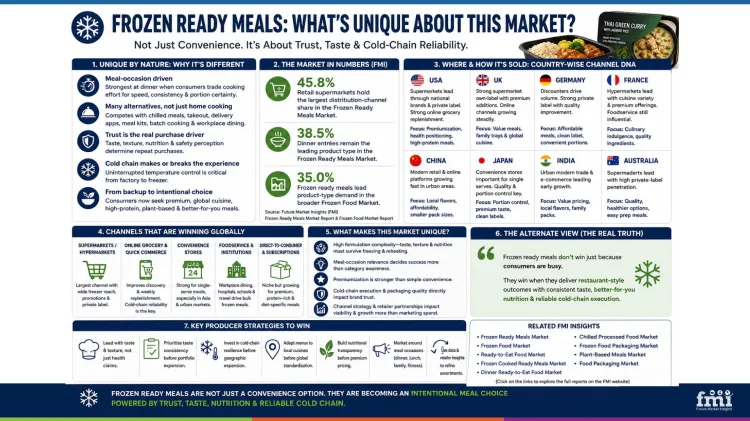
That matters because FMI’s Frozen Ready Meals Market identifies retail supermarkets as the leading sales channel. When supermarkets hold the strongest position, retailers have structural influence over the category. They control freezer-door placement, promotional calendars, shelf adjacency, private-label positioning, loyalty-card offers, and increasingly online grocery ranking. A national brand can create consumer awareness, but the retailer controls much of the purchase environment.
The most vulnerable products are mainstream formats with limited differentiation. Basic pasta meals, rice bowls, lasagna, macaroni dishes, chicken-and-sauce entrées, family trays, value packs, and standard vegetarian meals are all easier for retailer brands to compete with. Shoppers can compare these products quickly by price, portion size, flavor, pack format, and promotion. A private-label pasta bake does not need to tell a better story than a premium brand. It only needs to taste good enough and offer better value for a regular dinner or lunch occasion.
Private label also has the advantage of data. Retailers know which frozen meals sell, which pack sizes are bought repeatedly, which promotions work, and which price points convert. In online grocery, they can also influence search visibility, substitution choices, and "similar item" recommendations. This gives retailer brands an advantage that many national brands may underestimate. The retailer does not need to create demand from scratch. It can see where demand already exists and then launch a comparable product with stronger shelf economics.
However, the risk from private label is not the same across all frozen ready meals. Premium brands with strong cuisine credibility, chef-style positioning, distinctive sauces, indulgent recipes, high-protein credentials, or trusted diet-specific claims are harder to replace. A premium Thai curry, Indian entrée, Korean rice bowl, Mediterranean protein bowl, plant-based pasta, gluten-free meal, or fitness-focused high-protein bowl can still defend a higher price if the brand delivers a clear eating experience. In these cases, consumers are not buying convenience alone. They are also buying taste confidence, cuisine trust, and product consistency.
The Ready-to-Eat Food Market is also relevant because frozen meals are part of a broader prepared-food competition set. Consumers compare frozen ready meals not only with other frozen meals but also with chilled meals, fresh prepared foods, takeout, and foodservice options. This makes private label stronger in routine grocery occasions but weaker where the consumer is looking for a more distinctive or restaurant-like meal.
The middle of the market is the danger zone. Brands that are not cheap enough to compete with private label and not special enough to justify premium pricing are most exposed. A mid-tier brand offering a standard frozen meal with average taste and a moderate price premium may lose repeat purchases to retailer-owned alternatives. The issue is not that private label is always better. The issue is that "acceptable enough" can win when the occasion is routine.
Private label becomes even stronger when frozen ready meals shift from emergency backup options to planned household purchases. When consumers buy frozen meals only occasionally, they may choose a familiar national brand. But when frozen meals become part of weekly routines for work lunches, late dinners, children’s meals, or backup family occasions, price differences become harder to ignore. The more routine the purchase becomes, the more room private label has to gain share.
Retailer brands are also no longer limited to basic value products. Many retailers now use a good-better-best structure, offering economy frozen meals, mainstream private-label entrées, and premium own-brand ranges. This means national brands cannot assume private label will only compete at the low end. Retailers can now challenge value, mainstream, and selected premium positions at the same time.
Packaging and shelf presentation also shape the threat. In the freezer aisle, packaging must communicate appetite appeal, portion size, cooking convenience, nutritional claims, and value within seconds. The Frozen Food Packaging Market is therefore relevant because private label can compete more effectively when pack design, freezer visibility, and claim communication narrow the perceived gap with national brands.
For manufacturers, this creates two realistic strategic choices. One option is to build a stronger branded position through distinctive taste, cuisine credibility, clear nutrition benefits, and stronger consumer loyalty. The other is to become a preferred private-label or co-manufacturing partner by offering scale, reliable cold-chain execution, and strong formulation capabilities. The weakest position is to remain a mid-tier national brand with limited differentiation and weak retailer influence.
The categories most exposed to private label are family trays, value entrées, simple pasta dishes, rice bowls, basic chicken meals, frozen lunch bowls, standard vegetarian meals, and mainstream dinner entrées. The safer areas are premium single-serve meals, cuisine-specific entrées, high-protein bowls, plant-based innovation, specialty diet meals, chef-led ranges, and products with strong brand craving.
The misconception is that convenience demand automatically protects national brands. It does not. Convenience supports the whole frozen ready meal category, including private label. Once frozen meals become a regular freezer solution, retailers have a stronger opportunity to turn that routine purchase into store-brand loyalty.
Bottom line: private label will not take frozen ready meal share evenly. It will take the routine, comparable, low-differentiation meals first. National brands that want to defend share must become clearly better, clearly more trusted, or clearly more occasion-specific than the retailer brand sitting next to them.
Related FMI Reports
- Frozen Ready Meals Market
- Frozen Food Market
- Ready-to-Eat Food Market
- Frozen Cooked Ready Meals Market
- Dinner Ready-to-Eat Food Market
- Chilled Processed Food Market
- Frozen Food Packaging Market

