


- Private label is becoming more relevant in sourdough because supermarkets and retail bakeries can convert artisan-style bread into accessible packaged, in-store, and frozen formats.
- Traditional sourdough’s strong product share makes it attractive for retailer brands because the format is familiar, repeatable, and easy to communicate.
- Organic sourdough also gives retailers a premium claim that can compete with artisan bakery brands at a more accessible price.
- National and artisan brands are safer when they own clear fermentation credibility, regional starter culture stories, flour quality, texture, and bakery authenticity.
- The middle of the market is most exposed: products that look premium but do not taste meaningfully different from ordinary packaged bread.
- The biggest misconception is that sourdough is protected from private label because it is artisanal. Once retailers can scale credible sourdough, they can mainstream the category quickly.
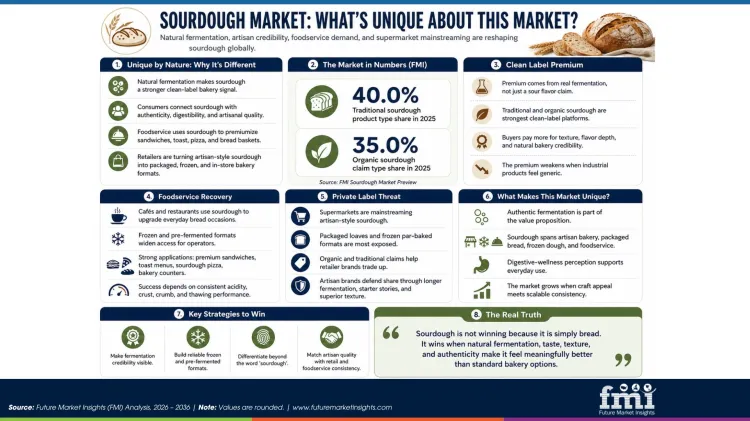
Private label is increasingly gaining ground in the world of sourdough, although the challenge posed by it is quite different from the one faced by standard packaged bread. There is no question of imitating a simple commodity product. Private labels seek to package artisanal sourdough in retail-ready packaging such as sliced breads, bakery-style breads, frozen par-baked bread, sourdough rolls, and sandwich breads.
FMI’s Sourdough Market shows why retailers are interested. Traditional sourdough holds 40.0% product type share in 2025, while organic sourdough holds 35.0% claim type share. These are strong, easy-to-communicate segments. Traditional sourdough signals authenticity. Organic sourdough signals clean label and premium quality. Both are useful for supermarket bakery positioning.
The retail industry offers a number of strengths. These include ownership over shelf locations, store bakery cases, frozen bakery cases, pricing specials, and private-label tiers. The retailer is able to produce standard sourdough bread, premium sourdough bread, organic sourdough bread, seeded sourdough bread, rye sourdough bread, and frozen sourdough bread using the same store design.
The most susceptible products are the ones that contain the word “sourdough” but offer no unique taste experience for the consumer. If a commercial sourdough bread fails to have enough crust hardness, bland flavors, and lack of distinctive fermentation flavors and textures, then a retailer’s brand will be able to contend effectively against it. The customer would not necessarily stick to the national brand.
Artisan bakers are less vulnerable, although not completely impervious. Their strengths are freshness, process visibility, regional branding, good flour, sourdough stories, and artisanal craftsmanship. Supermarket chains can replicate the bread type; however, replicating the complete baker experience is more difficult. The challenge lies in determining whether customers appreciate the added value sufficiently to pay a premium price.
Organic sourdough bread is especially crucial for private label strategy. It is possible for retailers to create the perception of luxury bread by utilizing organic labeling, recyclable packaging, seedings, and clean labeling. As stated by FMI, organic sourdough bread is becoming increasingly popular among consumers who prefer bakery products that are natural, GMO-free, and sustainable.
The presence of frozen sourdough is an even greater menace. Frozen and par-baked sourdough provide the ability for suppliers to have greater control over their supply chain while providing customers with a loaf that looks like freshly baked. With frozen sourdough, bakeries can avoid complex procedures involved in manual baking while maintaining their artisan look.
The strongest national and specialty brands will defend themselves through authenticity. They need to make clear why their sourdough is different: longer fermentation, named starter cultures, regional grains, rye expertise, ancient grains, stone milling, high hydration, hand shaping, or distinctive flavor profile. A generic premium look is not enough.
FMI’s Sourdough Ingredients Market is relevant because retailers and industrial bakeries need starter cultures, blends, and sourdough bases to produce consistent products at scale. As these systems become more available, the barrier to launching private-label sourdough decreases. This is good for category expansion, but it increases pressure on brands that rely only on basic sourdough claims.
Private-label risk is occasion-sensitive too. Standard sliced sourdough and sandwich breads are vulnerable since buyers can judge their value by comparing the cost and packaging. Round, artisan bread, gourmet rye sourdough, and locally produced bakery products could maintain their premium status. Par-baked sourdough is somewhere in between since it allows retailers greater flexibility while maintaining fresh bakery bread standards.
The misconception to avoid is that sourdough’s artisan image protects it from private label. Artisan image creates premium value, but retailers can mainstream premium cues when formats become scalable.
Bottom line: Private label will not eliminate artisan sourdough brands, but it will take share where sourdough is generic, packaged, price-comparable, and weakly differentiated. The brands that win will make fermentation credibility visible and difficult to copy.

