


- Native collagen capacity is constrained less by total collagen availability and more by the ability to preserve intact triple-helix structure through extraction, purification, drying, storage, and application-grade handling.
- FMI estimates the native collagen market at USD 227.68 million in 2026, rising to USD 343.57 million by 2036 at a 4.2% CAGR.
- The tightest bottlenecks sit in source qualification, low-temperature processing, denaturation control, pharmaceutical-grade documentation, batch consistency, and finished-format compatibility.
- Processing winners are suppliers that can serve nutraceutical, healthcare, pharmaceutical, cosmetic, food, beverage, animal feed, and laboratory buyers with clear source files and stable technical specifications.
- The biggest risk is assuming that peptide or hydrolysate capacity automatically solves native collagen demand. Native collagen requires different processing discipline and a stronger proof system.
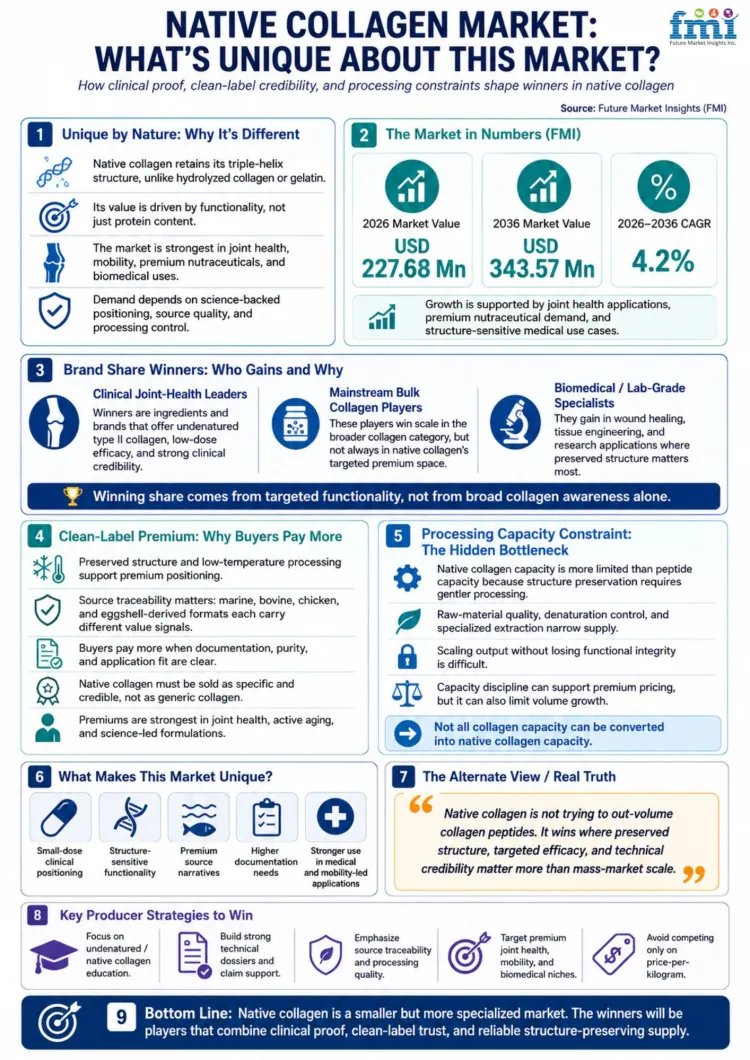
Native collagen is not facing a simple raw material shortage. The real constraint is more precise: which suppliers can scale collagen extraction and processing without destroying the structure that makes the ingredient “native” in the first place? This is why processing capacity is becoming a competitive filter. Any supplier can talk about collagen demand, but fewer suppliers can consistently protect native structure, meet source requirements, and support application-specific documentation at commercial scale.
FMI’s Native Collagen Market shows why this question matters. The category covers commercially purified collagen proteins retaining intact triple-helix quaternary structure from marine, bovine, poultry, porcine, and other biological sources. FMI segments demand across nutraceuticals and dietary supplements, healthcare and pharmaceuticals, food products, beverages, cosmetics and personal care, animal feed, laboratory tests, and other applications. The market is valued at USD 227.68 million in 2026 and is projected to reach USD 343.57 million by 2036 at a 4.2% CAGR. This confirms that the market is not a mass-volume peptide story; it is a controlled-processing and specification-led ingredient story.
The first capacity constraint is source qualification. Bovine hide and bone, porcine skin, poultry sternum cartilage, and marine fish scales and skin can all support native collagen supply, but they do not create the same manufacturing challenge. Each source brings different documentation needs, religious acceptability, allergen review, regional suitability, odor profile, contaminant expectations, and functional suitability. FMI expects marine to lead the source segment with 18.5% share in 2026, which shows that source is already influencing buyer selection. However, marine supply only becomes scalable when processors can manage raw material variability, cold-chain discipline, species traceability, purification, and sensory control.
The second constraint is processing discipline. Native collagen loses value when it is handled like hydrolyzed collagen. Hydrolysis, aggressive heat, uncontrolled pH, or harsh processing can move the material closer to peptide, hydrolysate, or gelatin-type functionality. FMI specifically excludes hydrolyzed collagen peptides, collagen hydrolysates, gelatin, recombinant human collagen, and plant-based collagen-boosting extracts from the native collagen scope. That boundary matters because the native collagen supplier is not only selling collagen protein. The supplier is selling preserved structure.
This is where low-temperature extraction, gentle purification, moisture control, lyophilization capability, membrane formation, gel handling, and storage stability become commercial advantages. In food and beverage ingredients, processors often scale by increasing throughput and simplifying handling. In native collagen, higher throughput can create risk if it damages structure or weakens batch reproducibility. The winning capacity is therefore not the largest tank capacity alone. It is the most controlled capacity.
The third constraint is application-grade capacity. Native collagen used in nutraceuticals and dietary supplements may require source documents, type identification, stability data, and claim support. Native collagen used in healthcare and pharmaceuticals needs a deeper specification package because wound dressings, collagen membranes, collagen sponges, tissue engineering scaffolds, and injectable aesthetic formulations carry stronger quality expectations. Native collagen used in laboratory tests and biomedical research needs repeatable material behavior. The same physical output volume may not be sellable across all these applications unless the processor has the right grade system.
This is why the supplier winners are likely to be established collagen processors and specialist matrix suppliers, not only finished supplement co-packers. FMI identifies Rousselot, Weishardt, GELITA AG, Tessenderlo Group NV, LAPI GELATINE S.p.a., Nitta Gelatin Inc., ITALGELATINE S.p.A., REINERT GRUPPE Ingredients GmbH, Ewald-Gelatine GmbH, GELNEX, TrobasGelatine B.V., JuncàGelatines SL, Collagen Solutions Plc, HolistaCollTech Ltd., and Advanced BioMatrix, Inc. within the native collagen competitive landscape. Their advantage is not just name recognition. It is the ability to combine raw material access, collagen know-how, documentation, customer qualification support, and application experience.
Finished product co-packers still matter, but their role is different. Capsule, tablet, sachet, softgel, powder blend, and functional food manufacturers can help brands commercialize native collagen, but they cannot compensate for weak ingredient-level processing. If the native collagen has already lost structure, poor downstream filling discipline will not restore it. Co-packers that understand temperature sensitivity, moisture management, ingredient compatibility, and label documentation will be better partners for premium native collagen brands than co-packers optimized only for generic supplement throughput.
The comparison with collagen peptides and hydrolysates explains the bottleneck clearly. FMI projects the collagen peptide market to reach USD 7.0 billion by 2036 at 9.7% CAGR, while the collagen hydrolysates market is forecast to reach USD 3.0 billion by 2036 at 7.8% CAGR. These categories benefit from stronger solubility, easier powder handling, broader supplement familiarity, and larger B2B ingredient supply systems. Native collagen cannot simply borrow that scale model, because the processing goal is different. Peptides are built around controlled breakdown. Native collagen is built around controlled preservation.
The misconception to avoid is that native collagen will scale automatically because the broader collagen market is growing. Broader collagen demand creates awareness, but native collagen growth depends on source-specific supply, controlled extraction, preserved structure, grade separation, and documentation strong enough to satisfy different buyer groups.
Bottom line: the winners in native collagen will not be the companies with the most generic collagen capacity. They will be the companies with the most controlled native collagen capacity: verified source, preserved structure, application-grade processing, and technical files strong enough to move from nutraceuticals into healthcare, pharmaceuticals, cosmetics, food, beverages, animal feed, and laboratory use.
FMI Related Reports
- Native Collagen Market: Primary interlink in introduction and conclusion
- Collagen Supplement Market: Use when comparing native collagen with mainstream supplement formats
- Collagen Peptide Market: Use when discussing peptide scale and consumer awareness competition
- Collagen Hydrolysates Market: Use when explaining why hydrolyzed collagen is a separate high-volume category
- Marine Collagen Market: Use when discussing marine source differentiation and non-bovine positioning
- Nutraceuticals Market: Use when linking native collagen to joint health, active aging, and supplement demand

