


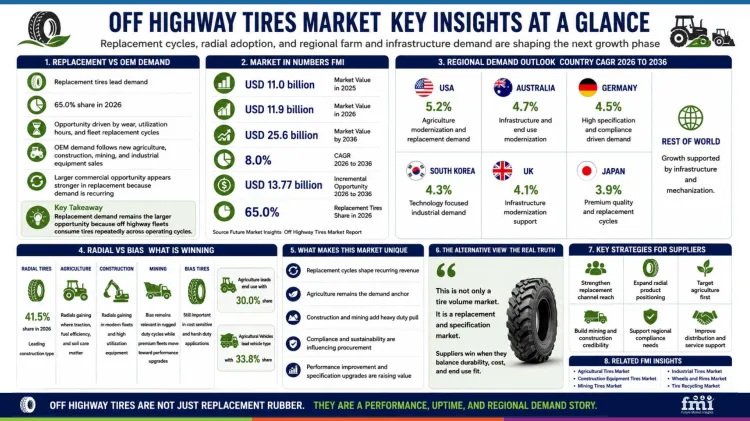
- Radial tires are projected to hold significant presence in market. FMI forecasts that the radial tires account for 41.5% of tire manufacturing demand by 2026.
- Radial construction improve traction, heat dissipation, tread wear, stability, ride quality, and fuel efficiency in applications where equipment utilization is high.
- Bias tires remain relevant in harsh operating conditions, low-speed, puncture-prone, and price-sensitive applications where sidewall rigidity and rugged construction matter.
- Radial tires significant growth in agriculture because of lower inflation pressure, soil protection, traction, and fuel efficiency which create measurable operating value.
- Mining and construction show a combined outcome because premium fleets are moving toward radial performance, while bias tires remain useful in harsh and specialized duty cycles.
- The analyst observes that radial tire is leading in value and performance transition, but bias tires also expected to remain ideal where operating conditions favor rigidity, repairability, and lower acquisition cost.
The choice between radial and bias off-highway tires is not based on a technology comparison. It is a decision about terrain, speed, load, heat, traction, equipment utilization, operating cost, puncture exposure, and procurement budget. Radial tires provide superior performance in many modern applications, but bias tires still solve practical problems in severe and price-sensitive environments.
FMI forecasts radial tires will account for 41.5% of off-highway tire construction demand in 2026. This puts the radial tire ahead in the construction segment and shows that end users are increasingly focusing on performance, efficiency and standardized procurement specifications. The share also points to a substantial part of the market still lying outside radial construction, including bias and specialty tire formats.
The difference between these two tires are based on construction methods. Radial tires consist of cords that usually run across the tire from bead to bead and have supporting belts behind the tread. This allows the sidewall and tread area to be more independent. Bias tires have plies that overlap and are laid diagonally, making the carcass more integrated and rigid.
Michelin explains that radial tires usually offer better traction, fuel efficiency, wear resistance, heat dissipation, ride quality, and stability. The company also states that bias tires hold advantages in selected off-road conditions. These differences help explain why radial adoption is rising in high-utilization applications but remains uneven across sectors.
Radial have significant opportunity in agriculture sectors. Tractors and farm machinery need traction which limits soil compaction and slippage. Tire that transfers power to the ground more efficiently reduce fuel use and improve field productivity, along with it a flexible radial sidewall also support a larger ground contact area at appropriate inflation pressure, which may help protect soil.
FMI projects that agriculture as the leading end-use segment with 30.0% share. This makes farm equipment the most vital application base for the radial vs bias transition.
The commercial case for agricultural radial tires is significant among large size farms, high-horsepower tractors, heavy implements, and operators that track fuel cost, slip, soil impact, and field productivity. These buyers are willing to pay a more, if the tire improves operating economics over its service life.
Radial tires can see a higher adoption when farmers travel more frequently between fields on roads. Better ride quality, heat control, and wear behavior become more valuable when equipment moves across both field and road surfaces.
In agriculture, bias tires are still useful, particularly on smaller, less-used machinery, older tractors, and farms with tight budgets. When sidewall stiffness and resistance to specific types of damage are important, they are perfect. Fuel or productivity savings might not cover the entire cost of radial tires for a farmer who uses equipment infrequently.
Construction applications also show growing radial use. Wheel loaders, graders, dumpers, telehandlers, and other machines benefit from improved traction, stability, ride, and tread life. Radial tires perform well in modern fleets where equipment operates for long hours and downtime is closely measured.
Heat dissipation becomes important in construction because repeated loading, movement, and travel generate heat. A tire which manages heat effectively support longer service and reduce failure risk. This is particularly relevant in applications involving higher speeds or longer travel distances.
At the same time construction sites can be highly damaging. Sharp debris, demolition material, rocks, sidewall impacts, and uneven ground can create conditions where a rigid bias carcass remains attractive. Some operators choose bias tires for specific short-cycle, low-speed, or puncture-prone work. This means radial is not superior on every site.
Mining creates the most demanding comparison. Surface mines operate large haul trucks and loaders under extreme loads, long cycles, high temperatures, and abrasive conditions. Tire performance can affect fleet productivity, haul speed, fuel consumption, and downtime. Premium radial earthmover tires are increasingly used where operators can measure and manage total cost per operating hour.
Radial construction can be advantageous in mining due to heat management, tread durability, grip, and comfort. Large mining tires generate significant heat, and overheating can decrease tire life or create safety concerns. Mines which have strong haul-road management, tire monitoring, and maintenance practices may get significant value from radial tires.
Bias tires remain relevant in rugged mining and quarry applications where sidewall stiffness, cut resistance, low speed, and severe terrain matter. Some underground or specialized vehicles continue to use bias construction because operating conditions differ from long-haul surface mining.
FMI finds mining fleet growth as a driver of additional demand for heavy-duty tires. This doesn’t mean one tire type will take over all mining sites. Rather, the choice between constructions will depend more on how each mine actually operates.
Tier cost remains a major factor. Radial tires are expensive because of their construction, materials, and manufacturing requirements. Bias tires are more affordable and may offer acceptable performance in lower-utilization or severe conditions. Buyers therefore need to compare total cost per hour rather than purchase price alone.
Tire life, fuel consumption, machine productivity, downtime, repairability, retreading possibilities, operator comfort, traction, and damage risk must all be taken into account when calculating total costs. When their performance and longer lifespan outweigh the initial expense, radial tires are selected. When tire life is restricted by cuts rather than tread wear and damage exposure is severe, bias tires are selected.
The type of equipment is also important. High-horsepower agricultural tractors, large loaders, surface mining trucks, and premium construction equipment are increasingly moving toward radial tires. Smaller tools, forklifts, compact machinery, older tractors, and specialized severe-duty equipment may retain bias or other tire formats.
Regional economic impact the shift. Established markets may adopt radial tires faster because buyers have stronger access to financing, service networks, pressure-management tools, and lifecycle-cost analysis. Emerging markets may retain bias demand where initial price and repair access matter more.
Radial adoption is also interconnected to tire management. Improper pressure, overloading, poor alignment, or unsuitable application can reduce the benefits of a premium tire. Suppliers need to provide application guidance, pressure recommendations, training, monitoring, and dealer support. Selling radial tires without helping customers operate them correctly can limit realized performance.
To say that radial technology is superior regardless of duty cycle is premature. Radial tires are clearly superior to other tires in many applications in terms of wear, comfort, traction, fuel economy, and heat build-up. When sidewall stiffness, challenging terrain, slow speed, and purchase price are the decisive considerations, bias tires still play a significant role.
As a result, rather than shifting to a single tier structure, the market seems to be divided. Modern construction fleets, high-productivity mining, and performance-driven agriculture are all seeing an increase in the use of radial tires. Bias tires are still useful for tough, low-speed, vintage, specialist, and cost-conscious machinery.
Radial tires appear to be strong long-term shift, supported by FMI’s 41.5% share and growing demand for traction, efficiency, heat control, and longer wear. Bias tires are unlikely to disappear because they remain practical in harsh and cost-sensitive applications. The strongest suppliers will offer both constructions and guide users toward the tire that delivers the best cost per operating hour.

