


- Regulatory pathways continue to be one of the biggest determinants of commercial success in the platelet rich plasma (PRP) market.
- Autologous PRP systems are typically on a faster track to the clinic compared to donor-derived products, because they are based on processing blood from the same patient.
- North America and Europe remain at the forefront when it comes to standardized regulatory frameworks, while Asia is experiencing fast growth through greater institutional acceptance.
- Vendors of closed system technologies, and well-validated preparation protocols are building up their competitive positioning.
- Regulatory consistency is emerging as a purchasing criterion for hospitals and specialty clinics along with platelet yield and workflow efficiency.
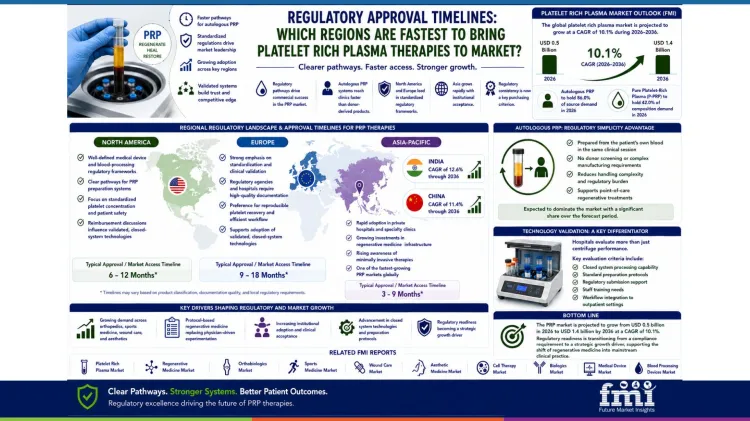
Platelet Rich Plasma Market is Transitioning from Physician-Driven Experimentation to Protocol-Based Regenerative Medicine. Demand continues to grow across orthopedics, sports medicine, wound care and aesthetics, but regional approval frameworks vary significantly, impacting commercialization strategies.
According to Future Market Insights, the global platelet rich plasma market is anticipated to reach around USD 0.5 billion in 2026, and is projected to reach a valuation of USD 1.4 billion by the end of 2036, growing at a CAGR of 10.1% during the assessment period. Also, the report estimates that Pure Platelet-Rich Plasma (P-PRP) will account for 42.0% of composition demand in 2026. On the other hand, the autologous PRP is expected to account for 86.0% of source demand owing to same-patient preparation minimizing the need for donor handling.
North America Benefits from Defined Regulatory Pathways
The United States remains one of the most commercially attractive regions as manufacturers can develop PRP preparation systems under clearly established medical device and blood-processing regulatory frameworks. Hospitals and specialty clinics increasingly are choosing systems that offer standardized platelet concentration and minimal risk of contamination.
Reimbursement discussions and documentation standards are also steering leading suppliers to validated, closed-system technologies as opposed to manually prepared solutions.
Europe Focuses on Standardization and Clinical Validation
European healthcare providers are increasingly concerned about procedural consistency and patient safety prior to adopting regenerative therapies. Standardized preparation systems are of more interest to regulatory agencies and hospital procurement teams needing good quality documentation than are various manual techniques.
This environment is favorable for manufacturers with the ability to demonstrate reproducible platelet recovery, efficient workflow and clinical reliability.
Asia-Pacific Accelerates Through Expanding Clinical Adoption
In emerging economies, private hospitals, dermatology centers and orthopedic clinics are incorporating PRP into their routine treatment protocols.
FMI says India is likely to see a CAGR of 12.6% through 2036, while China is likely to grow at a CAGR of 11.4%, making both countries some of the fastest growing PRP markets in the world. Adoption continues to be supported by growing investments in regenerative medicine infrastructure and increasing awareness of minimally invasive therapies.
Regulatory Simplicity Gives Autologous PRP a Commercial Edge
The autologous PRP is based on the patient’s own blood sample and is used in the same clinical session, unlike allogeneic biologics that require donor screening and strict control of the manufacturing process.
This ease of use reduces handling complexity and meets the physician’s preference for point-of-care regenerative treatments. Therefore, autologous systems are anticipated to dominate the market with a significant share over the forecast period.
Technology Validation Is Becoming a Competitive Differentiator
Hospitals are no longer just looking at centrifuge performance or platelet yield when evaluating PRP systems. The procurement teams are increasingly looking at:
- Closed system processing capability
- Standard preparation protocols
- Regulatory Submission Support
- Staff Training Needs
- Workflow integration to outpatient settings
Manufacturers that can meet these requirements will likely be the ones that get stronger institutional adoption.
Bottom Line
Regulatory execution is as important as clinical efficacy when it comes to the future of the Platelet Rich Plasma Market. Suppliers with both standardized preparation systems and strong regulatory positioning are expected to benefit the most as regenerative medicine moves from niche procedures to mainstream clinical practice. The market is projected to grow from USD 0.5 billion in 2026 to USD 1.4 billion by 2036. Regulatory readiness is transitioning from a compliance requirement to a strategic growth driver.

