


- Renovation demand appears commercially strong because ceiling tiles are frequently replaced during office upgrades, institutional modernization, healthcare refurbishments, school improvements, and retail refreshes.
- New construction still matters, particularly in commercial real estate, public infrastructure, manufacturing facilities, and institutional buildings.
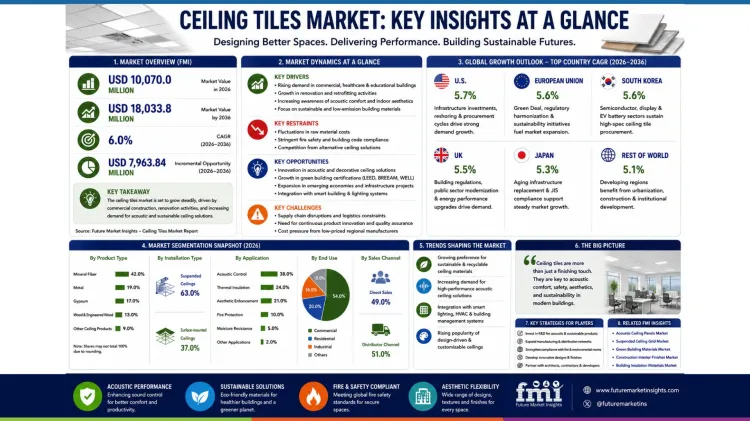
- FMI states that the ceiling tiles market will grow from USD 10,070.0 million in 2026 to USD 18,033.8 million by 2036 at a 6.0% CAGR.
- Commercial end use accounts for 54.0% of demand, which points to recurring refurbishment and fit-out cycles as a key demand base.
- Suspended ceilings hold 63.0% of installation demand, supporting renovation because grid-based systems allow faster tile replacement and access to building services.
- The faster growth pocket may depend on region. Renovation looks stronger in mature markets, while new construction remains more visible in expanding urban and industrial markets.
A ceiling tile is one of the few building products that can participate in both the first construction cycle and multiple later upgrade cycles. A building may be constructed once, and its ceilings can be changed several times. Offices are reconfigured. Retail interiors are refreshed. Schools and hospitals are modernized. Industrial facilities upgrade lighting, ventilation, and acoustic control. Public buildings replace stained or damaged panels. This makes renovation demand especially important in the ceiling tile market.
The FMI market outlook shows a steady expansion path. The ceiling tiles market was valued at USD 9,500.0 million in 2025, is estimated at USD 10,070.0 million in 2026, and is projected to reach USD 18,033.8 million by 2036. The 6.0% CAGR reflects demand from both new construction and replacement activity. The question is where the faster growth is likely to occur.
Commercial buildings provide the most useful starting point. FMI estimates that commercial end use accounts for 54.0% of demand. Commercial buildings are not static assets. Tenants change, layouts change, mechanical systems are upgraded, and interiors are periodically renewed. Ceiling tiles sit directly inside these fit-out cycles. A landlord may replace ceiling panels to improve appearance before leasing. A corporate occupier may upgrade acoustic performance during a workplace redesign. A healthcare facility may replace ceiling tiles for hygiene, maintenance access, or clean interior standards.
Suspended ceiling systems strengthen the renovation case. FMI places suspended installation at 63.0% of installation demand. A suspended grid ceiling allows contractors to remove and replace panels without major demolition. It also provides access to ducts, cables, pipes, sprinklers, sensors, and lighting. This makes ceiling tile replacement one of the more practical interior upgrade actions in commercial buildings.
Renovation demand is also supported by visual degradation. Ceiling tiles can stain, sag, crack, discolor, absorb odors, or show water damage. Even when the underlying building remains functional, ceiling appearance can signal age or poor maintenance. In offices, hotels, hospitals, schools, and retail spaces, this visible surface matters. Replacing tiles is a comparatively manageable way to improve interior perception.
Acoustics add another reason to renovate. Open offices, hybrid workspaces, classrooms, clinics, and shared public facilities have placed more attention on noise control. A building that originally used low-performance panels may upgrade to higher-NRC acoustic ceiling tiles. This type of demand is less about area expansion and more about performance uplift. It creates value even when floor area is unchanged.
New construction remains the other demand engine. Every new office tower, hospital, school, retail center, factory office, airport terminal, and institutional project creates ceiling specification opportunities. FMI points to USA growth at 5.7% through 2036, supported by infrastructure bill allocations, reshoring trends, and procurement cycles for mineral fiber materials. In markets where construction pipelines are active, project demand can be large and structured.
The USA is a useful example of overlap between the two demand types. Public infrastructure spending and reshoring can support new facilities, while the country large existing building stock creates renovation demand. Ceiling suppliers serving the USA cannot choose only one route. They need specification support for new projects and distributor availability for refurbishment.
The European Union 5.6% CAGR also has a renovation-heavy character. FMI connects EU growth with regulatory harmonization, Green Deal sustainability mandates, circular economy programs, and institutional procurement. Europe has a large stock of existing public and commercial buildings. Energy performance, acoustic comfort, fire safety, and sustainability requirements can push upgrades even when new building volumes are moderate.
The UK follows a similar pattern. FMI projects 5.5% CAGR and links demand to updated building regulations, fire safety standards, healthcare modernization, education, government facilities, and energy performance certificate requirements. In this type of market, ceiling tiles benefit from public sector renovation and compliance-led refurbishment rather than only new commercial development.
Japan growth at 5.3% has a strong replacement-cycle signal. FMI notes aging facility infrastructure, JIS compliance, rigorous qualification testing, and replacement procurement for suspended products. Mature markets such as Japan often generate demand through facility renewal, modernization, and quality upgrades. New construction may still occur, and replacement cycles can be commercially more predictable.
South Korea 5.6% CAGR reflects another demand profile. Semiconductor, display, and EV battery manufacturing sectors support high-specification procurement. This can include new clean manufacturing facilities, expansions, and upgrades. Ceiling tile demand in such sectors may be driven by controlled environments, durability, service access, and strict quality expectations. Here, new construction and facility expansion may be more visible than in mature office renovation markets.
Renovation generally grows faster where the installed base is large and buildings are under pressure to modernize. New construction usually grows faster where urbanization, industrial expansion, infrastructure spending, and institutional development are expanding the building stock. That distinction matters for suppliers.
A renovation-led market rewards distribution, inventory, replacement compatibility, easy installation, and contractor relationships. It favors products that fit existing grids, match common dimensions, and minimize downtime. Contractors may need ceiling panels available quickly in small to medium quantities. Facility managers may care about matching existing tiles, improving acoustics, and limiting disruption.
A new-construction-led market rewards specification selling. Architects, designers, general contractors, developers, and project owners influence selection earlier. Suppliers need technical documents, BIM objects, samples, fire and acoustic ratings, sustainability certificates, and project pricing. Large orders may go through direct sales or project contracts, which FMI identifies as part of the direct sales channel.
Direct sales account for 49.0% of sales channel demand according to FMI. This suggests that project contracts and bulk orders remain highly important. Renovation demand may flow through both direct and distributor channels depending on customer size. Institutional renovation programs can still use direct contracts, while smaller refurbishments rely more on regional distributors.
Mineral fiber again benefits from both demand routes. In new construction, it is specified into suspended ceilings. In renovation, it is replaced in existing grids. Metal and gypsum may gain more when renovation is part of a larger redesign rather than a simple tile replacement. A hotel lobby renovation may shift from mineral fiber to metal or wood panels. A hospital corridor may move toward gypsum or specialty panels for fire and hygiene requirements.
The cost environment can also influence renovation timing. During periods of high construction cost or financing pressure, owners may delay new construction and still fund refurbishment to extend asset life. Ceiling tile suppliers can benefit when building owners choose interior upgrades rather than full redevelopment. EPA sustainable construction guidance places high value on source reduction and preserving existing structures, which also aligns with renovation as a resource-efficient pathway.
Procurement language is changing as well. Renovation projects increasingly ask for low-emitting materials, recycled content, acoustic performance, and product documentation. A simple like-for-like replacement may become a performance upgrade when the buyer has sustainability or occupant comfort targets.
The demand signal, viewed carefully, is not that renovation always beats new construction. It is that renovation offers a more recurring and installed-base-driven opportunity, while new construction offers larger project volumes tied to development cycles. In mature economies, renovation may be the steadier and potentially faster-growing pocket. In expanding industrial and urban markets, new construction can remain the larger growth contributor.
For suppliers, the recommended approach is channel segmentation. Serve new construction through architects, contractors, project owners, and direct contracts. Serve renovation through distributors, facility managers, maintenance contractors, and quick-ship programs. A company that uses the same offer for both markets risks missing the different buying logic.
The observed market direction favors suppliers that can make replacement easy and specification upgrades worthwhile. Renovation demand grows when ceiling tiles solve visible problems quickly. New construction demand grows when ceiling systems meet performance standards at scale. Both are expanding, and renovation may provide the more durable recurring demand base in markets with large commercial building stocks.
In practical terms, the faster opportunity is likely renovation in the USA, EU, UK, and Japan, while new construction and expansion-led procurement may be more prominent in South Korea and other high-growth industrial markets. The more resilient ceiling tile suppliers will participate in both cycles rather than trying to predict one universal winner.

