


- • Nisin delivers the strongest commercial value when it is treated as a shelf-life ROI tool, not only as a clean-label preservative.
- • Buyers are willing to pay more for nisin when it reduces spoilage risk, extends usable shelf life, lowers batch rejection, supports export stability, and improves retail performance.
- • The strongest payback opportunity sits in processed cheese, dairy desserts, heat-treated meat products, sauces, soups, bakery fillings, liquid egg products, chilled ready-to-eat foods, and selected plant-based formulations.
- • Nisin does not create the same ROI in every food category. Payback depends on the microbial risk, permitted dosage, product pH, processing method, packaging system, distribution temperature, and cost of spoilage.
- • The biggest mistake suppliers can make is selling nisin as a premium ingredient without proving cost-in-use value. Food manufacturers pay more when nisin protects margin, not just when it supports cleaner labels.
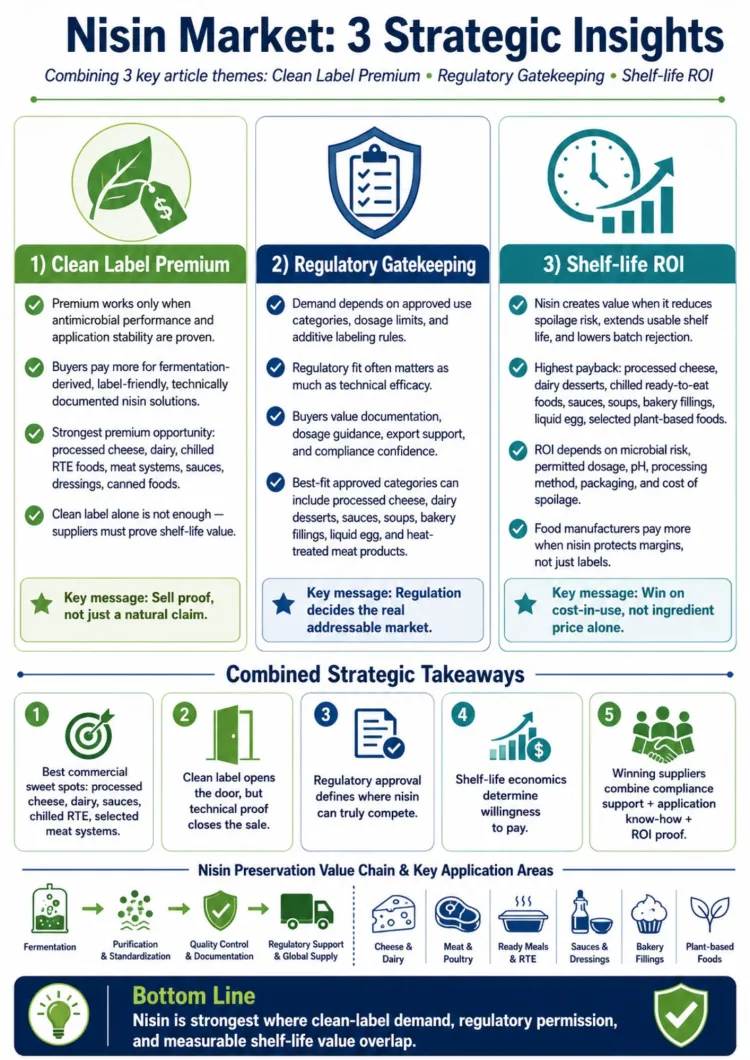
Shelf-life extension is one of the most commercially important reasons food manufacturers evaluate nisin. Clean-label positioning may open the conversation, but shelf-life economics usually decide adoption. A buyer will not switch to a premium antimicrobial system only because it sounds natural. The buyer needs to see how nisin reduces spoilage, improves product stability, protects retail quality, and lowers commercial risk.
According to Future Market Insights, the Nisin Market is expected to gain from rising demand for natural antimicrobial preservation, longer shelf life, and safer processed food systems. However, the strongest opportunity is not spread evenly across all applications. It is concentrated in categories where microbial spoilage creates direct financial loss and where nisin can perform within regulatory and technical limits.
This makes shelf-life ROI one of the best ways to understand the real value of nisin. The question is not simply where nisin can be used. The better question is: where does nisin pay for itself?
Shelf-life ROI Is Strongest Where Spoilage Is Expensive
Food manufacturers face several types of spoilage-related cost. These include batch rejection, product returns, shortened retail life, cold-chain failure, export rejection, consumer complaints, and brand damage. In high-risk categories, even a small improvement in shelf life can justify a premium preservative.
This is where nisin becomes commercially attractive. It can help control selected spoilage and pathogenic bacteria, especially Gram-positive bacteria and sporeformers, in suitable food systems. For products exposed to heat processing, chilled distribution, or long retail cycles, this can create meaningful value.
The highest ROI is usually found where three conditions overlap: the product has real microbial risk, the allowed dosage is technically useful, and the finished product carries enough value to absorb the preservative cost.
Processed cheese, dairy desserts, heat-treated meat products, sauces, soups, bakery fillings, liquid egg products, chilled meals, and selected plant-based products can fit this profile, depending on the local regulatory framework and formulation.
Processed Cheese and Dairy Remain Core ROI Applications
Processed cheese and dairy-related applications remain among the most important opportunity areas for nisin. These products often require microbial control, shelf-life stability, and consistent quality during storage. Because cheese and dairy systems can be vulnerable to spoilage and quality deterioration, preservation failure can quickly translate into commercial loss.
In these applications, nisin is not only a clean-label ingredient. It is a risk-control tool. If it helps reduce spoilage, protect texture, maintain product quality, and extend retail life, the cost-in-use can be justified.
Dairy desserts, cheese spreads, processed cheese products, and selected cream-based applications can also benefit from the consumer-facing value of cleaner preservation. However, technical fit still matters. The supplier must show that nisin works in the actual product matrix, not only in general preservation theory.
This is why dairy buyers often value supplier support. Application testing, dosage optimization, heat-process compatibility, and regulatory documentation can all influence whether nisin becomes a commercial solution or remains a trial-stage ingredient.
Meat, RTE Foods, and Chilled Meals Offer High-Value Growth Potential
Meat products, ready-to-eat foods, and chilled meals represent another important shelf-life ROI opportunity. These categories face strong pressure from food safety expectations, retail shelf-life requirements, and distribution complexity.
For manufacturers, a short shelf-life window creates economic pressure. Products may need faster turnover, tighter cold-chain management, and higher markdown rates. If nisin helps improve microbial stability in approved applications, it can support better inventory management and lower shrink.
However, the opportunity is not automatic. Meat and RTE applications often require hurdle preservation systems. Nisin may need to work alongside heat treatment, salt, organic acids, packaging atmosphere, refrigeration, and other antimicrobial systems. The value is highest when nisin improves the overall hurdle design without creating taste, texture, or labeling challenges.
This is also where suppliers can differentiate. A basic ingredient seller may struggle to justify premium pricing. A supplier that can model shelf-life gain, support trials, and prove cost-in-use savings can win stronger buyer confidence.
Sauces, Soups, and Bakery Fillings Need Application-Specific Proof
Sauces, soups, bakery fillings, and liquid or semi-solid processed foods can create attractive opportunities because they often require shelf-life stability across retail and foodservice channels. These products may experience microbial risk during processing, filling, storage, or after opening, depending on formulation and handling.
For these applications, nisin’s value depends heavily on product conditions. pH, heat treatment, water activity, fat content, protein content, packaging format, and storage temperature can all affect performance.
This means the ROI case must be built application by application. A supplier cannot assume that nisin will deliver equal value across all sauces or fillings. Instead, the supplier must show where the ingredient prevents spoilage risk better than alternatives and where the finished product value supports a premium preservation system.
In premium sauces, clean-label chilled dips, dairy-based fillings, and export-oriented processed foods, the value case can be stronger. In low-cost shelf-stable products, price resistance may be higher unless nisin clearly improves formulation reliability.
Plant-based Foods Are an Emerging but More Complex Opportunity
Plant-based foods are a promising but complex area for nisin. Many plant-based dairy and meat alternatives have high moisture content, complex ingredient systems, and strong clean-label expectations. These products often need preservation strategies that do not conflict with natural, vegan, or minimally processed positioning.
However, plant-based applications require careful evaluation. Nisin’s regulatory status, label acceptability, performance in plant-protein matrices, interaction with other ingredients, and consumer perception must all be considered. Some brands may welcome fermentation-derived preservation, while others may avoid additive-style declarations.
The ROI opportunity is strongest in premium plant-based foods where spoilage risk is high, shelf-life expectations are demanding, and cleaner preservation has brand value. It is weaker in products where lower-cost preservatives or processing systems already solve the shelf-life problem.
This makes plant-based foods an important future opportunity, but not a guaranteed high-volume application.
The Cost-in-Use Equation Matters More Than Ingredient Price
Nisin is often more expensive than conventional synthetic preservatives on a simple ingredient-price basis. But food manufacturers do not make decisions only on ingredient price. They evaluate cost-in-use.
Cost-in-use includes dosage, performance, waste reduction, shelf-life gain, quality protection, product returns, reformulation effort, regulatory risk, and brand value. If nisin allows a manufacturer to extend shelf life, reduce spoilage, or protect a premium clean-label claim, the higher ingredient cost may be justified.
This is the core of the shelf-life ROI argument. Nisin does not need to be cheaper than synthetic preservatives to win. It needs to create enough measurable value to justify the premium.
The strongest supplier conversations should therefore focus on economic outcomes: fewer rejected batches, longer distribution windows, lower retail shrink, better export stability, improved product consistency, and stronger clean-label positioning.
Where ROI Will Be Weakest
Nisin will face weaker ROI in food categories where spoilage risk is low, synthetic preservatives are accepted, the product price is low, or the permitted dosage is not sufficient for meaningful protection. In these categories, the buyer may see nisin as technically interesting but commercially difficult.
Mass-market products with very tight margins may also resist nisin unless the supplier can prove clear savings. Similarly, products with microbial challenges outside nisin’s strongest activity spectrum may require other preservatives or blended systems.
This means the Nisin Market should not be evaluated only by total processed food volume. A large food category is not necessarily a strong nisin opportunity. The better measure is the value of the preservation problem.
The Strategic Misconception
The common misconception is that shelf-life extension automatically creates nisin demand. The reality is more specific. Nisin creates strong demand only when the shelf-life problem is expensive enough, the application is technically suitable, and regulatory use is permitted.
Another misconception is that buyers will pay more simply because nisin is natural or fermentation-derived. In reality, buyers pay more when nisin protects commercial outcomes. Clean-label appeal may help justify the switch, but shelf-life ROI usually closes the sale.
This is why nisin suppliers need to speak the language of food manufacturers. The conversation should not stop at antimicrobial activity. It should cover production loss, retail shelf life, returns, safety margin, export stability, and finished-product profitability.
Bottom Line
Shelf-life ROI is one of the strongest commercial lenses for the Nisin Market. The best opportunities sit in applications where spoilage risk is high, finished-product value is meaningful, and nisin can deliver practical microbial control within regulatory limits.
Processed cheese, dairy desserts, heat-treated meat products, sauces, soups, bakery fillings, liquid egg products, chilled RTE foods, and selected plant-based foods offer the strongest potential. However, adoption will depend on product matrix, dosage permission, target organism, processing conditions, and cost-in-use proof.
For suppliers, the winning strategy is clear: do not sell nisin only as a clean-label preservative. Sell it as a shelf-life ROI system that helps food manufacturers reduce risk, protect quality, extend distribution windows, and defend product margins.
FMI Related Reports
- Nisin Market: First or second paragraph of the introduction
- Natural Food Preservatives Market: Clean-label preservation discussion
- Food Preservatives Market: Competitive alternatives section
- Dairy Ingredients Market: Dairy and processed cheese opportunity section
- Processed Cheese Market: Application premium opportunity section
- Ready-to-Eat Food Market: Shelf-life and chilled food discussion

