


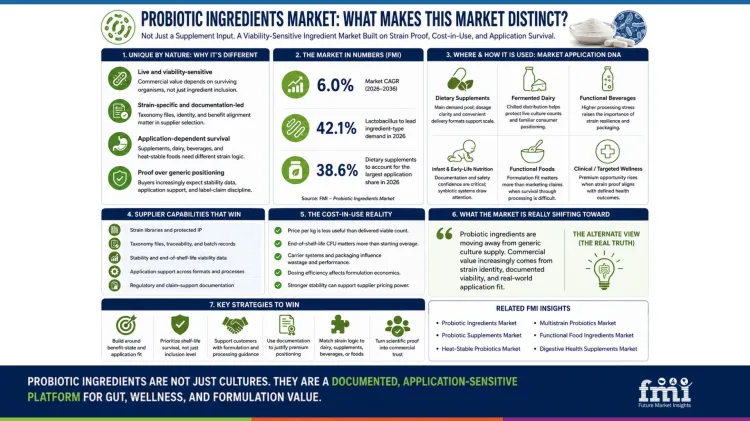
- Probiotic ingredient suppliers do not win only by offering high CFU counts; they win by proving strain identity, stability, benefit relevance, and application fit.
- FMI identifies Lactobacillus as the leading ingredient type in the Probiotic Ingredients Market, confirming that strain families remain central to supplier positioning.
- Dietary supplements lead application demand, but food, beverage, dairy, and functional nutrition formats increasingly require stronger application support from ingredient suppliers.
- The strongest suppliers combine strain libraries, IP control, clinical or technical dossiers, stability testing, and customer formulation service.
- Generic cultures are more exposed as buyers shift toward documented strains, multistrain systems, heat-stable formats, and benefit-specific positioning.
- The misconception to avoid is that probiotic ingredient competition is only about culture volume. In reality, it is about documented strain value and formulation reliability.
The Probiotic Ingredients Market is often discussed as a growth story linked to gut health, immune support, digestive wellness, and rising demand for functional foods. That framing is useful, but it does not fully explain how competition works at the ingredient level. Probiotic ingredients are not ordinary nutritional inputs. They are live, strain-dependent biological materials that must be produced, stored, transported, formulated, and consumed in a way that preserves intended functionality. This makes supplier capability a stronger determinant of market success than broad demand alone.
FMI's Probiotic Ingredients Market identifies Lactobacillus as the leading ingredient type and dietary supplements as the leading application. These two benchmarks are important because they show both the dominance of established probiotic strain families and the continued importance of supplement manufacturers as commercial buyers. However, the market is no longer only about supplying standard Lactobacillus cultures into capsules. Buyers increasingly ask whether a supplier can prove strain identity, maintain viable counts, support application trials, provide documentation, and help brands differentiate finished products.
The first capability that matters is strain ownership. Suppliers with proprietary strain banks, defined strain codes, deposition records, genome-level characterization, and long-term research investment are better positioned than suppliers selling generic culture categories. A label that says Lactobacillus is not enough for sophisticated buyers. The commercial question is which Lactobacillus strain, what benefit evidence exists, whether the strain survives processing, and how it performs in the intended format. This is why the Probiotic Strains Market is closely linked to probiotic ingredient competition. Strain identity is the commercial unit of trust.
The second capability is stability management. Probiotic ingredients must remain viable through production, storage, transport, and finished-product shelf life. A supplier selling a freeze-dried powder must understand moisture sensitivity, oxygen exposure, temperature control, packaging compatibility, and overage requirements. A buyer creating capsules, sachets, gummies, dairy products, or beverages will not evaluate the ingredient only at the delivery point. The real measure is whether the strain remains viable and useful at the point of consumption.
The third capability is application support. Dietary supplements lead demand, but finished-product innovation is spreading into functional foods, fermented dairy, beverages, gummies, powders, infant and family nutrition, and animal nutrition. These applications do not share the same formulation conditions. A probiotic that performs well in a capsule may not be suitable for an acidic beverage, a gummy exposed to moisture, a high-temperature baked good, or a dairy matrix requiring specific fermentation behavior. Ingredient suppliers with application labs become more valuable because they reduce trial-and-error for brand owners.
The Heat-Stable Probiotics Market highlights why survivability is becoming a distinct competitive issue. Spore-forming and heat-tolerant strains allow formulators to consider applications that would not work with more fragile probiotic cultures. This does not mean heat-stable strains replace traditional Lactobacillus and Bifidobacterium systems. It means suppliers must match strain choice to processing reality. The broader the application map, the more important technical guidance becomes.
The fourth supplier capability is evidence translation. Finished-product companies need benefits that can be communicated responsibly. Ingredient suppliers therefore need strain-specific documentation, stability data, clinical references where available, regulatory support, allergen and safety documentation, and clear usage guidance. This is especially important in markets where probiotic claim language is scrutinized. A strain with weak documentation may be difficult to commercialize even if it is technically viable.
Quality systems are also becoming part of supplier selection. Probiotic ingredient buyers need confidence in strain authentication, contaminant testing, allergen controls, heavy-metal testing where relevant, non-GMO or vegan documentation where claimed, and consistent batch release specifications. These details may not appear in consumer marketing, but they influence whether a brand, contract manufacturer, or functional food processor can qualify a supplier. A strong dossier can shorten onboarding time and reduce the commercial friction of launching a new finished product.
Scale also matters, but scale must be interpreted correctly. The best probiotic ingredient suppliers are not simply the ones that can produce the largest bulk culture volumes. They are the suppliers that can maintain consistent performance across batches while serving multiple formats and regions. Global customers may need the same strain supplied for capsules in North America, sachets in Asia, and dairy applications in Europe. That requires production resilience, documentation alignment, and technical service across markets.
Route-to-market strength is another differentiator. Some probiotic ingredient suppliers sell directly to multinational supplement and food companies. Others work through premix houses, contract manufacturers, regional distributors, or application specialists. The supplier that controls technical communication usually has an advantage because probiotics require explanation. Buyers need guidance on dosage, storage, label declarations, shelf-life testing, and benefit positioning. A distributor without technical depth may win price-sensitive accounts, but large customers usually need more than catalog supply.
Multistrain formulation adds another layer. The Multistrain Probiotics Market shows growing interest in combinations designed around complementary benefits. At the ingredient level, this raises questions about compatibility, dosage balance, stability interaction, and evidence quality. A supplier that can provide only individual strains may be less useful than one that can help buyers design systems. However, multistrain does not automatically mean better. The supplier must explain why the combination exists and how it supports the intended benefit state.
The competitive risk is highest for commodity culture suppliers. If a supplier cannot defend strain identity, document performance, provide application support, or help with regulatory questions, buyers may treat the ingredient as interchangeable. That pushes the market toward price comparison. In contrast, suppliers with proprietary strains, stability proof, and technical support can defend premium pricing because they reduce commercial risk for the customer.
The strongest opportunities sit with suppliers that can serve multiple buyer groups without diluting scientific credibility. Supplement brands need CFU stability and label support. Functional dairy companies need matrix compatibility and fermentation expertise. Beverage companies need acid and shelf-life tolerance. Gummies and sachets need moisture and packaging guidance. Animal nutrition buyers need species-specific functionality and production robustness. Each end use requires a different supplier conversation.
This is why the ingredient market is moving toward a tiered supplier structure. At the top are companies with proprietary strain libraries, validated application data, manufacturing depth, regulatory support, and global customer access. In the middle are regional culture suppliers with reliable production but narrower technical or documentation coverage. At the bottom are commodity sellers competing primarily on price. Growth in demand may lift all tiers, but value capture increasingly concentrates with suppliers that reduce risk for the finished-product manufacturer.
The misconception to avoid is that probiotic ingredient growth automatically benefits all suppliers equally. It does not. Category demand may expand, but buyers increasingly separate culture sellers from documented strain partners. The gap between those two supplier types is widening.
Bottom line: supplier winners in probiotic ingredients are not simply the companies with the largest culture volumes. They are the companies that combine strain IP, viability control, documented benefits, application support, and regulatory readiness. In a live-ingredient market, trust is built before the ingredient reaches the consumer.
Related FMI Reports
- Probiotic Ingredients Market: Primary interlink for market scope, Lactobacillus leadership, and application demand
- Probiotic Strains Market: Use when discussing strain identity, clinical proof, and supplier differentiation
- Multistrain Probiotics Market: Use when discussing strain combinations and compatibility
- Heat-Stable Probiotics Market: Use when discussing processing tolerance and survivability
- Probiotic Supplements Market: Use when discussing supplement buyer demand and finished-product formats
- Functional Food Ingredients Market: Use when discussing functional food applications and broader ingredient demand

