


Executive Summary: From Safety Records to Brand Proof
Food safety data is moving from a back-office compliance record to a brand asset. Packaged food companies are no longer judged only by whether they test products. Retailers and consumers now expect evidence that safety controls are traceable, current and easy to verify.
The commercial shift is visible at the shelf. A food brand can use audit-ready diagnostics to defend retailer trust. It can use QR-linked information to explain product origin and safety controls. It can also use traceability records to respond faster when a product question reaches a buyer, regulator or consumer.
This report examines the needs of Marketing/Sales leaders, CEOs, CIOs and CTOs in food and beverage companies. It connects Future Market Insights data with evidence from FDA, GS1 US, Trustwell, SGS and Eurofins. The central theme is the proof shelf. Food safety data now affects brand competition before a crisis occurs.
FDA’s Food Traceability Final Rule requires covered firms to maintain Key Data Elements linked to Critical Tracking Events. FDA states that covered firms must provide information to FDA within 24 hours or another reasonable time agreed by the agency. This changes traceability from a file-retention task into a response-readiness issue. [5]
Market Overview: The Rise of Food Safety Proof as a Brand Signal
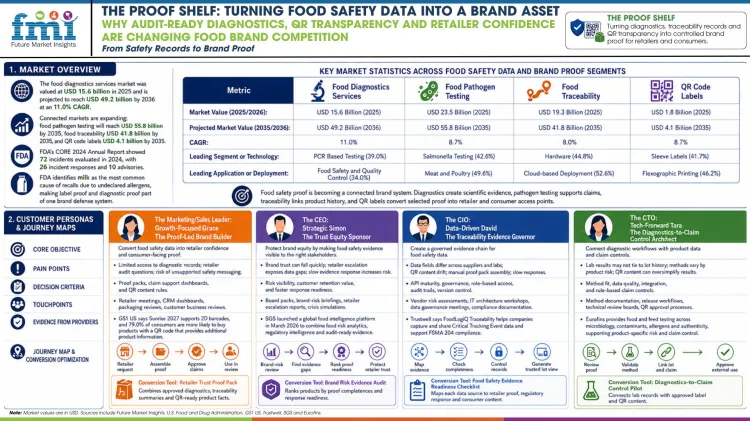
The food diagnostics services market was valued at USD 15.6 Billion in 2025. Future Market Insights projects the market to reach USD 49.2 Billion by 2036. The market is expected to expand at an 11.0% CAGR from 2026 to 2036. PCR-based testing is expected to lead with a 39.0% share. Food safety and quality control is expected to account for 34.0% of application demand. [1]
The connected markets show why food safety data is becoming a commercial tool. Food pathogen testing is projected to grow from USD 23.5 Billion in 2025 to USD 55.8 Billion by 2035. The food traceability market is expected to grow from USD 19.3 Billion in 2025 to USD 41.8 Billion by 2035. QR code labels are projected to rise from USD 1.8 Billion in 2025 to USD 4.1 Billion by 2035. [2] [3] [4]
FDA’s CORE 2024 Annual Report shows why brands need fast and credible evidence. FDA reported that CORE teams evaluated 72 incidents in 2024. The teams responded to 26 incidents and issued advisories for 10. Those investigations resulted in public health actions including recalls, advisories and prevention strategies. [7]
Label risk also affects brand trust. FDA states that milk is the most common cause of recalls due to undeclared allergens. FDA also identifies bakery products, snack foods, candy, dairy products and dressings as the five food types most often involved in food allergen recalls. This makes label proof and diagnostic proof part of the same brand defense system. [6]
Key Market Statistics Across Food Safety Data and Brand Proof Segments:
| Metric | Food Diagnostics Services | Food Pathogen Testing | Food Traceability | QR Code Labels |
|---|---|---|---|---|
| Market Value (2025/2026) | USD 15.6 Billion (2025) | USD 23.5 Billion (2025) | USD 19.3 Billion (2025) | USD 1.8 Billion (2025) |
| Projected Market Value (2035/2036) | USD 49.2 Billion (2036) | USD 55.8 Billion (2035) | USD 41.8 Billion (2035) | USD 4.1 Billion (2035) |
| CAGR | 11.0% | 8.7% | 8.0% | 8.7% |
| Leading Segment or Technology | PCR Based Testing (39.0%) | Salmonella Testing (42.6%) | Hardware (44.8%) | Sleeve Labels (41.7%) |
| Leading Application or Deployment | Food Safety and Quality Control (34.0%) | Meat and Poultry (49.6%) | Cloud-based Deployment (52.6%) | Flexographic Printing (46.2%) |
These figures show how food safety proof is becoming a connected brand system. Diagnostics create the scientific evidence. Pathogen testing supports product safety claims. Traceability links the product to its movement history. QR code labels convert selected proof into a consumer or retailer access point. The software opportunity sits in turning those records into a trusted brand-facing layer.
Customer Personas: Turning Food Safety Data into Brand Proof
Marketing & Sales: Growth-Focused Grace - The Proof-Led Brand Builder
Growth-Focused Grace leads Marketing and Sales for a packaged food company. She wants to differentiate the brand without relying on vague safety language. Retail buyers now ask for traceability, diagnostic evidence and fast recall readiness. Consumers also expect more product information from a label or QR scan. Grace must turn internal food safety records into a clear trust story.
- Core Objective: Grace must convert food safety data into retailer confidence and consumer-facing proof. She needs evidence that supports claims without creating legal or reputational risk.
- Pain Points: Sales teams often lack easy access to diagnostic records. Retailers may ask for audit evidence during category reviews. Consumers may not trust broad safety claims unless product information is specific. Brand teams can overpromise if safety data is not approved for external use.
- Decision Criteria: Grace needs proof packs that connect diagnostics, traceability and label information. She values dashboards that show which claims can be supported. She also needs QR content rules that prevent outdated or unsupported product messaging.
- Touchpoints: Grace uses retailer meetings, CRM dashboards, packaging reviews and customer business reviews.
Evidence from Providers:
GS1 US states that Sunrise 2027 supports the transition from 1D UPC barcodes to 2D barcodes such as QR codes. GS1 US also reports that 79.0% of consumers are more likely to purchase products with a scannable QR code that provides additional product information. This supports Grace’s need to connect product proof with consumer engagement. [8]
Journey Map & Conversion Optimization:
Grace’s journey begins when a retailer asks how the brand proves safety and transparency. She first gathers diagnostic summaries, traceability records and label data from separate teams. She then decides which proof can be used externally. A SaaS provider should offer a Retailer Trust Proof Pack. The pack should include approved safety records, traceability summaries and QR-ready product facts. Conversion improves when Grace can use the same proof in retailer reviews and packaging discussions.
The CEO: Strategic Simon - The Trust Equity Sponsor
Strategic Simon is the CEO of a food and beverage brand. He sees food safety as a trust-equity issue. A safety incident can damage retail access and consumer loyalty. A strong proof system can also help the brand defend premium positioning and reduce uncertainty during audits.
- Core Objective: Simon must protect brand equity by making food safety evidence visible to the right stakeholders. He needs a system that connects safety proof with commercial resilience.
- Pain Points: Brand trust can fall faster than internal teams can assemble records. Retailer escalation can expose gaps between quality, operations and sales. Safety proof may exist in labs or supplier systems but remain unavailable to leadership. A slow evidence response can make a small issue appear poorly controlled.
- Decision Criteria: Simon evaluates software by risk visibility and customer retention value. He needs executive dashboards that show readiness by brand, product family and retailer account. He also needs proof that the system can reduce response time during a product question.
- Touchpoints: Simon reviews board packs, brand-risk briefings, retailer escalation reports and crisis-response simulations.
Evidence from Providers:
SGS announced in March 2026 that its global food intelligence platform combines quality and inspection expertise with food risk analytics and regulatory intelligence. SGS states that the platform helps companies monitor regulatory changes, identify safety risks and generate audit-ready evidence across supplier networks. This supports Simon’s need for proof that connects safety data with brand risk control. [10]
Journey Map & Conversion Optimization:
Simon’s journey starts with a brand-risk review. He asks where safety evidence sits and how quickly it can be shown to a retailer. He then checks whether the brand can prove control across suppliers, products and geographies. A SaaS provider should offer a Brand Risk Evidence Audit. The audit should rank products by proof completeness and response readiness. Conversion improves when Simon sees that food safety data can protect retailer confidence before a public issue begins.
The CIO: Data-Driven David - The Traceability Evidence Governor
Data-Driven David owns the records behind food safety proof. His problem is data custody. Diagnostic results may sit in laboratory portals. Traceability events may sit in ERP or supplier systems. QR content may sit in packaging or marketing tools. David must connect these records before the brand can trust the proof it shares.
- Core Objective: David must create a governed evidence chain for food safety data. He needs traceability records, diagnostic records and external content approvals to work from one controlled data model.
- Pain Points: Data fields can differ across suppliers and labs. QR content can drift from approved product records. Retailer proof packs may require manual assembly. Response delays can increase when each team owns a separate record.
- Decision Criteria: David reviews API maturity and data governance. He needs role-based access, audit trails and version control. He also checks whether the platform can produce traceability records in the format required by FDA when applicable.
- Touchpoints: David reviews vendor risk assessments, IT architecture workshops, data governance meetings and compliance documentation.
Evidence from Providers:
Trustwell states that FoodLogiQ Traceability helps companies capture and share Critical Tracking Event data across organizations and stakeholders. The company also states that the platform supports FSMA 204 compliance by helping users store data and find traceability information when requested. This supports David’s need for a controlled traceability evidence layer. [9]
Journey Map & Conversion Optimization:
David’s journey begins with an evidence map. He identifies where diagnostic data, traceability data and QR content approvals are stored. He then checks whether records are complete by product and lot. A SaaS provider should offer a Food Safety Evidence Readiness Checklist. The checklist should map each data source to retailer proof, regulatory response and consumer-facing content. Conversion improves when David can generate one controlled record view for a product lot.
The CTO: Tech-Forward Tara - The Diagnostics-to-Claim Control Architect
Tech-Forward Tara is the CTO. She owns the technical pathway between diagnostic evidence and brand-facing proof. Her challenge is translating testing data into reliable product claims. A lab result alone does not create a safe consumer message. It must be tied to the right lot, supplier, method and release decision.
- Core Objective: Tara must connect diagnostic workflows with product data and claim controls. She needs scientific evidence that supports safe external use.
- Pain Points: Diagnostic records can lose value when they are not tied to lot history. Test methods may differ by product matrix and risk type. QR content can simplify a technical result too much. Marketing teams may need proof faster than technical teams can review it.
- Decision Criteria: Tara reviews method fit and data quality. She needs integration between laboratory systems, product records and claim review workflows. She also values rule-based controls that stop unsupported claims before content reaches packaging.
- Touchpoints: Tara reviews laboratory method documentation, product release workflows, technical review boards and QR content approval processes.
Evidence from Providers:
Eurofins states that it is a leading food and feed testing laboratory group and provides a range of analytical techniques. Eurofins also lists food safety testing services covering microbiology, contaminants, allergens and authenticity needs. This supports Tara’s need to connect diagnostic evidence with product-specific risk and claim controls. [11]
Journey Map & Conversion Optimization:
Tara’s journey starts with a product-proof review. She asks whether the diagnostic method supports the claim being made. She then checks whether the result is tied to the correct lot, supplier and packaging version. A SaaS provider should offer a Diagnostics-to-Claim Control Pilot. The pilot should connect lab records with approved label and QR content. Conversion improves when Tara can show that every external product claim has a verified evidence path.
Key Market Research Pointers: Future Outlook for B2B SaaS in Food Safety Data and Brand Proof
To provide a specific perspective beyond standard syndicated research, consider these five evidence-based pointers for the future of the Food Safety Data Market, specifically for B2B SaaS providers:
- Retailer Trust Packs as a Sales Asset: Food brands will need proof packs that combine diagnostic records, traceability summaries and label approvals. Sales teams can use these packs during category reviews and new account pitches. The value is not more data. The value is approved evidence that a retailer can review quickly. SaaS providers can build this as a repeatable sales enablement workflow.
- QR Transparency with Claim Governance: QR codes can turn packaging into a controlled information channel. The risk is that consumer-facing content may become outdated or unsupported. SaaS platforms can connect QR pages to approved product records, test evidence and label rules. This gives marketing teams a safer way to share product origin, safety controls and quality data.
- Audit-Ready Diagnostics by Lot and Product Family: Diagnostic results become more useful when they are organized by lot, product family and supplier. Food brands need evidence that can be shown to customers without manual assembly. SaaS platforms can create audit-ready views for high-risk products and major retail accounts. This helps quality teams and sales teams work from the same proof base.
- Traceability-to-Brand Response Workflows: FSMA-style traceability records are often treated as compliance files. Brand teams can use the same data to respond to product questions faster. SaaS workflows can connect CTE records, KDE records and customer communications. This helps brands control the evidence trail before a retailer or consumer issue expands.
- Proof Scores for Retailer Confidence: Retailers may increasingly compare brands by proof readiness. SaaS platforms can score each product by diagnostic completeness, traceability coverage and content approval status. Marketing teams can use the score to prepare buyer meetings. CEOs can use it to find brands or product lines with weak trust infrastructure.
Uniqueness Explanation: These pointers move beyond food safety testing as a compliance cost. The article treats food safety data as a commercial asset for food and beverage brands. The operating shift is from storing records to preparing proof. The technology shift is from separate lab and traceability tools to controlled evidence systems. The buyer shift is from safety assurance to retailer and consumer trust.
Conclusion: The Strategic Imperative of the Proof Shelf
Food safety data is becoming part of food brand competition. Audit-ready diagnostics, QR transparency and traceability records now affect how retailers evaluate suppliers. They also influence how consumers judge packaged food claims. The strongest brands will not only say their products are safe. They will show the right proof to the right audience at the right time.
B2B SaaS providers must help food brands turn internal records into controlled external evidence. Marketing teams need approved proof packs. CEOs need brand-risk visibility. CIOs need governed traceability records. CTOs need a reliable bridge between diagnostic evidence and product claims. The practical opportunity is clear. Food safety data must become a brand proof system before a product reaches the shelf.
Ready to turn food safety data into brand proof? Request a Demo of our Food Safety Proof Platform to build retailer trust packs, govern QR transparency and connect diagnostics with approved product claims.
References
- [1] Future Market Insights. "Food Diagnostics Services Market | Global Market Analysis Report - 2036." https://www.futuremarketinsights.com/reports/food-diagnostics-market
- [2] Future Market Insights. "Food Pathogen Testing Market Size 2025-2035." April 5, 2025. https://www.futuremarketinsights.com/reports/food-pathogen-testing-market
- [3] Future Market Insights. "Food Traceability Market: Global Industry Analysis 2015 - 2024 and Opportunity Assessment 2025 - 2035." September 12, 2025. https://www.futuremarketinsights.com/reports/food-traceability-market
- [4] Future Market Insights. "QR Code Labels Market | Global Market Analysis Report." September 4, 2025. https://www.futuremarketinsights.com/reports/qr-code-labels-market
- [5] USA Food and Drug Administration. "FSMA Final Rule on Requirements for Additional Traceability Records for Certain Foods." https://www.fda.gov/food/food-safety-modernization-act-fsma/fsma-final-rule-requirements-additional-traceability-records-certain-foods
- [6] USA Food and Drug Administration. "Food Allergies." March 11, 2026. https://www.fda.gov/food/nutrition-food-labeling-and-critical-foods/food-allergies
- [7] USA Food and Drug Administration. "FDA Releases the CORE 2024 Annual Report: Investigations of Foodborne Outbreaks and Adverse Events in FDA-Regulated Foods." March 17, 2026. https://www.fda.gov/food/hfp-constituent-updates/fda-releases-core-2024-annual-report-investigations-foodborne-outbreaks-and-adverse-events-fda
- [8] GS1 US. "What is GS1 Sunrise 2027?" https://www.gs1us.org/industries-and-insights/by-topic/sunrise-2027
- [9] Trustwell. "Food Traceability Software." https://www.trustwell.com/products/foodlogiq/traceability/
- [10] SGS. "SGS Launches New Global Food Intelligence Platform to Help Industry Predict Safety and Regulatory Risks." March 18, 2026. https://www.sgs.com/en-in/news/2026/03/sgs-launches-new-global-food-intelligence-platform-to-help-industry-predict-safety
- [11] Eurofins. "Food and Feed Testing." March 23, 2026. https://www.eurofins.com/food-and-feed-testing/

