

- Market Size (2026)
- USD 1.5 Bn
- Forecast (2036)
- USD 5.6 Bn
- CAGR (2026 to 2036)
- 14.0%
How big is Lion's Mane & Functional Mushroom Extracts Market in 2026?
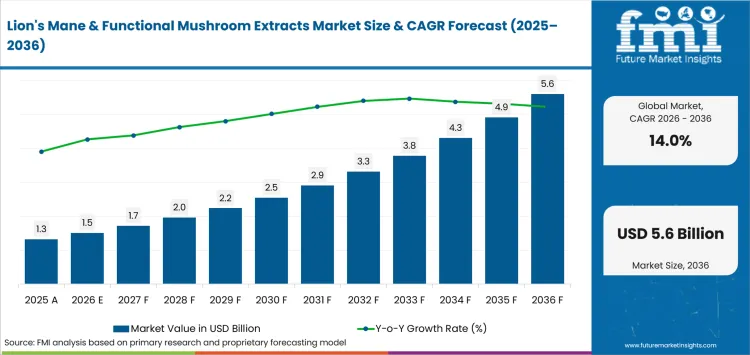
USD 1.5 billion in 2026 and USD 5.6 billion by 2036 at a 14.0% CAGR.
Demand for lion's mane & functional mushroom extracts is estimated to increase valuation from USD 1.5 billion in 2026 to USD 5.6 billion by 2036 at 14.0% CAGR due to wider commercial use of standardized extracts. Commercial demand across functional mushroom formulations increasingly rewards verified species identity and declared active content. The FDA convened a public meeting in March 2026 on ingredient scope and new production methods for dietary supplements. The meeting covered microbials and precision fermentation, which directly affect fungal compounds developed through newer manufacturing routes. Companies developing nutraceutical ingredients therefore need reproducible assays and defensible labels to support recurring orders for unfamiliar concentrated materials.
United States demand benefits from a mature supplement channel and widespread familiarity with daily wellness products. NCHS reported in May 2026 that 60.2% of American adults used a dietary supplement during August 2021 through August 2023. The established user base supports dietary supplement formats, but concentrated fungal materials require ingredient-specific substantiation. Cultivated mycelium strains may follow different legal routes from familiar fruiting-body extracts across mushroom supplement products. Commercial programs must separate general supplement access from legal ingredient status and supported claim language in every intended channel. Supplement developers can reduce launch risk through strain records and validated specifications that remain consistent from ingredient qualification through finished-product release.
Key Takeaways of Lion's Mane & Functional Mushroom Extracts Market
- Demand is supported by wider supplement use and stronger preference for fungal ingredients with documented identity and active composition.
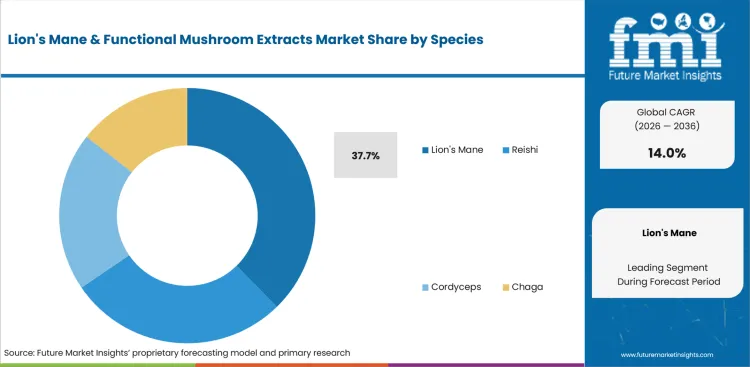
- Lion's mane is expected to account for 37.7% of species revenue in 2026, supported by familiar cognition positioning across several supplement formats.
- Erinacines are projected to represent 62.6% share in 2026, attributable to measurable differentiation within cultivated mycelium preparations.
- Cognition is anticipated to capture 47.9% share in 2026, driven by daily-use capsules and beverage powders developed for focus support.
- Authentication gaps and country-specific ingredient rules remain material constraints for extract manufacturers and finished-product developers across regulated channels.
- Competition includes Nammex; Real Mushrooms; M2 Ingredients; Sempera Organics; Grape King Bio Ltd; Novelara; Fungi Perfecti LLC; and Hifas da Terra.
Analyst Perspective
"Commercial value in lion's mane and functional mushroom extracts depends on proving what each batch contains. Species records must distinguish fruiting-body extracts from cultivated mycelium, and active testing must match the exact material used in the finished product. Companies that connect verified identity with stable erinacine or beta-glucan specifications can compete on repeatable performance instead of broad mushroom claims."
- Nandini Roy Choudhury, Principal Analyst, Future Market Insights
How is the Lion's Mane & Functional Mushroom Extracts Market segmented?
The lion's mane and functional mushroom extracts industry is segmented by species, actives, application, and region.
The market is segmented by species, actives, application, and region across the complete commercial value chain. Species comprises lion's mane, reishi, cordyceps, and chaga across commercial extract portfolios and finished formulation programs. Actives include erinacines and beta-glucans, which require material-specific analytical methods for reliable comparison across manufacturing routes. Application covers cognition, immunity, and energy across supplements, beverages, and other functional formulations sold through regulated channels. Regional analysis evaluates North America, Latin America, Western Europe, Eastern Europe, East Asia, South Asia and Pacific, and the Middle East and Africa. Country differences reflect ingredient status, claim rules, testing expectations, and commercial supply conditions for each intended formulation.
What makes lion's mane central to the species category?
Lion's mane connects a familiar species name with distinct fruiting-body and mycelium chemistry across supplements. Extract manufacturers must document the fungal material entering each batch and the active compounds measured by the finished specification. M2 Ingredients reported new lion's mane toxicology data in November 2025 through its broader safety program. The development strengthens commercial qualification without treating every cultivation and processing method as equivalent during technical review. Reliable beta-glucan ingredients testing remains relevant because starch interference can distort comparisons across mushroom powders and concentrated extracts made through different production routes.
- The lion's mane segment is likely to capture 37.7% share in 2026 attributable to familiar cognition positioning across capsules and beverage powders. Its broad format range gives supplement developers several commercial routes without relying on one active claim or delivery format.
- Quality laboratories favor lion's mane programs that separate fruiting-body markers from mycelium markers across commercial batches. Documented cultivation material and stable analytical methods reduce disputes during scale-up and finished-product release across repeated orders. The same controls also help investigators trace a failed specification to raw material identity or processing variation.
Why do erinacines hold the largest position within the actives category?
Erinacines create a measurable differentiation route for products made from cultivated lion's mane mycelium preparations. Their value depends on verified concentration and low grain carryover rather than a broad mycelium statement. Real Mushrooms launched Real Mycelium in June 2026 with five milligrams of Erinacine A per serving. The launch demonstrates how active disclosure supports clearer comparisons across commercial nootropic supplement formulations and ingredient claims. Commercial laboratories must also confirm that the selected analytical method remains suitable for the finished extract matrix.
- Erinacines are projected to hold 62.6% share in 2026 owing to measurable differentiation in grain-free mycelium preparations. Declared Erinacine A levels support clearer comparisons between active-focused preparations and broadly labeled mushroom powders during ingredient qualification across recurring commercial programs and products.
- Formulation teams adopt erinacine-focused extracts through specifications that state the measured compound and acceptable batch variation. Separate controls for grain carryover and assay suitability protect claim consistency across repeated capsule or beverage production. Separate assay and material controls also reduce the risk of comparing unlike mycelium preparations through one broad ingredient label.
How does cognition shape demand within the application category?
Cognition applications connect lion's mane extracts with capsules and beverage formats designed for focus or healthy aging. Host Defense, the consumer brand of Fungi Perfecti, launched MycoBenefits in March 2025 with a Focus formula containing lion's mane mycelium. The launch shows how a mushroom material becomes a defined daily-use proposition rather than a species name. Demand for cognitive health supplements therefore favors extracts with stable sensory performance and careful structure-function communication. Finished-product developers also need evidence that matches the exact dose and formulation sold in each market.
- The application category is forecast to be led by cognition at 47.9% share in 2026 due to established interest in daily focus and healthy-aging products. Capsules and drink powders provide familiar use routes that support cognition formulations across several retail channels and consumer routines.
- Supplement developers prioritize cognition formulations that combine acceptable flavor with documented active levels and country-appropriate communication. Testing the final dose inside the intended format reduces unsupported claims and costly reformulation during commercial launches. The application route depends on sensory performance and claim discipline rather than species recognition across the finished product.
What are the drivers, restraints, and opportunities in the Lion's Mane & Functional Mushroom Extracts Market?
Demand strengthens through standardized fungal identity and reproducible active disclosure; regulatory boundaries and inconsistent assays limit wider qualification.
- Driver: Standardized identity and active disclosure give formulation teams a repeatable basis for comparing extracts across species and production routes.
- Restraint: Inconsistent methods for species authentication and active measurement increase qualification costs across mushroom powders and concentrated extracts.
- Opportunity: Application-ready extracts can shorten beverage and supplement development through better solubility and sensory control under commercial processing conditions.
Reliable identity records strengthen category demand by giving supplement manufacturers a consistent basis for comparing fungal materials. M2 Ingredients launched United States-made mushroom extracts in May 2025 with domestic cultivation and processing controls. The development gives capsule and beverage developers clearer origin records across repeated production lots and finished formulations. Stable specifications also reduce disputes during ingredient qualification and finished-product release across repeated commercial orders. Documented composition and predictable batch performance help companies gain repeat business in food supplement ingredients used across commercial formulations.
Related fungal species and starch-containing biomass can distort quality comparisons across powders and concentrated extracts. Nammex reported in April 2026 that laboratories need authenticated fungal reference materials and species-specific analytical methods. Limited reference standards raise testing costs and delay approval for companies without internal fungal expertise. A quality laboratory may reject an extract with incomplete taxonomy records despite acceptable formulation performance. Wider use of nutraceutical products therefore requires accessible reference materials and validated analytical methods for commercial qualification.
Application-ready extracts create a practical opening for coffee and beverage products that struggle with flavor or dispersion. M2 Ingredients introduced M2Brew in February 2026 for use in commercial brewing systems and finished beverage programs. The ingredient was designed to pass through filters and maintain cup quality under normal brewing conditions. Beverage developers can reduce reformulation cycles through extracts tested under real processing heat and filtration. The opportunity favors ingredient companies that disclose performance limits and support finished-product validation across commercial production runs.
Which country CAGRs are profiled in the Lion's Mane & Functional Mushroom Extracts Market?
| Country | CAGR |
|---|---|
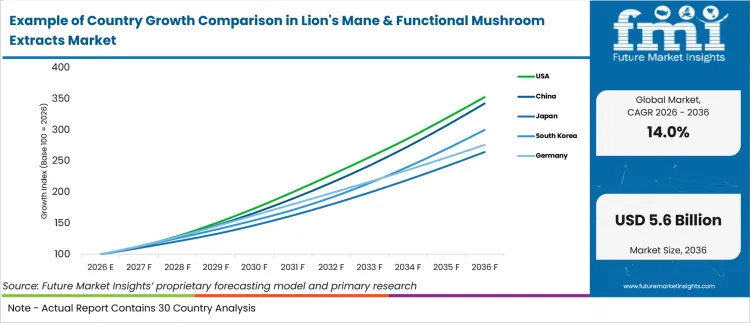
| China | 13.1% |
| South Korea | 11.6% |
| USA | 11.2% |
| Germany | 10.7% |
| Japan | 10.2% |
How do country-level CAGRs compare in the Lion's Mane & Functional Mushroom Extracts Market?
The country comparison spans 2.9 percentage points and reflects distinct legal routes for fungal materials used in foods or supplements. China creates the widest separation from the next forecast through a strain-specific raw material review process. South Korea and the USA form the closest pair with a 0.4-point difference between their approved forecasts. Germany and Japan remain separated by 0.5 point despite different classification and notification systems for functional products. The narrow spacing shows that similar forecasts can conceal materially different commercialization requirements across national channels.
- China's forecast reflects domestic cultivation capacity and a formal new food raw material pathway, but strain-specific decisions can change commercialization plans during development.
- South Korea combines established health functional food distribution with periodic ingredient reassessment, which requires product portfolios capable of absorbing a status change.
- The USA offers broad supplement access and domestic contract manufacturing, yet newer cultivated materials may require a new dietary ingredient notification.
- Germany supports specialist distribution and analytical services, but products near the medicine boundary can face a more demanding classification route.
- Japan provides a visible notification database for Foods with Function Claims, although each operator remains responsible for evidence and compliant product communication.
Comparable forecasts do not create identical entry conditions across countries with different ingredient status and claim systems. Companies must align strain identity and extraction records with local legal routes to prevent costly reformulation or delayed commercialization. The full report provides country-level CAGR analysis across North America and Latin America alongside Europe and East Asia. It also covers South Asia and Oceania together with the Middle East and Africa for a broader regional comparison.
Country-wise Analysis
- China requires a new food raw material review for cultivated fungal strains that lack established lawful use in finished foods. The National Health Commission accepted an application for Hericium erinaceus BCRC35669 mycelium in February 2025 through its formal review system. Adoption of functional mushroom extracts in China is estimated to expand at 13.1% CAGR through 2036, supported by domestic cultivation capacity and formal strain-specific review. The agency denied that application in July 2025 and confirmed the commercial risk attached to strain-specific approvals. Domestic fermentation capacity supports scale, but a negative decision can strand formulation work and dedicated production planning. Extract manufacturers therefore need complete strain records and alternative ingredient routes for products intended across several Chinese sales channels.
- South Korea combines a developed health functional food channel with periodic reassessment of approved mushroom ingredients. South Korea's functional mushroom extract outlook is anticipated to advance at 11.6% CAGR over the assessment period, reinforced by established functional-food distribution and familiar consumer formats. The Ministry of Food and Drug Safety proposed removing reishi fruiting-body extract from functional ingredient status in July 2025. The proposal shows that established commercial use does not eliminate the risk of later safety-based reassessment. Organized retail and familiar dosage formats support adoption, but a status change can disrupt several products using the same ingredient. Local regulatory monitoring and reformulation capacity therefore determine whether a portfolio can preserve access during a classification change.
- United States brands reach consumers through supplement retail and direct online channels under a defined federal ingredient framework. Domestic cultivation and contract extraction provide shorter technical feedback loops for formulation and finished-product testing. The FDA released educational materials on the new dietary ingredient notification process in June 2025 for manufacturers preparing submissions. The American functional mushroom extracts sector is projected to record 11.2% CAGR during the assessment period, aided by broad supplement access and domestic contract manufacturing. The guidance gives newer mycelium preparations a clearer submission route, but ingredient history remains a material commercialization friction. Successful programs combine domestic supply with safety records that match the exact strain and intended consumer use.
- Germany applies European food law alongside national review for products near the boundary between foods and medicinal products. The Federal Office of Consumer Protection and Food Safety reconstituted its borderline expert commission in March 2025. Functional mushroom extract sales in Germany are forecast to expand at 10.7% CAGR by 2036, shaped by established supplement distribution and specialized analytical services. The commission gives German authorities a formal route for difficult classification questions involving food ingredients and therapeutic positioning. Specialist distributors and analytical laboratories support commercialization, but therapeutic wording can redirect the legal pathway and delay market entry. Manufacturers need claim language and composition records that remain defensible across European and German enforcement expectations.
- Japan permits Foods with Function Claims through a notification system that assigns evidence responsibility to each business operator. Functional mushroom extract demand in Japan is forecast to rise at 10.2% CAGR over the forecast period, influenced by organized retail channels and familiar functional products. The Consumer Affairs Agency renewed its functional foods notification database in April 2025 for current product filings. The database provides a visible submission route, yet notification does not transfer substantiation responsibility to the regulator. Organized retail and familiar functional products support adoption across capsules and powders used in daily wellness routines. Commercial success depends on evidence and consumer communication that match the exact ingredient and finished formulation.
Who are the notable companies in the Lion's Mane & Functional Mushroom Extracts Market?
Nammex, Real Mushrooms, M2 Ingredients, Sempera Organics, Grape King Bio Ltd, Novelara, Fungi Perfecti LLC, and Hifas da Terra are the notable companies shaping this market.
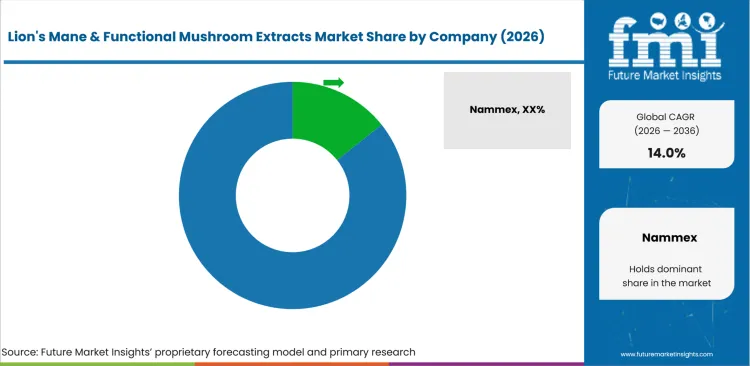
Competition separates extract specialists from consumer supplement developers and mycelium platforms standardized for named actives. Nammex and M2 Ingredients emphasize cultivation records and extract specifications for professional formulation programs across multiple finished formats. Real Mushrooms and Fungi Perfecti translate mushroom materials into branded supplement formats with visible composition and consumer education. Sempera Organics and Hifas da Terra connect fungal production with application research across several finished formats. Grape King Bio and Novelara provide fermentation and active-standardization capabilities for commercial mycelium ingredient programs. Selection of mushroom products depends on verified species identity and fit with the intended finished format.
- Nammex and M2 Ingredients support professional formulation programs through controlled extract sourcing and technical documentation across finished formats. Commercial evaluation centers on verified material identity and reproducible active specifications across repeated production lots.
- Real Mushrooms and Fungi Perfecti address finished supplement channels through broad mushroom portfolios and consumer-facing product formats. Their operating strength combines formulation development with composition disclosure across established branded retail lines and educational programs.
- Sempera Organics and Hifas da Terra connect fungal production with application research across several mushroom ingredient formats. Grape King Bio and Novelara add fermentation-based active platforms supported by strain records and release specifications.
Competitive Benchmarking: Lion's Mane & Functional Mushroom Extracts Market
| Company | Species and Source Control | Active Standardization | Application Support | Geographic Reach |
|---|---|---|---|---|
| Nammex | High | High | Medium | North America |
| Real Mushrooms | High | High | High | North America |
| M2 Ingredients | High | Medium | High | North America |
| Sempera Organics | Medium | Medium | Medium | North America |
| Grape King Bio Ltd | High | High | Medium | East Asia and North American partnerships |
| Novelara | Medium | High | Medium | North American and East Asian partnerships |
| Fungi Perfecti LLC | Medium | Low | High | North America |
| Hifas da Terra | High | High | High | Europe |
Key Developments in the Lion's Mane & Functional Mushroom Extracts Market
- In February 2026, Real Mushrooms acquired Mushroom Science and combined two North American functional mushroom supplement businesses. The transaction added traditional hot-water extraction experience to Real Mushrooms' established quality and distribution platform. The combined operation broadens branded extract availability and practitioner education through one integrated commercial portfolio. Retailers that previously carried both brands may also gain simpler portfolio management and replenishment across their ordering systems.
- In February 2026, M2 Ingredients opened its Center of Innovation for mushroom ingredient research and formulation support. The facility expanded technical resources for sensory work and processing validation across several finished product formats. Customers can evaluate extract behavior inside finished products rather than relying on powder specifications alone. The development strengthens domestic support for beverage and supplement companies using United States-grown functional mushrooms.
- In June 2026, Nammex introduced ErinaPrime through an exclusive partnership with Novelara for standardized lion's mane mycelium. The ingredient uses grain-free mycelium and carries a one percent Erinacine A specification for commercial release. Grape King Bio provides production support through fermentation and dedicated analytical infrastructure located in Taiwan. The launch expands access to active-standardized material for companies seeking measurable differentiation from fruiting-body extracts.
- In December 2025, Hifas da Terra completed the AccelerEAT project with new production evidence for medicinal mushroom extracts. The work evaluated more than five food-industry by-products across extract production processes and measured their effect on active molecules. The project produced more than 50 prototype ingredients with quantified active molecules across the research program. Commercial scale-up requires consistent active profiles and finished-product performance as each revised production process advances beyond pilot production.
Key Players in the Lion's Mane & Functional Mushroom Extracts Market
Extract and Ingredient Specialists
- Nammex
- M2 Ingredients
- Sempera Organics
- Hifas da Terra
Branded Supplement Developers
- Real Mushrooms
- Fungi Perfecti LLC
Mycelium and Active Platforms
- Grape King Bio Ltd
- Novelara
Lion's Mane & Functional Mushroom Extracts Market - Report Scope
| Coverage field | Report scope |
|---|---|
| Market breakdown | Species, actives, application, and region. |
| Quantitative Units | Revenue in USD Million and CAGR in %. |
| Market Definition | Standardized powders and extracts from lion's mane, reishi, cordyceps, chaga, and other functional mushrooms used in supplements or functional formulations. |
| Regions Covered | North America, Latin America, Western Europe, Eastern Europe, East Asia, South Asia and Pacific, and the Middle East and Africa. |
| Countries Covered | China, South Korea, USA, Germany, and Japan. |
| Key Companies Profiled | Nammex, Real Mushrooms, M2 Ingredients, Sempera Organics, Grape King Bio Ltd, Novelara, Fungi Perfecti LLC, and Hifas da Terra |
| Forecast Period | 2026 to 2036. |
| Approach | Hybrid bottom-up and top-down market sizing supported by primary research and official desk research. |
Lion's Mane & Functional Mushroom Extracts Market - Research Methodology
| Method | Approach |
|---|---|
| Primary Research | FMI analysts gathered input from manufacturers, service providers, technology developers, distributors, end users, procurement teams, and subject-matter experts. Interviews examined purchasing decisions, product or service evaluation, adoption barriers, approval requirements, pricing considerations, and expectations for technical or commercial support. Respondents were also asked what evidence is required before a trial, pilot, or initial order develops into regular purchasing. |
| Desk Research | Desk research covered government statistics, regulatory publications, trade data, industry associations, technical literature, standards, company filings, product information, and official corporate announcements. Sources were reviewed for relevance, publication date, geographic coverage, and consistency with the defined market scope. Claims relating to performance, applications, approvals, capacity, investment, and commercial activity were retained only when supported by credible public evidence. |
| Market Sizing and Forecasting | The market model combined the baseline value with historical performance, segment structure, pricing and volume indicators, adoption levels, company participation, and country-level demand conditions. Forecast assumptions considered economic activity, investment trends, regulatory developments, technology adoption, purchasing cycles, supply availability, and barriers to wider market use. Segment and regional estimates were reconciled before the final market total was calculated. |
| Data Validation | Estimates were checked against multiple independent indicators, including public data, company activity, trade patterns, industry developments, and findings from primary interviews. Validation also tested whether products, services, applications, and company revenues fell within the defined market boundaries. Adjacent categories, unsupported claims, overlapping revenues, and activities without direct market relevance were excluded to reduce double counting and maintain consistency across segments and countries. |
Lion's Mane & Functional Mushroom Extracts Market by Segments
Lion's Mane and Functional Mushroom Extracts Market segmented by species:
- Lion's Mane
- Reishi
- Cordyceps
- Chaga
Lion's Mane and Functional Mushroom Extracts Market segmented by actives:
- Erinacines
- Beta-glucans
Lion's Mane and Functional Mushroom Extracts Market segmented by application:
- Cognition
- Immunity
- Energy
Lion's Mane & Functional Mushroom Extracts Market by Region:
- North America
- United States
- Canada
- Latin America
- Brazil
- Mexico
- Argentina
- Chile
- Western Europe
- Germany
- France
- United Kingdom
- Italy
- Spain
- Benelux
- Nordics
- Eastern Europe
- Poland
- Czech Republic
- Romania
- Hungary
- East Asia
- China
- Japan
- South Korea
- South Asia and Pacific
- India
- ASEAN
- Australia and New Zealand
- Middle East and Africa
- GCC Countries
- South Africa
- Türkiye
- Israel
Research Sources and Bibliography
- Stierman, B., Couch, C. A., Gahche, J. J., & Mishra, S. (2026, May). Dietary supplement use: United States, August 2021-August 2023.
- USA Food and Drug Administration. (2026, March 27). Public meeting exploring the scope of dietary supplement ingredients.
- USA Food and Drug Administration. (2025, June 11). FDA releases educational materials on the new dietary ingredient notification process for dietary supplements.
- National Health Commission of the People’s Republic of China. (2025, February 14). 2025年02月14日新食品原料受理情况公告 [Announcement on the acceptance of new food raw material applications on February 14, 2025].
- National Health Commission of the People’s Republic of China. (2025, July 9). 2025年07月09日新食品原料不予行政许可决定书信息送达 [Delivery of decisions denying administrative permission for new food raw materials on July 9, 2025].
- Consumer Affairs Agency. (2025, April 1). 機能性表示食品制度届出データベースを更改しました [The Foods with Function Claims notification database was renewed].
- Ministry of Food and Drug Safety. (2025, July 23). 「건강기능식품의 기준 및 규격」 일부개정고시(안) 행정예고(공고 제2025-318호. 2025.7.23.) [Advance notice of a partial amendment to the standards and specifications for health functional foods].
- Federal Office of Consumer Protection and Food Safety. (2025, March 11). Im Grenzbereich zwischen Arznei- und Lebensmitteln [At the boundary between medicinal products and foods].
- Nammex. (2026, April 16). Nammex highlights urgent need for authenticated fungal reference materials at ICSB 2026.
- Nammex Team. (2026, June 1). Nammex introduces ErinaPrime™ pure Lion’s Mane mycelium ingredient free of grain or fillers through exclusive partnership with Novelara.
- Real Mushrooms. (2026, June 22). Real Mushrooms® debuts Real Mycelium™, a pure Lion's Mane mycelium supplement delivering a clinically verified dose of Erinacine A.
- Real Mushrooms. (2026, February 26). Real Mushrooms® acquires Mushroom Science, uniting to advance integrity and transparency in functional mushroom supplements.
- M2 Ingredients. (2025, May 12). M2 Ingredients launches US-made mushroom extracts to meet growing demand.
- M2 Ingredients. (2025, November 14). Raising the bar on safety: New toxicology data for Lion’s Mane and Turkey Tail-and how it builds on our Reishi and Cordyceps safety studies.
- M2 Ingredients. (2026, February 3). Grand opening: M2 Center of Innovation.
- M2 Ingredients. (2026, February 25). M2Brew: A breakthrough for brewed functional coffee.
- Sempera Organics. (2025, March 5). Sempera's clinical study cited in UK's Telegraph.
- Fungi Perfecti, LLC. (2025, March 17). Host Defense introduces MycoBenefits: A new line of mushroom mycelium supplements.
- Equipo Editorial Hifas. (2026, February 20). The AccelerEAT Project concludes its implementation with significant results for Hifas da Terra.
This bibliography is provided for reader reference and is not exhaustive. The full report contains the complete reference list and detailed citations
This Report Answers
- How large is the lion's mane and functional mushroom extracts market in 2026 and 2036?
- Which identity and testing requirements support repeat purchasing across functional mushroom extracts?
- Why does lion's mane account for the largest species share in 2026?
- How do erinacines create differentiation within cultivated mycelium products?
- Why does cognition represent the largest application share in 2026?
- How do national ingredient rules affect commercialization across China, South Korea, the USA, Germany, and Japan?
- Which companies provide standardized extracts, consumer formats, or active-focused mycelium platforms?
- What limits reliable comparison across mushroom powders and concentrated extracts?
- How can application-ready extracts support beverage and supplement development?
Frequently Asked Questions
How big is the Lion's Mane & Functional Mushroom Extracts Market in 2026?
The lion's mane & functional mushroom extracts market is valued at USD 1.5 billion in 2026 and is forecast to reach USD 5.6 billion by 2036, supported by wider commercial adoption of standardized extracts with verified species identity and declared active content across supplement, beverage, and functional formulation programs.
What is the CAGR of the Lion's Mane & Functional Mushroom Extracts Market from 2026 to 2036?
The lion's mane & functional mushroom extracts market is projected to grow at a CAGR of 14.0% between 2026 and 2036, supported by growing supplement user demand for documented fungal identity, expanding cognition and immunity formulation programs, and increasing availability of application-ready extracts with stable sensory and active concentration performance.
What is the CAGR of the Lion's Mane & Functional Mushroom Extracts Market from 2026 to 2036?
The lion's mane & functional mushroom extracts market is projected to grow at a CAGR of 14.0% between 2026 and 2036, supported by growing supplement user demand for documented fungal identity, expanding cognition and immunity formulation programs, and increasing availability of application-ready extracts with stable sensory and active concentration performance.
Which actives lead the Lion's Mane & Functional Mushroom Extracts Market?
Erinacines account for 62.6% of the lion's mane & functional mushroom extracts market by actives in 2026, driven by measurable differentiation within grain-free cultivated mycelium preparations, with declared Erinacine A levels supporting clearer comparisons across commercial nootropic supplement formulations during ingredient qualification.
How much will the Lion's Mane & Functional Mushroom Extracts Market add between 2026 and 2036?
The lion's mane & functional mushroom extracts market is set to add USD 4.1 billion between 2026 and 2036, growing from USD 1.5 billion to USD 5.6 billion as standardized species identity records, expanding active-disclosure requirements, and application-ready extract innovation across beverages and capsules accelerate commercial adoption globally.
Who are the leading companies in the Lion's Mane & Functional Mushroom Extracts Market?
Leading companies in the lion's mane & functional mushroom extracts market include Nammex, M2 Ingredients, Sempera Organics, Hifas da Terra, Real Mushrooms, Fungi Perfecti, Grape King Bio, and Novelara, competing across extract and ingredient specialist platforms, branded supplement development, and mycelium and active standardization systems with North American, European, and East Asian reach.
Preview the report firsthand - request a free sample
Get SampleGet the brochure for pricing and purchase details.
Get PDFTable of Content
- Key Takeaways
- Market Size and CAGR
- Top Growth Driver
- Fastest Growing Segment
- Leading Region
- Key Companies
- Emerging Opportunities
- Executive Summary
- Global Market Outlook
- Demand-side Trends
- Supply-side Trends
- Technology Roadmap Analysis
- Analysis and Recommendations
- Analyst Perspective (What is happening? Why now? What should investors know?)
- Key Questions Answered
- How large is the market?
- What is the CAGR?
- What are key trends?
- Which region dominates?
- Who are the leaders?
- Market Overview
- Market Coverage / Taxonomy
- Market Definition / Scope / Limitations
- Research Methodology
- Chapter Orientation
- Analytical Lens and Working Hypotheses
- Market Structure, Signals, and Trend Drivers
- Benchmarking and Cross-market Comparability
- Market Sizing, Forecasting, and Opportunity Mapping
- Research Design and Evidence Framework
- Desk Research Programme (Secondary Evidence)
- Expert Input and Fieldwork (Primary Evidence)
- Tooling, Models, and Reference Databases
- Data Engineering and Model Build
- Quality Assurance and Audit Trail
- Market Background
- Market Dynamics (Drivers, Restraints, Opportunity, Trends)
- Scenario Forecast (Optimistic, Likely, Conservative)
- Impact Analysis
- AI Impact
- Sustainability Impact
- Regulatory Impact
- Technology Impact
- Consumer / Buyer Analysis
- Purchase Drivers
- Adoption Barriers
- Buyer Journey
- Opportunity Map Analysis
- Product Life Cycle Analysis
- Supply Chain Analysis
- Investment Feasibility Matrix
- Value Chain Analysis
- PESTLE and Porter's Analysis
- Regulatory Landscape
- Regional Parent Market Outlook
- Production and Consumption Statistics
- Import and Export Statistics
- Global Market Analysis and Forecast, 2021 to 2036
- Historical Market Size Value (USD Million) Analysis, 2021 to 2025
- Current and Future Market Size Value (USD Million) Projections, 2026 to 2036
- Y-o-Y Growth Trend Analysis
- Absolute $ Opportunity Analysis
- Global Market Pricing Analysis, 2021 to 2036
- Global Market Analysis and Forecast, By Species, 2021 to 2036
- Introduction / Key Findings
- Historical Market Size Value (USD Million) Analysis By Species, 2021 to 2025
- Current and Future Market Size Value (USD Million) Analysis and Forecast By Species, 2026 to 2036
- Lion's Mane
- Reishi
- Cordyceps
- Chaga
- Lion's Mane
- Y-o-Y Growth Trend Analysis By Species, 2021 to 2025
- Absolute $ Opportunity Analysis By Species, 2026 to 2036
- Global Market Analysis and Forecast, By Actives, 2021 to 2036
- Introduction / Key Findings
- Historical Market Size Value (USD Million) Analysis By Actives, 2021 to 2025
- Current and Future Market Size Value (USD Million) Analysis and Forecast By Actives, 2026 to 2036
- Erinacines
- Beta-glucans
- Erinacines
- Y-o-Y Growth Trend Analysis By Actives, 2021 to 2025
- Absolute $ Opportunity Analysis By Actives, 2026 to 2036
- Global Market Analysis and Forecast, By Application, 2021 to 2036
- Introduction / Key Findings
- Historical Market Size Value (USD Million) Analysis By Application, 2021 to 2025
- Current and Future Market Size Value (USD Million) Analysis and Forecast By Application, 2026 to 2036
- Cognition
- Immunity
- Energy
- Cognition
- Y-o-Y Growth Trend Analysis By Application, 2021 to 2025
- Absolute $ Opportunity Analysis By Application, 2026 to 2036
- Global Market Analysis and Forecast, By Region, 2021 to 2036
- Introduction
- Historical Market Size Value (USD Million) Analysis By Region, 2021 to 2025
- Current Market Size Value (USD Million) Analysis and Forecast By Region, 2026 to 2036
- North America
- Latin America
- Western Europe
- Eastern Europe
- East Asia
- South Asia and Pacific
- Middle East & Africa
- Market Attractiveness Analysis By Region
- North America Market Analysis and Forecast, By Country, 2021 to 2036
- Historical Market Size Value (USD Million) Trend Analysis By Market Taxonomy, 2021 to 2025
- Market Size Value (USD Million) Forecast By Market Taxonomy, 2026 to 2036
- By Country
- USA
- Canada
- By Species
- By Actives
- By Application
- By Country
- Market Attractiveness Analysis
- By Country
- By Species
- By Actives
- By Application
- Key Takeaways
- Latin America Market Analysis and Forecast, By Country
- Historical Market Size Value (USD Million) Trend Analysis By Market Taxonomy, 2021 to 2025
- Market Size Value (USD Million) Forecast By Market Taxonomy, 2026 to 2036
- By Country
- Brazil
- Mexico
- Chile
- Rest of Latin America
- By Species
- By Actives
- By Application
- By Country
- Market Attractiveness Analysis
- By Country
- By Species
- By Actives
- By Application
- Key Takeaways
- Western Europe Market Analysis and Forecast, By Country
- Historical Market Size Value (USD Million) Trend Analysis By Market Taxonomy, 2021 to 2025
- Market Size Value (USD Million) Forecast By Market Taxonomy, 2026 to 2036
- By Country
- Germany
- UK
- Italy
- Spain
- France
- Nordic
- BENELUX
- Rest of Western Europe
- By Species
- By Actives
- By Application
- By Country
- Market Attractiveness Analysis
- By Country
- By Species
- By Actives
- By Application
- Key Takeaways
- Eastern Europe Market Analysis and Forecast, By Country
- Historical Market Size Value (USD Million) Trend Analysis By Market Taxonomy, 2021 to 2025
- Market Size Value (USD Million) Forecast By Market Taxonomy, 2026 to 2036
- By Country
- Russia
- Poland
- Hungary
- Balkan & Baltic
- Rest of Eastern Europe
- By Species
- By Actives
- By Application
- By Country
- Market Attractiveness Analysis
- By Country
- By Species
- By Actives
- By Application
- Key Takeaways
- East Asia Market Analysis and Forecast, By Country
- Historical Market Size Value (USD Million) Trend Analysis By Market Taxonomy, 2021 to 2025
- Market Size Value (USD Million) Forecast By Market Taxonomy, 2026 to 2036
- By Country
- China
- Japan
- South Korea
- By Species
- By Actives
- By Application
- By Country
- Market Attractiveness Analysis
- By Country
- By Species
- By Actives
- By Application
- Key Takeaways
- South Asia and Pacific Market Analysis and Forecast, By Country
- Historical Market Size Value (USD Million) Trend Analysis By Market Taxonomy, 2021 to 2025
- Market Size Value (USD Million) Forecast By Market Taxonomy, 2026 to 2036
- By Country
- India
- ASEAN
- Australia & New Zealand
- Rest of South Asia and Pacific
- By Species
- By Actives
- By Application
- By Country
- Market Attractiveness Analysis
- By Country
- By Species
- By Actives
- By Application
- Key Takeaways
- Middle East & Africa Market Analysis and Forecast, By Country
- Historical Market Size Value (USD Million) Trend Analysis By Market Taxonomy, 2021 to 2025
- Market Size Value (USD Million) Forecast By Market Taxonomy, 2026 to 2036
- By Country
- Kingdom of Saudi Arabia
- Other GCC Countries
- Türkiye
- South Africa
- Other African Union
- Rest of Middle East & Africa
- By Species
- By Actives
- By Application
- By Country
- Market Attractiveness Analysis
- By Country
- By Species
- By Actives
- By Application
- Key Takeaways
- Key Countries Market Analysis
- USA
- Pricing Analysis
- Market Share Analysis, 2025
- By Species
- By Actives
- By Application
- Canada
- Pricing Analysis
- Market Share Analysis, 2025
- By Species
- By Actives
- By Application
- Mexico
- Pricing Analysis
- Market Share Analysis, 2025
- By Species
- By Actives
- By Application
- Brazil
- Pricing Analysis
- Market Share Analysis, 2025
- By Species
- By Actives
- By Application
- Chile
- Pricing Analysis
- Market Share Analysis, 2025
- By Species
- By Actives
- By Application
- Germany
- Pricing Analysis
- Market Share Analysis, 2025
- By Species
- By Actives
- By Application
- UK
- Pricing Analysis
- Market Share Analysis, 2025
- By Species
- By Actives
- By Application
- Italy
- Pricing Analysis
- Market Share Analysis, 2025
- By Species
- By Actives
- By Application
- Spain
- Pricing Analysis
- Market Share Analysis, 2025
- By Species
- By Actives
- By Application
- France
- Pricing Analysis
- Market Share Analysis, 2025
- By Species
- By Actives
- By Application
- India
- Pricing Analysis
- Market Share Analysis, 2025
- By Species
- By Actives
- By Application
- ASEAN
- Pricing Analysis
- Market Share Analysis, 2025
- By Species
- By Actives
- By Application
- Australia & New Zealand
- Pricing Analysis
- Market Share Analysis, 2025
- By Species
- By Actives
- By Application
- China
- Pricing Analysis
- Market Share Analysis, 2025
- By Species
- By Actives
- By Application
- Japan
- Pricing Analysis
- Market Share Analysis, 2025
- By Species
- By Actives
- By Application
- South Korea
- Pricing Analysis
- Market Share Analysis, 2025
- By Species
- By Actives
- By Application
- Russia
- Pricing Analysis
- Market Share Analysis, 2025
- By Species
- By Actives
- By Application
- Poland
- Pricing Analysis
- Market Share Analysis, 2025
- By Species
- By Actives
- By Application
- Hungary
- Pricing Analysis
- Market Share Analysis, 2025
- By Species
- By Actives
- By Application
- Kingdom of Saudi Arabia
- Pricing Analysis
- Market Share Analysis, 2025
- By Species
- By Actives
- By Application
- Türkiye
- Pricing Analysis
- Market Share Analysis, 2025
- By Species
- By Actives
- By Application
- South Africa
- Pricing Analysis
- Market Share Analysis, 2025
- By Species
- By Actives
- By Application
- USA
- Market Structure Analysis
- Competition Dashboard
- Competition Benchmarking
- Market Share Analysis of Top Players
- By Regional
- By Species
- By Actives
- By Application
- Emerging Startups
- Innovation Benchmarking
- Competition Analysis
- Competition Deep Dive
- Nammex
- Overview
- Product Portfolio
- Profitability by Market Segments
- Sales Footprint
- Strategy Overview
- Marketing Strategy
- Product Strategy
- Channel Strategy
- Real Mushrooms
- DÖHLER
- Gencor
- Mycrobez
- Chenland
- Nutra Green
- Nammex
- Case Studies
- Success Stories
- Recent Developments
- Competition Deep Dive
- Assumptions & Acronyms Used


