

- Industry Size (2026)
- USD 101.0 Mn
- Forecast (2036)
- USD 257.2 Mn
- CAGR (2026 to 2036)
- 9.80%
Mushroom-Based Biodegradable Packaging Solutions Market Size, Market Forecast and Outlook By FMI
The mushroom-based biodegradable packaging solutions market was valued at USD 91.9 million in 2025. The sector size is poised to cross USD 101.0 million in 2026 at a CAGR of 9.80% during the forecast period. Continued investment is driving the mycelium packaging market to reach an estimated valuation of USD 257.2 million by 2036, as global electronics and cold-chain companies move away from traditional fossil‑based foams to avoid rising extended producer responsibility tariffs.
Logistics operators and procurement directors are no longer treating fungal composites as pilot-stage novelties, but rather as necessary drop-in substitutes for conventional packaging foam. The decision forced upon them today is whether to radically redesign their secondary transit architecture or qualify organic replacements that match existing shock-absorption parameters. Delaying this EPS replacement with mycelium packaging exposes high-volume shippers to per-kilogram plastic levies that compress distribution margins. The change accelerates aggressively, where strict anti-plastic regulatory frameworks align with expanding commercial composting capabilities, establishing the mushroom packaging market as a critical procurement category.
The critical threshold for self-reinforcing adoption lies in standardizing the regional inoculation and curing networks. Once localized bio-fabrication hubs guarantee uniform drop-test performance across multiple continents simultaneously, multinational brands can confidently execute global phase-outs of synthetic packaging inserts without risking localized transit damage or localized supply shortages. This establishes compostable protective packaging not just as an environmental initiative, but as a derisked operational standard.
Summary of Mushroom-Based Biodegradable Packaging Solutions Market
- Mushroom-Based Biodegradable Packaging Solutions Market Definition
- Functional protective and thermal transit materials cultivated from fungal mycelium bound with organic substrates. It forms a biodegradable alternative to legacy synthetic foams, specifically serving logistics applications where end-of-life disposal is heavily regulated or directly taxed.
- Demand Drivers in the Market
- Escalating extended producer responsibility tariffs compel transit logistics managers to qualify non-fossil void fill to protect regional distribution margins.
- Corporate zero-waste mandates force procurement heads at consumer electronics firms to secure eco-friendly packaging alternatives to polystyrene that meet identical drop-test standards.
- Brand-led sustainable unboxing initiatives drive packaging design leads to source visually distinct organic materials that signal environmental commitment directly to the end consumer.
- Key Segments Analyzed in the FMI Report
- Pure mycelium composite: Pure mycelium composite is poised to account for 46.0% share in 2026, as its established performance validation profile makes it the most derisked option for immediate enterprise substitution.
- End caps & corner blocks: End caps & corner blocks are anticipated to hold 41.0% share in 2026, directly targeting the highest-volume application of legacy expanded polystyrene in heavy appliance transit.
- Consumer electronics: Consumer electronics is expected to garner 29.0% share in 2026, driven by high-value unboxing requirements and strict corporate decarbonization timelines.
- Direct B2B custom projects: Direct B2B custom projects is estimated to capture 72.0% share in 2026, reflecting the current operational necessity of engineering specific molds for exact product geometries.
- Shock absorption: Shock absorption is likely to secure 38.0% share in 2026, matching the primary operational function previously dominated by synthetic foams.
- United Kingdom: 11.3% compound growth, reflecting immediate commercial pressure from active plastic packaging tax enforcement and a mature local bio-fabrication network.
- Analyst Opinion at FMI
- Ismail Sutaria, Principal Analyst, Packaging, at FMI, estimates, "The standard corporate sustainability metric captures total volume of renewable materials sourced, but it entirely misses the actual operational bottleneck: curing time. While procurement teams model a rapid phase-out of expanded polystyrene based on approaching cost parity, the clock runs on the physical limitations of fungal biology. You cannot accelerate mycelium growth with a budget increase, meaning companies that fail to secure licensed regional capacity today will find themselves locked out of bio-composites when packaging taxes hit their critical threshold."
- Strategic Implications / Executive Takeaways
- Packaging procurement directors must lock in regional bio-fabrication capacity to ensure supply continuity before escalating plastic taxes trigger mass market conversion.
- Cold-chain logistics operators should initiate multi-season thermal validation for fungal shippers to avoid being trapped in legacy fossil-foam systems as outright disposal bans take effect.
- Bio-composite formulators face a scaling constraint that requires transitioning from centralized growing hubs to localized, licensed inoculation facilities positioned near major manufacturing centers.
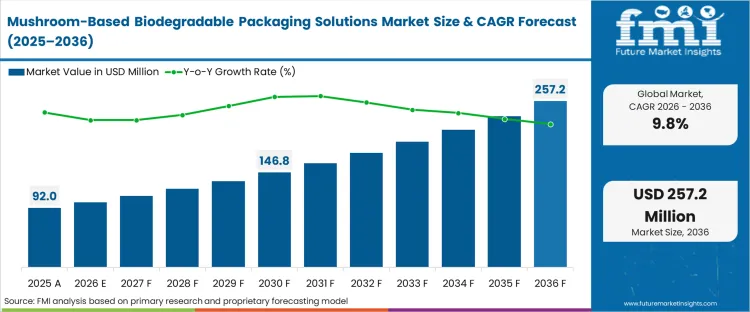
Mushroom-Based Biodegradable Packaging Solutions Market Key Takeaways
| Metric | Details |
|---|---|
| Industry Size (2026) | USD 101.0 million |
| Industry Value (2036) | USD 257.2 million |
| CAGR (2026-2036) | 9.80% |
Source: Future Market Insights (FMI) analysis, based on proprietary forecasting model and primary research
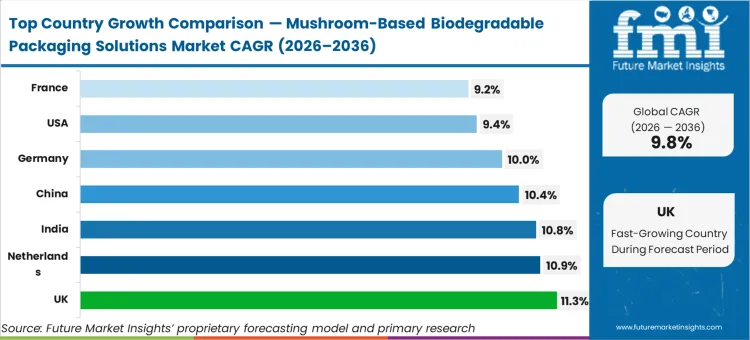
The United Kingdom is expected to advance at 11.3%, driven by near-term substitution pressure from explicit plastic packaging tax frameworks. The Netherlands follows closely, projected to expand at 10.9% as its commercial bio-fabrication ecosystem matures. India is estimated to record a 10.8% trajectory as compliance pressure intensifies across its massive consumer goods export sector. China is set to track at 10.4%, supported by large transit volumes transitioning toward organic composites. Germany is anticipated to post a 10.0% CAGR, reflecting industrial demand for premium protective formats driven by waste reduction mandates. The United States is likely to grow at 9.4%, benefiting from a substantial innovation base. France follows at 9.2%. The variation across these regions is driven by how strongly national waste regulations penalize fossil‑based void fill while rewarding the adoption of organic alternatives.
Mushroom-Based Biodegradable Packaging Solutions Market Definition
The mushroom-based biodegradable packaging solutions market encompasses protective and insulated transit materials cultivated from fungal networks bound with agricultural or organic waste substrates. It is defined functionally as a direct, home-compostable replacement for expanded polystyrene and polyurethane foams in demanding shipping applications, clearly distinguished from general flexible bioplastics by its rigid, shock-absorbing integrity. It serves as the best alternative to Styrofoam packaging for high-value transit.
Mushroom-Based Biodegradable Packaging Solutions Market Inclusions
Scope inclusions cover pure fungal structures, hemp or agricultural waste composites, and moisture-managed components engineered explicitly for product protection, thermal insulation, or void fill. Revenue accounts for custom-grown foam packaging inserts, end caps, thermal shippers, and the licensing models required to produce these geometries regionally at commercial scale.
Mushroom-Based Biodegradable Packaging Solutions Market Exclusions
Flexible films, polylactic acid rigid containers, standard molded fiber packaging formats lacking a fungal binder, and edible mushroom products are explicitly excluded. These categories bypass the biological inoculation and curing processes that define true mycelium composites, serving different functions in the primary consumer packaging layer rather than heavy-duty industrial transit.
Mushroom-Based Biodegradable Packaging Solutions Market Research Methodology
- Primary Research: Procurement directors at tier-1 consumer electronics brands and cold-chain logistics sustainability officers were interviewed to map qualification timelines and volume transition targets.
- Desk Research: European and North American extended producer responsibility registries, alongside mycelium packaging certification frameworks, were aggregated to establish regulatory cost-parity thresholds.
- Market-Sizing and Forecasting: The baseline anchors to the verifiable displacement volume of expanded polystyrene within premium appliance transit and pharmaceutical cold-chain corridors.
- Data Validation and Update Cycle: Forecasts were cross-validated against regional production capacity expansions announced by licensed bio-fabricators and pilot facility curing throughput data.
Segmental Analysis
Mushroom-Based Biodegradable Packaging Solutions Market Analysis by Material type
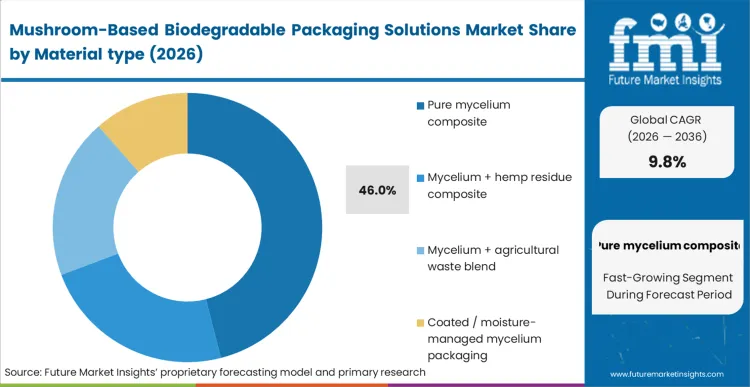
The key reason pure mycelium composite holds 46.0% of this segment is not aesthetic preference, but the unforgiving nature of enterprise drop-test protocols. Logistics engineers refuse to accept the mechanical variance often found in heterogeneous substrate blends when shipping high-value fragile goods. Pure composites deliver the predictable energy dissipation required to substitute expanded polystyrene on a one-to-one thickness ratio. Buyers specifying biodegradable packaging for transit cannot tolerate a 5% failure rate to achieve a sustainability target. They demand exact shock-absorption parity. The commercial outcome for procurement teams who attempt to use unverified material blends is an immediate spike in return-merchandise authorizations, forcing a costly retreat to legacy synthetics.
- Predictability: Pure fungal matrices provide uniform density profiles across molded geometries. Logistics managers secure consistent drop-test performance without expanding the external dimensions of their shipping cartons.
- Qualification: Enterprise procurement frameworks mandate minimum viable performance data before vendor onboarding. Engineering teams bypass lengthy internal testing phases by specifying the most extensively documented organic substrate available.
- Standardization: Global appliance manufacturers require identical protective characteristics regardless of the geographic origin of the packaging. Supply chain directors lock in pure composites to ensure standard handling procedures across fragmented international distribution networks.
Mushroom-Based Biodegradable Packaging Solutions Market Analysis by Packaging format
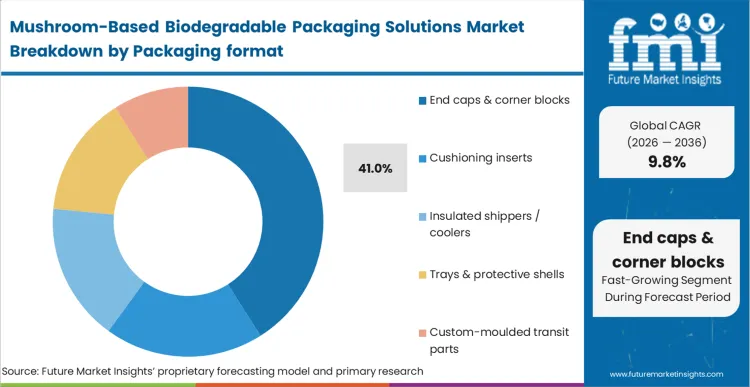
End caps and corner blocks capture 41.0% of the format segment because they directly attack the highest volume, most heavily penalized application of legacy transit foams. Based on FMI's assessment, consumer appliance manufacturers face an immediate operational reality: standard sustainable packaging alternatives like corrugated cardboard cannot adequately brace a 40-kilogram appliance against shear forces during intermodal transport. Organically grown corner blocks absorb these precise rotational impacts without cracking. The decision pattern for logistics buyers has shifted from seeking a universal box replacement to surgically replacing the specific interior components that trigger the highest extended producer responsibility tariffs. Appliance brands that delay qualifying mycelium end caps and corner blocks face escalating taxation on their heaviest packaging components, directly degrading unit profitability.
- Shear resistance: Custom-grown organic corner bracing distributes rotational impact energy more effectively than folded paperboard. Distribution centers eliminate transit damage on heavy white goods without reverting to fossil-based polymers.
- Friction reduction: Molded fungal composites maintain surface integrity under vibration without scratching premium appliance finishes. Quality assurance teams avoid the secondary protective wrapping steps previously required with abrasive molded pulp alternatives.
- Geometry matching: Bio-fabrication allows for complex negative-space molding that perfectly contours to asymmetrical product designs. Industrial designers maintain complex product shapes without sacrificing transit protection or increasing box volume.
Mushroom-Based Biodegradable Packaging Solutions Market Analysis by End-use industry
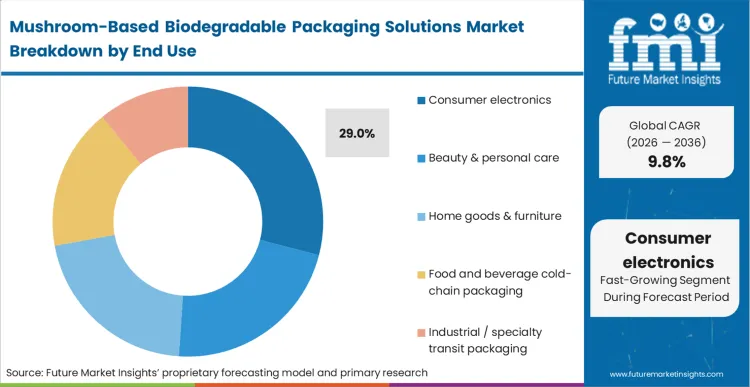
Consumer electronics brands are being asked to decide right now whether their premium unboxing experience justifies the escalating regulatory penalties of synthetic void fill. FMI analysts estimate that consumer electronics is set to lead with 29.0% share because the margin of premium devices can easily absorb the current unit-cost premium of mycelium packaging. These companies are not waiting for price parity; they are buying the physical manifestation of corporate decarbonization to present directly to their end users. The operational advantage is the ability to hit aggressive zero-waste-to-landfill targets without compromising the integrity required to ship delicate circuitry globally. Electronics brands that cling to legacy foams face reputational risk and eventual exclusion from municipal waste streams in advanced regulatory markets, cementing the need for mycelium packaging for electronics.
- Margin tolerance: High-value hardware absorbs the bio-fabrication premium without altering retail pricing strategies. Brand managers transition away from synthetics without requiring approval from cost-reduction committees to procure sustainable packaging for electronics shipping.
- Aesthetic signaling: The distinct, organic visual texture of fungal composites communicates sustainability immediately upon opening. Marketing directors convert the transit layer into a core component of the premium brand narrative.
- Disposal compliance: Organic transit materials integrate seamlessly into municipal home-composting guidelines. Product managers eliminate end-user friction regarding complex recycling instructions, increasing overall customer satisfaction.
Mushroom-Based Biodegradable Packaging Solutions Market Analysis by Sales model
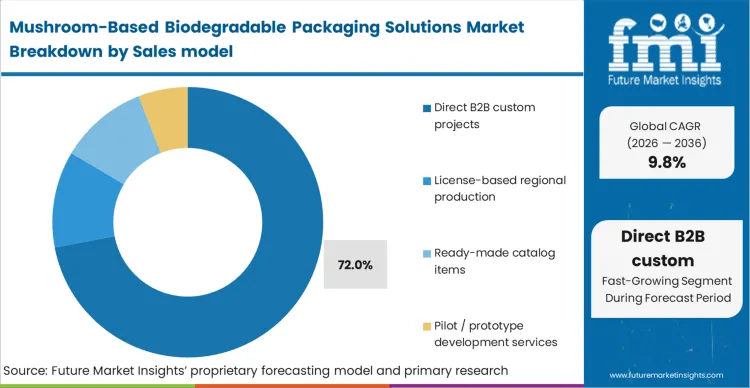
The necessity of engineering specific molds for exact product geometries dictates why direct B2B custom projects command 72.0% of the sales model segment. The buyer in this segment is an industrial packaging engineer who must integrate the biological curing shrinkage rate into their precise computer-aided design tolerances. This constraint forces an intimate, long-term co-development relationship between the brand and the bio-fabricator to deploy custom molded mycelium packaging. Buyers who fail to initiate these custom engineering projects early find themselves paralyzed, unable to source adequate volumes of generic moulded fibre pulp packaging when sudden regulatory deadlines compel them to abandon expanded polystyrene.
- Tolerance engineering: Custom B2B contracts account for the exact shrinkage dynamics of fungal networks during the dehydration phase. Packaging engineers guarantee millimeter-perfect friction fits for highly sensitive equipment.
- Volume allocation: Direct contracts secure dedicated regional curing capacity ahead of actual production runs. Supply chain directors insulate their operations from the material shortages expected as broader industrial transition accelerates.
- Iterative validation: Co-development allows for multi-stage drop-testing and density adjustments during the mold design phase. Quality control managers ensure the final biological composite meets exact specifications before committing to global rollout.
Mushroom-Based Biodegradable Packaging Solutions Market Analysis by Function
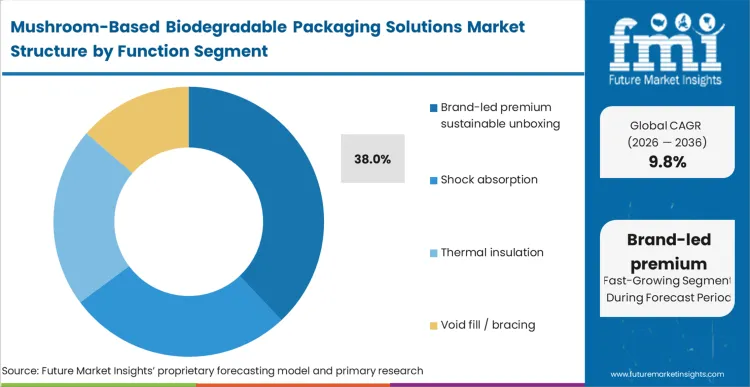
The commercial outcome for a logistics network that loses its shock absorption capability is immediate distribution paralysis, which explains why this function holds 38.0% of the market. Protective packaging buyers specify fungal composites explicitly because the cellular structure of the dried mycelium mimics the impact-dissipation mechanics of legacy synthetics. The operational consequence of this choice is the ability to drop home-compostable protective packaging directly into existing fulfillment workflows without recalibrating automated handling equipment or changing box dimensions. Procurement directors who compromise on shock absorption to achieve a lower price point inevitably trigger downstream damage claims that eclipse any initial material savings.
- Impact dissipation: The chitin-based cellular matrix crushes under extreme force, absorbing kinetic energy rather than transferring it to the product. Logistics operators maintain acceptable damage rates in high-velocity courier networks.
- Workflow continuity: Dimensionally stable organic components slot perfectly into existing automated packing lines. Fulfillment center managers avoid costly equipment modifications when transitioning away from legacy expanded polystyrene.
- Vibration dampening: Fungal networks resist the high-frequency vibrations inherent in long-haul freight transport. Electronics distributors prevent microscopic component fracturing during intercontinental transit.
Mushroom-Based Biodegradable Packaging Solutions Market Drivers, Restraints, and Opportunities
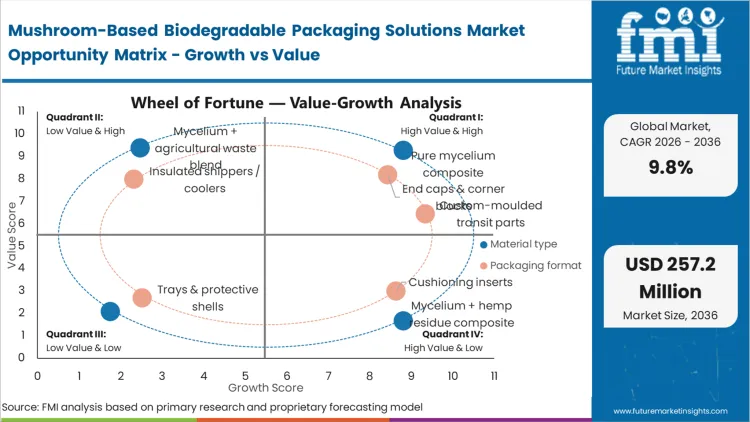
Extended producer responsibility frameworks in European and North American markets penalise mixed-material and fossil-based packaging, compelling logistics managers to qualify home-compostable alternatives. These imperative forces procurement directors at consumer appliance and electronics firms to abandon expanded polystyrene and secure regional supplies of organic composites from established mushroom packaging vendors for e-commerce shipping. Failing to qualify these materials exposes large-scale shippers to per-kilogram plastic levies that rapidly erode distribution margins. The commercial stakes require immediate validation of fungal transit components to ensure compliance before taxation thresholds tighten further.
The single biggest buyer friction is the biological curing timeline inherent in fungal fabrication, which heavily impacts the mycelium packaging cost vs EPS calculation at scale. Unlike thermoplastic injection molding which scales production instantly through additional shifts, growing a protective composite requires days of controlled environmental incubation. This biological bottleneck prevents rapid response to sudden demand spikes or seasonal shipping surges. While regional licensing models attempt to distribute this curing burden closer to the point of use, logistics directors must restructure their procurement calendars to account for organic lead times, rather than relying on just-in-time synthetic foam deliveries.
Opportunities in the Mushroom-Based Biodegradable Packaging Solutions Market
- Cold-chain insulation: The inherent thermal resistance of dense fungal matrices creates a natural substitution pathway for polyurethane shippers. Pharmaceutical logistics operators capture this opportunity by validating mycelium-based solutions for temperature-sensitive biologics, bypassing single-use plastic bans in critical medical transit lanes.
- Licensing expansion: The high volumetric cost of shipping empty protective packaging forces production localization. Material science firms unlock exponential revenue by licensing their proprietary fungal strains and molding technologies to regional packaging converters rather than exporting bulk compostable protective inserts.
- Agri-waste valorization: Access to low-cost regional agricultural byproducts allows bio-fabricators to stabilize substrate input costs. Supply chain strategists co-locate inoculation facilities near major agricultural hubs, creating a cost-advantaged closed-loop raw material pipeline.
Regional Analysis
.webp "Top Country Growth Comparison Mushroom Based Biodegradable Packaging Solutions Market Cagr (2026 2036)")
As per the regional analysis, the Mushroom-Based Biodegradable Packaging Solutions market is segmented into North America, Europe, and the Asia Pacific across 40 plus countries.
| Country | CAGR (2026 to 2036) |
|---|---|
| United Kingdom | 11.3% |
| Netherlands | 10.9% |
| India | 10.8% |
| China | 10.4% |
| Germany | 10.0% |
| United States | 9.4% |
| France | 9.2% |
Source: Future Market Insights (FMI) analysis, based on proprietary forecasting model and primary research
Europe Mushroom-Based Biodegradable Packaging Solutions Market Analysis
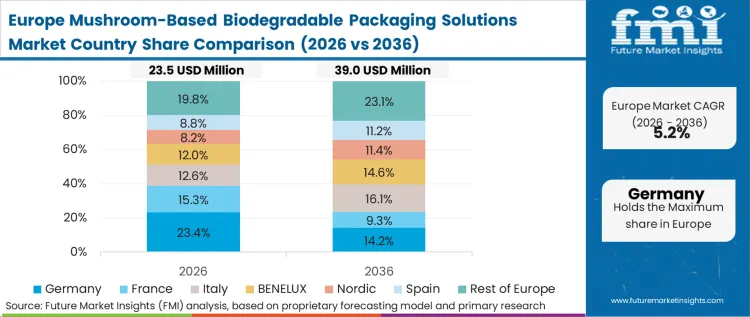
Europe's policy-led transition enforces the adoption of home-compostable transit materials through aggressive extended producer responsibility fee modulation, cementing the dominance of the Europe mycelium packaging market. Rather than relying on corporate goodwill, logistics directors across the continent evaluate bio-composites strictly as a mechanism to evade punitive levies on expanded polystyrene. According to FMI's estimates, this localized regulatory pressure has cultivated the most mature bio-fabrication infrastructure globally, moving the operational challenge from material validation to securing sufficient incubation capacity before outright bans on single-use fossil foams materialize.
- United Kingdom: The explicit implementation of the Plastic Packaging Tax creates an immediate, quantifiable cost differential between legacy foams and organic alternatives. Logistics managers running British distribution routes are systematically stripping out synthetic void fill to stay below taxation thresholds. Over the forecast period, mushroom packaging in the UK is set for a CAGR of 11.3%. UK mushroom packaging companies that move first capture preferred supplier status in procurement frameworks that are unlikely to reopen once initial bio-vendors are qualified.
- Netherlands: FMI estimates the segment in the Netherlands to expand at an annual growth rate of 10.9%. A highly concentrated agricultural sector provides bio-fabricators with an uninterrupted, low-cost supply of high-quality substrate. Procurement heads leverage this localised supply chain to secure high-volume protective inserts without exposure to international freight volatility. This mature ecosystem positions Dutch converters as the primary export hub for specialized fungal molds into adjacent European manufacturing centres.
- Germany: Germany's updated packaging waste directives severely penalize heavy industrial transit packaging that cannot be easily composted or recycled. Automotive and appliance manufacturers must integrate bio-composites into their heavy-duty shipping crates to avoid compounding disposal fees. The German market for organic protective solutions is likely to post a CAGR of 10.0%. Operations heads who successfully validate these materials eliminate their exposure to future regulatory waste audits.
- France: The French landscape is set to achieve a CAGR of 9.2%. Aggressive anti-waste legislation forces premium beauty and fashion brands to eliminate all single-use plastics from their direct-to-consumer shipping channels. Brand managers specify rigid organic inserts to maintain a premium unboxing aesthetic while ensuring strict compliance with national compostability mandates. The transition establishes a new baseline for luxury e-commerce packaging that competitors in adjacent European markets are forced to emulate.
FMI's report includes secondary European markets currently upgrading their municipal composting infrastructure. The speed at which these nations harmonize their extended producer responsibility tariffs with the EU average dictates the next wave of regional bio-fabrication facility investments.
Asia Pacific Mushroom-Based Biodegradable Packaging Solutions Market Analysis
The dynamic in the Asia Pacific is defined by the massive scale of its export manufacturing base colliding with the sustainability demands of its Western clients. Procurement directors at Asian assembly hubs do not adopt organic transit materials to satisfy domestic policy; they adopt them to prevent their consumer electronics and appliance exports from being blocked at European and North American ports. Based on FMI's assessment, this buyer behaviour forces rapid qualification cycles, demanding that localised bio-fabricators scale their curing operations to match the immense output of tier-1 contract manufacturers.
- India: Massive volumes of consumer goods exports require immediate compliance with international packaging directives to maintain access to lucrative Western retail networks. Supply chain directors are aggressively qualifying organic protective blocks to replace expanded polystyrene in outbound ocean freight. India's industry is expected to demonstrate a CAGR of 10.8%. Securing reliable, high-volume bio-composite supply allows Indian contract manufacturers to bid aggressively on sustainability-focused global tenders.
- China: China's sector is projected to witness growth at a CAGR of 10.4%. The sheer scale of domestic appliance manufacturing demands localized bio-fabrication capacity that can absorb millions of units per quarter. Operations heads must balance the transition to organic packaging with the necessity of maintaining uninterrupted production line velocities. The operational outcome of this transition is the establishment of massive, highly automated fungal incubation hubs that drive down the global unit cost of organic protective materials.
FMI's report includes emerging Southeast Asian assembly hubs where packaging volumes are expanding rapidly. The trajectory of these markets hinges entirely on their ability to establish domestic bio-fabrication licenses rather than importing bulky finished materials.
North America Mushroom-Based Biodegradable Packaging Solutions Market Analysis
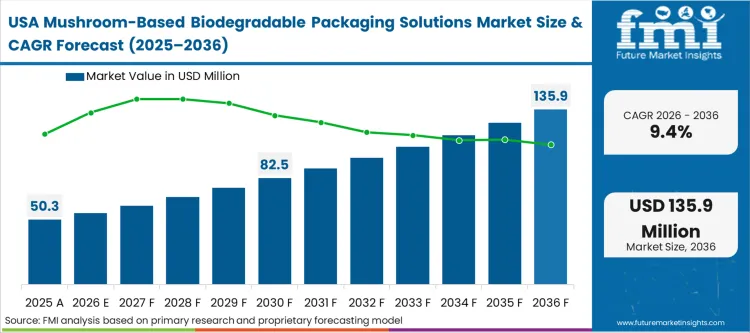
Infrastructure-led constraints define the North American trajectory, as a highly fragmented state-by-state regulatory environment forces brands to engineer packaging for the lowest common denominator of municipal waste management. In FMI's view, corporate sustainability officers at US firms drive adoption to hit internal decarbonization targets, but they must ensure the resulting compostable packaging films and rigid fungal inserts do not contaminate legacy recycling streams. This forces a heavy reliance on distinct, brand-led education initiatives to ensure proper end-of-life disposal by the consumer.
- United States: A CAGR of 9.4% is expected for the sector in the US over the forecast period. The absence of a unified federal extended producer responsibility framework means adoption is driven aggressively by corporate mandates rather than uniform taxation. E-commerce logistics directors deploy organic void fill to satisfy zero-waste commitments, despite uneven industrial composting access across different states. Brands that fail to navigate this fragmented landscape risk triggering localised consumer backlash if organic materials are misdirected into stressed municipal landfills.
FMI's report includes Canadian provincial markets operating under stricter environmental mandates. The dynamic here reflects a faster regulatory push toward organic substitution, closely mirroring the structural pressures seen in Western Europe.
Competitive Aligners for Market Players
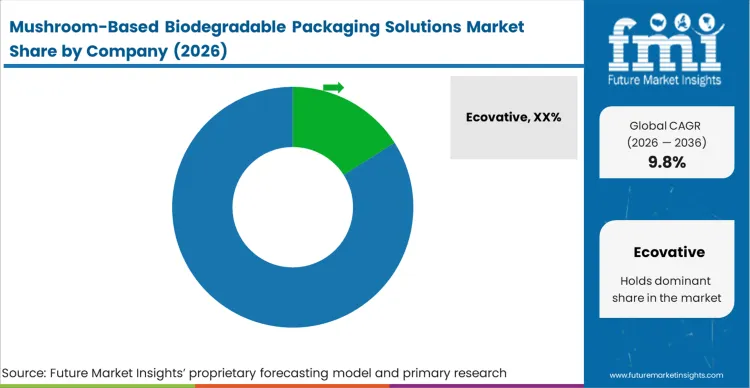
The concentrated nature of this market stems from the formidable biological and intellectual property barriers preventing rapid entry by legacy paper and plastic converters. Leading mushroom packaging companies like Ecovative, Magical Mushroom Company, and MYCO s.r.o. dominate because they control the specific, patented fungal strains and precise environmental curing parameters required to achieve reproducible drop-test performance. Buyers distinguishing between qualified and unqualified mycelium packaging suppliers look immediately past sustainability marketing, requiring verifiable data on incubation failure rates, density consistency, and localized production capacity.
The structural advantage held by incumbents is their established library of pre-engineered molds and optimized substrate recipes. A challenger mushroom packaging manufacturer must build an entirely new biological supply chain—from sourcing specific agricultural waste streams to mastering the delicate dehydration phase that halts fungal growth without compromising structural integrity. Integrating a bio foam insert into an automated fulfillment line demands tolerances that only experienced bio-fabricators can consistently deliver, creating a steep learning curve that protects early movers.
Large consumer electronics and appliance buyers aggressively resist locking themselves into single-source proprietary bio-materials. This structural tension forces leading bio-fabricators to transition from centralized manufacturing to a distributed licensing model, allowing regional packaging converters to utilize proprietary strains. Through 2036, the market will structurally diverge: intellectual property holders will focus on advancing material science and mycelium packaging lifecycle assessment, while localized contract manufacturers will absorb the heavy capital expenditure required to scale physical incubation facilities.
Key Players in Mushroom-Based Biodegradable Packaging Solutions Market
- Ecovative
- Magical Mushroom Company
- GROWN bio
- MYCO s.r.o.
- S.Lab
- Mushroom Material
- BioFab
Scope of the Report
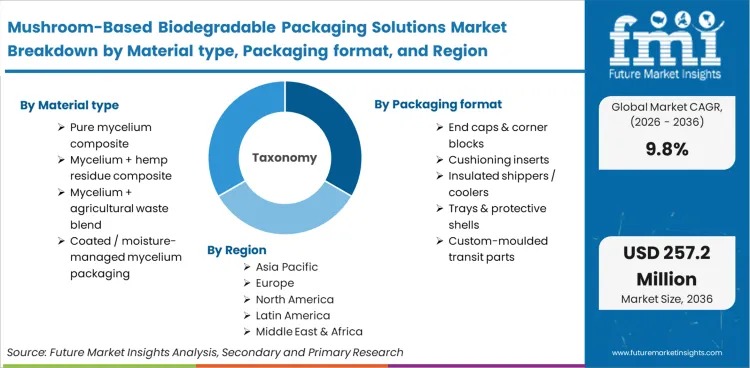
| Metric | Value |
|---|---|
| Quantitative Units | USD 101.0 million to USD 257.2 million, at a CAGR of 9.80% |
| Market Definition | Functional protective and thermal transit materials cultivated from fungal mycelium bound with organic substrates, serving as home-compostable alternatives to legacy synthetic foams. |
| Material type Segmentation | Pure mycelium composite, Mycelium + hemp residue composite, Mycelium + agricultural waste blend, Coated / moisture-managed mycelium packaging |
| Packaging format Segmentation | End caps & corner blocks, Cushioning inserts, Insulated shippers / coolers, Trays & protective shells, Custom-moulded transit parts |
| End-use industry Segmentation | Consumer electronics, Beauty & personal care, Home goods & furniture, Food and beverage cold-chain packaging, Industrial / specialty transit packaging |
| Sales model Segmentation | Direct B2B custom projects, License-based regional production, Ready-made catalog items, Pilot / prototype development services |
| Regions Covered | North America, Europe, Asia Pacific |
| Countries Covered | United States, United Kingdom, Germany, Netherlands, France, China, India, and 40 plus countries |
| Key Companies Profiled | Ecovative, Magical Mushroom Company, GROWN bio, MYCO s.r.o., S.Lab, Mushroom Material, BioFab |
| Forecast Period | 2026 to 2036 |
| Approach | Procurement directors at tier-1 consumer electronics brands and cold-chain logistics sustainability officers were interviewed to map qualification timelines. The baseline anchors to the verifiable displacement volume of expanded polystyrene within premium appliance transit and pharmaceutical cold-chain corridors. Forecasts were cross-validated against regional production capacity expansions announced by licensed bio-fabricators and pilot facility curing throughput data. |
Source: Future Market Insights (FMI) analysis, based on proprietary forecasting model and primary research
Mushroom-Based Biodegradable Packaging Solutions Market Analysis by Segments
Material type:
- Pure mycelium composite
- Mycelium + hemp residue composite
- Mycelium + agricultural waste blend
- Coated / moisture-managed mycelium packaging
Packaging format:
- End caps & corner blocks
- Cushioning inserts
- Insulated shippers / coolers
- Trays & protective shells
- Custom-moulded transit parts
End-use industry:
- Consumer electronics
- Beauty & personal care
- Home goods & furniture
- Food and beverage cold-chain packaging
- Industrial / specialty transit packaging
Sales model:
- Direct B2B custom projects
- License-based regional production
- Ready-made catalog items
- Pilot / prototype development services
Function:
- Shock absorption
- Thermal insulation
- Void fill / bracing
- Brand-led premium sustainable unboxing
Region:
- North America
- United States
- Canada
- Europe
- Germany
- United Kingdom
- France
- Italy
- Spain
- Asia Pacific
- China
- Japan
- South Korea
- Taiwan
- Singapore
- Latin America
- Brazil
- Mexico
- Argentina
- Middle East & Africa
- GCC Countries
- South Africa
- Israel
Bibliography
- Bhaskar, R., Rutledge, T., Trangone, K., & Latimore, O. (2026, January). Mycelium-Based Composites Using Minimally Processed Industrial Hemp Biomass: Impact of Species and Feedstock Ratio on Mechanical Performance Compared to Polystyrene Packaging. Journal of Composites Science.
- Bundesministerium für Umwelt, Naturschutz, nukleare Sicherheit und Verbraucherschutz. (2025, January). European legislation on packaging and packaging waste.
- HM Revenue & Customs. (2026, February). Plastic Packaging Tax: steps to take. GOV.UK.
- Parhizi, Z., Dearnaley, J., Kauter, K., Mikkelsen, D., Pal, P., Shelley, T., & Burey, P. P. (2025, July). The Fungus Among Us: Innovations and Applications of Mycelium-Based Composites. Journal of Fungi.
- Shin, H.-J., Ro, H.-S., Kawauchi, M., & Honda, Y. (2025, January). Review on mushroom mycelium-based products and their production process: from upstream to downstream. Mycobiology.
- USA Environmental Protection Agency. (2024, November). National strategy to prevent plastic pollution.
This bibliography is provided for reader reference. The full FMI report contains the complete reference list with primary source documentation.
This Report Addresses
- Market intelligence to support strategic decision making across bio-fabricated protective components, organic corner blocks, and fungal cold-chain shippers.
- Market size estimation and 10-year revenue forecasts from 2026 to 2036, supported by verifiable displacement volumes of expanded polystyrene in premium transit corridors.
- Growth opportunity mapping across Pure mycelium composite and End caps & corner blocks with emphasis on standardizing regional inoculation networks.
- Segment and regional revenue forecasts covering custom B2B engineering projects across aggressive European extended producer responsibility environments.
- Competition strategy assessment including intellectual property control, strain validation performance, and localized curing capabilities.
- Material development tracking including fungal dehydration protocols, agricultural substrate validation, and biological drop-test compliance frameworks.
- Market access analysis covering explicit plastic packaging tax thresholds, municipal composting mandates, and global appliance procurement pathways.
- Market report delivery in PDF, Excel, PPT, and interactive dashboard formats for executive strategy, enterprise logistics planning, and operational benchmarking use.
Frequently Asked Questions
what is the market size of mushroom-based packaging?
The market reaches USD 101.0 million in 2026. This figure signals the point at which logistics directors begin shifting substantial procurement volume away from legacy synthetic foams to evade mounting plastic waste tariffs.
What will it be valued at by 2036?
The valuation expands to USD 257.2 million by 2036. This trajectory reflects the total commercial displacement of expanded polystyrene in high-value, highly regulated appliance and electronics transit corridors.
What CAGR is projected?
A CAGR of 9.80% is expected during the forecast period. This steady rate is constrained entirely by the physical incubation time required to grow the biological material, rather than a lack of downstream corporate demand.
Which Material type segment leads?
Pure mycelium composite leads the segment. Logistics engineers demand this specific matrix because it provides the uniform density and predictable energy dissipation required to pass stringent enterprise drop-test protocols.
Which Packaging format segment leads?
End caps & corner blocks hold the dominant share. Appliance manufacturers target these heavy geometries first because they trigger the highest extended producer responsibility penalties when made from fossil-based materials.
Which End-use industry segment leads?
Consumer electronics dominates the end-use adoption curve. High-margin hardware brands absorb the current bio-fabrication cost premium to physically demonstrate zero-waste decarbonization directly to their end users.
What is mycelium packaging and how is it made?
It is a functional transit material grown rather than manufactured. Fungal networks (mycelium) are inoculated into agricultural waste substrates, grown in custom molds for several days, and then heat-treated to deactivate the fungus, creating a rigid, shock-absorbing composite.
Which companies are leading the mycelium packaging space?
The market is highly concentrated around intellectual property holders like Ecovative, Magical Mushroom Company, and GROWN bio. These firms control the patented fungal strains and curing processes necessary to produce commercial-grade protective geometries.
Is mycelium packaging better than Styrofoam?
From a regulatory and disposal perspective, it is significantly better as it evades plastic packaging taxes and composts naturally. Operationally, it is engineered to achieve exact kinetic energy dissipation parity with Styrofoam, making it a viable one-to-one drop-in substitute.
compare mycelium packaging with molded pulp and EPS?
Unlike rigid but abrasive molded pulp, mycelium maintains surface integrity and resists shear forces under vibration without scratching premium finishes. Compared to EPS, it delivers identical shock absorption but introduces a biological curing timeline that requires longer procurement lead times.
should brands switch from EPS to mushroom packaging?
Brands facing strict European or North American extended producer responsibility frameworks must switch to protect their distribution margins. Retaining EPS exposes high-volume shippers to compounding per-kilogram plastic levies that rapidly erode baseline profitability.
Can mushroom packaging replace Styrofoam in electronics shipping?
Yes, and it is actively doing so. The cellular structure of the dried mycelium crushes under extreme force, absorbing kinetic energy in the exact same manner as EPS, which prevents delicate circuitry from shattering during high-velocity courier transit.
How does mycelium packaging compare with molded fiber?
When comparing mycelium packaging vs molded fiber, fungal composites offer vastly superior protection against rotational impacts and heavy shear forces. A 40-kilogram appliance will crush standard molded fiber during transit, whereas a mycelium corner block absorbs the load without structural failure.
Is mycelium packaging home compostable?
Yes, pure biological composites integrate seamlessly into municipal and home-composting environments. This eliminates end-user friction regarding complex recycling instructions and bypasses the disposal bottlenecks associated with legacy mixed-material packaging.
Why is mushroom packaging growing faster in Europe and the UK?
Aggressive modulation of disposal fees and explicit plastic packaging taxes effectively penalize the use of synthetic foams. Logistics operators use fungal transit blocks to immediately strip heavy, highly taxed synthetics from their regional distribution networks.
What are the main barriers to commercial scale-up?
The unalterable biological curing timeline creates severe supply inelasticity. Packaging engineers cannot simply add a production shift to meet a demand spike; they must wait days for the fungal network to properly colonize and bind the substrate.
Which end-use sectors are adopting mycelium packaging first?
High-margin sectors like consumer electronics and premium appliances are moving first. Their margin structure can absorb the initial unit-cost premium, and their heavy, fragile products trigger the highest regulatory penalties when shipped in fossil-based foams.
How expensive is mycelium packaging relative to EPS?
While the upfront unit cost remains higher than mass-produced EPS, the total cost of ownership is approaching parity in regulated markets. When extended producer responsibility tariffs and disposal fees are factored in, the financial penalty of retaining EPS outweighs the bio-fabrication premium.
How does localized curing change supply chain architecture?
Because shipping empty bio-blocks is volumetrically inefficient, brands must source locally. This forces a transition from importing finished packaging to licensing proprietary fungal strains for regional incubation.
What role does India play in the global transition?
India's contract manufacturing hubs are aggressively validating organic transit blocks to ensure their massive consumer goods exports comply with strict European and North American retail procurement standards.
Why are flexible films excluded from this specific market definition?
Fungal composites are rigid, structural materials grown to absorb heavy impacts. Flexible bioplastics serve the primary consumer contact layer, bypassing the unique biological incubation processes that define protective mycelium networks.
What validates the market sizing baseline for this report?
The valuation is anchored directly to the verifiable displacement volume of expanded polystyrene within premium appliance and pharmaceutical cold-chain logistics, tracking the exact tonnage shifting away from fossil foams.
Preview the report firsthand - request a free sample
Get SampleGet the brochure for pricing and purchase details.
Get PDFTable of Content
- Executive Summary
- Global Market Outlook
- Demand-side Trends
- Supply-side Trends
- Technology Roadmap Analysis
- Analysis and Recommendations
- Market Overview
- Market Coverage / Taxonomy
- Market Definition / Scope / Limitations
- Research Methodology
- Chapter Orientation
- Analytical Lens and Working Hypotheses
- Market Structure, Signals, and Trend Drivers
- Benchmarking and Cross-market Comparability
- Market Sizing, Forecasting, and Opportunity Mapping
- Research Design and Evidence Framework
- Desk Research Programme (Secondary Evidence)
- Company Annual and Sustainability Reports
- Peer-reviewed Journals and Academic Literature
- Corporate Websites, Product Literature, and Technical Notes
- Earnings Decks and Investor Briefings
- Statutory Filings and Regulatory Disclosures
- Technical White Papers and Standards Notes
- Trade Journals, Industry Magazines, and Analyst Briefs
- Conference Proceedings, Webinars, and Seminar Materials
- Government Statistics Portals and Public Data Releases
- Press Releases and Reputable Media Coverage
- Specialist Newsletters and Curated Briefings
- Sector Databases and Reference Repositories
- FMI Internal Proprietary Databases and Historical Market Datasets
- Subscription Datasets and Paid Sources
- Social Channels, Communities, and Digital Listening Inputs
- Additional Desk Sources
- Expert Input and Fieldwork (Primary Evidence)
- Primary Modes
- Qualitative Interviews and Expert Elicitation
- Quantitative Surveys and Structured Data Capture
- Blended Approach
- Why Primary Evidence is Used
- Field Techniques
- Interviews
- Surveys
- Focus Groups
- Observational and In-context Research
- Social and Community Interactions
- Stakeholder Universe Engaged
- C-suite Leaders
- Board Members
- Presidents and Vice Presidents
- R&D and Innovation Heads
- Technical Specialists
- Domain Subject-matter Experts
- Scientists
- Physicians and Other Healthcare Professionals
- Governance, Ethics, and Data Stewardship
- Research Ethics
- Data Integrity and Handling
- Primary Modes
- Tooling, Models, and Reference Databases
- Desk Research Programme (Secondary Evidence)
- Data Engineering and Model Build
- Data Acquisition and Ingestion
- Cleaning, Normalisation, and Verification
- Synthesis, Triangulation, and Analysis
- Quality Assurance and Audit Trail
- Market Background
- Market Dynamics
- Drivers
- Restraints
- Opportunity
- Trends
- Scenario Forecast
- Demand in Optimistic Scenario
- Demand in Likely Scenario
- Demand in Conservative Scenario
- Opportunity Map Analysis
- Product Life Cycle Analysis
- Supply Chain Analysis
- Investment Feasibility Matrix
- Value Chain Analysis
- PESTLE and Porter’s Analysis
- Regulatory Landscape
- Regional Parent Market Outlook
- Production and Consumption Statistics
- Import and Export Statistics
- Market Dynamics
- Global Market Analysis 2021 to 2025 and Forecast, 2026 to 2036
- Historical Market Size Value (USD Million) Analysis, 2021 to 2025
- Current and Future Market Size Value (USD Million) Projections, 2026 to 2036
- Y-o-Y Growth Trend Analysis
- Absolute $ Opportunity Analysis
- Global Market Pricing Analysis 2021 to 2025 and Forecast 2026 to 2036
- Global Market Analysis 2021 to 2025 and Forecast 2026 to 2036, By Material type
- Introduction / Key Findings
- Historical Market Size Value (USD Million) Analysis By Material type , 2021 to 2025
- Current and Future Market Size Value (USD Million) Analysis and Forecast By Material type , 2026 to 2036
- Pure mycelium composite
- Mycelium + hemp residue composite
- Mycelium + agricultural waste blend
- Coated / moisture-managed mycelium packaging
- Pure mycelium composite
- Y-o-Y Growth Trend Analysis By Material type , 2021 to 2025
- Absolute $ Opportunity Analysis By Material type , 2026 to 2036
- Global Market Analysis 2021 to 2025 and Forecast 2026 to 2036, By Packaging format
- Introduction / Key Findings
- Historical Market Size Value (USD Million) Analysis By Packaging format, 2021 to 2025
- Current and Future Market Size Value (USD Million) Analysis and Forecast By Packaging format, 2026 to 2036
- End caps & corner blocks
- Cushioning inserts
- Insulated shippers / coolers
- Trays & protective shells
- Custom-moulded transit parts
- End caps & corner blocks
- Y-o-Y Growth Trend Analysis By Packaging format, 2021 to 2025
- Absolute $ Opportunity Analysis By Packaging format, 2026 to 2036
- Global Market Analysis 2021 to 2025 and Forecast 2026 to 2036, By End Use
- Introduction / Key Findings
- Historical Market Size Value (USD Million) Analysis By End Use, 2021 to 2025
- Current and Future Market Size Value (USD Million) Analysis and Forecast By End Use, 2026 to 2036
- Consumer electronics
- Beauty & personal care
- Home goods & furniture
- Food and beverage cold-chain packaging
- Industrial / specialty transit packaging
- Consumer electronics
- Y-o-Y Growth Trend Analysis By End Use, 2021 to 2025
- Absolute $ Opportunity Analysis By End Use, 2026 to 2036
- Global Market Analysis 2021 to 2025 and Forecast 2026 to 2036, By Sales model
- Introduction / Key Findings
- Historical Market Size Value (USD Million) Analysis By Sales model, 2021 to 2025
- Current and Future Market Size Value (USD Million) Analysis and Forecast By Sales model, 2026 to 2036
- Direct B2B custom projects
- License-based regional production
- Ready-made catalog items
- Pilot / prototype development services
- Direct B2B custom projects
- Y-o-Y Growth Trend Analysis By Sales model, 2021 to 2025
- Absolute $ Opportunity Analysis By Sales model, 2026 to 2036
- Global Market Analysis 2021 to 2025 and Forecast 2026 to 2036, By Function
- Introduction / Key Findings
- Historical Market Size Value (USD Million) Analysis By Function, 2021 to 2025
- Current and Future Market Size Value (USD Million) Analysis and Forecast By Function, 2026 to 2036
- Brand-led premium sustainable unboxing
- Shock absorption
- Thermal insulation
- Void fill / bracing
- Brand-led premium sustainable unboxing
- Y-o-Y Growth Trend Analysis By Function, 2021 to 2025
- Absolute $ Opportunity Analysis By Function, 2026 to 2036
- Global Market Analysis 2021 to 2025 and Forecast 2026 to 2036, By Region
- Introduction
- Historical Market Size Value (USD Million) Analysis By Region, 2021 to 2025
- Current Market Size Value (USD Million) Analysis and Forecast By Region, 2026 to 2036
- North America
- Latin America
- Western Europe
- Eastern Europe
- East Asia
- South Asia and Pacific
- Middle East & Africa
- Market Attractiveness Analysis By Region
- North America Market Analysis 2021 to 2025 and Forecast 2026 to 2036, By Country
- Historical Market Size Value (USD Million) Trend Analysis By Market Taxonomy, 2021 to 2025
- Market Size Value (USD Million) Forecast By Market Taxonomy, 2026 to 2036
- By Country
- USA
- Canada
- Mexico
- By Material type
- By Packaging format
- By End Use
- By Sales model
- By Function
- By Country
- Market Attractiveness Analysis
- By Country
- By Material type
- By Packaging format
- By End Use
- By Sales model
- By Function
- Key Takeaways
- Latin America Market Analysis 2021 to 2025 and Forecast 2026 to 2036, By Country
- Historical Market Size Value (USD Million) Trend Analysis By Market Taxonomy, 2021 to 2025
- Market Size Value (USD Million) Forecast By Market Taxonomy, 2026 to 2036
- By Country
- Brazil
- Chile
- Rest of Latin America
- By Material type
- By Packaging format
- By End Use
- By Sales model
- By Function
- By Country
- Market Attractiveness Analysis
- By Country
- By Material type
- By Packaging format
- By End Use
- By Sales model
- By Function
- Key Takeaways
- Western Europe Market Analysis 2021 to 2025 and Forecast 2026 to 2036, By Country
- Historical Market Size Value (USD Million) Trend Analysis By Market Taxonomy, 2021 to 2025
- Market Size Value (USD Million) Forecast By Market Taxonomy, 2026 to 2036
- By Country
- Germany
- UK
- Italy
- Spain
- France
- Nordic
- BENELUX
- Rest of Western Europe
- By Material type
- By Packaging format
- By End Use
- By Sales model
- By Function
- By Country
- Market Attractiveness Analysis
- By Country
- By Material type
- By Packaging format
- By End Use
- By Sales model
- By Function
- Key Takeaways
- Eastern Europe Market Analysis 2021 to 2025 and Forecast 2026 to 2036, By Country
- Historical Market Size Value (USD Million) Trend Analysis By Market Taxonomy, 2021 to 2025
- Market Size Value (USD Million) Forecast By Market Taxonomy, 2026 to 2036
- By Country
- Russia
- Poland
- Hungary
- Balkan & Baltic
- Rest of Eastern Europe
- By Material type
- By Packaging format
- By End Use
- By Sales model
- By Function
- By Country
- Market Attractiveness Analysis
- By Country
- By Material type
- By Packaging format
- By End Use
- By Sales model
- By Function
- Key Takeaways
- East Asia Market Analysis 2021 to 2025 and Forecast 2026 to 2036, By Country
- Historical Market Size Value (USD Million) Trend Analysis By Market Taxonomy, 2021 to 2025
- Market Size Value (USD Million) Forecast By Market Taxonomy, 2026 to 2036
- By Country
- China
- Japan
- South Korea
- By Material type
- By Packaging format
- By End Use
- By Sales model
- By Function
- By Country
- Market Attractiveness Analysis
- By Country
- By Material type
- By Packaging format
- By End Use
- By Sales model
- By Function
- Key Takeaways
- South Asia and Pacific Market Analysis 2021 to 2025 and Forecast 2026 to 2036, By Country
- Historical Market Size Value (USD Million) Trend Analysis By Market Taxonomy, 2021 to 2025
- Market Size Value (USD Million) Forecast By Market Taxonomy, 2026 to 2036
- By Country
- India
- ASEAN
- Australia & New Zealand
- Rest of South Asia and Pacific
- By Material type
- By Packaging format
- By End Use
- By Sales model
- By Function
- By Country
- Market Attractiveness Analysis
- By Country
- By Material type
- By Packaging format
- By End Use
- By Sales model
- By Function
- Key Takeaways
- Middle East & Africa Market Analysis 2021 to 2025 and Forecast 2026 to 2036, By Country
- Historical Market Size Value (USD Million) Trend Analysis By Market Taxonomy, 2021 to 2025
- Market Size Value (USD Million) Forecast By Market Taxonomy, 2026 to 2036
- By Country
- Kingdom of Saudi Arabia
- Other GCC Countries
- Turkiye
- South Africa
- Other African Union
- Rest of Middle East & Africa
- By Material type
- By Packaging format
- By End Use
- By Sales model
- By Function
- By Country
- Market Attractiveness Analysis
- By Country
- By Material type
- By Packaging format
- By End Use
- By Sales model
- By Function
- Key Takeaways
- Key Countries Market Analysis
- USA
- Pricing Analysis
- Market Share Analysis, 2025
- By Material type
- By Packaging format
- By End Use
- By Sales model
- By Function
- Canada
- Pricing Analysis
- Market Share Analysis, 2025
- By Material type
- By Packaging format
- By End Use
- By Sales model
- By Function
- Mexico
- Pricing Analysis
- Market Share Analysis, 2025
- By Material type
- By Packaging format
- By End Use
- By Sales model
- By Function
- Brazil
- Pricing Analysis
- Market Share Analysis, 2025
- By Material type
- By Packaging format
- By End Use
- By Sales model
- By Function
- Chile
- Pricing Analysis
- Market Share Analysis, 2025
- By Material type
- By Packaging format
- By End Use
- By Sales model
- By Function
- Germany
- Pricing Analysis
- Market Share Analysis, 2025
- By Material type
- By Packaging format
- By End Use
- By Sales model
- By Function
- UK
- Pricing Analysis
- Market Share Analysis, 2025
- By Material type
- By Packaging format
- By End Use
- By Sales model
- By Function
- Italy
- Pricing Analysis
- Market Share Analysis, 2025
- By Material type
- By Packaging format
- By End Use
- By Sales model
- By Function
- Spain
- Pricing Analysis
- Market Share Analysis, 2025
- By Material type
- By Packaging format
- By End Use
- By Sales model
- By Function
- France
- Pricing Analysis
- Market Share Analysis, 2025
- By Material type
- By Packaging format
- By End Use
- By Sales model
- By Function
- India
- Pricing Analysis
- Market Share Analysis, 2025
- By Material type
- By Packaging format
- By End Use
- By Sales model
- By Function
- ASEAN
- Pricing Analysis
- Market Share Analysis, 2025
- By Material type
- By Packaging format
- By End Use
- By Sales model
- By Function
- Australia & New Zealand
- Pricing Analysis
- Market Share Analysis, 2025
- By Material type
- By Packaging format
- By End Use
- By Sales model
- By Function
- China
- Pricing Analysis
- Market Share Analysis, 2025
- By Material type
- By Packaging format
- By End Use
- By Sales model
- By Function
- Japan
- Pricing Analysis
- Market Share Analysis, 2025
- By Material type
- By Packaging format
- By End Use
- By Sales model
- By Function
- South Korea
- Pricing Analysis
- Market Share Analysis, 2025
- By Material type
- By Packaging format
- By End Use
- By Sales model
- By Function
- Russia
- Pricing Analysis
- Market Share Analysis, 2025
- By Material type
- By Packaging format
- By End Use
- By Sales model
- By Function
- Poland
- Pricing Analysis
- Market Share Analysis, 2025
- By Material type
- By Packaging format
- By End Use
- By Sales model
- By Function
- Hungary
- Pricing Analysis
- Market Share Analysis, 2025
- By Material type
- By Packaging format
- By End Use
- By Sales model
- By Function
- Kingdom of Saudi Arabia
- Pricing Analysis
- Market Share Analysis, 2025
- By Material type
- By Packaging format
- By End Use
- By Sales model
- By Function
- Turkiye
- Pricing Analysis
- Market Share Analysis, 2025
- By Material type
- By Packaging format
- By End Use
- By Sales model
- By Function
- South Africa
- Pricing Analysis
- Market Share Analysis, 2025
- By Material type
- By Packaging format
- By End Use
- By Sales model
- By Function
- USA
- Market Structure Analysis
- Competition Dashboard
- Competition Benchmarking
- Market Share Analysis of Top Players
- By Regional
- By Material type
- By Packaging format
- By End Use
- By Sales model
- By Function
- Competition Analysis
- Competition Deep Dive
- Ecovative
- Overview
- Product Portfolio
- Profitability by Market Segments (Product/Age /Sales Channel/Region)
- Sales Footprint
- Strategy Overview
- Marketing Strategy
- Product Strategy
- Channel Strategy
- Magical Mushroom Company
- GROWN bio
- MYCO s.r.o.
- S.Lab
- Mushroom Material
- BioFab
- Ecovative
- Competition Deep Dive
- Assumptions & Acronyms Used


