

- Market Size (2026)
- USD 903.9 Mn
- Forecast (2036)
- USD 3562.5 Mn
- CAGR (2026 to 2036)
- 14.7%
How big is Fermentation-Derived Astaxanthin & Carotenoids Market in 2026?
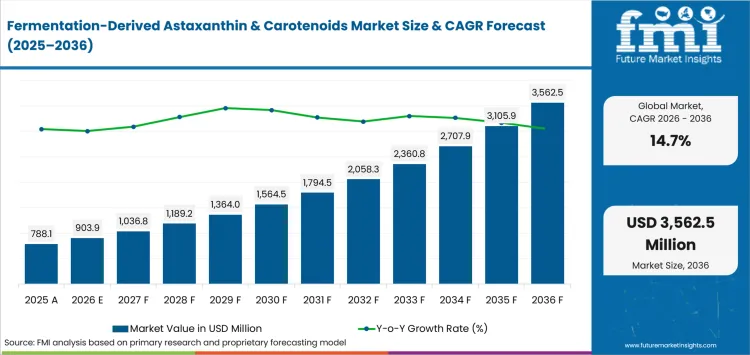
USD 903.9 million in 2026 and USD 3,562.5 million by 2036 at a 14.7% CAGR.
Demand for fermentation-derived astaxanthin & carotenoids is projected to expand at 14.7% CAGR from 2026 to 2036. Valuation is expected to rise from USD 903.9 million in 2026 to USD 3562.5 million by 2036. Growth is driven by stable pigment concentration through cultivation and extraction with the same specification surviving storage and final formulation across nutrition and feed programs. In September 2025, AstaReal announced a United Kingdom distribution partnership that expanded local access for supplement and cosmeceutical customers. The resulting regional route supports commercial astaxanthin formulations, although final acceptance depends on verified stability data and application support.
Microalgae cultivation and dark fermentation create distinct production risks through contamination exposure and variable process yields across this market. Cyanotech reported in June 2025 that its Hawaiian operation cultivates and processes natural astaxanthin at one production site. The filing also described contamination exposure and utility dependence as risks that can interrupt output. Those conditions require supply planning to assess production resilience beside ingredient specifications and documented release requirements. Biological routes require verified organism identity and consistent batch release across each commercial production cycle. Synthetic products require impurity control and reproducible isomer composition across every commercial batch entering nutrition or feed programs. Companies serving broader carotenoid portfolios therefore need route-specific release tests and contingency plans ahead of recurring commercial orders.
Key Takeaways of Fermentation-Derived Astaxanthin & Carotenoids Market
- Nutrition and feed applications support demand for pigments that combine repeatable color performance with documented identity and stability controls across commercial production.
- Microalgae is expected to account for 54.0% of source demand in 2026 due to established cultivation routes and natural ingredient positioning.
- By product, Astaxanthin is projected to represent 45.3% in 2026 owing to established supplement and aquaculture formulation requirements.
- Supplements are anticipated to capture 45.4% of application demand in 2026 supported by measured dosing formats and recurring brand programs.
- Scale-up losses and separate authorization routes increase qualification costs across fermentation-derived carotenoid programs and downstream formulations in regulated applications.
- Key competitors include Kuehnle AgroSystems, Algatech, and Cyanotech across commercial algae production and controlled bioprocess routes. BASF and dsm-firmenich provide diversified carotenoid platforms; Divi’s Laboratories and Fuji Chemical Industries add manufacturing and application support.
Analyst Perspective
“Commercial value depends on reproducing astaxanthin concentration and ester profile through cultivation and extraction at commercial scale. Drying and storage must preserve pigment titre across supplement capsules and aquaculture premixes under routine handling conditions. Producers need route-specific evidence that connects organism identity with oxidation control and country authorization requirements across each intended use. Recurring orders develop through repeated lots that meet the same release specification and support clear investigation of every production deviation.”
- Nandini Roy Choudhury, Principal Consultant, Future Market Insights
How is the Fermentation-Derived Astaxanthin & Carotenoids Market segmented?
The market is segmented by source, product, application, and region.
The market is segmented across source, product, application, and region to separate production routes from downstream commercial uses. Source covers microalgae, dark fermentation, and synthetic routes according to cultivation control, extraction requirements, impurity management, and production consistency. Product separates astaxanthin, beta-carotene, and lutein through pigment identity, stability, delivery format, and intended biological or coloring function. Application includes supplements, functional food and beverages, and feed based on dosage form, authorization pathway, shelf-life requirements, and technical support needs. Regional analysis compares North America, Latin America, Western Europe, Eastern Europe, East Asia, South Asia and Pacific, and the Middle East and Africa.
Why does microalgae lead the source category?
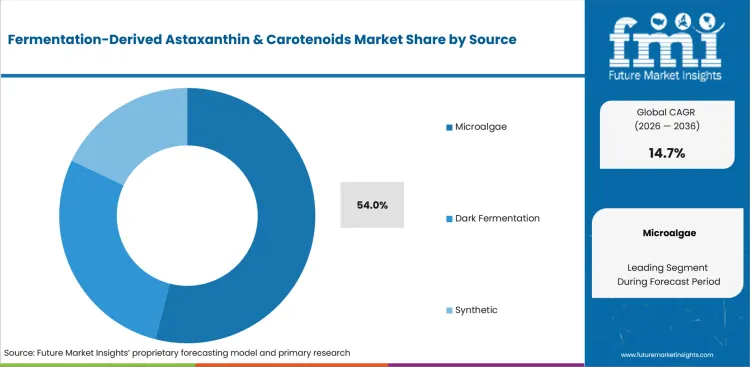
Microalgae production combines strain management with controlled cultivation and scheduled harvesting across repeated commercial batches. Cell disruption and extraction must preserve pigment concentration and limit contamination or oxidation throughout each processing cycle. Cyanotech reported in June 2025 that bulk astaxanthin sales increased 74% during fiscal 2025 alongside improved production efficiency. The result shows active demand for established microalgae output rather than technical interest without volume. Commercial performance therefore depends on consistent release specifications across cultivation cycles and customer delivery formats.
- The source category is forecast to be led by microalgae at 54.0% share in 2026 due to established cultivation and extraction control across commercial production. Integrated production connects organism identity with batch release and reduces variation between harvested lots during repeated production cycles. The position reflects route maturity and reliable pigment preservation across recurring supplement and feed commercial programs.
- Supplement and feed formulators adopt microalgae ingredients with clear organism identity and repeatable ester profiles. Controlled drying limits oxidation losses during storage and transport and protects pigment concentration across routine commercial conditions. Technical teams validate transfer into capsules and premixes across several consecutive production lots to support recurring orders.
How does astaxanthin shape the product category?
Astaxanthin specifications determine whether the same pigment can serve supplement and feed formulations across regulated applications. In May 2025, the European Commission Joint Research Centre published an authorization-renewal application for astaxanthin used in fish and crustacean feed. The application specified at least 96% total coloring matter and proposed a maximum of 100 milligrams per kilogram in compound feed. Those limits show that purity and use concentration remain separate commercial controls for the product category. Related natural food colors face comparable stability duties through processing and commercial shelf life.
- Astaxanthin is likely to capture 45.3% share in 2026 attributable to established use across supplements and aquaculture feed. Application breadth supports recurring formulation work across supplement capsules and aquaculture premixes serving established commercial nutrition programs. Manufacturers must control purity and oxygen exposure across each delivery format to protect repeat performance.
- Product developers select astaxanthin formats according to esterification and bioavailability requirements across each intended application. Residual solvents and oxygen exposure remain separate release criteria throughout ingredient qualification and finished-format development across intended applications. Adoption improves through formats that retain a defined concentration across shelf life and routine processing conditions.
What supports supplements within the application category?
Supplement programs require dependable access to bulk ingredients and finished dosage formats across regulated nutrition channels. AstaReal reported in May 2025 that its Benelux agreement covered bulk formulations together with capsules and softgels. The announcement expanded commercial availability across Belgium and Luxembourg through a distributor serving the wider Benelux region. Dutch customers also gained local support for ingredient selection and finished dosage development during commercial formulation work. Comparable dietary supplement channels require stable dosing records and country-ready technical documentation ahead of recurring brand orders.
- Supplements are projected to hold 45.4% share in 2026 owing to measured dosing and repeat purchase programs across established nutrition brands. Capsules and softgels support measured intake across recurring consumer programs with defined dosage and package requirements. Manufacturers must retain dosing accuracy and shelf-life evidence across each final package and planned country submission.
- Supplement manufacturers require documented ingredient identity and shelf-life performance across every routine commercial batch release. Capsules and softgels support measured intake but they do not remove separate country evidence duties. Adoption therefore depends on stability data that remains valid across intended packages and storage conditions. Limited claim portability increases local review expense during each market-entry cycle and later product reformulation.
What are the drivers, restraints, and opportunities in the Fermentation-Derived Astaxanthin & Carotenoids Market?
Nutrition and feed applications support demand for repeatable pigment specifications; oxidation sensitivity and separate authorization routes increase qualification costs. Distributor expansion creates an opening for validated formats supported by local technical service.
- Driver: Nutrition and feed applications increase demand for repeatable pigment specifications and documented production control across commercial batches.
- Restraint: Oxidation sensitivity and separate authorization routes increase testing expense across applications and countries during commercial qualification.
- Opportunity: Distributor expansion creates room for validated astaxanthin formats that combine stable dosing with local technical support.
Additional carotenoid capacity supports market growth through higher output across active ingredients and finished formulations. Divi’s reported in July 2025 that its integrated nutraceutical division produced both carotenoid ingredients and finished formats. The company also stated that its portfolio was gaining share and that Unit 3 Phase 1 would expand capacity with backward integration. Commercial gains depend on consistent release specifications across the added capacity rather than production volume alone. Comparable nutraceutical ingredient qualification favors manufacturers that pair higher output with stable specifications and dependable application support.
Authorization requirements create a material restraint across feed applications that need separate safety and efficacy dossiers. EFSA stated in May 2026 that new feed additives require assessment prior to commercial placement in the European Union. The current process begins with pre-submission and completeness review, followed by formal scientific risk assessment for dossiers that pass initial administrative checks. A final decision follows the scientific opinion and can impose specific conditions on each approved use. Carotenoid producers therefore face higher testing costs whenever a new use changes the required evidence package.
Distributor execution creates a commercial opening for manufacturers that combine validated ingredients with local formulation support. AstaReal reported in June 2026 that existing Benelux customers expanded volumes, and new customers entered the astaxanthin segment. The update connects natural antioxidant distribution with observed volume growth rather than broad consumer interest. Companies can capture this opening by maintaining the same specification across higher volumes and several finished formats. Local technical support also reduces formulation delays across capsules and softgels during customer qualification work.
Which country CAGRs are profiled in the Fermentation-Derived Astaxanthin & Carotenoids Market?
| Country | CAGR |
|---|---|
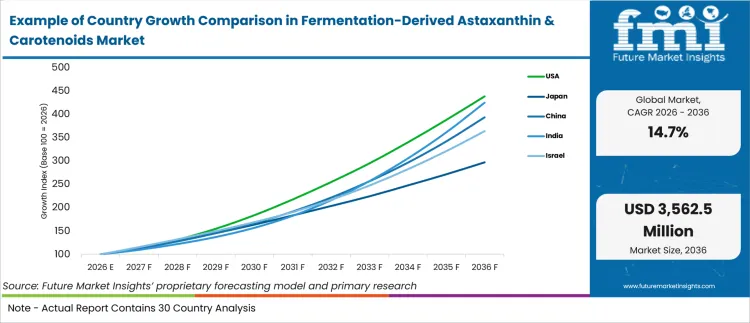
| India | 15.6% |
| China | 14.7% |
| Israel | 13.8% |
| USA | 12.5% |
| Japan | 11.5% |
How do country-level CAGRs compare in the Fermentation-Derived Astaxanthin & Carotenoids Market?
The profiled rates span 4.1 percentage points from India to Japan across different authorization and commercialization environments. India and China form the first comparison band with 0.9 percentage points separating their forecasts. Israel occupies the middle position and remains 0.9 percentage points below China within the current forecast set. The USA and Japan form the final band with 1.0 percentage point between their forecasts. The spacing reflects modeled conversion pace rather than current revenue or confirmed legal access alone. Commercial sequencing therefore depends on country-specific authorization costs and the technical support required for each application.
- India remains 0.9 percentage points above China across the approved forecasts, but its non-specified ingredient pathway can extend launch timing through dossier review.
- China remains 0.9 percentage points above Israel in the comparison, although its lutein ester standards project has not reached final legal effect.
- Israel remains 1.3 percentage points above the USA in the current outlook, although undefined review timing creates planning risk despite a formal safety-dossier route.
- The USA remains 1.0 percentage point above Japan in the comparison, supported by a defined federal feed route with strict concentration and labeling limits.
- Japan forms the lower edge of the profiled range, although its notification system leaves scientific evidence responsibility with each filing company.
Country authorization expense and technical service requirements create different account economics despite comparable CAGRs across these markets. Market-entry planning should compare approval steps with available formulation support ahead of allocating commercial resources beside each modeled rate. The full report extends the country comparison across North America and Latin America together with Europe and East Asia. Coverage also includes South Asia and Oceania alongside the Middle East and Africa for broader regional planning.
Country-wise Analysis
- India requires prior approval for non-specified foods and ingredients that lack an existing national standard. India's fermentation-derived astaxanthin and carotenoids sector is projected to record 15.6% CAGR during the assessment period, supported by active supplement formulation and a defined approval route. FSSAI requires risk analysis by scientific panels and published an updated application status list on July 22, 2026 covering cases through July 15. The route gives ingredient manufacturers a defined process for entering regulated supplement programs across the country. Local formulation activity supports demand for qualified astaxanthin and carotenoid ingredients across established nutrition channels. Dossier completeness and review timing remain material frictions for production routes without an established standard.
- China is developing a national standard for lutein esters within its regulated special-food raw-material framework. Manufacturers need clear ingredient identity specifications and permitted-use conditions to plan credible commercial health-food submissions across regulated channels. Fermentation-derived astaxanthin and carotenoid demand in China is predicted to advance at 14.7% CAGR through 2036, enabled by domestic ingredient capacity and formal standard development. The national standards platform assigned project 20260287-T-424 in January 2026 with an eighteen-month drafting period. The project gives manufacturers visible technical direction for defining ingredient identity and future commercial specifications. Registration duties and an unfinished standard continue to limit launch certainty across new health-food formulations.
- Israel requires a safety dossier for algae ingredients that do not appear in the national supplement database. Fermentation-derived astaxanthin and carotenoid demand in Israel is forecast to rise at 13.8% CAGR over the forecast period, reinforced by a formal safety-dossier pathway for unlisted algae ingredients. The local route requires ingredient identity and statutory status with use history and contaminant controls. As of July 2026, the Ministry of Health requires submitted evidence to rely on scientific regulatory material rather than promotional claims. The process gives importers and manufacturers a defined regulatory route for qualifying previously unlisted ingredients. Undefined review timing and incomplete submissions remain the main commercial frictions for planned product launches.
- United States feed use follows a precise federal rule for astaxanthin as a stabilized color-additive mixture. Human nutrition programs require a separate evidence pathway from the established rules governing regulated feed use. The USA fermentation-derived astaxanthin and carotenoids market outlook is anticipated to advance at 12.5% CAGR over the assessment period, influenced by established feed rules and mature supplement channels. Federal rules current in July 2026 allow astaxanthin in salmonid feed at no more than 80 milligrams per kilogram. The established animal feed additives route gives qualified astaxanthin formulations a clear commercial pathway. Concentration limits and separate supplement requirements prevent one compliance package from covering every intended application.
- Japan permits functional claims through a premarket notification system based on company-submitted safety and efficacy evidence. Adoption of fermentation-derived astaxanthin and carotenoids in Japan is estimated to expand at 11.5% CAGR through 2036, shaped by local manufacturing and strict evidence responsibility for health claims. As of July 2026, the Consumer Affairs Agency states that government reviewers do not evaluate individual products through this system. Each filing company therefore carries full responsibility for scientific support and accurate product labeling across its submitted claims. The notification route supports differentiated supplement and functional-food formats across established national channels with transparent filing records. Evidence preparation and continuing claim responsibility increase qualification expense for new products or later reformulations.
Who are the notable companies in the Fermentation-Derived Astaxanthin & Carotenoids Market?
Kuehnle AgroSystems, Algatech, Cyanotech, BASF, dsm-firmenich, Divi’s Laboratories, and Fuji Chemical Industries are the notable companies profiled in this market.
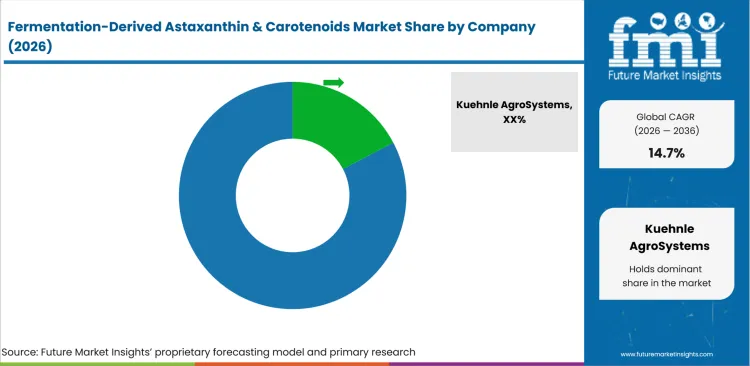
Competition divides into controlled algae producers and diversified nutrition groups serving human nutrition and feed applications. Kuehnle AgroSystems is scaling a proprietary dark-fermentation route for astaxanthin across nutraceutical and aquaculture applications. Algatech and Cyanotech operate commercial microalgae cultivation systems, whereas BASF and dsm-firmenich provide broader carotenoid portfolios across several regions. Divi’s Laboratories combines ingredient manufacturing with finished formulations, and Fuji Chemical Industries supports production and research through the AstaReal business. Expansion across functional food ingredients increases the value of stable delivery formats and country-ready documentation.
- Kuehnle AgroSystems is scaling dark fermentation through a development partnership that targets nutrition and feed applications across commercial programs. Algatech operates in Israel and Cyanotech cultivates in Hawaii through established photobioreactor systems at commercial scale. Their algae-based ingredients positions depend on repeatable output and formulation support across nutrition programs and feed applications.
- Diversified carotenoid platforms include BASF and dsm-firmenich across established human nutrition and animal-feed applications worldwide. BASF’s 2025 report identifies vitamins and carotenoids as retained nutrition priorities across human and animal applications. dsm-firmenich’s 2025 report places carotenoid capabilities within global health and nutrition businesses supported by application science.
- Manufacturing and application specialists include Divi’s Laboratories and Fuji Chemical Industries across several carotenoid formats. Divi’s integrates active-ingredient production with finished formulations and application testing across commercial carotenoid customer programs. Fuji Chemical owns AstaReal and supports natural astaxanthin production with global research and international distribution.
Competitive Benchmarking: Fermentation-Derived Astaxanthin & Carotenoids Market
| Company | Source and Process Control | Formulation and Application Support | Scale and Validation Support | Geographic Reach |
|---|---|---|---|---|
| Kuehnle AgroSystems | Medium | Low | Low | North America with European development partners |
| Algatech | High | High | High | Israel |
| Cyanotech | High | Medium | High | North America with international sales |
| BASF | Medium | High | High | Global |
| dsm-firmenich | Medium | High | High | Global |
| Divi’s Laboratories | Medium | High | High | Global |
| Fuji Chemical Industries | High | High | High | Japan with international AstaReal distribution |
Key Developments in the Fermentation-Derived Astaxanthin & Carotenoids Market
- In July 2025, Algal Bio and Japan Bio Science Laboratory began commercial-scale production of microalgae-based astaxanthin ingredients at an indoor facility in Kyushu. The program joins strain screening with cultivation scale-up and domestic extraction through an active manufacturing route. Commercial relevance comes from available production capacity rather than a laboratory result, although customer qualification requires repeatable specifications for each intended application.
- In August 2025, Corbion and Kuehnle AgroSystems entered a strategic partnership to develop and commercialize natural astaxanthin from non-GMO heterotrophic algae. The planned route applies controlled fermentation across human and animal nutrition applications and separates production from light-dependent cultivation. The agreement expands production-method choice, although commercial availability remains dependent on successful scale-up and technical transfer.
- In September 2025, BASF completed the sale of its Food and Health Performance Ingredients business to Louis Dreyfus Company following regulatory approvals. The transaction transferred a German production site with three application laboratories; BASF retained its strategic focus on vitamins and carotenoids. The completed transfer clarifies portfolio ownership and preserves BASF’s stated direction across human and animal nutrition ingredients.
- In February 2026, dsm-firmenich signed an agreement to divest its Animal Nutrition & Health business to CVC Capital Partners. The announced transaction includes vitamins and carotenoids, with dsm-firmenich expected to retain a 20% equity interest upon completion. Closing remains expected near the end of 2026 subject to required approvals, so current ownership and contractual responsibility continue until the transaction completes.
Key Players in the Fermentation-Derived Astaxanthin & Carotenoids Market
Natural Algae and Fermentation Specialists
- Kuehnle AgroSystems
- Algatech
- Cyanotech
- Fuji Chemical Industries
Diversified Carotenoid and Nutrition Platforms
- BASF
- dsm-firmenich
- Divi’s Laboratories
Fermentation-Derived Astaxanthin & Carotenoids Market - Report Scope
| Coverage field | Report scope |
|---|---|
| Market breakdown | Source, product, application, and region. |
| Quantitative Units | Revenue in USD Million and CAGR in %. |
| Market Definition | Astaxanthin, beta-carotene, and lutein produced through microalgae cultivation, dark fermentation, or chemical synthesis with emphasis on controlled bioprocess routes. |
| Regions Covered | North America, Latin America, Western Europe, Eastern Europe, East Asia, South Asia and Pacific, Middle East and Africa. |
| Countries Covered | India, China, Israel, USA, and Japan, with more than twenty-five additional countries in the full report. |
| Key Companies Profiled | Kuehnle AgroSystems, Algatech, Cyanotech, BASF, dsm-firmenich, Divi’s Laboratories, and Fuji Chemical Industries |
| Forecast Period | 2026 to 2036. |
| Approach | Hybrid bottom-up and top-down market sizing supported by primary interviews and official desk research. |
Fermentation-Derived Astaxanthin & Carotenoids Market - Research Methodology
| Method | Approach |
|---|---|
| Primary Research | FMI analysts gathered input from manufacturers, service providers, technology developers, distributors, end users, procurement teams, and subject-matter experts. Interviews examined purchasing decisions, product or service evaluation, adoption barriers, approval requirements, pricing considerations, and expectations for technical or commercial support. Respondents were also asked what evidence is required before a trial, pilot, or initial order develops into regular purchasing. |
| Desk Research | Desk research covered government statistics, regulatory publications, trade data, industry associations, technical literature, standards, company filings, product information, and official corporate announcements. Sources were reviewed for relevance, publication date, geographic coverage, and consistency with the defined market scope. Claims relating to performance, applications, approvals, capacity, investment, and commercial activity were retained only when supported by credible public evidence. |
| Market Sizing and Forecasting | The market model combined the baseline value with historical performance, segment structure, pricing and volume indicators, adoption levels, company participation, and country-level demand conditions. Forecast assumptions considered economic activity, investment trends, regulatory developments, technology adoption, purchasing cycles, supply availability, and barriers to wider market use. Segment and regional estimates were reconciled before the final market total was calculated. |
| Data Validation | Estimates were checked against multiple independent indicators, including public data, company activity, trade patterns, industry developments, and findings from primary interviews. Validation also tested whether products, services, applications, and company revenues fell within the defined market boundaries. Adjacent categories, unsupported claims, overlapping revenues, and activities without direct market relevance were excluded to reduce double counting and maintain consistency across segments and countries. |
Fermentation-Derived Astaxanthin & Carotenoids Market by Segments
Fermentation-Derived Astaxanthin & Carotenoids Market segmented by Source:
- Microalgae
- Dark Fermentation
- Synthetic
Fermentation-Derived Astaxanthin & Carotenoids Market segmented by Product:
- Astaxanthin
- Beta-carotene
- Lutein
Fermentation-Derived Astaxanthin & Carotenoids Market segmented by Application:
- Supplements
- Functional F&B
- Feed
Fermentation-Derived Astaxanthin & Carotenoids Market by Region:
- North America
- United States
- Canada
- Latin America
- Brazil
- Mexico
- Argentina
- Chile
- Western Europe
- Germany
- France
- United Kingdom
- Italy
- Spain
- Benelux
- Nordics
- Eastern Europe
- Poland
- Czech Republic
- Romania
- Hungary
- East Asia
- China
- Japan
- South Korea
- South Asia and Pacific
- India
- ASEAN
- Australia and New Zealand
- Middle East and Africa
- GCC Countries
- South Africa
- Türkiye
- Israel
Research Sources and Bibliography
- Algal Bio Co., Ltd. (2025, July 10). Commercial scale production of microalgae-based Astaxanthin ingredients has launched as a result of joint development by Algal Bio and Japan Bio Science Laboratory.
- AstaReal AB. (2025, May 15). AstaReal expands Benelux presence - new agreement with Lithos Ingredients.
- AstaReal AB. (2025, September 5). AstaReal announces new UK partnership with i-ingredients Ltd.
- AstaReal AB. (2026, June 9). Natural Astaxanthin Gains Momentum in Benelux: “New customers and increased demand”.
- BASF SE. (2025, September 30). Joint News Release: BASF and Louis Dreyfus Company Complete Sale and Purchase Transaction for BASF’s Food and Health Performance Ingredients Business.
- BASF SE. (2026, February 27). Nutrition & Care - BASF Report 2025.
- Corbion. (2025, August 19). Corbion and Kuehnle AgroSystems join forces to develop natural Astaxanthin from algae fermentation.
- Cyanotech Corporation. (2025, June 23). Q4 and Fiscal Year 2025 Earnings Broadcast.
- Cyanotech Corporation. (2025, June 30). Form 10-K for the fiscal year ended March 31, 2025.
- Divi’s Laboratories Limited. (2025, July). 35th Annual Report 2024-25.
- dsm-firmenich. (2026, February 9). dsm-firmenich announces agreement to divest Animal Nutrition & Health to CVC Capital Partners.
- dsm-firmenich. (2026, February 19). Our markets - dsm-firmenich Integrated Annual Report 2025.
- Electronic Code of Federal Regulations. (2026, July 17). 21 CFR 73.35 -- Astaxanthin.
- European Food Safety Authority. (2026, May 27). Feed additives application procedure.
- Food Safety and Standards Authority of India. (2026, July 22). Non-Specified Food.
- European Commission, Joint Research Centre. (2025, May 15). FEED-2024-29452 - Astaxanthin (2a161j).
- Government of Israel, Ministry of Health. (n.d.). Application for Approval of a New Ingredient or Product in a Dietary Supplement: Safety Dossier Review.
- Japan Consumer Affairs Agency. (n.d.). 機能性表示食品について [Foods with function claims].
- State Administration for Market Regulation. (2026, January 28). 保健食品原料 叶黄素酯 [Health food raw materials: Lutein esters].
This bibliography is provided for reader reference and is not exhaustive. The full report contains the complete reference list and detailed citations.
This Report Answers
- How large is the fermentation-derived astaxanthin and carotenoids market in 2026 and 2036?
- Which production and application conditions support recurring demand across controlled carotenoid supply chains?
- Why does microalgae account for the notable source share in 2026?
- How does astaxanthin influence product qualification across supplements and feed applications?
- Why do supplements hold the dominant application position in 2026?
- How do country growth rates differ across India, China, Israel, USA, and Japan?
- Which companies provide controlled algae production, formulation support, or global carotenoid manufacturing?
- Which stability and authorization requirements constrain wider commercial adoption across countries?
- How should decision-makers compare production control with application support and geographic reach?
Frequently Asked Questions
How big is the Fermentation-Derived Astaxanthin & Carotenoids Market in 2026?
The fermentation-derived astaxanthin & carotenoids market is valued at USD 903.9 million in 2026 and is forecast to reach USD 3562.5 million by 2036, supported by nutrition and feed applications demanding repeatable pigment specifications and documented production control across commercial supplement, functional food, and aquaculture programs.
What is the CAGR of the Fermentation-Derived Astaxanthin & Carotenoids Market from 2026 to 2036?
The fermentation-derived astaxanthin & carotenoids market is projected to grow at a CAGR of 14.7% between 2026 and 2036, supported by expanding distributor networks for validated astaxanthin formats, growing aquaculture feed authorization pathways, and increasing supplement brand demand for stable pigment concentrations with documented identity and batch release controls.
Which source leads the Fermentation-Derived Astaxanthin & Carotenoids Market?
Microalgae accounts for 54.0% of the fermentation-derived astaxanthin & carotenoids market by source in 2026, driven by established cultivation and extraction control that connects organism identity with batch release, reducing lot-to-lot variation across recurring supplement and aquaculture feed commercial programs.
How much will the Fermentation-Derived Astaxanthin & Carotenoids Market add between 2026 and 2036?
The fermentation-derived astaxanthin & carotenoids market is set to add USD 2658.6 million between 2026 and 2036, growing from USD 903.9 million to USD 3562.5 million as capacity expansions across controlled bioprocess routes, expanding regional distribution partnerships, and broadening country authorization pathways accelerate commercial adoption across supplement and feed applications globally.
Who are the leading companies in the Fermentation-Derived Astaxanthin & Carotenoids Market?
Leading companies in the fermentation-derived astaxanthin & carotenoids market include Kuehnle AgroSystems, Algatech, Cyanotech, Fuji Chemical Industries, BASF, dsm-firmenich, and Divi's Laboratories, competing across natural algae and fermentation specialist production, diversified carotenoid and nutrition platforms, and integrated manufacturing and application support with global and regional reach.
Preview the report firsthand - request a free sample
Get SampleGet the brochure for pricing and purchase details.
Get PDFTable of Content
- Key Takeaways
- Market Size and CAGR
- Top Growth Driver
- Fastest Growing Segment
- Leading Region
- Key Companies
- Emerging Opportunities
- Executive Summary
- Global Market Outlook
- Demand-side Trends
- Supply-side Trends
- Technology Roadmap Analysis
- Analysis and Recommendations
- Analyst Perspective (What is happening? Why now? What should investors know?)
- Key Questions Answered
- How large is the market?
- What is the CAGR?
- What are key trends?
- Which region dominates?
- Who are the leaders?
- Market Overview
- Market Coverage / Taxonomy
- Market Definition / Scope / Limitations
- Research Methodology
- Chapter Orientation
- Analytical Lens and Working Hypotheses
- Market Structure, Signals, and Trend Drivers
- Benchmarking and Cross-market Comparability
- Market Sizing, Forecasting, and Opportunity Mapping
- Research Design and Evidence Framework
- Desk Research Programme (Secondary Evidence)
- Expert Input and Fieldwork (Primary Evidence)
- Tooling, Models, and Reference Databases
- Data Engineering and Model Build
- Quality Assurance and Audit Trail
- Market Background
- Market Dynamics (Drivers, Restraints, Opportunity, Trends)
- Scenario Forecast (Optimistic, Likely, Conservative)
- Impact Analysis
- AI Impact
- Sustainability Impact
- Regulatory Impact
- Technology Impact
- Consumer / Buyer Analysis
- Purchase Drivers
- Adoption Barriers
- Buyer Journey
- Opportunity Map Analysis
- Product Life Cycle Analysis
- Supply Chain Analysis
- Investment Feasibility Matrix
- Value Chain Analysis
- PESTLE and Porter's Analysis
- Regulatory Landscape
- Regional Parent Market Outlook
- Production and Consumption Statistics
- Import and Export Statistics
- Global Market Analysis and Forecast, 2021 to 2036
- Historical Market Size Value (USD Million) Analysis, 2021 to 2025
- Current and Future Market Size Value (USD Million) Projections, 2026 to 2036
- Y-o-Y Growth Trend Analysis
- Absolute $ Opportunity Analysis
- Global Market Pricing Analysis, 2021 to 2036
- Global Market Analysis and Forecast, By Source, 2021 to 2036
- Introduction / Key Findings
- Historical Market Size Value (USD Million) Analysis By Source, 2021 to 2025
- Current and Future Market Size Value (USD Million) Analysis and Forecast By Source, 2026 to 2036
- Microalgae
- Dark Fermentation
- Synthetic
- Microalgae
- Y-o-Y Growth Trend Analysis By Source, 2021 to 2025
- Absolute $ Opportunity Analysis By Source, 2026 to 2036
- Global Market Analysis and Forecast, By Product, 2021 to 2036
- Introduction / Key Findings
- Historical Market Size Value (USD Million) Analysis By Product, 2021 to 2025
- Current and Future Market Size Value (USD Million) Analysis and Forecast By Product, 2026 to 2036
- Astaxanthin
- Beta-carotene
- Lutein
- Astaxanthin
- Y-o-Y Growth Trend Analysis By Product, 2021 to 2025
- Absolute $ Opportunity Analysis By Product, 2026 to 2036
- Global Market Analysis and Forecast, By Application, 2021 to 2036
- Introduction / Key Findings
- Historical Market Size Value (USD Million) Analysis By Application, 2021 to 2025
- Current and Future Market Size Value (USD Million) Analysis and Forecast By Application, 2026 to 2036
- Supplements
- Functional F&B
- Feed
- Supplements
- Y-o-Y Growth Trend Analysis By Application, 2021 to 2025
- Absolute $ Opportunity Analysis By Application, 2026 to 2036
- Global Market Analysis and Forecast, By Region, 2021 to 2036
- Introduction
- Historical Market Size Value (USD Million) Analysis By Region, 2021 to 2025
- Current Market Size Value (USD Million) Analysis and Forecast By Region, 2026 to 2036
- North America
- Latin America
- Western Europe
- Eastern Europe
- East Asia
- South Asia and Pacific
- Middle East & Africa
- Market Attractiveness Analysis By Region
- North America Market Analysis and Forecast, By Country, 2021 to 2036
- Historical Market Size Value (USD Million) Trend Analysis By Market Taxonomy, 2021 to 2025
- Market Size Value (USD Million) Forecast By Market Taxonomy, 2026 to 2036
- By Country
- USA
- Canada
- By Source
- By Product
- By Application
- By Country
- Market Attractiveness Analysis
- By Country
- By Source
- By Product
- By Application
- Key Takeaways
- Latin America Market Analysis and Forecast, By Country
- Historical Market Size Value (USD Million) Trend Analysis By Market Taxonomy, 2021 to 2025
- Market Size Value (USD Million) Forecast By Market Taxonomy, 2026 to 2036
- By Country
- Brazil
- Mexico
- Chile
- Rest of Latin America
- By Source
- By Product
- By Application
- By Country
- Market Attractiveness Analysis
- By Country
- By Source
- By Product
- By Application
- Key Takeaways
- Western Europe Market Analysis and Forecast, By Country
- Historical Market Size Value (USD Million) Trend Analysis By Market Taxonomy, 2021 to 2025
- Market Size Value (USD Million) Forecast By Market Taxonomy, 2026 to 2036
- By Country
- Germany
- UK
- Italy
- Spain
- France
- Nordic
- BENELUX
- Rest of Western Europe
- By Source
- By Product
- By Application
- By Country
- Market Attractiveness Analysis
- By Country
- By Source
- By Product
- By Application
- Key Takeaways
- Eastern Europe Market Analysis and Forecast, By Country
- Historical Market Size Value (USD Million) Trend Analysis By Market Taxonomy, 2021 to 2025
- Market Size Value (USD Million) Forecast By Market Taxonomy, 2026 to 2036
- By Country
- Russia
- Poland
- Hungary
- Balkan & Baltic
- Rest of Eastern Europe
- By Source
- By Product
- By Application
- By Country
- Market Attractiveness Analysis
- By Country
- By Source
- By Product
- By Application
- Key Takeaways
- East Asia Market Analysis and Forecast, By Country
- Historical Market Size Value (USD Million) Trend Analysis By Market Taxonomy, 2021 to 2025
- Market Size Value (USD Million) Forecast By Market Taxonomy, 2026 to 2036
- By Country
- China
- Japan
- South Korea
- By Source
- By Product
- By Application
- By Country
- Market Attractiveness Analysis
- By Country
- By Source
- By Product
- By Application
- Key Takeaways
- South Asia and Pacific Market Analysis and Forecast, By Country
- Historical Market Size Value (USD Million) Trend Analysis By Market Taxonomy, 2021 to 2025
- Market Size Value (USD Million) Forecast By Market Taxonomy, 2026 to 2036
- By Country
- India
- ASEAN
- Australia & New Zealand
- Rest of South Asia and Pacific
- By Source
- By Product
- By Application
- By Country
- Market Attractiveness Analysis
- By Country
- By Source
- By Product
- By Application
- Key Takeaways
- Middle East & Africa Market Analysis and Forecast, By Country
- Historical Market Size Value (USD Million) Trend Analysis By Market Taxonomy, 2021 to 2025
- Market Size Value (USD Million) Forecast By Market Taxonomy, 2026 to 2036
- By Country
- Kingdom of Saudi Arabia
- Other GCC Countries
- Türkiye
- South Africa
- Other African Union
- Rest of Middle East & Africa
- By Source
- By Product
- By Application
- By Country
- Market Attractiveness Analysis
- By Country
- By Source
- By Product
- By Application
- Key Takeaways
- Key Countries Market Analysis
- USA
- Pricing Analysis
- Market Share Analysis, 2025
- By Source
- By Product
- By Application
- Canada
- Pricing Analysis
- Market Share Analysis, 2025
- By Source
- By Product
- By Application
- Mexico
- Pricing Analysis
- Market Share Analysis, 2025
- By Source
- By Product
- By Application
- Brazil
- Pricing Analysis
- Market Share Analysis, 2025
- By Source
- By Product
- By Application
- Chile
- Pricing Analysis
- Market Share Analysis, 2025
- By Source
- By Product
- By Application
- Germany
- Pricing Analysis
- Market Share Analysis, 2025
- By Source
- By Product
- By Application
- UK
- Pricing Analysis
- Market Share Analysis, 2025
- By Source
- By Product
- By Application
- Italy
- Pricing Analysis
- Market Share Analysis, 2025
- By Source
- By Product
- By Application
- Spain
- Pricing Analysis
- Market Share Analysis, 2025
- By Source
- By Product
- By Application
- France
- Pricing Analysis
- Market Share Analysis, 2025
- By Source
- By Product
- By Application
- India
- Pricing Analysis
- Market Share Analysis, 2025
- By Source
- By Product
- By Application
- ASEAN
- Pricing Analysis
- Market Share Analysis, 2025
- By Source
- By Product
- By Application
- Australia & New Zealand
- Pricing Analysis
- Market Share Analysis, 2025
- By Source
- By Product
- By Application
- China
- Pricing Analysis
- Market Share Analysis, 2025
- By Source
- By Product
- By Application
- Japan
- Pricing Analysis
- Market Share Analysis, 2025
- By Source
- By Product
- By Application
- South Korea
- Pricing Analysis
- Market Share Analysis, 2025
- By Source
- By Product
- By Application
- Russia
- Pricing Analysis
- Market Share Analysis, 2025
- By Source
- By Product
- By Application
- Poland
- Pricing Analysis
- Market Share Analysis, 2025
- By Source
- By Product
- By Application
- Hungary
- Pricing Analysis
- Market Share Analysis, 2025
- By Source
- By Product
- By Application
- Kingdom of Saudi Arabia
- Pricing Analysis
- Market Share Analysis, 2025
- By Source
- By Product
- By Application
- Türkiye
- Pricing Analysis
- Market Share Analysis, 2025
- By Source
- By Product
- By Application
- South Africa
- Pricing Analysis
- Market Share Analysis, 2025
- By Source
- By Product
- By Application
- USA
- Market Structure Analysis
- Competition Dashboard
- Competition Benchmarking
- Market Share Analysis of Top Players
- By Regional
- By Source
- By Product
- By Application
- Emerging Startups
- Innovation Benchmarking
- Competition Analysis
- Competition Deep Dive
- Kuehnle AgroSystems
- Overview
- Product Portfolio
- Profitability by Market Segments
- Sales Footprint
- Strategy Overview
- Marketing Strategy
- Product Strategy
- Channel Strategy
- AlgaTech
- Cyanotech
- BASF
- dsm-firmenich
- Divi's
- Fuji Chemical
- Kuehnle AgroSystems
- Case Studies
- Success Stories
- Recent Developments
- Competition Deep Dive
- Assumptions & Acronyms Used


