


- Sports nutrition has a trust problem as much as a growth opportunity; consumers must believe the label, dosage, safety, and performance promise.
- Third-party testing, banned-substance screening, transparent ingredient sourcing, dosage clarity, and quality documentation are becoming practical benchmarks.
- FMI’s sports food outlook notes the importance of testing validation for new SKU listings, showing that trust increasingly influences route-to-market access.
- Personalization can improve relevance, but only when recommendations are credible, simple, and tied to measurable goals.
- Ingredient transparency matters most in protein, pre-workout, hydration, recovery, plant-based, and high-performance products where users are sensitive to efficacy and safety.
- The misconception to avoid is that sports nutrition buyers only want stronger claims. Many now want proof, safety, and guidance as much as intensity.
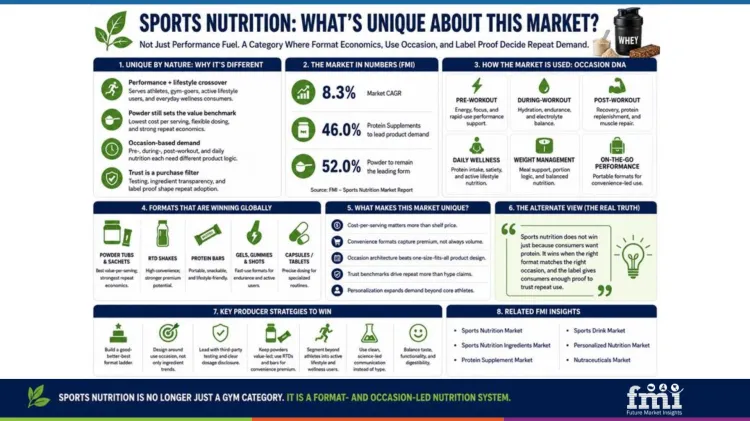
Sports nutrition is a high-promise category. Products claim to support energy, strength, recovery, hydration, endurance, muscle maintenance, lean body goals, and daily performance. That promise creates demand, but it also creates scrutiny. In the Sports Nutrition Market , trust is becoming a commercial benchmark, not just a compliance requirement.
This is why a trust-benchmark angle is more specific than a general clean-label angle. Clean label matters, but sports nutrition has a deeper verification challenge. Consumers want to know whether the product contains what it claims, whether the dosage is meaningful, whether the ingredients are safe, whether the product is suitable for their goal, and whether it has been tested for banned substances or contamination risks.
FMI’s Sports Food Market commentary is useful because it points to stricter third-party testing validation as a listing requirement for new SKUs. This is important because trust is no longer only consumer-facing. Retailers, sports organizations, gyms, online platforms, and professional buyers may also require proof before supporting a product.
The first trust benchmark is label accuracy. Sports nutrition buyers often compare grams of protein, caffeine level, creatine dose, sugar content, electrolyte levels, amino acid profile, serving count, and calorie load. If the product relies on vague proprietary blends or unclear dosing, advanced users may lose confidence. Mainstream users may not read every technical detail, but they still respond to simple, transparent communication.
The second benchmark is safety and testing. This is especially important for athletes and competitive users who face banned-substance risk. Products that are third-party tested or supported by recognized quality programs can reduce anxiety. Even for non-competitive users, testing signals seriousness. A category associated with exaggerated claims benefits from stronger proof systems.
The third benchmark is ingredient quality. Protein source, amino acid completeness, solubility, taste, digestibility, and processing method all influence perception. A whey isolate, whey concentrate, hydrolysate, collagen protein, pea protein, soy protein, or blended plant system does not carry the same consumer meaning. Brands need to explain why the source fits the use case.
The Whey Protein Ingredients Market is relevant because whey remains central to sports nutrition trust. Whey has strong consumer familiarity and performance association, but quality still varies by specification, solubility, flavor compatibility, and processing. A product cannot rely only on the word whey; it must deliver mixability, taste, and a credible protein claim.
The Plant-Based Protein Market also matters because plant-based sports nutrition is gaining attention among vegan, dairy-free, allergen-aware, and sustainability-oriented consumers. Yet plant-based trust depends on more than source identity. Brands must address amino acid profile, texture, off-notes, digestibility perception, and protein completeness.
The fourth benchmark is claim discipline. Sports nutrition products can quickly become overloaded with claims: high protein, low sugar, energy, recovery, no crash, clean energy, gut health, immunity, hydration, focus, fat metabolism, vegan, natural, and clinically supported. Too many claims can weaken trust if the product does not clearly own one use case. Strong brands make fewer claims but support them better.
The Sports Nutrition Ingredients Market helps frame this point because the ingredient universe includes protein, probiotics, prebiotics, vitamins, amino acids, carotenoids, plant extracts, minerals, fiber, carbohydrates, and other inputs. A broad ingredient pool creates innovation potential, but also increases the need for formulation logic and documentation.
The fifth benchmark is personalization. Sports nutrition consumers increasingly expect products that fit their goals: strength, endurance, weight management, active aging, muscle recovery, hydration, gut support, or daily wellness. Personalization can improve relevance, but it can also become confusing if the consumer receives complicated recommendations or unclear product bundles.
The Personalized Nutrition Market is useful because it shows how measurement-led nutrition is developing. Sports nutrition brands can apply this logic through goal-based quizzes, training-linked bundles, wearable-informed routines, or coach-supported product systems. However, personalization should simplify the purchase, not bury the consumer in data.
The sixth benchmark is repeatability. Sports nutrition is not a one-time category. The consumer must like the product enough to use it repeatedly. Taste, mixability, digestive comfort, texture, sweetness, flavor variety, and tolerance are all trust factors. A pre-workout that causes discomfort, a protein powder that clumps, or a bar that tastes artificial can lose repeat demand even if the label looks strong.
The seventh benchmark is channel credibility. Products sold through gyms, specialty stores, coaches, dietitians, pharmacy channels, and trusted online platforms may carry different credibility than products discovered only through aggressive social media marketing. Influencer-led discovery can create trial, but repeat adoption increasingly depends on whether the brand has verification behind the message.
For brands, the practical benchmark is to build a trust stack. That stack includes clear dosage, meaningful active levels, quality sourcing, third-party testing where relevant, transparent claims, simple goal guidance, and strong sensory performance. The brands that treat trust as packaging language alone will be weaker than those that build it into formulation and channel execution.
The misconception to avoid is that sports nutrition buyers only want stronger claims. Some do. But many consumers, especially mainstream users, want confidence. They want to know that the product is safe, useful, understandable, and suitable for their routine. Trust can therefore be as important as intensity.
Bottom line: sports nutrition is moving from claim-led selling toward proof-led adoption. The winners will be brands that combine performance promise with testing, transparency, personalization, and repeatable product experience.

