


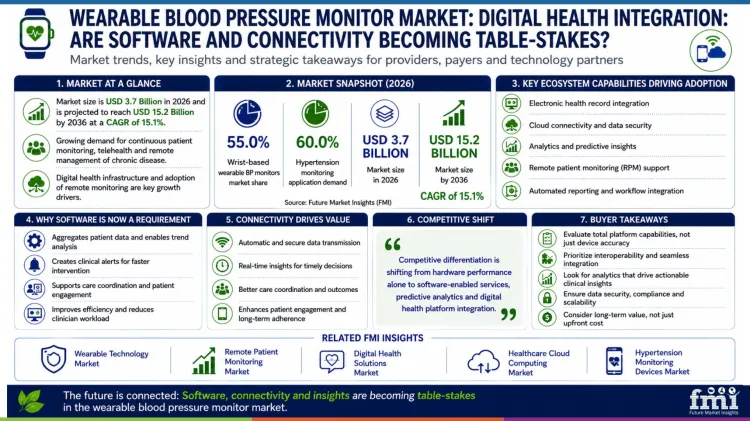
- Wearable Blood Pressure Monitor Market is USD 3.7 Billion in 2026 and it is expected to reach USD 15.2 Billion by 2036 at a CAGR of 15.1%. The market is growing because of the increasing digital health infrastructure and the growing adoption of remote monitoring.
- Healthcare organizations are seeking software integration, continuous patient monitoring, automated reporting and clinical workflow connectivity. These are fast becoming baseline purchase requirements.
- Market share of wrist-based wearable blood pressure monitors is 55.0% and is benefiting from mobile health platforms and patient engagement applications.
- The demand applications for Hypertension monitoring are 60.0%. Interoperability and longitudinal data management are becoming more important for programs of management of chronic disease.
- Electronic health record integration, cloud connectivity, analytics and remote patient monitoring support are among the ecosystem capabilities that healthcare providers are considering as they evaluate wearable monitoring solutions.
- Competitive differentiation is shifting from hardware performance alone to software enabled services, predictive analytics and digital health platform integration.
Introduction
The wearable blood pressure monitor market is undergoing a structural change as healthcare systems move to connected care delivery models. Device accuracy is still a basic requirement, but buying decisions are no longer driven by hardware specs. Instead, healthcare providers are looking at how wearable monitoring technologies can integrate directly into larger digital health ecosystems.
The market size is USD 3.7 billion in 2026 and is projected to reach USD 15.2 billion by 2036, at a CAGR of 15.1%. The market is driven by increasing demand for continuous patient monitoring, telehealth services, and remote management of chronic disease. Software functionality and connectivity capabilities are rapidly moving from differentiators to prerequisites for procurement as digital health strategies become critical in the transformation of healthcare.
This evolution is redefining product development priorities, procurement criteria and competitive dynamics across the wearable blood pressure monitor market.
Market Context
Healthcare delivery is increasingly data-driven. Providers are shifting from episodic clinical encounters to continuous monitoring models that provide meaningful patient insights outside of traditional care settings.
Here, wearable blood pressure monitors can be used in two ways. They serve as physiological monitors and as data collection points in larger healthcare information networks.
The nature of the application market makes this change even more important. 60.0% of the total demand is hypertension monitoring which requires long-term patient engagement with continuous data analysis, rather than one-off measurements. Wrist-based devices account for 55.0% of market demand, indicating a strong preference for user-friendly technologies that can support continuous monitoring programs.
Software is becoming a key product requirement.
The traditional wearable blood pressure monitor was mainly designed for blood pressure measurement and display. Today’s healthcare environment demands much greater functionality.
Healthcare providers are increasingly looking for monitoring solutions that include software platforms that can aggregate patient data, create clinical alerts, provide trend analysis, and support activities such as care coordination. Expectations from providers are changing and devices that can't keep up may struggle to meet those expectations.
The move to software-enabled monitoring is in line with other healthcare goals of improving efficiency and lightening the load on clinicians. Automated reporting tools, patient dashboards and centralized monitoring interfaces help providers manage larger patient populations while maintaining visibility into clinical risk indicators.
So software is becoming a more and more important part of the product offering, not an add-on. That means manufacturers are investing heavily in platform development to ensure their devices are relevant in digitally enabled health care environments.
The increasing significance of software is also affecting revenue models. Vendors are increasingly discovering value in recurring software services, subscription-based platforms and analytics capabilities built on top of traditional hardware sales.
Connectivity Drives Adoption
Connectivity is another important market requirement.
There is an increasing expectation that wearable blood pressure monitors will automatically transmit patient data to healthcare providers via secure digital channels. Manual data collection processes lead to operational inefficiencies and decreased importance of continuous monitoring programs.
Linked monitoring systems enable patients and their healthcare teams to share data in real-time to facilitate faster intervention and better care coordination. This capacity is especially pertinent to hypertension where ongoing follow up can assist in detecting emerging risk before complications arise.
With the rapid growth of remote patient monitoring programs, the demand for connected devices is growing. Healthcare organizations require technologies that can integrate patient-generated health data into centralized clinical systems without disrupting existing workflows.
Connectivity also delivers on your patient engagement goals. Mobile applications, personalized health insights, and automated reminders further promote adherence and long-term participation in monitoring programs.
With investments in virtual care infrastructure continuing to grow, connected monitoring technologies are becoming an increasingly integral component of digital care delivery models.
How Interoperability is Altering Procurement Choices
Interoperability is becoming an increasing procurement priority.
Healthcare providers are operating in a more complex technology environment that includes electronic health records, telehealth platforms, remote monitoring systems, analytics tools and population health management applications. Wearable monitoring devices need to work well in these ecosystems.
That’s why more and more procurement teams are looking at vendor integration capabilities when they make their decisions. Devices working in isolation makes workflows difficult and patient-generated data less useful.
Interoperability requirements affect contract negotiations, vendor selection, and product development strategies. Healthcare organizations want solutions that will allow them to exchange information efficiently between disparate clinical systems.
This trend is especially important for large health systems beginning to implement enterprise-wide remote monitoring programs. Standardized integration capabilities facilitate deployment, accelerate clinician adoption and enhance the value of monitoring programs.
Manufacturers that are focused on interoperability are better positioned to meet the changing needs of healthcare providers and enhance their competitive position.
Segment Insights
55.0% of the market demand is for wrist-based wearable monitors, which indicates the growing importance of patient-centred technology design. These devices are well suited to be embedded into digital health as they enable continuous monitoring at high degrees of user convenience.
In addition, their compatibility with smartphones, mobile health apps and cloud-based monitoring platforms ensures their place in connected care environments.
On the other hand, hypertension monitoring constitutes 60.0% of application demand, creating a significant demand for long-term data management capabilities. Continuous monitoring programmes generate a lot of information regarding patients which need sophisticated software tools for analysis, interpretation and clinical decision.
The segment dynamics also highlight the growing significance of digital capabilities as healthcare providers seek to derive maximum value from wearable monitoring technologies.
End-User Insights
Hospitals, outpatient care providers and remote monitoring programs are incorporating wearable blood pressure monitors as part of larger digital health strategies.
Healthcare organizations want technologies that enable care delivery outside of traditional clinical settings, but can monitor patient health status. Connected monitoring solutions enable providers to deliver care in the patient’s home while maintaining access to clinically relevant information.
End user increasingly drives remote patient monitoring programs. These efforts leverage software platforms, automated data transmission and analytics capabilities to efficiently manage large patient populations.
Therefore, software functionality is becoming increasingly important to healthcare organizations to achieve operational and clinical goals related to delivering care remotely.
Buyer Behaviour and Procurement
Digital health integration is a key strategic priority and procurement criteria are changing fast.
Healthcare buyers are no longer just looking at measurement accuracy, battery performance or hardware reliability when assessing wearable blood pressure monitors. The software’s capabilities, integration support, cybersecurity protections and data management functionality are increasingly important in purchase decisions.
As wearable monitoring solutions are becoming increasingly technologically complex, information technology teams are playing an increasingly prominent role in the procurement process. Buyers want to know if they can integrate devices with existing clinical systems and if they will allow them to support future digital transformation initiatives.
Long-term vendor relationships are also becoming more important. Health care providers want to work with suppliers that provide ongoing software upgrades, cybersecurity enhancements, interoperability improvements and innovation in their platforms.
These considerations are rendering skills in software development as important as traditional skills in device engineering.
Competitive Implications
The competitive dynamics in the wearable blood pressure monitor market are changing due to digital health.
Manufacturers now compete more on the strength of the ecosystem than on the bare performance of the hardware. Those that can combine monitoring devices with cloud platforms, analytics tools, patient engagement apps and clinical workflow integration have an advantage in the marketplace.
More and more vendors are looking to technology partnerships to extend software capabilities and accelerate digital innovation. Manufacturers are teaming up with telehealth providers, electronic health record (EHR) vendors, and healthcare analytics companies to strengthen their value propositions.
At the same time, barriers to competition are rising. Building and maintaining complex software platforms is expensive and requires regulatory expertise and cybersecurity capability.
Software and connectivity are becoming market expectations, and the differentiators of competitors will increasingly be the quality of the digital experiences delivered to providers and patients.
Strategic Implications
The wearable blood pressure monitor market is transforming from a hardware-dominated industry to a digital-driven healthcare technology category. This is a shift that dovetails with broader healthcare priorities around remote monitoring, chronic disease management and data-driven clinical decision making.
Healthcare providers are seeking solutions that provide accurate physiological measurement, along with reliable connectivity, advanced analytics and interoperability support. Such capabilities are quickly becoming baseline requirements to play in current models of healthcare delivery.
Manufacturers that continue to focus chiefly on hardware innovation may face growing competitive challenges as provider expectations evolve. The ability to deliver integrated digital health ecosystems that deliver clinical, operational and economic value will increasingly determine future market leadership.
Bottom Line
Increasingly, software integration and connectivity are table stakes in the wearable blood pressure monitor market. As providers scale remote monitoring programs and invest in digital health infrastructure, procurement decisions are increasingly focused on interoperability, analytics and ecosystem capabilities rather than hardware performance. Manufacturers able to combine precise monitoring with capable digital platforms will be well placed to harness long-term growth opportunities and build relationships with healthcare providers looking for scalable connected care solutions.
Related FMI Reports

