


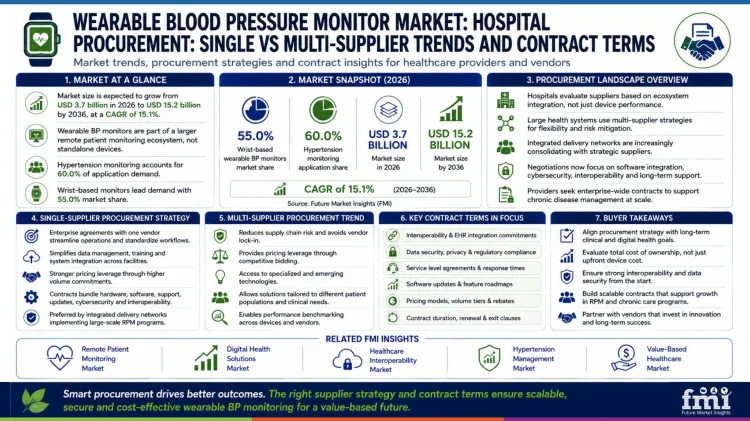
- The wearable blood pressure monitor market size is expected to increase from USD 3.7 billion in 2026 to USD 15.2 billion by 2036, at a CAGR of 15.1%, making it a rapidly expanding procurement category for healthcare providers. The market's rise from USD 3.7 billion in 2026 to USD 15.2 billion by 2036 reflects increasing investment in remote patient monitoring infrastructure.
- Hospitals are considering wearable blood pressure monitors as part of a larger remote patient monitoring ecosystem not as an island device which affects the criteria for selecting suppliers.
- Large health systems still use multi-supplier purchasing when they need technology flexibility, while integrated delivery networks are increasingly consolidating with a strategic supplier.
- As device pricing negotiations move to software integration, support for cybersecurity, interoperability commitments and long-term service contracts.
- Wrist-based wearable blood pressure monitors are the leading force in market demand, accounting for 55.0% of the total demand, and are subject to volume purchase contracts and standardization efforts.
- Apps for monitoring hypertension account for the lion’s share of demand, and healthcare providers are negotiating enterprise-wide monitoring contracts to support chronic disease management programs.
Introduction
The introduction of wearable monitoring technologies into clinical care pathways is revolutionising procurement strategies in healthcare systems. Hospitals are moving from episodic care to continuous patient monitoring, and that’s changing the way they evaluate suppliers, structure contracts and manage vendor relationships.
Increasing demand for remote monitoring solutions for long-term patient engagement and chronic disease management is driving the wearable blood pressure monitor market, which is projected to grow from USD 3.7 billion in 2026 to USD 15.2 billion by 2036 at a CAGR of 15.1%. As wearable monitoring technologies transition from pilot programs to enterprise-wide deployment, procurement teams are assessing supplier capabilities, technology integration and long-term value creation.
These buying priorities are evolving, and they are altering competitive dynamics across the market and affecting how manufacturers position their products and services.
Market Context
Historically, clinical departments were the main buyers of blood pressure monitoring devices, and the choice of device was mostly driven by accuracy, reliability and cost of acquisition. The wearable monitoring technologies have changed this model.
Wearable blood pressure monitors are increasingly being adopted into today’s healthcare organizations and are being used in a variety of care settings, including hospitals, outpatient clinics, telehealth programs and home-based care programs. The expanded use raises the strategic importance of vendor selection and complicates the procurement process.
Healthcare providers don’t buy monitoring devices as stand-alone products anymore. Instead, they are funding the monitoring infrastructures that support population health management, remote patient-monitoring programs and chronic disease intervention strategies.
This is especially important as the demand for application monitoring of hypertension constitutes 60.0%, which shows the importance of wearable monitoring in addressing one of the largest chronic disease populations in healthcare. Wrist-based devices have a market demand of 55.0% due to their convenience, usability and suitability for continuous monitoring programs.
These are market forces driving procurement decisions at the enterprise and departmental levels.
Single Source Procurement Strategies
Many healthcare providers are moving toward single-supplier procurement strategies to improve operational efficiencies and standardize technology.
Hospitals typically negotiate enterprise agreements with one vendor that covers device deployment, software platforms, technical support, data integration, training services and lifecycle management. This approach reduces the burden on vendor management and helps to standardize clinical workflows across a variety of facilities.
Single-supplier contracts are especially attractive to Integrated Delivery Networks implementing major remote monitoring programs. Standardization of monitoring technologies allows for training of clinicians and centralization of data management and maintenance.
Procurement leaders also view supplier consolidation as a way to achieve better pricing through increased buying volumes. In enterprise, contracts tend to bundle services with hardware purchases, which may include analytics platforms, software updates, cybersecurity protections and interoperability support.
As healthcare systems are moving more towards digital transformation, procurements are seeing more consolidation with suppliers with complete monitoring ecosystems.
Multi-Supplier Procurement Trend
Consolidation of suppliers is an area of growing interest, but most large healthcare organizations still use multiple suppliers for their purchasing.
Many procurement teams deliberately keep multiple vendors for supply chain risk mitigation, pricing leverage and access to specialized technologies. This is becoming especially relevant as healthcare providers look for the flexibility to adapt to changing patient monitoring needs.
Multi-supplier strategies also provide organizations the ability to assess emerging technologies without being locked into any single technology roadmap. Different providers may have different solutions for wearable blood pressure monitoring programs in different patient populations or clinical specialties.
The variety of technology can be particularly valuable for firms looking to compare device performance, user engagement levels and data integration capabilities before scaling up deployments.
Another major consideration is supply chain resilience. Healthcare providers are increasingly conscious of the risks of relying on a single supplier, particularly for technologies that are vital to patient management.
In the process, procurement teams are weighing the operational efficiencies of consolidation against the strategic flexibility of a diversified vendor portfolio.
Contract terms are moving beyond hardware.
The complexity of contract structures is one of the most significant trends in the procurement of wearable blood pressure monitors.
Traditionally, device contracts focused on acquisition cost, warranty coverage and replacement schedules. Today’s agreements often include software functionality, data management capabilities, cybersecurity responsibilities and interoperability commitments.
Providers want contractual assurances that the platform is reliable, that the system is up, that the software is updated frequently and that there is integration support. Increasingly vendors are expected to demonstrate long-term commitment to evolving regulatory requirements and digital health standards.
Provisions for performance-based contracts are also becoming increasingly common. Procurement teams are looking for service benchmarks that can be measured by implementation timelines, responsiveness of technical support, and platform performance.
These developments are a reflection of the growing perception of wearable blood pressure monitors as digital healthcare platforms, rather than mere diagnostic tools.
Insights on Segment
This large market focus on wrist-worn wearables makes a huge impact on buying behavior. This segment is expected to hold 55.0% of the demand. Hospitals generally prefer wrist-based solutions when they implement large-scale monitoring programs owing to ease of deployment and acceptance by patients.
High patient adherence is increasingly a procurement consideration. Devices that enable sustained patient engagement tend to yield more reliable monitoring data that further the goals of chronic disease management and improve program efficiency.
Similarly, the high demand for hypertension monitoring applications (60.0% of market demand) provides incentives for providers to negotiate contracts that can support enterprise-wide cardiovascular management initiatives.
As healthcare organizations scale remote monitoring programs, procurement teams are increasingly looking for solutions that can support large patient populations, while keeping clinical workflow efficient.
Buyer Behaviour and Decision-Making
Procurement decision making is increasingly multidisciplinary.
Clinicians, IT specialists, digital health leaders, cybersecurity teams and population health managers are now often part of hospital purchasing committees. The increase in stakeholder engagement is a sign of the strategic importance of wearable monitoring technologies.
The clinical teams place great importance on monitoring accuracy and patient compliance. IT departments are considering integration capabilities and data security. Financial stakeholders look at the total cost of ownership and ROI in the long run.
This means that successful suppliers need to meet a wider range of evaluation criteria than is typical in more traditional medical device purchasing environments.
Buyers are increasingly looking at vendor stability, and long-term innovation roadmaps. As the healthcare industry invests in digital monitoring infrastructure, they need to be assured that suppliers will continue to meet the changing technological and regulatory needs.
Competition Implications
The changing buying environment is changing the competitive landscape in the wearable blood pressure monitor market.
The trend is to manufacturers that provide a complete monitoring ecosystem, not just a supplier of device hardware. On the competitive front, the emphasis is moving to software capabilities, interoperability, analytics functionality and service support.
Procurement consolidation trends create opportunities for larger vendors with the ability to support enterprise-scale deployments. At the same time, specialized providers can differentiate on the basis of innovation, niche expertise and better user experiences.
Partnership strategies are ever more important as suppliers look to accelerate their digital health capabilities. There are growing competitive advantages with cloud infrastructure, artificial intelligence, electronic health record integration, and remote monitoring platform collaborations.
The ability to customize product offerings to shifting procurement priorities is fast becoming a critical to market success.
Strategic Implications
The future make-up of the wearable blood pressure monitor market is being shaped by increasing hospital procurement strategies. Today, buying decisions are about the long-term planning of digital health infrastructure, not about product choice.
Healthcare providers want better solutions for scalability, interoperability, patient engagement and outcomes – but not at any cost. These priorities are driving demand for integrated monitoring ecosystems and influencing supplier selection criteria.
Manufacturers able to successfully implement procurement transformation and align their commercial strategies with enterprise healthcare goals will be best positioned to capitalize on the growth opportunities as adoption of wearable monitoring increases.
Bottom Line
The wearable blood pressure monitor market is projected to expand from USD 3.7 billion in 2026 to USD 15.2 billion by 2036 as procurement shifts from transactional device purchasing to strategic technology partnerships. Some providers are consolidating suppliers for better efficiencies and integration, while other providers are moving ahead with multi-supplier models to maintain flexibility and reduce risk. As monitoring technologies grow more central to the management of chronic disease and remote care delivery, contract structures, interoperability commitments and ecosystem capabilities will increasingly determine competitive success for manufacturers and purchasing value for healthcare organizations.
Related FMI Reports

