


The Common Narrative
Flexible packaging continues to benefit from strong structural demand. Brands value it because it is lightweight, material-efficient, convenient, printable, and adaptable across food, beverages, personal care, household products, pharmaceuticals, and e-commerce. Pouches, films, wraps, sachets, and form-fill-seal formats remain attractive because they can reduce transport weight, extend shelf life, and support portioning and product differentiation.
The common commercial assumption is that rising demand should improve converter economics. More volume should increase machine utilization, spread fixed costs, strengthen purchasing leverage, and support better margins. Converters with broad portfolios and modern assets are therefore expected to benefit directly from category growth.
This assumption also appears in investment cases. Flexible packaging is often positioned as a scale business in which higher throughput creates operating leverage. New presses, laminators, coaters, slitters, pouch-making lines, and digital systems are justified on the expectation that demand growth will fill capacity and improve returns.
The difficulty is that volume growth and margin growth are not the same outcome.
Flexible packaging converters operate between powerful substrate suppliers and large brand owners. They often carry the operational burden of redesign, qualification, short-run complexity, regulatory change, and service requirements, while having limited freedom to reprice every cost increase. As the market grows, the mix of work can become more demanding even when total tonnage rises.
Why That Narrative Is Incomplete
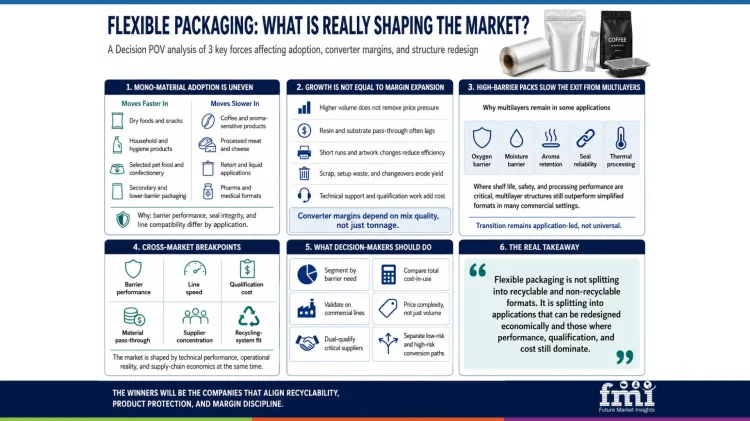
The flexible packaging market is not a single-volume business. It is a portfolio of jobs with different run lengths, material structures, print requirements, barrier needs, changeover frequency, technical risk, and customer service intensity.
A converter may report higher sales while producing more low-volume SKUs, more frequent artwork changes, more customer-specific structures, and more qualification work. These activities increase revenue but can reduce line efficiency and labor productivity.
Raw-material exposure is another source of pressure. Polyethylene, polypropylene, PET, polyamide, aluminium foil, paper, adhesives, coatings, inks, solvents, and energy can account for a large share of converter cost. When input prices rise rapidly, customer pass-through often lags. When input prices fall, customers may demand immediate reductions. This creates an asymmetric pricing cycle in which converters absorb part of inflation but do not always retain the benefit of deflation.
Sustainability requirements add further complexity. Mono-material development, recycled-content integration, downgauging, solvent reduction, recyclability testing, and PPWR readiness require technical resources and production trials. Customers may view these activities as part of normal supplier support rather than separately billable development.
The result is a business where market growth can increase workload, capital intensity, and working-capital exposure without creating an equivalent improvement in operating margin.
How the Market Actually Behaves
Margin outcomes differ sharply by converter type.
Large integrated converters can use scale to negotiate substrate contracts, serve multinational customers, spread technical resources across plants, and shift production between facilities. They may also have stronger positions in high-barrier, pharmaceutical, retort, medical, or specialty applications where qualification creates switching costs.
Commodity converters face more price pressure. Standard films, basic laminates, printed rolls, bags, and common pouches can attract many competing bids. Buyers can compare suppliers easily, especially when specifications are mature and qualification requirements are limited. Volume may grow, but price competition prevents converters from retaining much of the value.
Short runs create another divide. They can carry higher unit prices, but frequent changeovers, plate or cylinder preparation, ink handling, waste at start-up, cleaning, scheduling, and artwork management can erode the apparent premium. Digital printing reduces some setup burdens, yet profitability still depends on job mix, press utilization, finishing capacity, and whether the converter can avoid bottlenecks downstream.
Customer concentration also shapes margins. A converter serving a small number of large FMCG accounts may achieve high utilization but face strong annual price negotiations, strict service-level expectations, and significant customer-specific investment. Losing one major account can leave specialized capacity underutilized.
Growth therefore rewards converters that control mix, complexity, and customer economics. It does not automatically reward those that simply process more volume.
Structural Constraints or Breakpoints
Material cost pass-through is a central breakpoint.
Converters buy substrates and chemicals continuously, but customer contracts may reset monthly, quarterly, or annually. During sudden inflation, the converter finances the gap between supplier price increases and customer recovery. This increases working-capital needs and can compress gross margin even when revenue rises.
Operational complexity is another constraint.
A high number of SKUs, frequent design changes, low minimum-order requirements, and promotional packaging reduce effective capacity. Installed capacity may appear adequate, while usable capacity becomes limited by changeovers, cleaning, cylinder availability, quality approvals, and scheduling conflicts.
Scrap and yield losses are also critical. Flexible packaging conversion involves printing, coating, laminating, curing, slitting, and pouch-making. Waste generated at several stages accumulates. A small decline in yield can materially affect contribution margin because the lost substrate has already been purchased and processed.
Qualification burden creates a further breakpoint. New recyclable structures, PCR-containing films, inks, adhesives, and coatings require trials and testing. RecyClass continues to update design-for-recycling guidance for PE and PP flexible films, reflecting how inks, adhesives, barriers, and other components affect compatibility with recycling streams. These technical developments improve circularity but also require converters to maintain testing, documentation, and process-control capability.
Capital intensity adds pressure. New coating, orientation, solvent-recovery, digital-printing, inspection, and recycling-compatible converting equipment can improve capability, but returns depend on sustained utilization and an appropriate product mix. Growth alone does not guarantee that the new asset will run enough profitable work.
Where Decisions Commonly Break
A common mistake is measuring converter performance through sales growth and plant utilization without examining contribution margin by job.
Two lines can operate at similar utilization while producing very different returns. One may run long, standardized jobs with low waste. The other may process frequent short runs with repeated changeovers, technical support, and customer-specific requirements.
Another failure occurs when converters accept complex projects to secure strategic customers but do not price the full service burden. Development trials, color matching, artwork changes, regulatory documentation, emergency scheduling, inventory holding, and technical visits can remain outside the quoted conversion price.
Capacity expansion decisions can also fail when demand is evaluated at category level rather than by product mix. A market may be growing, but the incremental demand may be fragmented across short runs, recyclable redesigns, and lower-volume premium SKUs. New high-speed capacity does not create value if the order profile cannot use it efficiently.
Converters also misjudge sustainability investment when they assume customers will pay automatically for improved recyclability or recycled content. Brand owners may support the technical direction while continuing to negotiate aggressively on price.
Another recurring error is treating every tonne as equally valuable. High-volume commodity work can fill machines but consume working capital and expose the converter to input volatility. Lower-volume specialty work may appear less efficient but deliver stronger margins if technical differentiation and switching costs are high.
What Decision-Makers Should Do Differently
Converters should manage the business around contribution quality rather than topline volume.
Job-level costing should include substrate consumption, setup waste, machine time, labor, energy, inks, adhesives, curing, quality control, artwork management, inventory, and technical support. This makes it possible to identify customers and SKUs that generate revenue but destroy margin.
Pricing mechanisms should be matched more closely to input exposure. Index-linked contracts, shorter reset periods, surcharge clauses, and clearly defined pass-through formulas can reduce the lag between supplier inflation and customer recovery.
Complexity should be treated as a priced service. Small orders, urgent scheduling, repeated artwork changes, specialized testing, and customer-held inventory should not be absorbed automatically. Commercial teams need clear rules for minimum order quantities, changeover charges, development fees, and service premiums.
Capacity planning should focus on bottlenecks rather than headline machine speed. A printing press may have spare hours while lamination, curing, slitting, inspection, or pouch-making remains constrained. Investment decisions should be based on the full production flow.
Portfolio strategy also matters. Converters should distinguish between commodity volume that supports base utilization, strategic volume that strengthens customer relationships, and differentiated volume that delivers superior margin. The objective is not to eliminate low-margin work, but to prevent it from dominating the asset base.
Technical capability should be linked to commercial capture. Investment in recyclable structures, mono-material platforms, PCR processing, barrier coatings, and digital printing must be supported by qualification advantage, customer lock-in, or pricing power. Innovation without a monetization path increases cost without improving returns.
Customer concentration should be managed alongside utilization. A full plant dependent on a few powerful customers can be less resilient than a slightly lower-utilized plant with a balanced and profitable account mix.
The Misconception to Avoid
The misconception is that growing flexible packaging demand automatically creates operating leverage for converters.
Operating leverage appears only when incremental volume uses capacity efficiently, carries adequate price recovery, and does not introduce disproportionate complexity, scrap, working-capital needs, or technical-service costs.
Bottom Line
Flexible packaging growth creates opportunity, but stronger margins depend on controlling mix, pass-through, complexity, yield, customer concentration, and capital utilization. The converters that win will not necessarily be those processing the most volume. They will be those that understand which volume deserves scarce capacity.
Related Future Market Insights Reports
- Flexible Plastic Packaging Market: Primary FMI report covering flexible plastic formats, end-use demand, materials, regions and supplier competition.
- Flexible Packaging Market: Provides broader coverage across plastic, paper, foil and other flexible packaging formats.
- Flexible Plastic Packaging Market Share Analysis: Supports analysis of leading suppliers, tier positioning and competitive strategies.
- High-Recyclability Mono-Material Flexible Packaging Market: Relevant for redesign costs, converter capability and recyclable format development.
- Packaging Films Market: Supports analysis of film substrates, application requirements and converter demand.
- High Barrier Packaging Films Market: Relevant for specialty structures where technical performance and qualification support stronger pricing.
- Digital Printing Packaging Market: Supports assessment of short-run economics, utilization and customization strategies.
Sources
- Regulation (EU) 2025/40, EUR-Lex: https://eur-lex.europa.eu/eli/reg/2025/40/oj/eng
- RecyClass Design for Recycling Guidelines: https://recyclass.eu/protocols-guidelines/design-for-recycling-guidelines/
- RecyClass Packaging Guidelines for PE and PP Flexible Films: https://recyclass.eu/protocols-guidelines/design-for-recycling-guidelines/packaging/
- Future Market Insights, Flexible Plastic Packaging Market: https://www.futuremarketinsights.com/reports/flexible-plastic-packaging-market
- Future Market Insights, Flexible Packaging Market: https://www.futuremarketinsights.com/reports/flexible-packaging-market
- Future Market Insights, Flexible Plastic Packaging Market Share Analysis: https://www.futuremarketinsights.com/reports/flexible-plastic-packaging-market-share-analysis
- Future Market Insights, High-Recyclability Mono-Material Flexible Packaging Market: https://www.futuremarketinsights.com/reports/high-recyclability-mono-material-flexible-packaging-market
- Future Market Insights, Packaging Films Market: https://www.futuremarketinsights.com/reports/packaging-films-market
- Future Market Insights, High Barrier Packaging Films Market: https://www.futuremarketinsights.com/reports/high-barrier-film-packaging-market

