


The Common Narrative
The dominant narrative in flexible packaging is that multilayer structures are approaching the end of their commercial life. Regulatory pressure, design-for-recycling guidance, retailer commitments, and brand sustainability targets are all encouraging movement towards mono-PE, mono-PP, and other simplified structures that can enter more clearly defined recycling streams.
In this view, multilayer packaging is treated mainly as a legacy design problem. PET, polyamide, aluminium foil, metallised layers, EVOH, adhesives, coatings, and sealants are combined to deliver performance, but the resulting structures can be difficult to separate or recycle. Once equivalent barrier technologies become available within a predominantly single-polymer structure, conversion is expected to accelerate.
This interpretation is reinforced by current design guidance. CEFLEX recommends favouring mono-PE or mono-PP structures where possible, while allowing barrier layers and coatings within defined thresholds so that functionality and recyclability can be balanced. RecyClass likewise evaluates whether barriers, adhesives, inks, and other components remain compatible with specific recycling streams.
The expected direction is clear. Flexible packaging should use fewer incompatible materials.
The commercial mistake is assuming that every application can move at the same speed.
Why That Narrative Is Incomplete
High-barrier flexible packaging exists because the packaged product is sensitive to oxygen, moisture, aroma loss, light, grease, chemicals, sterilisation conditions, or microbial exposure. The package is not simply a container. It is an active part of the product's shelf-life, safety, quality, and distribution system.
Multilayer structures allow different materials to perform specialized functions. PET can provide stiffness, printability, and heat resistance. Polyamide contributes puncture resistance and mechanical strength. Aluminium foil and metallised layers provide strong barriers against light, oxygen, and moisture. EVOH can add gas barrier performance. Polyethylene and polypropylene provide sealing, flexibility, and moisture resistance.
Replacing these layers does not remove the functional requirement. It transfers the burden into oriented films, specialised resin grades, thinner barrier layers, coatings, compatibilizers, tie layers, and more precise process control.
A structure can therefore become simpler in material classification while becoming more technically demanding to produce. The redesign may require tighter specifications, narrower sealing windows, new coating technology, slower line speeds, more frequent quality checks, or additional qualification work.
Recycling compatibility is also threshold-dependent rather than absolute. RecyClass testing found that EVOH at up to 5% of total PE film weight had a minor impact on recycled material, while higher levels affected extrusion. CEFLEX guidance similarly recognizes that barrier materials and coatings remain necessary in many flexible structures but must be controlled so that they do not undermine recyclability.
The relevant question is not whether high-barrier packaging can become more recyclable. It is whether the new structure can preserve the product, run on existing equipment, meet regulatory requirements, and remain economically viable at commercial scale.
How the Market Actually Behaves
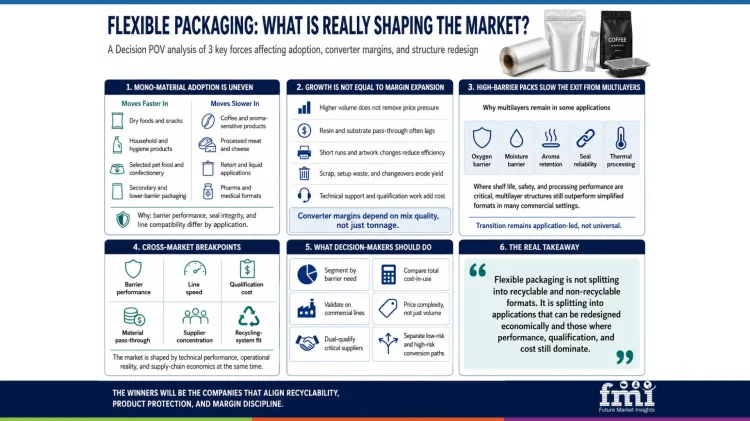
The shift away from multilayer structures is advancing fastest in applications where barrier requirements are moderate and the cost of failure is limited.
Dry snacks, household products, frozen foods, selected confectionery, secondary packaging, and some pet food formats can often move towards mono-material designs using oriented PE or PP, functional coatings, controlled EVOH content, or metallisation. The redesign remains technically demanding, but the protection requirement can be reproduced without relying on a highly complex laminate.
The transition slows as product sensitivity increases.
Coffee requires protection against oxygen, moisture, and aroma loss. Cheese, processed meat, and other protein products may require strong oxygen barriers and reliable sealing under contamination. Retort foods must withstand high-temperature processing. Liquids require leak resistance and mechanical stability. Pharmaceuticals and medical products may require moisture protection, sterilisation compatibility, migration control, tamper evidence, and formal validation.
In these categories, the commercial cost of barrier failure can exceed the value of the packaging itself. Reduced shelf life increases product waste and inventory risk. Seal failure creates recalls, leakage, complaints, and reputational damage. A change in moisture or oxygen transmission can alter product quality before the end of the stated shelf life.
Adoption also depends on the asset base. New mono-material structures may perform well on modern lines with precise temperature, tension, and sealing control. They can be harder to run across older or mixed equipment networks. A multinational brand may need one film to operate across several plants, machine generations, climates, and suppliers. A structure that works in one controlled trial is not yet a scalable replacement.
High-barrier conversion will therefore proceed application by application, line by line, and market by market. It will not follow one universal material transition.
Structural Constraints or Breakpoints
Shelf-life protection is the most important breakpoint.
Barrier requirements are determined by the sensitivity of the product, the intended shelf life, the distribution environment, and the pack geometry. A small deterioration in oxygen or moisture protection may be acceptable for a short-life product but unacceptable for coffee, pharmaceuticals, powdered nutrition, retort foods, or export-oriented products with long supply chains.
Sealing performance creates another constraint.
High-barrier structures must often seal reliably through product contamination, speed variation, pressure changes, and a wide operating window. Mono-material redesign can alter heat resistance, stiffness, shrinkage, coefficient of friction, and seal-initiation temperature. A package can pass laboratory barrier testing and still fail during filling.
Mechanical strength is also a breakpoint. Vacuum-packed products, sharp contents, heavy packs, and long-distance transport require puncture, tear, and flex-crack resistance. Removing polyamide or PET may require thicker polyolefin structures or higher-specification materials. This can reduce downgauging benefits and increase resin cost.
Thermal processing limits conversion in retort, hot-fill, and sterilised applications. The packaging must maintain dimensional stability, seal integrity, and barrier performance under heat and pressure. Materials that recycle well in a standard stream may not deliver the required performance without additional layers or coatings.
Qualification cost further slows adoption. Food, pharmaceutical, and medical applications can require shelf-life studies, migration testing, sterilisation validation, transport trials, line qualification, and formal change control. The investment is repeated when a structure is modified, a supplier changes, or production moves to another plant.
These constraints make high-barrier packaging less responsive to broad sustainability deadlines than lower-risk applications.
Where Decisions Commonly Break
A common decision error is treating the current multilayer structure as over-engineered without understanding why each layer was introduced.
Some layers may have been added to address old equipment limitations, but others protect against real product failure. Removing them without reconstructing the performance logic can create a package that looks simpler but performs inconsistently.
Another failure occurs when teams benchmark recyclability without benchmarking shelf-life economics. A structure may score better under design-for-recycling guidance while increasing product waste, rejected packs, consumer complaints, or inventory write-offs. The total environmental and commercial result can become worse.
Pilot trials can also create false confidence. Trials often use selected materials, skilled operators, reduced speeds, and close supplier support. Commercial rollout introduces normal batch variability, full production speed, different factories, less controlled storage, and a wider product portfolio.
Procurement comparisons frequently understate qualification cost. The new film price may appear manageable, but migration testing, line trials, machine adjustments, tooling, inventory conversion, quality control, and parallel supply can add significant cost.
Another mistake is imposing a common conversion timetable across high-barrier and low-barrier applications. This can push technical teams towards solutions that are compliant in principle but not robust enough for the product.
Supplier diversification can also become harder. Advanced recyclable barrier structures may depend on proprietary coatings, resin combinations, metallisation, orientation technology, or converter expertise. A simplified material declaration can therefore create a more concentrated qualified supplier base.
What Decision-Makers Should Do Differently
Companies should begin with the product protection requirement rather than the desired material declaration.
Each application should be classified by oxygen sensitivity, moisture sensitivity, light exposure, aroma retention, puncture risk, sealing conditions, thermal processing, shelf-life target, and regulatory requirement. This creates a realistic hierarchy of conversion difficulty.
The portfolio should then be divided into formats that can move quickly, formats that require controlled development, and formats where the current multilayer structure remains necessary until technology or infrastructure improves.
Redesign targets should include simultaneous performance thresholds. Recyclability, barrier transmission, seal strength, line speed, scrap, product shelf life, and total cost-in-use should be evaluated together. A solution should not be approved because it performs strongly against only one of these measures.
Commercial line trials should be conducted on the most demanding equipment in the network. Testing only the newest or most stable line can hide future rollout problems. Trials should also use realistic product contamination, storage, transport, and speed conditions.
Companies should establish explicit exception pathways for safety-critical and high-barrier applications. An exception should not become an excuse to avoid improvement. It should document the performance requirement, current technical limitation, available alternatives, supplier development plan, and review date.
Supplier evaluation should include barrier consistency, coating and metallisation capability, line-support resources, quality-control systems, recyclability evidence, scale-up history, and alternative sourcing options.
The strongest transition strategy is not to eliminate multilayer packaging everywhere at once. It is to remove unnecessary complexity where performance allows, reduce incompatible materials where thresholds permit, and preserve multilayer functionality where product protection remains the binding commercial constraint.
The Misconception to Avoid
The misconception is that multilayer flexible packaging survives mainly because converters or brands are unwilling to redesign it.
In many high-barrier applications, multilayer structures remain because they deliver a combination of shelf life, safety, sealing, mechanical strength, and processing performance that simplified structures cannot yet reproduce consistently across commercial conditions.
Bottom Line
The move towards recyclable flexible packaging will continue, but high-barrier applications will set the pace of the transition. Multilayer structures will decline where their functions can be replaced economically. They will remain where product protection, validation, and line performance still outweigh the benefit of material simplification.
Related Future Market Insights Reports
- Barrier Packaging Market: Provides broader analysis of barrier formats, materials, end-use requirements, and market structure.
- Packaging Barrier Film Market: Supports analysis of moisture, oxygen, aroma, and light barrier requirements across packaging applications.
- High Barrier Packaging Films for Pharmaceuticals Market: Relevant for regulated applications requiring moisture protection, stability, and formal validation.
- Flexible Plastic Packaging Market: Provides context on flexible formats, materials, converters, and end-use adoption.
- High-Recyclability Mono-Material Flexible Packaging Market: Relevant for comparison between simplified structures and high-performance barrier requirements.
- High Barrier Packaging Films Market: Primary FMI report covering high-performance films, multilayer structures, applications, and supplier competition.
- Packaging Films Market: Supports analysis of film substrates, application performance, and regional demand.
Sources
- Regulation (EU) 2025/40, EUR-Lex: https://eur-lex.europa.eu/eli/reg/2025/40/oj/eng
- CEFLEX Designing for a Circular Economy Guidelines: https://guidelines.ceflex.eu/guidelines/
- CEFLEX Design Principles: https://guidelines.ceflex.eu/guidelines/design-principles/
- CEFLEX Design Choices for Barrier Layers and Coatings: https://guidelines.ceflex.eu/guidelines/design-choices/
- RecyClass Design for Recycling Guidelines: https://recyclass.eu/protocols-guidelines/design-for-recycling-guidelines/
- RecyClass PE Flexible Films Functional Barrier Findings: https://recyclass.eu/news/pe-flexible-films-recycling-new-findings-for-functional-barriers/
- Future Market Insights, High Barrier Packaging Films Market: https://www.futuremarketinsights.com/reports/high-barrier-film-packaging-market
- Future Market Insights, Barrier Packaging Market: https://www.futuremarketinsights.com/reports/barrier-packaging-market
- Future Market Insights, Packaging Barrier Film Market: https://www.futuremarketinsights.com/reports/packaging-barrier-films-market
- Future Market Insights, Flexible Plastic Packaging Market: https://www.futuremarketinsights.com/reports/flexible-plastic-packaging-market
- Future Market Insights, Packaging Films Market: https://www.futuremarketinsights.com/reports/packaging-films-market
- Future Market Insights, High Barrier Packaging Films for Pharmaceuticals Market: https://www.futuremarketinsights.com/reports/high-barrier-packaging-films-for-pharmaceuticals-market

