

- Industry Size (2026)
- USD 6.04 Bn
- Forecast (2036)
- USD 9.14 Bn
- CAGR (2026 to 2036)
- 4.22%
Abrasive Grains Market Size, Market Forecast and Outlook By FMI
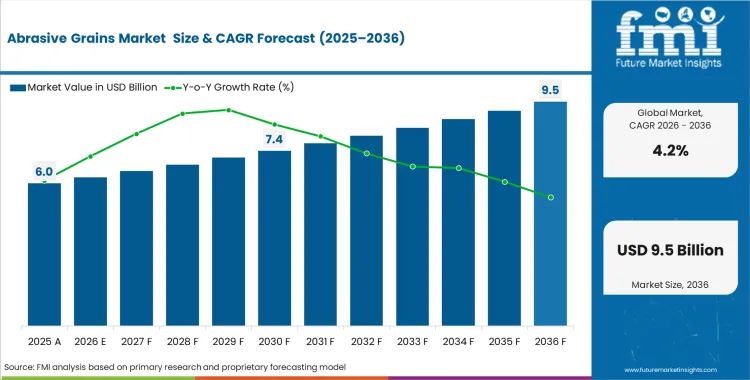
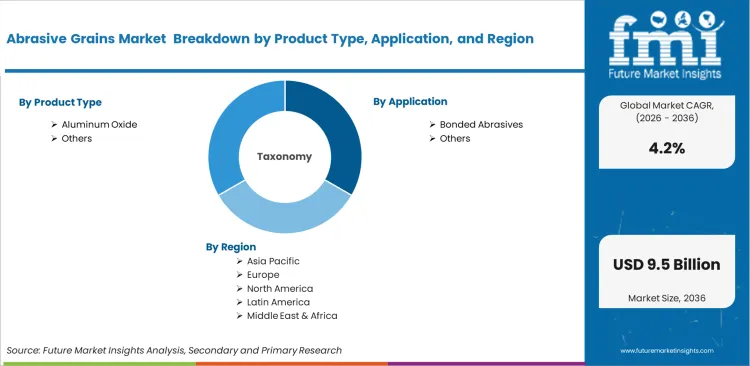
The global abrasive grains market was valued at USD 5.80 Billion in 2025. The market is projected to reach USD 6.04 billion in 2026, and USD 9.14 Billion by 2036, expanding at a CAGR 4.22% over the forecast period. Growth is being supported by rising industrial finishing and precision grinding demand, with Aluminum Oxide accounting for 36.4% share by product type and Bonded Abrasives holding 34.8% share by application.
Summary of Abrasive Grains Market
- Market Snapshot
- The abrasive grains market is estimated at USD 5.80 Billion in 2025 and is forecast to attain USD 9.14 Billion by 2036.
- The market is anticipated to expand at a CAGR 4.22% as industrial manufacturing and surface finishing requirements increase.
- Product and application leadership remains concentrated in Aluminum Oxide with 36.4% share and Bonded Abrasives with 34.8% share.
- Demand and Growth Drivers
- Demand is being driven by metalworking, automotive component finishing, machinery production, and precision engineering applications.
- Industrial users are increasing consumption of abrasive grains for grinding, cutting, polishing, deburring, and surface preparation processes.
- Replacement demand from maintenance, repair, and overhaul activities continues to provide stable volume support across mature manufacturing economies.
- Product and Segment View
- Aluminum Oxide remains the leading product category due to its cost efficiency, hardness, and broad suitability across ferrous and non-ferrous applications.
- Bonded abrasive systems continue to dominate application demand because of their extensive use in grinding wheels and precision finishing tools.
- Product development is increasingly focused on grain consistency, thermal stability, and application-specific performance for high-speed automated operations.
- Geography and Competitive Outlook
- Asia Pacific remains the principal production and consumption hub, supported by large-scale manufacturing, infrastructure activity, and automotive output.
- North America sustains demand through aerospace, industrial machinery, and advanced fabrication sectors requiring high-performance abrasive solutions.
- Europe maintains a strong position due to precision engineering, automotive manufacturing, and stringent quality standards in industrial finishing.
- Analyst Opinion
- Ismail Sutaria, Senior Consultant at FMI says, ‘The advantage in abrasive grains will depend on balancing grain performance and end-use customization.'
Global Abrasive Grains Market Definition
Abrasive grains are hard mineral particles used to remove material from a workpiece through grinding, cutting, polishing, lapping, or surface finishing processes. They are incorporated into bonded, coated, and loose abrasive products across industrial and commercial applications. Common grain types are selected based on hardness, friability, thermal resistance, and compatibility with target materials.
Global Abrasive Grains Market Inclusions
The report includes,
- Market sizing and forecast for abrasive grains used in bonded, coated, and loose abrasive applications.
- Analysis of product type, application, end-use industry, and regional demand patterns.
- Competitive assessment of major manufacturers and suppliers participating in the abrasive grains value chain.
Global Abrasive Grains Market Exclusions
The report excludes,
- Finished power tools and grinding equipment not directly related to abrasive grain consumption.
- Detailed pricing analysis of unrelated industrial minerals and non-abrasive raw materials.
- Company-specific financial forecasting beyond publicly available strategic and operational developments.
Global Abrasive Grains Market Research Methodology
The study combines secondary research from industry publications, company disclosures, trade associations, and government manufacturing databases with structured market modeling. Forecasts are developed through triangulation of demand trends across product type, application, and end-use industries, supported by competitive benchmarking and regional industrial output indicators. Qualitative insights are validated through analyst interpretation of supply chain, technology, and end-market developments.
Key Drivers, Restraints, and Trends in Global Abrasive Grains Market
Drivers
The abrasive grains market is being driven by sustained growth in industrial machinery manufacturing and construction-related processing activities. Increasing demand for precision finishing and improved surface quality is expanding the use of high-performance abrasive materials. Automation in grinding and polishing lines is also supporting demand for grains with consistent cutting behavior and longer service life. In addition, maintenance requirements in mature industrial sectors are reinforcing recurring consumption across replacement cycles.
Restraints
Market expansion is influenced by volatility in raw material availability and industrial input pricing, which can pressure producer margins and customer procurement budgets. Environmental and occupational safety regulations related to dust generation are increasing compliance costs for manufacturers and end users. The market also faces substitution pressure in selected applications from superabrasives and advanced finishing technologies. Furthermore, cyclical slowdowns in manufacturing output can temporarily reduce abrasive grain consumption in capital-intensive sectors.
Trends
A notable market trend is the shift toward engineered grain structures that improve cut rate and extend operational life. Manufacturers are also focusing on application-specific formulations tailored to automated production systems . Sustainability considerations are encouraging lower-emission production methods across the value chain. At the same time, regional supply diversification is gaining importance as buyers seek greater resilience against logistics disruptions and raw material concentration risks.
Segmental Analysis
Global Abrasive Grains Market Analysis by Product Type
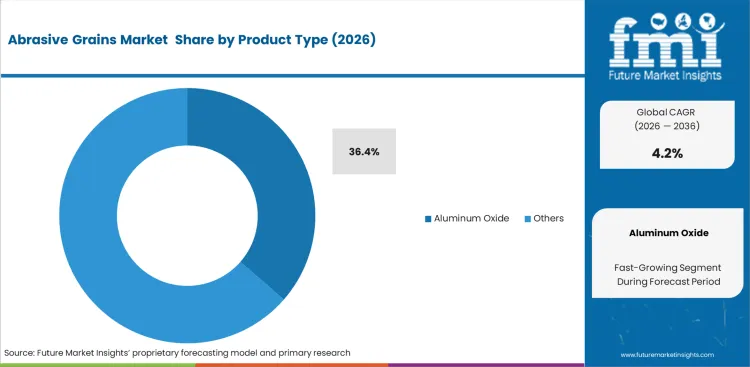
Aluminum Oxide leads the product type and is likely to account for 36.4% share in 2026. Its economic viability makes it suitable for grinding and finishing ferrous metals and general-purpose industrial applications. The segment benefits from wide availability and compatibility with multiple abrasive formats. Continued demand from metalworking and machinery industries is expected to preserve Aluminum Oxide's leading position over the forecast period.
Global Abrasive Grains Market Analysis by Application
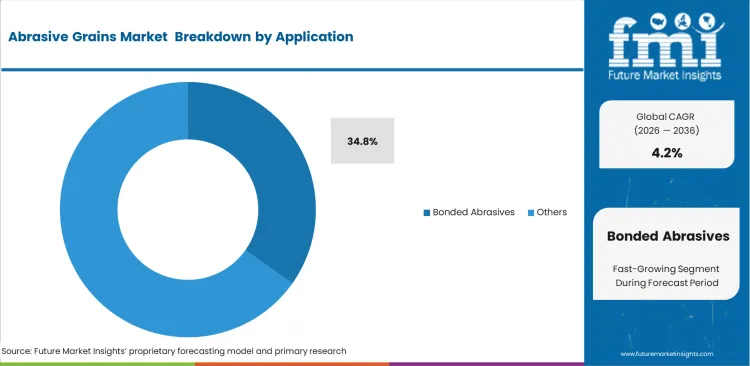
Bonded Abrasives are likely to account for 34.8% share of the application segment in 2026. These systems are preferred in industrial operations requiring dimensional accuracy and repeatable performance under high-load conditions. Demand is likely to remain particularly strong in maintenance operations. Ongoing adoption of automated grinding processes is further strengthening the relevance of bonded abrasive grain consumption.
Competitive Aligners for Market Players
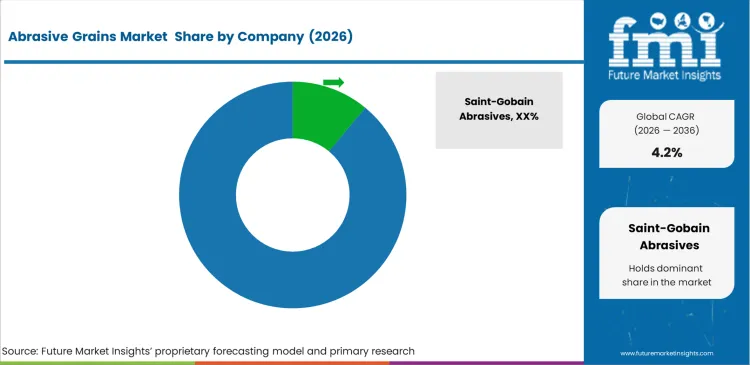
Saint-Gobain Abrasives remains one of the leading players in the market. The company is leveraging its broad abrasive portfolio, global manufacturing footprint, and emphasis on high-performance industrial solutions. 3M Company is another prominent player in the market. Carborundum Universal Limited is focusing on boosting its market presence through integrated manufacturing capabilities and a wide product offering. These companies are focusing on product consistency, end-use customization, and channel expansion to maintain their share in a moderately consolidated competitive environment.
Imerys S.A. contributes to the competitive landscape through supply chain relationships that support abrasive material applications. Other key players such as Washington Mills, Henan Huanghe Whirlwind Co. Ltd. and Asahi Diamond Industrial Co. Ltd. add competitive intensity through their expertise in advanced abrasive and superabrasive technologies. Across the market, participants are pursuing capacity optimization, regional distribution strengthening, and technology-led differentiation to improve resilience and capture higher-value demand.
Key Players in Global Abrasive Grains Market
- Saint-Gobain Abrasives
- 3M Company
- Carborundum Universal Limited
- Imerys S.A.
- Washington Mills
- Henan Huanghe Whirlwind Co. Ltd.
- Asahi Diamond Industrial Co. Ltd.
- Fujimi Incorporated
- Eruslu Abrasive
- Sak Abrasives Limited
Strategic Outlook by FMI on Global Abrasive Grains Market
FMI views the abrasive grains market as structurally stable, with medium-term growth underpinned by recurring industrial finishing demand and gradual technology upgrading. Strategic success will depend on the ability of suppliers to deliver reliable grain quality, application-specific performance, and cost discipline amid raw material and regulatory pressures. Companies with diversified regional footprints and strong relationships in metalworking and precision manufacturing are likely to outperform. Innovation in engineered grains and process efficiency will remain central to long-term competitive positioning.
Scope of the Report
| Metric | Value |
|---|---|
| Market Value | USD 5.80 Billion in 2025 to USD 9.14 Billion by 2036 |
| CAGR | 4.22% from 2026 to 2036 |
| Base Year | 2025 |
| Forecast Period | 2026 to 2036 |
| Product Type Segmentation | Aluminum Oxide, Silicon Carbide, Ceramic Alumina, Zirconia Alumina, Superabrasives |
| Application Segmentation | Bonded Abrasives, Coated Abrasives, Blasting Media, Lapping and Polishing, Refractory and Specialty Uses |
| End Use Industry Segmentation | Automotive, Metal Fabrication, Machinery, Electronics and Semiconductors, Construction, Aerospace |
| Regions Covered | North America, Latin America, Western Europe, Eastern Europe, East Asia, South Asia and Pacific, Middle East and Africa |
Bibliography
- USA Geological Survey. 2025. Mineral Commodity Summaries 2025.
- USA Geological Survey. Manufactured Abrasives Statistics and Information.
- World Steel Association. 2025. World Steel in Figures 2025.
- OECD. Industrial Production Indicator.
- USA Census Bureau. Annual Survey of Manufactures.
- European Commission. Industrial Ecosystems.
- UNIDO. Industrial Development Report 2024.
Frequently Asked Questions
How big is the abrasive grains market?
The abrasive grains market is estimated to be valued at USD 5.80 Billion in 2025 and is projected to reach USD 9.14 Billion by 2036.
What is the forecasted CAGR of abrasive grains market?
The market is forecast to expand at a CAGR 4.22% during the forecast period.
Which product type leads in the abrasive grains market?
Aluminum Oxide leads the product type segment with 36.4% share.
Which application leads in the abrasive grains market?
Bonded Abrasives lead the application segment with 34.8% share.
What drives growth of the abrasive grains market?
Growth is driven by rising demand from metal fabrication, automotive manufacturing, industrial machinery production, and precision finishing applications.
Who are the key companies in the abrasive grains market?
Key companies include Saint-Gobain Abrasives, 3M Company, Carborundum Universal Limited, Imerys S.A., Washington Mills, Henan Huanghe Whirlwind Co. Ltd., and Asahi Diamond Industrial Co. Ltd.
Preview the report firsthand - request a free sample
Get SampleGet the brochure for pricing and purchase details.
Get PDFTable of Content
- Executive Summary
- Global Market Outlook
- Demand-side Trends
- Supply-side Trends
- Technology Roadmap Analysis
- Analysis and Recommendations
- Market Overview
- Market Coverage / Taxonomy
- Market Definition / Scope / Limitations
- Research Methodology
- Chapter Orientation
- Analytical Lens and Working Hypotheses
- Market Structure, Signals, and Trend Drivers
- Benchmarking and Cross-market Comparability
- Market Sizing, Forecasting, and Opportunity Mapping
- Research Design and Evidence Framework
- Desk Research Programme (Secondary Evidence)
- Company Annual and Sustainability Reports
- Peer-reviewed Journals and Academic Literature
- Corporate Websites, Product Literature, and Technical Notes
- Earnings Decks and Investor Briefings
- Statutory Filings and Regulatory Disclosures
- Technical White Papers and Standards Notes
- Trade Journals, Industry Magazines, and Analyst Briefs
- Conference Proceedings, Webinars, and Seminar Materials
- Government Statistics Portals and Public Data Releases
- Press Releases and Reputable Media Coverage
- Specialist Newsletters and Curated Briefings
- Sector Databases and Reference Repositories
- FMI Internal Proprietary Databases and Historical Market Datasets
- Subscription Datasets and Paid Sources
- Social Channels, Communities, and Digital Listening Inputs
- Additional Desk Sources
- Expert Input and Fieldwork (Primary Evidence)
- Primary Modes
- Qualitative Interviews and Expert Elicitation
- Quantitative Surveys and Structured Data Capture
- Blended Approach
- Why Primary Evidence is Used
- Field Techniques
- Interviews
- Surveys
- Focus Groups
- Observational and In-context Research
- Social and Community Interactions
- Stakeholder Universe Engaged
- C-suite Leaders
- Board Members
- Presidents and Vice Presidents
- R&D and Innovation Heads
- Technical Specialists
- Domain Subject-matter Experts
- Scientists
- Physicians and Other Healthcare Professionals
- Governance, Ethics, and Data Stewardship
- Research Ethics
- Data Integrity and Handling
- Primary Modes
- Tooling, Models, and Reference Databases
- Desk Research Programme (Secondary Evidence)
- Data Engineering and Model Build
- Data Acquisition and Ingestion
- Cleaning, Normalisation, and Verification
- Synthesis, Triangulation, and Analysis
- Quality Assurance and Audit Trail
- Market Background
- Market Dynamics
- Drivers
- Restraints
- Opportunity
- Trends
- Scenario Forecast
- Demand in Optimistic Scenario
- Demand in Likely Scenario
- Demand in Conservative Scenario
- Opportunity Map Analysis
- Product Life Cycle Analysis
- Supply Chain Analysis
- Investment Feasibility Matrix
- Value Chain Analysis
- PESTLE and Porter’s Analysis
- Regulatory Landscape
- Regional Parent Market Outlook
- Production and Consumption Statistics
- Import and Export Statistics
- Market Dynamics
- Global Market Analysis 2021 to 2025 and Forecast, 2026 to 2036
- Historical Market Size Value (USD Million) Analysis, 2021 to 2025
- Current and Future Market Size Value (USD Million) Projections, 2026 to 2036
- Y-o-Y Growth Trend Analysis
- Absolute $ Opportunity Analysis
- Global Market Pricing Analysis 2021 to 2025 and Forecast 2026 to 2036
- Global Market Analysis 2021 to 2025 and Forecast 2026 to 2036, By Product Type
- Introduction / Key Findings
- Historical Market Size Value (USD Million) Analysis By Product Type , 2021 to 2025
- Current and Future Market Size Value (USD Million) Analysis and Forecast By Product Type , 2026 to 2036
- Aluminum Oxide
- Others
- Aluminum Oxide
- Y-o-Y Growth Trend Analysis By Product Type , 2021 to 2025
- Absolute $ Opportunity Analysis By Product Type , 2026 to 2036
- Global Market Analysis 2021 to 2025 and Forecast 2026 to 2036, By Application
- Introduction / Key Findings
- Historical Market Size Value (USD Million) Analysis By Application, 2021 to 2025
- Current and Future Market Size Value (USD Million) Analysis and Forecast By Application, 2026 to 2036
- Bonded Abrasives
- Others
- Bonded Abrasives
- Y-o-Y Growth Trend Analysis By Application, 2021 to 2025
- Absolute $ Opportunity Analysis By Application, 2026 to 2036
- Global Market Analysis 2021 to 2025 and Forecast 2026 to 2036, By Region
- Introduction
- Historical Market Size Value (USD Million) Analysis By Region, 2021 to 2025
- Current Market Size Value (USD Million) Analysis and Forecast By Region, 2026 to 2036
- North America
- Latin America
- Western Europe
- Eastern Europe
- East Asia
- South Asia and Pacific
- Middle East & Africa
- Market Attractiveness Analysis By Region
- North America Market Analysis 2021 to 2025 and Forecast 2026 to 2036, By Country
- Historical Market Size Value (USD Million) Trend Analysis By Market Taxonomy, 2021 to 2025
- Market Size Value (USD Million) Forecast By Market Taxonomy, 2026 to 2036
- By Country
- USA
- Canada
- Mexico
- By Product Type
- By Application
- By Country
- Market Attractiveness Analysis
- By Country
- By Product Type
- By Application
- Key Takeaways
- Latin America Market Analysis 2021 to 2025 and Forecast 2026 to 2036, By Country
- Historical Market Size Value (USD Million) Trend Analysis By Market Taxonomy, 2021 to 2025
- Market Size Value (USD Million) Forecast By Market Taxonomy, 2026 to 2036
- By Country
- Brazil
- Chile
- Rest of Latin America
- By Product Type
- By Application
- By Country
- Market Attractiveness Analysis
- By Country
- By Product Type
- By Application
- Key Takeaways
- Western Europe Market Analysis 2021 to 2025 and Forecast 2026 to 2036, By Country
- Historical Market Size Value (USD Million) Trend Analysis By Market Taxonomy, 2021 to 2025
- Market Size Value (USD Million) Forecast By Market Taxonomy, 2026 to 2036
- By Country
- Germany
- UK
- Italy
- Spain
- France
- Nordic
- BENELUX
- Rest of Western Europe
- By Product Type
- By Application
- By Country
- Market Attractiveness Analysis
- By Country
- By Product Type
- By Application
- Key Takeaways
- Eastern Europe Market Analysis 2021 to 2025 and Forecast 2026 to 2036, By Country
- Historical Market Size Value (USD Million) Trend Analysis By Market Taxonomy, 2021 to 2025
- Market Size Value (USD Million) Forecast By Market Taxonomy, 2026 to 2036
- By Country
- Russia
- Poland
- Hungary
- Balkan & Baltic
- Rest of Eastern Europe
- By Product Type
- By Application
- By Country
- Market Attractiveness Analysis
- By Country
- By Product Type
- By Application
- Key Takeaways
- East Asia Market Analysis 2021 to 2025 and Forecast 2026 to 2036, By Country
- Historical Market Size Value (USD Million) Trend Analysis By Market Taxonomy, 2021 to 2025
- Market Size Value (USD Million) Forecast By Market Taxonomy, 2026 to 2036
- By Country
- China
- Japan
- South Korea
- By Product Type
- By Application
- By Country
- Market Attractiveness Analysis
- By Country
- By Product Type
- By Application
- Key Takeaways
- South Asia and Pacific Market Analysis 2021 to 2025 and Forecast 2026 to 2036, By Country
- Historical Market Size Value (USD Million) Trend Analysis By Market Taxonomy, 2021 to 2025
- Market Size Value (USD Million) Forecast By Market Taxonomy, 2026 to 2036
- By Country
- India
- ASEAN
- Australia & New Zealand
- Rest of South Asia and Pacific
- By Product Type
- By Application
- By Country
- Market Attractiveness Analysis
- By Country
- By Product Type
- By Application
- Key Takeaways
- Middle East & Africa Market Analysis 2021 to 2025 and Forecast 2026 to 2036, By Country
- Historical Market Size Value (USD Million) Trend Analysis By Market Taxonomy, 2021 to 2025
- Market Size Value (USD Million) Forecast By Market Taxonomy, 2026 to 2036
- By Country
- Kingdom of Saudi Arabia
- Other GCC Countries
- Turkiye
- South Africa
- Other African Union
- Rest of Middle East & Africa
- By Product Type
- By Application
- By Country
- Market Attractiveness Analysis
- By Country
- By Product Type
- By Application
- Key Takeaways
- Key Countries Market Analysis
- USA
- Pricing Analysis
- Market Share Analysis, 2025
- By Product Type
- By Application
- Canada
- Pricing Analysis
- Market Share Analysis, 2025
- By Product Type
- By Application
- Mexico
- Pricing Analysis
- Market Share Analysis, 2025
- By Product Type
- By Application
- Brazil
- Pricing Analysis
- Market Share Analysis, 2025
- By Product Type
- By Application
- Chile
- Pricing Analysis
- Market Share Analysis, 2025
- By Product Type
- By Application
- Germany
- Pricing Analysis
- Market Share Analysis, 2025
- By Product Type
- By Application
- UK
- Pricing Analysis
- Market Share Analysis, 2025
- By Product Type
- By Application
- Italy
- Pricing Analysis
- Market Share Analysis, 2025
- By Product Type
- By Application
- Spain
- Pricing Analysis
- Market Share Analysis, 2025
- By Product Type
- By Application
- France
- Pricing Analysis
- Market Share Analysis, 2025
- By Product Type
- By Application
- India
- Pricing Analysis
- Market Share Analysis, 2025
- By Product Type
- By Application
- ASEAN
- Pricing Analysis
- Market Share Analysis, 2025
- By Product Type
- By Application
- Australia & New Zealand
- Pricing Analysis
- Market Share Analysis, 2025
- By Product Type
- By Application
- China
- Pricing Analysis
- Market Share Analysis, 2025
- By Product Type
- By Application
- Japan
- Pricing Analysis
- Market Share Analysis, 2025
- By Product Type
- By Application
- South Korea
- Pricing Analysis
- Market Share Analysis, 2025
- By Product Type
- By Application
- Russia
- Pricing Analysis
- Market Share Analysis, 2025
- By Product Type
- By Application
- Poland
- Pricing Analysis
- Market Share Analysis, 2025
- By Product Type
- By Application
- Hungary
- Pricing Analysis
- Market Share Analysis, 2025
- By Product Type
- By Application
- Kingdom of Saudi Arabia
- Pricing Analysis
- Market Share Analysis, 2025
- By Product Type
- By Application
- Turkiye
- Pricing Analysis
- Market Share Analysis, 2025
- By Product Type
- By Application
- South Africa
- Pricing Analysis
- Market Share Analysis, 2025
- By Product Type
- By Application
- USA
- Market Structure Analysis
- Competition Dashboard
- Competition Benchmarking
- Market Share Analysis of Top Players
- By Region
- By Product Type
- By Application
- Competition Analysis
- Competition Deep Dive
- Saint-Gobain Abrasives
- Overview
- Product Portfolio
- Profitability by Market Segments (Product/Age /Sales Channel/Region)
- Sales Footprint
- Strategy Overview
- Marketing Strategy
- Product Strategy
- Channel Strategy
- 3M Company
- Carborundum Universal Limited
- Imerys S.A.
- Washington Mills
- Henan Huanghe Whirlwind Co. Ltd.
- Asahi Diamond Industrial Co. Ltd.
- Saint-Gobain Abrasives
- Competition Deep Dive
- Assumptions & Acronyms Used


