

- Industry Size (2026)
- USD 1.23 Bn
- Forecast (2036)
- USD 1.84 Bn
- CAGR (2026 to 2036)
- 4.1%
Abrasive Base Paper Market Size, Market Forecast and Outlook By FMI
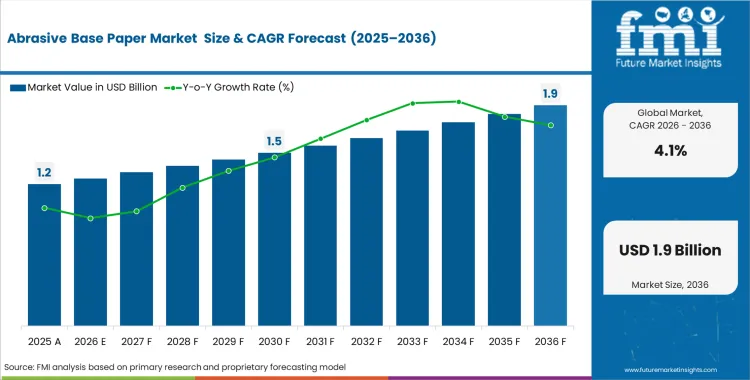
The abrasive base paper market was valued at USD 1.18 billion in 2025. The market is projected to reach USD 1.23 billion in 2026 and USD 1.84 billion by 2036, expanding at a CAGR of 4.1% during the forecast period. Latex-Impregnated Paper is expected to lead product type with a 31.4% share in 2026. Automotive is projected to remain the leading end-use industry with a 28.7% share in 2026.
Summary of Abrasive Base Paper Market
- Market Snapshot
- The abrasive base paper market is estimated at USD 1.18 billion in 2025 and is forecast to reach USD 1.84 billion by 2036.
- The market is projected to expand at a CAGR of 4.1% during the forecast period 2026-2036.
- Demand is driven by broad usage in sanding, polishing, grinding, and surface preparation applications across industrial sectors.
- Demand and Growth Drivers
- Automotive refinishing and component finishing are likely to account for significant demand during the forecast period due to consistent requirements for precision surface treatment.
- Manufacturing activity in metalworking, woodworking, and construction materials processing continues to support recurring abrasive paper consumption.
- Replacement demand and repeat purchasing patterns are sustained by the consumable nature of abrasive-backed paper products.
- Product and Segment View
- Latex-Impregnated Paper is likely to lead the product landscape with 31.4% share in 2026, supported by tear resistance and wet-sanding suitability.
- Manufacturers are focusing on base paper uniformity to improve abrasive performance.
- Product development is increasingly focused on process efficiency for industrial converters.
- Geography and Competitive Outlook
- East Asia is likely to remain a key market owing to its large manufacturing base and strong industrial supply chains.
- Europe is likely to create significant opportunities owing to centers that produce technical paper.
- North America, led by the USA, is likely to sustain demand on account of strong automotive aftermarket activity and woodworking applications.
- Analyst Opinion
- Ismail Sutaria, Senior Consultant at FMI says, "Value in abrasive base paper will continue to pool around converter-grade consistency during the forecast period. Suppliers that can meet the scale and customized requirements are likely to retain pricing power in quality-sensitive industrial applications."
Global Abrasive Base Paper Market Definition
Abrasive base paper refers to specialty paper engineered to serve as the backing substrate for coated abrasive products such as sandpaper and related finishing materials. It is designed to provide controlled strength, flexibility, weight consistency, and adhesion compatibility for abrasive grains and binder systems. These papers are used across dry and wet sanding applications in various industries.
Global Abrasive Base Paper Market Inclusions
This report covers,
- Specialty paper backings used in coated abrasive applications across multiple weight grades and performance specifications.
- Product type analysis by paper treatment and performance characteristics, including latex-impregnated variants.
- End-use demand across automotive, industrial manufacturing, woodworking, metal finishing, and related sectors.
Global Abrasive Base Paper Market Exclusions
This report does not cover,
- Finished abrasive tools and non-paper abrasive backings such as cloth, fiber, film, or vulcanized substrates.
- Raw abrasive minerals and grains sold independently of abrasive base paper applications.
- General printing, packaging, or decorative papers not intended for abrasive converting.
Global Abrasive Base Paper Market Research Methodology
The report is based on a combination of secondary research, company-level assessment, trade flow review, and analysis of end-use industry trends influencing abrasive converting demand. Market sizing and forecasting are derived through triangulation of supply-side specialty paper capacity, downstream abrasive consumption patterns, and regional manufacturing indicators. Qualitative insights are supported by evaluation of product innovation, competitive positioning, and application-specific adoption trends. This study evaluates the market across key segments and regions for the base year 2025 and the forecast period 2026 to 2036. All market values are presented in USD billion. The analysis is built on a review of regulatory references, company disclosures, product and technology developments, trade literature, and industry documentation relevant to the value chain. Market estimates are derived through triangulation of demand-side trends, supply-side positioning, pricing dynamics, application intensity, and regional adoption patterns to establish current market size and forecast potential.
Key Drivers, Restraints, and Trends in Global Abrasive Base Paper Market
Drivers
Demand for abrasive base paper is being supported by steady use of coated abrasives in automotive refinishing, metalworking, industrial fabrication, and woodworking. Vehicle production and repair activity continue to generate regular demand for sanding and surface-preparation materials. OICA’s production statistics show that world motor vehicle output in 2025 remained substantial, with more than 21 million vehicles produced in the first three quarters alone. At the same time, converters are looking for better base papers that hold abrasive grains securely, run smoothly through production, and stay stable during use. Because these products are consumables, demand also benefits from routine replacement across workshops and industrial settings.
Restraints
Growth in the abrasive base paper market is held back by a few persistent pressures. Specialty paper producers are influenced by various factors. Producer price data through February 2026 indicate that industrial input costs have remained active. Environmental compliance adds to the burden, particularly for coated and treated paper grades, as paper and board production remains subject to emissions-management and process-control expectations under the EU’s BAT framework. The Federal Reserve’s Beige Book for March 2026 noted softness in parts of paper, printing, and wood-related manufacturing, underscoring the market’s exposure to broader manufacturing and construction cycles.
Trends
A notable market trend is the shift toward higher-performance engineered papers that offer improved properties. Producers are also investing in process optimization to deliver tighter basis weight control and more uniform surfaces for consistent abrasive coating performance. Sustainability is becoming more prominent, with attention on responsible fiber sourcing growing. Another visible trend is closer collaboration between paper manufacturers and abrasive converters to tailor backing properties to specific end-use requirements.
Segmental Analysis
Global Abrasive Base Paper Market Analysis by Product Type
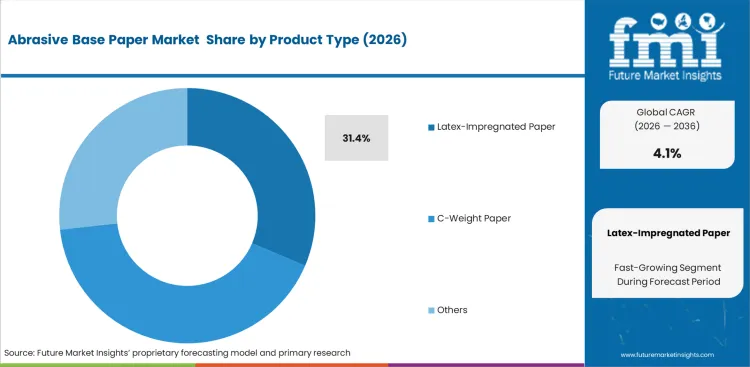
Latex-Impregnated Paper is likely to hold 31.4% share of the product type segment in 2026. Its enhanced flexibility and tear resistance make it particularly effective in sanding operations that require conformity to curved or irregular surfaces. The segment also benefits from superior wet-strength characteristics, which support use in water-assisted finishing and automotive refinishing environments. As converters prioritize durability and finish consistency, latex-impregnated grades are expected to retain a leading position in the product mix.
Global Abrasive Base Paper Market Analysis by End Use Industry
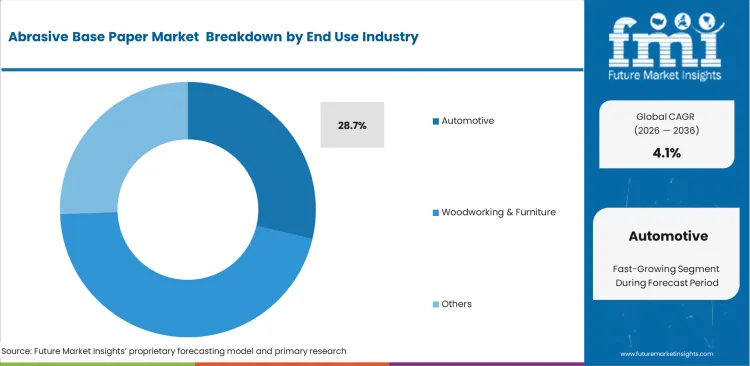
Automotive segment is likely to account for 28.7% share of the market in 2026, The installed vehicle base continues to support recurring demand for abrasive paper products used in refinishing and surface preparation. In the United States alone, total motor-vehicle registrations reached 297.5 million in 2024. That large and still-growing parc sustains a broad repair, maintenance, and refinishing ecosystem. New vehicle output also remains substantial.
Global Abrasive Base Paper Market Analysis by Region
East Asia is likely to provide significant growth opportunities to end-users on account of steady demand from its end-use industries. The region benefits from integrated supply chains and broad demand from metalworking and electronics-related finishing applications. China, Japan, and South Korea collectively support substantial consumption through large-scale manufacturing ecosystems. Continued industrial modernization and quality-focused finishing requirements are expected to reinforce East Asia’s strategic importance in the market.
Competitive Aligners for Market Players
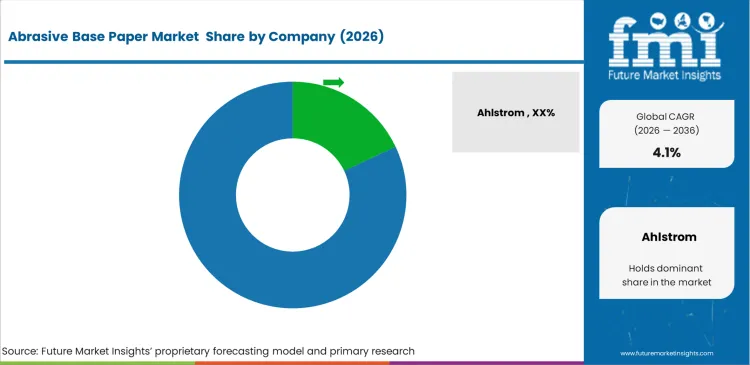
The competitive landscape in abrasive base paper remains fairly concentrated around a small group of specialty paper manufacturers with long experience in engineered paper grades. Ahlstrom continues to hold an important position in this space, supported by its background in high-performance fiber-based materials and its ability to serve industrial applications that demand consistency at the converting stage. Munksjö also remains relevant because abrasive converters tend to value paper that runs predictably, holds coating well, and can be adapted to specific production needs. Sappi brings similar strength from its broader specialty paper platform, particularly in grades where surface properties and process control matter to downstream performance.
Japanese producers such as Mitsubishi Paper Mills and Nippon Paper Industries remain part of this core supply base, largely because abrasive applications leave little room for variation in paper quality. Their presence is tied less to aggressive market positioning and more to manufacturing discipline, technical control, and the ability to serve quality-sensitive uses reliably over time. Fedrigoni adds another layer to the market through its specialty paper capabilities, while Twin Rivers Paper gives the landscape some added depth by serving more focused customer requirements and niche specifications.
Key Players in Global Abrasive Base Paper Market
- Ahlstrom
- Munksjö
- Sappi Limited
- Mitsubishi Paper Mills Limited
- Nippon Paper Industries Co., Ltd.
- Fedrigoni S.p.A.
- Twin Rivers Paper Company
- Mativ Holdings, Inc.
Strategic Outlook by FMI on Global Abrasive Base Paper Market
FMI views the abrasive base paper market as a stable market with moderate but dependable expansion potential. Future gains are expected to come from increasing penetration in automotive and industrial finishing requirements. East Asia is likely to remain key to demand during the forecast period, while premium product innovation will continue to shape competitive advantage globally. Companies that balance cost discipline with engineered product differentiation are expected to be best positioned through the forecast period.
Scope of the Report
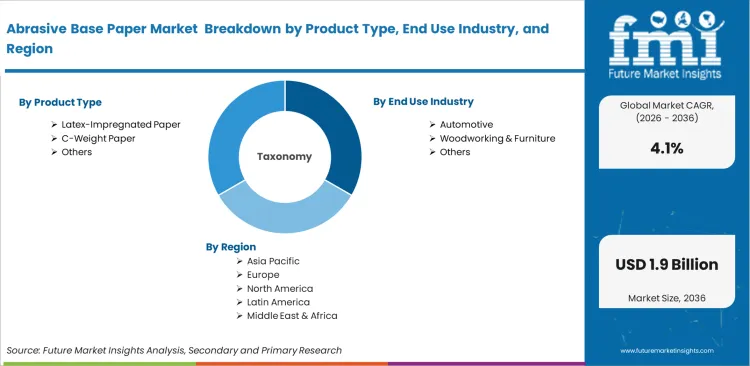
| Metric | Value |
|---|---|
| Market Value | USD 1.18 billion in 2025 to USD 1.84 billion by 2036 |
| CAGR | 4.1% from 2026 to 2036 |
| Base Year | 2025 |
| Forecast Period | 2026 to 2036 |
| Product Type Segmentation | Latex-Impregnated Paper, C-Weight Paper, D-Weight Paper, E/F-Weight Paper, Waterproof Paper |
| End Use Industry Segmentation | Automotive, Woodworking & Furniture, Metal Fabrication, Construction, Electronics & Precision Finishing, DIY & Retail |
| Regions Covered | North America, Latin America, Western Europe, Eastern Europe, East Asia, South Asia and Pacific, Middle East and Africa |
Bibliography
- OECD. 2024. Industrial Production (OECD Data Indicator).
- International Energy Agency. 2025. Energy Prices (Data Product).
- International Energy Agency. 2025. Electricity 2025.
- International Organization of Motor Vehicle Manufacturers (OICA). 2024. Production Statistics / World Motor Vehicle Production, 2024.
- World Bank. 2023. Global Economic Prospects, January 2023 or Global Economic Prospects, June 2023.
- CEPI. 2025. Cepi Key Statistics 2024.
- UNIDO. 2024. Industrial Development Report 2024: Turning Challenges into Sustainable Solutions: The New Era of Industrial Policy.
- FAO. 2024. Forest Products Annual Market Review 2023-2024.
- FAO. 2024. Pulp and Paper Capacities Annual Survey 2023-2025.
Frequently Asked Questions
How big is the abrasive base paper market?
The abrasive base paper market is valued at USD 1.18 billion in 2025 and is projected to reach USD 1.84 billion by 2036.
What is the CAGR of the abrasive base paper market?
The market is expected to expand at a CAGR of 4.1% during the forecast period.
Which product type leads the abrasive base paper market?
Latex-Impregnated Paper leads the product type segment with a 31.4% share.
Which end-use industry leads the abrasive base paper market?
Automotive is the leading end-use industry, accounting for a 28.7% share.
What drives growth in the abrasive base paper market?
Growth is driven by steady demand from automotive refinishing, industrial manufacturing, woodworking, and metal finishing, along with the need for durable, high-performance abrasive backings.
Who are the key companies in the abrasive base paper market?
Key companies include Ahlstrom, Sappi Limited, Mitsubishi Paper Mills Limited, Nippon Paper Industries Co., Ltd., Fedrigoni S.p.A., and Twin Rivers Paper Company.
Preview the report firsthand - request a free sample
Get SampleGet the brochure for pricing and purchase details.
Get PDFTable of Content
- Executive Summary
- Global Market Outlook
- Demand-side Trends
- Supply-side Trends
- Technology Roadmap Analysis
- Analysis and Recommendations
- Market Overview
- Market Coverage / Taxonomy
- Market Definition / Scope / Limitations
- Research Methodology
- Chapter Orientation
- Analytical Lens and Working Hypotheses
- Market Structure, Signals, and Trend Drivers
- Benchmarking and Cross-market Comparability
- Market Sizing, Forecasting, and Opportunity Mapping
- Research Design and Evidence Framework
- Desk Research Programme (Secondary Evidence)
- Company Annual and Sustainability Reports
- Peer-reviewed Journals and Academic Literature
- Corporate Websites, Product Literature, and Technical Notes
- Earnings Decks and Investor Briefings
- Statutory Filings and Regulatory Disclosures
- Technical White Papers and Standards Notes
- Trade Journals, Industry Magazines, and Analyst Briefs
- Conference Proceedings, Webinars, and Seminar Materials
- Government Statistics Portals and Public Data Releases
- Press Releases and Reputable Media Coverage
- Specialist Newsletters and Curated Briefings
- Sector Databases and Reference Repositories
- FMI Internal Proprietary Databases and Historical Market Datasets
- Subscription Datasets and Paid Sources
- Social Channels, Communities, and Digital Listening Inputs
- Additional Desk Sources
- Expert Input and Fieldwork (Primary Evidence)
- Primary Modes
- Qualitative Interviews and Expert Elicitation
- Quantitative Surveys and Structured Data Capture
- Blended Approach
- Why Primary Evidence is Used
- Field Techniques
- Interviews
- Surveys
- Focus Groups
- Observational and In-context Research
- Social and Community Interactions
- Stakeholder Universe Engaged
- C-suite Leaders
- Board Members
- Presidents and Vice Presidents
- R&D and Innovation Heads
- Technical Specialists
- Domain Subject-matter Experts
- Scientists
- Physicians and Other Healthcare Professionals
- Governance, Ethics, and Data Stewardship
- Research Ethics
- Data Integrity and Handling
- Primary Modes
- Tooling, Models, and Reference Databases
- Desk Research Programme (Secondary Evidence)
- Data Engineering and Model Build
- Data Acquisition and Ingestion
- Cleaning, Normalisation, and Verification
- Synthesis, Triangulation, and Analysis
- Quality Assurance and Audit Trail
- Market Background
- Market Dynamics
- Drivers
- Restraints
- Opportunity
- Trends
- Scenario Forecast
- Demand in Optimistic Scenario
- Demand in Likely Scenario
- Demand in Conservative Scenario
- Opportunity Map Analysis
- Product Life Cycle Analysis
- Supply Chain Analysis
- Investment Feasibility Matrix
- Value Chain Analysis
- PESTLE and Porter’s Analysis
- Regulatory Landscape
- Regional Parent Market Outlook
- Production and Consumption Statistics
- Import and Export Statistics
- Market Dynamics
- Global Market Analysis 2021 to 2025 and Forecast, 2026 to 2036
- Historical Market Size Value (USD Million) Analysis, 2021 to 2025
- Current and Future Market Size Value (USD Million) Projections, 2026 to 2036
- Y-o-Y Growth Trend Analysis
- Absolute $ Opportunity Analysis
- Global Market Pricing Analysis 2021 to 2025 and Forecast 2026 to 2036
- Global Market Analysis 2021 to 2025 and Forecast 2026 to 2036, By Product Type
- Introduction / Key Findings
- Historical Market Size Value (USD Million) Analysis By Product Type , 2021 to 2025
- Current and Future Market Size Value (USD Million) Analysis and Forecast By Product Type , 2026 to 2036
- Latex-Impregnated Paper
- C-Weight Paper
- Others
- Latex-Impregnated Paper
- Y-o-Y Growth Trend Analysis By Product Type , 2021 to 2025
- Absolute $ Opportunity Analysis By Product Type , 2026 to 2036
- Global Market Analysis 2021 to 2025 and Forecast 2026 to 2036, By End Use Industry
- Introduction / Key Findings
- Historical Market Size Value (USD Million) Analysis By End Use Industry, 2021 to 2025
- Current and Future Market Size Value (USD Million) Analysis and Forecast By End Use Industry, 2026 to 2036
- Automotive
- Woodworking & Furniture
- Others
- Automotive
- Y-o-Y Growth Trend Analysis By End Use Industry, 2021 to 2025
- Absolute $ Opportunity Analysis By End Use Industry, 2026 to 2036
- Global Market Analysis 2021 to 2025 and Forecast 2026 to 2036, By Region
- Introduction
- Historical Market Size Value (USD Million) Analysis By Region, 2021 to 2025
- Current Market Size Value (USD Million) Analysis and Forecast By Region, 2026 to 2036
- North America
- Latin America
- Western Europe
- Eastern Europe
- East Asia
- South Asia and Pacific
- Middle East & Africa
- Market Attractiveness Analysis By Region
- North America Market Analysis 2021 to 2025 and Forecast 2026 to 2036, By Country
- Historical Market Size Value (USD Million) Trend Analysis By Market Taxonomy, 2021 to 2025
- Market Size Value (USD Million) Forecast By Market Taxonomy, 2026 to 2036
- By Country
- USA
- Canada
- Mexico
- By Product Type
- By End Use Industry
- By Country
- Market Attractiveness Analysis
- By Country
- By Product Type
- By End Use Industry
- Key Takeaways
- Latin America Market Analysis 2021 to 2025 and Forecast 2026 to 2036, By Country
- Historical Market Size Value (USD Million) Trend Analysis By Market Taxonomy, 2021 to 2025
- Market Size Value (USD Million) Forecast By Market Taxonomy, 2026 to 2036
- By Country
- Brazil
- Chile
- Rest of Latin America
- By Product Type
- By End Use Industry
- By Country
- Market Attractiveness Analysis
- By Country
- By Product Type
- By End Use Industry
- Key Takeaways
- Western Europe Market Analysis 2021 to 2025 and Forecast 2026 to 2036, By Country
- Historical Market Size Value (USD Million) Trend Analysis By Market Taxonomy, 2021 to 2025
- Market Size Value (USD Million) Forecast By Market Taxonomy, 2026 to 2036
- By Country
- Germany
- UK
- Italy
- Spain
- France
- Nordic
- BENELUX
- Rest of Western Europe
- By Product Type
- By End Use Industry
- By Country
- Market Attractiveness Analysis
- By Country
- By Product Type
- By End Use Industry
- Key Takeaways
- Eastern Europe Market Analysis 2021 to 2025 and Forecast 2026 to 2036, By Country
- Historical Market Size Value (USD Million) Trend Analysis By Market Taxonomy, 2021 to 2025
- Market Size Value (USD Million) Forecast By Market Taxonomy, 2026 to 2036
- By Country
- Russia
- Poland
- Hungary
- Balkan & Baltic
- Rest of Eastern Europe
- By Product Type
- By End Use Industry
- By Country
- Market Attractiveness Analysis
- By Country
- By Product Type
- By End Use Industry
- Key Takeaways
- East Asia Market Analysis 2021 to 2025 and Forecast 2026 to 2036, By Country
- Historical Market Size Value (USD Million) Trend Analysis By Market Taxonomy, 2021 to 2025
- Market Size Value (USD Million) Forecast By Market Taxonomy, 2026 to 2036
- By Country
- China
- Japan
- South Korea
- By Product Type
- By End Use Industry
- By Country
- Market Attractiveness Analysis
- By Country
- By Product Type
- By End Use Industry
- Key Takeaways
- South Asia and Pacific Market Analysis 2021 to 2025 and Forecast 2026 to 2036, By Country
- Historical Market Size Value (USD Million) Trend Analysis By Market Taxonomy, 2021 to 2025
- Market Size Value (USD Million) Forecast By Market Taxonomy, 2026 to 2036
- By Country
- India
- ASEAN
- Australia & New Zealand
- Rest of South Asia and Pacific
- By Product Type
- By End Use Industry
- By Country
- Market Attractiveness Analysis
- By Country
- By Product Type
- By End Use Industry
- Key Takeaways
- Middle East & Africa Market Analysis 2021 to 2025 and Forecast 2026 to 2036, By Country
- Historical Market Size Value (USD Million) Trend Analysis By Market Taxonomy, 2021 to 2025
- Market Size Value (USD Million) Forecast By Market Taxonomy, 2026 to 2036
- By Country
- Kingdom of Saudi Arabia
- Other GCC Countries
- Turkiye
- South Africa
- Other African Union
- Rest of Middle East & Africa
- By Product Type
- By End Use Industry
- By Country
- Market Attractiveness Analysis
- By Country
- By Product Type
- By End Use Industry
- Key Takeaways
- Key Countries Market Analysis
- USA
- Pricing Analysis
- Market Share Analysis, 2025
- By Product Type
- By End Use Industry
- Canada
- Pricing Analysis
- Market Share Analysis, 2025
- By Product Type
- By End Use Industry
- Mexico
- Pricing Analysis
- Market Share Analysis, 2025
- By Product Type
- By End Use Industry
- Brazil
- Pricing Analysis
- Market Share Analysis, 2025
- By Product Type
- By End Use Industry
- Chile
- Pricing Analysis
- Market Share Analysis, 2025
- By Product Type
- By End Use Industry
- Germany
- Pricing Analysis
- Market Share Analysis, 2025
- By Product Type
- By End Use Industry
- UK
- Pricing Analysis
- Market Share Analysis, 2025
- By Product Type
- By End Use Industry
- Italy
- Pricing Analysis
- Market Share Analysis, 2025
- By Product Type
- By End Use Industry
- Spain
- Pricing Analysis
- Market Share Analysis, 2025
- By Product Type
- By End Use Industry
- France
- Pricing Analysis
- Market Share Analysis, 2025
- By Product Type
- By End Use Industry
- India
- Pricing Analysis
- Market Share Analysis, 2025
- By Product Type
- By End Use Industry
- ASEAN
- Pricing Analysis
- Market Share Analysis, 2025
- By Product Type
- By End Use Industry
- Australia & New Zealand
- Pricing Analysis
- Market Share Analysis, 2025
- By Product Type
- By End Use Industry
- China
- Pricing Analysis
- Market Share Analysis, 2025
- By Product Type
- By End Use Industry
- Japan
- Pricing Analysis
- Market Share Analysis, 2025
- By Product Type
- By End Use Industry
- South Korea
- Pricing Analysis
- Market Share Analysis, 2025
- By Product Type
- By End Use Industry
- Russia
- Pricing Analysis
- Market Share Analysis, 2025
- By Product Type
- By End Use Industry
- Poland
- Pricing Analysis
- Market Share Analysis, 2025
- By Product Type
- By End Use Industry
- Hungary
- Pricing Analysis
- Market Share Analysis, 2025
- By Product Type
- By End Use Industry
- Kingdom of Saudi Arabia
- Pricing Analysis
- Market Share Analysis, 2025
- By Product Type
- By End Use Industry
- Turkiye
- Pricing Analysis
- Market Share Analysis, 2025
- By Product Type
- By End Use Industry
- South Africa
- Pricing Analysis
- Market Share Analysis, 2025
- By Product Type
- By End Use Industry
- USA
- Market Structure Analysis
- Competition Dashboard
- Competition Benchmarking
- Market Share Analysis of Top Players
- By Region
- By Product Type
- By End Use Industry
- Competition Analysis
- Competition Deep Dive
- Ahlstrom
- Overview
- Product Portfolio
- Profitability by Market Segments (Product/Age /Sales Channel/Region)
- Sales Footprint
- Strategy Overview
- Marketing Strategy
- Product Strategy
- Channel Strategy
- Munksjö
- Sappi Limited
- Mitsubishi Paper Mills Limited
- Nippon Paper Industries Co., Ltd.
- Fedrigoni S.p.A.
- Ahlstrom
- Competition Deep Dive
- Assumptions & Acronyms Used


