

- Industry Size (2026)
- USD 106.0 Mn
- Forecast (2036)
- USD 285.1 Mn
- CAGR (2026 to 2036)
- 10.4%
Bio-Based PSA for Paper and Fiber-Based Flexible Packaging Market Size, Market Forecast and Outlook By FMI
The bio-based PSA for paper and fiber-based flexible packaging market was valued at USD 96.0 million in 2025. Sales are poised to hit USD 106.0 million in 2026 at a CAGR of 10.4% during this forecast period. The valuation is expected to be USD 285.1 million through 2036 as extended producer responsibility legislation ties end-of-life compostability directly to brand taxation rates.
Packaging engineers face an immediate qualification deadline regarding mono-material mandates approaching across major global jurisdictions. Failing to transition away from fossil-derived acrylics exposes brands to severe financial penalties under strict food contact compostable adhesives regulations. R&D directors weigh whether to absorb higher per-unit coating costs immediately or risk total exclusion from retail shelves once rigid repulpability standards take effect. FMI's assessment indicates this pressure accelerates timeline conversions far faster than internal corporate sustainability pledges ever achieved independently.
Summary of Bio-Based PSA for Paper and Fiber-Based Flexible Packaging Market
- Bio-Based PSA for Paper and Fiber-Based Flexible Packaging Market Definition
- Polymers formulated primarily from renewable carbon sources designed to bond cellulosic substrates under light pressure while maintaining strict end-of-life compostability or repulpability standards.
- Demand Drivers in the Market
- Extended producer responsibility taxation forces procurement directors to abandon fossil-acrylics.
- Mono-material retail mandates push packaging engineers to specify compatible cellulosic binders.
- Corporate scope-3 emission targets compel supply chain managers to source renewable feedstocks.
- Key Segments Analyzed in the FMI Report
- Starch & dextrin derivatives: This segment is anticipated to hold 36.8% share in 2026, matching existing coating machinery line speeds without requiring capital expenditure for new drying ovens.
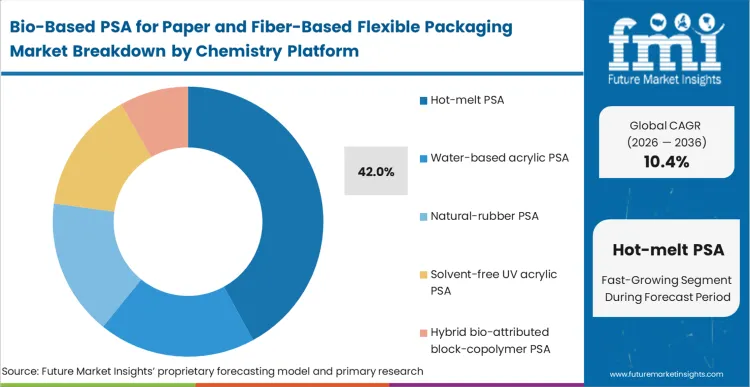
- Hot-melt PSA: This segment is expected to lead by Chemistry Platform, driven by rapid set times required on high-speed flow-wrap lines.
- Resealable pouches, bags, and flow-wrap closures: This segment is projected to capture 31.6% share in 2026, supported by shifting consumer preferences toward portion-controlled dry foods.
- Kraft paper and paper mailers: This segment is set to dominate Substrate Format with 34.7% share in 2026, reflecting massive e-commerce logistics expansion.
- Food & beverage: This segment is estimated to lead End Use holding 42.5% share in 2026, responding to intense regulatory scrutiny regarding packaging waste.
- India: India is expected to register 12.3% CAGR, responding to immediate domestic bans on specific single-use plastic flexible films.
- Analyst Opinion at FMI
- Ismail Sutaria, Principal Analyst, Packaging, at FMI, points out, "Procurement directors assume achieving a certified repulpable bond is simply a matter of swapping fossil acrylics for bio-based alternatives. In reality, formulation chemistry is only a fraction of this challenge. True friction emerges during coating operations. Porous kraft substrates absorb bio-adhesives at completely different rates than synthetic films, forcing converters to either slow line speeds drastically or apply excessive coat weights. Buyers who fail to account for this absorption penalty in total cost modeling inevitably face budget overruns within early commercial scale-up phases. Generalist analysts focus entirely on shear strength metrics displayed on technical data sheets. Practitioners managing actual converting facilities understand that viscosity curves under varying humidity environments dictate true production efficiency. Brands forcing suppliers into rushed transitions routinely discover newly sustainable pouches delaminating during ocean transit, proving environmental compliance without mechanical reliability yields zero commercial value."
- Strategic Implications / Executive Takeaways
- Coating plant managers must upgrade drying oven configurations to accommodate distinct water evaporation profiles.
- Regulatory compliance officers require verifiable carbon-dating certificates to defend greenwashing accusations.
- R&D directors face strict mandates to optimize peel strength without sacrificing end-of-life compost certification.
- Methodology
- Primary Research: Conversations with packaging engineers and formulation chemists reveal hidden operational bottlenecks.
- Desk Research: European repulpability registries provide verifiable commercialization timelines for emerging polymers.
- Market-Sizing and Forecasting: Volume ties directly to global kraft paper production outputs serving FMCG sectors.
- Data Validation and Update Cycle: Bio-monomer import records independently verify supply chain flow against reported production volumes.
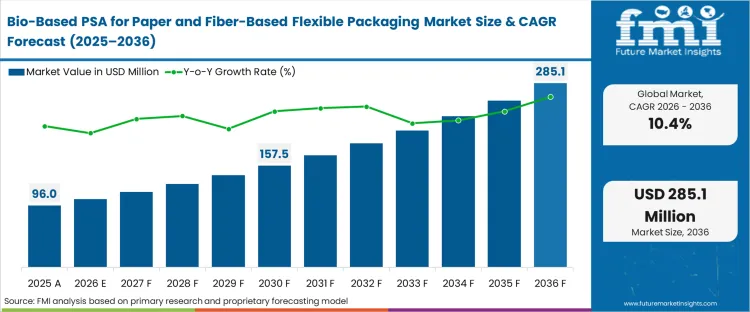
Bio-Based PSA for Paper and Fiber-Based Flexible Packaging Market Key Takeaways
| Metric | Details |
|---|---|
| Industry Size (2026) | USD 106.0 million |
| Industry Value (2036) | USD 285.1 million |
| CAGR (2026 to 2036) | 10.4% |
Source: Future Market Insights (FMI) analysis, based on proprietary forecasting model and primary research
Mill operators finalizing unified repulpability testing protocols trigger critical mass adoption phases globally. Standardizing these metrics allows procurement departments to bypass secondary sorting validations entirely. Clear performance baselines shift purchasing behaviors from localized pilot programs toward integrated global supply contracts almost overnight.
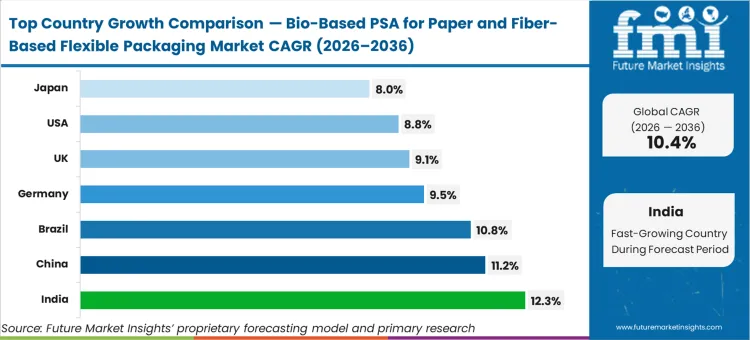
India leads expansion at 12.3% as domestic regulations prohibiting single-use plastic films force consumer goods manufacturers into paper-based alternatives requiring immediate high-tack sealing solutions. China follows at 11.2% through aggressive state-backed paperization initiatives, while Brazil tracks at 10.8% driven by agricultural export packaging shifts. Germany records 9.5% based on advanced circular economy taxation structures. The United Kingdom advances at 9.1%, the United States grows at 8.8%, and Japan expands at 8.0%. Legislative frameworks dictate adoption speeds entirely across these varying geographic jurisdictions.
Bio-Based PSA for Paper and Fiber-Based Flexible Packaging Market Definition
Polymers formulated primarily from renewable carbon sources designed specifically to bond cellulosic substrates under light pressure without requiring heat or solvent activation at specific application points. Formulations must achieve strict shear and peel adhesion metrics compatible with flexible paper structures while maintaining end-of-life compostability or repulpability standards.
Bio-Based PSA for Paper and Fiber-Based Flexible Packaging Market Inclusions
Product scope covers naturally derived tackifiers, water-based bio-acrylics, and bio-attributed block copolymers applied directly to paper or fiber matrices. Applications encompass e-commerce mailer flap seals, resealable dry food pouches, and compostable adhesives utilized in tamper-evident labeling. Revenue calculations account for bulk adhesive sales directed specifically into flexible cellulosic packaging conversion lines.
Bio-Based PSA for Paper and Fiber-Based Flexible Packaging Market Exclusions
Rigid packaging glues and structural wood-binding resins fall outside this specific evaluation. Medical-grade skin contact formulations and pressure sensitive adhesives applied to non-porous synthetic films do not contribute to volume metrics. Traditional fossil-derived hot melts containing only trace amounts of renewable rosin are deliberately omitted to maintain strict sustainability profiling integrity.
Bio-Based PSA for Paper and Fiber-Based Flexible Packaging Market Research Methodology
- Primary Research: Procurement directors at multinational paper converters, lead formulation chemists at adhesive suppliers, and packaging engineers at Tier-1 FMCG brands.
- Desk Research: European repulpability certification registries, global biopolymer patent filings, and supplier technical data sheets detailing renewable carbon percentages.
- Market-Sizing and Forecasting: Baseline volume anchors directly to annual coated kraft paper production outputs designated for flexible consumer goods.
- Data Validation and Update Cycle: Independent cross-validation utilizing import records for raw tall-oil rosin and bio-monomer chemical shipments.
Segmental Analysis
Bio-Based PSA for Paper and Fiber-Based Flexible Packaging Market Analysis by Feedstock Source
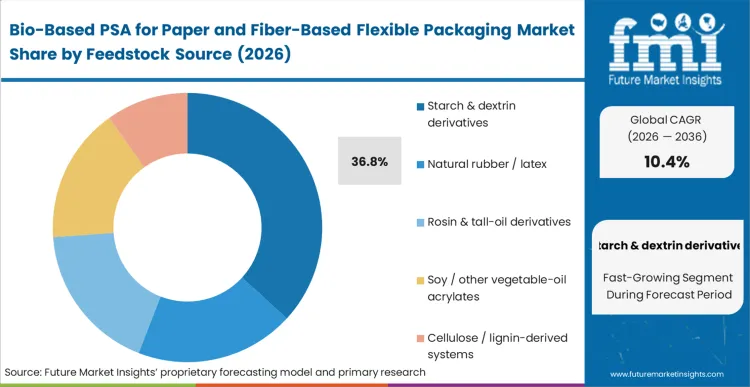
Production lines calibrated for specific viscosity parameters determine initial formulation selections across flexible conversion facilities globally. The starch & dextrin derivatives segment is anticipated to hold 36.8% share in 2026 precisely because these polymers integrate into existing legacy coating machinery without requiring extensive capital expenditure for new specialized drying ovens. Operations managers at major paper converters strongly favor this specific feedstock to maintain critical high-volume throughput speeds during peak manufacturing cycles. FMI observes that recyclability certified labels and adhesives relying heavily on these derivatives face hidden operational penalties entirely missed by standard cost models. Starch derivatives struggle profoundly with high-humidity storage environments, quietly forcing consumer brands into expensive secondary climate-controlled warehousing solutions to prevent premature cross-linking. Procurement teams neglecting this downstream supply chain cost consistently miscalculate total implementation budgets across multi-year contracts. Brands failing to secure appropriate climate-controlled transit conditions routinely experience total adhesive batch failures before finished products ever reach retail supermarket shelves.
- Machine compatibility advantage: Plant operators utilize existing hot-melt application nozzles without modifying critical internal line infrastructure. Production directors successfully avoid millions in capital expenditure requirements previously associated with mandatory sustainable equipment upgrades. Failing to leverage legacy converting equipment forces immediate margin collapse during early commercialization phases.
- Humidity degradation risk: High moisture environments severely compromise internal shear strength across starch-based polymer chains. Logistics managers must proactively secure specialized climate-controlled transit routes across tropical distribution networks. Ignoring ambient moisture exposure results directly in catastrophic seal failures during extended global shipping cycles.
- Scale-up economics: Raw material abundance allows aggressive suppliers to offer immediate pricing parity against legacy fossil alternatives. Sourcing officers achieve strict corporate sustainability goals without destroying delicate product margin structures. Brands exploiting this cost parity capture massive market share from competitors delayed by expensive alternative chemistries.
Bio-Based PSA for Paper and Fiber-Based Flexible Packaging Market Analysis by Chemistry Platform
Application methodologies dictate platform choices based entirely on required line speeds and substrate thermal sensitivities. Facility engineers specifying bio based tackifier resins prefer this chemistry to eliminate drying times completely from converting operations. Based on FMI's assessment, calculating comprehensive carbon footprints reveals a distinct contradiction regarding these materials. Hot-melt requires strict temperature controls during transport and storage, an energy-intensive requirement that actively negates a significant portion of lifecycle carbon benefits originally claimed. Hot-melt PSA segment is expected to lead in 2036 by delivering instant tack necessary for high-volume manufacturing lines. Sustainability directors ignoring this thermal energy requirement present flawed environmental impact reports to critical stakeholders. Purchasing officers failing to account for heating utility spikes discover their sustainable packaging initiatives actually increase overall facility operating costs significantly.
- Instant bonding necessity: Flow-wrap machinery demands immediate adhesion to prevent flap pop-open during rapid mechanical processing. Packaging engineers rely entirely on this instant tack to maintain profitable line efficiency quotas. Replacing hot-melts with slower-drying alternatives devastates overall facility output metrics across multi-shift operations.
- Thermal energy penalty: Maintaining precise application temperatures requires substantial electrical input at converter facilities. Operations directors bear increased utility costs directly linked to melting bio-polymers continuously. Miscalculating these massive energy demands ruins profitability models originally designed to justify sustainable material transitions.
- Lifecycle assessment gaps: Transporting temperature-sensitive chemistry introduces hidden greenhouse gas emissions into corporate supply chains. Environmental compliance officers struggle continuously to balance these figures against rigid corporate emission reduction targets. Stakeholders demanding absolute carbon neutrality reject formulations carrying heavy hidden transportation energy burdens.
Bio-Based PSA for Paper and Fiber-Based Flexible Packaging Market Analysis by Application
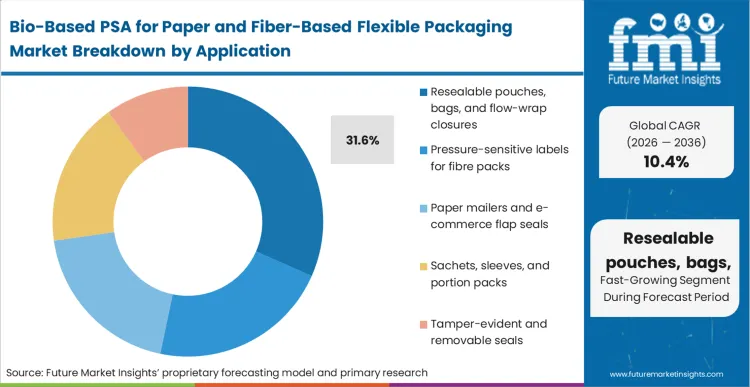
Resealable pouches, bags, and flow-wrap closures segment is projected to capture 31.6% share in 2026 as brands prioritize portion-controlled formats for sensitive dry goods. Final user interaction dictates required peel strength and reclosure longevity specifications across consumer retail categories. Product development teams specify bio based laminate packaging materials equipped with these adhesives to extend shelf life after initial consumer opening. FMI analysts note that achieving consistent performance introduces unexpected material demands largely ignored by generalist observers. Resealable closures using natural bio-polymers often fail completely upon a third open cycle, pushing R&D departments to over-engineer initial coat weights just to guarantee basic functionality. Margin analysts discover material usage increasing by twenty percent simply to match legacy fossil-acrylic performance standards. Brand managers authorizing these thicker applications absorb severe unit-cost penalties to protect consumer brand loyalty.
- Z-direction strength: Removing a resealable flap places extreme stress directly upon underlying paper fibers. Formulation chemists must perfectly balance adhesive tack against inherent substrate tear resistance limits. Applying excessive bonding strength guarantees catastrophic package destruction during initial consumer opening attempts.
- Coat weight escalation: Compensating for weak reclosure cycling forces converters to apply substantially thicker adhesive layers. Procurement managers face rising unit costs directly tied to this systemic material over-application. Brands refusing to increase application weights suffer immediate consumer backlash regarding dysfunctional pouch closures.
- Consumer friction points: Failing adhesive bonds frustrate buyers attempting to store dry goods securely over extended periods. Brand managers risk severe customer loyalty erosion due directly to premature packaging failures. Competitors retaining highly functional legacy seals easily poach frustrated consumers tired of defective sustainable closures.
Bio-Based PSA for Paper and Fiber-Based Flexible Packaging Market Analysis by Substrate Format
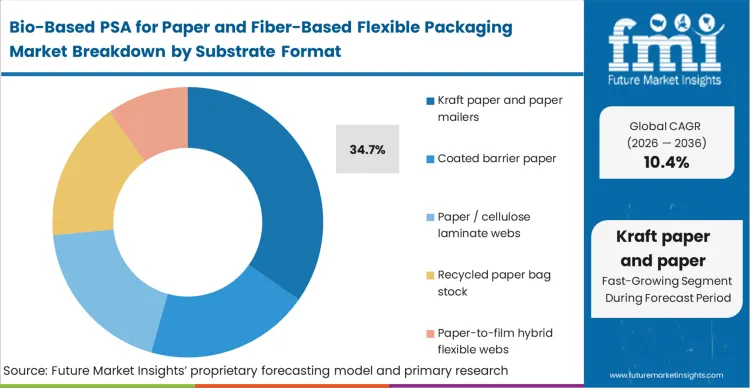
Material porosity defines exact mathematical boundaries for efficient adhesive application across different automated converting operations. Packaging technologists deploying psa film alternatives recognize unbleached cellulosic fibers present unique bonding challenges compared to smooth synthetic webs. Kraft paper and paper mailers segment is set to dominate with 34.7% share in 2026 due to overwhelming e-commerce shipping volume expansion globally. According to FMI's estimates, calculating precise usage rates uncovers a severe operational flaw plaguing early adopters. Uncoated kraft's highly porous nature absorbs up to fifteen percent more liquid adhesive mass than coated variants, quietly ruining fragile unit-cost models before commercialization even begins. Finance directors investigating margin erosion frequently trace massive financial losses directly back to this uncalculated fiber absorption phenomenon. Supply chain managers failing to adjust procurement volumes accordingly face sudden material shortages mid-production.
- Fiber penetration depth: Uncoated cellulosic structures rapidly draw wet adhesives away from active surface bonding layers. Coating engineers struggle constantly to maintain sufficient surface tack without authorizing excessive volumetric application. Solving this porosity challenge requires complex rheology adjustments previously unnecessary with standard plastic films.
- E-commerce transit stress: Mailer flaps endure aggressive physical handling through highly mechanized logistics sorting facilities. Quality control officers demand exceptional initial grab strength to prevent catastrophic transit tampering incidents. Adhesives failing these rigorous drop tests trigger massive retailer chargebacks against original packaging suppliers.
- Recycling stream purity: Adhesives applied to kraft must wash away completely cleanly during standard repulping processes. Mill operators forcefully reject contaminated bales causing massive financial penalties for original converters. Formulators prioritizing shear strength over solubility face total blacklisting from major municipal recycling recovery facilities.
Bio-Based PSA for Paper and Fiber-Based Flexible Packaging Market Analysis by End Use
Regulatory scrutiny regarding consumer safety dictates adoption priorities across distinct commercial retail sectors. Food & beverage segment is estimated to lead by holding 42.5% share in 2026 as brand owners desperately transition away from problematic fossil chemistries. Compliance officers demand laminating adhesives capable of passing stringent chemical migration thresholds required for direct consumption items. FMI's analysis indicates securing commercial market entry has very little to do with actual physical bonding capability. Complex food contact migration testing protocols create a massive financial barrier, meaning actual hurdles to commercialization involve regulatory filing costs rather than polymer performance limits. Product managers launching new sustainable snacks frequently experience six-month delays waiting exclusively for external laboratory toxicity clearances. Brands bypassing these rigorous certification steps face devastating product recalls and permanent reputational damage.
- Chemical migration limits: Regulators strictly monitor any potential chemical transfer from adhesive layers directly into consumable goods. Safety officers conduct extensive analytical testing to verify total compliance against shifting regional standards. Formulators utilizing untested novel bio-monomers face extreme scrutiny from national food safety administrations globally.
- Filing cost barriers: External laboratory validation requires significant upfront capital allocation per specific adhesive formulation. Financial controllers restrict R&D pipelines based entirely on these escalating external certification expenses. Smaller chemical suppliers unable to fund comprehensive toxicity studies remain permanently locked out of lucrative food segments.
- Retail shelf access: Major grocery chains categorically refuse products lacking comprehensive environmental and safety documentation. Account managers lose critical distribution nodes without presenting verified bio-based credentials upon initial product pitches. Winning premium retail placement depends entirely upon supplying unimpeachable end-of-life compostability certificates.
Bio-Based PSA for Paper and Fiber-Based Flexible Packaging Market Drivers, Restraints, and Opportunities
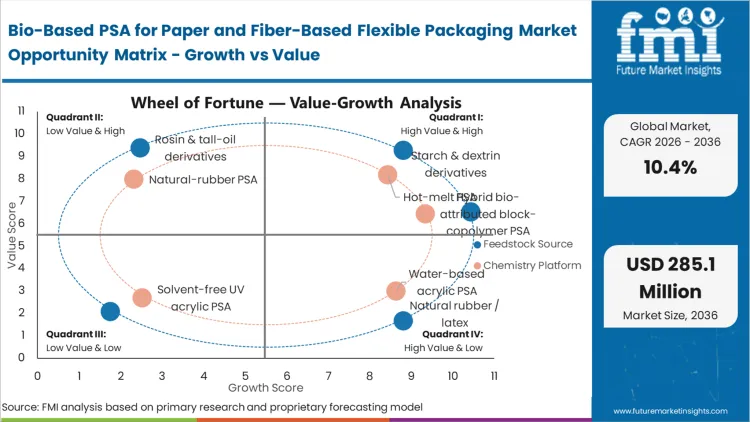
Tax implications attached to extended producer responsibility frameworks force corporate procurement directors to abandon fossil-derived polymers entirely. Failing to utilize certified repulpable materials exposes multinational brands to exorbitant end-of-life disposal fees across European and North American jurisdictions. Supply chain managers scramble to secure reliable volumes of adhesives and sealants derived from renewable feedstocks before impending 2030 mono-material deadlines activate. FMI observes this legislative threat accelerates material qualification timelines from multiple years down to mere months. Brands lacking compliant cellulosic bonding solutions face literal exclusion from major retail shelves once retailers enforce independent sustainability mandates. Procurement departments prioritize supply security over unit cost, aggressively locking smaller converting facilities into exclusive long-term bio-adhesive contracts to guarantee uninterrupted output.
Machinery limitations at converter levels actively prevent rapid deployment even when purchasing departments fully approve novel bio-based formulations. Transitioning from traditional hot-melts to advanced water-based bio-acrylics requires vastly different drying oven configurations to manage unique moisture evaporation profiles. Facility engineers attempting to run renewable chemistries on legacy equipment immediately face severe line speed reductions. This throughput penalty destroys internal production economics, forcing converters to choose between missing critical delivery quotas or rejecting sustainable adhesives entirely until expensive capital upgrades occur.
Opportunities in the Bio-Based PSA for Paper and Fiber-Based Flexible Packaging Market
- Cold-seal formulation development: Formulating materials capable of bonding under extreme pressure without thermal activation. Plant managers utilizing these chemistries eliminate costly heating infrastructure entirely from their converting lines.
- Medical sterilization resilience: Developing bio-polymers capable of surviving aggressive gamma irradiation processes intact. Healthcare packaging directors gain immediate access to highly sustainable bioadhesives for packaging applications previously dominated by fossil plastics.
- Direct food contact clearances: Securing comprehensive global regulatory approvals for immediate physical proximity to consumable goods. Brand managers leverage these specific certifications to dominate premium organic snack segments demanding total packaging purity.
Regional Analysis
.webp "Top Country Growth Comparison Bio Based Psa For Paper And Fiber Based Flexible Packaging Market Cagr (2026 2036)")
Based on regional analysis, bio-based PSA for paper and fiber-based flexible packaging market is segmented into North America, Europe, Asia Pacific, Latin America, and Middle East & Africa across 40 plus countries.
| Country | CAGR (2026 to 2036) |
|---|---|
| India | 12.3% |
| China | 11.2% |
| Brazil | 10.8% |
| Germany | 9.5% |
| United Kingdom | 9.1% |
| United States | 8.8% |
| Japan | 8.0% |
Source: Future Market Insights (FMI) analysis, based on proprietary forecasting model and primary research
North America Bio-Based PSA for Paper and Fiber-Based Flexible Packaging Market Analysis
Fractured state-level extended producer responsibility legislation creates massive compliance complexity for national consumer brands. Packaging technologists face contradictory repulpability definitions depending entirely upon which municipal jurisdiction processes the post-consumer waste. FMI's analysis indicates sourcing departments actively resist localized adhesive purchasing, demanding universally compliant formulations capable of passing the strictest regional standards simultaneously. Chemical suppliers failing to achieve this universal cross-state compatibility face immediate contract termination from Tier-1 converters.
- United States: Regulatory uncertainty forces packaging engineers to specify highly versatile cellulosic binders capable of functioning across diverse legacy recycling infrastructures. Operations directors require drop-in solutions that do not disrupt existing high-speed automated fulfillment lines. The United States grows at 8.8% compound growth, owing to versatility, drop-in compatibility, regulatory compliance, collaboration, cost competitiveness, and supply chain resilience. Successfully navigating these contradictory state mandates requires continuous collaboration between formulation chemists and regional recovery facility operators.
FMI's report includes additional qualitative evaluations covering Canadian converting sectors. Operations managers prioritize cold-weather transit durability when specifying water-based acrylics for cross-border logistics applications.
Europe Bio-Based PSA for Paper and Fiber-Based Flexible Packaging Market Analysis
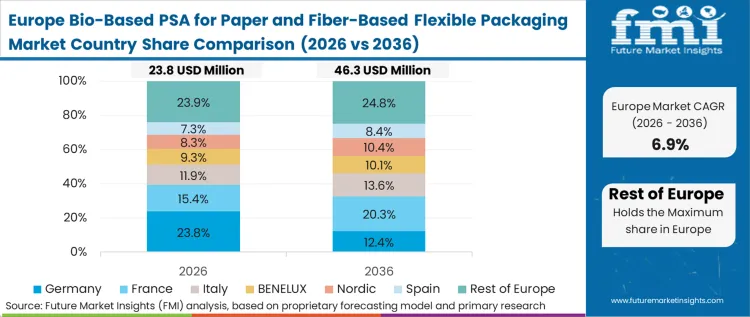
Advanced circular economy taxation structures explicitly penalize brands utilizing non-repulpable barrier materials. Regulatory bodies continuously tighten precise definitions regarding what constitutes a fully compostable package. FMI's analysis indicates synthetic and bio emulsion polymer specialists focus entirely on achieving compliance with unified continental recycling protocols. Converters operating across borders face intense pressure to standardize adhesive purchasing, eliminating fragmented localized inventory models entirely. Securing European repulpability certification serves as a universal commercial passport, granting suppliers immediate credibility across global export channels.
- Germany: Strict sorting facility requirements force packaging engineers to eliminate all silicone and fossil-acrylic contaminants from active paper streams. Procurement directors source verified cellulose-derived adhesives specifically to pass these rigorous municipal processing tests. Germany grows at a CAGR of around 9.5%, due to strict sorting compliance, cellulose adhesive verification, elimination of contaminants, cost savings, municipal acceptance, and profit margin recovery. Successful integration completely eliminates punitive disposal taxes previously eroding brand profit margins.
- United Kingdom: Major supermarket chains independently dictate packaging requirements noticeably stricter than national legislation. Account managers must present verifiable bio polyol green polyol certifications to maintain highly contested shelf space for dry goods. United Kingdom advances at a CAGR of 9.1%, due to retailer mandates, certification requirements, shelf space competition, operational bottlenecks, compliance assurance, and growth opportunities, collectively. Navigating these aggressive retailer-specific mandates becomes a primary operational bottleneck for packaging converters.
FMI's report includes extensive data covering French, Italian, and Spanish conversion nodes. Supply chain managers across these southern territories heavily prioritize regionalized bio-acrylic sourcing to minimize intra-continental transport emissions.
Asia Pacific Bio-Based PSA for Paper and Fiber-Based Flexible Packaging Market Analysis
Immediate legislative bans targeting single-use plastic films fundamentally reshape raw material sourcing across local manufacturing hubs. Consumer goods producers desperately pivot toward cellulosic formats to maintain massive product distribution networks. FMI analysts note this rapid shift exposes severe limitations within domestic conversion facilities attempting to process novel materials at scale. Supply chain directors prioritizing paper packaging share analysis realize local adhesive infrastructure cannot support sudden surges in demand for sustainable tackifiers. Multinational chemical companies aggressively build regional blending facilities to capture this exploding demand before domestic startups optimize their own bio-polymer recipes.
- India: Aggressive state-level prohibitions regarding plastic flexible packaging force immediate adoption of paper-based sachets. FMCG operations managers require high-tack bio-adhesives to seal these porous structures securely without utilizing fossil plastics. India registers 12.3% CAGR, due to state prohibitions, paper sachet adoption, bio-adhesive sealing, domestic supply contracts, and cost advantages. Securing reliable domestic supply contracts grants early adopters a massive cost advantage over competitors relying on expensive imported chemistry.
- China: Centralized mandates targeting plastic reduction within e-commerce logistics drive unprecedented demand for secure paper shipping mailers. Packaging technologists specify bio-based flap seals to ensure total parcel repulpability. China tracks at 11.2% CAGR, owing to centralized mandates, e-commerce logistics focus, bio-based flap seals, high-speed qualification, and scale advantages . Achieving qualification on these high-speed converting lines permanently locks out smaller regional adhesive formulators lacking massive scale.
- Japan: Extreme demographic focus on premium easily opened packaging pushes R&D departments toward highly engineered resealable closures. Formulation chemists struggle to balance bio-content requirements against strict consumer functionality expectations. Japan records 8.0% CAGR, due to premium packaging demand, resealable closure innovation, bio-content balance, consumer functionality expectations, and chemical resolution. Resolving this chemical tension dictates which material science firms control upcoming decades of premium retail packaging.
FMI's report includes secondary assessments across South Korean and Australian converting markets. Quality control officers operating within these highly automated facilities demand exceptional batch-to-batch consistency from all regional sustainable polymer suppliers.
Latin America Bio-Based PSA for Paper and Fiber-Based Flexible Packaging Market Analysis
Agricultural export dominance dictates strict performance criteria for bulk paper packaging closures. Supply chain directors managing multi-week ocean transit routes require exceptional adhesive resilience against severe humidity fluctuations. FMI observes procurement departments routinely reject formulations prioritizing extreme compostability if they compromise necessary barrier sealing strength during intercontinental shipping. Securing commercial contracts depends entirely upon proving chemical stability across aggressive tropical distribution networks rather than simply matching European repulpability timelines.
- Brazil: Massive raw material processing operations demand sustainable high-tack solutions for heavy-duty multi-wall paper sacks, due to which Brazil tracks at 10.8% CAGR. Logistics managers specify bio-attributed formulations highly resistant to premature moisture degradation. Developing climate-resilient natural polymers grants progressive chemical suppliers immediate commercial dominance across southern agricultural export corridors.
FMI's report includes broader assessments encompassing Mexican converting operations. Facility engineers frequently adopt sustainable adhesive technologies driven specifically by North American brand owners outsourcing their sustainable packaging production.
Middle East & Africa Bio-Based PSA for Paper and Fiber-Based Flexible Packaging Market Analysis
Import reliance dictates packaging material specifications across expanding regional food security initiatives. Procurement directors managing localized converting facilities lack the domestic biochemical infrastructure required to formulate complex renewable adhesives internally. Supply chain managers depend entirely upon imported masterbatches from European and Asian chemical conglomerates to satisfy emerging municipal sustainability targets. FMI observes this import dependency creates severe pricing volatility, preventing smaller flexible packaging converters from committing to permanent bio-based transitions. Agricultural exporters targeting premium European retail markets represent the sole consistent demand pool, utilizing imported certified compostable flap seals specifically to bypass strict continental import tariffs. Establishing domestic blending capacity remains the critical structural gate required to achieve mass commercialization across these territories.
FMI's report includes extensive qualitative assessments regarding secondary markets across the GCC and South Africa. Material scientists continuously evaluate how extreme desert transit conditions affect long-term shear strength profiles within these specific distribution networks.
Competitive Aligners for Market Players
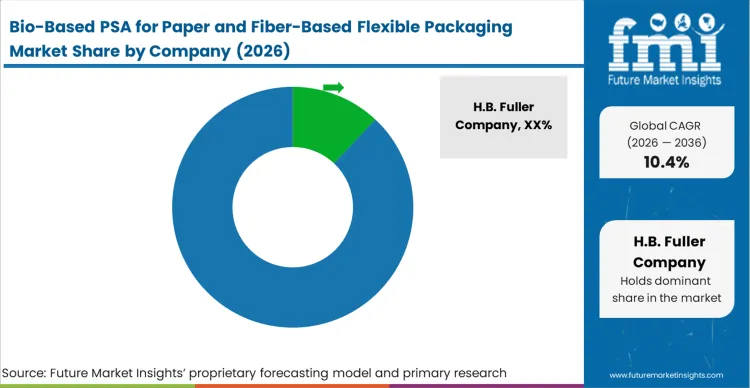
Complex polymer chemistry dictates survival regarding shear strength parity against legacy fossil alternatives. Henkel AG & Co. KGaA and Arkema S.A. dominate specific converting lines because they possess decades of proprietary cross-linking data. Procurement directors evaluating new compostable plastic packaging bonds prioritize this deep historical reliability over slight price advantages offered by emerging natural-rubber specialists. Sourcing departments categorically refuse to risk catastrophic seal failures on high-speed lines simply to achieve minor unit-cost reductions.
Incumbent suppliers hold massive advantages regarding certified repulpability documentation. Avery Dennison Corporation maintains extensive libraries containing third-party laboratory clearances verifying their specific formulations wash away cleanly during mill processing. Challengers attempting to market novel bio polyethylene hybrid adhesives must endure eighteen-month testing cycles just to bid on commercial enterprise contracts. This rigid certification barrier heavily protects established players while simultaneously choking innovation velocity across broader material science ecosystems.
Large multinational paper converters actively resist relying entirely on single-source bio-formulations. Operations managers construct complex qualification matrices forcing chemical suppliers to prove exact drop-in compatibility with competitors' materials. Structural tension constantly emerges as formulation chemists try to protect proprietary intellectual property while simultaneously satisfying aggressive buyer demands for universal machine interoperability. Resolving this friction determines which bio based building materials adjacent technologies successfully transition into mainstream flexible packaging architectures over upcoming decades.
Key Players in Bio-Based PSA for Paper and Fiber-Based Flexible Packaging Market
- H.B. Fuller Company
- Henkel AG & Co. KGaA
- Arkema S.A. (Bostik)
- Avery Dennison Corporation
- UPM Adhesive Materials
- Paramelt B.V.
- BioBond Adhesives, Inc.
Scope of the Report
| Metric | Value |
|---|---|
| Quantitative Units | USD 106.0 million to USD 285.1 million, at a CAGR of 10.4% |
| Market Definition | Polymers formulated primarily from renewable carbon sources designed specifically to bond cellulosic substrates under light pressure without requiring heat or solvent activation. Formulations must achieve specific shear metrics compatible with flexible paper structures while maintaining compostability standards. |
| Segmentation | Feedstock Source, Chemistry Platform, Application, Substrate Format, End Use |
| Regions Covered | North America, Europe, Asia Pacific, Latin America, Middle East & Africa |
| Countries Covered | India, China, Brazil, Germany, United Kingdom, United States, Japan |
| Key Companies Profiled | H.B. Fuller Company, Henkel AG & Co. KGaA, Arkema S.A. (Bostik), Avery Dennison Corporation, UPM Adhesive Materials, Paramelt B.V., BioBond Adhesives, Inc. |
| Forecast Period | 2026 to 2036 |
| Approach | Baseline volume anchors directly to annual coated kraft paper production outputs designated for flexible consumer goods. |
Source: Future Market Insights (FMI) analysis, based on proprietary forecasting model and primary research
Bio-Based PSA for Paper and Fiber-Based Flexible Packaging Market Analysis by Segments
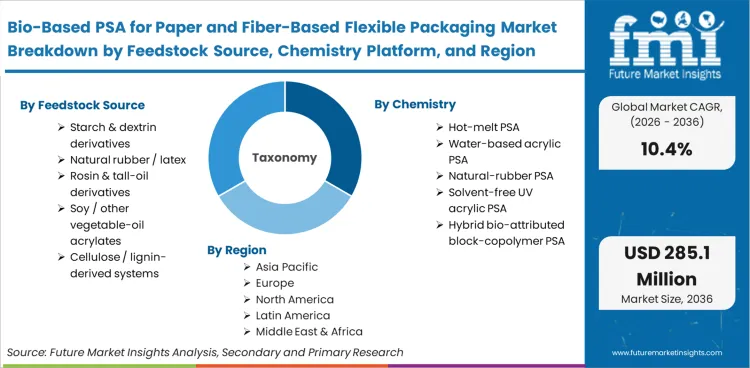
Feedstock Source
- Starch & dextrin derivatives
- Natural rubber / latex
- Rosin & tall-oil derivatives
- Soy / other vegetable-oil acrylates
- Cellulose / lignin-derived systems
Chemistry Platform
- Hot-melt PSA
- Water-based acrylic PSA
- Natural-rubber PSA
- Solvent-free UV acrylic PSA
- Hybrid bio-attributed block-copolymer PSA
Application
- Resealable pouches, bags, and flow-wrap closures
- Pressure-sensitive labels for fibre packs
- Paper mailers and e-commerce flap seals
- Sachets, sleeves, and portion packs
- Tamper-evident and removable seals
Substrate Format
- Kraft paper and paper mailers
- Coated barrier paper
- Paper / cellulose laminate webs
- Recycled paper bag stock
- Paper-to-film hybrid flexible webs
End Use
- Food & beverage
- Home and personal care
- E-commerce and logistics
- Healthcare / OTC
- Industrial dry goods
Region
- North America
- United States
- Canada
- Europe
- Germany
- United Kingdom
- France
- Italy
- Spain
- Asia Pacific
- China
- India
- Japan
- South Korea
- Australia
- Latin America
- Brazil
- Mexico
- Argentina
- Middle East & Africa
- GCC Countries
- South Africa
- Israel
- Rest of Middle East & Africa
Bibliography
- Pi, B. S., Lee, K., Song, C., Jeon, B., Han, Y., & Choi, S. Q. (2024, September). Processable, reversible, and reusable 100% bio-based pressure-sensitive adhesives using nanostarch. Chemical Engineering Journal.
- Wang, X., et al. (2024, April). Biodegradable polyurethane pressure-sensitive adhesives derived from bio-based polyols. ACS Applied Polymer Materials.
- Marinelli, L. G. T., et al. (2025, March). Sustainable bio-based pressure-sensitive adhesives from epoxidized soybean oil. Reactive and Functional Polymers.
- Xue, W., et al. (2025, September). Biobased itaconate acrylic pressure-sensitive adhesives via sustainable polymerization. ACS Applied Materials & Interfaces.
- Kim, D., et al. (2024, February). New chemistries for degradable pressure-sensitive adhesives and recycling-ready materials. ChemPlusChem (Wiley).
This bibliography is provided for reader reference. The full FMI report contains the complete reference list with primary source documentation.
This Report Addresses
- Production lines calibrated for specific viscosity parameters determining initial formulation selections.
- Humidity degradation risks affecting starch derivatives during extended logistics cycles.
- Thermal energy penalties associated directly with hot-melt chemistry applications.
- Fiber penetration dynamics complicating adhesive application across porous kraft substrates.
- Filing cost barriers preventing smaller formulators from entering lucrative food contact sectors.
- Domestic single-use plastic bans accelerating paperization initiatives across Asian markets.
- Circular economy taxation structures penalizing fossil-acrylic usage across European jurisdictions.
- Supplier certification libraries acting as massive commercial barriers against emerging challengers.
Frequently Asked Questions
What is the current valuation of this industry?
Demand reached USD 96.0 million in 2025. This baseline anchors directly to total volumes of coated kraft paper produced globally for flexible consumer goods requiring certified compostable closures.
What is the projected growth rate?
Sales are poised to expand at a 10.4% CAGR through 2036. Extended producer responsibility legislation actively ties end-of-life packaging compostability directly to corporate taxation rates, forcing immediate transitions away from fossil-acrylics.
What valuation is expected by the end of the forecast period?
Cumulative buildup lifts total valuation to USD 285.1 million by 2036. Mono-material mandates approaching across major jurisdictions require procurement directors to secure massive volumes of cellulosic binding agents.
Which feedstock segment dominates commercial volumes?
Starch & dextrin derivatives is anticipated to hold 36.8% share in 2026. These specific polymers integrate flawlessly into existing legacy coating machinery without requiring extensive capital expenditure for new specialized drying ovens.
Why do starch derivatives maintain their leading position?
Operations managers favor this feedstock to maintain critical high-volume throughput speeds during peak manufacturing cycles. High raw material abundance allows aggressive suppliers to offer immediate pricing parity against legacy fossil alternatives.
What non-obvious operational challenge affects starch formulations?
High moisture environments severely compromise internal shear strength across starch-based polymer chains. Logistics managers must proactively secure specialized climate-controlled transit routes to prevent premature cross-linking during tropical distribution operations.
Which chemistry platform leads adoption rates?
Hot-melt PSA is expected to lead by Chemistry Platform. Flow-wrap machinery demands immediate adhesion to prevent flap pop-open during rapid mechanical processing, making instant tack absolutely critical for converter efficiency.
What hidden penalty accompanies hot-melt applications?
Maintaining precise application temperatures requires substantial electrical input at converter facilities. Transporting temperature-sensitive chemistry introduces hidden greenhouse gas emissions that actively negate significant portions of claimed lifecycle carbon benefits.
Which application format records the highest usage?
Resealable pouches, bags, and flow-wrap closures is projected to capture 31.6% share in 2026. Product development teams specify these formats extensively to extend product shelf life after initial consumer opening.
What tension exists within resealable pouch engineering?
Resealable closures using natural bio-polymers often fail completely upon a third open cycle. R&D departments must drastically over-engineer initial coat weights just to guarantee basic functionality, devastating unit-cost profitability models.
Which substrate format drives maximum adhesive consumption?
Kraft paper and paper mailers is set to dominate Substrate Format with 34.7% share in 2026. Overwhelming global e-commerce shipping volume expansion dictates massive requirements for secure, tamper-evident cellulosic flap seals.
How does kraft paper affect application economics?
Uncoated kraft's highly porous nature absorbs up to fifteen percent more liquid adhesive mass than coated variants. Coating engineers struggle constantly to maintain sufficient surface tack without authorizing excessive volumetric material application.
What advantage do incumbent chemical suppliers hold?
Established corporations maintain extensive libraries containing third-party laboratory clearances verifying specific formulations wash away cleanly during mill processing. Challengers face eighteen-month testing cycles just to bid on commercial enterprise contracts.
What limits adoption speed at the converter facility level?
Transitioning from traditional hot-melts to advanced water-based bio-acrylics requires vastly different drying oven configurations to manage unique moisture evaporation profiles. Facility engineers face severe line speed reductions until expensive upgrades occur.
How do retail mandates influence procurement strategy?
Major grocery chains categorically refuse products lacking comprehensive environmental and safety documentation. Winning premium retail placement depends entirely upon supplying unimpeachable end-of-life compostability certificates alongside standard physical performance data.
What future technology opportunity disrupts existing formulations?
Developing cold-seal formulations capable of bonding under extreme pressure without thermal activation remains highly lucrative. Plant managers utilizing these advanced chemistries eliminate costly heating infrastructure entirely from their converting lines.
Preview the report firsthand - request a free sample
Get SampleGet the brochure for pricing and purchase details.
Get PDFTable of Content
- Executive Summary
- Global Market Outlook
- Demand-side Trends
- Supply-side Trends
- Technology Roadmap Analysis
- Analysis and Recommendations
- Market Overview
- Market Coverage / Taxonomy
- Market Definition / Scope / Limitations
- Research Methodology
- Chapter Orientation
- Analytical Lens and Working Hypotheses
- Market Structure, Signals, and Trend Drivers
- Benchmarking and Cross-market Comparability
- Market Sizing, Forecasting, and Opportunity Mapping
- Research Design and Evidence Framework
- Desk Research Programme (Secondary Evidence)
- Company Annual and Sustainability Reports
- Peer-reviewed Journals and Academic Literature
- Corporate Websites, Product Literature, and Technical Notes
- Earnings Decks and Investor Briefings
- Statutory Filings and Regulatory Disclosures
- Technical White Papers and Standards Notes
- Trade Journals, Industry Magazines, and Analyst Briefs
- Conference Proceedings, Webinars, and Seminar Materials
- Government Statistics Portals and Public Data Releases
- Press Releases and Reputable Media Coverage
- Specialist Newsletters and Curated Briefings
- Sector Databases and Reference Repositories
- FMI Internal Proprietary Databases and Historical Market Datasets
- Subscription Datasets and Paid Sources
- Social Channels, Communities, and Digital Listening Inputs
- Additional Desk Sources
- Expert Input and Fieldwork (Primary Evidence)
- Primary Modes
- Qualitative Interviews and Expert Elicitation
- Quantitative Surveys and Structured Data Capture
- Blended Approach
- Why Primary Evidence is Used
- Field Techniques
- Interviews
- Surveys
- Focus Groups
- Observational and In-context Research
- Social and Community Interactions
- Stakeholder Universe Engaged
- C-suite Leaders
- Board Members
- Presidents and Vice Presidents
- R&D and Innovation Heads
- Technical Specialists
- Domain Subject-matter Experts
- Scientists
- Physicians and Other Healthcare Professionals
- Governance, Ethics, and Data Stewardship
- Research Ethics
- Data Integrity and Handling
- Primary Modes
- Tooling, Models, and Reference Databases
- Desk Research Programme (Secondary Evidence)
- Data Engineering and Model Build
- Data Acquisition and Ingestion
- Cleaning, Normalisation, and Verification
- Synthesis, Triangulation, and Analysis
- Quality Assurance and Audit Trail
- Market Background
- Market Dynamics
- Drivers
- Restraints
- Opportunity
- Trends
- Scenario Forecast
- Demand in Optimistic Scenario
- Demand in Likely Scenario
- Demand in Conservative Scenario
- Opportunity Map Analysis
- Product Life Cycle Analysis
- Supply Chain Analysis
- Investment Feasibility Matrix
- Value Chain Analysis
- PESTLE and Porter’s Analysis
- Regulatory Landscape
- Regional Parent Market Outlook
- Production and Consumption Statistics
- Import and Export Statistics
- Market Dynamics
- Global Market Analysis 2021 to 2025 and Forecast, 2026 to 2036
- Historical Market Size Value (USD Million) Analysis, 2021 to 2025
- Current and Future Market Size Value (USD Million) Projections, 2026 to 2036
- Y-o-Y Growth Trend Analysis
- Absolute $ Opportunity Analysis
- Global Market Pricing Analysis 2021 to 2025 and Forecast 2026 to 2036
- Global Market Analysis 2021 to 2025 and Forecast 2026 to 2036, By Feedstock Source
- Introduction / Key Findings
- Historical Market Size Value (USD Million) Analysis By Feedstock Source , 2021 to 2025
- Current and Future Market Size Value (USD Million) Analysis and Forecast By Feedstock Source , 2026 to 2036
- Starch & dextrin derivatives
- Natural rubber / latex
- Rosin & tall-oil derivatives
- Soy / other vegetable-oil acrylates
- Cellulose / lignin-derived systems
- Starch & dextrin derivatives
- Y-o-Y Growth Trend Analysis By Feedstock Source , 2021 to 2025
- Absolute $ Opportunity Analysis By Feedstock Source , 2026 to 2036
- Global Market Analysis 2021 to 2025 and Forecast 2026 to 2036, By Chemistry Platform
- Introduction / Key Findings
- Historical Market Size Value (USD Million) Analysis By Chemistry Platform, 2021 to 2025
- Current and Future Market Size Value (USD Million) Analysis and Forecast By Chemistry Platform, 2026 to 2036
- Hot-melt PSA
- Water-based acrylic PSA
- Natural-rubber PSA
- Solvent-free UV acrylic PSA
- Hybrid bio-attributed block-copolymer PSA
- Hot-melt PSA
- Y-o-Y Growth Trend Analysis By Chemistry Platform, 2021 to 2025
- Absolute $ Opportunity Analysis By Chemistry Platform, 2026 to 2036
- Global Market Analysis 2021 to 2025 and Forecast 2026 to 2036, By Application
- Introduction / Key Findings
- Historical Market Size Value (USD Million) Analysis By Application, 2021 to 2025
- Current and Future Market Size Value (USD Million) Analysis and Forecast By Application, 2026 to 2036
- Resealable pouches, bags, and flow-wrap closures
- Pressure-sensitive labels for fibre packs
- Paper mailers and e-commerce flap seals
- Sachets, sleeves, and portion packs
- Tamper-evident and removable seals
- Resealable pouches, bags, and flow-wrap closures
- Y-o-Y Growth Trend Analysis By Application, 2021 to 2025
- Absolute $ Opportunity Analysis By Application, 2026 to 2036
- Global Market Analysis 2021 to 2025 and Forecast 2026 to 2036, By Substrate Format
- Introduction / Key Findings
- Historical Market Size Value (USD Million) Analysis By Substrate Format, 2021 to 2025
- Current and Future Market Size Value (USD Million) Analysis and Forecast By Substrate Format, 2026 to 2036
- Kraft paper and paper mailers
- Coated barrier paper
- Paper / cellulose laminate webs
- Recycled paper bag stock
- Paper-to-film hybrid flexible webs
- Kraft paper and paper mailers
- Y-o-Y Growth Trend Analysis By Substrate Format, 2021 to 2025
- Absolute $ Opportunity Analysis By Substrate Format, 2026 to 2036
- Global Market Analysis 2021 to 2025 and Forecast 2026 to 2036, By End Use
- Introduction / Key Findings
- Historical Market Size Value (USD Million) Analysis By End Use, 2021 to 2025
- Current and Future Market Size Value (USD Million) Analysis and Forecast By End Use, 2026 to 2036
- Food & beverage
- Home and personal care
- E-commerce and logistics
- Healthcare / OTC
- Industrial dry goods
- Food & beverage
- Y-o-Y Growth Trend Analysis By End Use, 2021 to 2025
- Absolute $ Opportunity Analysis By End Use, 2026 to 2036
- Global Market Analysis 2021 to 2025 and Forecast 2026 to 2036, By Region
- Introduction
- Historical Market Size Value (USD Million) Analysis By Region, 2021 to 2025
- Current Market Size Value (USD Million) Analysis and Forecast By Region, 2026 to 2036
- North America
- Latin America
- Western Europe
- Eastern Europe
- East Asia
- South Asia and Pacific
- Middle East & Africa
- Market Attractiveness Analysis By Region
- North America Market Analysis 2021 to 2025 and Forecast 2026 to 2036, By Country
- Historical Market Size Value (USD Million) Trend Analysis By Market Taxonomy, 2021 to 2025
- Market Size Value (USD Million) Forecast By Market Taxonomy, 2026 to 2036
- By Country
- USA
- Canada
- Mexico
- By Feedstock Source
- By Chemistry Platform
- By Application
- By Substrate Format
- By End Use
- By Country
- Market Attractiveness Analysis
- By Country
- By Feedstock Source
- By Chemistry Platform
- By Application
- By Substrate Format
- By End Use
- Key Takeaways
- Latin America Market Analysis 2021 to 2025 and Forecast 2026 to 2036, By Country
- Historical Market Size Value (USD Million) Trend Analysis By Market Taxonomy, 2021 to 2025
- Market Size Value (USD Million) Forecast By Market Taxonomy, 2026 to 2036
- By Country
- Brazil
- Chile
- Rest of Latin America
- By Feedstock Source
- By Chemistry Platform
- By Application
- By Substrate Format
- By End Use
- By Country
- Market Attractiveness Analysis
- By Country
- By Feedstock Source
- By Chemistry Platform
- By Application
- By Substrate Format
- By End Use
- Key Takeaways
- Western Europe Market Analysis 2021 to 2025 and Forecast 2026 to 2036, By Country
- Historical Market Size Value (USD Million) Trend Analysis By Market Taxonomy, 2021 to 2025
- Market Size Value (USD Million) Forecast By Market Taxonomy, 2026 to 2036
- By Country
- Germany
- UK
- Italy
- Spain
- France
- Nordic
- BENELUX
- Rest of Western Europe
- By Feedstock Source
- By Chemistry Platform
- By Application
- By Substrate Format
- By End Use
- By Country
- Market Attractiveness Analysis
- By Country
- By Feedstock Source
- By Chemistry Platform
- By Application
- By Substrate Format
- By End Use
- Key Takeaways
- Eastern Europe Market Analysis 2021 to 2025 and Forecast 2026 to 2036, By Country
- Historical Market Size Value (USD Million) Trend Analysis By Market Taxonomy, 2021 to 2025
- Market Size Value (USD Million) Forecast By Market Taxonomy, 2026 to 2036
- By Country
- Russia
- Poland
- Hungary
- Balkan & Baltic
- Rest of Eastern Europe
- By Feedstock Source
- By Chemistry Platform
- By Application
- By Substrate Format
- By End Use
- By Country
- Market Attractiveness Analysis
- By Country
- By Feedstock Source
- By Chemistry Platform
- By Application
- By Substrate Format
- By End Use
- Key Takeaways
- East Asia Market Analysis 2021 to 2025 and Forecast 2026 to 2036, By Country
- Historical Market Size Value (USD Million) Trend Analysis By Market Taxonomy, 2021 to 2025
- Market Size Value (USD Million) Forecast By Market Taxonomy, 2026 to 2036
- By Country
- China
- Japan
- South Korea
- By Feedstock Source
- By Chemistry Platform
- By Application
- By Substrate Format
- By End Use
- By Country
- Market Attractiveness Analysis
- By Country
- By Feedstock Source
- By Chemistry Platform
- By Application
- By Substrate Format
- By End Use
- Key Takeaways
- South Asia and Pacific Market Analysis 2021 to 2025 and Forecast 2026 to 2036, By Country
- Historical Market Size Value (USD Million) Trend Analysis By Market Taxonomy, 2021 to 2025
- Market Size Value (USD Million) Forecast By Market Taxonomy, 2026 to 2036
- By Country
- India
- ASEAN
- Australia & New Zealand
- Rest of South Asia and Pacific
- By Feedstock Source
- By Chemistry Platform
- By Application
- By Substrate Format
- By End Use
- By Country
- Market Attractiveness Analysis
- By Country
- By Feedstock Source
- By Chemistry Platform
- By Application
- By Substrate Format
- By End Use
- Key Takeaways
- Middle East & Africa Market Analysis 2021 to 2025 and Forecast 2026 to 2036, By Country
- Historical Market Size Value (USD Million) Trend Analysis By Market Taxonomy, 2021 to 2025
- Market Size Value (USD Million) Forecast By Market Taxonomy, 2026 to 2036
- By Country
- Kingdom of Saudi Arabia
- Other GCC Countries
- Turkiye
- South Africa
- Other African Union
- Rest of Middle East & Africa
- By Feedstock Source
- By Chemistry Platform
- By Application
- By Substrate Format
- By End Use
- By Country
- Market Attractiveness Analysis
- By Country
- By Feedstock Source
- By Chemistry Platform
- By Application
- By Substrate Format
- By End Use
- Key Takeaways
- Key Countries Market Analysis
- USA
- Pricing Analysis
- Market Share Analysis, 2025
- By Feedstock Source
- By Chemistry Platform
- By Application
- By Substrate Format
- By End Use
- Canada
- Pricing Analysis
- Market Share Analysis, 2025
- By Feedstock Source
- By Chemistry Platform
- By Application
- By Substrate Format
- By End Use
- Mexico
- Pricing Analysis
- Market Share Analysis, 2025
- By Feedstock Source
- By Chemistry Platform
- By Application
- By Substrate Format
- By End Use
- Brazil
- Pricing Analysis
- Market Share Analysis, 2025
- By Feedstock Source
- By Chemistry Platform
- By Application
- By Substrate Format
- By End Use
- Chile
- Pricing Analysis
- Market Share Analysis, 2025
- By Feedstock Source
- By Chemistry Platform
- By Application
- By Substrate Format
- By End Use
- Germany
- Pricing Analysis
- Market Share Analysis, 2025
- By Feedstock Source
- By Chemistry Platform
- By Application
- By Substrate Format
- By End Use
- UK
- Pricing Analysis
- Market Share Analysis, 2025
- By Feedstock Source
- By Chemistry Platform
- By Application
- By Substrate Format
- By End Use
- Italy
- Pricing Analysis
- Market Share Analysis, 2025
- By Feedstock Source
- By Chemistry Platform
- By Application
- By Substrate Format
- By End Use
- Spain
- Pricing Analysis
- Market Share Analysis, 2025
- By Feedstock Source
- By Chemistry Platform
- By Application
- By Substrate Format
- By End Use
- France
- Pricing Analysis
- Market Share Analysis, 2025
- By Feedstock Source
- By Chemistry Platform
- By Application
- By Substrate Format
- By End Use
- India
- Pricing Analysis
- Market Share Analysis, 2025
- By Feedstock Source
- By Chemistry Platform
- By Application
- By Substrate Format
- By End Use
- ASEAN
- Pricing Analysis
- Market Share Analysis, 2025
- By Feedstock Source
- By Chemistry Platform
- By Application
- By Substrate Format
- By End Use
- Australia & New Zealand
- Pricing Analysis
- Market Share Analysis, 2025
- By Feedstock Source
- By Chemistry Platform
- By Application
- By Substrate Format
- By End Use
- China
- Pricing Analysis
- Market Share Analysis, 2025
- By Feedstock Source
- By Chemistry Platform
- By Application
- By Substrate Format
- By End Use
- Japan
- Pricing Analysis
- Market Share Analysis, 2025
- By Feedstock Source
- By Chemistry Platform
- By Application
- By Substrate Format
- By End Use
- South Korea
- Pricing Analysis
- Market Share Analysis, 2025
- By Feedstock Source
- By Chemistry Platform
- By Application
- By Substrate Format
- By End Use
- Russia
- Pricing Analysis
- Market Share Analysis, 2025
- By Feedstock Source
- By Chemistry Platform
- By Application
- By Substrate Format
- By End Use
- Poland
- Pricing Analysis
- Market Share Analysis, 2025
- By Feedstock Source
- By Chemistry Platform
- By Application
- By Substrate Format
- By End Use
- Hungary
- Pricing Analysis
- Market Share Analysis, 2025
- By Feedstock Source
- By Chemistry Platform
- By Application
- By Substrate Format
- By End Use
- Kingdom of Saudi Arabia
- Pricing Analysis
- Market Share Analysis, 2025
- By Feedstock Source
- By Chemistry Platform
- By Application
- By Substrate Format
- By End Use
- Turkiye
- Pricing Analysis
- Market Share Analysis, 2025
- By Feedstock Source
- By Chemistry Platform
- By Application
- By Substrate Format
- By End Use
- South Africa
- Pricing Analysis
- Market Share Analysis, 2025
- By Feedstock Source
- By Chemistry Platform
- By Application
- By Substrate Format
- By End Use
- USA
- Market Structure Analysis
- Competition Dashboard
- Competition Benchmarking
- Market Share Analysis of Top Players
- By Regional
- By Feedstock Source
- By Chemistry Platform
- By Application
- By Substrate Format
- By End Use
- Competition Analysis
- Competition Deep Dive
- H.B. Fuller Company
- Overview
- Product Portfolio
- Profitability by Market Segments (Product/Age /Sales Channel/Region)
- Sales Footprint
- Strategy Overview
- Marketing Strategy
- Product Strategy
- Channel Strategy
- Henkel AG & Co. KGaA
- Arkema S.A. (Bostik)
- Avery Dennison Corporation
- UPM Adhesive Materials
- Paramelt B.V.
- BioBond Adhesives, Inc.
- H.B. Fuller Company
- Competition Deep Dive
- Assumptions & Acronyms Used


