

- Industry Size (2026)
- USD 1.9 Bn
- Forecast (2036)
- USD 3.4 Bn
- CAGR (2026 to 2036)
- 6.00%
Bio Based Tackifier Resins Market Size, Market Forecast and Outlook By FMI
The Bio Based Tackifier Resins Market was valued at USD 1.8 billion in 2025. The industry is poised to cross USD 1.9 billion in 2026 at a CAGR of 6.00% during the forecast period. Sustained investment carries the valuation to USD 3.4 billion through 2036 as formulation shifts to insulate margins against petrochemical volatility drive baseline conversion across industrial applications.
Procurement directors at tier-1 manufacturing firms are currently forced to decide whether to maintain dual-source supply chains or commit their adhesive specifications entirely to renewable inputs. This operational shift is driven by incoming corporate Scope 3 emission mandates rather than immediate price parity with hydrocarbon alternatives. Companies that delay this transition risk missing the qualification window for major sustainable packaging contracts, essentially locking themselves out of the highest-margin supplier tiers. While general market consensus focuses on consumer demand for green products, the actual adoption catalyst is the need to secure supply lines against cyclical petrochemical shortages. Data regarding rosin derivative integration indicates that early adopters are securing preferential pricing models.
Summary of Bio Based Tackifier Resins Market
- Bio Based Tackifier Resins Market Definition:
- This market provides organically sourced chemical tackifiers that replace synthetic hydrocarbon resins in adhesive systems. It is defined by its reliance on renewable feedstocks-primarily pine and citrus derivatives-and its function in enabling formulators to meet strict bio-content regulatory standards.
- Demand Drivers in the Market:
- Scope 3 emission mandates require tier-1 packaging manufacturers to eliminate petroleum-derived inputs from their structural adhesive profiles.
- Petrochemical supply chain volatility forces industrial formulators to qualify alternative, agriculturally derived resin streams.
- Extended producer responsibility frameworks compel fast-moving consumer goods brands to demand fully repulpable and biodegradable labeling systems.
- Key Segments Analyzed in the FMI Report:
- Rosin Resins: Rosin Resins is expected to hold 55.5% share in 2026, driven by its established drop-in compatibility with legacy hot-melt manufacturing equipment.
- Adhesives & Sealants: Adhesives & Sealants is estimated to record 62.0% share in 2026, as industrial binding represents the largest immediate replacement opportunity for synthetic tackifiers.
- Packaging: Packaging is poised to garner 45.0% share in 2026, compelled by rapid shifts toward sustainable e-commerce shipping materials.
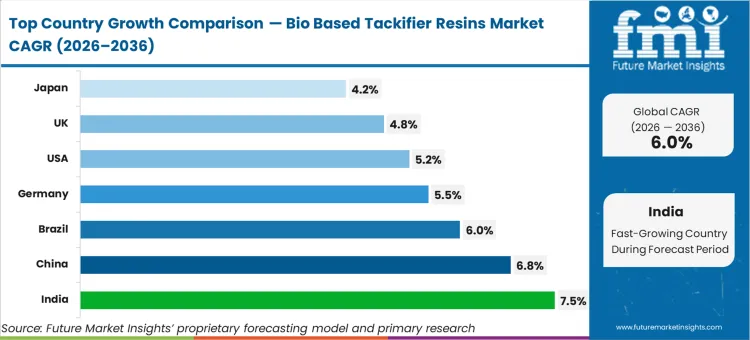
- India: 7.5% compound growth, driven by domestic packaging infrastructure modernization that bypasses legacy synthetic systems.
- Analyst Opinion at FMI:
- Nikhil Kaitwade, Principal Analyst, Chemicals, at FMI, opines, "Procurement teams are often structurally misaligned with their own sustainability mandates. Sustainability officers mandate a shift to bio-based inputs, but the procurement directors evaluating the contracts still penalize natural tackifiers for batch-to-batch color variance. This incentive gap artificially suppresses the adoption curve, as formulators are forced into extended, multi-year qualification cycles just to prove that slight aesthetic variations do not impact mechanical sheer strength."
- Strategic Implications / Executive Takeaways:
- Formulators must secure long-term extraction contracts with pine chemical refineries to guarantee consistent supply volumes during peak demand cycles.
- Chemical distillation plant managers should invest in advanced hydrogenation capacity to eliminate the odor profiles that currently restrict consumer-facing applications.
- End-use packaging brands face structural constraints in verifying true biological carbon content, requiring investment in standardized isotope testing protocols.
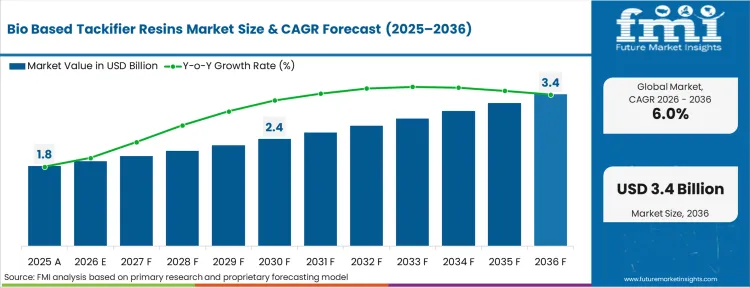
Before growth becomes self-reinforcing, formulators must achieve low-color and low-odor profiles that strictly match existing synthetic hydrocarbon resins. Chemical extraction leaders trigger this shift by investing in advanced distillation technologies that stabilize batch-to-batch consistency. Once this operational gate is crossed, mid-tier formulators can transition their production lines without re-engineering their core hot-melt application equipment.
India is expected to track a 7.5% CAGR, followed by China advancing at 6.8%, Brazil registering 6.0%, and Germany expanding at 5.5%. The United States is estimated to post a 5.2% CAGR, while the United Kingdom and Japan grow at 4.8% and 4.2% respectively. The structural divergence across this range reflects the pace at which domestic packaging infrastructure modernizes; emerging economies are bypassing legacy synthetic systems entirely, while mature industrial bases face the friction of displacing deeply entrenched petrochemical supply chains.
Bio Based Tackifier Resins Market Key Takeaways
| Metric | Details |
|---|---|
| Industry Size (2026) | USD 1.9 billion |
| Industry Value (2036) | USD 3.4 billion |
| CAGR (2026-2036) | 6.00% |
Source: Future Market Insights (FMI) analysis, based on proprietary forecasting model and primary research
Bio Based Tackifier Resins Market Definition
The bio based tackifier resins market encompasses organic, non-petroleum-derived chemical compounds used primarily to increase the tack or stickiness of adhesive formulations. Structurally, these materials are sourced from pine trees, citrus peels, and agricultural byproducts, functioning as sustainable substitutes for aliphatic and aromatic hydrocarbon resins. The defining boundary of this market is the strict requirement for verifiable renewable carbon content, excluding conventional synthetic tackifiers entirely.
Bio Based Tackifier Resins Market Inclusions
This market includes rosin esters, terpene resins, polyterpenes, and emerging soybean-based resin formulations applied across industrial binding applications. Scope captures the chemical modification processes, such as hydrogenation and esterification, required to stabilize these natural extracts for commercial use. Revenue generated from the integration of these materials into hot melt adhesives and pressure-sensitive systems is fully accounted for within this analysis.
Bio Based Tackifier Resins Market Exclusions
Petroleum-derived hydrocarbon resins, including C5 aliphatic and C9 aromatic tackifiers, are explicitly excluded from this analysis. Unprocessed raw pine sap and crude tall oil, before they undergo refinement into distinct tackifying agents, are outside the scope. These materials are excluded because they function as raw feedstocks or synthetic counterparts, lacking either the refinement or the biological carbon origin that defines this specific specialty chemical category.
Bio Based Tackifier Resins Market Research Methodology
- Primary Research: Procurement directors at tier-1 adhesive formulators, chemical distillation plant managers, and sustainability compliance officers.
- Desk Research: REACH compliance registries, ISO bio-based carbon certification databases, and pine chemical association trade data.
- Market-Sizing and Forecasting: Baseline volume anchors to annual global pine extraction yields and commercial tall oil fractionation throughput.
- Data Validation and Update Cycle: Forecasts cross-validated against independent corporate sustainability reports tracking Scope 3 emission reduction targets in the packaging sector.
Segmental Analysis
Bio Based Tackifier Resins Market Analysis by Product Type
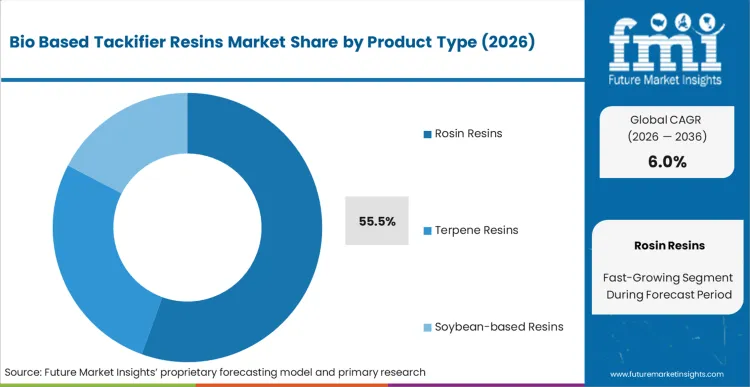
The reason rosin resins hold 55.5% of this market comes down to a single operational reality: mid-tier adhesive formulators cannot absorb the capital expense of re-engineering their hot-melt application equipment for entirely new chemical behaviours. Based on FMI's assessment, this specific extraction provides a true drop-in replacement for aliphatic hydrocarbon resins, maintaining the exact melt viscosity required by existing industrial lines. Formulators choosing this pathway avoid triggering extended downtime during the transition phase. However, the natural variation in pine harvests introduces colour stability issues that synthetic alternatives do not possess. Formulators who attempt to shift to less refined grades to save costs ultimately face immediate rejection from consumer-facing packaging clients who demand optically clear adhesive beads.
- Performance parity: Rosin derivatives deliver the necessary sheer strength required by industrial binding lines. Quality control managers can approve these batches without rewriting their mechanical testing protocols.
- Color stability: Hydrogenated variants address the yellowing issues inherent in natural pine extracts. Packaging manufacturers who specify these premium grades avoid aesthetic degradation in clear labeling applications.
- Odor profile: Advanced distillation strips volatile organic compounds from the final resin. Consumer goods brands utilizing these low-odor tackifiers secure compliance in sensitive food-contact and personal care applications.
Bio Based Tackifier Resins Market Analysis by Application
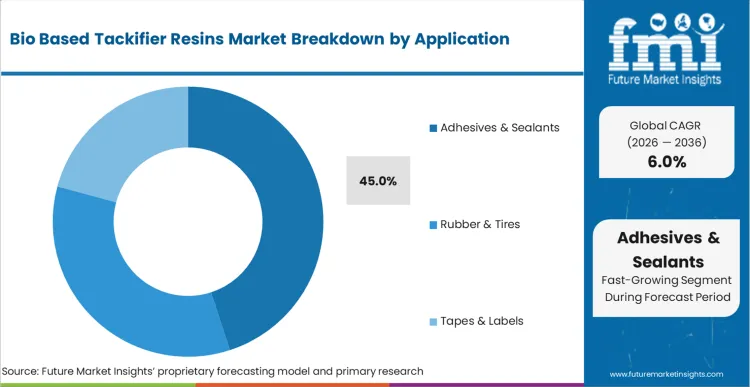
Adhesive formulators are currently facing a critical decision: continue blending synthetic tackifiers to maintain margin or transition their entire pressure sensitive tapes portfolios to 100% bio-based systems. This tension defines the adhesives and sealants segment, which dominates the market.
FMI analysts opine that the push toward biological content is no longer a premium differentiator, but a baseline requirement to bid on major fulfilment centre contracts. Formulators must balance the slightly higher raw material costs of terpene resins against the commercial risk of losing tier-1 logistics clients. Those who delay full transition in their adhesive lines will eventually encounter procurement blockades as logistics giants strictly enforce their Scope 3 emission reduction targets on all suppliers.
- Formulation trigger: The initial shift is driven by corporate mandates to remove petroleum dependencies. Formulators initiate pilot programs to test bio-resin compatibility with existing elastomer bases.
- Qualification metrics: During pilot phases, the resin must demonstrate identical peel and tack values to the legacy synthetic. Lab directors require uninterrupted thermal stability before authorizing commercial scale-up.
- Expansion criteria: Once a bio-based hot-melt is qualified, procurement directors aggressively expand its use across secondary product lines to simplify their raw material inventory.
Bio Based Tackifier Resins Market Analysis by End Use
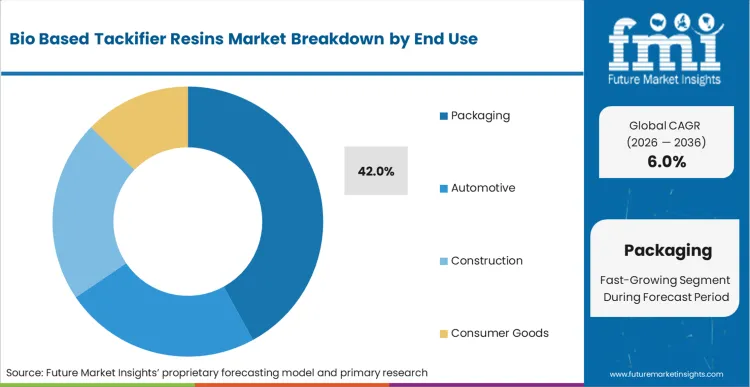
Legacy synthetic tackifiers fail to meet the repulpability standards now heavily enforced within the European and North American paper recycling streams. This displacement dynamic has positioned packaging as the dominant end-use sector. According to FMI's estimates, extended producer responsibility laws effectively tax mixed-material shipping cartons, forcing e-commerce giants to demand fully compatible biological adhesives. The operational shift is profound; box manufacturers are no longer just buying glue; they are purchasing compliance documents. Failure to integrate verified natural tackifiers into carton sealing processes results in severe regulatory penalties and immediate removal from the approved vendor lists of major online retailers.
- E-commerce pioneers: Major fulfilment networks mandate bio-based adhesives to align with their public carbon-neutral pledges. Supplier ecosystems are forced to adapt their formulations to retain these massive volume contracts.
- Industrial followers: Heavy manufacturing logistics gradually adopt the technology as supply scales and prices stabilize. Plant managers integrate these resins to improve the overall sustainability scores of their outbound freight.
- Regulated latecomers: Food and pharmaceutical packaging sectors convert last due to strict migration testing requirements. Compliance officers authorize the shift only after multi-year toxicity profiles are proven entirely benign.
Bio Based Tackifier Resins Market Drivers, Restraints, and Opportunities
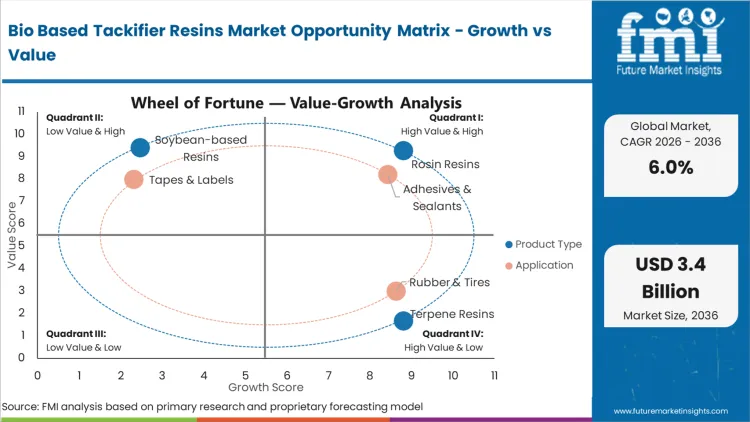
Scope 3 emission mandates require tier-1 packaging manufacturers to eliminate petroleum-derived inputs from their structural adhesive profiles. This structural pressure forces procurement directors to actively seek out high-tack bio-based alternatives, regardless of slight pricing premiums. The commercial stakes are absolute; failing to present a verified biological carbon supply chain disqualifies these manufacturers from competing for multi-year global logistics contracts.
The primary structural friction in this market is the inherent variability of natural feedstocks. Unlike strictly controlled petrochemical synthesis, pine and citrus extracts fluctuate in molecular weight and colour profile depending on seasonal harvest conditions. This inconsistency forces quality assurance teams into extended batch-testing cycles, artificially slowing production rates. While chemical refiners are introducing advanced distillation techniques to standardize the output, these extra refinement steps compress margins and limit the speed at which formulators can comfortably scale their bio-based operations.
Opportunities in the Bio Based Tackifier Resins Market
- Supply integration: The limited global capacity for crude tall oil fractionation creates an opening for vertical integration. Chemical refiners who secure long-term forestry contracts establish an unassailable volume advantage.
- Hydrogenation capacity: Demand for water-white, low-odor resins outpaces current supply. Distillation firms investing in targeted hydrogenation infrastructure capture premium packaging adhesives applications.
- Isotope verification: Regulatory skepticism regarding "greenwashed" materials necessitates strict proof of origin. Laboratories developing standardized bio-carbon isotope testing protocols position themselves as the mandatory gatekeepers for tier-1 procurement.
Regional Analysis
Based on the regional analysis, the Bio Based Tackifier Resins market is segmented into North America, Latin America, Europe, East Asia, South Asia, Oceania, and Middle East & Africa across 40 plus countries.
.webp "Top Country Growth Comparison Bio Based Tackifier Resins Market Cagr (2026 2036)")
| Country | CAGR (2026 to 2036) |
|---|---|
| India | 7.5% |
| China | 6.8% |
| Brazil | 6.0% |
| Germany | 5.5% |
| United States | 5.2% |
| United Kingdom | 4.8% |
| Japan | 4.2% |
Source: Future Market Insights (FMI) analysis, based on a proprietary forecasting model and primary research
North America Bio Based Tackifier Resins Market Analysis
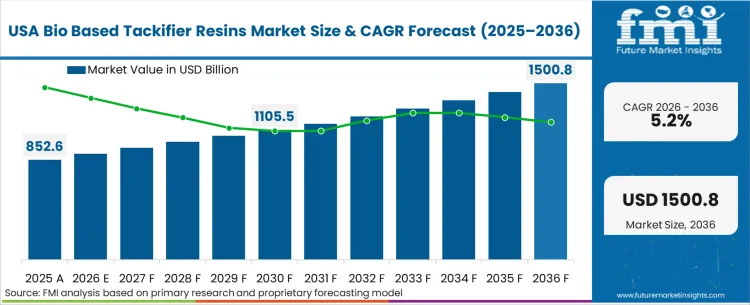
Capital availability and massive e-commerce logistics footprints drive the adoption pattern in North America. Rather than waiting for federal regulatory mandates, major retail networks are utilising their purchasing power to force bio-based transitions across their supplier base. As per FMI's projection, these dynamic bypasses traditional legislative timelines, creating rapid, localised spikes in demand as specific corporate targets approach. Formulators operating within this environment are less concerned with regulatory compliance and heavily focused on securing the sheer volume of refined rosin required to satisfy tier-1 vendor contracts.
- United States: Demand for Bio-Based Tackifier Resins in the United States is set to grow at 5.2%. Procurement directors at major US logistics firms mandate bio-based hot-melts to hit internal carbon goals. Formulators who successfully qualify these specialised resins secure highly lucrative, multi-year supply agreements that essentially guarantee consistent revenue streams.
FMI's report includes analysis of Canada and Mexico. The integration of North American free trade zones allows specialized refining capacity in the southern United States to seamlessly supply the expanding sustainable packaging sectors across all three nations.
Europe Bio Based Tackifier Resins Market Analysis
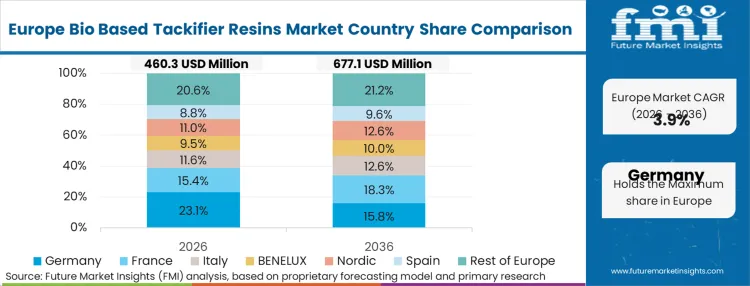
The regulatory environment in Europe strictly penalizes mixed-material packaging formats that disrupt municipal recycling streams. This policy-led market forces adhesive formulators to abandon synthetic tackifiers in favour of repulpable natural alternatives. In FMI's view, the transition here is not driven by voluntary corporate sustainability, but by aggressive extended producer responsibility frameworks that directly tax non-compliant materials. Adhesives are no longer viewed simply as structural components; they are heavily regulated chemical inputs that determine the final taxation class of the product.
- Germany: Germany's updated producer responsibility requirements create a direct cost penalty for synthetic adhesives. The market is advancing at 5.5% compound between 2026 and 2036. Formulators operating here aggressively phase out hydrocarbons to maintain cost competitiveness against regional rivals who have already completed the bio-transition.
- United Kingdom: A CAGR of 4.8% is expected for Bio Based Tackifier Resins in the United Kingdom over the forecast period. The UK packaging tax explicitly targets single-use formats, indirectly forcing the adoption of bio-compatible labelling systems. Companies capable of supplying verified bio-resins create a distinct commercial gap between themselves and competitors still relying on imported petrochemicals.
FMI's report includes analysis of France, Italy, and the Nordics. The Nordic region's massive domestic forestry infrastructure provides a localized, highly secure feedstock supply that insulates European formulators from global shipping volatility.
Asia Pacific Bio Based Tackifier Resins Market Analysis
Industrial modernization across Asia Pacific dictates a completely different adoption curve. Rather than retrofitting mature facilities, rapid greenfield expansion in the manufacturing sector allows operations to integrate bio-based systems from day one. Based on FMI's assessment, this leapfrog dynamic allows regional players to bypass the costly synthetic-to-bio transition phase entirely. The focus here is on maximising throughput; procurement teams prioritise reliable supply volumes and consistent tack performance over complex carbon tracking documentation.
- India: India's rapid expansion in organized retail and e-commerce requires massive volumes of packaging adhesives. Formulators integrating bio-resins bypass the volatility of imported synthetic tackifiers, achieving highly stabilized production costs. The India landscape is set to achieve a CAGR of 7.5%.
- China: Massive investments in domestic pine chemical extraction capabilities reduce China's reliance on imported feedstocks. China's bio-based tackifier resins industry is projected to witness growth at a CAGR of 6.8%. This localised supply chain establishes a long-term structural trajectory where bio-based resins become the default economic choice, rather than a premium alternative.
- Japan: Stringent quality standards in Japanese consumer goods dictate the use of ultra-refined, low-odour terpene resins. Formulators mastering these high-purity extraction techniques capture dominant positions in premium personal care and hygiene applications. Japan is expected to see its bio-based tackifier resins sector grow at a compound annual rate of 4.2%.
FMI's report includes an analysis of South Korea and ASEAN nations. Rising export volumes to heavily regulated Western markets compel ASEAN manufacturers to preemptively adopt compliant bio-adhesives to avoid border rejections.
Competitive Aligners for Market Players
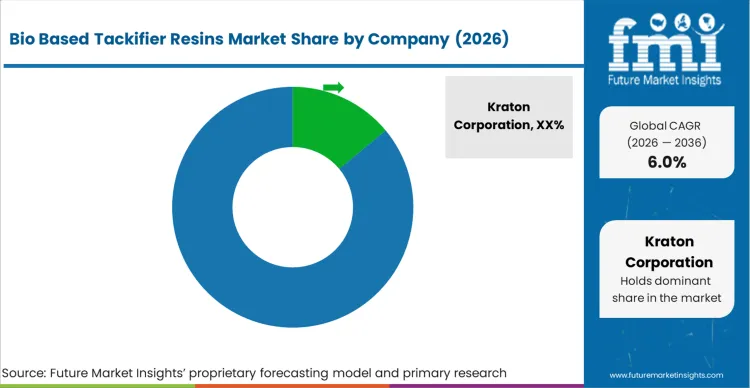
The bio-based tackifier resins market remains highly concentrated at the extraction and refinement tier. Companies like Kraton Corporation and Ingevity Corporation hold a significant structural advantage because securing raw pine chemical feedstocks requires massive, long-term contracts with the paper and pulp industry. Procurement directors evaluating vendor viability do not simply look at resin performance; they heavily scrutinise the supplier's backward integration to ensure they won't be cut off during seasonal feedstock shortages.
Incumbents maintain their dominant positions through advanced, proprietary distillation and hydrogenation infrastructure. Natural resins inherently possess colour and odour profile challenges; established players have spent decades refining these out. A challenger attempting to disrupt this space must build equivalent chemical purification capabilities to achieve the "water-white" specifications demanded by consumer-facing automotive adhesives and packaging brands.
As the market approaches 2036, tier-1 adhesive formulators will actively resist supplier lock-in by qualifying multiple bio-resin sources simultaneously. The structural tension lies between the formulators' need for supply diversity and the refiners' desire for exclusive volume contracts. The market is structurally inclined toward slight fragmentation downstream, as specialised formulators emerge to serve niche, high-performance applications that massive bulk refiners cannot efficiently address.
Key Players in Bio Based Tackifier Resins Market
- Kraton Corporation
- DSM-Firmenich (formerly DRT)
- Ingevity Corporation
- Eastman Chemical Company
- Arakawa Chemical Industries
- Harima Chemicals Group
- Arizona Chemical
Scope of the Report
| Metric | Value |
|---|---|
| Quantitative Units | USD 1.9 billion to USD 3.4 billion, at a CAGR of 6.00% |
| Market Definition | This market provides organically sourced chemical tackifiers that replace synthetic hydrocarbon resins in adhesive systems, defined by renewable feedstocks and verifiable bio-carbon content. |
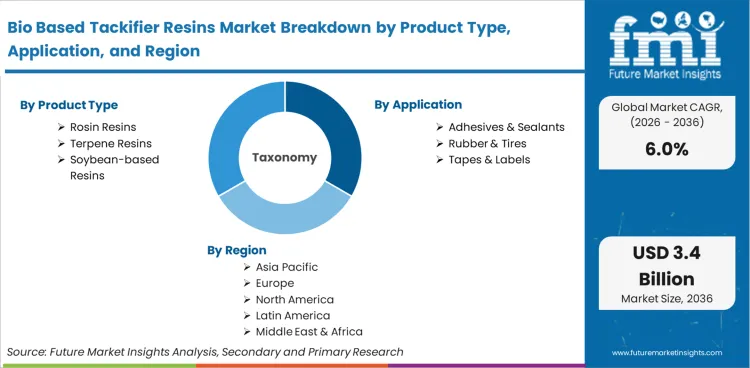
| Product Type Segmentation | Rosin Resins, Terpene Resins, Soybean-based Resins |
| Application Segmentation | Adhesives & Sealants, Rubber & Tires, Tapes & Labels |
| End Use Segmentation | Packaging, Automotive, Construction, Consumer Goods |
| Regions Covered | North America, Latin America, Europe, East Asia, South Asia, Oceania, Middle East & Africa |
| Countries Covered | United States, Germany, China, India, Brazil, United Kingdom, Japan, and 40 plus countries |
| Key Companies Profiled | Kraton Corporation, DSM-Firmenich (formerly DRT), Ingevity Corporation, Eastman Chemical Company, Arakawa Chemical Industries, Harima Chemicals Group, Arizona Chemical |
| Forecast Period | 2026 to 2036 |
| Approach | Procurement directors and chemical plant managers were interviewed to establish operational realities. Baseline volumes were anchored to annual global pine extraction yields. Forecasts were cross-validated against independent corporate sustainability reports tracking Scope 3 targets. |
Source: Future Market Insights (FMI) analysis, based on a proprietary forecasting model and primary research
Bio Based Tackifier Resins Market Analysis by Segments
Product Type:
- Rosin Resins
- Terpene Resins
- Soybean-based Resins
Application:
- Adhesives & Sealants
- Rubber & Tires
- Tapes & Labels
End Use:
- Packaging
- Automotive
- Construction
- Consumer Goods
Region:
- North America
- United States
- Europe
- Germany
- United Kingdom
- Asia Pacific
- China
- India
- Japan
- Latin America
- Brazil
Bibliography
- U.S. Department of Agriculture, Rural Development. (2024, March 8). An economic impact analysis of the U.S. biobased products industry. U.S. Department of Agriculture.
- Ke, Z., Yu, J., Liao, L., & Rao, X. (2024). Application progress of rosin in food packaging: A review. International Journal of Biological Macromolecules, 280(Pt 3), 135900.
- Cho, J.-H., Ryu, K., & Kim, H.-J. (2024). Adhesive properties of eco-friendly hot melt adhesive based on poly(butylene adipate-co-terephthalate) and rosin maleic resin. Macromolecular Materials and Engineering, 309(12), e202400103.
- Ajala, O. A., Nakayama, Y., Shiono, T., & Tanaka, R. (2024). A bio-based tackifier synthesized by room-temperature cationic copolymerization of isobutene and β-pinene. Catalysts, 14(7), 402.
- Prebihalo, E. A., & Reineke, T. M. (2024). Natural product-based pressure-sensitive adhesives via carveol-dithiothreitol thiol-ene step-growth polymerization. ACS Macro Letters, 13(10), 1355–1361.
- Jahangiri, F., Mohanty, A. K., & Misra, M. (2024). Sustainable biodegradable coatings for food packaging: Challenges and opportunities. Green Chemistry, 26, 4934–4974.
- Singh, M., & Manik, G. (2025). Bio-based adhesives from plant oils. In C. Baskar, S. Ramakrishna, & A. D. L. Rosa (Eds.), Encyclopedia of Green Materials (pp. 123–134). Springer.
This bibliography is provided for reader reference. The full FMI report contains the complete reference list with primary source documentation.
This Report Addresses
- Market intelligence to support strategic decision making across rosin and terpene extraction categories
- Market size estimation and 10-year revenue forecasts from 2026 to 2036, supported by pine chemical fractionation throughput data
- Growth opportunity mapping across specific packaging and structural binding dimensions with emphasis on the achievement of low-colour profile gates
- Segment and regional revenue forecasts covering elastomer blending sub-segments across heavily regulated European producer responsibility environments
- Competition strategy assessment, including backward integration, distillation infrastructure, and feedstock security
- Technology development tracking, including advanced hydrogenation processes and isotope verification standards, is discussed in this article
- Market access analysis covering REACH compliance frameworks and specific Scope 3 procurement pathways
- Market report delivery in PDF, Excel, PPT, and interactive dashboard formats for executive strategy, chemical procurement planning, and operational benchmarking use
Frequently Asked Questions
How large is the Bio Based Tackifier Resins Market in 2026?
The industry is expected to cross USD 1.9 billion in 2026. This figure establishes the baseline for an industry rapidly transitioning from voluntary green initiatives to mandatory compliance-driven volume requirements.
What will it be valued at by 2036?
Sustained investment lifts the valuation to USD 3.4 billion through 2036. This cumulative buildup reflects the absolute replacement of synthetic aliphatic resins in major global packaging supply chains.
What CAGR is projected?
The market is poised to expand at a 6.00% CAGR during the forecast period. This rate is constrained heavily by the physical limits of global pine extraction yields, not by a lack of downstream consumer demand.
Which Product Type segment leads?
Rosin Resins is poised to lead with a 55.5% share in 2026. These specific extracts provide a true drop-in replacement for legacy synthetics, allowing formulators to switch materials without re-engineering their core application equipment.
Which Application segment leads?
Adhesives & Sealants is estimated to record a 62.0% share in 2026. Formulators in this space are forced by major retail logistics networks to implement fully repulpable and sustainable bonding agents.
Which End Use segment leads?
Packaging is poised to garner a 45.0% share in 2026. The shift here is mandated by extended producer responsibility laws that actively tax mixed-material shipping cartons.
What drives rapid growth?
Corporate Scope 3 emission mandates require tier-1 packaging manufacturers to eliminate petroleum-derived inputs. This structural pressure forces action regardless of short-term pricing premiums on bio-based materials.
What is the primary restraint?
The natural inconsistency of agricultural and forestry feedstocks requires extended batch testing. Quality assurance teams are forced into prolonged qualification cycles to verify stable colour and odour profiles.
Which country grows fastest?
India is expected to track a 7.5% CAGR, compared to China's 6.8%. India's modernisation of its packaging infrastructure allows domestic manufacturers to bypass legacy synthetic systems entirely, integrating bio-resins from day one.
How do European EPR frameworks impact procurement?
Extended producer responsibility laws directly tax non-recyclable materials. This shifts the decision from a sustainability goal to a direct operational cost calculation for manufacturing firms.
What role does advanced hydrogenation play?
Hydrogenation strips the inherent yellowing and strong odors from natural pine extracts. This refinement step is the mandatory technical gate for deploying bio-tackifiers in consumer-facing hygiene applications.
Why is backward integration critical for vendors?
Because crude tall oil and pine derivatives are finite natural resources subject to seasonal yields. Refiners who secure forestry contracts guarantee their formulator clients a stable supply during global shortages.
Why do terpene resins command a price premium?
Terpenes offer specific compatibility advantages with advanced styrene block copolymers used in specialized tapes. The complex extraction process from citrus and pine sources naturally restricts total supply volumes.
How do formulators manage color variance?
They must continuously blend and test incoming batches against strict optical clarity standards. Formulators who fail to manage this variance face immediate rejection from transparent labeling clients.
What is the impact of synthetic resin price volatility?
It provides the financial catalyst for mid-tier formulators to finally qualify biological alternatives. The goal is to insulate long-term margin profiles from unpredictable petrochemical cycles.
How do tier-1 brands verify bio-content?
They increasingly demand standardised carbon isotope testing documentation. Procurement networks reject suppliers offering "mass-balance" claims without verifiable, localised biological origin data.
Why is the United States adoption curve different from Europe's?
The US transition is driven primarily by the purchasing power of massive e-commerce networks rather than federal tax penalties. This creates rapid, localized demand spikes as specific corporate sustainability deadlines approach.
What limits the adoption of soybean-based resins?
Soy-based chemistry currently struggles to match the aggressive initial sheer strength of pine derivatives. Adoption remains restricted to low-stress consumer binding until chemical modification techniques improve.
Will the market become more or less concentrated by 2036?
It structurally leans toward upstream concentration as smaller refiners fail to secure affordable feedstock contracts. However, downstream formulation will likely fragment to serve specialized niche applications.
What happens to manufacturers who delay transition?
They are systematically removed from the approved vendor lists of major global logistics and consumer goods brands. This essentially locks them out of the most lucrative and stable industrial contracts.
How is desk research utilized in FMI's methodology?
Analysts aggregate data from REACH registries and ISO bio-based databases. This documentation validates the actual commercial deployment rates against theoretical supply capacities.
Why are aliphatic hydrocarbon resins excluded from scope?
Because they are derived entirely from petroleum cracking processes. This market analysis specifically targets the chemical pathways utilising verified renewable biological carbon inputs.
Preview the report firsthand - request a free sample
Get SampleGet the brochure for pricing and purchase details.
Get PDFTable of Content
- Executive Summary
- Global Market Outlook
- Demand-side Trends
- Supply-side Trends
- Technology Roadmap Analysis
- Analysis and Recommendations
- Market Overview
- Market Coverage / Taxonomy
- Market Definition / Scope / Limitations
- Research Methodology
- Chapter Orientation
- Analytical Lens and Working Hypotheses
- Market Structure, Signals, and Trend Drivers
- Benchmarking and Cross-market Comparability
- Market Sizing, Forecasting, and Opportunity Mapping
- Research Design and Evidence Framework
- Desk Research Programme (Secondary Evidence)
- Company Annual and Sustainability Reports
- Peer-reviewed Journals and Academic Literature
- Corporate Websites, Product Literature, and Technical Notes
- Earnings Decks and Investor Briefings
- Statutory Filings and Regulatory Disclosures
- Technical White Papers and Standards Notes
- Trade Journals, Industry Magazines, and Analyst Briefs
- Conference Proceedings, Webinars, and Seminar Materials
- Government Statistics Portals and Public Data Releases
- Press Releases and Reputable Media Coverage
- Specialist Newsletters and Curated Briefings
- Sector Databases and Reference Repositories
- FMI Internal Proprietary Databases and Historical Market Datasets
- Subscription Datasets and Paid Sources
- Social Channels, Communities, and Digital Listening Inputs
- Additional Desk Sources
- Expert Input and Fieldwork (Primary Evidence)
- Primary Modes
- Qualitative Interviews and Expert Elicitation
- Quantitative Surveys and Structured Data Capture
- Blended Approach
- Why Primary Evidence is Used
- Physicians and Other Healthcare Professionals
- Primary Modes
- Governance, Ethics, and Data Stewardship
- Research Ethics
- Data Integrity and Handling
- Desk Research Programme (Secondary Evidence)
- Tooling, Models, and Reference Databases
- Data Engineering and Model Build
- Data Acquisition and Ingestion
- Cleaning, Normalisation, and Verification
- Synthesis, Triangulation, and Analysis
- Quality Assurance and Audit Trail
- Market Background
- Market Dynamics
- Drivers
- Restraints
- Opportunity
- Trends
- Scenario Forecast
- Demand in Optimistic Scenario
- Demand in Likely Scenario
- Demand in Conservative Scenario
- Opportunity Map Analysis
- Product Life Cycle Analysis
- Supply Chain Analysis
- Investment Feasibility Matrix
- Value Chain Analysis
- PESTLE and Porter’s Analysis
- Regulatory Landscape
- Regional Parent Market Outlook
- Production and Consumption Statistics
- Import and Export Statistics
- Market Dynamics
- Global Market Analysis 2021 to 2025 and Forecast, 2026 to 2036
- Historical Market Size Value (USD Million) Analysis, 2021 to 2025
- Current and Future Market Size Value (USD Million) Projections, 2026 to 2036
- Y-o-Y Growth Trend Analysis
- Absolute $ Opportunity Analysis
- Global Market Pricing Analysis 2021 to 2025 and Forecast 2026 to 2036
- Global Market Analysis 2021 to 2025 and Forecast 2026 to 2036, By Product Type
- Introduction / Key Findings
- Historical Market Size Value (USD Million) Analysis By Product Type , 2021 to 2025
- Current and Future Market Size Value (USD Million) Analysis and Forecast By Product Type , 2026 to 2036
- Rosin Resins
- Terpene Resins
- Soybean-based Resins
- Rosin Resins
- Y-o-Y Growth Trend Analysis By Product Type , 2021 to 2025
- Absolute $ Opportunity Analysis By Product Type , 2026 to 2036
- Global Market Analysis 2021 to 2025 and Forecast 2026 to 2036, By Application
- Introduction / Key Findings
- Historical Market Size Value (USD Million) Analysis By Application, 2021 to 2025
- Current and Future Market Size Value (USD Million) Analysis and Forecast By Application, 2026 to 2036
- Adhesives & Sealants
- Rubber & Tires
- Tapes & Labels
- Adhesives & Sealants
- Y-o-Y Growth Trend Analysis By Application, 2021 to 2025
- Absolute $ Opportunity Analysis By Application, 2026 to 2036
- Global Market Analysis 2021 to 2025 and Forecast 2026 to 2036, By End Use
- Introduction / Key Findings
- Historical Market Size Value (USD Million) Analysis By End Use, 2021 to 2025
- Current and Future Market Size Value (USD Million) Analysis and Forecast By End Use, 2026 to 2036
- Packaging
- Automotive
- Construction
- Consumer Goods
- Packaging
- Y-o-Y Growth Trend Analysis By End Use, 2021 to 2025
- Absolute $ Opportunity Analysis By End Use, 2026 to 2036
- Global Market Analysis 2021 to 2025 and Forecast 2026 to 2036, By Region
- Introduction
- Historical Market Size Value (USD Million) Analysis By Region, 2021 to 2025
- Current Market Size Value (USD Million) Analysis and Forecast By Region, 2026 to 2036
- North America
- Latin America
- Western Europe
- Eastern Europe
- East Asia
- South Asia and Pacific
- Middle East & Africa
- Market Attractiveness Analysis By Region
- North America Market Analysis 2021 to 2025 and Forecast 2026 to 2036, By Country
- Historical Market Size Value (USD Million) Trend Analysis By Market Taxonomy, 2021 to 2025
- Market Size Value (USD Million) Forecast By Market Taxonomy, 2026 to 2036
- By Country
- USA
- Canada
- Mexico
- By Product Type
- By Application
- By End Use
- By Country
- Market Attractiveness Analysis
- By Country
- By Product Type
- By Application
- By End Use
- Key Takeaways
- Latin America Market Analysis 2021 to 2025 and Forecast 2026 to 2036, By Country
- Historical Market Size Value (USD Million) Trend Analysis By Market Taxonomy, 2021 to 2025
- Market Size Value (USD Million) Forecast By Market Taxonomy, 2026 to 2036
- By Country
- Brazil
- Chile
- Rest of Latin America
- By Product Type
- By Application
- By End Use
- By Country
- Market Attractiveness Analysis
- By Country
- By Product Type
- By Application
- By End Use
- Key Takeaways
- Western Europe Market Analysis 2021 to 2025 and Forecast 2026 to 2036, By Country
- Historical Market Size Value (USD Million) Trend Analysis By Market Taxonomy, 2021 to 2025
- Market Size Value (USD Million) Forecast By Market Taxonomy, 2026 to 2036
- By Country
- Germany
- UK
- Italy
- Spain
- France
- Nordic
- BENELUX
- Rest of Western Europe
- By Product Type
- By Application
- By End Use
- By Country
- Market Attractiveness Analysis
- By Country
- By Product Type
- By Application
- By End Use
- Key Takeaways
- Eastern Europe Market Analysis 2021 to 2025 and Forecast 2026 to 2036, By Country
- Historical Market Size Value (USD Million) Trend Analysis By Market Taxonomy, 2021 to 2025
- Market Size Value (USD Million) Forecast By Market Taxonomy, 2026 to 2036
- By Country
- Russia
- Poland
- Hungary
- Balkan & Baltic
- Rest of Eastern Europe
- By Product Type
- By Application
- By End Use
- By Country
- Market Attractiveness Analysis
- By Country
- By Product Type
- By Application
- By End Use
- Key Takeaways
- East Asia Market Analysis 2021 to 2025 and Forecast 2026 to 2036, By Country
- Historical Market Size Value (USD Million) Trend Analysis By Market Taxonomy, 2021 to 2025
- Market Size Value (USD Million) Forecast By Market Taxonomy, 2026 to 2036
- By Country
- China
- Japan
- South Korea
- By Product Type
- By Application
- By End Use
- By Country
- Market Attractiveness Analysis
- By Country
- By Product Type
- By Application
- By End Use
- Key Takeaways
- South Asia and Pacific Market Analysis 2021 to 2025 and Forecast 2026 to 2036, By Country
- Historical Market Size Value (USD Million) Trend Analysis By Market Taxonomy, 2021 to 2025
- Market Size Value (USD Million) Forecast By Market Taxonomy, 2026 to 2036
- By Country
- India
- ASEAN
- Australia & New Zealand
- Rest of South Asia and Pacific
- By Product Type
- By Application
- By End Use
- By Country
- Market Attractiveness Analysis
- By Country
- By Product Type
- By Application
- By End Use
- Key Takeaways
- Middle East & Africa Market Analysis 2021 to 2025 and Forecast 2026 to 2036, By Country
- Historical Market Size Value (USD Million) Trend Analysis By Market Taxonomy, 2021 to 2025
- Market Size Value (USD Million) Forecast By Market Taxonomy, 2026 to 2036
- By Country
- Kingdom of Saudi Arabia
- Other GCC Countries
- Turkiye
- South Africa
- Other African Union
- Rest of Middle East & Africa
- By Product Type
- By Application
- By End Use
- By Country
- Market Attractiveness Analysis
- By Country
- By Product Type
- By Application
- By End Use
- Key Takeaways
- Key Countries Market Analysis
- USA
- Pricing Analysis
- Market Share Analysis, 2025
- By Product Type
- By Application
- By End Use
- Canada
- Pricing Analysis
- Market Share Analysis, 2025
- By Product Type
- By Application
- By End Use
- Mexico
- Pricing Analysis
- Market Share Analysis, 2025
- By Product Type
- By Application
- By End Use
- Brazil
- Pricing Analysis
- Market Share Analysis, 2025
- By Product Type
- By Application
- By End Use
- Chile
- Pricing Analysis
- Market Share Analysis, 2025
- By Product Type
- By Application
- By End Use
- Germany
- Pricing Analysis
- Market Share Analysis, 2025
- By Product Type
- By Application
- By End Use
- UK
- Pricing Analysis
- Market Share Analysis, 2025
- By Product Type
- By Application
- By End Use
- Italy
- Pricing Analysis
- Market Share Analysis, 2025
- By Product Type
- By Application
- By End Use
- Spain
- Pricing Analysis
- Market Share Analysis, 2025
- By Product Type
- By Application
- By End Use
- France
- Pricing Analysis
- Market Share Analysis, 2025
- By Product Type
- By Application
- By End Use
- India
- Pricing Analysis
- Market Share Analysis, 2025
- By Product Type
- By Application
- By End Use
- ASEAN
- Pricing Analysis
- Market Share Analysis, 2025
- By Product Type
- By Application
- By End Use
- Australia & New Zealand
- Pricing Analysis
- Market Share Analysis, 2025
- By Product Type
- By Application
- By End Use
- China
- Pricing Analysis
- Market Share Analysis, 2025
- By Product Type
- By Application
- By End Use
- Japan
- Pricing Analysis
- Market Share Analysis, 2025
- By Product Type
- By Application
- By End Use
- South Korea
- Pricing Analysis
- Market Share Analysis, 2025
- By Product Type
- By Application
- By End Use
- Russia
- Pricing Analysis
- Market Share Analysis, 2025
- By Product Type
- By Application
- By End Use
- Poland
- Pricing Analysis
- Market Share Analysis, 2025
- By Product Type
- By Application
- By End Use
- Hungary
- Pricing Analysis
- Market Share Analysis, 2025
- By Product Type
- By Application
- By End Use
- Kingdom of Saudi Arabia
- Pricing Analysis
- Market Share Analysis, 2025
- By Product Type
- By Application
- By End Use
- Turkiye
- Pricing Analysis
- Market Share Analysis, 2025
- By Product Type
- By Application
- By End Use
- South Africa
- Pricing Analysis
- Market Share Analysis, 2025
- By Product Type
- By Application
- By End Use
- USA
- Market Structure Analysis
- Competition Dashboard
- Competition Benchmarking
- Market Share Analysis of Top Players
- By Regional
- By Product Type
- By Application
- By End Use
- Competition Analysis
- Competition Deep Dive
- Kraton Corporation
- Overview
- Product Portfolio
- Profitability by Market Segments (Product/Age /Sales Channel/Region)
- Sales Footprint
- Strategy Overview
- Marketing Strategy
- Product Strategy
- Channel Strategy
- DSM-Firmenich (formerly DRT)
- Ingevity Corporation
- Eastman Chemical Company
- Arakawa Chemical Industries
- Harima Chemicals Group
- Arizona Chemical
- Kraton Corporation
- Competition Deep Dive
- Assumptions & Acronyms Used


