

- Industry Size (2026)
- USD 65.1 Bn
- Forecast (2036)
- USD 737.5 Mn
- CAGR (2026 to 2036)
- 7.90%
Bio Based Epoxy Curing Agents Market Size, Market Forecast and Outlook By FMI
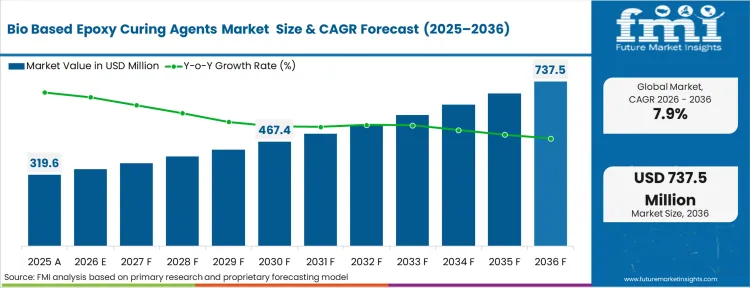
The bio based epoxy curing agents was valued at USD 319.6 million in 2025. Demand analysis is poised to surpass USD 344.8 million in 2026 at a CAGR of 7.90% during the forecast period. Investment is expected to push the market valuation to USD 737.5 million by 2036, driven by the strong performance of cashew nutshell liquid derivatives compared to traditional petrochemical amines, along with tightening VOC regulations that are accelerating their use in heavy‑duty coatings.
Formulators are currently forced to decide whether to maintain dual inventories for both petrochemical and bio-content hardeners or transition entire product lines to drop-in bio-based replacements. Retaining parallel product tracks fragments purchasing power and complicates compliance reporting under extended producer responsibility frameworks. Practitioners actively working with epoxy curing agents recognize that the green premium is rarely the primary purchasing trigger; these systems are adopted because phenalkamines actually cure faster at sub-zero temperatures than their conventional counterparts. Companies that delay full-line transition risk losing preferred supplier status as tier-1 end users standardize around lower-carbon specifications.
Summary of Bio Based Epoxy Curing Agents Market
- Bio Based Epoxy Curing Agents Market Definition:
- Bio based epoxy curing agents represent a advancement in polymer crosslinking, substituting petroleum-derived polyamines with renewable biomass derivatives like phenalkamines and fatty acid amides. The market is defined by products that deliver equal or superior thermoset performance, particularly in moisture tolerance and rapid cure times, while reducing the carbon footprint of the final polymer matrix.
- Demand Drivers in the Market:
- Stringent volatile organic compound emission limits across architectural and industrial applications, Bio-based coating formulators to replace solvent-heavy petrochemical hardeners with low-VOC bio-based alternatives.
- Procurement mandates from tier-1 marine and shipbuilding contractors force secondary suppliers to qualify bio-content systems for vessel maintenance and repair operations.
- Advancements in biomass-balance manufacturing allow global chemical networks to drop sustainable variants directly into existing supply chains without requiring applicators to adjust their mixing equipment.
- Key Segments Analyzed in the FMI Report:
- Phenalkamines / CNSL-based curing agents: Phenalkamines / CNSL-based curing agents is expected to grab 34.0% share in 2026, as their intrinsic hydrophobic nature and exceptionally low-temperature cure speeds make them indispensable for offshore and marine applications.
- Cashew nutshell liquid derivatives: Cashew nutshell liquid derivatives is expected to garner 38.0% share in 2026, benefiting from a highly established, scalable extraction infrastructure that outperforms the developmental economics of lignin or furan alternatives.
- Protective coatings: Protective coatings is expected to hold 31.0% share in 2026, driven by the immediate commercial need to reformulate heavy-duty anticorrosive systems without sacrificing long-term asset lifecycle metrics.
- Building & construction: Building & construction is expected to account for 29.0% share in 2026, primarily due to the vast volume of flooring systems and civil engineering grouts embracing cleaner sourcing methods.
- Ambient / room-temperature cure: Ambient / room-temperature cure is projected to record 41.0% share in 2026, as field-applied coatings and civil engineering projects cannot rely on thermal baking processes.
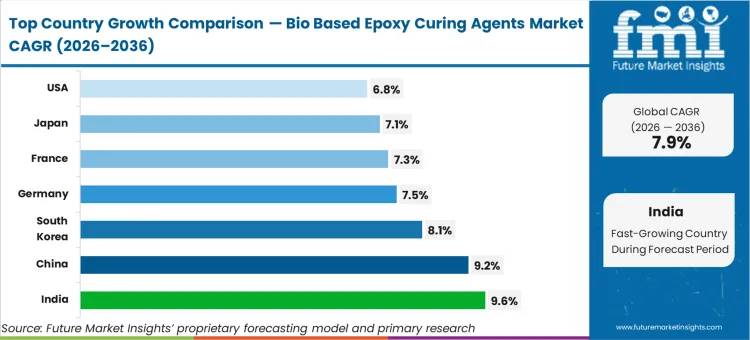
- India: 9.6% compound growth, continued by the country's dual role as a primary producer of cashew feedstock and a rapidly expanding consumer of civil infrastructure coatings.
- Analyst Opinion at FMI:
- Nikhil Kaitwade, Principal Analyst, Chemicals, at FMI, opines, "The general market assumption is that adoption speed relies strictly on corporate sustainability budgets. However, procurement directors in the marine sector switch to phenalkamines precisely because they cure fast at five degrees Celsius in high humidity. The bio-content is a secondary reporting benefit; the primary driver is eliminating operational downtime in drydocks. Manufacturers who position these hardeners purely as 'green' alternatives miss the performance advantage that actually closes the sale."
- Strategic Implications / Executive Takeaways:
- Specialty chemical formulators must secure long-term raw material agreements for cashew nutshell liquid to insulate their margins against seasonal agricultural volatility.
- Tier-2 regional coating manufacturers should bypass intermediate R&D by adopting drop-in biomass-balance amine hardener systems to avoid losing municipal infrastructure bids.
- Global procurement heads face fragmented global certification standards that require hyper-localized vendor qualification strategies for bio-content verification.
The transition toward fully integrated biomass-balance production operates as the gate for this industry. Once major chemical networks qualify waterborne coatings and bio-content curing agents across their primary marine and protective portfolios, the volume scale immediately normalizes the cost delta against legacy systems. The resulting cost parity effectively eliminates the last remaining operational friction, allowing applicators to switch systems without raising their own bid prices on large-scale infrastructure projects.
India is estimated to expand at 9.6%, supported by massive domestic availability of raw cashew feedstock intersecting with high-volume infrastructure demands. China follows at 9.2%, where heavy-duty industrial coatings formulators are actively replacing legacy hardeners to meet municipal emissions targets. South Korea tracks at 8.1%, propelled by its concentrated shipbuilding sector qualifying low-temperature cure systems. Germany is expected to post a 7.5% rate as European regulatory rules aggressively penalize high-VOC petrochemical variants. France registers 7.3%, driven by building materials procurement. Japan garners 7.1%, characterised by electronics encapsulation requiring high-purity biomass-derived resins. The United States advances at 6.8%, where adoption is highly localised to specialised composites rather than mass-market civil engineering. These regional differences mainly reflect how closely each area is connected to raw bio‑feedstock sources and the industries that rely on them, rather than a uniform global move in the same direction.
Bio Based Epoxy Curing Agents Market Key Takeaways
| Metric | Details |
|---|---|
| Industry Size (2026) | USD 344.8 million |
| Industry Value (2036) | USD 737.5 million |
| CAGR (2026-2036) | 7.90% |
Source: Future Market Insights (FMI) analysis, based on proprietary forecasting model and primary research
Bio Based Epoxy Curing Agents Market Definition
Bio-based epoxy curing agents are highly reactive chemical hardeners derived from renewable biomass sources, such as cashew nutshell liquid, vegetable oils, and lignin, used to crosslink epoxy resins into solid thermoset polymers. These agents replace traditional petrochemical polyamines and polyamides, providing the necessary active hydrogen sites for crosslinking while delivering specific operational characteristics like rapid low-temperature curing, superior moisture tolerance, and enhanced chemical resistance.
Bio Based Epoxy Curing Agents Market Inclusions
The scope of this analysis encompasses all commercially available curing agents synthesized primarily from renewable organic feedstocks intended for epoxy crosslinking. This includes phenalkamines, modified polyamides derived from dimerized fatty acids, amidoamines from vegetable oils, and emerging lignin-derived aromatics. The assessment tracks both 100% bio-based variants and hybrid specialty amine curing agents that achieve verifiable bio-content thresholds through biomass-balance mass accounting approaches.
Bio Based Epoxy Curing Agents Market Exclusions
Conventional petrochemical-derived curing agents, including standard diethylenetriamine (DETA) and triethylenetetramine (TETA) with zero renewable carbon content, are explicitly excluded. The baseline epoxy resin formulations themselves fall outside this scope, as the analysis isolates the market value and volume specifically tied to the hardener component of the two-part thermoset system.
Bio Based Epoxy Curing Agents Market Research Methodology
- Primary Research: Chief formulators, product development directors, and procurement heads at tier-1 industrial coating and adhesive manufacturing firms.
- Desk Research: Biomass certification registries, chemical compliance filings under REACH and equivalent frameworks, and raw material mass-balance public disclosures.
- Market-Sizing and Forecasting: Baseline volume anchors directly to regional cashew production outputs and commercialized dimer fatty acid supply chain capacities.
- Data Validation and Update Cycle: Forecasts cross-validated against independent production declarations from the top five global epoxy amine producers.
Segmental Analysis
Bio Based Epoxy Curing Agents Market Analysis by Chemistry type
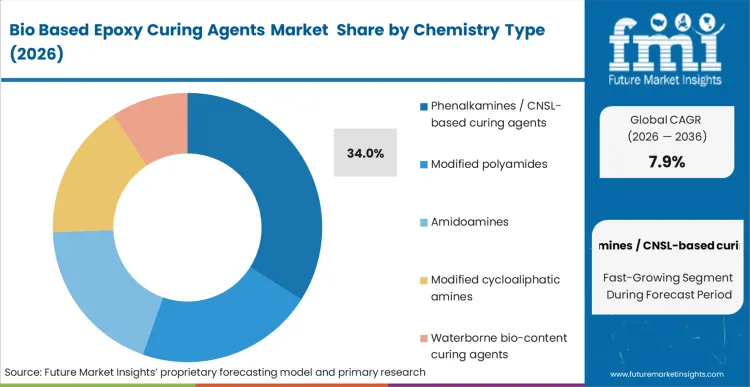
The reason Phenalkamines / CNSL-based curing agents hold 34.0% of this market comes down to a single operational reality: marine and offshore applicators cannot absorb the curing delays associated with standard polyamides in cold, humid environments.
According to FMI's estimates, this chemistry is chosen because its long hydrophobic aliphatic chain naturally repels water during the crosslinking phase. Formulators using phenalkamines do not need to heavily modify their systems to achieve anti-corrosive properties, simplifying the manufacturing footprint. This advantage changes the buying criteria from simple cost-per-kilo to total applied cost, as drydock times are drastically reduced. Applicators who cling to legacy petrochemical hardeners for winter maintenance schedules face severe margin erosion due to extended labour requirements and weather-related curing failures.
- Initial selection: Heavy-duty coating formulators select phenalkamines primarily to solve the bottleneck of curing thick-film anti-corrosive layers in adverse weather conditions.
- Qualification validation: During field testing, the chemistry proves its value by displacing moisture on the substrate surface, allowing for direct-to-metal applications without exhaustive blast-cleaning.
- Renewal criteria: Formulators expand their use of these agents across broader product lines once the reduction in customer claims regarding coating delamination is fully realized in post-project audits.
Bio Based Epoxy Curing Agents Market Analysis by Bio-feedstock source
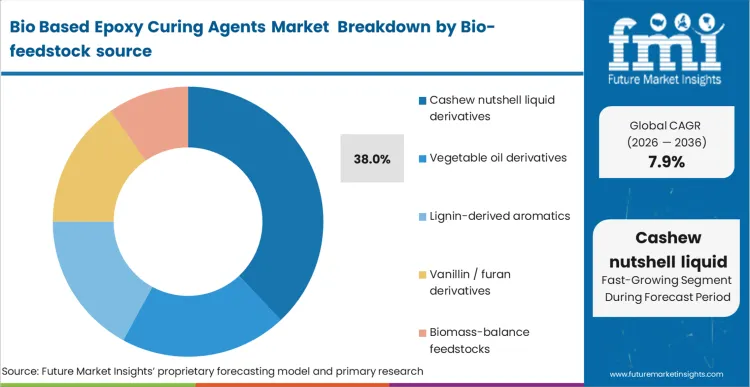
Cashew nutshell liquid derivatives dominate with 38.0% share because the agricultural supply chain surrounding cashew processing generates this phenolic lipid as an abundant, highly reactive byproduct.
FMI analysts opine that, unlike engineered vegetable oils or complex lignin extraction processes, cashew nutshell liquid requires significantly less capital-intensive refinement to yield usable cardanol. This allows manufacturers to produce curing agents at a scale and price point that competes directly with synthetic equivalents. Formulators relying on this feedstock avoid the volatility of petrochemical pricing cycles while securing a reliable, drop-in reactive diluent substitute. Delaying the integration of cardanol-based systems leaves tier-2 manufacturers vulnerable to supply shocks when standard amine precursors face industrial shortages.
- Cost origin: Savings materialize early in the procurement cycle because the raw cardanol is extracted from an established agricultural waste stream, bypassing high-cost chemical synthesis steps.
- Hidden expenditures: Formulators must invest initially in adjusting viscosity profiles, as naturally derived lipids can present batch-to-batch variations that require tighter quality control during mixing.
- Lifecycle comparison: Over a multi-year production cycle, the stabilized cost of agricultural-derived phenolic compounds provides a more predictable margin profile than naphtha-linked petrochemical precursors.
Bio Based Epoxy Curing Agents Market Analysis by Application
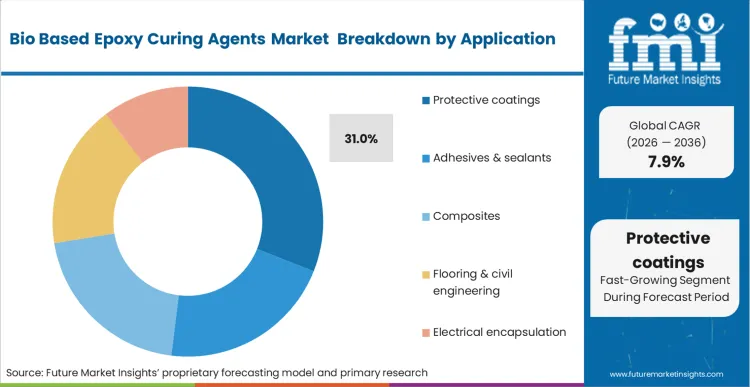
Formulators in the heavy industrial space are actively transitioning toward bio-based systems, enabling Protective coatings to capture a 31.0% share of the volume.
Based on FMI's assessment, the specific choice facing a steel coatings buyer right now is whether to continue defending legacy high-VOC systems against regulatory pressure or to adopt bio-based alternatives that inherently offer better flexibility and impact resistance. The naturally long aliphatic chains in bio-derived hardeners provide internal plasticization, which prevents the rigid epoxy matrix from micro-cracking under thermal cycling. This fundamentally changes how maintenance directors specify materials for bridges and offshore platforms. Formulators who fail to supply these compliant, high-build systems risk being engineered out of public infrastructure procurement frameworks altogether.
- Failure prevention: Bio-based amidoamines prevent the catastrophic brittle failure of protective layers on steel subject to extreme temperature fluctuations.
- Residual risk: While flexibility is enhanced, applicators must carefully manage the slightly prolonged pot life to avoid sagging when applying high-build layers on vertical surfaces.
- Operational capture: To realize the full lifecycle extension of the asset, contractors must train their spray operators to optimize the specific spray-tip pressures required for these internally plasticized systems.
Bio Based Epoxy Curing Agents Market Analysis by End use
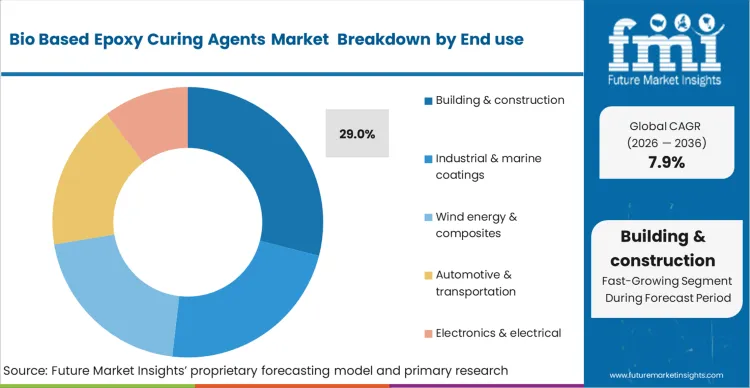
The sheer volume of flooring, grouting, and repair projects ensures Building & construction accounts for a leading 29.0% share.
As per FMI's projection, epoxy grouts and civil engineering polymers require hardeners that emit zero toxic fumes in confined spaces, a threshold that bio-based systems easily cross. Contractors working in operational commercial facilities or poorly ventilated subterranean infrastructure cannot utilize standard volatile amines without triggering severe occupational health shutdowns. The adoption of bio-based agents removes this operational friction, allowing simultaneous trade work alongside epoxy application. Sub-contractors who wait for further price drops in bio-materials face immediate exclusion from LEED-certified commercial development projects where indoor air quality standards are strictly enforced.
- Scale producers: Diversified chemical majors maintain this segment by utilizing biomass-balance mass accounting, allowing them to supply massive volumes of certified material to global construction chemical brands.
- Supply planning: Procurement directors must plan around the seasonal availability of specific vegetable-oil precursors, often negotiating annual volume guarantees to prevent mid-summer construction shortages.
- Future availability: Approaching 2036, the supply domain will move from niche toll‑manufacturers to fully integrated continuous‑process plants, locking in stable supply lines for civil engineering giants.
Bio Based Epoxy Curing Agents Market Analysis by Cure profile
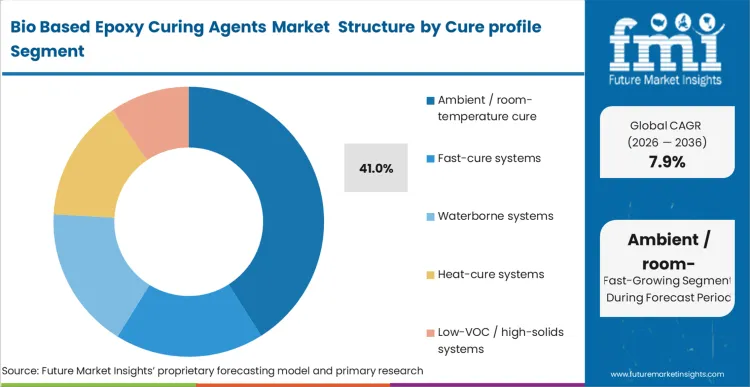
By 2026, Ambient / room-temperature cure applications represent 41.0% of the market, driven by the impossibility of applying thermal baking processes to massive assets. In FMI's view, the trajectory of this segment hinges on the ability of bio-based agents to rapidly crosslink without external heat, a critical requirement for field-applied adhesive films and civil repairs. The long-term change over the next decade involves reformulating even factory-applied systems to ambient cure to eliminate the massive energy costs associated with curing ovens. This change allows manufacturers to decarbonize both their material inputs and their direct energy consumption simultaneously. Operations clinging to heat-cure legacy systems forfeit their ability to bid on carbon-neutral manufacturing contracts.
- Performance baseline: The bio-based agents exceed expectations by achieving complete crosslinking at ambient temperatures without the problematic 'blushing' or surface exudation common in synthetic polyamides.
- Edge conditions: Performance gaps can appear in extremely low-humidity environments where the specific moisture-scavenging properties of phenalkamines are less utilized, occasionally extending the tack-free time.
- Acceptability standards: Qualification under international anti-corrosion standards like ISO 12944 dictates whether these ambient-cured films are acceptable for severe offshore (C5-M) environments.
Bio Based Epoxy Curing Agents Market Drivers, Restraints, and Opportunities
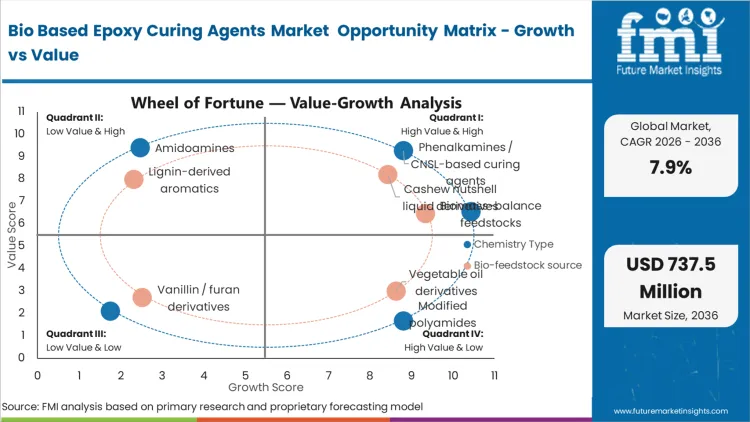
The pressure of extended producer responsibility and tightening VOC regulations compels formulators of heavy-duty marine and industrial coatings to qualify low-emission crosslinking systems immediately. This transition forces tier-1 chemical procurement directors to replace traditional diethylenetriamine (DETA) variants with bio-derived phenalkamines or amidoamines that deliver necessary performance without the regulatory penalty. Retaining legacy petrochemical systems invites compounding compliance costs and restricts access to municipal and federal infrastructure contracts that now mandate sustainable material sourcing.
The recalibration of existing formulations creates a significant operational friction that slows adoption among smaller, regional coating manufacturers. Transitioning to a bio-based curing agent is rarely a simple one-to-one drop-in substitution; it requires adjusting stoichiometric mix ratios, recalibrating pot life expectations, and modifying application equipment. This technical barrier remains until massive chemical suppliers standardize their biomass-balance portfolios, meaning tier-2 applicators currently must invest heavily in proprietary R&D just to maintain their existing product performance baselines.
Opportunities in the Bio Based Epoxy Curing Agents Market
- Waterborne conversion: The technical maturation of water-reducible bio-hardeners enables the complete elimination of solvent-borne systems in confined-space applications. Formulators of global water borne inks paints can capture premium pricing in commercial flooring markets by offering zero-odor, fast-return-to-service products.
- Electronic encapsulation: The high purity and low outgassing properties of specific synthesized bio-amines create a pathway into advanced manufacturing. Procurement heads in semiconductor packaging can utilize these agents to prevent thermal cycling micro-fractures in sensitive electronics adhesives.
- Biomass-balance drop-ins: The implementation of certified mass-balance accounting within mega-scale chemical plants allows for immediate integration. Category managers at global adhesive brands can seamlessly transition massive volume lines to verifiable bio-content without altering a single factory mixing protocol.
Regional Analysis
According to the regional analysis, the Bio‑Based Epoxy Curing Agents market is divided into Asia Pacific, Europe, and North America, covering more than 40 countries.
.webp "Top Country Growth Comparison Bio Based Epoxy Curing Agents Market Cagr (2026 2036)")
| Country | CAGR (2026 to 2036) |
|---|---|
| India | 9.6% |
| China | 9.2% |
| South Korea | 8.1% |
| Germany | 7.5% |
| France | 7.3% |
| Japan | 7.1% |
| United States | 6.8% |
Source: Future Market Insights (FMI) analysis, based on proprietary forecasting model and primary research
Asia Pacific Bio Based Epoxy Curing Agents Market Analysis
The massive concentration of shipbuilding, structural steel fabrication, and electronics manufacturing across Asia Pacific dictates a rapid transition toward specialized bio-based crosslinkers. Rather than being driven solely by environmental policy, adoption here is heavily indexed to the proximity of raw feedstock, specifically the cashew processing hubs, which feed directly into regional chemical formulation. According to FMI's estimates, procurement directors operating in this region bypass the complex biomass-balance tracking preferred in the West, opting instead for direct, 100% bio-based phenalkamines that immediately solve high-humidity application challenges in tropical shipyards.
- India: India's dual position as a massive generator of raw cashew nutshell byproduct and a rapidly expanding consumer of civil infrastructure coatings allows local formulators to completely bypass global supply chain bottlenecks. FMI estimates the Bio Based Epoxy Curing Agents market in India to expand at an annual growth rate of 9.6%. Regional manufacturers operate with a distinct cost advantage, formulating heavy-duty anti-corrosive systems without the import tariffs associated with synthetic amines. This localised integration establishes a trajectory where India transitions from a raw material exporter to a dominant regional hub for finished, high-performance bio-epoxy systems.
- China: China is expected to see its Bio Based Epoxy Curing Agents sector grow at a compound annual rate of 9.2%. Stringent municipal volatile organic compound mandates in major manufacturing hubs force heavy-duty industrial coating applicators to abandon solvent-heavy legacy hardeners. Formulators must immediately move to higher-solids, bio-based systems to keep their factory lines operational during government-mandated clean air windows. Those who master these new low-emission formulations capture highly lucrative, exclusive contracts for the country's ongoing high-speed rail and bridge expansion projects.
- South Korea: The extreme concentration of tier-1 shipbuilding operations defines South Korea's trajectory, requiring massive volumes of low-temperature curing agents to keep drydocks moving during winter months. Marine procurement officers rely heavily on CNSL-derivatives, as standard petrochemical polyamides simply fail to crosslink fast enough in freezing coastal conditions. The Bio Based Epoxy Curing Agents landscape in South Korea is set to achieve a CAGR of 8.1%. This dynamic creates a competitive positioning gap, allowing Korean shipyards to turn over vessel maintenance significantly faster than adjacent maritime hubs operating on legacy chemistries.
- Japan: Over the forecast period, Bio Based Epoxy Curing Agents in Japan is set for a CAGR of 7.1%. Stringent qualification standards in advanced electronic packaging adhesives require curing agents with exceptional purity and internal flexibility to prevent thermal shock in miniaturised components. Engineers must qualify highly refined bio-based amidoamines that deliver precise crosslinking densities without introducing ionic impurities. Achieving these exacting material specifications enables domestic formulators to dominate the high-margin, global semiconductor packaging supply chain.
FMI's report includes secondary industrial markets across Southeast Asia, including Vietnam and Indonesia. A distinct pattern of capacity migration is occurring here, as epoxy resin industry analysis in asia pacific indicates that multinational formulators are establishing localized blending facilities directly adjacent to agricultural feedstock sources to insulate against trans-pacific shipping volatility.
Europe Bio Based Epoxy Curing Agents Market Analysis
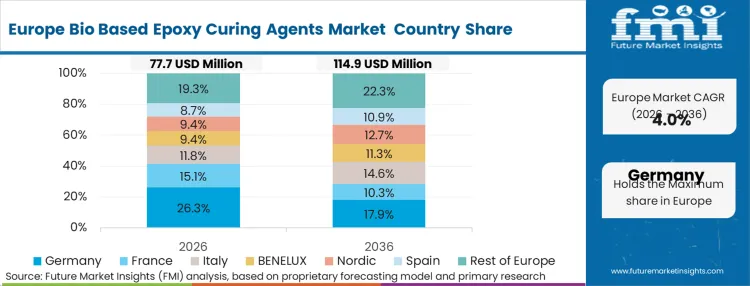
Europe's aggressive implementation of REACH regulations and stringent chemical registration frameworks structurally forces formulators away from traditional high-toxicity petrochemical amines. FMI analysts opine that this policy-led environment changes the buyer's focus from simple performance metrics to verifiable supply chain transparency and carbon mass accounting. A procurement head operating in this region cannot simply source a functionally equivalent hardener; they must qualify systems that satisfy internal corporate targets and municipal green-procurement laws simultaneously.
- Germany: Germany's complex extended producer responsibility requirements penalise the use of hazardous synthetic crosslinkers in both consumer and industrial applications, making the transition to bio-based alternatives a financial necessity rather than a compliance gesture. The market for Bio Based Epoxy Curing Agents in Germany is forecast to register a CAGR of 7.5%. Chemical formulators running massive European distribution lines are actively recalibrating their flagship protective coatings to utilise certified biomass-balance inputs. Companies that successfully validate these systems capture preferred supplier status in highly rigid demand for electronic adhesives in eu networks that rarely reopen to challengers.
- France: Aggressive public procurement mandates requiring low-carbon building materials dictate France's trajectory in civil engineering polymers. Construction managers must specify bio‑based flooring and grouting systems to meet the required criteria for new commercial developments. Bio Based Epoxy Curing Agents revenue in France is anticipated to increase by a CAGR of 7.3%. Adopting these certified systems fundamentally simplifies the operational headache of site-level compliance reporting and environmental health inspections.
FMI's report includes the Nordic countries and the United Kingdom, which represent mature end-user markets. The growth in these adjacent zones is characterized by a rapid phase-out of conventional solvent-borne epoxy systems in favour of advanced, water-reducible bio-amine technologies.
North America Bio Based Epoxy Curing Agents Market Analysis
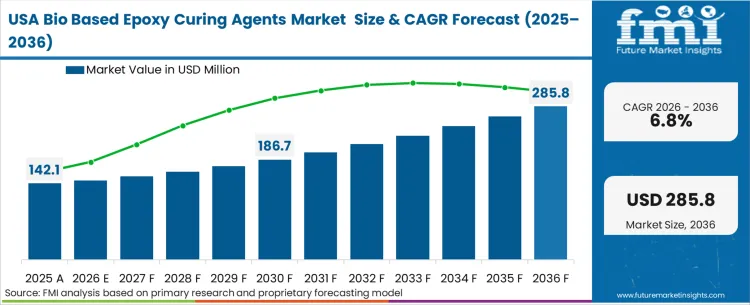
In North America, the adoption of bio-based curing agents is determined by performance-led economics rather than uniform environmental legislation. Formulators adopt these chemistries only when they solve specific operational failures, such as adhesion loss on damp concrete or insufficient flexibility in composite structures. As per FMI's projection, the sheer scale of the region's ageing infrastructure creates a massive, albeit fragmented, opportunity for specialised field-repair polymers where environmental conditions cannot be controlled.
- United States: A CAGR of 6.8% is expected for Bio Based Epoxy Curing Agents in the United States over the forecast period. The necessity for all-weather, surface-tolerant coatings in structural steel maintenance and bridge repair forces American formulators to utilise phenalkamines. Asset managers must deploy repair systems that can bond to marginally prepared, damp surfaces, a capability where bio-derived phenolic lipids vastly outperform legacy synthetic polyamines. The practitioner reality here is that applicators specify these products entirely for their robust, idiot-proof handling characteristics in the field, with the bio-content remaining a largely unadvertised secondary feature.
FMI's report includes Canada and Mexico, where market dynamics are closely tied to cross-border manufacturing operations. A pattern emerging across these markets involves heavy-duty automotive and aerospace composite fabricators leveraging bio-based epoxy casting potting resin to meet specific internal lightweighting and thermal resistance targets.
Competitive Aligners for Market Players
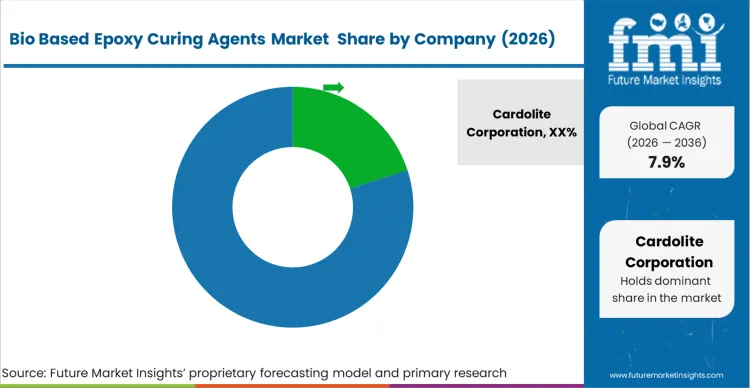
Bio based epoxy curing agents industry exhibits moderate concentration at the top tier, driven by the capital requirements of specialized bio-feedstock extraction and the massive scale needed for verifiable biomass-balance accounting. Leading companies such as Cardolite Corporation, Evonik Industries AG, and BASF SE control significant volume because they offer complete, globally supported portfolios rather than isolated specialty products. Buyers in the heavy industrial and marine sectors use global supply reliability and consistency of batch-to-batch curing profiles as the primary variables to distinguish qualified partners from opportunistic regional toll-blenders.
The advantage held by incumbents lies in their vertically integrated supply chains or their deeply entrenched mass-balance chemical networks. Companies like Westlake Epoxy and Huntsman Corporation possess the regulatory architecture and the formulation expertise to synthesize highly consistent fatty amines and amidoamines at scale. To replicate this, a challenger must build not just a novel extraction process, but an entire qualification matrix that tier-1 coating manufacturers trust enough to drop into their flagship global product lines.
Through 2036, the tension between massive protective coating brands demanding lower prices and chemical majors protecting their margins will define the evolution of the market. Large buyers actively resist lock-in by designing their specifications around standardized bio-content thresholds rather than proprietary single-source molecules. This dynamic ensures that while the top tier remains highly capitalized, the market will not fully consolidate, as regional formulators leveraging local agricultural streams continue to capture localized infrastructure projects.
Key Players in Bio Based Epoxy Curing Agents Market
- Cardolite Corporation
- Evonik Industries AG
- Westlake Epoxy
- BASF SE
- Huntsman Corporation
- Aditya Birla Chemicals
- Mitsubishi Chemical Group
Scope of the Report
| Metric | Value |
|---|---|
| Quantitative Units | USD 344.8 million to USD 737.5 million, at a CAGR of 7.90% |
| Market Definition | Bio based epoxy curing agents are highly reactive chemical hardeners derived from renewable biomass sources-such as cashew nutshell liquid, vegetable oils, and lignin-used to crosslink epoxy resins into solid thermoset polymers. Functionally, these agents replace traditional petrochemical polyamines and polyamides, providing the necessary active hydrogen sites for crosslinking while delivering specific operational characteristics like rapid low-temperature curing, superior moisture tolerance, and enhanced chemical resistance. |
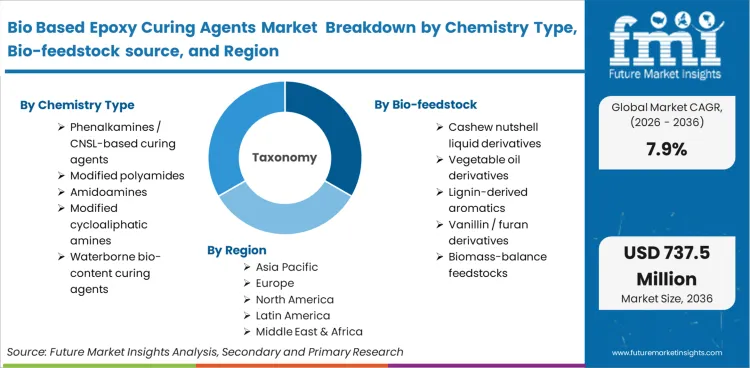
| Chemistry type Segmentation | Phenalkamines / CNSL-based curing agents, Modified polyamides, Amidoamines, Modified cycloaliphatic amines, Waterborne bio-content curing agents |
| Bio-feedstock source Segmentation | Cashew nutshell liquid derivatives, Vegetable oil derivatives, Lignin-derived aromatics, Vanillin / furan derivatives, Biomass-balance feedstocks |
| Application Segmentation | Protective coatings, Adhesives & sealants, Composites, Flooring & civil engineering, Electrical encapsulation |
| End use Segmentation | Building & construction, Industrial & marine coatings, Wind energy & composites, Automotive & transportation, Electronics & electrical |
| Regions Covered | Asia Pacific, Europe, North America |
| Countries Covered | India, China, South Korea, Germany, France, Japan, United States, and 40 plus countries |
| Key Companies Profiled | Cardolite Corporation, Evonik Industries AG, Westlake Epoxy, BASF SE, Huntsman Corporation, Aditya Birla Chemicals, Mitsubishi Chemical Group |
| Forecast Period | 2026 to 2036 |
| Approach | Primary research targeted chief formulators, product development directors, and procurement heads at tier-1 industrial coating and adhesive manufacturing firms. The baseline volume was anchored directly to regional cashew production outputs and commercialized dimer fatty acid supply chain capacities. Forecasts were cross-validated against independent production declarations from the top five global epoxy amine producers. |
Source: Future Market Insights (FMI) analysis, based on proprietary forecasting model and primary research
Bio Based Epoxy Curing Agents Market Analysis by Segments
Chemistry type:
- Phenalkamines / CNSL-based curing agents
- Modified polyamides
- Amidoamines
- Modified cycloaliphatic amines
- Waterborne bio-content curing agents
Bio-feedstock source:
- Cashew nutshell liquid derivatives
- Vegetable oil derivatives
- Lignin-derived aromatics
- Vanillin / furan derivatives
- Biomass-balance feedstocks
Application:
- Protective coatings
- Adhesives & sealants
- Composites
- Flooring & civil engineering
- Electrical encapsulation
End use:
- Building & construction
- Industrial & marine coatings
- Wind energy & composites
- Automotive & transportation
- Electronics & electrical
Cure profile:
- Ambient / room-temperature cure
- Fast-cure systems
- Waterborne systems
- Heat-cure systems
- Low-VOC / high-solids systems
Region:
- North America
- Europe
- Asia-Pacific
- Rest of the World
- Latin America
- Middle East, and Africa
Bibliography
- Rashid, M. A., Islam, M. A., Hasan, M. M., & Pranto, M. M. I. (2026). Biobased curing agents with intrinsically reversible bonds for recyclable epoxy thermosets: A review. Materials Today Communications, 50, 114440.
- Billington, E. K., & Shaver, M. P. (2025). Recyclable Epoxy Composites Built with a Biobased Hardener. ACS Sustainable Chemistry & Engineering, 13(39), 16638-16645.
- Zhang, Y., Liu, X., Wan, M., Zhu, Y., & Zhang, K. (2024). Recent Development of Functional Bio-Based Epoxy Resins. Molecules, 29(18), 4428.
- Li, K., Wang, S., Jiang, Y., Chen, M., Dong, W., & Shi, D. (2025). High-Performance, Recyclable, and Degradable Bio-Based Epoxy Resins Based on Dynamic Covalent Imine Bonds. Journal of Applied Polymer Science, 142, e57033.
- Anbazhagan, A., Choudhury, P. R., Sambandam, S., & Saraswathi, J. L. (2024). Sustainable Composite of Cardanol Based Phenalkamine Cured Epoxy Systems: Fabrication, Characterization and Mechanical Performance Evaluation for Emerging Applications. Journal of Polymer Materials, 41(4), 299-313.
- Yu, L., Guoqing, W., Yali, G., Ning, F., Jingxiang, L., Zheng, L., & Junhan, L. (2024). Preparation of cardanol-based curing agent for underwater drainage pipeline repairs. e-Polymers, 24(1), 105511.
- Özbudak-Çelik, F. B., & Oktay, B. (2025). Preparation of composite epoxy networks by eco-friendly epoxy curing agents. Macromolecular Research, 33, 1163-1174.
- Matykiewicz, D., Dudziec, B., Barczewski, M., & Piasecki, A. (2025). Application of Bio-Based Epoxy Resin Synthesized from Eugenol in Composites Reinforced with Flax, Nettle, and Basalt Fabrics. Journal of Natural Fibers, 22(1), 2499096.
This bibliography is provided for reader reference. The full FMI report contains the complete reference list with primary source documentation.
This Report Addresses
- Market intelligence to support strategic decision making across phenalkamines, modified polyamides, and advanced waterborne bio-content systems
- Market size estimation and 10-year revenue forecasts from 2026 to 2036, supported by biomass certification registries and regional cashew yield data
- Growth opportunity mapping across marine coatings and electronic encapsulation with emphasis on the qualification of waterborne bio-content systems by tier-1 manufacturers
- Segment and regional revenue forecasts covering cashew nutshell liquid derivatives across stringent European extended producer responsibility frameworks
- Competition strategy assessment including global supply reliability, consistency of batch-to-batch curing profiles, and biomass-balance infrastructure maturity
- Product development tracking including mass-balance drop-in amidoamines and low-temperature curing phenalkamine technologies
- Market access analysis covering REACH compliance pathways and municipal green-procurement laws in civil engineering
- Market report delivery in PDF, Excel, PPT, and interactive dashboard formats for executive strategy, global chemical procurement planning, and operational benchmarking use
Frequently Asked Questions
How large is the Bio Based Epoxy Curing Agents in 2026?
The industry size is expected to reach USD 344.8 million in 2026. This baseline valuation reflects the immediate, high-volume substitution of petrochemical polyamides in marine and industrial coatings, where performance parity has already been achieved by agricultural derivatives.
What will it be valued at by 2036?
Continued investment is projected to lift the market valuation to USD 737.5 million by 2036, supported by the wider implementation of biomass‑balance mass accounting that enables major chemical producers to bring change in entire supply chains without overhauling existing infrastructure.
What CAGR is projected?
A compound annual growth rate of 7.90% is expected during the forecast period. This rate is structurally dictated by the capital expenditure cycles of civil infrastructure and marine shipbuilding, rather than moving strictly in lockstep with corporate announcements.
Which Chemistry type segment leads?
Phenalkamines / CNSL-based curing agents lead the market. Their dominance is driven by an inherent chemical structure, long hydrophobic aliphatic chains, that physically repels moisture during the crosslinking phase, making them indispensable for damp, field-applied heavy-duty coatings.
Which Bio-feedstock source segment leads?
Cashew nutshell liquid derivatives capture the primary volume share. Unlike highly engineered alternatives, raw cardanol is an abundant byproduct of an existing agricultural process, bypassing massive synthetic refinement costs and allowing manufacturers to deliver drop-in systems at competitive price points.
Which Application segment leads?
Protective coatings account for the leading share of applications. Applicators require hardeners that provide intense anti-corrosive properties and internal plasticization for structural steel, forcing a direct switch to flexible, low-VOC bio-based amidoamines to prevent brittle failure.
What drives rapid growth?
Stringent VOC regulations and extended producer responsibility frameworks physically penalize the use of synthetic, solvent-heavy crosslinkers. Procurement directors are forced to standardize around high-solids, bio-based alternatives to maintain their approved vendor status with major municipal and structural contractors.
What is the primary restraint?
The recalibration of existing formulations creates massive technical friction. Smaller applicators cannot simply swap a petrochemical amine for a bio-based agent; they must heavily invest in adjusting mix ratios, testing viscosity, and altering spray equipment to achieve the required application profile.
Which country grows fastest?
India expands at 9.6%, followed by China at 9.2%. India's trajectory benefits from massive domestic access to raw cashew byproduct, allowing regional formulators to bypass global supply chain import constraints and dominate heavy-duty infrastructure bids locally.
How do European regulations impact the transition to bio-based curing agents?
The aggressive implementation of REACH and extended producer responsibility laws actively penalizes legacy synthetic hardeners. This policy-led environment forces tier-1 chemical brands to adopt certified biomass-balance inputs simply to maintain access to commercial construction and marine procurement networks.
Why are waterborne bio-content systems considered a critical inflection point?
The maturation of water-reducible bio-hardeners enables the total elimination of solvent usage in confined spaces. Once these zero-odor, high-performance systems are fully qualified by major coatings brands, the last remaining health and safety friction in civil engineering application is removed.
How do global chemical majors maintain their competitive edge?
Incumbents leverage massive, vertically integrated biomass-balance networks that tier-2 formulators cannot easily replicate. They secure the market not through niche proprietary molecules, but by offering absolute global supply reliability and verifiable bio-content certification across massive volume lines.
Why are phenalkamines preferred in winter marine maintenance?
Standard petrochemical polyamides fail to crosslink efficiently in sub-zero, high-humidity environments, causing severe operational delays in drydocks. Phenalkamines cure rapidly under these exact conditions, providing an immediate commercial benefit that heavily outweighs their initial material premium.
What structural limitation do lignin-derived aromatics face?
While lignin is highly renewable, extracting and refining it into a consistently reactive amine substitute requires extreme capital investment. Until extraction yields and batch-to-batch consistency improve, formulators will continue to rely on the more stabilized economics of cashew and vegetable oil derivatives.
How does biomass-balance accounting change formulation strategy?
It allows large chemical plants to blend renewable feedstocks with conventional inputs, verifying the renewable portion mathematically rather than physically separating production streams. This lets global adhesive brands adopt bio‑content without changing any factory mixing protocols.
Why is the United States market adoption highly localized?
Unlike Europe's uniform regulatory push, U.S. adoption is dictated strictly by functional performance. Asset managers specify bio-based systems primarily for specialized infrastructure repairs where surface-tolerant, all-weather application is non-negotiable, treating the bio-content as a secondary feature.
What role do fast-cure systems play in civil engineering?
Commercial flooring and structural grouting projects operate under severe time penalties for facility downtime. Bio-based hardeners that can deliver rapid crosslinking without relying on hazardous accelerators allow contractors to bid on fast-return-to-service projects inside operational buildings.
How does the shipbuilding cycle affect South Korean demand?
South Korea's massive concentration of tier-1 shipyards creates a localized surge for low-temperature curing agents. The procurement of CNSL-derivatives tracks directly with winter vessel maintenance schedules, allowing yards to clear vessels faster than competitors using standard chemistries.
Why are bio-based agents utilized in electronics encapsulation?
The intense miniaturization of semiconductor packaging requires potting compounds that resist thermal shock. Specific, highly purified bio-amidoamines provide the exact crosslinking density and internal flexibility needed to prevent micro-fractures without introducing ionic contaminants.
What prevents total market consolidation by top-tier suppliers?
While chemical majors dominate mass-balance volumes, large industrial buyers actively resist sole-source lock-in by designing their procurement specifications around standardized bio-content thresholds. This allows regional formulators leveraging local agricultural streams to remain competitive in localized bids.
How do specific processed cashew market share analysis metrics impact curing agent prices?
Because phenalkamines are directly tied to the agricultural output of the cashew industry, poor harvest yields or disruptions in cashew nut processing immediately spike raw cardanol costs. Specialty formulators must secure multi-year off-take agreements to insulate their margins against this agricultural volatility.
What changes structurally in the market by 2036?
The designation of "bio-based" will cease to be a premium, isolated product category. Because biomass-balance feedstocks will be deeply integrated into all standard amine synthesis, bio-content will become the default baseline performance standard for all new epoxy formulations globally.
Preview the report firsthand - request a free sample
Get SampleGet the brochure for pricing and purchase details.
Get PDFTable of Content
- Executive Summary
- Global Market Outlook
- Demand-side Trends
- Supply-side Trends
- Technology Roadmap Analysis
- Analysis and Recommendations
- Market Overview
- Market Coverage / Taxonomy
- Market Definition / Scope / Limitations
- Research Methodology
- Chapter Orientation
- Analytical Lens and Working Hypotheses
- Market Structure, Signals, and Trend Drivers
- Benchmarking and Cross-market Comparability
- Market Sizing, Forecasting, and Opportunity Mapping
- Research Design and Evidence Framework
- Desk Research Programme (Secondary Evidence)
- Company Annual and Sustainability Reports
- Peer-reviewed Journals and Academic Literature
- Corporate Websites, Product Literature, and Technical Notes
- Earnings Decks and Investor Briefings
- Statutory Filings and Regulatory Disclosures
- Technical White Papers and Standards Notes
- Trade Journals, Industry Magazines, and Analyst Briefs
- Conference Proceedings, Webinars, and Seminar Materials
- Government Statistics Portals and Public Data Releases
- Press Releases and Reputable Media Coverage
- Specialist Newsletters and Curated Briefings
- Sector Databases and Reference Repositories
- FMI Internal Proprietary Databases and Historical Market Datasets
- Subscription Datasets and Paid Sources
- Social Channels, Communities, and Digital Listening Inputs
- Additional Desk Sources
- Expert Input and Fieldwork (Primary Evidence)
- Primary Modes
- Qualitative Interviews and Expert Elicitation
- Quantitative Surveys and Structured Data Capture
- Blended Approach
- Why Primary Evidence is Used
- Field Techniques
- Interviews
- Surveys
- Focus Groups
- Observational and In-context Research
- Social and Community Interactions
- Stakeholder Universe Engaged
- C-suite Leaders
- Board Members
- Presidents and Vice Presidents
- R&D and Innovation Heads
- Technical Specialists
- Domain Subject-matter Experts
- Scientists
- Physicians and Other Healthcare Professionals
- Governance, Ethics, and Data Stewardship
- Research Ethics
- Data Integrity and Handling
- Primary Modes
- Tooling, Models, and Reference Databases
- Desk Research Programme (Secondary Evidence)
- Data Engineering and Model Build
- Data Acquisition and Ingestion
- Cleaning, Normalisation, and Verification
- Synthesis, Triangulation, and Analysis
- Quality Assurance and Audit Trail
- Market Background
- Market Dynamics
- Drivers
- Restraints
- Opportunity
- Trends
- Scenario Forecast
- Demand in Optimistic Scenario
- Demand in Likely Scenario
- Demand in Conservative Scenario
- Opportunity Map Analysis
- Product Life Cycle Analysis
- Supply Chain Analysis
- Investment Feasibility Matrix
- Value Chain Analysis
- PESTLE and Porter’s Analysis
- Regulatory Landscape
- Regional Parent Market Outlook
- Production and Consumption Statistics
- Import and Export Statistics
- Market Dynamics
- Global Market Analysis 2021 to 2025 and Forecast, 2026 to 2036
- Historical Market Size Value (USD Million) Analysis, 2021 to 2025
- Current and Future Market Size Value (USD Million) Projections, 2026 to 2036
- Y-o-Y Growth Trend Analysis
- Absolute $ Opportunity Analysis
- Global Market Pricing Analysis 2021 to 2025 and Forecast 2026 to 2036
- Global Market Analysis 2021 to 2025 and Forecast 2026 to 2036, By Chemistry Type
- Introduction / Key Findings
- Historical Market Size Value (USD Million) Analysis By Chemistry Type , 2021 to 2025
- Current and Future Market Size Value (USD Million) Analysis and Forecast By Chemistry Type , 2026 to 2036
- Phenalkamines / CNSL-based curing agents
- Modified polyamides
- Amidoamines
- Modified cycloaliphatic amines
- Waterborne bio-content curing agents
- Phenalkamines / CNSL-based curing agents
- Y-o-Y Growth Trend Analysis By Chemistry Type , 2021 to 2025
- Absolute $ Opportunity Analysis By Chemistry Type , 2026 to 2036
- Global Market Analysis 2021 to 2025 and Forecast 2026 to 2036, By Bio-feedstock source
- Introduction / Key Findings
- Historical Market Size Value (USD Million) Analysis By Bio-feedstock source, 2021 to 2025
- Current and Future Market Size Value (USD Million) Analysis and Forecast By Bio-feedstock source, 2026 to 2036
- Cashew nutshell liquid derivatives
- Vegetable oil derivatives
- Lignin-derived aromatics
- Vanillin / furan derivatives
- Biomass-balance feedstocks
- Cashew nutshell liquid derivatives
- Y-o-Y Growth Trend Analysis By Bio-feedstock source, 2021 to 2025
- Absolute $ Opportunity Analysis By Bio-feedstock source, 2026 to 2036
- Global Market Analysis 2021 to 2025 and Forecast 2026 to 2036, By Application
- Introduction / Key Findings
- Historical Market Size Value (USD Million) Analysis By Application, 2021 to 2025
- Current and Future Market Size Value (USD Million) Analysis and Forecast By Application, 2026 to 2036
- Protective coatings
- Adhesives & sealants
- Composites
- Flooring & civil engineering
- Electrical encapsulation
- Protective coatings
- Y-o-Y Growth Trend Analysis By Application, 2021 to 2025
- Absolute $ Opportunity Analysis By Application, 2026 to 2036
- Global Market Analysis 2021 to 2025 and Forecast 2026 to 2036, By End use
- Introduction / Key Findings
- Historical Market Size Value (USD Million) Analysis By End use, 2021 to 2025
- Current and Future Market Size Value (USD Million) Analysis and Forecast By End use, 2026 to 2036
- Building & construction
- Industrial & marine coatings
- Wind energy & composites
- Automotive & transportation
- Electronics & electrical
- Building & construction
- Y-o-Y Growth Trend Analysis By End use, 2021 to 2025
- Absolute $ Opportunity Analysis By End use, 2026 to 2036
- Global Market Analysis 2021 to 2025 and Forecast 2026 to 2036, By Cure profile
- Introduction / Key Findings
- Historical Market Size Value (USD Million) Analysis By Cure profile, 2021 to 2025
- Current and Future Market Size Value (USD Million) Analysis and Forecast By Cure profile, 2026 to 2036
- Ambient / room-temperature cure
- Fast-cure systems
- Waterborne systems
- Heat-cure systems
- Low-VOC / high-solids systems
- Ambient / room-temperature cure
- Y-o-Y Growth Trend Analysis By Cure profile, 2021 to 2025
- Absolute $ Opportunity Analysis By Cure profile, 2026 to 2036
- Global Market Analysis 2021 to 2025 and Forecast 2026 to 2036, By Region
- Introduction
- Historical Market Size Value (USD Million) Analysis By Region, 2021 to 2025
- Current Market Size Value (USD Million) Analysis and Forecast By Region, 2026 to 2036
- North America
- Latin America
- Western Europe
- Eastern Europe
- East Asia
- South Asia and Pacific
- Middle East & Africa
- Market Attractiveness Analysis By Region
- North America Market Analysis 2021 to 2025 and Forecast 2026 to 2036, By Country
- Historical Market Size Value (USD Million) Trend Analysis By Market Taxonomy, 2021 to 2025
- Market Size Value (USD Million) Forecast By Market Taxonomy, 2026 to 2036
- By Country
- USA
- Canada
- Mexico
- By Chemistry Type
- By Bio-feedstock source
- By Application
- By End use
- By Cure profile
- By Country
- Market Attractiveness Analysis
- By Country
- By Chemistry Type
- By Bio-feedstock source
- By Application
- By End use
- By Cure profile
- Key Takeaways
- Latin America Market Analysis 2021 to 2025 and Forecast 2026 to 2036, By Country
- Historical Market Size Value (USD Million) Trend Analysis By Market Taxonomy, 2021 to 2025
- Market Size Value (USD Million) Forecast By Market Taxonomy, 2026 to 2036
- By Country
- Brazil
- Chile
- Rest of Latin America
- By Chemistry Type
- By Bio-feedstock source
- By Application
- By End use
- By Cure profile
- By Country
- Market Attractiveness Analysis
- By Country
- By Chemistry Type
- By Bio-feedstock source
- By Application
- By End use
- By Cure profile
- Key Takeaways
- Western Europe Market Analysis 2021 to 2025 and Forecast 2026 to 2036, By Country
- Historical Market Size Value (USD Million) Trend Analysis By Market Taxonomy, 2021 to 2025
- Market Size Value (USD Million) Forecast By Market Taxonomy, 2026 to 2036
- By Country
- Germany
- UK
- Italy
- Spain
- France
- Nordic
- BENELUX
- Rest of Western Europe
- By Chemistry Type
- By Bio-feedstock source
- By Application
- By End use
- By Cure profile
- By Country
- Market Attractiveness Analysis
- By Country
- By Chemistry Type
- By Bio-feedstock source
- By Application
- By End use
- By Cure profile
- Key Takeaways
- Eastern Europe Market Analysis 2021 to 2025 and Forecast 2026 to 2036, By Country
- Historical Market Size Value (USD Million) Trend Analysis By Market Taxonomy, 2021 to 2025
- Market Size Value (USD Million) Forecast By Market Taxonomy, 2026 to 2036
- By Country
- Russia
- Poland
- Hungary
- Balkan & Baltic
- Rest of Eastern Europe
- By Chemistry Type
- By Bio-feedstock source
- By Application
- By End use
- By Cure profile
- By Country
- Market Attractiveness Analysis
- By Country
- By Chemistry Type
- By Bio-feedstock source
- By Application
- By End use
- By Cure profile
- Key Takeaways
- East Asia Market Analysis 2021 to 2025 and Forecast 2026 to 2036, By Country
- Historical Market Size Value (USD Million) Trend Analysis By Market Taxonomy, 2021 to 2025
- Market Size Value (USD Million) Forecast By Market Taxonomy, 2026 to 2036
- By Country
- China
- Japan
- South Korea
- By Chemistry Type
- By Bio-feedstock source
- By Application
- By End use
- By Cure profile
- By Country
- Market Attractiveness Analysis
- By Country
- By Chemistry Type
- By Bio-feedstock source
- By Application
- By End use
- By Cure profile
- Key Takeaways
- South Asia and Pacific Market Analysis 2021 to 2025 and Forecast 2026 to 2036, By Country
- Historical Market Size Value (USD Million) Trend Analysis By Market Taxonomy, 2021 to 2025
- Market Size Value (USD Million) Forecast By Market Taxonomy, 2026 to 2036
- By Country
- India
- ASEAN
- Australia & New Zealand
- Rest of South Asia and Pacific
- By Chemistry Type
- By Bio-feedstock source
- By Application
- By End use
- By Cure profile
- By Country
- Market Attractiveness Analysis
- By Country
- By Chemistry Type
- By Bio-feedstock source
- By Application
- By End use
- By Cure profile
- Key Takeaways
- Middle East & Africa Market Analysis 2021 to 2025 and Forecast 2026 to 2036, By Country
- Historical Market Size Value (USD Million) Trend Analysis By Market Taxonomy, 2021 to 2025
- Market Size Value (USD Million) Forecast By Market Taxonomy, 2026 to 2036
- By Country
- Kingdom of Saudi Arabia
- Other GCC Countries
- Turkiye
- South Africa
- Other African Union
- Rest of Middle East & Africa
- By Chemistry Type
- By Bio-feedstock source
- By Application
- By End use
- By Cure profile
- By Country
- Market Attractiveness Analysis
- By Country
- By Chemistry Type
- By Bio-feedstock source
- By Application
- By End use
- By Cure profile
- Key Takeaways
- Key Countries Market Analysis
- USA
- Pricing Analysis
- Market Share Analysis, 2025
- By Chemistry Type
- By Bio-feedstock source
- By Application
- By End use
- By Cure profile
- Canada
- Pricing Analysis
- Market Share Analysis, 2025
- By Chemistry Type
- By Bio-feedstock source
- By Application
- By End use
- By Cure profile
- Mexico
- Pricing Analysis
- Market Share Analysis, 2025
- By Chemistry Type
- By Bio-feedstock source
- By Application
- By End use
- By Cure profile
- Brazil
- Pricing Analysis
- Market Share Analysis, 2025
- By Chemistry Type
- By Bio-feedstock source
- By Application
- By End use
- By Cure profile
- Chile
- Pricing Analysis
- Market Share Analysis, 2025
- By Chemistry Type
- By Bio-feedstock source
- By Application
- By End use
- By Cure profile
- Germany
- Pricing Analysis
- Market Share Analysis, 2025
- By Chemistry Type
- By Bio-feedstock source
- By Application
- By End use
- By Cure profile
- UK
- Pricing Analysis
- Market Share Analysis, 2025
- By Chemistry Type
- By Bio-feedstock source
- By Application
- By End use
- By Cure profile
- Italy
- Pricing Analysis
- Market Share Analysis, 2025
- By Chemistry Type
- By Bio-feedstock source
- By Application
- By End use
- By Cure profile
- Spain
- Pricing Analysis
- Market Share Analysis, 2025
- By Chemistry Type
- By Bio-feedstock source
- By Application
- By End use
- By Cure profile
- France
- Pricing Analysis
- Market Share Analysis, 2025
- By Chemistry Type
- By Bio-feedstock source
- By Application
- By End use
- By Cure profile
- India
- Pricing Analysis
- Market Share Analysis, 2025
- By Chemistry Type
- By Bio-feedstock source
- By Application
- By End use
- By Cure profile
- ASEAN
- Pricing Analysis
- Market Share Analysis, 2025
- By Chemistry Type
- By Bio-feedstock source
- By Application
- By End use
- By Cure profile
- Australia & New Zealand
- Pricing Analysis
- Market Share Analysis, 2025
- By Chemistry Type
- By Bio-feedstock source
- By Application
- By End use
- By Cure profile
- China
- Pricing Analysis
- Market Share Analysis, 2025
- By Chemistry Type
- By Bio-feedstock source
- By Application
- By End use
- By Cure profile
- Japan
- Pricing Analysis
- Market Share Analysis, 2025
- By Chemistry Type
- By Bio-feedstock source
- By Application
- By End use
- By Cure profile
- South Korea
- Pricing Analysis
- Market Share Analysis, 2025
- By Chemistry Type
- By Bio-feedstock source
- By Application
- By End use
- By Cure profile
- Russia
- Pricing Analysis
- Market Share Analysis, 2025
- By Chemistry Type
- By Bio-feedstock source
- By Application
- By End use
- By Cure profile
- Poland
- Pricing Analysis
- Market Share Analysis, 2025
- By Chemistry Type
- By Bio-feedstock source
- By Application
- By End use
- By Cure profile
- Hungary
- Pricing Analysis
- Market Share Analysis, 2025
- By Chemistry Type
- By Bio-feedstock source
- By Application
- By End use
- By Cure profile
- Kingdom of Saudi Arabia
- Pricing Analysis
- Market Share Analysis, 2025
- By Chemistry Type
- By Bio-feedstock source
- By Application
- By End use
- By Cure profile
- Turkiye
- Pricing Analysis
- Market Share Analysis, 2025
- By Chemistry Type
- By Bio-feedstock source
- By Application
- By End use
- By Cure profile
- South Africa
- Pricing Analysis
- Market Share Analysis, 2025
- By Chemistry Type
- By Bio-feedstock source
- By Application
- By End use
- By Cure profile
- USA
- Market Structure Analysis
- Competition Dashboard
- Competition Benchmarking
- Market Share Analysis of Top Players
- By Regional
- By Chemistry Type
- By Bio-feedstock source
- By Application
- By End use
- By Cure profile
- Competition Analysis
- Competition Deep Dive
- Cardolite Corporation
- Overview
- Product Portfolio
- Profitability by Market Segments (Product/Age /Sales Channel/Region)
- Sales Footprint
- Strategy Overview
- Marketing Strategy
- Product Strategy
- Channel Strategy
- Evonik Industries AG
- Westlake Epoxy
- BASF SE
- Huntsman Corporation
- Aditya Birla Chemicals
- Mitsubishi Chemical Group
- Cardolite Corporation
- Competition Deep Dive
- Assumptions & Acronyms Used


