

- Industry Size (2026)
- USD 383.6 Mn
- Forecast (2036)
- USD 970.5 Mn
- CAGR (2026 to 2036)
- 9.7%
Bio-Based PE Skincare Tubes Market Size, Market Forecast and Outlook By FMI
The bio-based PE skincare tubes market crossed a valuation of USD 345.6 million in 2025. The industry is expected to reach USD 383.6 million in 2026 at a CAGR of 9.7% during the forecast period. Demand outlook carries the market valuation to USD 970.5 million by 2036 as sustainability regulations and brand-led circular packaging initiatives accelerate the transition away from fossil-derived plastic packaging in premium skincare formats.
The architectural pivot from conventional petrochemical polyethylene to sugarcane-derived resins forces cosmetic packaging converters to overhaul their entire extrusion infrastructure. Packaging engineers executing new product launches now reject standard plastic tubes that compromise corporate environmental scoring. Suppliers entering upcoming tender cycles without verified bio-based material certification face a disqualification window they cannot bypass once shortlisting commences. This structural transition requires cosmetic brands to absorb temporary margin compression to secure access to limited biopolymer feedstock. Brands that delay this supply chain integration lose their competitive positioning in premium retail channels.
The true inflection point for renewable packaging occurs when major cosmetic retail distributors begin enforcing strict minimum bio-resin content thresholds for all shelved inventory. Packaging procurement directors must secure long-term capacity agreements with certified biopolymer extruders before the impending 2028 regulatory compliance window permanently restricts virgin plastic allocations. Facilities failing to secure these sustainable supply lines will rapidly lose their retail shelf placement to compliant competitors.
Summary of Bio-Based PE Skincare Tubes Market
- Bio-Based PE Skincare Tubes Market Definition
- Bio-Based PE Skincare Tubes encompass specialized flexible packaging containers extruded from plant-derived polyethylene to deliver creams, gels, and lotions. The functional boundary of this market relies entirely on the substitution of petrochemical ethylene with renewable ethanol while maintaining strict compatibility with existing cosmetic filling and sealing infrastructure.
- Demand Drivers in the Market
- Extended producer responsibility regulations force global cosmetic brand owners to adopt packaging materials with verified low carbon footprints to avoid steep financial penalties.
- Premium skincare consumers actively reject fossil-based plastic containers, compelling retail merchandisers to prioritize brands utilizing renewable packaging architectures.
- The volatile pricing of crude oil derivatives drives packaging converters to secure bio-based supply chains that offer more predictable long-term material economics.
- Key Segments Analyzed in the FMI Report
- 51 ml to 100 ml: 42.5% share in 2026, reflecting the standard volume requirement for travel-friendly facial cleansers and premium daily moisturizers.
- Multi-layer/Co-extruded: 68.4% share in 2026, as brands demand advanced oxygen and moisture protection for sensitive active skincare ingredients.
- China: 12.5% compound growth driven by rapid domestic expansion of independent beauty brands utilizing green marketing to capture market share.
- Analyst Opinion at FMI
- Ismail Sutaria, Principal Consultant for Packaging at Future Market Insights, opines, “In our recent Bio-Based PE Skincare Tubes Market assessment, my team and I have observed that brand credibility increasingly hinges on measurable sustainability outcomes rather than symbolic material substitutions. Bio-based polyethylene enables brands to retain the mechanical strength, squeeze performance, and decoration compatibility of conventional tubes while lowering reliance on fossil feedstocks. However, certification transparency and traceable bio-resin sourcing will determine buyer confidence. Packaging suppliers that align renewable resin integration with recyclability standards and scalable tube production will define the next wave of sustainable beauty packaging.”
- Strategic Implications / Executive Takeaways
- Resin suppliers must scale their sugar cane ethanol conversion capacities to meet the impending volume demands of Tier-1 cosmetic conglomerates.
- Packaging converters should invest in advanced co-extrusion technology to blend bio-PE seamlessly with barrier materials without compromising the tube's mechanical integrity.
- Cosmetic brand managers must clearly communicate the renewable origin of their packaging directly on the primary display panel to capture the associated consumer premium.
- Methodology
- Primary Research: FMI conducted detailed technical interviews with principal packaging engineers, polymer scientists, and cosmetic supply chain directors across 40 countries to validate material adoption timelines.
- Desk Research: Analysts aggregated public sustainability reports from major beauty brands, biopolymer certification registries, and national environmental packaging directives.
- Market-Sizing and Forecasting: The model applies a bottom-up methodology starting with global installed base metrics for cosmetic filling lines and projecting the conversion rate to bio-based tube specifications.
- Data Validation and Update Cycle: Segment forecasts undergo cross-validation against quarterly bio-resin shipment volumes for the personal care sector.
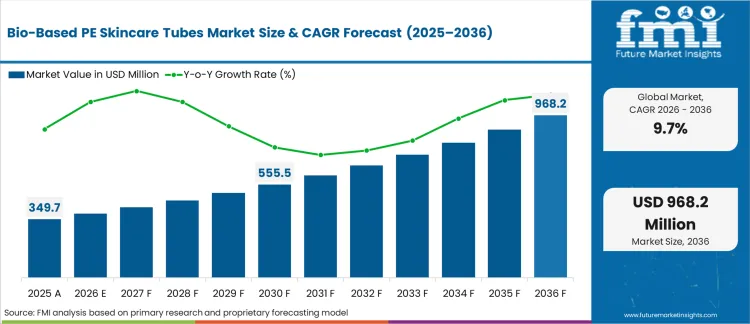
Bio-Based PE Skincare Tubes Market Key Takeaways
| Metric | Details |
|---|---|
| Industry Size (2026) | USD 383.6 million |
| Industry Value (2036) | USD 970.5 million |
| CAGR (2026-2036) | 9.7% |
Source: Future Market Insights (FMI) analysis, based on proprietary forecasting model and primary research
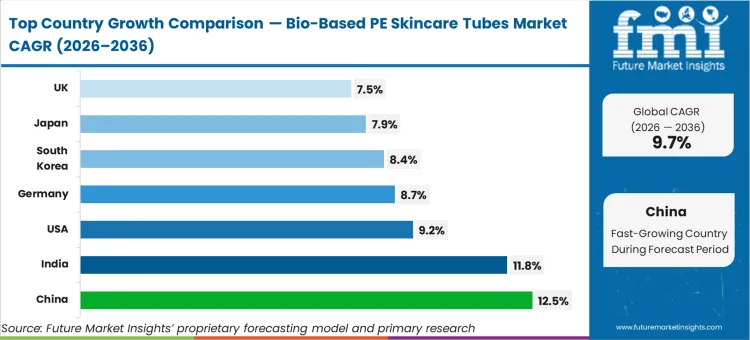
As regional cosmetic manufacturing hubs navigate this material transition, China sets the pace with a 12.5% CAGR as domestic brands rapidly scale renewable packaging lines. India advances at an 11.8% rate anchored by localized tube extrusion investments. The United States follows closely at a 9.2% trajectory supported by strict state-level packaging waste directives. Germany records an 8.7% expansion while South Korea tracks at 8.4%, both driven by premium cosmetic export standards. Japan expands at a 7.9% trajectory anchored by established sustainable material sourcing networks. The UK maintains a steady 7.5% pace as cosmetic retailers enforce eco-friendly packaging mandates. This geographic dispersion reflects varying regulatory pressures compelling global skincare manufacturers to localize their sustainable material supply chains.
Bio-Based PE Skincare Tubes Market Definition
Bio-Based PE Skincare Tubes represent the flexible cylindrical packaging format manufactured entirely or partially from polyethylene derived from renewable biological resources rather than petrochemicals. The ecosystem includes single-layer and multi-layer extruded tubes designed specifically to dispense cosmetic and dermatological formulations. This market distinguishes itself from conventional plastic packaging by utilizing ethanol from sugar cane or starch blends to synthesize the ethylene monomers, resulting in a packaging solution that matches the mechanical performance of virgin plastic while drastically lowering the associated carbon footprint.
Bio-Based PE Skincare Tubes Market Inclusions
The market scope includes extruded mono-layer bio-PE tubes, co-extruded multi-layer structures incorporating bio-based tie layers, and laminated biopolymer tube solutions specifically engineered for the skincare sector. Associated closure mechanisms manufactured from bio-resins, high-barrier bio-PE tubes integrating EVOH for formula protection, and tubes utilizing masterbatches compatible with biological polyethylene fall entirely within the boundaries. Products explicitly marketed for facial, body, and dermatological applications using these renewable plastic tube formats are fully incorporated.
Bio-Based PE Skincare Tubes Market Exclusions
Standard commercial cosmetic tubes manufactured from 100% fossil-based high-density or low-density polyethylene are excluded. Pure aluminum tubes, glass cosmetic containers, and rigid plastic jars fall outside the defined parameters. Tubes made from biodegradable plastics that are not structurally polyethylene, such as pure PLA or PHA formulations designed for industrial composting rather than standard recycling streams, are explicitly omitted from the valuation.
Bio-Based PE Skincare Tubes Market Research Methodology
-
Primary Research: Analysts engaged with cosmetic packaging procurement directors, primary polymer extrusion engineers, and sustainable brand managers to map the specific decision gates triggering renewable material upgrades.
- Desk Research: The data collection phase aggregated compliance roadmaps from major cosmetic conglomerates, global plastic pact commitments, and bioplastic resin production capacity reports.
- Market-Sizing and Forecasting: The baseline value derives from a bottom-up aggregation of bio-PE resin shipments dedicated to cosmetic applications, applying regional sustainability mandates to project the future adoption velocity.
- Data Validation and Update Cycle: Projections are rigorously tested against publicly reported packaging expenditure guidance from the leading global personal care and beauty manufacturing corporations.
Segmental Analysis
Bio-Based PE Skincare Tubes Market Analysis by Capacity
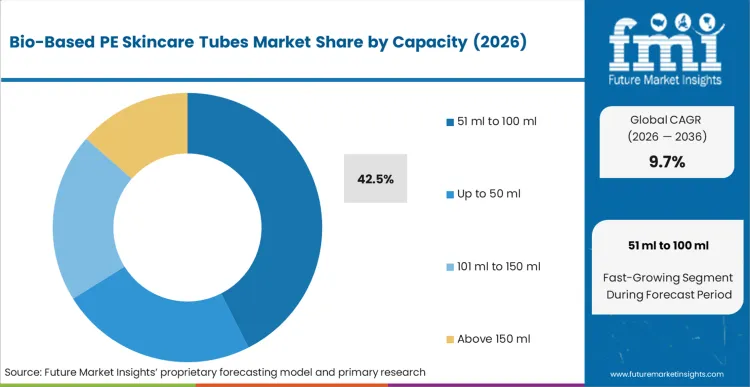
The dominant 51 ml to 100 ml segment commands a 42.5% share in 2026, driven directly by global aviation security compliance and consumer preference for portable skincare routines. Cosmetic brand managers face intense pressure to format their most profitable facial cleansers and daily serums into travel-compliant sizes without sacrificing premium aesthetic appeal. FMI analysts opine that standardizing on this specific capacity allows manufacturers to streamline their filling line changeovers while satisfying the largest demographic of mobile consumers. Relying on sugarcane composite structures for these mid-sized tubes ensures the packaging remains lightweight and highly durable during transit. Cosmetic procurement teams standardizing on this capacity threshold capture higher margin multiples per milliliter while meeting strict retail shelving constraints.
- Aviation Compliance: Global transit regulations force skincare brands to prioritize packaging formats that guarantee hassle-free consumer mobility.
- Line Efficiency: Standardized mid-capacity dimensions permit contract manufacturers to run continuous high-speed filling operations without costly mechanical recalibrations.
- Margin Optimization: Formulating premium serums into smaller volume tubes allows luxury beauty conglomerates to maximize profit margins on raw active ingredients.
Bio-Based PE Skincare Tubes Market Analysis by Layer Type
Conventional mono-layer plastic failing to protect sensitive Vitamin C and retinol formulations forces the rapid adoption of complex multi-layer architectures. Multi-layer/Co-extruded tubes hold a 68.4% share in 2026 as skincare chemists explicitly mandate advanced barrier properties to prevent premature formula oxidation. Extrusion engineers integrating bio-PE with internal EVOH layers create impenetrable barriers that significantly extend product shelf life. As per FMI's projection, this sophisticated material blending requires immense capital investment in advanced bio-based laminate properties and co-extrusion machinery. Converters failing to provide certified multi-layer barrier guarantees risk immediate disqualification from lucrative dermatological packaging contracts.
- Formula Preservation: Oxygen-sensitive active ingredients demand strict barrier layers to maintain their clinical efficacy over extended retail storage periods.
- Structural Integrity: Fusing multiple polymer layers prevents aggressive chemical solvents within acne treatments from degrading the outer decorative packaging layer.
- Recycling Compatibility: Modern co-extrusion techniques ensure that the barrier layers remain thin enough to bypass rejection at municipal sorting facilities.
Bio-Based PE Skincare Tubes Market Analysis by Closure Type
Flip-top Cap formats emerge as the primary functional choice, representing a 54.2% share in 2026 due to the overwhelming consumer demand for one-handed dispensing convenience in wet bathroom environments. Packaging designers catering to modern beauty routines reject cumbersome screw caps that slow down the application process and risk contamination when dropped. Utilizing precise metallocene polyethylene processing ensures the hinge mechanism on these caps withstands thousands of actuation cycles without snapping. Based on FMI's assessment, matching the closure resin to the bio-based tube body is critical for achieving a unified recycling classification. Brand owners failing to implement seamless one-handed closure mechanisms face immediate consumer backlash and reduced repurchase rates in saturated cosmetic categories.
- Wet-environment Functionality: Bathroom application scenarios necessitate closure mechanisms that consumers can operate easily without compromising product hygiene.
- Hinge Durability: Advanced polymer engineering prevents the repeated stress of daily opening and closing from fracturing the cap structure.
- Material Homogenization: Manufacturing the cap from the identical biological resin family as the tube body streamlines the post-consumer recycling workflow.
Bio-Based PE Skincare Tubes Market Analysis by End-use Application
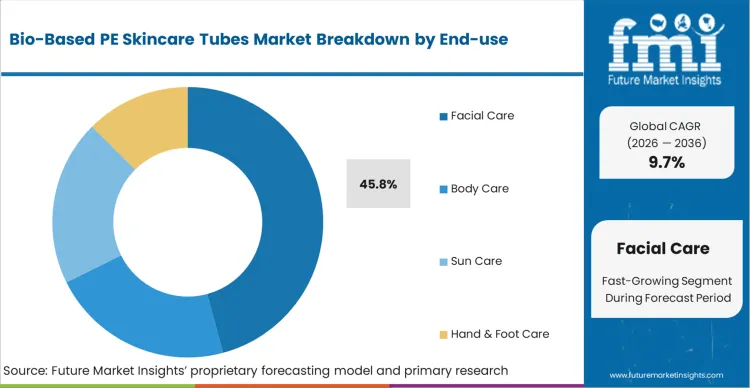
The surge in complex multi-step anti-aging routines establishes Facial Care as the leading application segment with a 45.8% share in 2026. Skincare formulation scientists developing highly concentrated facial serums require precise dispensing mechanisms that standard wide-mouth jars cannot provide. Employing PEF barrier formulations within these specific tubes ensures that volatile organic compounds in facial peels do not evaporate through the packaging walls. FMI's analysis indicates that the premium pricing associated with facial treatments easily absorbs the marginal cost increase of bio-based packaging. Product managers launching high-end facial treatments without sustainable packaging certifications immediately alienate the eco-conscious demographic driving modern beauty revenue.
- Dosage Precision: Highly active facial serums require restrictive orifices to prevent consumers from dispensing wasteful and potentially irritating product volumes.
- Brand Premiumization: Utilizing sustainable packaging materials signals luxury and environmental responsibility to discerning premium facial care buyers.
- Contamination Prevention: Squeeze tube architectures prevent atmospheric oxygen and bacteria from compromising the sterile environment of the facial formulation.
Bio-Based PE Skincare Tubes Market Drivers, Restraints, and Opportunities
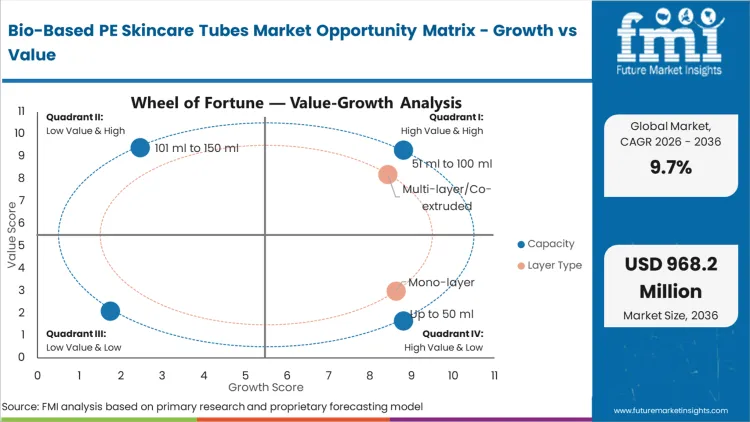
Strict corporate sustainability mandates force global cosmetic conglomerates to aggressively audit their entire packaging supply chains. Brand procurement directors facing public carbon reduction deadlines must replace fossil-based plastics with verified renewable alternatives to maintain their corporate ESG ratings. This transition ensures that bio-based PE tubes become a mandatory baseline requirement rather than a niche premium offering, effectively driving massive volume expansion. Cosmetic manufacturers who ignore these rigid cosmetics packaging standards lose access to major retail distribution networks that prioritize eco-friendly brand portfolios.
The persistent price premium of biological resins compared to highly subsidized petrochemical polyethylene creates severe margin pressure for independent cosmetic brands. Smaller packaging buyers lack the procurement leverage to negotiate favorable bio-resin pricing from major chemical refineries. This economic reality forces mid-tier brands to either raise their retail prices and risk consumer abandonment, or accept degraded profitability to meet basic skincare packaging procurement expectations.
Opportunities in the Bio-Based PE Skincare Tubes Market
- Closed-Loop Collection Systems: Forward-thinking cosmetic brands establish proprietary take-back programs that recover empty bio-PE tubes directly from consumers. This raw material security allows packaging converters to blend post-consumer bio-resin with virgin bio-resin to dramatically lower overall production costs.
- Direct-to-Consumer Customization: Advanced digital printing technology enables agile tube manufacturers to run highly customized, short-run batch orders for niche indie beauty brands. This specific capability allows packaging suppliers to capture high-margin revenue from emerging skincare labels.
- Lightweighting Engineering: Polymer scientists continually refine the extrusion process to reduce the overall wall thickness of the bio-based tubes without sacrificing barrier protection. This material efficiency allows mass-market skincare conglomerates to offset the initial cost premium of the renewable biopolymer.
Regional Analysis
.webp "Top Country Growth Comparison Bio Based Pe Skincare Tubes Market Cagr (2026 2036)")
Based on the regional analysis, the Bio-Based PE Skincare Tubes market is segmented into North America, Latin America, Europe, East Asia, South Asia, Oceania and Middle East & Africa across 40+ countries.
| Country | CAGR (2026 to 2036) |
|---|---|
| China | 12.5% |
| India | 11.8% |
| USA | 9.2% |
| Germany | 8.7% |
| South Korea | 8.4% |
| Japan | 7.9% |
| UK | 7.5% |
Source: Future Market Insights (FMI) analysis, based on proprietary forecasting model and primary research
Asia Pacific Bio-Based PE Skincare Tubes Market Analysis
The explosive growth of domestic beauty brands across Asia Pacific rapidly shifts regional packaging demands away from basic utilitarian formats toward highly decorated sustainable solutions. In FMI's view, contract manufacturers updating their extrusion lines recognize that offering certified bio-based options is the only way to secure long-term manufacturing agreements with the next generation of Asian cosmetic giants. This regional manufacturing pivot relies entirely on securing consistent imports of biological resins from global agricultural hubs.
- China: China's aggressive domestic beauty sector launches thousands of new skincare SKUs annually, requiring incredibly agile packaging supply chains to support viral social media marketing cycles. Domestic packaging converters must rapidly deploy bio-based extrusion capabilities to help local brands mimic the sustainability claims of international luxury labels. The scale of China's localized cosmetic manufacturing infrastructure allows these converters to immediately achieve production volumes that drive down the per-unit cost of renewable packaging. China's skincare sector demand is rising at a CAGR of 12.5% as government guidelines heavily penalize the use of non-recyclable virgin plastics. Independent beauty brand founders failing to secure verified bio-based squeeze tube applications lose access to the highly lucrative eco-conscious Gen-Z consumer demographic.
- India: A rising middle class in India actively trades up from basic sachets to premium tube-based skincare formats, triggering massive domestic packaging demand. Extrusion facility operators must upgrade their legacy machinery to handle the unique thermal properties of bio-PE resins without causing production bottlenecks. Local cosmetic brands prioritizing sustainable cosmetic formats capitalize on this consumer transition by establishing a premium brand identity early in the market lifecycle. This localized manufacturing upgrade sustains an 11.8% compound rate for India's renewable tube packaging sector. Plant managers unable to stabilize the extrusion temperature profiles for biological resins suffer catastrophic tube failure rates during the sealing process.
- South Korea: South Korea's world-leading dermatological innovation engine requires highly specialized barrier packaging to protect complex active ingredients like snail mucin and unstable vitamin compounds. Skincare formulation chemists mandate uncompromising multi-layer co-extrusion standards before approving any bio-based packaging alternative. The relentless pace of K-Beauty product development forces regional tube manufacturers to maintain vast libraries of pre-certified laminated tube architectures ready for immediate deployment. This relentless cycle of innovation positions South Korea at an 8.4% compound growth rate. Export compliance officers lacking the necessary international certifications for their bio-based packaging immediately forfeit lucrative distribution agreements in European and North American retail channels.
- Japan: Legacy cosmetic conglomerates in Japan operate under stringent corporate environmental philosophies that dictate comprehensive life-cycle assessments for all new packaging materials. Brand packaging engineers conduct exhaustive barrier and compatibility testing to ensure bio-PE tubes perfectly mirror the performance of traditional aluminum tube replacements. This meticulous qualification process ensures incredibly low defect rates once the sustainable packaging enters mass production. The Japanese market advances at a 7.9% compound trajectory to 2036 as these major brands systematically phase out fossil plastics. Contract packagers unable to meet these zero-defect manufacturing tolerances face permanent exclusion from the domestic Japanese cosmetic supply chain.
FMI's report includes extensive coverage of the broader Asia Pacific packaging landscape. Emerging Southeast Asian cosmetic manufacturing hubs are increasingly integrating bio-based materials to attract outsourced production contracts from Western brands demanding strict ESG compliance.
North America Bio-Based PE Skincare Tubes Market Analysis
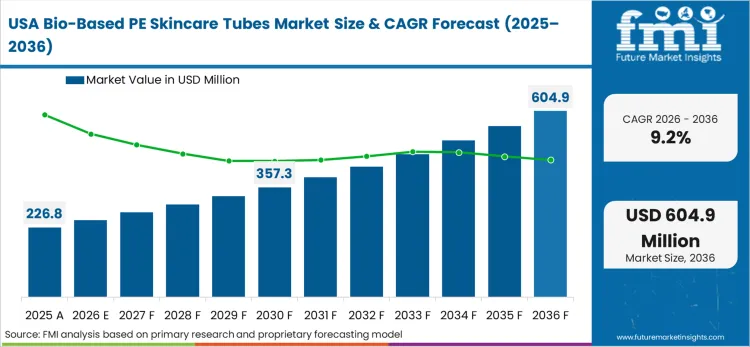
Stringent state-level legislation targeting single-use plastics fundamentally disrupts the North American cosmetic packaging supply chain. Packaging procurement directors leading major brand portfolios face strict legal directives to integrate high percentages of renewable or post-consumer materials into their product lines. According to FMI's estimates, the proliferation of clean beauty retail standards forces legacy brands to completely abandon their historical reliance on cheap petrochemical containers. This legislative and retail pressure accelerates the deployment of localized bio-resin extrusion facilities to circumvent volatile international shipping logistics.
- USA: The United States clean beauty retail sector enforces strict ingredient and packaging visibility mandates across its entire multi-tier brand ecosystem. Cosmetic brand managers overhauling their product lines must deploy eco-friendly packaging compliance strategies that verify the exact biological origin of their plastic tubes. Expanding state-level extended producer responsibility laws actively financially penalize beauty brands that continue utilizing virgin fossil-based polyethylene. The United States advances at a 9.2% annual growth rate as personal care conglomerates unify their sustainable packaging procurement strategies. Supply chain executives lacking documented traceability for their bio-based resins face immediate delisting from major cosmetic retail powerhouses like Sephora and Ulta.
FMI's report includes a comprehensive evaluation of the North American sustainable packaging sector. The analysis heavily features the Canadian cosmetic market, where aggressive national carbon taxation policies compel brand owners to rapidly adopt plant-based packaging solutions to mitigate escalating operational costs.
Europe Bio-Based PE Skincare Tubes Market Analysis
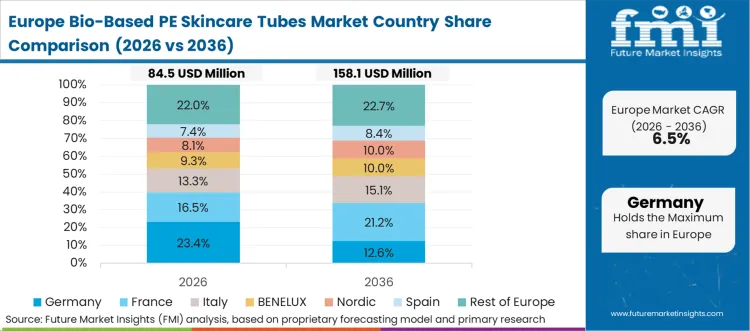
The European Green Deal actively heavily taxes the continued production of fossil-based plastic packaging, fundamentally altering the economics of cosmetic manufacturing. Sustainable brand architects redesigning legacy product lines must integrate fully recyclable bio-based tubes to comply with the impending packaging waste directives. This regulatory reality forces a rapid expansion of local biopolymer compounding facilities to ensure steady material access for the continent's massive cosmetic industry. Upgrading the core extrusion infrastructure provides the necessary precision to process these sensitive personal care pack lines without increasing factory scrap rates.
- Germany: Germany's powerful cosmetic export sector dictates stringent validation criteria for active ingredient stability within new renewable packaging formats. Skincare compliance officers must demonstrate flawless barrier performance under extreme temperature fluctuations before authorizing the mass rollout of bio-based tubes. The national focus on circular economy principles creates a recurring compliance cycle that accelerates the abandonment of biodegradable plastic alternatives that contaminate standard recycling streams. This systemic qualification pressure drives an 8.7% CAGR for certified bio-PE tubes as the standard proliferates across the domestic beauty sector. European packaging converters targeting these lucrative dermatological brands must guarantee absolute formula compatibility prior to the finalization of annual procurement budgets.
- UK: The United Kingdom's aggressive plastic packaging tax requires brands to definitively prove their packaging contains significant non-fossil material to avoid heavy financial levies. Cosmetic supply chain planners deploying new product launches mandate bio-based packaging architectures capable of easily clearing these strict government audit thresholds. The massive shift in consumer sentiment against virgin plastics forces established beauty brands to abandon their historical beauty packaging aesthetics in favor of demonstrably green materials. This critical regulatory transition anchors the UK's 7.5% compound rate over the 2026 to 2036 planning window as retailers systematically reject non-compliant products. Brand formulation chemists unable to stabilize their skincare products within these new bio-resins forfeit their placement in major high-street pharmacies.
FMI's report includes a thorough investigation of the European sustainable packaging framework. A prevailing structural condition across France and Italy is the mandatory alignment of luxury packaging aesthetics with biological materials, forcing asset owners to specify bio-PE tubes that perfectly replicate the glossy finish of traditional premium plastics.
Competitive Aligners for Market Players
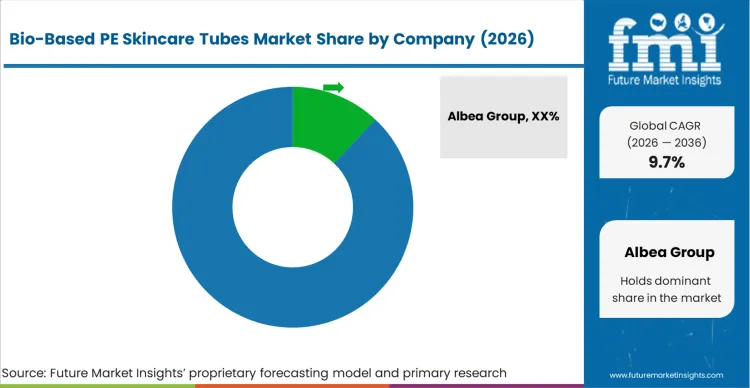
The rapid maturation of bio-resin production technology is fundamentally reshaping how cosmetic buyers evaluate primary packaging suppliers. Procurement teams previously focused exclusively on unit cost now demand verified supply chain traceability and guaranteed continuous access to biological feedstocks in all new tenders. This requirement heavily favors consolidated industry leaders over fragmented regional extruders, as the capital requirements to secure long-term bio-PE contracts remain incredibly high. Major packaging converters like Albea Group, Hoffmann Neopac AG, and Essel Propack leverage their massive purchasing power to dominate the supply of premium biological FMCG packaging metrics, establishing a severe barrier to entry for smaller manufacturers.
Vendors embedding advanced decoration and finishing capabilities directly into their bio-based tube manufacturing lines gain a significant architectural advantage. Cosmetic brands refuse to compromise their visual identity when transitioning to renewable materials, demanding that bio-PE tubes accept complex hot-stamping, silk-screening, and metallic foiling exactly like their fossil-based predecessors. Companies like Huhtamaki Oyj and Berry Global Inc., which possess proprietary surface treatment technologies, help brand owners seamlessly transition their packaging without alerting consumers to a drop in aesthetic quality. This capability accelerates brand migration projects, allowing marketing directors to prioritize suppliers that eliminate the visual risk associated with sustainable materials.
The persistent threat of bio-resin shortages empowers massive cosmetic conglomerates to demand multi-vendor qualification protocols to prevent catastrophic supply chain disruptions. Large buyers actively cultivate relationships with secondary packaging suppliers to ensure they never face a production halt if a primary vendor loses access to sugar cane ethanol feedstocks. This aggressive multi-sourcing strategy structurally limits the pricing power of the dominant tube manufacturers, forcing them to compete aggressively on extrusion tolerances and delivery speed rather than relying on material exclusivity. Brand procurement directors will continue to exert immense pressure on tube suppliers to absorb the fluctuating costs of agricultural feedstocks throughout the forecast period.
Key Players in Bio-Based PE Skincare Tubes Market
- Albea Group
- Essel Propack (EPL Limited)
- Hoffmann Neopac AG
- Huhtamaki Oyj
- Berry Global Inc.
- Tubex Holding GmbH
- Viva Healthcare Packaging
- Laminate Tubes Industries
- CTI Packaging
- IntraPac International
Scope of the Report
| Metric | Value |
|---|---|
| Quantitative Units | USD 383.6 million to USD 970.5 million, at a CAGR of 9.7% |
| Market Definition | Bio-Based PE Skincare Tubes represent flexible packaging containers extruded from plant-derived polyethylene designed to match the performance of virgin plastic while drastically lowering carbon footprints. |
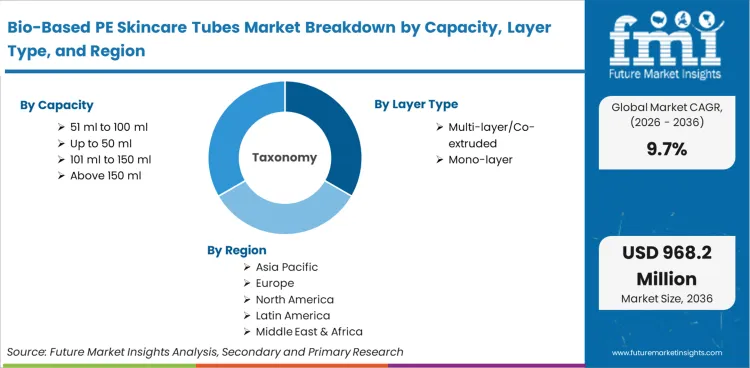
| Capacity Segmentation | Up to 50 ml, 51 ml to 100 ml, 101 ml to 150 ml, Above 150 ml |
| Layer Type Segmentation | Mono-layer, Multi-layer/Co-extruded |
| Closure Type Segmentation | Flip-top Cap, Screw Cap, Pump Dispenser, Others |
| End-use Application Segmentation | Facial Care, Body Care, Sun Care, Hand & Foot Care |
| Regions Covered | North America, Latin America, Europe, East Asia, South Asia, Oceania, Middle East & Africa |
| Countries Covered | China, India, USA, Germany, South Korea, Japan, UK, and 40 plus countries |
| Key Companies Profiled | Albea Group, Essel Propack (EPL Limited), Hoffmann Neopac AG, Huhtamaki Oyj, Berry Global Inc., Tubex Holding GmbH, Viva Healthcare Packaging |
| Forecast Period | 2026 to 2036 |
| Approach | The baseline value derives from a bottom-up aggregation of bio-PE resin shipments dedicated to cosmetic applications, applying regional sustainability mandates to project future adoption velocity. |
Source: Future Market Insights (FMI) analysis, based on proprietary forecasting model and primary research
Bio-Based PE Skincare Tubes Market Analysis by Segments
Capacity:
- Up to 50 ml
- 51 ml to 100 ml
- 101 ml to 150 ml
- Above 150 ml
Layer Type:
- Mono-layer
- Multi-layer/Co-extruded
Closure Type:
- Flip-top Cap
- Screw Cap
- Pump Dispenser
- Others
End-use Application:
- Facial Care
- Body Care
- Sun Care
- Hand & Foot Care
Region:
- Asia Pacific
- India
- China
- Japan
- South Korea
- Indonesia
- Australia & New Zealand
- ASEAN
- Rest of Asia Pacific
- Europe
- Germany
- Italy
- France
- United Kingdom
- Spain
- Benelux
- Nordics
- Central & Eastern Europe
- Rest of Europe
- North America
- United States
- Canada
- Mexico
- Latin America
- Brazil
- Argentina
- Chile
- Rest of Latin America
- Middle East & Africa
- Kingdom of Saudi Arabia
- United Arab Emirates
- South Africa
- Turkey
- Rest of Middle East & Africa
Bibliography
- Organisation for Economic Co-operation and Development. (2024). Policy scenarios for eliminating plastic pollution by 2040. OECD.
- Department of the Environment. (2024). Notice with respect to reporting of plastic resins and certain plastic products for the Federal Plastics Registry for 2024, 2025 and 2026. Canada Gazette, Part I, 158(16).
- Simboli, A., Sinibaldi, L., Taddeo, R., Rimano, M., Cutarella, L., & Casolani, V. (2024). Product ecodesign: An application of bio-based materials in the personal care packaging industry. Circular Economy and Sustainability, 4(4), 2427–2448.
- USA Department of Agriculture. (2024). Indicators and trends of the USA biobased economy: 2019 through 2021.
- National Institute of Standards and Technology. (2024). The USA plastics recycling economy: Current state, challenges, and opportunities (NIST AMS 100-64).
This bibliography is provided for reader reference. The full FMI report contains the complete reference list with primary source documentation.
This Report Addresses
- Market sizing for the organized bio-based PE skincare tubes layer
- Forecast demand for renewable cosmetic packaging from 2026 to 2036
- Capacity analysis across specific mid-volume and high-volume tube formats
- Layer Type demand patterns across mono-layer and complex co-extruded structures
- Regional growth comparisons shaped by local plastic taxation and retail mandates
- Competitive positioning factors for global cosmetic packaging converters
- Revenue opportunities tied to custom digital printing on renewable materials
- Strategic implications for beauty brand procurement directors
Frequently Asked Questions
How large is the Bio-Based PE Skincare Tubes Market in 2026?
The bio-based PE skincare tubes market is estimated to be valued at USD 383.6 million in 2026. This valuation relies directly on global beauty conglomerates executing massive purchase orders to replace their legacy fossil-based packaging formats.
What will the Bio-Based PE Skincare Tubes Market be valued at by 2036?
Demand is projected to reach USD 970.5 million by 2036. This massive expansion occurs as strict governmental zero-waste mandates permanently outlaw the use of non-renewable plastics in consumer goods.
What CAGR is projected for the Bio-Based PE Skincare Tubes Market from 2026 to 2036?
Compound expansion at 9.7% is projected across the forecast decade. The absolute necessity of meeting corporate ESG commitments ensures brand owners absorb the material cost premium, sustaining predictable revenue growth.
Which Capacity segment dominates the market?
51 ml to 100 ml leads with a 42.5% share in 2026. Cosmetic brands mandate this specific volume to optimize their profit margins on premium active ingredients while satisfying strict travel-size retail requirements.
Why is the Multi-layer/Co-extruded segment leading by Layer Type?
Multi-layer structures hold a dominant 68.4% share in 2026. Skincare chemists explicitly require these complex barriers to prevent volatile dermatological acids from degrading and compromising the tube's physical integrity.
Which Closure Type holds the most significant market share?
Flip-top Caps secure a 54.2% share in 2026. Wet bathroom application environments necessitate closure mechanisms that consumers can operate effortlessly with a single hand.
Why does Facial Care lead the End-use Application dimension?
Facial Care captures 45.8% of the market share in 2026. The premium retail pricing of anti-aging facial serums easily absorbs the elevated manufacturing costs associated with biological polymer sourcing.
What prevents smaller brands from adopting bio-based tubes?
The persistent cost premium of biological resins compared to highly subsidized petrochemical polyethylene creates severe margin compression for independent brands. Smaller packaging buyers lack the procurement leverage required to negotiate favorable long-term bio-resin contracts.
How do closed-loop systems create a market opportunity?
Cosmetic brands that establish proprietary take-back programs can recover empty bio-PE tubes directly from consumers to offset virgin material costs. Blending post-consumer bio-resin with virgin bio-resin significantly improves overall packaging supply chain economics.
What regulatory dynamic accelerates the transition from conventional plastics?
Extended producer responsibility laws actively financially penalize beauty brands that continue utilizing virgin fossil-based polyethylene. Corporate boards must eliminate these packaging liabilities to protect their long-term operating margins.
What is driving demand in China?
China's massive independent beauty sector requires incredibly agile packaging supply chains to support rapid product launch cycles. Domestic packaging converters rapidly deploy bio-based extrusion capabilities to help local brands mimic the sustainability claims of international luxury labels.
Why is India projected to grow rapidly?
India is projected to expand at an 11.8% CAGR over the forecast window. The rapid transition of the domestic middle class toward premium tube-based skincare formats triggers massive localized extrusion facility upgrades.
What supports growth in the United States?
The United States advances at a 9.2% compound rate to 2036. Clean beauty retail giants like Sephora enforce strict ingredient and packaging visibility mandates that force brands to verify the biological origin of their plastic tubes.
How does Germany differ from other European markets?
Germany expands at an 8.7% CAGR driven by its powerful cosmetic export sector. Skincare compliance officers must demonstrate flawless barrier performance under extreme temperature fluctuations before authorizing the mass rollout of bio-based tubes.
Why is South Korea a critical market for multi-layer tubes?
South Korea records an 8.4% growth rate due to its relentless dermatological innovation cycle. Formulation chemists mandate uncompromising multi-layer co-extrusion standards to protect highly unstable active ingredients like snail mucin.
What dictates material qualification in Japan?
Japan advances at a 7.9% trajectory as legacy cosmetic conglomerates conduct exhaustive life-cycle assessments on all new packaging materials. Brand engineers ensure bio-PE tubes perfectly mirror the performance of traditional premium plastics before entering mass production.
What compliance standard drives the UK market?
The UK maintains a 7.5% pace anchored by the national plastic packaging tax. Cosmetic supply chain planners mandate bio-based architectures capable of clearing strict government audit thresholds to avoid heavy financial levies.
Why do buyers utilize multi-vendor qualification strategies?
The persistent threat of bio-resin shortages empowers massive cosmetic conglomerates to cultivate relationships with secondary packaging suppliers. This strategy prevents catastrophic production halts if a primary vendor loses access to agricultural feedstocks.
How do advanced finishing capabilities alter competitive positioning?
Tube manufacturers possessing proprietary surface treatment technologies help brand owners seamlessly transition their packaging without altering premium aesthetics. Marketing directors prioritize these suppliers to eliminate the visual risk associated with adopting renewable materials.
What is the functional definition of this market?
Bio-Based PE Skincare Tubes represent flexible packaging containers extruded from plant-derived polyethylene designed to dispense cosmetic formulations. The market relies entirely on substituting petrochemical ethylene with renewable ethanol.
What products are excluded from this analysis?
Standard commercial cosmetic tubes manufactured from 100% fossil-based high-density or low-density polyethylene are completely excluded. Rigid plastic jars and tubes made from industrially compostable PLA are also omitted.
How is the market sizing validated?
The baseline value derives from a bottom-up aggregation of bio-PE resin shipments dedicated to cosmetic applications. Segment forecasts undergo cross-validation against quarterly packaging expenditure reports from leading global beauty corporations.
What is a key strategic takeaway for resin suppliers?
Polymer suppliers must scale their sugar cane ethanol conversion capacities immediately to meet impending volume demands. Securing output volume is critical as Tier-1 cosmetic conglomerates prepare to execute massive global portfolio conversions.
How does extrusion machinery impact market adoption?
Packaging converters must invest heavily in advanced co-extrusion technology to blend bio-PE seamlessly with necessary chemical barriers. Failing to master this complex thermal processing results in catastrophic tube failure rates during the factory sealing phase.
Preview the report firsthand - request a free sample
Get SampleGet the brochure for pricing and purchase details.
Get PDFTable of Content
- Executive Summary
- Global Market Outlook
- Demand-side Trends
- Supply-side Trends
- Technology Roadmap Analysis
- Analysis and Recommendations
- Market Overview
- Market Coverage / Taxonomy
- Market Definition / Scope / Limitations
- Research Methodology
- Chapter Orientation
- Analytical Lens and Working Hypotheses
- Market Structure, Signals, and Trend Drivers
- Benchmarking and Cross-market Comparability
- Market Sizing, Forecasting, and Opportunity Mapping
- Research Design and Evidence Framework
- Desk Research Programme (Secondary Evidence)
- Company Annual and Sustainability Reports
- Peer-reviewed Journals and Academic Literature
- Corporate Websites, Product Literature, and Technical Notes
- Earnings Decks and Investor Briefings
- Statutory Filings and Regulatory Disclosures
- Technical White Papers and Standards Notes
- Trade Journals, Industry Magazines, and Analyst Briefs
- Conference Proceedings, Webinars, and Seminar Materials
- Government Statistics Portals and Public Data Releases
- Press Releases and Reputable Media Coverage
- Specialist Newsletters and Curated Briefings
- Sector Databases and Reference Repositories
- FMI Internal Proprietary Databases and Historical Market Datasets
- Subscription Datasets and Paid Sources
- Social Channels, Communities, and Digital Listening Inputs
- Additional Desk Sources
- Expert Input and Fieldwork (Primary Evidence)
- Primary Modes
- Qualitative Interviews and Expert Elicitation
- Quantitative Surveys and Structured Data Capture
- Blended Approach
- Why Primary Evidence is Used
- Field Techniques
- Interviews
- Surveys
- Focus Groups
- Observational and In-context Research
- Social and Community Interactions
- Stakeholder Universe Engaged
- C-suite Leaders
- Board Members
- Presidents and Vice Presidents
- R&D and Innovation Heads
- Technical Specialists
- Domain Subject-matter Experts
- Scientists
- Physicians and Other Healthcare Professionals
- Governance, Ethics, and Data Stewardship
- Research Ethics
- Data Integrity and Handling
- Primary Modes
- Tooling, Models, and Reference Databases
- Desk Research Programme (Secondary Evidence)
- Data Engineering and Model Build
- Data Acquisition and Ingestion
- Cleaning, Normalisation, and Verification
- Synthesis, Triangulation, and Analysis
- Quality Assurance and Audit Trail
- Market Background
- Market Dynamics
- Drivers
- Restraints
- Opportunity
- Trends
- Scenario Forecast
- Demand in Optimistic Scenario
- Demand in Likely Scenario
- Demand in Conservative Scenario
- Opportunity Map Analysis
- Product Life Cycle Analysis
- Supply Chain Analysis
- Investment Feasibility Matrix
- Value Chain Analysis
- PESTLE and Porter’s Analysis
- Regulatory Landscape
- Regional Parent Market Outlook
- Production and Consumption Statistics
- Import and Export Statistics
- Market Dynamics
- Global Market Analysis 2021 to 2025 and Forecast, 2026 to 2036
- Historical Market Size Value (USD Million) Analysis, 2021 to 2025
- Current and Future Market Size Value (USD Million) Projections, 2026 to 2036
- Y-o-Y Growth Trend Analysis
- Absolute $ Opportunity Analysis
- Global Market Pricing Analysis 2021 to 2025 and Forecast 2026 to 2036
- Global Market Analysis 2021 to 2025 and Forecast 2026 to 2036, By Capacity
- Introduction / Key Findings
- Historical Market Size Value (USD Million) Analysis By Capacity , 2021 to 2025
- Current and Future Market Size Value (USD Million) Analysis and Forecast By Capacity , 2026 to 2036
- 51 ml to 100 ml
- Up to 50 ml
- 101 ml to 150 ml
- Above 150 ml
- 51 ml to 100 ml
- Y-o-Y Growth Trend Analysis By Capacity , 2021 to 2025
- Absolute $ Opportunity Analysis By Capacity , 2026 to 2036
- Global Market Analysis 2021 to 2025 and Forecast 2026 to 2036, By Layer Type
- Introduction / Key Findings
- Historical Market Size Value (USD Million) Analysis By Layer Type, 2021 to 2025
- Current and Future Market Size Value (USD Million) Analysis and Forecast By Layer Type, 2026 to 2036
- Multi-layer/Co-extruded
- Mono-layer
- Multi-layer/Co-extruded
- Y-o-Y Growth Trend Analysis By Layer Type, 2021 to 2025
- Absolute $ Opportunity Analysis By Layer Type, 2026 to 2036
- Global Market Analysis 2021 to 2025 and Forecast 2026 to 2036, By Closure Type
- Introduction / Key Findings
- Historical Market Size Value (USD Million) Analysis By Closure Type, 2021 to 2025
- Current and Future Market Size Value (USD Million) Analysis and Forecast By Closure Type, 2026 to 2036
- Flip-top Cap
- Screw Cap
- Pump Dispenser
- Others
- Flip-top Cap
- Y-o-Y Growth Trend Analysis By Closure Type, 2021 to 2025
- Absolute $ Opportunity Analysis By Closure Type, 2026 to 2036
- Global Market Analysis 2021 to 2025 and Forecast 2026 to 2036, By End-use
- Introduction / Key Findings
- Historical Market Size Value (USD Million) Analysis By End-use, 2021 to 2025
- Current and Future Market Size Value (USD Million) Analysis and Forecast By End-use, 2026 to 2036
- Facial Care
- Body Care
- Sun Care
- Hand & Foot Care
- Facial Care
- Y-o-Y Growth Trend Analysis By End-use, 2021 to 2025
- Absolute $ Opportunity Analysis By End-use, 2026 to 2036
- Global Market Analysis 2021 to 2025 and Forecast 2026 to 2036, By Region
- Introduction
- Historical Market Size Value (USD Million) Analysis By Region, 2021 to 2025
- Current Market Size Value (USD Million) Analysis and Forecast By Region, 2026 to 2036
- North America
- Latin America
- Western Europe
- Eastern Europe
- East Asia
- South Asia and Pacific
- Middle East & Africa
- Market Attractiveness Analysis By Region
- North America Market Analysis 2021 to 2025 and Forecast 2026 to 2036, By Country
- Historical Market Size Value (USD Million) Trend Analysis By Market Taxonomy, 2021 to 2025
- Market Size Value (USD Million) Forecast By Market Taxonomy, 2026 to 2036
- By Country
- USA
- Canada
- Mexico
- By Capacity
- By Layer Type
- By Closure Type
- By End-use
- By Country
- Market Attractiveness Analysis
- By Country
- By Capacity
- By Layer Type
- By Closure Type
- By End-use
- Key Takeaways
- Latin America Market Analysis 2021 to 2025 and Forecast 2026 to 2036, By Country
- Historical Market Size Value (USD Million) Trend Analysis By Market Taxonomy, 2021 to 2025
- Market Size Value (USD Million) Forecast By Market Taxonomy, 2026 to 2036
- By Country
- Brazil
- Chile
- Rest of Latin America
- By Capacity
- By Layer Type
- By Closure Type
- By End-use
- By Country
- Market Attractiveness Analysis
- By Country
- By Capacity
- By Layer Type
- By Closure Type
- By End-use
- Key Takeaways
- Western Europe Market Analysis 2021 to 2025 and Forecast 2026 to 2036, By Country
- Historical Market Size Value (USD Million) Trend Analysis By Market Taxonomy, 2021 to 2025
- Market Size Value (USD Million) Forecast By Market Taxonomy, 2026 to 2036
- By Country
- Germany
- UK
- Italy
- Spain
- France
- Nordic
- BENELUX
- Rest of Western Europe
- By Capacity
- By Layer Type
- By Closure Type
- By End-use
- By Country
- Market Attractiveness Analysis
- By Country
- By Capacity
- By Layer Type
- By Closure Type
- By End-use
- Key Takeaways
- Eastern Europe Market Analysis 2021 to 2025 and Forecast 2026 to 2036, By Country
- Historical Market Size Value (USD Million) Trend Analysis By Market Taxonomy, 2021 to 2025
- Market Size Value (USD Million) Forecast By Market Taxonomy, 2026 to 2036
- By Country
- Russia
- Poland
- Hungary
- Balkan & Baltic
- Rest of Eastern Europe
- By Capacity
- By Layer Type
- By Closure Type
- By End-use
- By Country
- Market Attractiveness Analysis
- By Country
- By Capacity
- By Layer Type
- By Closure Type
- By End-use
- Key Takeaways
- East Asia Market Analysis 2021 to 2025 and Forecast 2026 to 2036, By Country
- Historical Market Size Value (USD Million) Trend Analysis By Market Taxonomy, 2021 to 2025
- Market Size Value (USD Million) Forecast By Market Taxonomy, 2026 to 2036
- By Country
- China
- Japan
- South Korea
- By Capacity
- By Layer Type
- By Closure Type
- By End-use
- By Country
- Market Attractiveness Analysis
- By Country
- By Capacity
- By Layer Type
- By Closure Type
- By End-use
- Key Takeaways
- South Asia and Pacific Market Analysis 2021 to 2025 and Forecast 2026 to 2036, By Country
- Historical Market Size Value (USD Million) Trend Analysis By Market Taxonomy, 2021 to 2025
- Market Size Value (USD Million) Forecast By Market Taxonomy, 2026 to 2036
- By Country
- India
- ASEAN
- Australia & New Zealand
- Rest of South Asia and Pacific
- By Capacity
- By Layer Type
- By Closure Type
- By End-use
- By Country
- Market Attractiveness Analysis
- By Country
- By Capacity
- By Layer Type
- By Closure Type
- By End-use
- Key Takeaways
- Middle East & Africa Market Analysis 2021 to 2025 and Forecast 2026 to 2036, By Country
- Historical Market Size Value (USD Million) Trend Analysis By Market Taxonomy, 2021 to 2025
- Market Size Value (USD Million) Forecast By Market Taxonomy, 2026 to 2036
- By Country
- Kingdom of Saudi Arabia
- Other GCC Countries
- Turkiye
- South Africa
- Other African Union
- Rest of Middle East & Africa
- By Capacity
- By Layer Type
- By Closure Type
- By End-use
- By Country
- Market Attractiveness Analysis
- By Country
- By Capacity
- By Layer Type
- By Closure Type
- By End-use
- Key Takeaways
- Key Countries Market Analysis
- USA
- Pricing Analysis
- Market Share Analysis, 2025
- By Capacity
- By Layer Type
- By Closure Type
- By End-use
- Canada
- Pricing Analysis
- Market Share Analysis, 2025
- By Capacity
- By Layer Type
- By Closure Type
- By End-use
- Mexico
- Pricing Analysis
- Market Share Analysis, 2025
- By Capacity
- By Layer Type
- By Closure Type
- By End-use
- Brazil
- Pricing Analysis
- Market Share Analysis, 2025
- By Capacity
- By Layer Type
- By Closure Type
- By End-use
- Chile
- Pricing Analysis
- Market Share Analysis, 2025
- By Capacity
- By Layer Type
- By Closure Type
- By End-use
- Germany
- Pricing Analysis
- Market Share Analysis, 2025
- By Capacity
- By Layer Type
- By Closure Type
- By End-use
- UK
- Pricing Analysis
- Market Share Analysis, 2025
- By Capacity
- By Layer Type
- By Closure Type
- By End-use
- Italy
- Pricing Analysis
- Market Share Analysis, 2025
- By Capacity
- By Layer Type
- By Closure Type
- By End-use
- Spain
- Pricing Analysis
- Market Share Analysis, 2025
- By Capacity
- By Layer Type
- By Closure Type
- By End-use
- France
- Pricing Analysis
- Market Share Analysis, 2025
- By Capacity
- By Layer Type
- By Closure Type
- By End-use
- India
- Pricing Analysis
- Market Share Analysis, 2025
- By Capacity
- By Layer Type
- By Closure Type
- By End-use
- ASEAN
- Pricing Analysis
- Market Share Analysis, 2025
- By Capacity
- By Layer Type
- By Closure Type
- By End-use
- Australia & New Zealand
- Pricing Analysis
- Market Share Analysis, 2025
- By Capacity
- By Layer Type
- By Closure Type
- By End-use
- China
- Pricing Analysis
- Market Share Analysis, 2025
- By Capacity
- By Layer Type
- By Closure Type
- By End-use
- Japan
- Pricing Analysis
- Market Share Analysis, 2025
- By Capacity
- By Layer Type
- By Closure Type
- By End-use
- South Korea
- Pricing Analysis
- Market Share Analysis, 2025
- By Capacity
- By Layer Type
- By Closure Type
- By End-use
- Russia
- Pricing Analysis
- Market Share Analysis, 2025
- By Capacity
- By Layer Type
- By Closure Type
- By End-use
- Poland
- Pricing Analysis
- Market Share Analysis, 2025
- By Capacity
- By Layer Type
- By Closure Type
- By End-use
- Hungary
- Pricing Analysis
- Market Share Analysis, 2025
- By Capacity
- By Layer Type
- By Closure Type
- By End-use
- Kingdom of Saudi Arabia
- Pricing Analysis
- Market Share Analysis, 2025
- By Capacity
- By Layer Type
- By Closure Type
- By End-use
- Turkiye
- Pricing Analysis
- Market Share Analysis, 2025
- By Capacity
- By Layer Type
- By Closure Type
- By End-use
- South Africa
- Pricing Analysis
- Market Share Analysis, 2025
- By Capacity
- By Layer Type
- By Closure Type
- By End-use
- USA
- Market Structure Analysis
- Competition Dashboard
- Competition Benchmarking
- Market Share Analysis of Top Players
- By Regional
- By Capacity
- By Layer Type
- By Closure Type
- By End-use
- Competition Analysis
- Competition Deep Dive
- Albea Group
- Overview
- Product Portfolio
- Profitability by Market Segments (Product/Age /Sales Channel/Region)
- Sales Footprint
- Strategy Overview
- Marketing Strategy
- Product Strategy
- Channel Strategy
- Essel Propack (EPL Limited)
- Hoffmann Neopac AG
- Huhtamaki Oyj
- Berry Global Inc.
- Tubex Holding GmbH
- Viva Healthcare Packaging
- Laminate Tubes Industries
- CTI Packaging
- IntraPac International
- Albea Group
- Competition Deep Dive
- Assumptions & Acronyms Used


