

- Industry Size (2026)
- USD 42.3 Bn
- Forecast (2036)
- USD 107.6 Bn
- CAGR (2026 to 2036)
- 9.8%
Bio-Based Levulinic Acid Market Size, Market Forecast and Outlook By FMI
In 2025, the bio-based levulinic acid market was valued at USD 38.5 billion. Based on Future Market Insights' analysis, demand for bio-based levulinic acid is estimated to grow to USD 42.3 billion in 2026 and USD 107.6 billion by 2036. FMI projects a CAGR of 9.8% during the forecast period. This scale of expansion is transformational rather than incremental, reflecting structural substitution of petro-based intermediates in solvents, plasticizers, and biofuels; growth remains steady but moderated by biomass feedstock price volatility, capital intensity of biorefinery scale-up, and regulatory compliance costs linked to sustainability certification and carbon accounting frameworks.
As Ilham Kadri, Chief Executive Officer of Solvay, noted regarding SBTi validation and the company’s pathway to lower-carbon raw materials, "We are proud to receive this recognition from the SBTi, which reflects our ongoing commitment to raise the bar in tackling climate change by setting serious, science-based targets that will help us fight global warming [1]." In practice, this kind of top-down commitment matters for bio-based levulinic acid because it signals tighter internal screening of fossil-derived inputs and faster qualification of renewable-carbon alternatives, yet it also reinforces why pricing is still negotiated around multi-year contracts, feedstock indexation, and pass-through clauses when biomass and energy costs swing.
Summary of Bio-Based Levulinic Acid Market
- Market Definition
- The market comprises renewable levulinic acid derived from biomass feedstocks and sold as a chemical intermediate for solvents, plasticizers, resins, fuel additives, and pharmaceutical precursors.
- Demand Drivers
- Agrochemical manufacturers are incorporating bio-based levulinates into crop protection formulations to meet residue and sustainability compliance requirements in Europe and North America.
- Coatings and resin producers are substituting petroleum-derived intermediates with renewable alternatives to meet Scope 3 emission reduction targets set by large industrial buyers.
- Fuel additive blenders are evaluating levulinic derivatives to improve combustion efficiency in low-carbon fuel blends aligned with national biofuel mandates.
- Key Segments Analyzed
- By product type, industrial-grade bio-based levulinic acid holds the leading share, accounting for an estimated 64% of total consumption in 2026 due to cost competitiveness.
- By application, solvents and plasticizers represent the dominant use case, contributing approximately 38% of global demand.
- By geography, China leads global consumption, supported by domestic biomass processing capacity and downstream specialty chemical manufacturing.
- Analyst Opinion at FMI
- Nikhil Kaitwade, principal consultant for Chemicals & Materials at Future Market Insights, opines, ‘Industry leaders who prioritize deep feedstock integration and strategically structured downstream contracts achieve far greater margin resilience than those relying on short‑term spot‑market pricing.’’
- Strategic Implications/Executive Takeaways
- Secure long-term biomass sourcing agreements to mitigate feedstock price swings and seasonal volatility.
- Invest in multi-product biorefinery platforms to improve asset utilization and diversify revenue streams.
- Align product certification with regional sustainability standards to access regulated European and North American markets.
- Methodology
- Market size estimates were derived using a hybrid bottom-up capacity assessment validated against downstream consumption data.
- Primary interviews with producers and distributors were used to cross-check pricing and utilization rates.
- Trade statistics and company disclosures were triangulated to verify regional demand allocation and forecast assumptions.
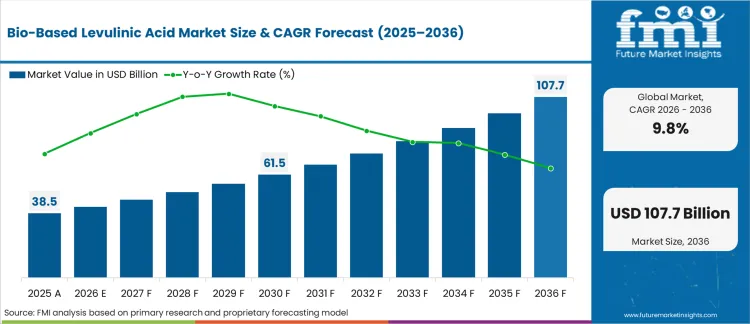
| Metric | Value |
|---|---|
| Expected Value (2026E) | USD 42.3 billion |
| Projected Value (2036F) | USD 107.6 billion |
| CAGR (2026-2036) | 9.8% |
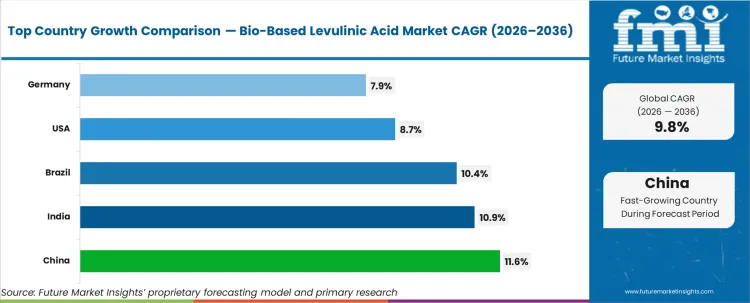
China is projected to lead with a CAGR of 11.6%, supported by state-backed biorefinery capacity expansion and downstream demand from bio-based solvents and plasticizers. India follows at 10.9%, driven by policy support for biomass valorization and ethanol-blending infrastructure that strengthens feedstock ecosystems. Brazil is expected to grow at 10.4%, benefiting from abundant sugarcane residue and integrated biofuel supply chains.
The United States and Germany, at 8.7% and 7.9% respectively, represent mature markets where growth stems largely from replacement demand and portfolio decarbonization mandates. Structural constraints in these markets include higher compliance costs and slower permitting cycles for new bio-based production facilities.
Source: Future Market Insights - analysis driven by proprietary forecasting models and primary research
Bio-Based Levulinic Acid Market Definition
The bio-based levulinic acid market covers the production and sale of levulinic acid made from renewable biomass such as agricultural residues, wood waste, or sugar-based feedstocks instead of petroleum. Levulinic acid is a chemical building block used to manufacture solvents, plasticizers, resins, coatings, fuel additives, and pharmaceutical intermediates. Its primary function is to act as a platform molecule that can be converted into higher-value specialty chemicals. Key end uses include bio-based plastics, crop protection products, and sustainable fuel formulations.
Bio-Based Levulinic Acid Market Inclusions
This report covers global and regional market size estimates for bio-based levulinic acid, with forecasts from 2026 to 2036. It provides detailed segmentation by application, and region, along with country-level growth analysis. The study includes pricing trend assessment, feedstock cost sensitivity analysis, capacity mapping of biorefineries, and trade flow evaluation to understand import-export dynamics and regional supply concentration across major producing and consuming markets.
Bio-Based Levulinic Acid Market Exclusions
The scope excludes petroleum-based levulinic acid and synthetic levulinates unless derived from renewable feedstocks. It also omits downstream finished consumer goods such as packaged bio-plastics, formulated agrochemical products, and retail fuel blends containing levulinic derivatives. Niche laboratory-scale applications and academic research volumes are not included. The report focuses strictly on bio-based levulinic acid and its immediate industrial intermediates, rather than branded end products.
Bio-Based Levulinic Acid Market Research Methodology
- Primary research: FMI analysts conducted structured interviews with biorefinery operators, renewable chemical producers, feedstock aggregators, specialty chemical distributors, and procurement heads in downstream segments such as bio-based solvents, green plasticizers, and bio-based platform chemicals to validate demand patterns and pricing benchmarks.
- Desk research: The study draws on publicly available data from company annual reports, investor presentations, regulatory filings, bioeconomy policy documents, customs trade databases, and standards body publications relevant to biomass valorization chemicals and renewable feedstock supply chains.
- Market-sizing and forecasting: A hybrid model combining bottom-up capacity assessment of operating and announced bio-based production units with top-down validation against downstream consumption of bio-based resins and sustainable fuel additives was used to derive market estimates and ten-year projections.
- Data validation and update cycle: All estimates were cross-verified through triangulation of primary interviews, company disclosures, and trade statistics, with periodic updates aligned to major capacity announcements and policy revisions affecting green solvents and bio-intermediates.
Segment Analysis
Bio-Based Levulinic Acid Market Analysis by Product Type
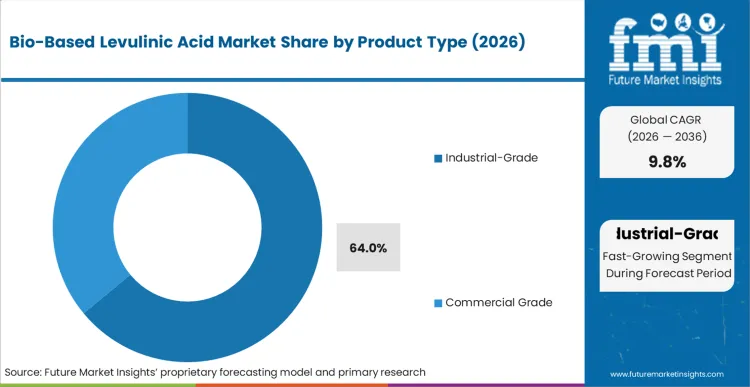
Based on FMI's bio-based levulinic acid market report, consumption of industrial-grade bio-based levulinic acid is estimated to hold a 64% share in 2026. This grade dominates because it balances purity with cost efficiency, making it suitable for large-volume applications such as solvents, plasticizers, and fuel additives. Buyers prefer industrial-grade material as it solves price sensitivity challenges while meeting performance thresholds required for downstream chemical synthesis.
- Capacity Expansion: GFBiochemicals announced expansion of its bio-based levulinic acid production capacity to serve specialty chemical markets, strengthening industrial-scale supply reliability [2]. This investment signals producer confidence in sustained industrial demand.
- Process Optimization: Avantium has continued development of renewable carbon platform technologies aimed at improving biomass-to-chemical conversion yields, reducing cost per ton of bio-based intermediates [3]. Efficiency improvements directly enhance competitiveness of industrial-grade volumes.
- Supply Chain Integration: Several European biorefineries have moved toward integrated biomass sourcing agreements to stabilize feedstock flows amid agricultural residue price volatility [4]. This integration reduces procurement risk for industrial buyers reliant on bulk supply contracts.
Bio-Based Levulinic Acid Market Analysis by Application
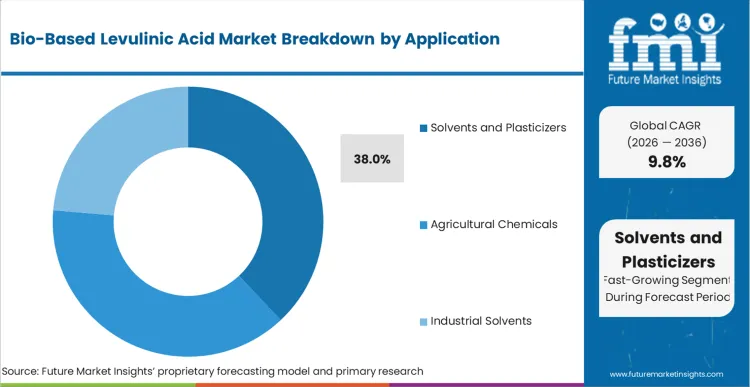
Based on FMI's bio-based levulinic acid market report, consumption in solvents and plasticizers is estimated to hold a 38% share in 2026. This segment leads because levulinic derivatives provide functional performance comparable to petrochemical alternatives while helping downstream manufacturers reduce carbon intensity. It solves compliance pressures faced by coatings and polymer formulators under tightening sustainability disclosure requirements.
- Corporate Investment: Solvay disclosed increased allocation toward renewable and circular feedstock integration within its specialty chemicals portfolio, reinforcing downstream adoption of bio-derived intermediates [5]. Such alignment supports demand from solvent and resin manufacturers.
- Product Launch: GFBiochemicals commercialized levulinic acid derivatives positioned as bio-based replacements for conventional solvents in coatings formulations [6]. These product introductions accelerate substitution in regulated markets.
- Regulatory Pull: The European Union’s Renewable Energy Directive III strengthens demand for bio-based components in industrial supply chains, indirectly benefiting renewable solvent intermediates [7]. Regulatory alignment sustains structural demand in this application.
Bio-Based Levulinic Acid Market Drivers, Restraints, and Opportunities
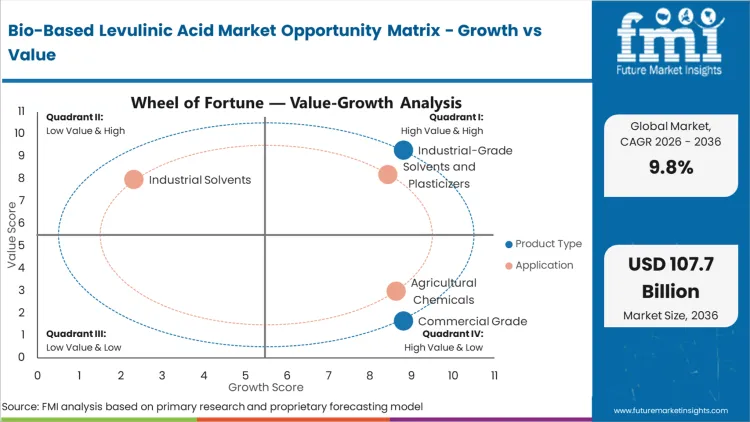
Analysis by FMI indicates that the bio-based levulinic acid market remains in a structured growth phase rather than maturity, anchored in its role as a renewable platform molecule within specialty chemicals. The market exists at its current valuation due to regulatory pressure to decarbonize industrial supply chains, particularly in coatings, plasticizers, and fuel additives. Carbon disclosure mandates, renewable energy targets, and Scope 3 accounting frameworks have forced downstream manufacturers to qualify bio-derived intermediates, sustaining baseline demand despite cost premiums over petrochemical alternatives.
Commodity-grade petrochemical intermediates continue to dominate in price-sensitive applications, limiting substitution in bulk markets. Growth is concentrated in regulated segments such as green solvents and biofuel components where compliance value offsets higher per-ton pricing. While bio-based levulinic acid carries a feedstock and processing premium, volumes are expanding in higher-margin specialty niches; this nets out to steady revenue growth rather than explosive volumetric expansion.
- Regulatory Decarbonization Mandates: The European Union Renewable Energy Directive III and expanding carbon border adjustment mechanisms are increasing scrutiny of fossil-derived inputs. This pushes coatings, agrochemical, and polymer manufacturers to incorporate renewable carbon intermediates, directly supporting demand for bio-based levulinic acid.
- Biorefinery Scale-Up in Asia: China and India are investing in biomass valorization and integrated ethanol infrastructure, improving feedstock availability and lowering marginal production costs. Regional scale advantages are reshaping supply concentration and increasing export competitiveness.
- Feedstock Volatility Exposure: Biomass residues, sugar derivatives, and agricultural waste streams remain subject to seasonal variation and competing biofuel demand. This creates pricing instability that constrains rapid substitution in cost-sensitive applications, reinforcing the need for long-term procurement contracts.
Regional Analysis
The regional assessment covers China, India, Brazil, the United States, and Germany, representing high-growth bioeconomy hubs and mature specialty chemical markets. Geographically, the market is segmented into Asia Pacific, Latin America, North America, and Western Europe to reflect feedstock access, policy frameworks, and downstream industrial demand. The full report provides comparative market attractiveness analysis across these countries and regions.
.webp "Top Country Growth Comparison Bio Based Levulinic Acid Market Cagr (2026 2036)")
| Country | CAGR (2026 to 2036) |
|---|---|
| China | 11.6% |
| India | 10.9% |
| Brazil | 10.4% |
| USA | 8.7% |
| Germany | 7.9% |
Source: Future Market Insights analysis, supported by a proprietary forecasting model and primary research
Asia Pacific Market Analysis
Asia Pacific is the production epicenter and feedstock expansion frontier for biomass-derived intermediates, supported by integrated agro-processing infrastructure and scale efficiencies. China anchors the region through domestic capacity expansion and export positioning, while India acts as a rapidly emerging biorefinery investment hub. Regional players, including GFBiochemicals (commercial presence in Asia) and several state-backed biorefinery ventures, maintain upstream feedstock linkages. The region competes primarily on cost efficiency, localized feedstock aggregation, and supply security rather than premium sustainability positioning alone.
- China: The market for bio-based levulinic acid in China is forecast to register a CAGR of 11.6% through 2036. Policy-backed biomass utilization programs under the 14th Five-Year Plan support growth for Bioeconomy Development, which prioritizes high-value chemical conversion of agricultural residues. China’s advantage lies in abundant crop residues and integrated ethanol infrastructure; however, overcapacity risks and export margin compression remain structural constraints tied to commodity competition.
- India: India is expected to see its bio-based levulinic acid sector grow at a compound annual rate of 10.9% through 2036. The National Bio-Energy Mission and the Ethanol Blended Petrol Programme expansion to higher mandatory blending targets have strengthened biomass collection networks that indirectly support chemical feedstock conversion. Domestic policy alignment rather than export markets drive growth; structural constraints include fragmented residue supply chains and higher capital costs relative to Chinese producers.
The comprehensive FMI report provides an in-depth analysis of the broader Asia Pacific ecosystem, extending beyond China and India to identify highly lucrative opportunities in Southeast Asia. Thailand and Indonesia are rapidly emerging as high-potential biorefinery hubs, leveraging their massive agricultural and palm oil residue availability to attract foreign joint ventures focused on renewable chemical production and downstream bio-plastics manufacturing.
Latin America Market Analysis
Latin America acts as the biomass abundance corridor, leveraging sugarcane-based feedstock and integrated biofuel supply chains. Brazil leads regional adoption due to its established ethanol ecosystem and chemical export base. The competitive landscape includes local ethanol processors and multinational specialty chemical firms evaluating renewable intermediates.
- Brazil: Brazil's bio-based levulinic acid industry is projected to witness growth at a CAGR of 10.4% through 2036. Several sugar and ethanol groups disclosed biomass-to-chemical feasibility initiatives in their annual reports. Brazil’s advantage lies in consistent sugarcane residue supply; however, export dependency and currency volatility can influence capital allocation decisions in specialty chemicals.
The FMI report goes in-depth to evaluate the wider Latin American ecosystem, highlighting that while Brazil dominates volume, countries like Argentina and Colombia remain highly lucrative hubs. Argentina’s vast soybean and corn processing industries provide a robust foundation for biomass valorization, while Colombia is increasingly exploring its sugarcane and palm sectors to diversify into high-value renewable chemicals aimed at sustainable agriculture solutions.
North America Market Analysis
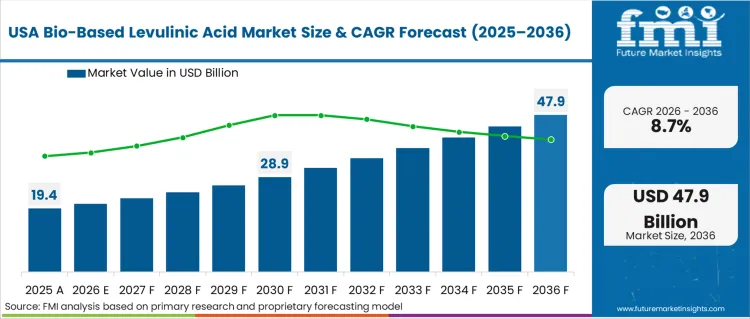
North America operates as the regulated specialty chemicals hub, where sustainability disclosure and corporate carbon commitments shape purchasing decisions. The United States dominates the region with strong specialty chemical infrastructure and ESG-driven procurement strategies. Key participants include specialty chemical producers integrating renewable feedstocks into portfolio diversification strategies.
- United States: Sales of bio-based levulinic acid products in the USA are on track to record a CAGR of 8.7% through 2036. The Inflation Reduction Act includes tax incentives for clean energy and bio-manufacturing investments, indirectly supporting renewable chemical pathways. Corporate disclosures from specialty chemical manufacturers emphasize Scope 3 emission reduction targets, reinforcing renewable intermediate sourcing. Growth remains steady but moderate due to higher compliance costs and longer permitting timelines for new bio-based facilities.
FMI’s extensive report gets in-depth on the broader North American landscape by analyzing additional high-potential markets like Canada and Mexico. Canada represents a highly lucrative hub driven by its immense forestry sector, with government-backed initiatives incentivizing the conversion of wood residues into bio-based chemicals. Concurrently, Mexico possesses highly favorable agricultural supply chains, positioning it as an emerging nearshoring hub for bio-based intermediates supplying the broader North American manufacturing base.
Europe Market Analysis
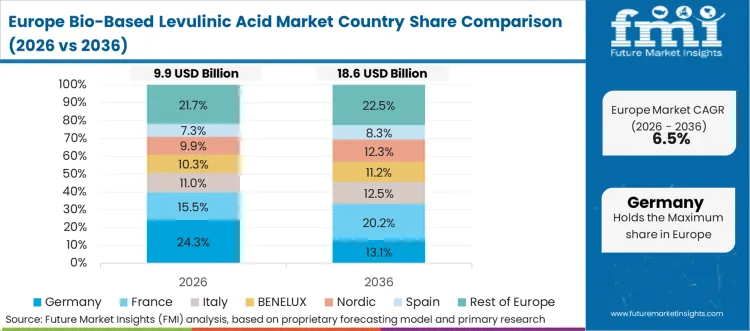
Europe functions as the global regulatory laboratory for renewable chemicals, where policy frameworks accelerate fossil substitution. Germany leads regional demand, supported by advanced chemical manufacturing and carbon reduction mandates. Producers compete on sustainability certification, traceability, and compliance rather than price alone.
- Germany: Over the forecast period, bio-based levulinic acid in Germany is set for a CAGR of 7.9% through 2036. The German Federal Climate Protection Act amendments strengthen sectoral emission reduction pathways, encouraging renewable chemical integration in industrial processes. European Union’s Renewable Energy Directive III implementation across member states reinforces renewable feedstock adoption in industrial supply chains. German specialty chemical companies reported sustainability-linked capital investments, focusing on renewable carbon integration. While demand remains stable, structural constraints include high energy costs and complex permitting requirements compared to Asian production bases.
FMI latest report provides an in-depth look at the wider European market, analyzing lucrative hubs outside of Germany. The Netherlands serves as a critical biorefining and logistics anchor, utilizing its world-class port infrastructure to import and process advanced bio-feedstocks. Additionally, France is recognized as a potential hub experiencing a rise in specialized biomass conversion, heavily supported by national agricultural policies pushing for the valorization of local farming residues into green specialty chemicals.
Competitive Aligners for Market Players
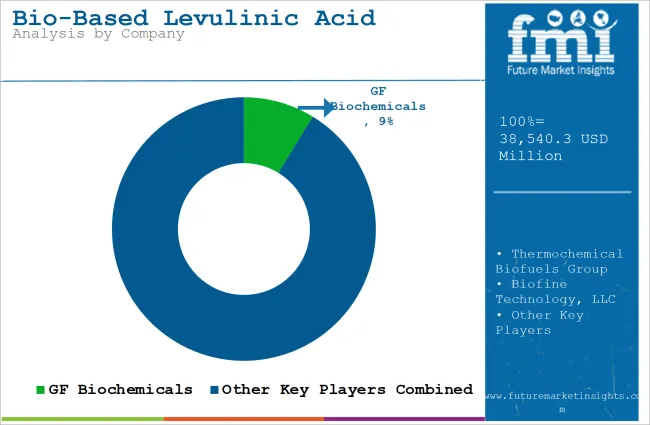
The competitive landscape for bio-based levulinic acid remains highly concentrated at the supply end, with one scaled specialist producer and a long tail of smaller chemical manufacturers supplying limited volumes or derivatives. In practice, most commercial supply is controlled by a small set of players with established process know-how and qualifying histories with downstream formulators. The primary competitive variable is delivered cost-to-performance because buyers benchmark levulinic acid against petro-based solvents/intermediates and will only switch when performance is comparable and compliance value offsets the premium.
Companies with structural advantages are those that can combine proprietary conversion technology with secure biomass sourcing and repeatable quality control at scale. Players with access to captive or contracted feedstock streams such as agri-residues, sugar-based intermediates, or multi-feedstock configurations are better positioned to dampen seasonal volatility and offer steadier contract pricing. Those with established downstream derivative portfolios (also widen addressable demand beyond the acid itself, improving plant utilization and customer stickiness.
Buyer behavior is increasingly procurement-led and risk-managed. Large customers in coatings, cleaning, agrochemicals, and additives typically qualify multiple suppliers to avoid dependency risk, and they prefer multi-year contracts with indexation tied to biomass, energy, and freight variables. This reduces supplier pricing power in commoditized applications, while enabling selective premium pricing only where customers need renewable-carbon content for compliance, labeling, or Scope 3 reporting.
Recent Developments
- In February 2026, GFBiochemicals formally announced the launch of RE:CHEMISTRY, describing it as a plant-based technology platform leveraging levulinic-acid/levulinate chemistry and emphasizing scale-up and commercialization for safer everyday-product ingredients.
- Bio Base Europe Pilot Plant (BBEPP) commissioned a 75,000 L fermenter (November 2024) to expand scale-up and demonstration capability for bio-based products, improving the commercialization pathway for biomass-derived chemical intermediates.
Key Players Profiled
- GFBiochemicals Ltd
- Godavari Biorefineries Limited
- Avantium N.V.
- Segetis, Inc.
- Hebei Xinhua Chemical Co., Ltd.
- Tokyo Chemical Industry Co., Ltd.
- Merck KGaA
- Simagchem Corporation
Scope of the Report
| Metric | Value |
|---|---|
| Quantitative Units | 2026: USD 42.3 Billion 2036: USD 107.6 Billion CAGR (2026-2036): 9.8% |
| Market Definition | Production and commercialization of levulinic acid derived from renewable biomass feedstocks for use as a chemical intermediate in solvents, plasticizers, resins, fuel additives, agrochemicals, and pharmaceutical precursors. |
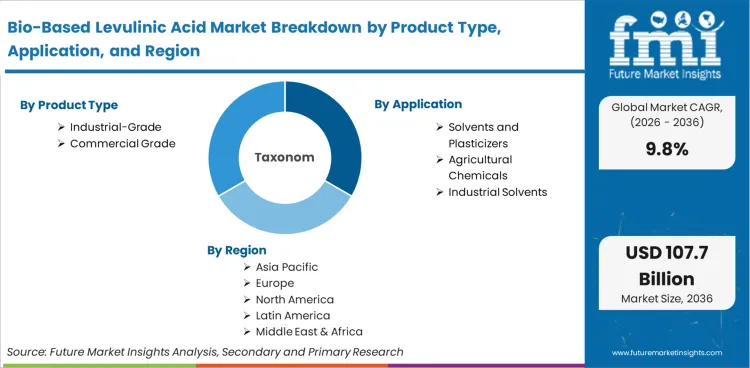
| Application Segmentation | Solvents & Plasticizers; Fuel Additives; Agrochemicals; Pharmaceuticals & Intermediates; Resins & Coatings; Others |
| Regions Covered | East Asia; South Asia; Latin America; North America; Western Europe |
| Countries Covered | China; India; Brazil; United States; Germany |
| Key Companies Profiled | GFBiochemicals Ltd; Godavari Biorefineries Limited; Avantium N.V.; Segetis, Inc.; Hebei Xinhua Chemical Co., Ltd.; Tokyo Chemical Industry Co., Ltd.; Merck KGaA; Simagchem Corporation |
| Forecast Period | 2026 to 2036 |
| Approach | Hybrid forecasting model combining bottom-up capacity assessment with top-down demand validation through primary interviews, company disclosures, trade data triangulation, and policy impact modeling. |
Bio-Based Levulinic Acid Market Analysis by Segments
Product Type:
- Commercial Grade
- Industrial Grade
Application:
- Pharmaceuticals & Cosmetics
- Agricultural Chemicals
- Food & Beverages
- Biofuels
- Industrial Solvents
- Others
Region:
- North America
- Latin America
- Western Europe
- Eastern Europe
- East Asia
- South Asia
- Oceania
- Middle East & Africa
Bibliography
- [1] Solvay. (March 2023). Solvay’s 2030 climate targets approved by SBTi.
- [2] GFBiochemicals. Company press release on capacity expansion initiatives, 2023.
- [3] Avantium N.V. Annual Report 2023, renewable carbon technology development section.
- [4] European Biorefinery Association publications on biomass sourcing agreements, 2023-2024.
- [5] Solvay Integrated Annual Report 2023, sustainable portfolio strategy section.
- [6] GFBiochemicals product announcement on levulinic derivatives commercialization, 2023.
- [7] European Commission. Renewable Energy Directive (RED III) adoption update, 2023.
- [8] Agilent Technologies. (2024, January 16). Agilent announces new ProteoAnalyzer system: Automated parallel capillary electrophoresis system simplifies protein analysis.
- [9] Bio-Rad Laboratories. (2024, July 1). Bio-Rad launches ChemiDoc Go Imaging System for highly sensitive benchtop gel and western blot imaging.
- [10] Helena Biosciences. (2025, September 23-25). IBMS Biomedical Science Congress 2025: Official UK launch of V8 UltraCE
This bibliography is provided for reader reference and is not exhaustive. The full report contains the complete reference list and detailed citations.
This Report Addresses
- Market intelligence to enable structured strategic decision-making across mature and emerging bio-based levulinic acid markets.
- Market size estimation and 10-year revenue forecasts from 2026 to 2036, supported by validated biorefinery project data and end-use sector growth analysis.
- Growth opportunity mapping across applications with emphasis on pharmaceutical intermediates and agricultural chemical derivatives.
- Segment and regional revenue forecasts covering pharmaceuticals, agriculture, biofuels, and industrial solvent applications.
- Competition strategy assessment including production technology, application development capability, and sustainability certification.
- Regulatory impact analysis covering REACH, EPA Safer Choice, and green chemistry initiatives.
- Market report delivery in PDF, Excel, PPT, and interactive dashboard formats for executive and operational use.
Frequently Asked Questions
How large is the bio-based levulinic acid market today?
In 2025, the bio-based levulinic acid market was valued at USD 38.5 billion.
What will the market size be in 2026?
Demand is estimated to reach USD 42.3 billion in 2026.
What is the projected market value by 2036?
The market is forecast to reach USD 107.6 billion by 2036.
What is the expected CAGR during the forecast period?
FMI projects a CAGR of 9.8% during the forecast period.
How much absolute growth will the market generate between 2025 and 2035?
The market expands from USD 38.5 billion in 2025 to USD 97.9 billion in 2035, creating substantial incremental value.
Is the growth outlook steady or volatile?
With a 9.8% CAGR and growth from USD 42.3 billion in 2026 to USD 107.6 billion in 2036, the outlook reflects steady structural expansion.
What does the 2026 to 2036 expansion indicate for investors?
An increase from USD 42.3 billion in 2026 to USD 107.6 billion in 2036 signals long-term capacity expansion potential.
How significant is the projected 2036 valuation?
Reaching USD 107.6 billion by 2036 positions the market among high-growth renewable chemical platforms.
What scale of opportunity exists at the start of the forecast period?
The opportunity base begins at USD 42.3 billion in 2026.
How large was the market before entering the forecast window?
In 2025, the market stood at USD 38.5 billion.
Does the CAGR support double-digit expansion?
Yes, the projected CAGR is 9.8%, reflecting near double-digit annual growth.
What revenue potential exists over the next decade?
Growth from USD 42.3 billion in 2026 to USD 107.6 billion in 2036 highlights strong long-term revenue potential.
How rapidly is the market scaling after 2025?
The market moves from USD 38.5 billion in 2025 to USD 42.3 billion in 2026, reflecting continued acceleration.
What valuation milestone defines the end of the forecast period?
The market reaches USD 107.6 billion by 2036.
How does the 2036 outlook compare with 2025 levels?
The market expands from USD 38.5 billion in 2025 to USD 107.6 billion in 2036.
Is the growth trajectory linear or compounding?
With a CAGR of 9.8%, the expansion from USD 42.3 billion in 2026 to USD 107.6 billion in 2036 reflects compounded growth.
What baseline should procurement teams consider for 2026 planning?
Procurement strategies should benchmark against a USD 42.3 billion market size in 2026.
What is the headline forecast for executive dashboards?
USD 42.3 billion in 2026 growing to USD 107.6 billion by 2036 at a 9.8% CAGR.
Preview the report firsthand - request a free sample
Get SampleGet the brochure for pricing and purchase details.
Get PDFTable of Content
- Executive Summary
- Global Market Outlook
- Demand-side Trends
- Supply-side Trends
- Technology Roadmap Analysis
- Analysis and Recommendations
- Market Overview
- Market Coverage / Taxonomy
- Market Definition / Scope / Limitations
- Research Methodology
- Chapter Orientation
- Analytical Lens and Working Hypotheses
- Market Structure, Signals, and Trend Drivers
- Research Design and Evidence Framework
- Desk Research Programme (Secondary Evidence)
- Company Annual and Sustainability Reports
- Peer-reviewed Journals and Academic Literature
- Corporate Websites, Product Literature, and Technical Notes
- Earnings Decks and Investor Briefings
- Statutory Filings and Regulatory Disclosures
- Technical White Papers and Standards Notes
- Trade Journals, Industry Magazines, and Analyst Briefs
- Conference Proceedings, Webinars, and Seminar Materials
- Government Statistics Portals and Public Data Releases
- Press Releases and Reputable Media Coverage
- Specialist Newsletters and Curated Briefings
- Sector Databases and Reference Repositories
- FMI Internal Proprietary Databases and Historical Market Datasets
- Subscription Datasets and Paid Sources
- Social Channels, Communities, and Digital Listening Inputs
- Additional Desk Sources
- Expert Input and Fieldwork (Primary Evidence)
- Primary Modes
- Qualitative Interviews and Expert Elicitation
- Quantitative Surveys and Structured Data Capture
- Blended Approach
- Why Primary Evidence is Used
- Field Techniques
- Interviews
- Surveys
- Focus Groups
- Observational and In-context Research
- Social and Community Interactions
- Stakeholder Universe Engaged
- C-suite Leaders
- Board Members
- Presidents and Vice Presidents
- R&D and Innovation Heads
- Technical Specialists
- Domain Subject-matter Experts
- Scientists
- Physicians and Other Healthcare Professionals
- Governance, Ethics, and Data Stewardship
- Research Ethics
- Data Integrity and Handling
- Primary Modes
- Tooling, Models, and Reference Databases
- Desk Research Programme (Secondary Evidence)
- Data Engineering and Model Build
- Data Acquisition and Ingestion
- Cleaning, Normalisation, and Verification
- Synthesis, Triangulation, and Analysis
- Quality Assurance and Audit Trail
- Market Background
- Market Dynamics
- Drivers
- Restraints
- Opportunity
- Trends
- Scenario Forecast
- Demand in Optimistic Scenario
- Demand in Likely Scenario
- Demand in Conservative Scenario
- Opportunity Map Analysis
- Product Life Cycle Analysis
- Supply Chain Analysis
- Investment Feasibility Matrix
- Value Chain Analysis
- PESTLE and Porter’s Analysis
- Regulatory Landscape
- Regional Parent Market Outlook
- Production and Consumption Statistics
- Import and Export Statistics
- Market Dynamics
- Global Market Analysis 2021 to 2025 and Forecast, 2026 to 2036
- Historical Market Size Value (USD Million) Analysis, 2021 to 2025
- Current and Future Market Size Value (USD Million) Projections, 2026 to 2036
- Y-o-Y Growth Trend Analysis
- Absolute $ Opportunity Analysis
- Global Market Pricing Analysis 2021 to 2025 and Forecast 2026 to 2036
- Global Market Analysis 2021 to 2025 and Forecast 2026 to 2036, By Product Type
- Introduction / Key Findings
- Historical Market Size Value (USD Million) Analysis By Product Type , 2021 to 2025
- Current and Future Market Size Value (USD Million) Analysis and Forecast By Product Type , 2026 to 2036
- Industrial-Grade
- Commercial Grade
- Industrial-Grade
- Y-o-Y Growth Trend Analysis By Product Type , 2021 to 2025
- Absolute $ Opportunity Analysis By Product Type , 2026 to 2036
- Global Market Analysis 2021 to 2025 and Forecast 2026 to 2036, By Application
- Introduction / Key Findings
- Historical Market Size Value (USD Million) Analysis By Application, 2021 to 2025
- Current and Future Market Size Value (USD Million) Analysis and Forecast By Application, 2026 to 2036
- Solvents and Plasticizers
- Agricultural Chemicals
- Industrial Solvents
- Solvents and Plasticizers
- Y-o-Y Growth Trend Analysis By Application, 2021 to 2025
- Absolute $ Opportunity Analysis By Application, 2026 to 2036
- Global Market Analysis 2021 to 2025 and Forecast 2026 to 2036, By Region
- Introduction
- Historical Market Size Value (USD Million) Analysis By Region, 2021 to 2025
- Current Market Size Value (USD Million) Analysis and Forecast By Region, 2026 to 2036
- North America
- Latin America
- Western Europe
- Eastern Europe
- East Asia
- South Asia and Pacific
- Middle East & Africa
- Market Attractiveness Analysis By Region
- North America Market Analysis 2021 to 2025 and Forecast 2026 to 2036, By Country
- Historical Market Size Value (USD Million) Trend Analysis By Market Taxonomy, 2021 to 2025
- Market Size Value (USD Million) Forecast By Market Taxonomy, 2026 to 2036
- By Country
- USA
- Canada
- Mexico
- By Product Type
- By Application
- By Country
- Market Attractiveness Analysis
- By Country
- By Product Type
- By Application
- Key Takeaways
- Latin America Market Analysis 2021 to 2025 and Forecast 2026 to 2036, By Country
- Historical Market Size Value (USD Million) Trend Analysis By Market Taxonomy, 2021 to 2025
- Market Size Value (USD Million) Forecast By Market Taxonomy, 2026 to 2036
- By Country
- Brazil
- Chile
- Rest of Latin America
- By Product Type
- By Application
- By Country
- Market Attractiveness Analysis
- By Country
- By Product Type
- By Application
- Key Takeaways
- Western Europe Market Analysis 2021 to 2025 and Forecast 2026 to 2036, By Country
- Historical Market Size Value (USD Million) Trend Analysis By Market Taxonomy, 2021 to 2025
- Market Size Value (USD Million) Forecast By Market Taxonomy, 2026 to 2036
- By Country
- Germany
- UK
- Italy
- Spain
- France
- Nordic
- BENELUX
- Rest of Western Europe
- By Product Type
- By Application
- By Country
- Market Attractiveness Analysis
- By Country
- By Product Type
- By Application
- Key Takeaways
- Eastern Europe Market Analysis 2021 to 2025 and Forecast 2026 to 2036, By Country
- Historical Market Size Value (USD Million) Trend Analysis By Market Taxonomy, 2021 to 2025
- Market Size Value (USD Million) Forecast By Market Taxonomy, 2026 to 2036
- By Country
- Russia
- Poland
- Hungary
- Balkan & Baltic
- Rest of Eastern Europe
- By Product Type
- By Application
- By Country
- Market Attractiveness Analysis
- By Country
- By Product Type
- By Application
- Key Takeaways
- East Asia Market Analysis 2021 to 2025 and Forecast 2026 to 2036, By Country
- Historical Market Size Value (USD Million) Trend Analysis By Market Taxonomy, 2021 to 2025
- Market Size Value (USD Million) Forecast By Market Taxonomy, 2026 to 2036
- By Country
- China
- Japan
- South Korea
- By Product Type
- By Application
- By Country
- Market Attractiveness Analysis
- By Country
- By Product Type
- By Application
- Key Takeaways
- South Asia and Pacific Market Analysis 2021 to 2025 and Forecast 2026 to 2036, By Country
- Historical Market Size Value (USD Million) Trend Analysis By Market Taxonomy, 2021 to 2025
- Market Size Value (USD Million) Forecast By Market Taxonomy, 2026 to 2036
- By Country
- India
- ASEAN
- Australia & New Zealand
- Rest of South Asia and Pacific
- By Product Type
- By Application
- By Country
- Market Attractiveness Analysis
- By Country
- By Product Type
- By Application
- Key Takeaways
- Middle East & Africa Market Analysis 2021 to 2025 and Forecast 2026 to 2036, By Country
- Historical Market Size Value (USD Million) Trend Analysis By Market Taxonomy, 2021 to 2025
- Market Size Value (USD Million) Forecast By Market Taxonomy, 2026 to 2036
- By Country
- Kingdom of Saudi Arabia
- Other GCC Countries
- Turkiye
- South Africa
- Other African Union
- Rest of Middle East & Africa
- By Product Type
- By Application
- By Country
- Market Attractiveness Analysis
- By Country
- By Product Type
- By Application
- Key Takeaways
- Key Countries Market Analysis
- USA
- Pricing Analysis
- Market Share Analysis, 2025
- By Product Type
- By Application
- Canada
- Pricing Analysis
- Market Share Analysis, 2025
- By Product Type
- By Application
- Mexico
- Pricing Analysis
- Market Share Analysis, 2025
- By Product Type
- By Application
- Brazil
- Pricing Analysis
- Market Share Analysis, 2025
- By Product Type
- By Application
- Chile
- Pricing Analysis
- Market Share Analysis, 2025
- By Product Type
- By Application
- Germany
- Pricing Analysis
- Market Share Analysis, 2025
- By Product Type
- By Application
- UK
- Pricing Analysis
- Market Share Analysis, 2025
- By Product Type
- By Application
- Italy
- Pricing Analysis
- Market Share Analysis, 2025
- By Product Type
- By Application
- Spain
- Pricing Analysis
- Market Share Analysis, 2025
- By Product Type
- By Application
- France
- Pricing Analysis
- Market Share Analysis, 2025
- By Product Type
- By Application
- India
- Pricing Analysis
- Market Share Analysis, 2025
- By Product Type
- By Application
- ASEAN
- Pricing Analysis
- Market Share Analysis, 2025
- By Product Type
- By Application
- Australia & New Zealand
- Pricing Analysis
- Market Share Analysis, 2025
- By Product Type
- By Application
- China
- Pricing Analysis
- Market Share Analysis, 2025
- By Product Type
- By Application
- Japan
- Pricing Analysis
- Market Share Analysis, 2025
- By Product Type
- By Application
- South Korea
- Pricing Analysis
- Market Share Analysis, 2025
- By Product Type
- By Application
- Russia
- Pricing Analysis
- Market Share Analysis, 2025
- By Product Type
- By Application
- Poland
- Pricing Analysis
- Market Share Analysis, 2025
- By Product Type
- By Application
- Hungary
- Pricing Analysis
- Market Share Analysis, 2025
- By Product Type
- By Application
- Kingdom of Saudi Arabia
- Pricing Analysis
- Market Share Analysis, 2025
- By Product Type
- By Application
- Turkiye
- Pricing Analysis
- Market Share Analysis, 2025
- By Product Type
- By Application
- South Africa
- Pricing Analysis
- Market Share Analysis, 2025
- By Product Type
- By Application
- USA
- Market Structure Analysis
- Competition Dashboard
- Competition Benchmarking
- Market Share Analysis of Top Players
- By Regional
- By Product Type
- By Application
- Competition Analysis
- Competition Deep Dive
- GFBiochemicals Ltd
- Overview
- Product Portfolio
- Profitability by Market Segments (Product/Age /Sales Channel/Region)
- Sales Footprint
- Strategy Overview
- Marketing Strategy
- Product Strategy
- Channel Strategy
- Godavari Biorefineries Limited
- Avantium N.V.
- Segetis, Inc.
- Hebei Xinhua Chemical Co., Ltd.
- Tokyo Chemical Industry Co., Ltd.
- Merck KGaA
- GFBiochemicals Ltd
- Competition Deep Dive
- Assumptions & Acronyms Used


