

- Market Size (2026)
- USD 6.6 Bn
- Forecast (2036)
- USD 11.3 Bn
- CAGR (2026 to 2036)
- 5.5%
How Big is the Acoustic Liners Market in 2026?
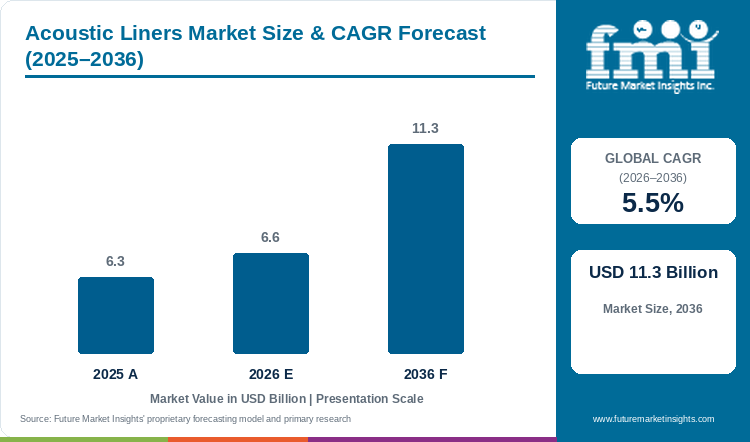
Acoustic liner sales are set at USD 6.6 Billion in 2026, against USD 6.3 Billion in 2025, and will reach USD 11.3 Billion by 2036 at a 5.5% CAGR.
Acoustic liners market size is projected to reach USD 11.3 Billion by 2036, at 5.5% CAGR, as per FMI. Value moves from USD 6.3 Billion in 2025 to USD 6.6 Billion in 2026 on the market size chart, adding USD 4.7 Billion by 2036. Key drivers of the acoustic liners market include higher engine output, as Safran delivered more than 1,800 LEAP engines in 2025, up 28% from 2024, and expect deliveries to grow about 15% in 2026 [1]. Sales of acoustic liners are highest in aircraft engines and nacelles, at 44% of demand by end use in 2026, as each new engine needs a full liner set.
Aircraft and nacelle OEMs will account for 42% of orders for acoustic liners in 2026, according to FMI, with repair shops and industrial buyers placing most remaining orders. Revenue from liner repair is increasing, as Safran said in January 2026 that the AMES repair venture will add 40% more workshop space in 2027 than in 2025 [2]. Key trends in the acoustic liners market point to engine deliveries driving most new orders through 2036, with repair shops adding orders from the in-service fleet.
Key Takeaways
- Leading companies in the acoustic liners market include Safran Nacelles, Collins Aerospace, Spirit AeroSystems, FACC, GKN Aerospace, Hexcel and The Gill Corporation.
- Based on liner type, aircraft nacelle liners are projected to account for 36% in 2026, as noise certification applies to every jet and large turboprop nacelle.
- In 2026, Nomex honeycomb is estimated to hold 31% by material, since low-density aramid cells can be tuned to perforated panels.
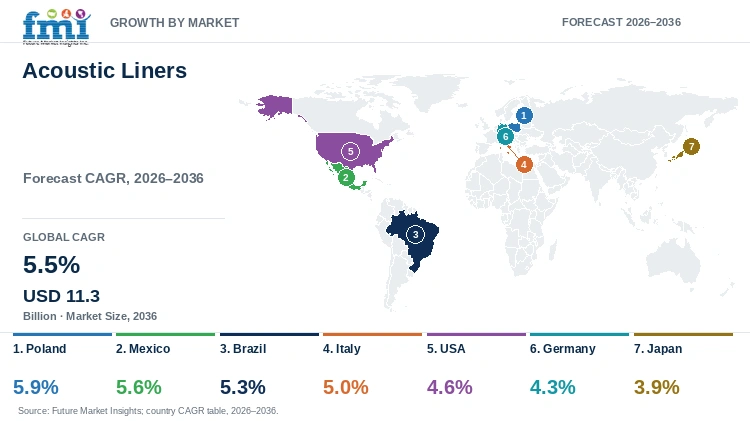
- Poland is projected at 5.9% CAGR through 2036, followed by Mexico at 5.6%, as both countries add aerospace production for European and North American programs.
Analyst Perspective
“Over the next ten years, I expect new high-bypass engines to leave less nacelle surface for acoustic treatment, due to which attenuation per kilogram will become the main buying measure. Engine and nacelle programs, at 44% of demand in 2026, will stay the largest source of orders as the LEAP ramp continues, and suppliers in Poland and Mexico, growing at 5.9% and 5.6% CAGR through 2036, will take a larger part of new panel work as production moves closer to engine and aerostructure lines.”
- Nikhil Kaitwade, Principal Consultant, Future Market Insights
How is the Acoustic Liners Market Segmented?
The acoustic liners market is divided into liner type, material, end use, sales channel, application and region.
As per FMI, the market is segregated by liner type into aircraft nacelle liners, duct acoustic liners, panel acoustic liners, honeycomb liners and perforated composite liners. By material, the market is divided into Nomex honeycomb, carbon composite, glass fiber composite, aluminum honeycomb, foam and fiber laminates. End use is tracked across aircraft engines and nacelles, HVAC ducts, industrial silencers, rail and transport, and marine engine rooms. Sales channels covered in the study include aircraft and nacelle OEMs, acoustic system suppliers, MRO and retrofit, and industrial distributors. By application, the market is split into noise attenuation, flow duct lining, fan and engine noise control, and cabin and space acoustic comfort. Regional analysis covers seven regions and more than 30 countries.
Why Do Aircraft Nacelle Liners Lead the Acoustic Liners Market by Liner Type?
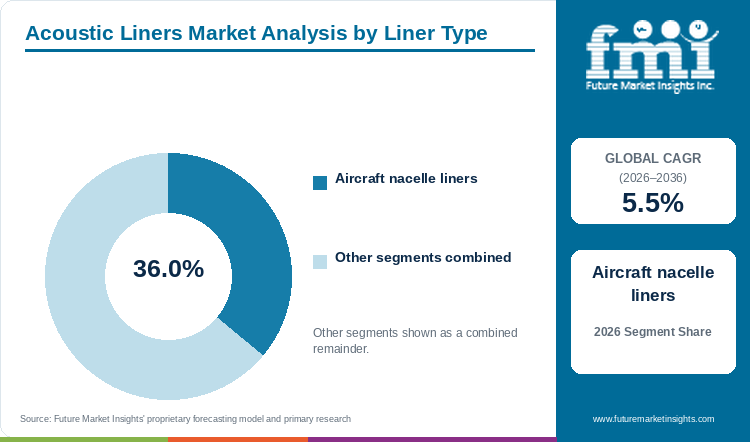
Based on liner type, aircraft nacelle liners will account for 36% of market share in 2026.
Aircraft nacelle liners are projected to capture the largest share of the liner type category, at 36% of demand in 2026. Demand is driven by engine programs ordering a complete liner set with every new engine, at a higher value per installation than any other buyer group. Demand for duct, panel, honeycomb and perforated composite liners will be slower, as HVAC, rail and industrial buyers order only when a building or plant project starts.
- Aircraft nacelle liners are projected to account for 36% of demand by liner type in 2026. Demand is driven by every new engine shipping with a full liner set.
- Airbus inaugurated a new A320 Family final assembly line in Toulouse in June 2026, adding nacelle demand on the highest-volume single-aisle program [3].
Why Does Nomex Honeycomb Lead the Acoustic Liners Market by Material?
In 2026, Nomex honeycomb will account for 31% of market share by material.
Nomex honeycomb is leading the material category with 31% of demand in 2026, as aircraft and nacelle makers seldom change an approved material once an engine program is running. Adoption of carbon composite, glass fiber, aluminum honeycomb and foam laminates will be slower, since rail, marine and industrial buyers choose these mainly on price and in small project volumes.
- Nomex honeycomb is estimated to hold 31% of demand by material in 2026, owing to approved use on running engine programs.
- In June 2025, Hexcel signed a five-year agreement with Kongsberg covering HexWeb engineered honeycombs and HexPly prepregs [4].
Why Do Aircraft Engines and Nacelles Lead the Acoustic Liners Market by End Use?
By end use, aircraft engines and nacelles will account for 44% of market share in 2026.
Aircraft engines and nacelles will dominate end use with 44% of demand in 2026. Demand is driven by rising engine deliveries, which create the largest and most regular stream of liner orders. Sales of liners for HVAC ducts and industrial silencers will grow more slowly, as these orders follow construction starts and plant upgrades. Rail and marine buyers order mainly at fleet renewal, which comes years apart.
- Aircraft engines and nacelles are projected to account for 44% of demand by end use in 2026. Sales are driven by rising engine deliveries, as each delivery adds a new liner order.
- JAXA reported in May 2025 that ultra-high-bypass engines leave a smaller sound-absorbing liner area than conventional engines [5].
Why Do Aircraft and Nacelle OEMs Lead the Acoustic Liners Market by Sales Channel?
Based on sales channel, aircraft and nacelle OEMs will account for 42% of market share in 2026.
Aircraft and nacelle OEMs account for the largest share of the sales channel category, placing 42% of liner orders in 2026. Adoption of the OEM channel is due to buyers preferring one source for liners across the full production life of each engine. Demand through system suppliers, MRO and retrofit shops and industrial distributors will be slower, as these buyers order replacement panels only after damage or wear.
- Aircraft and nacelle OEMs are expected to place 42% of liner orders in 2026, as program owners keep liner sourcing for the life of each engine.
- Boeing completed the acquisition of Spirit AeroSystems in December 2025, bringing Spirit's commercial and aftermarket operations into Boeing [6].
Why Does Noise Attenuation Lead the Acoustic Liners Market by Application?
In 2026, noise attenuation will account for 39% of market share by application.
Noise attenuation is expected to hold the top position in the application category with 39% of demand in 2026, as airports, building codes and workplace rules set noise limits buyers have to meet. Demand for flow duct lining, fan and engine noise control and cabin comfort will be slower, since buyers fund these only on new aircraft programs or premium building projects.
- Noise attenuation is projected to account for 39% of demand by application in 2026. Adoption is driven by tighter noise limits at airports and in buildings.
- In June 2025, the Dutch regulator ACM allowed Schiphol to charge more for the noisiest aircraft categories and less for quieter ones, to encourage airlines to fly quieter aircraft [7].
What are the Drivers, Restraints, and Opportunities in the Acoustic Liners Market?
Key drivers of the acoustic liners market include rising engine output and noise certification, according to FMI. Key challenges in the acoustic liners market include long qualification cycles, and sales potential is expected to emerge from compact liners for high-bypass engines through 2036.
- Driver: Among other drivers, higher engine deliveries will lead to massive sales of acoustic liners, as each new engine needs a certified liner set for the inlet, fan duct and thrust reverser.
- Restraint: Key challenges faced by manufacturers include long qualification cycles, as each new liner has to prove attenuation without extra weight, drag, pressure loss or repair problems.
- Opportunity: Sales potential is expected to emerge from compact liners for high-bypass engines, as new engines leave less liner area and need more attenuation from each panel.
Demand for replacement liner panels is increasing as more engines enter service each year. Airlines send damaged inlet and fan duct panels to approved repair shops, and each repair needs certified liner data from the original program. Core material supply is also expanding, as the honeycomb core materials market is projected to grow from USD 3.5 Billion in 2025 to USD 7.6 Billion by 2035 at 8% CAGR. Repair shops holding approved liner data are expected to receive a larger share of replacement panel orders through 2036.
Weight and qualification form the main challenges in the market, as an extra noise panel adds mass and fuel burn to an aircraft. Nacelle liners also face airflow, moisture and erosion in service. Buyers ask for production parts and repair methods that hold the approved acoustic performance over the life of the engine. Core supply is widening, as the aramid honeycomb core material market is projected at 12.6% CAGR through 2035 and the honeycomb aluminum foil market at 3.9% CAGR. Suppliers with long test records on running programs face fewer delays at approval.
Which Country CAGRs are Profiled in the Acoustic Liners Market?
| Country | CAGR, 2026 to 2036 |
|---|---|
| Poland | 5.9% |
| Mexico | 5.6% |
| Brazil | 5.3% |
| Italy | 5% |
| USA | 4.6% |
| Germany | 4.3% |
| Japan | 3.9% |
How do Country-level CAGRs Compare in the Acoustic Liners Market?
FMI's analysis points to a clear split between emerging aerospace hubs and mature markets. The country CAGR chart sorts the seven profiled countries into three growth bands, with Poland at the top and Japan at the bottom. Demand in Poland and Mexico is projected to grow fastest during the forecast period, at 5.9% and 5.6% CAGR, as both countries are adding engine part and aerostructure plants for programs in the aircraft nacelle market. Brazil and Italy are expected to follow at 5.3% and 5% through 2036, with growth coming from Embraer programs and European supply chain investment. Demand in the USA will be driven by the largest OEM and MRO base, though a mature fleet is expected to hold growth to 4.6%. Germany, at 4.3%, and Japan, at 3.9%, will grow slowest by 2036, as buyers in both countries focus on research-led compact liners for existing programs. New engine options are expected to add work across all seven countries, as the composite pylon fairing systems for new engine options market is projected at 6.8% CAGR through 2036. Mature bases in the USA and Germany will still generate larger liner revenue, as Poland and Mexico grow from smaller program bases.
- Poland is set to post the fastest growth in the group at 5.9% CAGR through 2036. Demand is driven by the Aviation Valley cluster taking on more nacelle and aerostructure work for European programs.
- Safran engine part plants are pulling liner demand closer to North American programs, putting Mexico second at 5.6% during the forecast period.
- Brazil is expected to grow at 5.3% CAGR through 2036. Sales are driven by rising Embraer commercial and executive jet output, which keeps Brazil ahead of Italy.
- European supply chain investment in aerospace is expected to push demand for acoustic liners in Italy up by 5% a year through 2036.
- Growth in the USA is projected at 4.6% CAGR through 2036, slower than the emerging hubs. Demand will be driven by the largest OEM and MRO base, with replacement orders adding to serial production.
- At 4.3% CAGR through 2036, Germany will grow on steady A320 family output from the Hamburg final assembly lines.
- Japan is expected to record the slowest growth at 3.9% during the forecast period, as buyers adopt new liners mainly through engine research programs on compact designs.
CAGR estimates for more than 30 national and grouped markets across seven regions are available in the full report.
Country Outlook
- Poland's Aviation Valley groups 193 entities with more than 35,000 staff and 90% of the sector's output [8]. Such a dense cluster gives nacelle and aerostructure buyers short supply routes, due to which panel makers inside the cluster are receiving more European program work. As a result, demand for acoustic liners in Poland is projected to grow at 5.9% CAGR through 2036, the fastest among the profiled countries.
- Sales of acoustic liners in Mexico are projected to rise at 5.6% CAGR through 2036. Safran runs 20 sites in the country with more than 15,000 employees, including parts for CFM56 and LEAP engines [9]. This engine base is expected to pull liner qualification closer to Mexican plants and shorten delivery routes for North American programs.
- Key drivers of demand for acoustic liners in Brazil include regional and business jet output. Embraer delivered 78 commercial jets and 155 executive jets in 2025 [10]. Each program needs liners in different cabin and nacelle sizes, and suppliers approved on several Embraer programs will receive repeat orders as Brazil grows at 5.3% CAGR through 2036.
- Adoption of acoustic liners in Italy is expected to grow at 5% CAGR during the forecast period, supported by European aerospace supply chain investment. Italian suppliers buy through European program structures with strict traceability rules, so each order requires full lot records and approved materials. Panel makers aligned with Tier 1 purchase cycles are expected to receive more orders.
- Ownership changes are reshaping liner sourcing in the USA. Boeing completed the acquisition of Spirit AeroSystems in December 2025, adding commercial and aftermarket operations in Wichita, Dallas and Tulsa [6]. Contracts moving under Boeing ownership are expected to favour suppliers already approved on Boeing programs, and demand in the USA will grow at 4.6% CAGR through 2036 on both serial and replacement orders.
- Germany is projected at 4.3% CAGR through 2036, with demand anchored in single-aisle production. Hamburg operates four of the ten A320 family final assembly lines in the Airbus network [3]. High output on these lines keeps German buyers focused on lightweight liners for single-aisle nacelles.
- Engine research sets the pace of liner demand in Japan. JAXA is developing sound-absorbing technology that delivers high noise reduction from a smaller liner area [5]. Buyers approve compact liners only after test validation, due to which Japan is expected to record the slowest growth in the group at 3.9% CAGR by 2036.
Who are the Notable Companies in the Acoustic Liners Market?
Safran Nacelles, Collins Aerospace, Spirit AeroSystems, FACC, Hexcel and The Gill Corporation are among the notable companies profiled by FMI across nacelle structures, cabin systems and core materials.
Competition in acoustic liners is moderately concentrated among a few nacelle groups and core material makers. Buyers compare suppliers on attenuation per kilogram, impedance control across production lots and approved repair data. Boeing completed the acquisition of Spirit AeroSystems in December 2025, consolidating aerostructure ownership [6]. Hexcel signed a five-year honeycomb and prepreg deal with Kongsberg in June 2025, locking in material supply [4]. Safran Nacelles is adding repair capacity through AMES, with a larger workshop planned for 2027 [2]. Liner designs are approved together with the nacelle, and incumbents keep firm pricing on running programs. Compact liner designs for new high-bypass engines will open new programs to bidders, and cabin suppliers also compete with products in the aerospace foams market. Approved repair data is expected to be the main differentiator through 2036.
- Integrated Nacelle and Acoustic Structures: Safran Nacelles, Collins Aerospace, Spirit AeroSystems and FACC supply nacelle structures, certified production and program-specific acoustic panels.
- Acoustic System and Cabin Integration: GKN Aerospace, Triumph Group and AIM Altitude supply duct, intake, thermo-acoustic and composite cabin assemblies with noise control built in.
- Core Materials and Damping Technologies: Hexcel, The Gill Corporation and 3M supply engineered honeycomb, septumized acoustic cores and damping materials for liner and cabin designs.
Competitive Benchmarking
| Company | Acoustic Liner Integration | Advanced Core/Panel Capability | Lifecycle & Retrofit Support | Geographic Reach |
|---|---|---|---|---|
| Safran Nacelles | High | High | High | Europe, North America, Asia and Middle East MRO network |
| Collins Aerospace | High | High | High | North America, Europe and Asia-Pacific program and MRO presence |
| GKN Aerospace | Medium | Medium | Low | Europe, North America and Asia aerospace operations |
| Spirit AeroSystems | High | Medium | Medium | USA, United Kingdom and Malaysia with global aircraft programs |
| FACC | High | High | High | Europe with global commercial aircraft customer programs |
| Triumph Group | Medium | Medium | Medium | North America and Europe with aircraft system operations |
| AIM Altitude | Medium | Medium | Low | United Kingdom and international cabin program exposure |
| Hexcel | Medium | High | Low | North America, Europe and Asia-Pacific materials network |
| The Gill Corporation | Medium | High | Low | North America with global aerospace program supply |
| 3M | Low | Medium | Low | Global industrial and aerospace materials reach |
Scoring basis: Acoustic Liner Integration rates documented ability to place noise treatment inside a nacelle, duct or aircraft assembly. Advanced Core/Panel Capability rates documented honeycomb, perforated composite, acoustic septum or damping panel capability. Lifecycle & Retrofit Support rates documented repair, MRO or aftermarket support for liner structures. A High rating reflects broad documented capability, a Medium rating a narrower proven range, and a Low rating limited public documentation or an adjacent role.
Key Developments
- In June 2025, Hexcel signed a five-year partnership agreement with Kongsberg Defence & Aerospace for HexWeb engineered honeycombs and HexPly prepregs [4].
- In December 2025, Boeing completed the acquisition of Spirit AeroSystems, bringing commercial and aftermarket operations into Boeing and keeping Spirit Defense as a separately governed subsidiary [6].
- In January 2026, Safran announced that AMES, the nacelle and composite repair venture with Air France Industries KLM Engineering & Maintenance, will open a larger workshop in 2027 [2].
Key Players
Integrated Nacelle and Acoustic Structures
- Safran Nacelles
- Collins Aerospace
- Spirit AeroSystems
- FACC
Acoustic System and Cabin Integration
- GKN Aerospace
- Triumph Group
- AIM Altitude
Core Materials and Damping Technologies
- Hexcel
- The Gill Corporation
- 3M
Report Scope and Methodology
| Coverage field | Report scope |
|---|---|
| Market breakdown | 5 categories plus region: Liner Type (Aircraft nacelle liners, Duct acoustic liners, Panel acoustic liners, Honeycomb liners, Perforated composite liners), Material (Nomex honeycomb, Carbon composite, Glass fiber composite, Aluminum honeycomb, Foam/fiber laminates), End Use (Aircraft engines/nacelles, HVAC ducts, Industrial silencers, Rail/transport, Marine engine rooms), Sales Channel (Aircraft/nacelle OEMs, Acoustic system suppliers, MRO/retrofit, Industrial distributors), Application (Noise attenuation, Flow duct lining, Fan/engine noise control, Cabin/space acoustic comfort), and Region |
| Quantitative units | USD Billion |
| Market definition | Revenue from acoustic liner panels, treated honeycomb or composite liner structures and liner materials sold within the stated segments. The definition excludes complete engines, nacelles, HVAC equipment, silencers, rail vehicles and ships, and general acoustic materials not sold as part of a liner solution. |
| Regions covered | North America, Latin America, Western Europe, Eastern Europe, East Asia, South Asia and Pacific, Middle East and Africa |
| Countries covered | More than 30 countries and country groups, including Poland, Mexico, Brazil, Italy, the USA, Germany and Japan |
| Key companies profiled | A few of the notable companies out of many players covered in the study: Safran Nacelles, Collins Aerospace, GKN Aerospace, Spirit AeroSystems, FACC, Triumph Group, AIM Altitude, Hexcel, The Gill Corporation and 3M |
| Forecast period | 2026 to 2036 |
| Approach | A hybrid bottom-up and top-down model built by FMI reconciles product revenue, demand by application, program activity and channel evidence within the defined market boundary. |
Research Methodology
| Method | Approach |
|---|---|
| Primary research | Interviews with acoustic liner manufacturers, nacelle and duct system suppliers, MRO organizations, procurement teams and technical specialists test qualification gates, material choice, sales channels, replacement cycles and purchase criteria. |
| Desk research | The analysis reviews aviation regulators, government aerospace publications, company filings, technical product documentation and research programs, retaining sources that are recent and relevant to acoustic liners. |
| Market sizing and forecasting | Sizing combines supplier and channel evidence with application and program indicators. Forecasts consider aircraft program ramps, noise compliance, replacement cycles, industrial installation needs and substitution among liner materials. |
| Data validation | Segment totals are cross-checked against company disclosures, technical evidence and country operating conditions. Liner assemblies counted inside finished systems and adjacent acoustic products outside the definition are excluded. |
Acoustic Liners Market by Segments
Acoustic Liners Market Segmented by Liner Type
- Aircraft nacelle liners
- Duct acoustic liners
- Panel acoustic liners
- Honeycomb liners
- Perforated composite liners
Acoustic Liners Market Segmented by Material
- Nomex honeycomb
- Carbon composite
- Glass fiber composite
- Aluminum honeycomb
- Foam/fiber laminates
Acoustic Liners Market Segmented by End Use
- Aircraft engines/nacelles
- HVAC ducts
- Industrial silencers
- Rail/transport
- Marine engine rooms
Acoustic Liners Market Segmented by Sales Channel
- Aircraft/nacelle OEMs
- Acoustic system suppliers
- MRO/retrofit
- Industrial distributors
Acoustic Liners Market Segmented by Application
- Noise attenuation
- Flow duct lining
- Fan/engine noise control
- Cabin/space acoustic comfort
Acoustic Liners Market Segmented by Region
- North America
- Latin America
- Western Europe
- Eastern Europe
- East Asia
- South Asia and Pacific
- Middle East and Africa
Research Sources and Bibliography
- [1] Leeham News (2026, February 13). Safran hails ‘outstanding’ 2025; prepares for Airbus ramp-up.
- [2] Safran (2026, January 28). AMES enters a new phase of accelerated growth in 2026.
- [3] Airbus (2026, June 15). Airbus inaugurates new A320 Family final assembly line in Toulouse.
- [4] Kongsberg (2025, June 19). KONGSBERG and HEXCEL sign long-term partnership agreement.
- [5] Japan Aerospace Exploration Agency (2025, May 13). Acoustic Liner Program for High-bypass-ratio Aircraft engines (acoustic performance improvement).
- [6] Boeing (2025, December 8). Boeing Completes Acquisition of Spirit AeroSystems.
- [7] Royal Schiphol Group (2025, June 4). ACM gives Schiphol the green light for new airport charges.
- [8] Polish Investment and Trade Agency (2025, August). The Aerospace Sector 2025.
- [9] Mexico Industry (2026, May 12). Safran cumple 35 años en México: 20 sitios, 15,000 empleos y una operación clave para Airbus y Boeing.
- [10] Embraer (2026, January 12). Embraer reports 91 aircraft delivered in the fourth quarter and surpasses 4Q24 mark to meet 2025 guidance.
This bibliography is provided for reader reference and is not exhaustive. The full report contains the complete reference list and detailed citations.
This Report Answers
- What will the Acoustic Liners Market size be in 2026, and what value will the market reach by 2036?
- Which aircraft noise rules and engine programs will support demand for acoustic liners till 2036?
- Why will aircraft nacelle liners hold the leading position within the Liner Type category in 2026?
- What role will Nomex honeycomb, carbon composite and aluminum honeycomb play in liner weight and cost?
- Why will aircraft engines and nacelles, OEM sales and noise attenuation anchor demand across the other categories?
- Which growth rates will Poland, Mexico, Brazil, Italy, the USA, Germany and Japan post till 2036?
- Which weight, airflow and qualification limits will slow the adoption of new liner designs?
- What will nacelle, MRO and industrial buyers need to verify before selecting an acoustic liner supplier?
Frequently Asked Questions
How Big Is the Acoustic Liners Market Expected to Be in 2026?
Acoustic liner sales will reach USD 6.6 Billion in 2026, up from USD 6.3 Billion in 2025, according to FMI estimates. The market will reach USD 11.3 Billion by 2036 as engine deliveries increase and new engines need more attenuation from smaller liner areas.
What Is the CAGR of the Acoustic Liners Market from 2026 to 2036?
The market will expand at a 5.5% CAGR between 2026 and 2036. New nacelle sets for engine programs and replacement panels from repair shops will add to sales through the period.
Which Liner Type Holds the Largest Share of the Acoustic Liners Market?
Aircraft nacelle liners will hold 36% of market share by liner type in 2026. Certified noise limits on jet and large turboprop aircraft will keep nacelle treatment at the top of the category.
Which Material Leads the Acoustic Liners Market?
Nomex honeycomb will account for 31% of market share by material in 2026. Low density and tunable cell geometry for perforated panels will support the lead.
Which Country Is Expected to Grow Fastest in the Acoustic Liners Market?
Poland will grow fastest at a 5.9% CAGR till 2036, followed by Mexico at 5.6% and Brazil at 5.3%. Japan will record the slowest rate of the seven profiled countries at 3.9% during the forecast period.
What Notable Restraint Affects the Acoustic Liners Market?
Key challenges will come from qualification, as a new liner will need to prove attenuation without extra weight, drag or repair problems. Long engine program cycles will delay new materials even after strong laboratory results.
Which Are the Key Companies in the Acoustic Liners Market?
Safran Nacelles, Collins Aerospace, GKN Aerospace, Spirit AeroSystems, FACC, Triumph Group, AIM Altitude, Hexcel, The Gill Corporation and 3M are among the notable companies covered by FMI. The study places these companies in three groups covering nacelle structures, system integration and core materials.
Preview the report firsthand - request a free sample
Get SampleGet the brochure for pricing and purchase details.
Get PDFTable of Content
- Key Takeaways
- Market Size and CAGR
- Top Growth Driver
- Fastest Growing Segment
- Leading Region
- Key Companies
- Emerging Opportunities
- Executive Summary
- Global Market Outlook
- Demand-side Trends
- Supply-side Trends
- Technology Roadmap Analysis
- Analysis and Recommendations
- Analyst Perspective (What is happening? Why now? What should investors know?)
- Key Questions Answered
- How large is the market?
- What is the CAGR?
- What are key trends?
- Which region dominates?
- Who are the leaders?
- Market Overview
- Market Coverage / Taxonomy
- Market Definition / Scope / Limitations
- Research Methodology
- Chapter Orientation
- Analytical Lens and Working Hypotheses
- Market Structure, Signals, and Trend Drivers
- Benchmarking and Cross-market Comparability
- Market Sizing, Forecasting, and Opportunity Mapping
- Research Design and Evidence Framework
- Desk Research Programme (Secondary Evidence)
- Expert Input and Fieldwork (Primary Evidence)
- Tooling, Models, and Reference Databases
- Data Engineering and Model Build
- Quality Assurance and Audit Trail
- Market Background
- Market Dynamics (Drivers, Restraints, Opportunity, Trends)
- Scenario Forecast (Optimistic, Likely, Conservative)
- Impact Analysis
- AI Impact
- Sustainability Impact
- Regulatory Impact
- Technology Impact
- Consumer / Buyer Analysis
- Purchase Drivers
- Adoption Barriers
- Buyer Journey
- Opportunity Map Analysis
- Product Life Cycle Analysis
- Supply Chain Analysis
- Investment Feasibility Matrix
- Value Chain Analysis
- PESTLE and Porter's Analysis
- Regulatory Landscape
- Regional Parent Market Outlook
- Production and Consumption Statistics
- Import and Export Statistics
- Global Market Analysis and Forecast, 2021 to 2036
- Historical Market Size Value (USD Billion) Analysis, 2021 to 2025
- Current and Future Market Size Value (USD Billion) Projections, 2026 to 2036
- Y-o-Y Growth Trend Analysis
- Absolute $ Opportunity Analysis
- Global Market Pricing Analysis, 2021 to 2036
- Global Market Analysis and Forecast, By Liner Type, 2021 to 2036
- Introduction / Key Findings
- Historical Market Size Value (USD Billion) Analysis By Liner Type, 2021 to 2025
- Current and Future Market Size Value (USD Billion) Analysis and Forecast By Liner Type, 2026 to 2036
- Aircraft nacelle liners
- Duct acoustic liners
- Panel acoustic liners
- Honeycomb liners
- Perforated composite liners
- Y-o-Y Growth Trend Analysis By Liner Type, 2021 to 2025
- Absolute $ Opportunity Analysis By Liner Type, 2026 to 2036
- Global Market Analysis and Forecast, By Material, 2021 to 2036
- Introduction / Key Findings
- Historical Market Size Value (USD Billion) Analysis By Material, 2021 to 2025
- Current and Future Market Size Value (USD Billion) Analysis and Forecast By Material, 2026 to 2036
- Nomex honeycomb
- Carbon composite
- Glass fiber composite
- Aluminum honeycomb
- Foam/fiber laminates
- Y-o-Y Growth Trend Analysis By Material, 2021 to 2025
- Absolute $ Opportunity Analysis By Material, 2026 to 2036
- Global Market Analysis and Forecast, By End Use, 2021 to 2036
- Introduction / Key Findings
- Historical Market Size Value (USD Billion) Analysis By End Use, 2021 to 2025
- Current and Future Market Size Value (USD Billion) Analysis and Forecast By End Use, 2026 to 2036
- Aircraft engines/nacelles
- HVAC ducts
- Industrial silencers
- Rail/transport
- Marine engine rooms
- Y-o-Y Growth Trend Analysis By End Use, 2021 to 2025
- Absolute $ Opportunity Analysis By End Use, 2026 to 2036
- Global Market Analysis and Forecast, By Sales Channel, 2021 to 2036
- Introduction / Key Findings
- Historical Market Size Value (USD Billion) Analysis By Sales Channel, 2021 to 2025
- Current and Future Market Size Value (USD Billion) Analysis and Forecast By Sales Channel, 2026 to 2036
- Aircraft/nacelle OEMs
- Acoustic system suppliers
- MRO/retrofit
- Industrial distributors
- Y-o-Y Growth Trend Analysis By Sales Channel, 2021 to 2025
- Absolute $ Opportunity Analysis By Sales Channel, 2026 to 2036
- Global Market Analysis and Forecast, By Application, 2021 to 2036
- Introduction / Key Findings
- Historical Market Size Value (USD Billion) Analysis By Application, 2021 to 2025
- Current and Future Market Size Value (USD Billion) Analysis and Forecast By Application, 2026 to 2036
- Noise attenuation
- Flow duct lining
- Fan/engine noise control
- Cabin/space acoustic comfort
- Y-o-Y Growth Trend Analysis By Application, 2021 to 2025
- Absolute $ Opportunity Analysis By Application, 2026 to 2036
- Global Market Analysis and Forecast, By Region, 2021 to 2036
- Introduction
- Historical Market Size Value (USD Billion) Analysis By Region, 2021 to 2025
- Current Market Size Value (USD Billion) Analysis and Forecast By Region, 2026 to 2036
- North America
- Latin America
- Western Europe
- Eastern Europe
- East Asia
- South Asia and Pacific
- Middle East and Africa
- Market Attractiveness Analysis By Region
- North America Market Analysis and Forecast, By Country, 2021 to 2036
- Historical Market Size Value (USD Billion) Trend Analysis By Market Taxonomy, 2021 to 2025
- Market Size Value (USD Billion) Forecast By Market Taxonomy, 2026 to 2036
- By Country
- By Liner Type
- By Material
- By End Use
- By Sales Channel
- By Application
- Market Attractiveness Analysis
- By Country
- By Liner Type
- By Material
- By End Use
- By Sales Channel
- By Application
- Key Takeaways
- Latin America Market Analysis and Forecast, By Country
- Historical Market Size Value (USD Billion) Trend Analysis By Market Taxonomy, 2021 to 2025
- Market Size Value (USD Billion) Forecast By Market Taxonomy, 2026 to 2036
- By Country
- By Liner Type
- By Material
- By End Use
- By Sales Channel
- By Application
- Market Attractiveness Analysis
- By Country
- By Liner Type
- By Material
- By End Use
- By Sales Channel
- By Application
- Key Takeaways
- Western Europe Market Analysis and Forecast, By Country
- Historical Market Size Value (USD Billion) Trend Analysis By Market Taxonomy, 2021 to 2025
- Market Size Value (USD Billion) Forecast By Market Taxonomy, 2026 to 2036
- By Country
- By Liner Type
- By Material
- By End Use
- By Sales Channel
- By Application
- Market Attractiveness Analysis
- By Country
- By Liner Type
- By Material
- By End Use
- By Sales Channel
- By Application
- Key Takeaways
- Eastern Europe Market Analysis and Forecast, By Country
- Historical Market Size Value (USD Billion) Trend Analysis By Market Taxonomy, 2021 to 2025
- Market Size Value (USD Billion) Forecast By Market Taxonomy, 2026 to 2036
- By Country
- By Liner Type
- By Material
- By End Use
- By Sales Channel
- By Application
- Market Attractiveness Analysis
- By Country
- By Liner Type
- By Material
- By End Use
- By Sales Channel
- By Application
- Key Takeaways
- East Asia Market Analysis and Forecast, By Country
- Historical Market Size Value (USD Billion) Trend Analysis By Market Taxonomy, 2021 to 2025
- Market Size Value (USD Billion) Forecast By Market Taxonomy, 2026 to 2036
- By Country
- By Liner Type
- By Material
- By End Use
- By Sales Channel
- By Application
- Market Attractiveness Analysis
- By Country
- By Liner Type
- By Material
- By End Use
- By Sales Channel
- By Application
- Key Takeaways
- South Asia and Pacific Market Analysis and Forecast, By Country
- Historical Market Size Value (USD Billion) Trend Analysis By Market Taxonomy, 2021 to 2025
- Market Size Value (USD Billion) Forecast By Market Taxonomy, 2026 to 2036
- By Country
- By Liner Type
- By Material
- By End Use
- By Sales Channel
- By Application
- Market Attractiveness Analysis
- By Country
- By Liner Type
- By Material
- By End Use
- By Sales Channel
- By Application
- Key Takeaways
- Middle East and Africa Market Analysis and Forecast, By Country
- Historical Market Size Value (USD Billion) Trend Analysis By Market Taxonomy, 2021 to 2025
- Market Size Value (USD Billion) Forecast By Market Taxonomy, 2026 to 2036
- By Country
- By Liner Type
- By Material
- By End Use
- By Sales Channel
- By Application
- Market Attractiveness Analysis
- By Country
- By Liner Type
- By Material
- By End Use
- By Sales Channel
- By Application
- Key Takeaways
- Key Countries Market Analysis
- Poland
- Pricing Analysis
- Market Share Analysis, 2025
- By Liner Type
- By Material
- By End Use
- By Sales Channel
- By Application
- Mexico
- Pricing Analysis
- Market Share Analysis, 2025
- By Liner Type
- By Material
- By End Use
- By Sales Channel
- By Application
- Brazil
- Pricing Analysis
- Market Share Analysis, 2025
- By Liner Type
- By Material
- By End Use
- By Sales Channel
- By Application
- Italy
- Pricing Analysis
- Market Share Analysis, 2025
- By Liner Type
- By Material
- By End Use
- By Sales Channel
- By Application
- USA
- Pricing Analysis
- Market Share Analysis, 2025
- By Liner Type
- By Material
- By End Use
- By Sales Channel
- By Application
- Germany
- Pricing Analysis
- Market Share Analysis, 2025
- By Liner Type
- By Material
- By End Use
- By Sales Channel
- By Application
- Japan
- Pricing Analysis
- Market Share Analysis, 2025
- By Liner Type
- By Material
- By End Use
- By Sales Channel
- By Application
- Poland
- Market Structure Analysis
- Competition Dashboard
- Competition Benchmarking
- Market Share Analysis of Top Players
- By Regional
- By Liner Type
- By Material
- By End Use
- By Sales Channel
- By Application
- Emerging Startups
- Innovation Benchmarking
- Competition Analysis
- Competition Deep Dive
- Safran Nacelles
- Overview
- Product Portfolio
- Profitability by Market Segments
- Sales Footprint
- Strategy Overview
- Marketing Strategy
- Product Strategy
- Channel Strategy
- Collins Aerospace
- GKN Aerospace
- Spirit AeroSystems
- FACC
- Triumph Group
- AIM Altitude
- Hexcel
- The Gill Corporation
- 3M
- Safran Nacelles
- Case Studies
- Success Stories
- Recent Developments
- Competition Deep Dive
- Assumptions & Acronyms Used


