

- Market Size (2026)
- USD 180.0 Mn
- Forecast (2036)
- USD 360.8 Mn
- CAGR (2026 to 2036)
- 7.2%
Active Humidification Incubator Market Size, Market Forecast and Outlook By FMI
USD 180.0 million in 2026 and USD 360.8 million by 2036 at a 7.2% CAGR.
The active humidification incubator industry value is predicted to grow from USD 167.9 million in 2025 to USD 360.8 million by 2036 at 7.2% CAGR since laboratories prioritize humidity recovery after repeated chamber access. Cell culture is forecast to represent 54.0% share in 2026 as mammalian cell workflows require stable humidity and CO₂ across longer culture cycles. Pharmaceutical and biotech companies are expected to secure 52.0% share in 2026, led by validation needs and sample-value protection
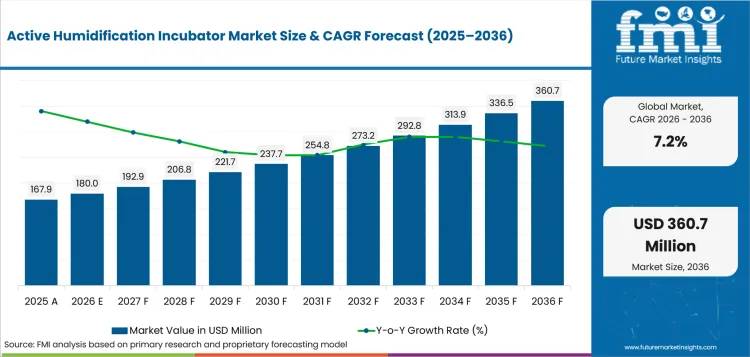
| Metric | Value |
|---|---|
| 2025 Market Size | USD 167.9 million |
| 2026 Market Size | USD 180.0 million |
| 2036 Market Size | USD 360.8 million |
| CAGR | 7.2% from 2026 to 2036 |
| Leading Application | Cell Culture |
| Cell Culture Share in 2026 | 54.0% |
| Leading End User | Pharmaceutical and Biotech Companies |
| Pharmaceutical and Biotech Companies Share in 2026 | 52.0% |
| Fastest-growing Country | India |
| India CAGR | 8.6% by 2036 |
| Market Signal | Commercial Impact |
|---|---|
| Demand and Growth Drivers | Cell culture and drug discovery laboratories are increasing demand for active humidification incubators that maintain stable humidity during repeated chamber access.
|
| Product and Segment View | Cell culture, pharmaceutical and biotechnology companies, and 150–250 liter incubators dominate their respective market segments.
|
| Geography and Growth Outlook | India and China are expected to remain the fastest-growing markets for active humidification incubators.
|
| Competitive Landscape | Competition is shifting toward performance-driven incubation systems supported by strong service capabilities.
|
| Analyst Perspective | Active humidification is becoming a key performance differentiator in laboratory incubator purchasing decisions.
— Anurag Sharma, Principal Consultant for Technology at FMI |
Laboratory investment is supported by research funding and supplier product design. NIH reported USD 35.3 billion in competing and non-competing extramural awards during FY 2025, giving academic and clinical laboratories a wider base for cell-based research equipment decisions. CDC’s ART surveillance recorded 435,426 assisted reproductive technology cycles across 457 reporting clinics, showing why IVF laboratories need stable incubation and traceable chamber conditions. PHC introduced Cell-IQ CO₂ incubators in June 2026 with active hybrid humidification supporting 80% to 90% humidity control, giving suppliers a direct benchmark for recovery-focused product upgrades.
Which factors support expansion in the active humidification incubator market?
Humidity recovery and cleanability support market value across research and biopharma channels.
- Market value is supported by active-humidity CO₂ incubator revenue before distributor service contracts add incremental sales.
- Supplier pricing reflects humidity sensors and validation support before capacity affects buyer comparison.
- Revenue improves as cell culture and IVF users replace passive water-pan units with controlled humidity recovery systems.
- Buyer trust rises as suppliers document humidity stability and service coverage in qualification files.
Why is the active humidification incubator market growing?
Laboratories are moving toward incubators protecting high-value cells and assays during repeated chamber access.
Growth is tied to controlled culture environments used in cell therapy and drug discovery. FDA stated in January 2026, its biologics center had approved close to 50 cell and gene therapy products over the prior decade, raising attention on culture systems able to support quality documentation during complex biologics work. Active humidification incubators gain value in this setting as laboratories connect chamber recovery and media evaporation reduction with repeatable sample outcomes.
How is the active humidification incubator market segmented?
Active humidification incubator industry is segmented by application, end user, capacity, sales channel, and technology.
- Cell culture is projected to secure 54.0% share in 2026, led by biologics research and mammalian cell workflows requiring stable humidity during longer experimental cycles.
- Pharmaceutical and biotech companies are anticipated to hold 52.0% share in 2026, supported by validated incubation and contamination-control requirements across regulated laboratories.
- The 150-250 liter capacity range is expected to capture 49.0% share in 2026, influenced by stacked placement and faster recovery than oversized systems.
- Direct supplier sales are forecast to represent 48.0% share in 2026, guided by installation planning and qualification-linked purchasing.
- Steam humidification is projected to account for 45.0% share in 2026, reflected by familiar vapor recovery validation and established maintenance routines.
Why does cell culture lead the active humidification incubator market?
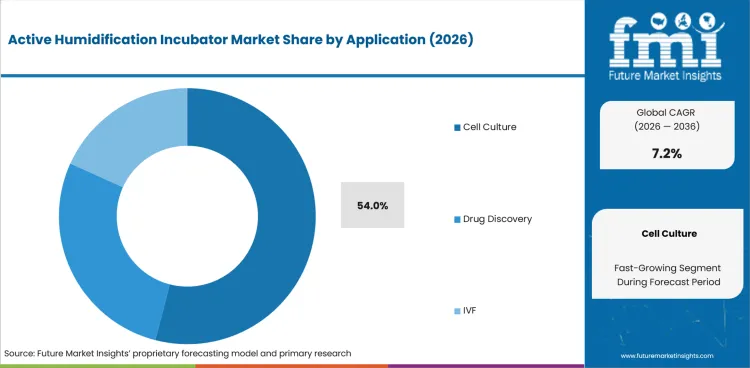
- Cell culture is projected to account for 54.0% share in 2026, shaped by mammalian cell workflows that require stable humidity and CO₂ during long research and drug discovery cycles.
- IVF gains added attention as embryo culture teams compare microchamber access and evaporation control before approving incubators for clinical laboratories.
Which end user leads the active humidification incubator market?
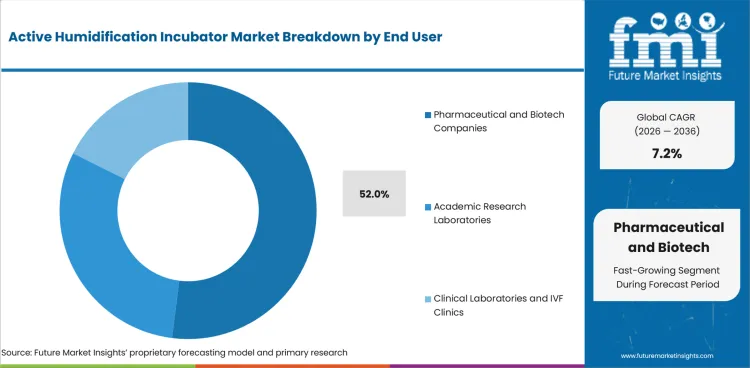
- Pharmaceutical and biotech companies are anticipated to hold 52.0% share in 2026, guided by contamination prevention and repeatability needs across cell-based research.
- Academic research laboratories add steady replacement demand as funded projects require reliable incubation for cell culture and translational research studies.
Which capacity range leads the active humidification incubator market?
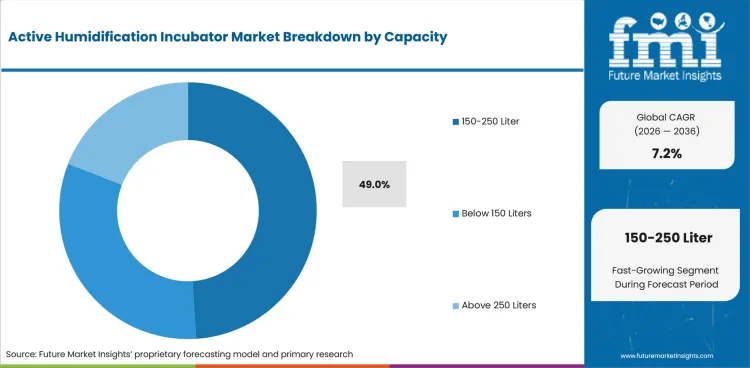
- The 150-250 liter capacity range is forecast to secure 49.0% share in 2026, led by laboratories seeking useful volume without slower chamber recovery linked to larger units.
- Below 150 liters systems support IVF and specialty research teams preferring smaller chambers to limit disturbance during frequent sample access.
Which sales channel leads the active humidification incubator market?
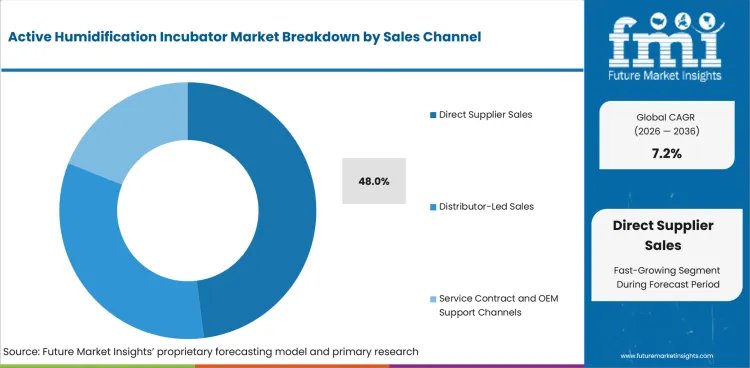
- Direct supplier sales are expected to hold 48.0% share in 2026, supported by installation guidance and qualification documentation.
- Distributor-led sales remain important in emerging laboratory markets as local service teams handle training and first-line technical support.
Which technology leads the active humidification incubator market?
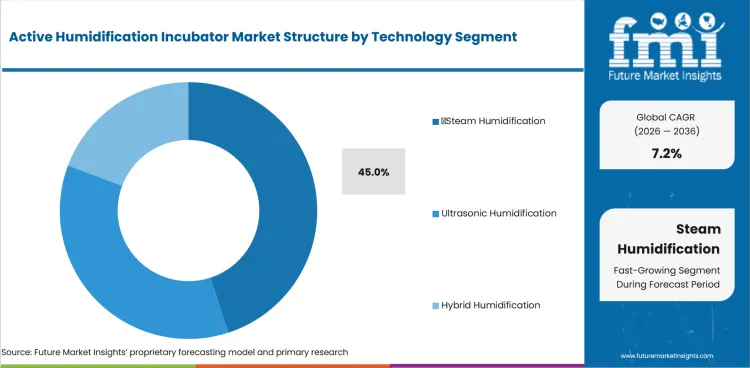
- Steam humidification is projected to account for 45.0% share in 2026, influenced by laboratory familiarity with vapor recovery and qualification records explaining chamber performance after repeated access.
- Hybrid humidification gains attention as suppliers combine sensor feedback and passive water support to improve recovery after chamber access.
What are the driver, restraints, and opportunities in the active humidification incubator market?
High-value samples support growth while cleaning burden and budget limits slow replacement.
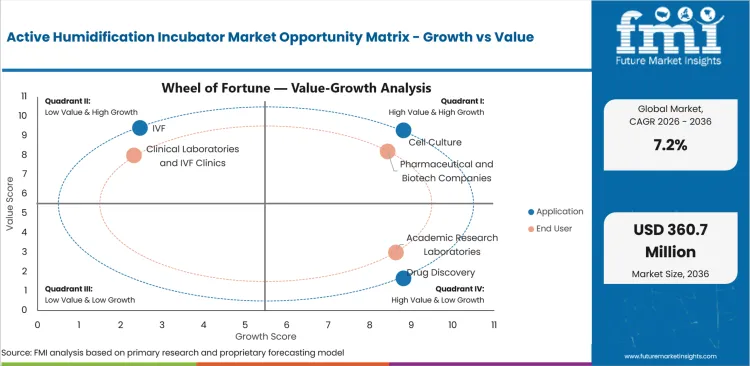
- Driver: Cell culture and biologics users are moving toward incubators that reduce evaporation and support documented recovery.
- Restraint: Higher purchase price and cleaning validation can slow adoption among cost-sensitive laboratories.
- Opportunity: Hybrid humidification and microchamber IVF systems are expected to support specialized sales for suppliers proving recovery speed and contamination control.
Active Humidification Incubator Demand Outlook
Demand outlook is shaped by laboratory funding and sample-value protection. NIH Data Book reporting for FY 2025 placed Research Project Grant funding above USD 26.5 billion, with SBIR and STTR funding near USD 1.2 billion. Active humidification incubators benefit from such research spending as cell culture and translational biology programs need culture chambers protecting samples during long study periods. Suppliers combining humidity recovery with service records and qualification support should gain better access to funded laboratories.
Water Handling and Service Burden Analysis
Water quality, sterilization routines, and contamination checks create a restraint for active humidification systems. HFEA reported 131 non-compliances and 792 incidents across the fertility sector during 2024 to 2025, highlighting why laboratories and clinics examine cleaning records before adding equipment to controlled rooms. Active humidification systems add tubing and sterilization steps required to be managed through documented maintenance. Smaller clinics can delay replacement if training time or local service support looks uncertain.
IVF Microchamber and Hybrid Humidification Opportunity Analysis
IVF laboratories create a premium opportunity as embryo handling favors small stable chambers and low disturbance. Esco Medical launched the MIRI M system in June 2025 with up to 18 independent movable chambers and an undocked operation window of up to 30 minutes. Such designs show how humidity control and chamber independence can be sold as part of a single embryo-culture workflow. Suppliers combining microchamber access with active humidity documentation can address fertility clinics seeking less disturbance during daily laboratory handling.
Who are the leading companies in the active humidification incubator market?
Thermo Fisher Scientific, PHCbi, Eppendorf, BINDER, Memmert, and Esco Medical.
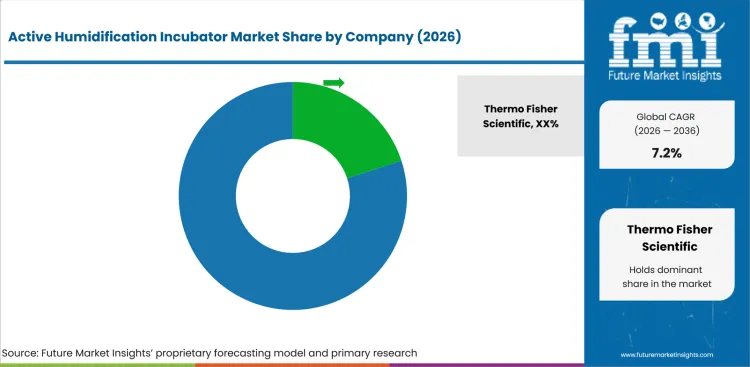
- Established laboratory equipment suppliers hold an advantage led by service coverage and qualification support.
- Specialist IVF suppliers gain access by offering compact chambers and embryo-handling workflow support.
- Controlled-environment suppliers compete depending on sterilization routines and documentation depth.
- Service-led distributors remain important in countries requiring training and spare-part support.
Active humidification incubator suppliers compete by combining recovery proof with cleaning support and field service. PHCbi’s Cell-IQ launch in June 2026 gave the market a clear active hybrid humidification benchmark led by sensor feedback and 80% to 90% humidity control. Thermo Fisher Scientific and Eppendorf benefit from broad research laboratory access. BINDER and Memmert compete through controlled-environment experience and GMP-aligned documentation.
IVF-focused suppliers compete based on chamber independence and sample-protection features. Esco Medical’s MIRI M launch in June 2025 showed how independent movable chambers can reduce disturbance during embryo handling. ASTEC remains linked to fertility and clinical workflows, while NuAire and regional distributors support buyers needing local installation and maintenance. Repeat orders depend on service response and confidence after installation.
Smaller and regional suppliers can compete through workflow-specific support. Academic laboratories may prioritize price and service speed, while biopharma users focus on qualification files and documented chamber stability. IVF clinics add another review step around gas recovery and cleaning records. Suppliers combining product proof with local service support should gain more durable account access.
How do top active humidification incubator companies compare?
Thermo Fisher Scientific and PHCbi lead on channel reach, while Esco Medical scores strongest on IVF workflow fit.
| Company | Relevance to Market Title | Humidity Recovery Proof | Decontamination Depth | IVF Workflow Fit | Channel Reach | Geographic Footprint |
|---|---|---|---|---|---|---|
| Thermo Fisher Scientific | Very High | High | Strong | Strong | Very Strong | Global |
| PHCbi | Very High | Very Strong | Very Strong | Strong | Very Strong | Global |
| Eppendorf | High | Strong | Strong | Medium | Strong | Global |
| BINDER | High | Strong | Very Strong | Medium | Strong | Europe, North America, and Asia |
| Memmert | High | Strong | Strong | Strong | Strong | Europe and Asia |
| Esco Medical | Very High | Medium | Strong | Very Strong | Strong | Global IVF channels |
| ASTEC | High | Medium | Medium | Very Strong | Moderate | Japan and export markets |
| NuAire | Moderate to High | Strong | Strong | Medium | Moderate | North America and Europe |
Source: Future Market Insights competitive analysis, 2026.
Who are the key players in the active humidification incubator market?
Thermo Fisher Scientific, PHCbi, Eppendorf, BINDER, and Memmert are listed with Esco Medical and ASTEC among other suppliers.
Key global companies leading the active humidification incubator market include:
- Thermo Fisher Scientific
- PHCbi
- Eppendorf
- BINDER
- Memmert
- Esco Medical
- ASTEC
- NuAire
- PHCbi
- Sheldon Manufacturing
Key Developments in Active Humidification Incubator Market
- In June 2026, PHC launched Cell-IQ CO₂ incubators with active hybrid humidification and internal humidity sensor control for laboratory cell culture workflows.
- In June 2025, Esco Medical introduced the MIRI M Multiroom IVF Incubator with independent movable chambers for patient-specific embryo culture.
- In March 2025, PHC introduced the MCO-171AICUVD-PA high heat CO₂ incubator with antimicrobial chamber material and high-heat sterilization.
Key Players in the Active Humidification Incubator Market
Global Laboratory Incubation Suppliers
- Thermo Fisher Scientific
- PHCbi
- Eppendorf
- BINDER
- Memmert
Specialist IVF and Clinical Suppliers
- Esco Medical
- ASTEC
- NuAire
Regional and Service-Focused Players
- Sheldon Manufacturing
- PHCbi
- Local scientific distributors
Which countries are growing fastest in the active humidification incubator market?
India 8.6% CAGR, China 8.3% CAGR, South Korea 7.5% CAGR, United States 7.4% CAGR, Japan 7.1% CAGR, Germany 7.0% CAGR, United Kingdom 6.8% CAGR, and France 6.7% CAGR through 2036.
.webp "Top Country Growth Comparison Active Humidification Incubator Market Cagr (2026 2036)")
| Country | CAGR |
|---|---|
| India | 8.6% |
| China | 8.3% |
| South Korea | 7.5% |
| United States | 7.4% |
| Japan | 7.1% |
| Germany | 7.0% |
| United Kingdom | 6.8% |
| France | 6.7% |
Source: Future Market Insights, 2026.
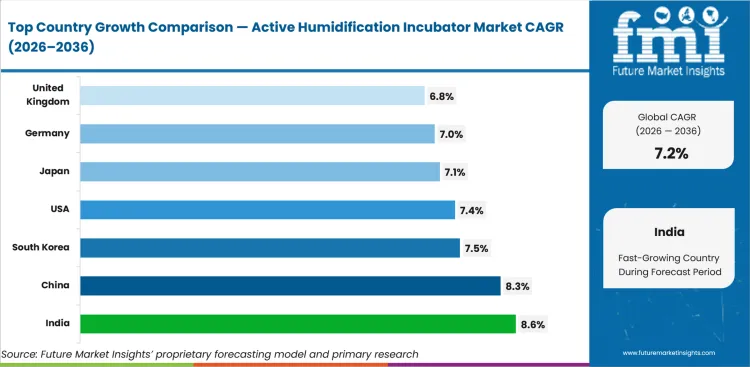
How do country-level CAGRs compare in the active humidification incubator market?
India leads country expansion while France records the most cautious outlook among profiled countries.
- India is forecast to record 8.6% CAGR by 2036, reflected by fertility clinic registration and research funding supporting humidified incubator purchases.
- China is expected to expand at 8.3% CAGR by 2036 due to life science R&D spending and clinical laboratory expansion raising controlled incubation needs.
- South Korea is projected to grow at 7.5% CAGR through 2036, led by high R&D intensity and fertility treatment activity influencing incubator upgrades.
- The United States is anticipated to rise at 7.4% CAGR from 2026 to 2036 through ART procedure volume and biopharma research demand.
- Japan is estimated to advance at 7.1% CAGR by 2036 since laboratory R&D spending and compact fertility workflows promote replacement sales.
- Germany is forecast to expand at 7.0% CAGR through 2036, driven by GMP laboratories and biotech users reviewing humidity-controlled incubation.
- The United Kingdom is projected to post 6.8% CAGR by 2036 as fertility oversight and public R&D funding guide quality-focused purchases.
- France is expected to grow at 6.7% CAGR through 2036, guided by research corridors and clinical laboratories replace older incubation systems.
How fast is the active humidification incubator market growing in India?
An 8.6% CAGR through 2036 reflects fertility clinic registration and private laboratory expansion.
Country Market Snapshot Table
| Parameter | Value |
|---|---|
| Market Size in 2025 (Value) | USD 9.7 million |
| Market Size in 2026 (Value) | USD 10.6 million |
| Market Forecast in 2036 (Value) | USD 24.0 million |
| CAGR (2026 to 2036) | 8.6% |
| Years Considered | 2021 to 2036 |
| Base Year | 2025 |
| Forecast Period | 2026 to 2036 |
| Units Considered | Value (USD million) |
| Leading Sub-Region | Maharashtra, Karnataka, Telangana, and Delhi NCR |
India Active Humidification Incubator Market Outlook
Industry in India is influenced by fertility clinic expansion and private healthcare investment. Buyers compare service availability and total ownership cost before selecting active humidification systems.
Distributor service strength is expected to remain important outside major research hubs. Suppliers with training support and spare-part availability should improve adoption among clinical and academic laboratories.
Key Growth Drivers
- Fertility laboratory expansion supports demand for controlled embryo culture systems, reinforced by India’s National ART and Surrogacy Registry listing 4,174 registered ART clinics.
- Research infrastructure funding supports cell culture equipment planning, strengthened by the RDI Scheme’s INR 1 lakh crore outlay over 6 years.
- Private fertility chains prefer compact incubators reducing disturbance during daily embryo handling.
- Academic laboratories need controlled CO₂ incubation as cell culture and drug screening work expands.
Key Restraints
- Compliance review can restrict equipment purchasing at unapproved facilities, shown by the National ART and Surrogacy Registry listing 690 rejected ART clinic applications.
- Price sensitivity can delay active humidification upgrades in smaller laboratories.
- Service availability outside large cities can affect adoption among regional clinics.
What makes India unique
India is unique due to fast fertility clinic registration and rising public support for research-led innovation.
Key Companies
- Thermo Fisher Scientific
- Eppendorf
- PHCbi
- Esco Medical
- BINDER
- Memmert
- NuAire
Sales & Marketing Channels
- Distributor-led sales
- Direct supplier sales
- Hospital chain purchasing
- Research institute tenders
- IVF clinic networks
- Service contract channels
Country Segment Breakdown Table
| Segment | Sub-Segments |
|---|---|
| By Application | Cell Culture · Drug Discovery · IVF |
| By End User | Pharmaceutical and Biotech Companies · Academic Research Laboratories · Clinical Laboratories and IVF Clinics |
| By Capacity | Below 150 Liters · 150-250 Liters · Above 250 Liters |
| By Sales Channel | Direct Supplier Sales · Distributor-Led Sales · Service Contract and OEM Support Channels |
| By Technology | Steam Humidification · Ultrasonic Humidification · Hybrid Humidification |
| Key Sub-Regions Covered, Clinical and Research Corridors | Maharashtra · Karnataka · Telangana · Delhi NCR · Tamil Nadu · Gujarat |
Frequently Asked Questions
How fast is India active humidification incubator market growing?
Sector in India is forecast to expand at 8.6% CAGR from 2026 to 2036, guided by fertility clinic registration and laboratory expansion.
Who leads India active humidification incubator market?
Thermo Fisher Scientific, Eppendorf, PHCbi, Esco Medical, and BINDER compete through distributor networks and clinical laboratory access.
What is driving adoption in India active humidification incubator market?
Fertility clinic registration, research funding, and private laboratory expansion are supporting active humidification incubator adoption.
What is the active humidification incubator market outlook in China?
An 8.3% CAGR through 2036 reflects life science research spending and biopharma process development.
Country Market Snapshot Table
| Parameter | Value |
|---|---|
| Market Size in 2025 (Value) | USD 26.8 million |
| Market Size in 2026 (Value) | USD 29.0 million |
| Market Forecast in 2036 (Value) | USD 64.4 million |
| CAGR (2026 to 2036) | 8.3% |
| Years Considered | 2021 to 2036 |
| Base Year | 2025 |
| Forecast Period | 2026 to 2036 |
| Units Considered | Value (USD million) |
| Leading Sub-Region | Yangtze River Delta and Greater Bay Area |
China Active Humidification Incubator Market Outlook
The market in China is driven by biopharma process development and clinical laboratory expansion. Buyers compare chamber reliability and price before approving active humidification systems.
Domestic and imported suppliers are expected to compete based on service depth and documentation. Research centers and hospital laboratories should support replacement sales during the forecast period.
Key Growth Drivers
- Life science laboratory investment supports controlled incubation needs, backed by China’s 2024 R&D expenditure of RMB 3.613 trillion.
- Basic research activity raises demand for controlled cell culture environments, evidenced by RMB 249.7 billion spent on basic research in 2024.
- Biopharma process development laboratories need incubators combining humidity recovery with contamination-control features.
- Regional clinical laboratory expansion supports distributor-led sales of CO₂ incubators and service contracts.
Key Restraints
- Premium imported systems face price pressure from local alternatives, indicated by China’s 2024 R&D intensity reaching 2.68% as domestic innovation capacity matured.
- Service coverage outside major research hubs can affect replacement timing.
- Qualification review can lengthen purchasing cycles for laboratories moving from passive to active systems.
What makes China unique
China is unique due to large research spending and fast clinical laboratory buildout.
Key Companies
- Thermo Fisher Scientific
- PHCbi
- Eppendorf
- Esco Medical
- BINDER
- Memmert
- Local distributor partners
Sales & Marketing Channels
- Distributor-led sales
- Direct supplier sales
- Hospital laboratory purchasing
- Biopharma account teams
- Academic institute tenders
- Service contract channels
Country Segment Breakdown Table
| Segment | Sub-Segments |
|---|---|
| By Application | Cell Culture · Drug Discovery · IVF |
| By End User | Pharmaceutical and Biotech Companies · Academic Research Laboratories · Clinical Laboratories and IVF Clinics |
| By Capacity | Below 150 Liters · 150-250 Liters · Above 250 Liters |
| By Sales Channel | Direct Supplier Sales · Distributor-Led Sales · Service Contract and OEM Support Channels |
| By Technology | Steam Humidification · Ultrasonic Humidification · Hybrid Humidification |
| Key Sub-Regions Covered, Research and Clinical Corridors | Shanghai · Beijing · Shenzhen · Guangzhou · Suzhou · Chengdu |
Frequently Asked Questions
How fast is China active humidification incubator market growing?
The market in China is likely to expand at 8.3% CAGR from 2026 to 2036, supported by research spending and clinical laboratory expansion.
Who leads China active humidification incubator market?
Thermo Fisher Scientific, PHCbi, Eppendorf, BINDER, and Memmert compete led by imported portfolios and local distributor service.
What is driving adoption in China active humidification incubator market?
R&D spendingand hospital laboratory expansion are supporting active humidification incubator demand.
How is the active humidification incubator market performing in South Korea?
A 7.5% CAGR through 2036 reflects IVF treatment activity, high R&D intensity, and compact laboratory requirements.
Country Market Snapshot Table
| Parameter | Value |
|---|---|
| Market Size in 2025 (Value) | USD 7.8 million |
| Market Size in 2026 (Value) | USD 8.4 million |
| Market Forecast in 2036 (Value) | USD 17.3 million |
| CAGR (2026 to 2036) | 7.5% |
| Years Considered | 2021 to 2036 |
| Base Year | 2025 |
| Forecast Period | 2026 to 2036 |
| Units Considered | Value (USD million) |
| Leading Sub-Region | Seoul Capital Area and Daejeon research corridor |
South Korea Active Humidification Incubator Market Outlook
Industry in South Korea is supported by fertility treatment activity and compact laboratory workflows. Buyers examine chamber recovery and service response before selecting systems.
Clinical laboratories and biotech research centers are expected to support premium incubator sales. Suppliers with dependable local service and clear validation files should gain stronger acceptance.
Key Growth Drivers
- High research intensity supports advanced laboratory equipment demand, reflected by South Korea’s 2024 R&D investment reaching 5.13% of GDP.
- Fertility treatment activity supports embryo culture equipment demand, reinforced by a 2025 annual report recording 200,007 infertility treatment cycles.
- Compact laboratory spaces favor incubators that deliver recovery performance without oversized chamber footprints.
- Biotech and academic research centers use CO₂ incubators for sensitive cell culture and translational research workflows.
Key Restraints
- Premium system review remains strict for clinic budgets, indicated by South Korea’s 2024 R&D investment of KRW 131 trillion concentrating spending among high-capacity institutions.
- Service contracts can slow adoption among independent fertility clinics.
- Existing validated incubators can extend replacement cycles if internal quality teams avoid requalification work.
What makes South Korea unique
South Korea is unique due to high R&D intensity and active fertility treatment workflows.
Key Companies
- Thermo Fisher Scientific
- PHCbi
- Eppendorf
- Esco Medical
- BINDER
- Memmert
- ASTEC
Sales & Marketing Channels
- Direct supplier sales
- Specialist distributors
- IVF clinic purchasing
- Academic institute sales
- Hospital laboratory channels
- Service contract channels
Country Segment Breakdown Table
| Segment | Sub-Segments |
|---|---|
| By Application | Cell Culture · Drug Discovery · IVF |
| By End User | Pharmaceutical and Biotech Companies · Academic Research Laboratories · Clinical Laboratories and IVF Clinics |
| By Capacity | Below 150 Liters · 150-250 Liters · Above 250 Liters |
| By Sales Channel | Direct Supplier Sales · Distributor-Led Sales · Service Contract and OEM Support Channels |
| By Technology | Steam Humidification · Ultrasonic Humidification · Hybrid Humidification |
| Key Sub-Regions Covered, Research and Clinical Corridors | Seoul · Incheon · Daejeon · Busan · Gyeonggi · Daegu |
Frequently Asked Questions
How fast is South Korea active humidification incubator market growing?
Sector in South Korea is projected to expand at 7.5% CAGR from 2026 to 2036, guided by research intensity and fertility treatment activity.
Who leads South Korea active humidification incubator market?
Thermo Fisher Scientific, PHCbi, Eppendorf, Esco Medical, and ASTEC compete depending on clinical and research laboratory access.
What is driving adoption in South Korea active humidification incubator market?
Fertility treatment activity and compact laboratory workflows are supporting adoption.
How fast is the active humidification incubator market growing in the United States?
A 7.4% CAGR through 2036 reflects ART procedure volume and biopharma laboratory replacement demand.
Country Market Snapshot Table
| Parameter | Value |
|---|---|
| Market Size in 2025 (Value) | USD 42.4 million |
| Market Size in 2026 (Value) | USD 45.5 million |
| Market Forecast in 2036 (Value) | USD 93.0 million |
| CAGR (2026 to 2036) | 7.4% |
| Years Considered | 2021 to 2036 |
| Base Year | 2025 |
| Forecast Period | 2026 to 2036 |
| Units Considered | Value (USD million) |
| Leading Sub-Region | Northeast and West Coast research corridors |
United States Active Humidification Incubator Market Outlook
United States demand is influenced by NIH research funding and biopharma process development. Laboratory buyers compare humidity recovery and service response before approving higher-priced CO₂ incubators.
Research hospitals and contract laboratories are expected to support replacement sales. Suppliers with local service coverage and qualification documents should gain stronger placement in fertility and cell culture facilities.
Key Growth Drivers
- Fertility laboratories support controlled embryo culture demand, supported by CDC’s ART surveillance recording 435,426 ART cycles across 457 reporting clinics.
- Academic and clinical research centers support cell culture equipment demand, backed by NIH reporting more than USD 26.5 billion in Research Project Grant funding during FY 2025.
- Biopharma laboratories use active humidification chambers to protect long cell-based assays during repeated access and documentation review.
- Clinical research teams prefer service-backed CO₂ incubators as uptime and calibration records influence equipment approval.
Key Restraints
- Small clinics can face budget discipline around premium replacements, illustrated by CDC data showing 184,423 egg or embryo banking cycles requiring careful storage-linked workflow planning.
- Higher service-plan costs can delay replacement among independent cell culture laboratories.
- Water-quality control adds maintenance responsibility for laboratories lacking dedicated equipment technicians.
What makes the United States unique
United States is unique due to an extensive NIH-funded research infrastructure and wide biopharma laboratory density.
Key Companies
- Thermo Fisher Scientific
- Eppendorf
- PHCbi
- Esco Medical
- NuAire
- PHCbi
- BINDER
Sales & Marketing Channels
- Direct supplier sales
- Distributor-led sales
- Hospital network purchasing
- Academic research channels
- Biopharma account teams
- Service contract channels
Country Segment Breakdown Table
| Segment | Sub-Segments |
|---|---|
| By Application | Cell Culture · Drug Discovery · IVF |
| By End User | Pharmaceutical and Biotech Companies · Academic Research Laboratories · Clinical Laboratories and IVF Clinics |
| By Capacity | Below 150 Liters · 150-250 Liters · Above 250 Liters |
| By Sales Channel | Direct Supplier Sales · Distributor-Led Sales · Service Contract and OEM Support Channels |
| By Technology | Steam Humidification · Ultrasonic Humidification · Hybrid Humidification |
| Key Sub-Regions Covered, Research and Clinical Corridors | Northeast · California · Texas · Midwest · Research Triangle · Pacific Northwest |
Frequently Asked Questions
How fast is United States active humidification incubator market growing?
Demand in the United States is anticipated to grow at 7.4% CAGR from 2026 to 2036, reflecting ART procedure volume and biopharma research demand.
Who leads United States active humidification incubator market?
Thermo Fisher Scientific, Eppendorf, PHCbi, NuAire, and BINDER compete due to research and clinical laboratory channels.
What is driving adoption in United States active humidification incubator market?
ART procedure volume and biopharma laboratory replacement demand are supporting adoption.
What is the active humidification incubator market forecast for Japan?
A 7.1% CAGR through 2036 reflects laboratory R&D spending and compact clinical workflow needs.
Country Market Snapshot Table
| Parameter | Value |
|---|---|
| Market Size in 2025 (Value) | USD 16.4 million |
| Market Size in 2026 (Value) | USD 17.6 million |
| Market Forecast in 2036 (Value) | USD 34.9 million |
| CAGR (2026 to 2036) | 7.1% |
| Years Considered | 2021 to 2036 |
| Base Year | 2025 |
| Forecast Period | 2026 to 2036 |
| Units Considered | Value (USD million) |
| Leading Sub-Region | Tokyo, Osaka, and Kansai research corridor |
Japan Active Humidification Incubator Market Outlook
The market in Japan is guided by precision laboratory formats and compact clinical spaces. Buyers favor reliable incubators that protect sample quality in space-constrained facilities.
Suppliers with precise chamber control and documentation support should perform well. IVF and research laboratories are expected to remain key purchasing centers.
Key Growth Drivers
- Laboratory R&D investment supports controlled incubation demand, evidenced by OECD reporting Japan’s R&D expenditure growth above 5.0% in 2024.
- Public science funding supports research equipment planning, reflected by Japan Science and Technology Agency’s FY 2025 initial budget of JPY 260,673 million.
- Space-constrained laboratories favor compact active humidification incubators with dependable recovery after access.
- IVF workflows encourage smaller chamber systems reducing disturbance during patient-specific embryo handling.
Key Restraints
- Fertility service providers can remain cautious with capital spending, indicated by Japan’s 2024 final vital statistics recording 686,061 live births and a 1.15 total fertility rate.
- Premium incubator pricing can slow replacement outside large urban clinics.
- Service validation requirements can extend adoption time for new chamber designs.
What makes Japan unique
Japan is unique due to compact laboratory formats and strong domestic incubation supplier presence.
Key Companies
- PHCbi
- ASTEC
- Thermo Fisher Scientific
- Eppendorf
- Esco Medical
- BINDER
- Memmert
Sales & Marketing Channels
- Direct supplier sales
- Distributor-led sales
- Clinical laboratory purchasing
- IVF clinic channels
- Research university sales
- Service contract channels
Country Segment Breakdown Table
| Segment | Sub-Segments |
|---|---|
| By Application | Cell Culture · Drug Discovery · IVF |
| By End User | Pharmaceutical and Biotech Companies · Academic Research Laboratories · Clinical Laboratories and IVF Clinics |
| By Capacity | Below 150 Liters · 150-250 Liters · Above 250 Liters |
| By Sales Channel | Direct Supplier Sales · Distributor-Led Sales · Service Contract and OEM Support Channels |
| By Technology | Steam Humidification · Ultrasonic Humidification · Hybrid Humidification |
| Key Sub-Regions Covered, Research and Clinical Corridors | Tokyo · Osaka · Kyoto · Yokohama · Kobe · Tsukuba |
Frequently Asked Questions
How fast is Japan active humidification incubator market growing?
Sector in Japan is expected to grow at 7.1% CAGR from 2026 to 2036, supported by laboratory R&D spending and compact clinical workflows.
Who leads Japan active humidification incubator market?
PHCbi, ASTEC, Thermo Fisher Scientific, Eppendorf, and Esco Medical compete depending on domestic service and clinical laboratory channels.
What is driving adoption in Japan active humidification incubator market?
Compact laboratory layouts and precision culture workflows are supporting active humidification incubator adoption.
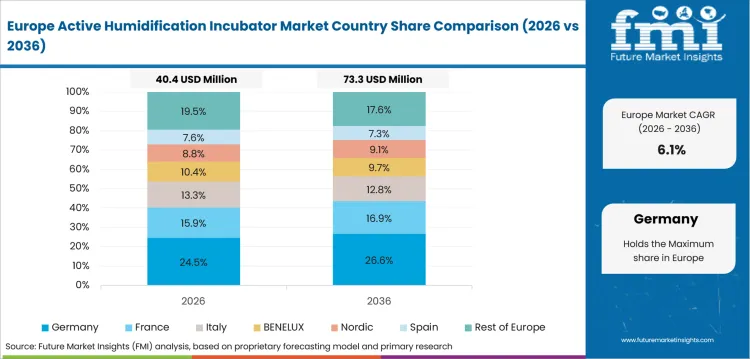
How is the active humidification incubator market performing in Germany?
A 7.0% CAGR through 2036 reflects GMP laboratory demandand validated incubation needs.
Country Market Snapshot Table
| Parameter | Value |
|---|---|
| Market Size in 2025 (Value) | USD 15.6 million |
| Market Size in 2026 (Value) | USD 16.7 million |
| Market Forecast in 2036 (Value) | USD 32.9 million |
| CAGR (2026 to 2036) | 7.0% |
| Years Considered | 2021 to 2036 |
| Base Year | 2025 |
| Forecast Period | 2026 to 2036 |
| Units Considered | Value (USD million) |
| Leading Sub-Region | Bavaria, Baden-Württemberg, and North Rhine-Westphalia |
Germany Active Humidification Incubator Market Outlook
Demand in Germany is promoted by pharmaceutical research and laboratory quality systems. Buyers often review sterilization performance and chamber material before approving equipment.
Domestic controlled-environment equipment expertise supports specialized purchasing. Suppliers with validated humidity systems and German-language service support should compete well across clinical and research laboratories.
Key Growth Drivers
- Germany’s research base supports laboratory equipment purchases, reinforced by WIPO’s 2025 tracker estimating Germany’s 2024 R&D spending at USD 132 billion.
- European research infrastructure supports scientific equipment replacement, backed by Eurostat estimating EU R&D spending at EUR 403.1 billion in 2024.
- Pharmaceutical and biotech facilities require incubators supporting GMP documentation and stable culture conditions.
- Domestic engineering familiarity supports buyer acceptance of controlled humidity systems with clear maintenance requirements.
Key Restraints
- Budget caution can slow premium replacement cycles, indicated by OECD reporting a 0.4% decline in Germany’s R&D expenditure growth during 2024.
- Strict qualification review can delay acceptance of newer hybrid humidification systems.
- Laboratories with older validated workflows may postpone replacement to avoid requalification time.
What makes Germany unique
Germany is unique due to controlled-environment equipment expertise and quality-focused laboratory purchasing.
Key Companies
- BINDER
- Memmert
- Eppendorf
- Thermo Fisher Scientific
- PHCbi
- Esco Medical
- ASTEC
Sales & Marketing Channels
- Direct supplier sales
- Distributor-led sales
- Pharmaceutical account teams
- University laboratory sales
- Hospital purchasing channels
- Service contract channels
Country Segment Breakdown Table
| Segment | Sub-Segments |
|---|---|
| By Application | Cell Culture · Drug Discovery · IVF |
| By End User | Pharmaceutical and Biotech Companies · Academic Research Laboratories · Clinical Laboratories and IVF Clinics |
| By Capacity | Below 150 Liters · 150-250 Liters · Above 250 Liters |
| By Sales Channel | Direct Supplier Sales · Distributor-Led Sales · Service Contract and OEM Support Channels |
| By Technology | Steam Humidification · Ultrasonic Humidification · Hybrid Humidification |
| Key Sub-Regions Covered, Research and Clinical Corridors | Bavaria · Baden-Württemberg · North Rhine-Westphalia · Berlin · Hesse · Hamburg |
Frequently Asked Questions
How fast is Germany active humidification incubator market growing?
Germany is projected to post 7.0% CAGR from 2026 to 2036, led by GMP laboratory demand and biotech users.
Who leads Germany active humidification incubator market?
BINDER, Memmert, Eppendorf, Thermo Fisher Scientific, and PHCbi compete through laboratory equipment expertise and service support.
What is driving adoption in Germany active humidification incubator market?
GMP documentation needs and controlled-environment equipment familiarity are supporting adoption.
How is the active humidification incubator market performing in the United Kingdom?
A 6.8% CAGR through 2036 reflects fertility sector oversight and public life science research funding.
Country Market Snapshot Table
| Parameter | Value |
|---|---|
| Market Size in 2025 (Value) | USD 12.8 million |
| Market Size in 2026 (Value) | USD 13.7 million |
| Market Forecast in 2036 (Value) | USD 26.5 million |
| CAGR (2026 to 2036) | 6.8% |
| Years Considered | 2021 to 2036 |
| Base Year | 2025 |
| Forecast Period | 2026 to 2036 |
| Units Considered | Value (USD million) |
| Leading Sub-Region | London, Cambridge, and Oxford laboratory corridor |
United Kingdom Active Humidification Incubator Market Outlook
Industry in the United Kingdom is guided by fertility clinic oversight and research funding. IVF laboratories assess chamber stability and cleaning records before approving incubators for embryo culture rooms.
Academic and translational research centers are expected to support active humidification replacement. Suppliers with compliance-ready files and service presence should gain acceptance in research and clinical accounts.
Key Growth Drivers
- Fertility sector oversight supports quality-focused equipment purchases, supported by HFEA reporting 141 licensed fertility clinics and 88 inspections during 2024 to 2025.
- Public R&D funding supports laboratory infrastructure planning, strengthened by GBP 55 billion in UK R&D funding through 2029 to 2030.
- Life science clusters in Cambridge, Oxford, and London support repeat demand for CO₂ incubators used in cell culture and translational research.
- IVF clinics prioritize microenvironment control as chamber access and humidity recovery affect daily embryo handling.
Key Restraints
- Clinic budgets can face funding pressure, shown by HFEA reporting NHS-funded fertility treatment declined to 27% of cycles in 2024.
- High service costs can slow replacement decisions among clinics with smaller capital budgets.
- Qualification review adds time before laboratories approve new humidification technologies.
What makes the United Kingdom unique
United Kingdom is unique due to fertility regulator oversight and concentrated life science research clusters.
Key Companies
- Thermo Fisher Scientific
- PHCbi
- Eppendorf
- BINDER
- Esco Medical
- Memmert
- NuAire
Sales & Marketing Channels
- Direct supplier sales
- Specialist distributors
- University research channels
- Fertility clinic purchasing
- Hospital laboratory sales
- Service contract channels
Country Segment Breakdown Table
| Segment | Sub-Segments |
|---|---|
| By Application | Cell Culture · Drug Discovery · IVF |
| By End User | Pharmaceutical and Biotech Companies · Academic Research Laboratories · Clinical Laboratories and IVF Clinics |
| By Capacity | Below 150 Liters · 150-250 Liters · Above 250 Liters |
| By Sales Channel | Direct Supplier Sales · Distributor-Led Sales · Service Contract and OEM Support Channels |
| By Technology | Steam Humidification · Ultrasonic Humidification · Hybrid Humidification |
| Key Sub-Regions Covered, Research and Clinical Corridors | London · Cambridge · Oxford · Manchester · Edinburgh · Birmingham |
Frequently Asked Questions
How fast is United Kingdom active humidification incubator market growing?
The sector in United Kingdom is forecast to expand at 6.8% CAGR from 2026 to 2036, supported by fertility oversight and life science funding.
Who leads United Kingdom active humidification incubator market?
Thermo Fisher Scientific, PHCbi, Eppendorf, BINDER, and Esco Medical compete based on research and clinical laboratory access.
What is driving adoption in United Kingdom active humidification incubator market?
University research clusters and life science funding are supporting adoption.
How is the active humidification incubator market performing in France?
A 6.7% CAGR through 2036 reflects research laboratory replacement and clinical workflow needs.
Country Market Snapshot Table
| Parameter | Value |
|---|---|
| Market Size in 2025 (Value) | USD 11.5 million |
| Market Size in 2026 (Value) | USD 12.3 million |
| Market Forecast in 2036 (Value) | USD 23.5 million |
| CAGR (2026 to 2036) | 6.7% |
| Years Considered | 2021 to 2036 |
| Base Year | 2025 |
| Forecast Period | 2026 to 2036 |
| Units Considered | Value (USD million) |
| Leading Sub-Region | Île-de-France, Auvergne-Rhône-Alpes, and Occitanie |
France Active Humidification Incubator Market Outlook
France demand is supported by public research laboratories and pharmaceutical facilities. Buyers compare humidity recovery and service support before approving new chambers.
Replacement sales are expected to remain quality-led. Clinics and laboratories prioritize systems that reduce evaporation risk and simplify maintenance records.
Key Growth Drivers
- Research laboratories support active humidification replacement, backed by WIPO’s 2025 tracker estimating France’s 2024 R&D spending at USD 66 billion.
- High-technology employment supports laboratory equipment demand, reflected by Eurostat reporting 498,000 people employed in high-technology sectors in Île-de-France in 2024.
- Public research networks encourage replacement of older CO₂ incubators with systems that support better humidity control.
- Fertility and clinical laboratories review active humidification systems as part of embryo handling and cell culture quality programs.
Key Restraints
- European budget discipline can slow premium purchases, indicated by Eurostat reporting EU R&D intensity at 2.24% of GDP in 2024, slightly below the prior year.
- Centralized purchasing review can extend decision cycles for research laboratories.
- Service-contract pricing can delay adoption among smaller clinical laboratories.
What makes France unique
France is unique due to public research networks and concentrated life science corridors.
Key Companies
- Thermo Fisher Scientific
- PHCbi
- Eppendorf
- BINDER
- Memmert
- Esco Medical
- NuAire
Sales & Marketing Channels
- Direct supplier sales
- Distributor partners
- Public research tenders
- Hospital laboratory purchasing
- IVF clinic networks
- Service contract channels
Country Segment Breakdown Table
| Segment | Sub-Segments |
|---|---|
| By Application | Cell Culture · Drug Discovery · IVF |
| By End User | Pharmaceutical and Biotech Companies · Academic Research Laboratories · Clinical Laboratories and IVF Clinics |
| By Capacity | Below 150 Liters · 150-250 Liters · Above 250 Liters |
| By Sales Channel | Direct Supplier Sales · Distributor-Led Sales · Service Contract and OEM Support Channels |
| By Technology | Steam Humidification · Ultrasonic Humidification · Hybrid Humidification |
| Key Sub-Regions Covered, Research and Clinical Corridors | Île-de-France · Auvergne-Rhône-Alpes · Occitanie · Nouvelle-Aquitaine · Provence-Alpes-Côte d’Azur · Grand Est |
Frequently Asked Questions
How fast is France active humidification incubator market growing?
Demand in France is expected to expand at 6.7% CAGR from 2026 to 2036, supported by research corridors and clinical laboratory replacement.
Who leads France active humidification incubator market?
Thermo Fisher Scientific, PHCbi, Eppendorf, BINDER, Memmert, and Esco Medical compete fueled by research and clinical laboratory access.
What is driving adoption in France active humidification incubator market?
Public research laboratories and pharmaceutical users are supporting active humidification incubator adoption.
Active Humidification Incubator Market - Report Scope
| Parameter | Details |
|---|---|
| Forecast period | 2026 to 2036 |
| Historical period | 2021 to 2025 |
| Quantitative unit | Revenue in USD million |
| By application | Cell culture, drug discovery, IVF |
| By end user | Pharmaceutical and biotech companies, academic research laboratories, clinical laboratories and IVF clinics |
| By capacity | Below 150 liters, 150-250 liters, above 250 liters |
| By sales channel | Direct supplier sales, distributor-led sales, service contract and OEM support channels |
| By technology | Steam humidification, ultrasonic humidification, hybrid humidification |
| Regions covered | North America, Latin America, Europe, East Asia, South Asia and Pacific, Middle East and Africa |
| Countries covered | India, China, South Korea, United States, Japan, Germany, United Kingdom, France |
| Key companies profiled | Thermo Fisher Scientific, PHCbi, Eppendorf, BINDER, Memmert, Esco Medical, ASTEC, NuAire |
| Approach | Bottom-up equipment-boundary approach using active humidification incubator revenue, application mix, replacement demand, service needs, and country-level laboratory indicators |
Source: Future Market Insights, 2026.
Active Humidification Incubator Market - Scope & Definition
| Attribute | Detail |
|---|---|
| Market Definition | Laboratory CO₂ and multi-gas incubators using controlled steam, ultrasonic, or hybrid humidity systems to maintain stable culture conditions. |
| Functions Covered | Humidity recovery, media evaporation reduction, gas-condition stability, contamination-control support, and chamber qualification support. |
| Applications Covered | Cell culture, drug discovery, IVF, biologics research, embryo culture, and clinical research workflows. |
| End-Use Industries | Pharmaceutical and biotechnology, academic research, clinical research, fertility treatment, and hospital laboratories. |
| Grades Covered | Below 150 liters, 150-250 liters, and above 250 liters across steam, ultrasonic, and hybrid systems. |
| Inclusions | Active humidification incubators sold to pharmaceutical and biotech companies, academic laboratories, IVF clinics, and clinical laboratories through direct, distributor, and service-linked channels. |
| Exclusions | Passive water-pan CO₂ incubators, neonatal incubators, poultry incubators, drying ovens, plant-only growth chambers, and environmental chambers without culture-specific humidity control. |
Active Humidification Incubator Market - Research Methodology
| Method | Description |
|---|---|
| Primary Research | FMI analyst interviews with laboratory managers, IVF clinic operators, biotech buyers, distributor specialists, and service teams across key markets. |
| Desk Research | Review of official company product literature, regulator publications, ART registry data, R&D funding sources, and public clinical statistics. |
| Market Sizing & Forecasting | Bottom-up equipment-boundary approach using active-humidity product revenue, average selling price bands, replacement cycles, application mix, and service needs. |
| Data Validation | Cross-verification using adjacent CO₂ incubator demand, supplier portfolios, fertility workload indicators, country-level research statistics, and product suitability checks. |
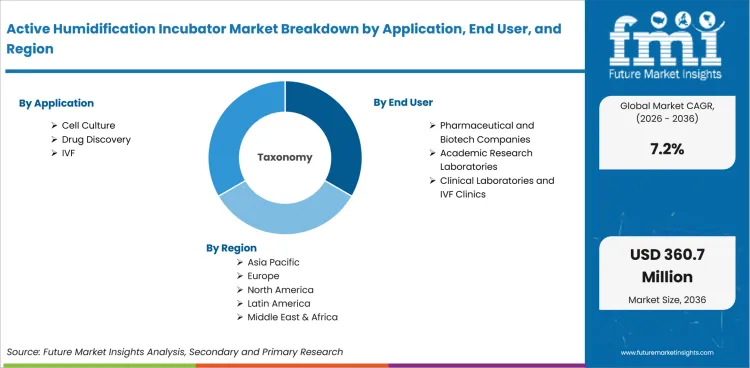
Active Humidification Incubator Market Breakdown by Application, End User, Capacity, Sales Channel, Technology, and Region
Active Humidification Incubator Market Segmented by Application
- Cell Culture
- Drug Discovery
- IVF
Active Humidification Incubator Market Segmented by End User
- Pharmaceutical and Biotech Companies
- Academic Research Laboratories
- Clinical Laboratories and IVF Clinics
Active Humidification Incubator Market Segmented by Capacity
- Below 150 Liters
- 150-250 Liters
- Above 250 Liters
Active Humidification Incubator Market Segmented by Sales Channel
- Direct Supplier Sales
- Distributor-Led Sales
- Service Contract and OEM Support Channels
Active Humidification Incubator Market Segmented by Technology
- Steam Humidification
- Ultrasonic Humidification
- Hybrid Humidification
Active Humidification Incubator Market by Region
- North America
- Latin America
- Europe
- East Asia
- South Asia and Pacific
- Middle East and Africa
Research Sources and Bibliography
- Centers for Disease Control and Prevention. (2024, December 10). Assisted reproductive technology surveillance.
- Department for Science, Innovation and Technology. (2025, October 30). GBP 55 billion R&D funding boost to unlock UK breakthroughs from health to clean energy.
- Department of Health Research. (2026, June 23). National ART and Surrogacy Registry dashboard.
- Department of Science and Technology. (2025, November 3). Research, Development, and Innovation Scheme.
- Eppendorf. (2025). CellXpert C170i CO₂ incubator performance information.
- Esco Medical. (2025, June 19). MIRI M launch announcement.
- Eurostat. (2025, December 4). EU spending on R&D exceeded EUR 403 billion in 2024.
- Eurostat. (2025). Research and development statistics at regional level.
- Food and Drug Administration. (2026, January 11). Flexible manufacturing and control requirements for cell and gene therapy products.
- Human Fertilisation and Embryology Authority. (2025, November 13). State of the fertility sector 2024 to 2025.
- Japan Science and Technology Agency. (2026). Japan Science and Technology Agency outline.
- Memmert. (2025, April). ICO CO₂ incubator operating manual.
- National Bureau of Statistics of China. (2025, February 7). China’s expenditure on research and experimental development in 2024.
- National Institutes of Health. (2026, April 24). NIH Data Book report 402: Distribution of NIH extramural awards.
- OECD. (2026, March 31). OECD overall R&D growth stable; government R&D budgets decline and reorient towards defence.
- PHC Corporation of North America. (2025, March). PHCbi MCO-171AICUVD-PA high heat CO₂ incubator product information.
- PHC Corporation of North America. (2026, June 18). PHC launches Cell-IQ CO₂ incubator series.
- Statistics Bureau of Japan. (2025, September 16). Vital statistics of Japan: Final data, 2024.
- Korean Culture and Information Service. (2025, December 29). GDP-to-R&D investment ratio in 2024 broke 5%.
- World Intellectual Property Organization. (2025, December 23). Despite the odds, global R&D spending grew again in 2024.
This bibliography is provided for reader reference and is not exhaustive. The full report contains the complete reference list and detailed citations.
This Report Answers
- Market size estimates for 2026 and forecasts through 2036 for the active humidification incubator market.
- Insights across regional and country-level laboratory equipment demand.
- Analysis of demand drivers and purchasing behavior.
- Evaluation of key applications and end users, including cell culture and biopharma laboratories.
- Assessment of humidity recovery systems and equipment validation needs.
- Identification of opportunities across application, end user, capacity, sales channel, and technology segments.
- Evaluation of service support and direct supplier sales structures.
- Country-level analysis covering India, China, South Korea, United States, Japan, Germany, United Kingdom, and France.
- Assessment of competition, including leading CO₂ incubator suppliers and IVF-focused participants.
- Analysis of replacement behavior and active humidity adoption patterns.
- Regional outlooks across North America, Europe, East Asia, and South Asia and Pacific.
- Delivery of market data, forecasts, and supporting analysis in PDF and Excel formats.
Frequently Asked Questions
What is the growth prospect for active humidification incubators?
Demand for active humidification incubators is expected to rise at a considerable pace as laboratories prioritize humidity recovery, sample protection, and chamber qualification.
Which companies are expected to shape the active humidification incubator market?
Thermo Fisher Scientific, PHCbi, Eppendorf, BINDER, Memmert, Esco Medical, ASTEC, and NuAire are expected to shape competition through CO₂ incubator portfolios, IVF workflow systems, and service support.
Why are laboratory equipment suppliers investing in active humidification incubators?
Laboratory equipment suppliers are investing in active humidification incubators to support cell culture, drug discovery, and IVF workflows that need controlled humidity after repeated chamber access.
Why are service channels important in the active humidification incubator market?
Service channels are important as buyers need installation support, calibration guidance, water-system maintenance, and qualification documents after purchase.
Which applications are gaining attention in active humidification incubators?
Cell culture and IVF are gaining attention as users seek lower evaporation risk, stronger chamber recovery, and better sample protection.
How do regulations influence active humidification incubator purchases?
Regulations influence purchases through quality documentation, cleaning records, laboratory validation, and clinical workflow requirements.
Why is humidity recovery important for active humidification incubators?
Humidity recovery is important since repeated door openings can change media evaporation and affect sample stability.
How do direct supplier sales support active humidification incubators?
Direct supplier sales support active humidification incubators through installation planning, service contracts, training, and qualification support.
Preview the report firsthand - request a free sample
Get SampleGet the brochure for pricing and purchase details.
Get PDFTable of Content
- Key Takeaways
- Market Size and CAGR
- Top Growth Driver
- Fastest Growing Segment
- Leading Region
- Key Companies
- Emerging Opportunities
- Executive Summary
- Global Market Outlook
- Demand-side Trends
- Supply-side Trends
- Technology Roadmap Analysis
- Analysis and Recommendations
- Analyst Perspective (What is happening? Why now? What should investors know?)
- Key Questions Answered
- How large is the market?
- What is the CAGR?
- What are key trends?
- Which region dominates?
- Who are the leaders?
- Market Overview
- Market Coverage / Taxonomy
- Market Definition / Scope / Limitations
- Research Methodology
- Chapter Orientation
- Analytical Lens and Working Hypotheses
- Market Structure, Signals, and Trend Drivers
- Benchmarking and Cross-market Comparability
- Market Sizing, Forecasting, and Opportunity Mapping
- Research Design and Evidence Framework
- Desk Research Programme (Secondary Evidence)
- Expert Input and Fieldwork (Primary Evidence)
- Tooling, Models, and Reference Databases
- Data Engineering and Model Build
- Quality Assurance and Audit Trail
- Market Background
- Market Dynamics (Drivers, Restraints, Opportunity, Trends)
- Scenario Forecast (Optimistic, Likely, Conservative)
- Impact Analysis
- AI Impact
- Sustainability Impact
- Regulatory Impact
- Technology Impact
- Consumer / Buyer Analysis
- Purchase Drivers
- Adoption Barriers
- Buyer Journey
- Opportunity Map Analysis
- Product Life Cycle Analysis
- Supply Chain Analysis
- Investment Feasibility Matrix
- Value Chain Analysis
- PESTLE and Porter's Analysis
- Regulatory Landscape
- Regional Parent Market Outlook
- Production and Consumption Statistics
- Import and Export Statistics
- Global Market Analysis and Forecast, 2021 to 2036
- Historical Market Size Value (USD Million) Analysis, 2021 to 2025
- Current and Future Market Size Value (USD Million) Projections, 2026 to 2036
- Y-o-Y Growth Trend Analysis
- Absolute $ Opportunity Analysis
- Global Market Pricing Analysis, 2021 to 2036
- Global Market Analysis and Forecast, By Application, 2021 to 2036
- Introduction / Key Findings
- Historical Market Size Value (USD Million) Analysis By Application, 2021 to 2025
- Current and Future Market Size Value (USD Million) Analysis and Forecast By Application, 2026 to 2036
- Cell Culture
- Drug Discovery
- IVF
- Cell Culture
- Y-o-Y Growth Trend Analysis By Application, 2021 to 2025
- Absolute $ Opportunity Analysis By Application, 2026 to 2036
- Global Market Analysis and Forecast, By End User, 2021 to 2036
- Introduction / Key Findings
- Historical Market Size Value (USD Million) Analysis By End User, 2021 to 2025
- Current and Future Market Size Value (USD Million) Analysis and Forecast By End User, 2026 to 2036
- Pharmaceutical and Biotech Companies
- Academic Research Laboratories
- Clinical Laboratories and IVF Clinics
- Pharmaceutical and Biotech Companies
- Y-o-Y Growth Trend Analysis By End User, 2021 to 2025
- Absolute $ Opportunity Analysis By End User, 2026 to 2036
- Global Market Analysis and Forecast, By Capacity, 2021 to 2036
- Introduction / Key Findings
- Historical Market Size Value (USD Million) Analysis By Capacity, 2021 to 2025
- Current and Future Market Size Value (USD Million) Analysis and Forecast By Capacity, 2026 to 2036
- 150-250 Liter
- Below 150 Liters
- Above 250 Liters
- 150-250 Liter
- Y-o-Y Growth Trend Analysis By Capacity, 2021 to 2025
- Absolute $ Opportunity Analysis By Capacity, 2026 to 2036
- Global Market Analysis and Forecast, By Sales Channel, 2021 to 2036
- Introduction / Key Findings
- Historical Market Size Value (USD Million) Analysis By Sales Channel, 2021 to 2025
- Current and Future Market Size Value (USD Million) Analysis and Forecast By Sales Channel, 2026 to 2036
- Direct Supplier Sales
- Distributor-Led Sales
- Service Contract and OEM Support Channels
- Direct Supplier Sales
- Y-o-Y Growth Trend Analysis By Sales Channel, 2021 to 2025
- Absolute $ Opportunity Analysis By Sales Channel, 2026 to 2036
- Global Market Analysis and Forecast, By Technology, 2021 to 2036
- Introduction / Key Findings
- Historical Market Size Value (USD Million) Analysis By Technology, 2021 to 2025
- Current and Future Market Size Value (USD Million) Analysis and Forecast By Technology, 2026 to 2036
- Steam Humidification
- Ultrasonic Humidification
- Hybrid Humidification
- Steam Humidification
- Y-o-Y Growth Trend Analysis By Technology, 2021 to 2025
- Absolute $ Opportunity Analysis By Technology, 2026 to 2036
- Global Market Analysis and Forecast, By Region, 2021 to 2036
- Introduction
- Historical Market Size Value (USD Million) Analysis By Region, 2021 to 2025
- Current Market Size Value (USD Million) Analysis and Forecast By Region, 2026 to 2036
- North America
- Latin America
- Western Europe
- Eastern Europe
- East Asia
- South Asia and Pacific
- Middle East & Africa
- Market Attractiveness Analysis By Region
- North America Market Analysis and Forecast, By Country, 2021 to 2036
- Historical Market Size Value (USD Million) Trend Analysis By Market Taxonomy, 2021 to 2025
- Market Size Value (USD Million) Forecast By Market Taxonomy, 2026 to 2036
- By Country
- USA
- Canada
- Mexico
- By Application
- By End User
- By Capacity
- By Sales Channel
- By Technology
- By Country
- Market Attractiveness Analysis
- By Country
- By Application
- By End User
- By Capacity
- By Sales Channel
- By Technology
- Key Takeaways
- Latin America Market Analysis and Forecast, By Country
- Historical Market Size Value (USD Million) Trend Analysis By Market Taxonomy, 2021 to 2025
- Market Size Value (USD Million) Forecast By Market Taxonomy, 2026 to 2036
- By Country
- Brazil
- Chile
- Rest of Latin America
- By Application
- By End User
- By Capacity
- By Sales Channel
- By Technology
- By Country
- Market Attractiveness Analysis
- By Country
- By Application
- By End User
- By Capacity
- By Sales Channel
- By Technology
- Key Takeaways
- Western Europe Market Analysis and Forecast, By Country
- Historical Market Size Value (USD Million) Trend Analysis By Market Taxonomy, 2021 to 2025
- Market Size Value (USD Million) Forecast By Market Taxonomy, 2026 to 2036
- By Country
- Germany
- UK
- Italy
- Spain
- France
- Nordic
- BENELUX
- Rest of Western Europe
- By Application
- By End User
- By Capacity
- By Sales Channel
- By Technology
- By Country
- Market Attractiveness Analysis
- By Country
- By Application
- By End User
- By Capacity
- By Sales Channel
- By Technology
- Key Takeaways
- Eastern Europe Market Analysis and Forecast, By Country
- Historical Market Size Value (USD Million) Trend Analysis By Market Taxonomy, 2021 to 2025
- Market Size Value (USD Million) Forecast By Market Taxonomy, 2026 to 2036
- By Country
- Russia
- Poland
- Hungary
- Balkan & Baltic
- Rest of Eastern Europe
- By Application
- By End User
- By Capacity
- By Sales Channel
- By Technology
- By Country
- Market Attractiveness Analysis
- By Country
- By Application
- By End User
- By Capacity
- By Sales Channel
- By Technology
- Key Takeaways
- East Asia Market Analysis and Forecast, By Country
- Historical Market Size Value (USD Million) Trend Analysis By Market Taxonomy, 2021 to 2025
- Market Size Value (USD Million) Forecast By Market Taxonomy, 2026 to 2036
- By Country
- China
- Japan
- South Korea
- By Application
- By End User
- By Capacity
- By Sales Channel
- By Technology
- By Country
- Market Attractiveness Analysis
- By Country
- By Application
- By End User
- By Capacity
- By Sales Channel
- By Technology
- Key Takeaways
- South Asia and Pacific Market Analysis and Forecast, By Country
- Historical Market Size Value (USD Million) Trend Analysis By Market Taxonomy, 2021 to 2025
- Market Size Value (USD Million) Forecast By Market Taxonomy, 2026 to 2036
- By Country
- India
- ASEAN
- Australia & New Zealand
- Rest of South Asia and Pacific
- By Application
- By End User
- By Capacity
- By Sales Channel
- By Technology
- By Country
- Market Attractiveness Analysis
- By Country
- By Application
- By End User
- By Capacity
- By Sales Channel
- By Technology
- Key Takeaways
- Middle East & Africa Market Analysis and Forecast, By Country
- Historical Market Size Value (USD Million) Trend Analysis By Market Taxonomy, 2021 to 2025
- Market Size Value (USD Million) Forecast By Market Taxonomy, 2026 to 2036
- By Country
- Kingdom of Saudi Arabia
- Other GCC Countries
- Türkiye
- South Africa
- Other African Union
- Rest of Middle East & Africa
- By Application
- By End User
- By Capacity
- By Sales Channel
- By Technology
- By Country
- Market Attractiveness Analysis
- By Country
- By Application
- By End User
- By Capacity
- By Sales Channel
- By Technology
- Key Takeaways
- Key Countries Market Analysis
- USA
- Pricing Analysis
- Market Share Analysis, 2025
- By Application
- By End User
- By Capacity
- By Sales Channel
- By Technology
- Canada
- Pricing Analysis
- Market Share Analysis, 2025
- By Application
- By End User
- By Capacity
- By Sales Channel
- By Technology
- Mexico
- Pricing Analysis
- Market Share Analysis, 2025
- By Application
- By End User
- By Capacity
- By Sales Channel
- By Technology
- Brazil
- Pricing Analysis
- Market Share Analysis, 2025
- By Application
- By End User
- By Capacity
- By Sales Channel
- By Technology
- Chile
- Pricing Analysis
- Market Share Analysis, 2025
- By Application
- By End User
- By Capacity
- By Sales Channel
- By Technology
- Germany
- Pricing Analysis
- Market Share Analysis, 2025
- By Application
- By End User
- By Capacity
- By Sales Channel
- By Technology
- UK
- Pricing Analysis
- Market Share Analysis, 2025
- By Application
- By End User
- By Capacity
- By Sales Channel
- By Technology
- Italy
- Pricing Analysis
- Market Share Analysis, 2025
- By Application
- By End User
- By Capacity
- By Sales Channel
- By Technology
- Spain
- Pricing Analysis
- Market Share Analysis, 2025
- By Application
- By End User
- By Capacity
- By Sales Channel
- By Technology
- France
- Pricing Analysis
- Market Share Analysis, 2025
- By Application
- By End User
- By Capacity
- By Sales Channel
- By Technology
- India
- Pricing Analysis
- Market Share Analysis, 2025
- By Application
- By End User
- By Capacity
- By Sales Channel
- By Technology
- ASEAN
- Pricing Analysis
- Market Share Analysis, 2025
- By Application
- By End User
- By Capacity
- By Sales Channel
- By Technology
- Australia & New Zealand
- Pricing Analysis
- Market Share Analysis, 2025
- By Application
- By End User
- By Capacity
- By Sales Channel
- By Technology
- China
- Pricing Analysis
- Market Share Analysis, 2025
- By Application
- By End User
- By Capacity
- By Sales Channel
- By Technology
- Japan
- Pricing Analysis
- Market Share Analysis, 2025
- By Application
- By End User
- By Capacity
- By Sales Channel
- By Technology
- South Korea
- Pricing Analysis
- Market Share Analysis, 2025
- By Application
- By End User
- By Capacity
- By Sales Channel
- By Technology
- Russia
- Pricing Analysis
- Market Share Analysis, 2025
- By Application
- By End User
- By Capacity
- By Sales Channel
- By Technology
- Poland
- Pricing Analysis
- Market Share Analysis, 2025
- By Application
- By End User
- By Capacity
- By Sales Channel
- By Technology
- Hungary
- Pricing Analysis
- Market Share Analysis, 2025
- By Application
- By End User
- By Capacity
- By Sales Channel
- By Technology
- Kingdom of Saudi Arabia
- Pricing Analysis
- Market Share Analysis, 2025
- By Application
- By End User
- By Capacity
- By Sales Channel
- By Technology
- Türkiye
- Pricing Analysis
- Market Share Analysis, 2025
- By Application
- By End User
- By Capacity
- By Sales Channel
- By Technology
- South Africa
- Pricing Analysis
- Market Share Analysis, 2025
- By Application
- By End User
- By Capacity
- By Sales Channel
- By Technology
- USA
- Market Structure Analysis
- Competition Dashboard
- Competition Benchmarking
- Market Share Analysis of Top Players
- By Regional
- By Application
- By End User
- By Capacity
- By Sales Channel
- By Technology
- Emerging Startups
- Innovation Benchmarking
- Competition Analysis
- Competition Deep Dive
- Thermo Fisher Scientific
- Overview
- Product Portfolio
- Profitability by Market Segments (Product/Region/Sales Channel)
- Sales Footprint
- Strategy Overview
- Marketing Strategy
- Product Strategy
- Channel Strategy
- PHCbi
- Eppendorf
- BINDER
- Memmert
- Esco Medical
- Thermo Fisher Scientific
- Case Studies
- Success Stories
- Recent Developments
- Competition Deep Dive
- Assumptions & Acronyms Used


