

- Market Size (2026)
- USD 1.9 Bn
- Forecast (2036)
- USD 11.3 Bn
- CAGR (2026 to 2036)
- 19.5%
How big is AI Sales Development Representative Market size?
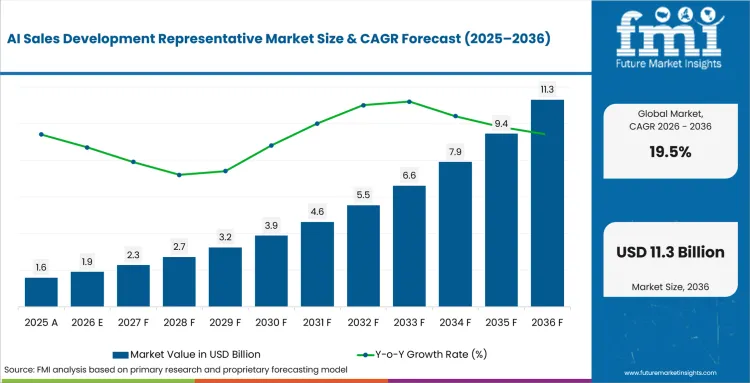
USD 1.9 billion in 2026 and USD 11.3 billion by 2036 at a 19.5% CAGR.
Demand for AI sales development representative is projected to expand at 19.5% CAGR between 2026 and 2036, increasing valuation from USD 1.9 billion in 2026 to USD 11.3 billion by 2036. Sales teams adopt AI sales development representative software to streamline sales intelligence and automate CRM record updates. Microsoft reported a 15.1% boost in lead-to-opportunity conversions for its Sales Development Agent in November 2025. Measurable qualification results provide clear justification during corporate budget reviews. Enterprise buyers award commercial approval on prospecting programs delivering high-quality meetings and reliable message delivery.
Buyers in Singapore and Australia prioritize prompt software setup across distributed teams alongside strong multilingual prospecting capabilities. Organizations in the United States and Germany require formal security reviews and detailed consent records before implementing enterprise AI tools. Eurostat confirmed for 20.0% of European Union businesses having integrated artificial intelligence tools during 2025 in a report published in December 2025. Daily familiarity with digital tools enables corporate leaders to deploy specialized AI agents safely under defined human oversight.
Key Takeaways for the AI Sales Development Representative Market
- Demand receives support from sales teams seeking greater prospect coverage without proportional increases in manual research and repetitive outreach effort.
- Cloud is set to garner 68.0% share of deployment in 2026, aided by shared access and centrally maintained software updates across distributed sales groups.
- Direct sales are forecasted to lead distribution channel with 44.0% share in 2026, guided by complex enterprise evaluations and customer-specific configuration requirements.
- Weak account records and excessive contact frequency restrain recurring adoption across customer programs, with unclear consent ownership adding further commercial exposure.
- Competition includes 11x.ai, Artisan AI, Regie.ai, AiSDR, and Salesforge across AI-native sales development. Reply.io, Outreach, Apollo.io, ZoomInfo, and HubSpot complete the profiled provider set.
Analyst Perspective
“AI sales development representative software creates commercial value by converting account evidence into controlled prospecting activity. Sales leaders examine accepted meetings and qualified opportunities during provider review, with complaints and human corrections adding essential operating evidence. Sustained adoption requires accurate CRM context and disciplined outreach frequency across every approved target group.”
- Sudip saha, Principal Analyst for Technology at Future Market Insights
How is AI Sales Development Representative Market segmented?
The AI sales development representative industry is segmented by product type, application, end user, distribution channel, deployment, and region.
The AI sales development representative sector is segmented by product type, application, end user, distribution channel, deployment, and region. Product type includes cloud-based AI SDR platforms, conversational AI SDR solutions, lead intelligence platforms, sales engagement platforms, and custom AI SDR solutions. Application coverage includes lead generation, sales outreach, meeting scheduling, pipeline management, and customer re-engagement. end user analysis spans large enterprises, small & medium enterprises, technology companies, BFSI, and healthcare organizations. Distribution channel includes direct sales, channel partners, cloud marketplace, online subscription, and managed service providers. Deployment coverage includes cloud, hybrid, and on-premise systems serving distinct hosting requirements. Regional assessment includes North America, Europe, East Asia, South Asia and Pacific, Latin America, and Middle East and Africa.
What supports cloud-based AI SDR platforms across product type?
HubSpot reported more than 15 Breeze Agents across marketing and service during October 2025, demonstrating connected agent families supported through unified customer context. Integrated records improve account research and maintain consistent prospecting rules across sales teams. Cloud-based AI SDR platforms combine prospect research with outreach preparation inside one shared service. Response classification and CRM updates extend workflow coverage across distributed sales groups.
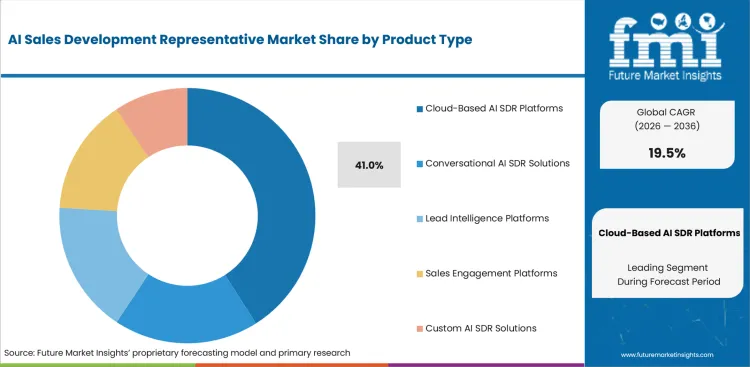
- Cloud-based AI SDR platforms are predicted to represent 41.0% share in 2026, influenced by unified access to prospect records and centrally maintained outreach rules. Enterprise buyers examine data permissions and CRM synchronization during review because correction workflows determine approval for wider seat allocation across participating sales teams.
- Conversational AI SDR solutions and lead intelligence platforms address specialized engagement or research needs across defined sales motions. Custom AI SDR Solutions support organizations requiring proprietary account models and private knowledge sources.
Why does lead generation lead application demand?
Lead generation starts with prospect identification and qualification across defined account criteria. Account research gains commercial value if contact records and buying signals produce sales-ready conversations through lead scoring software. Apollo reported more than 47 million targeted prospecting actions during 2025 in its May 2025 release, demonstrating substantial activity across automated account research and engagement. Sales leaders judge program quality through accepted meetings and qualified opportunities instead of activity volume.
- By application, lead generation is anticipated to account for 33.0% share in 2026, led by demand for prospect identification and lead qualification across recurring campaigns. Provider approval improves through documented contact accuracy and exclusion controls, as defined transfer points preserve human sales capacity during qualified prospect handoffs.
- Sales outreach and meeting scheduling extend value across message delivery and calendar coordination during active prospecting programs. Pipeline management and customer re-engagement require deeper CRM history since earlier interactions and recorded opportunity status shape every recommended account action.
What supports large enterprises across end user demand?
Eurostat reported AI use among 55.0% of large European Union businesses during 2025 in its March 2026 publication, establishing substantial readiness for governed sales automation. Scale strengthens enterprise adoption if data access and brand controls remain consistent across operating regions. Large enterprises manage extensive target lists across multiple sales territories and detailed approval policies. Central revenue operations teams maintain CRM fields and message libraries across business units.
- Large enterprises are likely to hold 39.0% share of end user in 2026, guided by extensive prospect pools and established revenue operations functions. Multi-country teams assess identity controls and audit records during enterprise review.
- Small & medium enterprises value lower administrative effort and simpler configuration across focused sales teams. Healthcare organizations emphasize regulated communications and clearly assigned approval responsibility throughout customer engagement.
How does direct sales shape distribution channel demand?
Direct Sales supports complex platform reviews involving sales leadership and revenue operations. Security and legal teams examine technical controls and communication obligations through provider-led demonstrations. Federal Trade Commission data published in December 2025 recorded about 258.5 million active registrations on its National Do Not Call Registry at fiscal year-end, reinforcing exclusion controls across outbound contact programs. Provider-led engagement increases control over implementation scope and compliance discussion across customer evaluations.
- Based on distribution channel, direct sales are projected to secure 44.0% share in 2026 since being reflected by enterprise demand for tailored demonstrations and negotiated operating controls. Integration planning and defined success criteria complete commercial assessment across enterprise purchasing discussions.
- Channel partners and managed service providers support customers requiring integration assistance across several connected systems. Cloud marketplace and online subscription routes favor standardized purchases and simpler administration.
What keeps cloud central to deployment selection?
German Federal Statistical Office data dated November 2025 showed 54.0% of enterprises purchased cloud computing services during 2025, confirming extensive familiarity with externally hosted business applications. Security review remains essential since prospect records and message histories contain commercially sensitive information. Public cloud application services offer shared access across distributed sales groups and centrally maintained model updates. API connections support CRM synchronization and connect email systems without separate local installations.
- In 2026, cloud is predicted to account for 68.0% share due to centralized administration and quicker access across geographically distributed teams. Buyers examine tenant separation and regional hosting during expansion review, with retention settings and CRM permissions completing technical assessment.
- Hybrid and on-premise deployment support organizations requiring local control over account records or proprietary sales knowledge. Added infrastructure duties increase implementation effort across model updates and monitoring, with integration administration extending internal support requirements.
What are drivers, restraints, and opportunities in AI Sales Development Representative Market?
Administrative workload supports adoption across sales teams and weak account evidence delays enterprise conversion. Controlled prospecting with human approval creates expansion potential across repeatable sales motions.
- Driver: Sales teams pursue wider account coverage without adding equivalent research headcount. Automated record updates and scheduled follow-ups reduce routine effort across recurring prospecting programs.
- Restraint: Poor account accuracy disrupts message delivery and weakens confidence in automated outreach. Repeated contact across unsuitable prospects lowers meeting quality and raises correction work for sales teams.
- Opportunity: Providers may concentrate on clearly defined prospecting activities reviewed by designated sales managers. Measured contact frequency and traceable pipeline outcomes improve buyer confidence during commercial assessment.
Sales representatives spend substantial time on administration and meeting preparation across routine customer activity. Salesforce reported non-selling tasks consumed 70.0% of sales representatives’ time in July 2024, demonstrating material capacity loss across prospect research and record maintenance. Automated research and CRM updates release more time for customer conversations if generated activity meets account-selection and message-quality standards.
Data preparation limits model quality across prospect research and personalized outreach programs. German Federal Statistical Office data dated November 2025 found 44.0% of enterprises considering artificial intelligence cited difficulties with required data availability or quality, highlighting preparation demands affecting model reliability. Incomplete CRM records raise correction effort and weaken qualification results across enterprise evaluations.
Outcome-linked commercial models create expansion potential for providers demonstrating dependable prospect recommendations. HubSpot reported customers using Prospecting Agent booked 80.0% more meetings during June 2026, connecting account research with measurable sales outcomes across customer programs. Continued adoption rests on customer acceptance of recommendation accuracy and operating controls.
How are country CAGRs aligned in AI Sales Development Representative Market?
| Country | CAGR |
|---|---|
| Singapore | 25.1% |
| Australia | 20.6% |
| Japan | 20.0% |
| Canada | 19.2% |
| USA | 14.9% |
| Germany | 14.5% |
| UK | 13.8% |
Source: Future Market Insights analysis, 2026.
How do country-level CAGRs compare in AI Sales Development Representative Market?
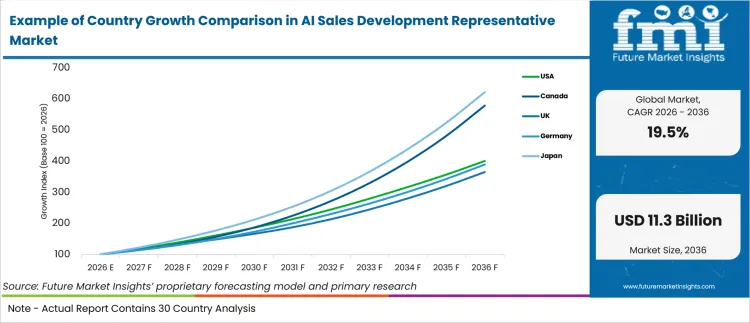
Country comparison shows a gradual step-down across profiled markets under distinct enterprise adoption and operating conditions. Singapore occupies the upper forecast position, followed by Australia at a measured distance across disclosed national rates. Japan and Canada form the middle forecast band through differing privacy controls and business-software readiness. The United States and Germany occupy closely grouped positions under extensive enterprise review and documentation requirements. UK completes disclosed comparison under established artificial intelligence use and detailed direct-marketing controls. An 11.3 percentage-point spread separates Singapore from United Kingdom, reflecting national differences across enterprise readiness and outbound-contact governance.
- Singapore establishes South Asia and Pacific as the lead development cluster across disclosed markets, with its enterprise AI readiness supporting stronger platform assessment.
- Australia follows Singapore and maintains a measured difference from first position, supported by business software adoption across geographically dispersed sales teams.
- Japan and Canada form the middle forecast band based on privacy-led enterprise review and growing interest in customer-facing artificial intelligence applications.
- USA and Germany occupy the next rate group under extensive software participation and documentation-intensive approval practices across enterprise sales organizations.
- UK completes disclosed comparison through established artificial intelligence use and detailed direct-marketing controls governing prospect contact programs.
Markets carrying similar CAGRs are expected to present distinct entry conditions through integration complexity and consent maintenance. Full report coverage includes North America, Europe, East Asia, South Asia and Pacific, Latin America, and Middle East and Africa.
Country-wise Analysis
- AI sales development representative market in Singapore is set to scale at 25.1% CAGR from 2026 to 2036, led by regional headquarters pursuing repeatable prospecting across Asia-Pacific accounts. Infocomm Media Development Authority reported 62.5% of non-SMEs adopted artificial intelligence during 2024 in its October 2025 release, establishing substantial enterprise readiness for software-assisted operations. Controlled multilingual outreach and clear customer-data permissions support provider entry across regional sales programs.
- Australian Bureau of Statistics reported 12.0% of businesses used artificial intelligence during 2024-25 in its June 2026 release, demonstrating an expanding base for software-assisted business activity. Enterprise sales automation supports Australia as forecasted to increase at 20.6% CAGR across the assessment period, driven by prospect research and follow-up across dispersed teams. Service coverage and message review shape provider approval across national customer accounts.
- Sector in Japan as predicted to rise at 20.0% CAGR during the study period, influenced by privacy-led enterprise review shaping AI sales development representative selection. Personal Information Protection Commission of Japan recorded 7,735 directly reported personal-data leak cases during fiscal 2024 first-half reporting in its May 2025 release, reinforcing careful access control across customer records. Traceable account sources and human message review improve provider acceptance across formal enterprise programs.
- Statistics Canada reported 25.6% of businesses planning artificial intelligence use identified marketing automation as an intended application in September 2025, demonstrating interest in customer-facing automation. Industry in Canada is projected to record 19.2% CAGR between 2026 and 2036, reflecting planned use across marketing and service functions. Clear workflow ownership and documented CRM changes support wider deployment across national sales teams.
- Demand in the United States is forecast to expand at 14.9% CAGR by 2036, guided by extensive enterprise software participation supports deep provider choice. USA Census Bureau reported artificial intelligence use reached 39.7% across Information-sector businesses in May 2026, establishing a technology-oriented buyer base for specialized sales agents. Complex consent requirements and security review moderate national deployment across outbound programs.
- Adoption in Germany is estimated to progress at 14.5% CAGR from 2026 to 2036, backed by enterprise demand moderated by formal legal and system reviews. German Federal Statistical Office data dated November 2025 showed 27.0% of artificial intelligence users applied it to workflow automation or decision-making, demonstrating operational familiarity across business functions. Precise data sources and retention rules support provider review across customer prospecting programs.
- Office for National Statistics reported 25.0% of businesses used some form of artificial intelligence in late December 2025 through its January 2026 release, supporting sales-agent assessment across established organizations. Direct-marketing obligations keep consent evidence and suppression lists central to provider selection across UK sales teams. Sales in the United Kingdom are anticipated to grow at 13.8% CAGR during the assessment period, aided by detailed message governance and enterprise review.
Who are notable companies in AI Sales Development Representative Market?
11x.ai, Artisan AI, Regie.ai, AiSDR, Salesforge, Reply.io, Outreach, Apollo.io, ZoomInfo, and HubSpot are notable companies shaping AI sales development representative competition.
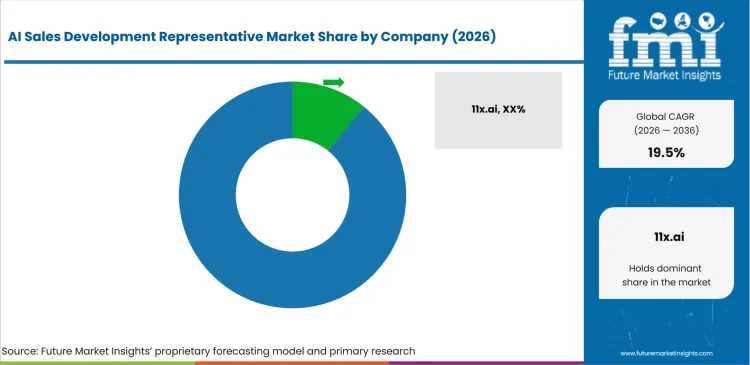
Competition centers on prospect-data depth and workflow coverage across recurring sales programs. AI-native providers focus on autonomous account research and controlled outreach across defined sales motions. Sales-engagement platforms connect agent functions with established sequencing tools and account-management processes across enterprise revenue teams. Data and CRM platforms use existing contact records and customer histories to strengthen recommendation context. Buyer review covers correction effort and consent handling during implementation and renewal.
- 11x.ai and Artisan AI compete based on autonomous prospect research connected with personalized outreach and meeting coordination. Customer teams assess message approval and human transfer quality across recurring outbound programs.
- Regie.ai and AiSDR compete driven by signal-based account selection connected with multichannel engagement and qualification support. Sales leaders examine contact accuracy and accepted-meeting quality during provider evaluation.
- Salesforge, Reply.io, and Outreach compete depending on integrated engagement workflows and established delivery controls across complex sales teams. Enterprise buyers assess CRM synchronization and message governance during wider account coverage.
- Apollo.io, ZoomInfo, and HubSpot compete led by extensive business records connected with prospecting assistance and customer context. Buyer review considers account-source transparency and correction requirements across repeatable sales motions.
Competitive Benchmarking: AI Sales Development Representative Market
| Company | Prospecting Workflow | Account Intelligence | Governance Support | Service Reach |
|---|---|---|---|---|
| 11x.ai | High | High | Medium | Multi-country |
| Artisan AI | High | High | Medium | Multi-country |
| Regie.ai | High | High | High | Multi-country |
| AiSDR | High | Medium | Medium | Multi-country |
| Salesforge | High | Medium | Medium | Multi-country |
| Reply.io | High | Medium | Medium | Global |
| Outreach | High | High | High | Global |
| Apollo.io | High | High | High | Global |
| ZoomInfo | Medium | High | High | Global |
| HubSpot | High | High | High | Global |
Source: Future Market Insights competitive analysis, 2026.
Key Developments in AI Sales Development Representative Market
- In April 2025, HubSpot expanded Breeze Prospecting Agent through selling profiles and automated target-account research across additional sales workspaces. Company information connected deeper customer context with improved account selection and reduced manual research across HubSpot-based sales teams.
- In May 2025, Outreach released AI Revenue Agent for autonomous prospect targeting through signal-based account selection and enriched research. Company information connected automated personalization with repeatable outbound engagement across existing and newly identified prospects.
- In October 2025, Apollo.io launched an agentic end-to-end GTM platform linking prospecting with inbound engagement and data enrichment. Company information connected coordinated agents with expanded artificial intelligence participation across multiple revenue-work stages.
AI Sales Development Representative Market Report Scope
| Coverage field | Report scope |
|---|---|
| Market breakdown | AI sales development representative market breakdown includes product type, application, end user, distribution channel, deployment, and region. |
| Quantitative Units | Revenue in USD Million, CAGR in %. |
| Market Definition | AI sales development representative software applies artificial intelligence to prospect research and outreach preparation. Response qualification and meeting scheduling support early sales activity. CRM updates and controlled customer re-engagement complete defined software coverage. Generic CRM software without sales-development intelligence is excluded. |
| Regions Covered | North America, Europe, East Asia, South Asia and Pacific, Latin America, and Middle East and Africa. |
| Countries Covered | Singapore, Australia, Japan, Canada, USA, Germany, UK, and additional countries complete full report coverage. |
| Key Companies Profiled | 11x.ai, Artisan AI, Regie.ai, AiSDR, Salesforge, Reply.io, Outreach, Apollo.io, ZoomInfo, and HubSpot. |
| Forecast Period | 2026 to 2036 |
| Approach | Hybrid bottom-up and top-down methodology uses segment shares and country CAGRs. Company activity and buyer adoption support final market reconciliation. |
Source: Future Market Insights analysis, 2026.
AI Sales Development Representative Market - Research Methodology
| Method | Approach |
|---|---|
| Primary Research | FMI analysts gathered input from manufacturers, service providers, technology developers, distributors, end users, procurement teams, and subject-matter experts. Interviews examined purchasing decisions, product or service evaluation, adoption barriers, approval requirements, pricing considerations, and expectations for technical or commercial support. Respondents were also asked what evidence is required before a trial, pilot, or initial order develops into regular purchasing. |
| Desk Research | Desk research covered government statistics, regulatory publications, trade data, industry associations, technical literature, standards, company filings, product information, and official corporate announcements. Sources were reviewed for relevance, publication date, geographic coverage, and consistency with the defined market scope. Claims relating to performance, applications, approvals, capacity, investment, and commercial activity were retained only when supported by credible public evidence. |
| Market Sizing and Forecasting | The market model combined the baseline value with historical performance, segment structure, pricing and volume indicators, adoption levels, company participation, and country-level demand conditions. Forecast assumptions considered economic activity, investment trends, regulatory developments, technology adoption, purchasing cycles, supply availability, and barriers to wider market use. Segment and regional estimates were reconciled before the final market total was calculated. |
| Data Validation | Estimates were checked against multiple independent indicators, including public data, company activity, trade patterns, industry developments, and findings from primary interviews. Validation also tested whether products, services, applications, and company revenues fell within the defined market boundaries. Adjacent categories, unsupported claims, overlapping revenues, and activities without direct market relevance were excluded to reduce double counting and maintain consistency across segments and countries. |
Source: Future Market Insights analysis, 2026.
AI Sales Development Representative Market by Segments
AI Sales Development Representative Market segmented by Product Type:
- Cloud-Based AI SDR Platforms
- Conversational AI SDR Solutions
- Lead Intelligence Platforms
- Sales Engagement Platforms
- Custom AI SDR Solutions
AI Sales Development Representative Market segmented by Application:
- Lead Generation
- Sales Outreach
- Meeting Scheduling
- Pipeline Management
- Customer Re-engagement
AI Sales Development Representative Market segmented by End User:
- Large Enterprises
- Small & Medium Enterprises
- Technology Companies
- BFSI
- Healthcare Organizations
AI Sales Development Representative Market segmented by Distribution Channel:
- Direct Sales
- Channel Partners
- Cloud Marketplace
- Online Subscription
- Managed Service Providers
AI Sales Development Representative Market segmented by Deployment:
- Cloud
- Hybrid
- On-Premise
AI Sales Development Representative Market segmented by Region:
- North America
- United States
- Canada
- Latin America
- Brazil
- Mexico
- Argentina
- Chile
- Western Europe
- Germany
- France
- United Kingdom
- Italy
- Spain
- Benelux
- Nordics
- Eastern Europe
- Poland
- Czech Republic
- Romania
- Hungary
- East Asia
- China
- Japan
- South Korea
- South Asia and Pacific
- India
- ASEAN
- Australia and New Zealand
- Middle East and Africa
- GCC Countries
- South Africa
- Türkiye
- Israel
Research Sources and Bibliography
- Goode, B. (2025, November 18). Microsoft Ignite 2025: Powering Frontier Firms with agentic business applications. Microsoft.
- Eurostat. (2025, December 11). 20% of EU enterprises use AI technologies.
- HubSpot Communications. (2025, October 6). From blueprint to breakthrough: HubSpot launches 200+ products to drive growth with hybrid human-AI teams.
- The Apollo Team. (2025, May 14). Apollo.io achieves 500% growth with AI sales platform, plans to add 300 team members.
- Eurostat. (2026, March 26). The use of artificial intelligence technologies in the European Union - Key results - 2026 edition.
- Federal Trade Commission. (2025, December 4). National Do Not Call Registry Data Book for Fiscal Year 2025.
- German Federal Statistical Office. (2025, November 24). Enterprises using cloud computing services.
- Salesforce. (2024, July 25). Salesforce report: Sales teams using AI 1.3x more likely to see revenue increase.
- German Federal Statistical Office. (2025, November 24). Reasons against the use of artificial intelligence technologies, by employment size class.
- HubSpot Communications. (2026, June 25). HubSpot data: AI is driving real outcomes for GTM teams.
- Infocomm Media Development Authority. (2025, October 6). Annual Report 2024/2025.
- Australian Bureau of Statistics. (2026, June 25). Characteristics of Australian Business, 2024-25 financial year.
- Personal Information Protection Commission of Japan. (2025, May 26). Privacy Awareness Week 2025 (26th May-1st June).
- Bryan, V., Sood, S., & Johnston, C. (2025, September 11). Analysis on expected use of artificial intelligence by businesses in Canada, third quarter of 2025. Statistics Canada.
- Grundy, A., Breaux, C., & Khatiwoda, D. (2026, May 26). Large Firms With at Least 20 Employees Biggest AI Users. USA Census Bureau.
- German Federal Statistical Office. (2025, November 24). Enterprises using artificial intelligence (AI) technologies, by employment size class.
- Office for National Statistics. (2026, January 8). Business insights and impact on the UK economy: 8 January 2026.
- HubSpot. (2025, April 10). HubSpot launches new and enhanced AI agents, plus over 200 updates at Spring 2025 Spotlight.
- Outreach. (2025, May 15). Outreach Product Release Notes - May 2025.
- The Apollo Team. (2025, October 9). Apollo.io unveils industry’s first fully agentic end-to-end GTM platform, redefining how companies drive revenue in the AI era.
This bibliography is provided for reader reference and is not exhaustive. The full report contains the complete reference list and detailed citations.
This Report Answers
- How do product type and application influence demand across end user and distribution channel coverage?
- What criteria guide sales teams evaluating AI sales development representative software prior to enterprise use?
- Why do country CAGRs differ across profiled national markets under distinct adoption and operating controls?
- What companies compete through prospect-data depth and controlled sales-development workflow coverage?
- How are forecasts validated through bottom-up and top-down analysis using independent operating indicators?
- What evidence supports company review prior to multi-team AI sales development representative deployment?
- Why do account accuracy and consent records influence provider selection across outbound prospecting programs?
- How does weak CRM preparation limit return across integration and correction work during enterprise adoption?
- How do human approval records influence acceptance across sales and revenue operations teams?
- What company capabilities improve long-term customer confidence and recurring platform use across approved programs?
Frequently Asked Questions
How big is the AI Sales Development Representative Market in 2026?
The AI sales development representative market is valued at USD 1.9 billion in 2026 and is forecast to reach USD 11.3 billion by 2036. Growth is supported by rising enterprise demand for automated prospect coverage, with Microsoft reporting a 15.1% boost in lead-to-opportunity conversions for its Sales Development Agent, giving sales leadership measurable justification for budget approval across prospecting programs.
What is the CAGR of the AI Sales Development Representative Market from 2026 to 2036?
The AI sales development representative market grows at a CAGR of 19.5% between 2026 and 2036, supported by sales teams adopting automated research and CRM record updates once providers demonstrate dependable contact accuracy, controlled outreach frequency, and clearly assigned human review steps across enterprise qualification and meeting-booking workflows.
Which product type leads the AI Sales Development Representative Market?
Cloud-based AI SDR platforms account for 41.0% of the AI sales development representative market by product type in 2026, driven by unified access to prospect records and centrally maintained outreach rules across distributed sales groups, where CRM synchronization and data-permission controls form the primary criteria during enterprise seat-allocation review.
How much will the AI Sales Development Representative Market add between 2026 and 2036?
The AI sales development representative market is set to add USD 9.4 billion between 2026 and 2036, growing from USD 1.9 billion to USD 11.3 billion as cloud-based prospecting platforms, conversational engagement solutions, and outcome-linked commercial models enter funded enterprise sales programs across technology, BFSI, and healthcare organizations in both established and high-growth national markets.
Who are the leading companies in the AI Sales Development Representative Market?
Ten companies lead the AI sales development representative market, including 11x.ai, Artisan AI, Regie.ai, AiSDR, Salesforge, Reply.io, Outreach, Apollo.io, ZoomInfo, and HubSpot, competing through autonomous prospect research, signal-based account selection, integrated engagement workflows, and extensive business-record depth across enterprise revenue teams in multi-country and global sales programs.
Preview the report firsthand - request a free sample
Get SampleGet the brochure for pricing and purchase details.
Get PDFTable of Content
- Key Takeaways
- Market Size and CAGR
- Top Growth Driver
- Fastest Growing Segment
- Leading Region
- Key Companies
- Emerging Opportunities
- Executive Summary
- Global Market Outlook
- Demand-side Trends
- Supply-side Trends
- Technology Roadmap Analysis
- Analysis and Recommendations
- Analyst Perspective (What is happening? Why now? What should investors know?)
- Key Questions Answered
- How large is the market?
- What is the CAGR?
- What are key trends?
- Which region dominates?
- Who are the leaders?
- Market Overview
- Market Coverage / Taxonomy
- Market Definition / Scope / Limitations
- Research Methodology
- Chapter Orientation
- Analytical Lens and Working Hypotheses
- Market Structure, Signals, and Trend Drivers
- Benchmarking and Cross-market Comparability
- Market Sizing, Forecasting, and Opportunity Mapping
- Research Design and Evidence Framework
- Desk Research Programme (Secondary Evidence)
- Expert Input and Fieldwork (Primary Evidence)
- Tooling, Models, and Reference Databases
- Data Engineering and Model Build
- Quality Assurance and Audit Trail
- Market Background
- Market Dynamics (Drivers, Restraints, Opportunity, Trends)
- Scenario Forecast (Optimistic, Likely, Conservative)
- Impact Analysis
- AI Impact
- Sustainability Impact
- Regulatory Impact
- Technology Impact
- Consumer / Buyer Analysis
- Purchase Drivers
- Adoption Barriers
- Buyer Journey
- Opportunity Map Analysis
- Product Life Cycle Analysis
- Supply Chain Analysis
- Investment Feasibility Matrix
- Value Chain Analysis
- PESTLE and Porter's Analysis
- Regulatory Landscape
- Regional Parent Market Outlook
- Production and Consumption Statistics
- Import and Export Statistics
- Global Market Analysis and Forecast, 2021 to 2036
- Historical Market Size Value (USD Billion) Analysis, 2021 to 2025
- Current and Future Market Size Value (USD Billion) Projections, 2026 to 2036
- Y-o-Y Growth Trend Analysis
- Absolute $ Opportunity Analysis
- Global Market Pricing Analysis, 2021 to 2036
- Global Market Analysis and Forecast, By Product Type, 2021 to 2036
- Introduction / Key Findings
- Historical Market Size Value (USD Billion) Analysis By Product Type, 2021 to 2025
- Current and Future Market Size Value (USD Billion) Analysis and Forecast By Product Type, 2026 to 2036
- Cloud-Based AI SDR Platforms
- AI Prospecting Platforms
- AI Outreach Platforms
- Conversational AI SDR Solutions
- AI Voice Agents
- AI Chat Agents
- Lead Intelligence Platforms
- Intent Data Platforms
- Lead Enrichment Platforms
- Sales Engagement Platforms
- Email Automation
- Multichannel Engagement
- Custom AI SDR Solutions
- Enterprise AI SDR
- Tailored AI Agents
- Cloud-Based AI SDR Platforms
- Y-o-Y Growth Trend Analysis By Product Type, 2021 to 2025
- Absolute $ Opportunity Analysis By Product Type, 2026 to 2036
- Global Market Analysis and Forecast, By Application, 2021 to 2036
- Introduction / Key Findings
- Historical Market Size Value (USD Billion) Analysis By Application, 2021 to 2025
- Current and Future Market Size Value (USD Billion) Analysis and Forecast By Application, 2026 to 2036
- Lead Generation
- Prospect Identification
- Lead Qualification
- Sales Outreach
- Email Outreach
- LinkedIn Outreach
- Meeting Scheduling
- Calendar Automation
- Follow-up Scheduling
- Pipeline Management
- Opportunity Tracking
- Sales Forecasting
- Customer Re-engagement
- Win-back Campaigns
- Retention Outreach
- Lead Generation
- Y-o-Y Growth Trend Analysis By Application, 2021 to 2025
- Absolute $ Opportunity Analysis By Application, 2026 to 2036
- Global Market Analysis and Forecast, By End User, 2021 to 2036
- Introduction / Key Findings
- Historical Market Size Value (USD Billion) Analysis By End User, 2021 to 2025
- Current and Future Market Size Value (USD Billion) Analysis and Forecast By End User, 2026 to 2036
- Large Enterprises
- Global Enterprises
- Multinational Corporations
- Small & Medium Enterprises
- Small Businesses
- Mid-sized Businesses
- Technology Companies
- SaaS Companies
- IT Service Providers
- BFSI
- Banking
- Financial Services
- Healthcare Organizations
- Pharma Companies
- Healthcare Providers
- Large Enterprises
- Y-o-Y Growth Trend Analysis By End User, 2021 to 2025
- Absolute $ Opportunity Analysis By End User, 2026 to 2036
- Global Market Analysis and Forecast, By Distribution Channel, 2021 to 2036
- Introduction / Key Findings
- Historical Market Size Value (USD Billion) Analysis By Distribution Channel, 2021 to 2025
- Current and Future Market Size Value (USD Billion) Analysis and Forecast By Distribution Channel, 2026 to 2036
- Direct Sales
- Enterprise Sales
- Inside Sales
- Channel Partners
- Value Added Resellers
- System Integrators
- Cloud Marketplace
- SaaS Marketplaces
- App Marketplaces
- Online Subscription
- Vendor Websites
- Self-Service Portals
- Managed Service Providers
- AI Consulting Firms
- IT Service Providers
- Direct Sales
- Y-o-Y Growth Trend Analysis By Distribution Channel, 2021 to 2025
- Absolute $ Opportunity Analysis By Distribution Channel, 2026 to 2036
- Global Market Analysis and Forecast, By Deployment, 2021 to 2036
- Introduction / Key Findings
- Historical Market Size Value (USD Billion) Analysis By Deployment, 2021 to 2025
- Current and Future Market Size Value (USD Billion) Analysis and Forecast By Deployment, 2026 to 2036
- Cloud
- Public Cloud
- Private Cloud
- Hybrid
- Cloud-Integrated
- On-Premise Hybrid
- On-Premise
- Local Deployment
- Private Infrastructure
- Cloud
- Y-o-Y Growth Trend Analysis By Deployment, 2021 to 2025
- Absolute $ Opportunity Analysis By Deployment, 2026 to 2036
- Global Market Analysis and Forecast, By Region, 2021 to 2036
- Introduction
- Historical Market Size Value (USD Billion) Analysis By Region, 2021 to 2025
- Current Market Size Value (USD Billion) Analysis and Forecast By Region, 2026 to 2036
- North America
- Latin America
- Western Europe
- Eastern Europe
- East Asia
- South Asia and Pacific
- Middle East & Africa
- Market Attractiveness Analysis By Region
- North America Market Analysis and Forecast, By Country, 2021 to 2036
- Historical Market Size Value (USD Billion) Trend Analysis By Market Taxonomy, 2021 to 2025
- Market Size Value (USD Billion) Forecast By Market Taxonomy, 2026 to 2036
- By Country
- USA
- Canada
- By Product Type
- By Application
- By End User
- By Distribution Channel
- By Deployment
- By Country
- Market Attractiveness Analysis
- By Country
- By Product Type
- By Application
- By End User
- By Distribution Channel
- By Deployment
- Key Takeaways
- Latin America Market Analysis and Forecast, By Country
- Historical Market Size Value (USD Billion) Trend Analysis By Market Taxonomy, 2021 to 2025
- Market Size Value (USD Billion) Forecast By Market Taxonomy, 2026 to 2036
- By Country
- Brazil
- Mexico
- Chile
- Rest of Latin America
- By Product Type
- By Application
- By End User
- By Distribution Channel
- By Deployment
- By Country
- Market Attractiveness Analysis
- By Country
- By Product Type
- By Application
- By End User
- By Distribution Channel
- By Deployment
- Key Takeaways
- Western Europe Market Analysis and Forecast, By Country
- Historical Market Size Value (USD Billion) Trend Analysis By Market Taxonomy, 2021 to 2025
- Market Size Value (USD Billion) Forecast By Market Taxonomy, 2026 to 2036
- By Country
- Germany
- UK
- Italy
- Spain
- France
- Nordic
- BENELUX
- Rest of Western Europe
- By Product Type
- By Application
- By End User
- By Distribution Channel
- By Deployment
- By Country
- Market Attractiveness Analysis
- By Country
- By Product Type
- By Application
- By End User
- By Distribution Channel
- By Deployment
- Key Takeaways
- Eastern Europe Market Analysis and Forecast, By Country
- Historical Market Size Value (USD Billion) Trend Analysis By Market Taxonomy, 2021 to 2025
- Market Size Value (USD Billion) Forecast By Market Taxonomy, 2026 to 2036
- By Country
- Russia
- Poland
- Hungary
- Balkan & Baltic
- Rest of Eastern Europe
- By Product Type
- By Application
- By End User
- By Distribution Channel
- By Deployment
- By Country
- Market Attractiveness Analysis
- By Country
- By Product Type
- By Application
- By End User
- By Distribution Channel
- By Deployment
- Key Takeaways
- East Asia Market Analysis and Forecast, By Country
- Historical Market Size Value (USD Billion) Trend Analysis By Market Taxonomy, 2021 to 2025
- Market Size Value (USD Billion) Forecast By Market Taxonomy, 2026 to 2036
- By Country
- China
- Japan
- South Korea
- By Product Type
- By Application
- By End User
- By Distribution Channel
- By Deployment
- By Country
- Market Attractiveness Analysis
- By Country
- By Product Type
- By Application
- By End User
- By Distribution Channel
- By Deployment
- Key Takeaways
- South Asia and Pacific Market Analysis and Forecast, By Country
- Historical Market Size Value (USD Billion) Trend Analysis By Market Taxonomy, 2021 to 2025
- Market Size Value (USD Billion) Forecast By Market Taxonomy, 2026 to 2036
- By Country
- India
- ASEAN
- Australia & New Zealand
- Rest of South Asia and Pacific
- By Product Type
- By Application
- By End User
- By Distribution Channel
- By Deployment
- By Country
- Market Attractiveness Analysis
- By Country
- By Product Type
- By Application
- By End User
- By Distribution Channel
- By Deployment
- Key Takeaways
- Middle East & Africa Market Analysis and Forecast, By Country
- Historical Market Size Value (USD Billion) Trend Analysis By Market Taxonomy, 2021 to 2025
- Market Size Value (USD Billion) Forecast By Market Taxonomy, 2026 to 2036
- By Country
- Kingdom of Saudi Arabia
- Other GCC Countries
- Türkiye
- South Africa
- Other African Union
- Rest of Middle East & Africa
- By Product Type
- By Application
- By End User
- By Distribution Channel
- By Deployment
- By Country
- Market Attractiveness Analysis
- By Country
- By Product Type
- By Application
- By End User
- By Distribution Channel
- By Deployment
- Key Takeaways
- Key Countries Market Analysis
- USA
- Pricing Analysis
- Market Share Analysis, 2025
- By Product Type
- By Application
- By End User
- By Distribution Channel
- By Deployment
- Canada
- Pricing Analysis
- Market Share Analysis, 2025
- By Product Type
- By Application
- By End User
- By Distribution Channel
- By Deployment
- Mexico
- Pricing Analysis
- Market Share Analysis, 2025
- By Product Type
- By Application
- By End User
- By Distribution Channel
- By Deployment
- Brazil
- Pricing Analysis
- Market Share Analysis, 2025
- By Product Type
- By Application
- By End User
- By Distribution Channel
- By Deployment
- Chile
- Pricing Analysis
- Market Share Analysis, 2025
- By Product Type
- By Application
- By End User
- By Distribution Channel
- By Deployment
- Germany
- Pricing Analysis
- Market Share Analysis, 2025
- By Product Type
- By Application
- By End User
- By Distribution Channel
- By Deployment
- UK
- Pricing Analysis
- Market Share Analysis, 2025
- By Product Type
- By Application
- By End User
- By Distribution Channel
- By Deployment
- Italy
- Pricing Analysis
- Market Share Analysis, 2025
- By Product Type
- By Application
- By End User
- By Distribution Channel
- By Deployment
- Spain
- Pricing Analysis
- Market Share Analysis, 2025
- By Product Type
- By Application
- By End User
- By Distribution Channel
- By Deployment
- France
- Pricing Analysis
- Market Share Analysis, 2025
- By Product Type
- By Application
- By End User
- By Distribution Channel
- By Deployment
- India
- Pricing Analysis
- Market Share Analysis, 2025
- By Product Type
- By Application
- By End User
- By Distribution Channel
- By Deployment
- ASEAN
- Pricing Analysis
- Market Share Analysis, 2025
- By Product Type
- By Application
- By End User
- By Distribution Channel
- By Deployment
- Australia & New Zealand
- Pricing Analysis
- Market Share Analysis, 2025
- By Product Type
- By Application
- By End User
- By Distribution Channel
- By Deployment
- China
- Pricing Analysis
- Market Share Analysis, 2025
- By Product Type
- By Application
- By End User
- By Distribution Channel
- By Deployment
- Japan
- Pricing Analysis
- Market Share Analysis, 2025
- By Product Type
- By Application
- By End User
- By Distribution Channel
- By Deployment
- South Korea
- Pricing Analysis
- Market Share Analysis, 2025
- By Product Type
- By Application
- By End User
- By Distribution Channel
- By Deployment
- Russia
- Pricing Analysis
- Market Share Analysis, 2025
- By Product Type
- By Application
- By End User
- By Distribution Channel
- By Deployment
- Poland
- Pricing Analysis
- Market Share Analysis, 2025
- By Product Type
- By Application
- By End User
- By Distribution Channel
- By Deployment
- Hungary
- Pricing Analysis
- Market Share Analysis, 2025
- By Product Type
- By Application
- By End User
- By Distribution Channel
- By Deployment
- Kingdom of Saudi Arabia
- Pricing Analysis
- Market Share Analysis, 2025
- By Product Type
- By Application
- By End User
- By Distribution Channel
- By Deployment
- Türkiye
- Pricing Analysis
- Market Share Analysis, 2025
- By Product Type
- By Application
- By End User
- By Distribution Channel
- By Deployment
- South Africa
- Pricing Analysis
- Market Share Analysis, 2025
- By Product Type
- By Application
- By End User
- By Distribution Channel
- By Deployment
- USA
- Market Structure Analysis
- Competition Dashboard
- Competition Benchmarking
- Market Share Analysis of Top Players
- By Regional
- By Product Type
- By Application
- By End User
- By Distribution Channel
- By Deployment
- Emerging Startups
- Innovation Benchmarking
- Competition Analysis
- Competition Deep Dive
- 11x.ai
- Overview
- Product Portfolio
- Profitability by Market Segments
- Sales Footprint
- Strategy Overview
- Marketing Strategy
- Product Strategy
- Channel Strategy
- Artisan AI
- Regie.ai
- AiSDR
- Salesforge
- Reply.io
- Outreach
- Apollo.io
- ZoomInfo
- HubSpot
- 11x.ai
- Case Studies
- Success Stories
- Recent Developments
- Competition Deep Dive
- Assumptions & Acronyms Used


