

- Market Size (2026)
- USD 521.2 Mn
- Forecast (2036)
- USD 857.1 Mn
- CAGR (2026 to 2036)
- 5.1%
How big is Angle Joints Market in 2026?
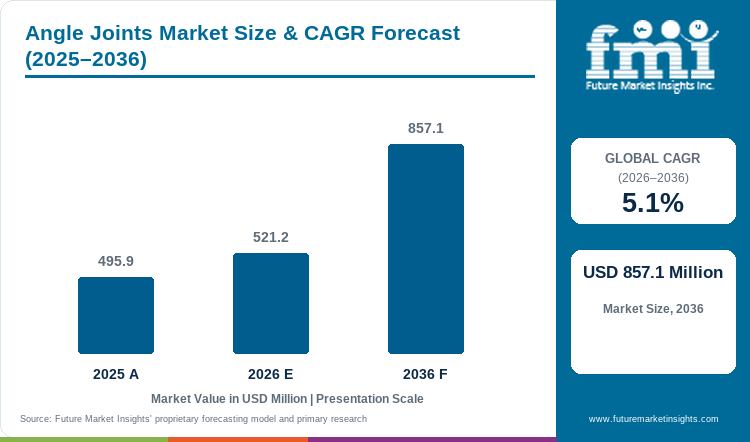
USD 521.2 Million in 2026 and USD 857.1 Million by 2036 at a 5.1% CAGR.
The Angle Joints Market was valued at USD 495.9 Million in 2025. It is estimated at USD 521.2 Million in 2026 and forecast to reach USD 857.1 Million by 2036, expanding at a 5.1% CAGR. Demand follows the installed base of machinery and vehicle mechanisms that need a compact connection able to transmit force while allowing angular movement. A joint has little value compared with the equipment around it, yet wear or excess play can interrupt motion. That makes fit, replacement access and service life central to the purchase.
Automation adds more moving interfaces around a production cell. The International Federation of Robotics reported 542,000 industrial robot installations in 2024 and 4.7 million industrial robots in operation worldwide. They show the scale of equipment investment that can create new linkage points and a future replacement base. The same installed-equipment logic appears in the industrial automation market, where new production systems create demand for mechanical motion components alongside controls and actuators. For angle joints, spending converts when the designer can match thread geometry, articulation and load with a part that remains available during maintenance.
Country demand reflects different industrial cycles. U.S. manufactured-goods orders reached USD 663.6 billion in July 2026. Germany recorded a 2.5% monthly increase in real manufacturing orders during July, although orders excluding large projects fell 1.4%. Japan reported a 9.7% monthly increase in core private machinery orders in June. Italy entered the second half of 2026 with weak machine-tool orders, while Mexico continued to operate a high-volume light-vehicle manufacturing base. These conditions change inventory timing and channel needs even when the mechanical job of the joint remains the same.
Key Takeaways
- Demand is tied to articulated motion points inside machinery and vehicle mechanisms. New equipment adds installed units, while wear and corrosion create replacement demand after commissioning.
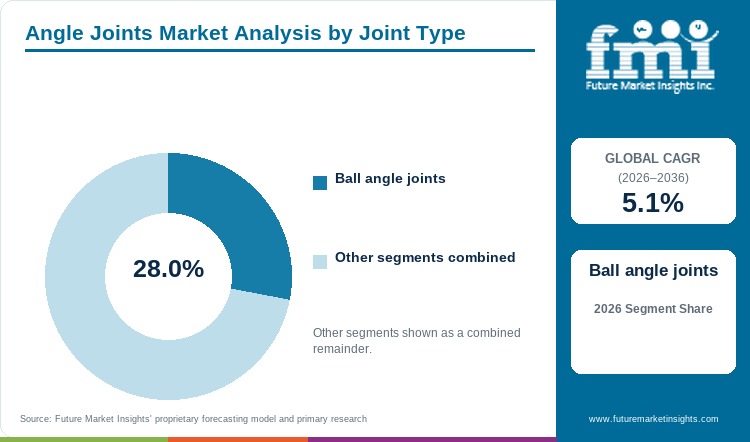
- Ball angle joints account for 28.0% of Joint Type demand in 2026. Steel represents 36.0% of Material demand, while Medium duty accounts for 48.0% of Load Class demand.
- Machinery linkages represent 28.0% of Application demand. Industrial distributors account for 43.0% of Sales Channel demand because standard dimensions and local stock shorten replacement time.
- Supplier switching is constrained by geometry and load validation. A thread that fits does not confirm that articulation range, pull-off force or body strength is appropriate for the application.
- Country CAGRs are profiled at 5.9% for Mexico, 5.4% for Italy, 4.9% for Germany, 4.5% for the USA and 4.0% for Japan from 2026 to 2036.
- Maintenance-free liners and corrosion-resistant materials create an upgrade path when buyers can preserve familiar mounting dimensions and reduce lubrication work.
Analyst Perspective
An angle joint must fit the linkage before price becomes relevant. Thread dimensions, movement angle and load capacity determine whether it can transmit force safely through the required stroke. Once specified, the same part may be needed years later for maintenance. Clear dimensional data and dependable stock help customers preserve the original mechanism when a joint wears out.
- Nikhil Kaitwade, Principal Consultant, Future Market Insights
How is the angle joints market segmented?
The angle joints market is segmented by Joint Type, Material, Load Class, Application, Sales Channel, and Region.
Joint Type separates ball angle joints, clevis angle joints, rod-end angle joints, universal angle joints and adjustable angle brackets according to the motion interface used. Material covers steel, stainless steel, aluminum, zinc die-cast and engineering plastic. Load Class is divided into light duty, medium duty and heavy duty. Application covers machinery linkages, automotive linkages, furniture and fixtures, industrial automation and construction hardware. Sales Channel includes industrial distributors, direct manufacturer supply, MRO catalog routes and OEM programs.
Joint Type determines the available movement; Material affects strength, corrosion resistance and weight. Load Class distinguishes the duty a connection must withstand. Machinery linkages, vehicle mechanisms and furniture fittings impose different space and service requirements, while the sales channel determines how an OEM or maintenance team obtains the part.
What makes Ball angle joints central to the Joint Type category?
Ball angle joints combine a ball shank with a socket so a linkage can transmit tensile or compressive force while tolerating angular offset. Ganter documents DIN 71802 angled ball joints with 15 degree movement for versions using a safety catch and 18 degrees for versions without one. That compact movement envelope suits linkage ends where the connected members cannot remain perfectly collinear through the full stroke.
The format also reduces design work because standard threads and ball sizes can be selected from a catalog. A designer can add a safety catch or dust protection when retention or contamination changes the risk profile. THK uses a related architecture in its Link Ball, which combines a spherical slide bearing with a ball stud and emphasizes low clearance. Clevis and universal joints remain important when the motion path or shaft arrangement calls for a different connection.
- Ball angle joints account for 28.0% of Joint Type demand in 2026 because compact ball-and-socket geometry fits repeated linkage and end-fitting applications.
- Ganter expanded its ball-joint selection in 2025 around angled and axial configurations, while THK continued to treat Link Ball products as a distinct motion-component business.
Why does Steel lead the Material category?
Steel is suited to angle joints because the shank and threaded interface must carry repeated force in a small section. It can be hardened where contact stress matters, then plated when ordinary industrial corrosion protection is needed. Ganter specifies steel for DIN 71802 angled ball joints and uses hardened steel for the ball. Jergens offers rod ends in alloy steel or 303 stainless steel, with selected alloy-steel parts documented at 150,000 PSI tensile strength. The material logic also connects with the bearing steel market, where fatigue behavior and consistent mechanical properties influence component reliability.
Stainless steel becomes more useful around washdown, salt exposure or chemicals. Aluminum can reduce mass, while engineering plastic can reduce lubrication work or corrosion risk. Zinc die-cast is relevant for housings and adjustable hardware where the load case permits it. Steel retains the 2026 lead because standard industrial linkages often prioritize mechanical margin and threaded durability before weight reduction.
- Steel represents 36.0% of Material demand in 2026, supported by familiar machining, durable threads and broad use in standardized linkage components.
- Ganter offers both zinc-plated steel and stainless DIN 71802 angle-joint variants, giving buyers a direct material choice without changing the basic joint architecture.
How does Medium duty shape the Load Class category?
Medium-duty joints cover mechanisms where loads are meaningful but do not justify the size or cost of a severe-duty design. Common examples include machine covers, actuator linkages and positioning assemblies that cycle repeatedly without serving as a primary structural member. The buyer still needs enough body strength and thread engagement to avoid deformation or fatigue, yet oversizing every joint adds weight and inventory complexity.
Selection remains application-specific. SKF guidance for self-lubricating spherical plain bearing rod ends starts with the attachment thread, then moves through bearing size and finally checks the load capability of the rod-end body. If that body does not meet the requirement, SKF directs the user to increase bearing size and repeat the selection. That sequence shows why a medium-duty category can serve many general machine connections while heavy-duty designs remain necessary for shock or demanding structural loads.
- Medium duty accounts for 48.0% of Load Class demand in 2026 because many machine linkages require repeatable force transfer without a heavy-duty envelope.
- Load classification should be treated as an engineering selection step. Thread size alone does not establish whether the joint body can carry the application load.
What supports Machinery linkages within the Application category?
Machinery linkages create a direct use case because the joint connects two moving members that must pivot or tolerate misalignment. It can sit between an actuator and lever, on an access mechanism or inside a positioning assembly. The nearby robotics actuators market illustrates how more controlled motion in automated equipment increases the number of mechanical interfaces around the actuator itself. Angle joints capture a small part of that hardware spend when a compact articulated end connection is required.
WDS Components offers fixed-force gas struts with angle-joint end fittings for machinery access panels, conveyor covers and machine guards. The fitting allows the strut end to pivot as the panel moves. Its articulation range and mounting dimensions must match the surrounding mechanism, particularly where a replacement strut is fitted to an existing machine.
- Machinery linkages account for 28.0% of Application demand in 2026 because articulated end connections are used across many machine mechanisms.
- WDS introduced fixed-force gas struts in December 2025 with angle-joint end-fitting options for repeat-use mechanisms, providing a current example of linkage-driven pull-through demand.
What drives Industrial distributors within the Sales Channel category?
Industrial distributors solve a timing problem. A low-value joint can stop a machine when the replacement size is unavailable, yet many buyers need only a few pieces at a time. Stocked standard sizes, searchable dimensions and adjacent hardware allow maintenance teams to replace the part without opening a custom sourcing project. Design engineers also use distributor catalogs during prototyping before a part is locked into an OEM bill of materials.
Direct manufacturer supply becomes more relevant for recurring OEM volume, custom geometry or technical support tied to a program. MRO catalog routes can be efficient where plants buy through contracted procurement systems. OEM programs support scheduled production. Industrial distributors retain the 2026 lead because fragmented replacement demand rewards breadth, local availability and the ability to match a part quickly.
- Industrial distributors represent 43.0% of Sales Channel demand in 2026 as stocked standard components shorten the path from failure identification to replacement.
- Rodobal, Ganter and WDS each publish multiple joint or end-fitting variants, illustrating why catalog breadth matters when buyers must match thread direction, material and movement requirements.
What are the drivers, restraints, and opportunities in the angle joints market?
Installed machinery supports demand, specification errors slow supplier switching, and maintenance-free joint designs create an upgrade route.
- Driver: New machinery and the installed equipment base add articulated connection points that eventually enter replacement cycles.
- Restraint: Incorrect load capability, articulation or interface geometry can cause binding and wear, so buyers are cautious about changing qualified parts.
- Opportunity: Corrosion-resistant and maintenance-free designs can reduce service work when they fit existing mounting envelopes.
Installed Machinery Creates a Recurring Linkage Base
Demand starts with the number of mechanisms that need controlled movement between connected members. IFR reported 542,000 industrial robot installations in 2024, with 4.7 million industrial robots operating worldwide. A robot count is not an angle-joint count, because many joints sit outside the robot arm. The useful signal is the scale of automated equipment entering service. Machine guards, auxiliary handling equipment and peripheral actuators add their own linkage points. The industrial robotics market provides a broader view of that factory investment cycle.
The second part of the mechanism appears after installation. Repeated motion can introduce wear or play. Corrosion can change socket movement, and accidental overload can deform a shank. When the machine remains productive enough to justify repair, the maintenance team needs the exact joint or a validated substitute. That replacement logic gives distributors and manufacturers revenue long after the original machine build.
Fit and Load Errors Keep Supplier Switching Deliberate
An incorrectly specified joint can compromise the linkage even when its purchase price is low. A replacement can match the nominal thread and still have an unsuitable body strength or movement angle. SKF selection guidance requires the user to choose thread type, select the spherical bearing size and then confirm rod-end load carrying capability. The sequence matters because the joint body can become the limiting element. A similar installed-base selection issue appears in the motor bearing market, where parts are often specified during equipment design and replaced within an established fit envelope.
This risk slows substitution. An MRO buyer may accept a price premium for a known part if changing suppliers creates test work or a chance of premature failure. OEM engineers face the same issue when a part is tied to drawings, safety factors or customer approval. Suppliers therefore need clear dimensions and load information before a lower price can translate into a new account.
Maintenance-Free Designs Target Service Cost
Low-maintenance joints can reduce lubrication work or corrosion problems while retaining the original linkage geometry. Rodobal documents PTFE-lined rod ends that operate without greasing and offers stainless versions for corrosive environments. igus uses polymer inner rings in rod-end designs to create dry-running motion. These approaches are valuable where grease can attract contamination or where access makes relubrication expensive.
Preserving the mounting geometry makes a low-maintenance joint easier to adopt. A dry-running or corrosion-resistant replacement must still match the original thread, articulation range and body strength. That fit allows a maintenance improvement without rebuilding the lever, strut mount or actuator connection.
Which country CAGRs are profiled in the Angle Joints Market?
| Country | CAGR (2026 to 2036) |
|---|---|
| USA | 4.5% |
| Germany | 4.9% |
| Japan | 4.0% |
| Italy | 5.4% |
| Mexico | 5.9% |
How do country-level CAGRs compare in the angle joints market?
Mexico has the highest profiled CAGR at 5.9% from 2026 to 2036, followed by Italy at 5.4%, Germany at 4.9%, USA at 4.5% and Japan at 4.0%. The 1.9 percentage-point range covers both vehicle-production and machinery markets. New equipment requires design-stage selection, while older machines generate small, urgent orders for dimensionally compatible replacements.
- Mexico is projected at 5.9% CAGR. Automotive assembly creates a clear need for locally available linkage hardware tied to production and maintenance schedules.
- Italy is projected at 5.4% CAGR. Machine-tool exposure creates opportunity, but order cycles can be uneven and require disciplined distributor stocking.
- Germany is projected at 4.9% CAGR. Standardized machine-element selection fits its engineering base, while current factory orders show that project timing can remain volatile.
- USA is projected at 4.5% CAGR. The market combines new equipment spending with a broad installed base that supports replacement demand through industrial distribution.
- Japan is projected at 4.0% CAGR. Precision-oriented buyers place weight on low play, repeatable dimensions and stable long-term supply before changing a qualified component.
Country-wise Analysis
- USA: Demand for angle joints is forecast to expand at 4.5% CAGR from 2026 to 2036. The U.S. Census Bureau reported that new orders for manufactured goods reached USD 663.6 billion in July 2026, up 0.9% from June. That broad order base gives component suppliers exposure to machinery production and to the installed equipment that follows. The purchasing challenge is fragmentation. An MRO team may need a small quantity immediately, while an OEM may require the same geometry under a controlled drawing. Suppliers can improve conversion by keeping common sizes in stock and publishing load data that lets engineers validate substitutes without reopening the complete linkage design.
- Germany: Demand is forecast to rise at 4.9% CAGR through 2036. Destatis reported that real manufacturing orders increased 2.5% in July 2026 from the previous month, while orders excluding large projects fell 1.4%. Automotive orders declined 12.5% in the same month. This mixed picture matters for angle joints because standard parts can be used across several machine programs even when one end market weakens. DIN-oriented dimensions and corrosion choices make specification easier, while uneven factory orders make inventory discipline important for distributors.
- Japan: Demand is forecast to grow at 4.0% CAGR from 2026 to 2036. Japan’s Cabinet Office reported that core private machinery orders excluding volatile categories increased 9.7% in June 2026. It forecast a 4.9% quarter-on-quarter increase for July to September. Angle-joint suppliers still face a deliberate qualification process where tolerance and play affect mechanism behavior. The route to growth is therefore tied to consistent dimensions and technical support rather than short-term machinery orders alone.
- Italy: Demand is forecast to expand at 5.4% CAGR through 2036. UCIMU reported that its machine-tool order index fell 25.8% year on year in the second quarter of 2026. Foreign orders fell 15.3%, while domestic orders fell 38.7%. The long-run rate and the current order cycle can therefore move in different directions. Component suppliers can manage that gap with flexible stock, quick quotation and a range of standard materials that can be configured when a machine project moves forward.
- Mexico: Demand is forecast to rise at 5.9% CAGR from 2026 to 2036. INEGI reported July 2026 light-vehicle production of 302,673 units and exports of 261,534 units. Vehicle assembly supports direct demand for linkage components and also creates maintenance demand around production equipment. Component orders depend on vehicle launch schedules and export production. Regional inventory and short lead times can reduce that risk when plants need a qualified standard joint without waiting for an overseas replenishment cycle.
Who are the notable companies in the angle joints market?
igus, SKF, THK, Schaeffler, Rodobal, RBC Bearings, Ganter, Elesa, WDS Components, and Jergens are the notable companies profiled in this market.
Competition falls into several practical buying routes. SKF, THK, Schaeffler and RBC Bearings bring bearing engineering into applications where load or misalignment requires detailed selection. Ganter and Elesa serve design engineers through standardized machine-element catalogs. WDS and Jergens support component selection where stock access and CAD-ready dimensions matter. igus and Rodobal offer material or liner options that can reduce lubrication work or address corrosion.
Engineers select at the joint-family level. Movement angle, thread or bore dimensions and body strength determine mechanical fit. Maintenance teams also need a part that tolerates the operating environment and can arrive within the repair window. Both catalog suppliers and bearing specialists can serve these requirements, depending on the application.
- Bearing and motion engineering suppliers: SKF, THK, Schaeffler and RBC Bearings participate through spherical bearings, rod ends or related articulated interfaces with published engineering guidance.
- Standard machine-element suppliers: Ganter, Elesa, WDS Components and Jergens fit catalog-led design and replacement workflows where dimensional information is central to selection.
- Specialized material and maintenance alternatives: igus and Rodobal use polymer or PTFE-based sliding interfaces alongside metal housings to address dry-running or corrosive applications.
Competitive Benchmarking: Angle Joints Market
| Company | Joint Family Breadth | Load & Qualification Depth | Material & Maintenance Options | Geographic Reach |
|---|---|---|---|---|
| igus | High | Medium | High | Multi-region industrial supply |
| SKF | Medium | High | High | Multi-region bearing supply |
| THK | Medium | Unscored | Unscored | Japan, North America and other THK markets |
| Schaeffler | Medium | High | High | Germany-based development with international industrial channels |
| Rodobal | Medium | Medium | High | Specialty distribution in Europe and selected international markets |
| RBC Bearings | Medium | High | High | North American aerospace and industrial base with international programs |
| Ganter | Medium | Unscored | Medium | International standard-parts distribution |
| Elesa | Medium | Unscored | Medium | International standard-parts distribution |
| WDS Components | Medium | Medium | Medium | UK-centered catalog supply with export capability |
| Jergens | Medium | Medium | Medium | North American workholding and component distribution |
Scoring basis: Joint Family Breadth measures documented coverage of angle, rod-end, ball, clevis or universal joint formats inside the market scope. Load & Qualification Depth reflects published load data, application guidance or formal qualification evidence. Material & Maintenance Options covers documented choices such as stainless steel, polymers, self-lubricating interfaces or corrosion-focused designs. High indicates broad capability against the criterion. Medium indicates narrower capability.
Key Developments in the Angle Joints Market
- In July 2025, Ganter announced an expansion of its ball-joint selection to include angled and axial ball joints. The company highlighted DIN 71802 angled joints for transmitting force while compensating for deviations from a right-angle connection. The update gives machine builders a standardized route for adding articulated connections without moving into a custom joint design.
- In October 2025, THK resolved to integrate THK Manufacturing of America’s Link Ball business into THK RHYTHM NORTH AMERICA. Operations were scheduled to move to the Ohio plant from November 1, 2025. The change concentrates North American Link Ball activity within an automotive-oriented THK operating company and can simplify coordination around vehicle linkage programs.
- In December 2025, WDS Components launched a fixed-force gas-strut range with several end-fitting choices, including angle joints. WDS positioned the struts for repeat-use applications such as machinery guards and access panels. The launch creates direct pull-through demand for standardized angle-joint end fittings within a larger motion assembly.
Key Players in the Angle Joints Market
Bearing and Motion Engineering Suppliers
- SKF
- THK
- Schaeffler
- RBC Bearings
Standard Machine-Element and Catalog Suppliers
- Ganter
- Elesa
- WDS Components
- Jergens
Specialized Joint and Low-Maintenance Suppliers
- igus
- Rodobal
Angle Joints Market - Report Scope
| Coverage field | Report scope |
|---|---|
| Market breakdown | Joint Type; Material; Load Class; Application; Sales Channel; Region |
| Quantitative Units | USD Million |
| Market Definition | Revenue includes discrete mechanical angle-joint components and articulated joint assemblies sold within the stated segmentation. It excludes fixed structural angle brackets without an articulated function, downstream finished equipment revenue and adjacent components sold outside the defined joint boundary. |
| Regions Covered | North America; Latin America; Western Europe; Eastern Europe; East Asia; South Asia and Pacific; Middle East and Africa |
| Countries Covered | USA, Germany, Japan, Italy, Mexico, and more than twenty-five additional countries in the full report |
| Key Companies Profiled | igus; SKF; THK; Schaeffler; Rodobal; RBC Bearings; Ganter; Elesa; WDS Components; Jergens |
| Forecast Period | 2026 to 2036 |
| Approach | Hybrid bottom-up and top-down sizing using component demand, application volumes, replacement behavior, price levels and country industrial indicators. |
Angle Joints Market - Research Methodology
| Method | Approach |
|---|---|
| Primary Research | FMI engages manufacturers, industrial distributors, machine builders, MRO buyers and engineering specialists to test product definitions, selection criteria, replacement behavior and channel conditions. |
| Desk Research | Research uses official industrial statistics, standards-oriented technical documentation, company filings, current product catalogs and dated first-party announcements relevant to the defined angle-joint boundary. |
| Market Sizing and Forecasting | A hybrid framework reconciles component demand with price levels, machinery applications, replacement cycles and country industrial indicators. Forecast assumptions reflect equipment activity, automation intensity, material substitution and channel availability. |
| Data Validation | Findings are triangulated across source types where practical. Downstream equipment revenue, adjacent component revenue, duplicate counts and unsupported claims are excluded before the forecast is finalized. |
Angle Joints Market by Segments
Angle Joints Market segmented by Joint Type:
- Ball angle joints
- Clevis angle joints
- Rod-end angle joints
- Universal angle joints
- Adjustable angle brackets
Angle Joints Market segmented by Material:
- Steel
- Stainless steel
- Aluminum
- Zinc die-cast
- Engineering plastic
Angle Joints Market segmented by Load Class:
- Medium duty
- Light duty
- Heavy duty
Angle Joints Market segmented by Application:
- Machinery linkages
- Automotive linkages
- Furniture / fixtures
- Industrial automation
- Construction hardware
Angle Joints Market segmented by Sales Channel:
- Industrial distributors
- Direct manufacturer
- MRO catalog
- OEM programs
Angle Joints Market by Region
- North America
- United States
- Canada
- Latin America
- Brazil
- Mexico
- Argentina
- Chile
- Western Europe
- Germany
- France
- United Kingdom
- Italy
- Spain
- Benelux
- Nordics
- Eastern Europe
- Poland
- Czech Republic
- Romania
- Hungary
- East Asia
- China
- Japan
- South Korea
- South Asia and Pacific
- India
- ASEAN
- Australia and New Zealand
- Middle East and Africa
- GCC Countries
- South Africa
- Türkiye
- Israel
Research Sources and Bibliography
- International Federation of Robotics. (2025, September 25). World Robotics 2025: Industrial Robots.
- U.S. Census Bureau. (2026, September 2). Monthly Full Report on Manufacturers’ Shipments, Inventories, & Orders: July 2026.
- Federal Statistical Office of Germany (Destatis). (2026, September 4). New orders in manufacturing in July 2026: +2.5% on the previous month.
- Cabinet Office of Japan, Economic and Social Research Institute. (2026, August 19). Machinery Orders in June 2026 and Forecast for July-September 2026.
- UCIMU-SISTEMI PER PRODURRE. (2026, July 14). Machine-tool order index for the second quarter of 2026.
- Instituto Nacional de Estadística y Geografía (INEGI). (2026, August 7). Administrative Record of the Light Vehicle Automotive Industry: July 2026.
- Ganter Norm. (2025, July). Precise, Compensating and Articulated: Ganter expands its ball joint selection to include angled and axial ball joints.
- Ganter Norm. DIN 71802 Angled Ball Joints: steel and stainless-steel product documentation.
- THK CO., LTD. (2025, October 21). Notice Regarding the Integration of THK Manufacturing of America, Inc. Link Ball Business into THK RHYTHM NORTH AMERICA CO., LTD.
- THK CO., LTD. Link Ball and Rod End product documentation.
- WDS Components Ltd. (2025, December 1). Fixed Force Gas Struts, Precisely Calibrated.
- SKF. Self-lubricating spherical plain bearing rod ends: design and selection guidance.
- Jergens Inc. Rod Ends: materials and product specifications.
- RBC Bearings Incorporated. Rod End Plain Bearings Engineering Data.
- Getecno. (2025, June 5). RODOBAL: High mechanical performance in every application.
- Schaeffler Group. (2025, April 3). Maintenance-free plain bearings for kingpins and chassis joints in construction machinery.
- igus. (2022, July 5). Self-lubricating rod ends: plastic-metal hybrid for higher loads in the food sector.
- Future Market Insights. Nikhil Kaitwade author profile and industrial equipment research coverage.
This bibliography is provided for reader reference and is not exhaustive. The full report contains the complete reference list and detailed research documentation.
This Report Answers
- What is the Angle Joints Market size in 2026 and what value is forecast for 2036?
- Which equipment and replacement mechanisms support demand for angle joints?
- Why do Ball angle joints account for 28.0% of Joint Type demand in 2026?
- Why does Steel represent 36.0% of Material demand?
- Why does Medium duty account for 48.0% of Load Class demand?
- How do the profiled country growth rates differ across the USA, Germany, Japan, Italy and Mexico?
- Which suppliers compete through bearing engineering, standard machine elements or low-maintenance joint designs?
- How do geometry, load validation and replacement availability influence supplier selection?
Frequently Asked Questions
How big is the Angle Joints Market in 2026?
The market is estimated at USD 521.2 Million in 2026 and is forecast to reach USD 857.1 Million by 2036. The market was valued at USD 495.9 Million in 2025.
What is the CAGR of the Angle Joints Market from 2026 to 2036?
The market is forecast to expand at a 5.1% CAGR from 2026 to 2036 as new machinery adds linkage points and installed equipment creates replacement demand.
Which Joint Type accounts for the main share in 2026?
Ball angle joints account for 28.0% of Joint Type demand in 2026. Their compact ball-and-socket geometry allows a linkage to transmit force while tolerating angular offset.
Which Sales Channel accounts for the main share in 2026?
Industrial distributors account for 43.0% of Sales Channel demand in 2026 because standard component availability is important when maintenance teams need exact replacements in small quantities.
What country growth rates are profiled through 2036?
The profiled CAGRs are 5.9% for Mexico, 5.4% for Italy, 4.9% for Germany, 4.5% for the USA and 4.0% for Japan from 2026 to 2036.
Which companies are notable in the Angle Joints Market?
The profiled companies include igus, SKF, THK, Schaeffler, Rodobal, RBC Bearings, Ganter, Elesa, WDS Components and Jergens.
Preview the report firsthand - request a free sample
Get SampleGet the brochure for pricing and purchase details.
Get PDFTable of Content
- Key Takeaways
- Market Size and CAGR
- Top Growth Driver
- Fastest Growing Segment
- Leading Region
- Key Companies
- Emerging Opportunities
- Executive Summary
- Global Market Outlook
- Demand-side Trends
- Supply-side Trends
- Technology Roadmap Analysis
- Analysis and Recommendations
- Analyst Perspective (What is happening? Why now? What should investors know?)
- Key Questions Answered
- How large is the market?
- What is the CAGR?
- What are key trends?
- Which region dominates?
- Who are the leaders?
- Market Overview
- Market Coverage / Taxonomy
- Market Definition / Scope / Limitations
- Research Methodology
- Chapter Orientation
- Analytical Lens and Working Hypotheses
- Market Structure, Signals, and Trend Drivers
- Benchmarking and Cross-market Comparability
- Market Sizing, Forecasting, and Opportunity Mapping
- Research Design and Evidence Framework
- Desk Research Programme (Secondary Evidence)
- Expert Input and Fieldwork (Primary Evidence)
- Tooling, Models, and Reference Databases
- Data Engineering and Model Build
- Quality Assurance and Audit Trail
- Market Background
- Market Dynamics (Drivers, Restraints, Opportunity, Trends)
- Scenario Forecast (Optimistic, Likely, Conservative)
- Impact Analysis
- AI Impact
- Sustainability Impact
- Regulatory Impact
- Technology Impact
- Consumer / Buyer Analysis
- Purchase Drivers
- Adoption Barriers
- Buyer Journey
- Opportunity Map Analysis
- Product Life Cycle Analysis
- Supply Chain Analysis
- Investment Feasibility Matrix
- Value Chain Analysis
- PESTLE and Porter's Analysis
- Regulatory Landscape
- Regional Parent Market Outlook
- Production and Consumption Statistics
- Import and Export Statistics
- Global Market Analysis and Forecast, 2021 to 2036
- Historical Market Size Value (USD Million) Analysis, 2021 to 2025
- Current and Future Market Size Value (USD Million) Projections, 2026 to 2036
- Y-o-Y Growth Trend Analysis
- Absolute $ Opportunity Analysis
- Global Market Pricing Analysis, 2021 to 2036
- Global Market Analysis and Forecast, By Joint Type, 2021 to 2036
- Introduction / Key Findings
- Historical Market Size Value (USD Million) Analysis By Joint Type, 2021 to 2025
- Current and Future Market Size Value (USD Million) Analysis and Forecast By Joint Type, 2026 to 2036
- Ball angle joints
- Clevis angle joints
- Rod-end angle joints
- Universal angle joints
- Adjustable angle brackets
- Y-o-Y Growth Trend Analysis By Joint Type, 2021 to 2025
- Absolute $ Opportunity Analysis By Joint Type, 2026 to 2036
- Global Market Analysis and Forecast, By Material, 2021 to 2036
- Introduction / Key Findings
- Historical Market Size Value (USD Million) Analysis By Material, 2021 to 2025
- Current and Future Market Size Value (USD Million) Analysis and Forecast By Material, 2026 to 2036
- Steel
- Stainless steel
- Aluminum
- Zinc die-cast
- Engineering plastic
- Y-o-Y Growth Trend Analysis By Material, 2021 to 2025
- Absolute $ Opportunity Analysis By Material, 2026 to 2036
- Global Market Analysis and Forecast, By Load Class, 2021 to 2036
- Introduction / Key Findings
- Historical Market Size Value (USD Million) Analysis By Load Class, 2021 to 2025
- Current and Future Market Size Value (USD Million) Analysis and Forecast By Load Class, 2026 to 2036
- Medium duty
- Light duty
- Heavy duty
- Y-o-Y Growth Trend Analysis By Load Class, 2021 to 2025
- Absolute $ Opportunity Analysis By Load Class, 2026 to 2036
- Global Market Analysis and Forecast, By Application, 2021 to 2036
- Introduction / Key Findings
- Historical Market Size Value (USD Million) Analysis By Application, 2021 to 2025
- Current and Future Market Size Value (USD Million) Analysis and Forecast By Application, 2026 to 2036
- Machinery linkages
- Automotive linkages
- Furniture / fixtures
- Industrial automation
- Construction hardware
- Y-o-Y Growth Trend Analysis By Application, 2021 to 2025
- Absolute $ Opportunity Analysis By Application, 2026 to 2036
- Global Market Analysis and Forecast, By Sales Channel, 2021 to 2036
- Introduction / Key Findings
- Historical Market Size Value (USD Million) Analysis By Sales Channel, 2021 to 2025
- Current and Future Market Size Value (USD Million) Analysis and Forecast By Sales Channel, 2026 to 2036
- Industrial distributors
- Direct manufacturer
- MRO catalog
- OEM programs
- Y-o-Y Growth Trend Analysis By Sales Channel, 2021 to 2025
- Absolute $ Opportunity Analysis By Sales Channel, 2026 to 2036
- Global Market Analysis and Forecast, By Region, 2021 to 2036
- Introduction
- Historical Market Size Value (USD Million) Analysis By Region, 2021 to 2025
- Current Market Size Value (USD Million) Analysis and Forecast By Region, 2026 to 2036
- North America
- Latin America
- Western Europe
- Eastern Europe
- East Asia
- South Asia and Pacific
- Middle East and Africa
- Market Attractiveness Analysis By Region
- North America Market Analysis and Forecast, By Country, 2021 to 2036
- Historical Market Size Value (USD Million) Trend Analysis By Market Taxonomy, 2021 to 2025
- Market Size Value (USD Million) Forecast By Market Taxonomy, 2026 to 2036
- By Country
- United States
- Canada
- By Joint Type
- By Material
- By Load Class
- By Application
- By Sales Channel
- By Country
- Market Attractiveness Analysis
- By Country
- By Joint Type
- By Material
- By Load Class
- By Application
- By Sales Channel
- Key Takeaways
- Latin America Market Analysis and Forecast, By Country
- Historical Market Size Value (USD Million) Trend Analysis By Market Taxonomy, 2021 to 2025
- Market Size Value (USD Million) Forecast By Market Taxonomy, 2026 to 2036
- By Country
- Brazil
- Mexico
- Argentina
- Chile
- By Joint Type
- By Material
- By Load Class
- By Application
- By Sales Channel
- By Country
- Market Attractiveness Analysis
- By Country
- By Joint Type
- By Material
- By Load Class
- By Application
- By Sales Channel
- Key Takeaways
- Western Europe Market Analysis and Forecast, By Country
- Historical Market Size Value (USD Million) Trend Analysis By Market Taxonomy, 2021 to 2025
- Market Size Value (USD Million) Forecast By Market Taxonomy, 2026 to 2036
- By Country
- Germany
- France
- United Kingdom
- Italy
- Spain
- Benelux
- Nordics
- By Joint Type
- By Material
- By Load Class
- By Application
- By Sales Channel
- By Country
- Market Attractiveness Analysis
- By Country
- By Joint Type
- By Material
- By Load Class
- By Application
- By Sales Channel
- Key Takeaways
- Eastern Europe Market Analysis and Forecast, By Country
- Historical Market Size Value (USD Million) Trend Analysis By Market Taxonomy, 2021 to 2025
- Market Size Value (USD Million) Forecast By Market Taxonomy, 2026 to 2036
- By Country
- Poland
- Czech Republic
- Romania
- Hungary
- By Joint Type
- By Material
- By Load Class
- By Application
- By Sales Channel
- By Country
- Market Attractiveness Analysis
- By Country
- By Joint Type
- By Material
- By Load Class
- By Application
- By Sales Channel
- Key Takeaways
- East Asia Market Analysis and Forecast, By Country
- Historical Market Size Value (USD Million) Trend Analysis By Market Taxonomy, 2021 to 2025
- Market Size Value (USD Million) Forecast By Market Taxonomy, 2026 to 2036
- By Country
- China
- Japan
- South Korea
- By Joint Type
- By Material
- By Load Class
- By Application
- By Sales Channel
- By Country
- Market Attractiveness Analysis
- By Country
- By Joint Type
- By Material
- By Load Class
- By Application
- By Sales Channel
- Key Takeaways
- South Asia and Pacific Market Analysis and Forecast, By Country
- Historical Market Size Value (USD Million) Trend Analysis By Market Taxonomy, 2021 to 2025
- Market Size Value (USD Million) Forecast By Market Taxonomy, 2026 to 2036
- By Country
- India
- ASEAN
- Australia and New Zealand
- By Joint Type
- By Material
- By Load Class
- By Application
- By Sales Channel
- By Country
- Market Attractiveness Analysis
- By Country
- By Joint Type
- By Material
- By Load Class
- By Application
- By Sales Channel
- Key Takeaways
- Middle East and Africa Market Analysis and Forecast, By Country
- Historical Market Size Value (USD Million) Trend Analysis By Market Taxonomy, 2021 to 2025
- Market Size Value (USD Million) Forecast By Market Taxonomy, 2026 to 2036
- By Country
- GCC Countries
- South Africa
- Türkiye
- Israel
- By Joint Type
- By Material
- By Load Class
- By Application
- By Sales Channel
- By Country
- Market Attractiveness Analysis
- By Country
- By Joint Type
- By Material
- By Load Class
- By Application
- By Sales Channel
- Key Takeaways
- Key Countries Market Analysis
- United States
- Pricing Analysis
- Market Share Analysis, 2025
- By Joint Type
- By Material
- By Load Class
- By Application
- By Sales Channel
- Canada
- Pricing Analysis
- Market Share Analysis, 2025
- By Joint Type
- By Material
- By Load Class
- By Application
- By Sales Channel
- Mexico
- Pricing Analysis
- Market Share Analysis, 2025
- By Joint Type
- By Material
- By Load Class
- By Application
- By Sales Channel
- Brazil
- Pricing Analysis
- Market Share Analysis, 2025
- By Joint Type
- By Material
- By Load Class
- By Application
- By Sales Channel
- Chile
- Pricing Analysis
- Market Share Analysis, 2025
- By Joint Type
- By Material
- By Load Class
- By Application
- By Sales Channel
- Germany
- Pricing Analysis
- Market Share Analysis, 2025
- By Joint Type
- By Material
- By Load Class
- By Application
- By Sales Channel
- United Kingdom
- Pricing Analysis
- Market Share Analysis, 2025
- By Joint Type
- By Material
- By Load Class
- By Application
- By Sales Channel
- Italy
- Pricing Analysis
- Market Share Analysis, 2025
- By Joint Type
- By Material
- By Load Class
- By Application
- By Sales Channel
- Spain
- Pricing Analysis
- Market Share Analysis, 2025
- By Joint Type
- By Material
- By Load Class
- By Application
- By Sales Channel
- France
- Pricing Analysis
- Market Share Analysis, 2025
- By Joint Type
- By Material
- By Load Class
- By Application
- By Sales Channel
- India
- Pricing Analysis
- Market Share Analysis, 2025
- By Joint Type
- By Material
- By Load Class
- By Application
- By Sales Channel
- ASEAN
- Pricing Analysis
- Market Share Analysis, 2025
- By Joint Type
- By Material
- By Load Class
- By Application
- By Sales Channel
- Australia and New Zealand
- Pricing Analysis
- Market Share Analysis, 2025
- By Joint Type
- By Material
- By Load Class
- By Application
- By Sales Channel
- China
- Pricing Analysis
- Market Share Analysis, 2025
- By Joint Type
- By Material
- By Load Class
- By Application
- By Sales Channel
- Japan
- Pricing Analysis
- Market Share Analysis, 2025
- By Joint Type
- By Material
- By Load Class
- By Application
- By Sales Channel
- South Korea
- Pricing Analysis
- Market Share Analysis, 2025
- By Joint Type
- By Material
- By Load Class
- By Application
- By Sales Channel
- Poland
- Pricing Analysis
- Market Share Analysis, 2025
- By Joint Type
- By Material
- By Load Class
- By Application
- By Sales Channel
- Hungary
- Pricing Analysis
- Market Share Analysis, 2025
- By Joint Type
- By Material
- By Load Class
- By Application
- By Sales Channel
- Türkiye
- Pricing Analysis
- Market Share Analysis, 2025
- By Joint Type
- By Material
- By Load Class
- By Application
- By Sales Channel
- South Africa
- Pricing Analysis
- Market Share Analysis, 2025
- By Joint Type
- By Material
- By Load Class
- By Application
- By Sales Channel
- United States
- Market Structure Analysis
- Competition Dashboard
- Competition Benchmarking
- Market Share Analysis of Top Players
- By Regional
- By Joint Type
- By Material
- By Load Class
- By Application
- By Sales Channel
- Emerging Startups
- Innovation Benchmarking
- Competition Analysis
- Competition Deep Dive
- igus
- Overview
- Product Portfolio
- Profitability by Market Segments
- Sales Footprint
- Strategy Overview
- Marketing Strategy
- Product Strategy
- Channel Strategy
- SKF
- THK
- Schaeffler
- Rodobal
- RBC Bearings
- Ganter
- Elesa
- WDS Components
- Jergens
- igus
- Case Studies
- Success Stories
- Recent Developments
- Competition Deep Dive
- Assumptions & Acronyms Used


