

- Market Size (2026)
- USD 420.9 Mn
- Forecast (2036)
- USD 641.2 Mn
- CAGR (2026 to 2036)
- 4.3%
How big is Anti-Chafing Sticks Market in 2026?
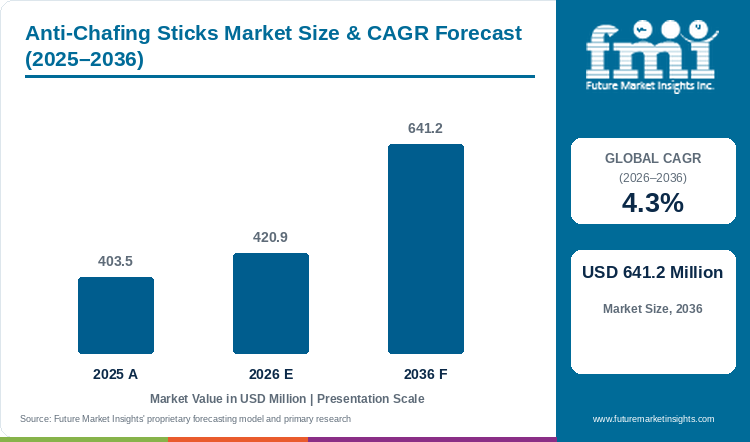
FMI values the anti-chafing sticks market at USD 420.9 million in 2026. Sales are forecast to reach USD 641.2 million by 2036 at a 4.3% CAGR. The 2025 value is USD 403.5 million.
The anti-chaffing sticks market value was USD 403.5 million in 2025. FMI estimates sales at USD 420.9 million in 2026 and USD 641.2 million by 2036. Demand is projected to grow at a 4.3% CAGR during the forecast period. Core / Classic Lines lead product type demand with 38.0% share. The growth outlook depends on how often buyers return after the first purchase. A stick may be bought for running or clothing friction and then used less frequently than expected. Consumer demand for anti-chafing products is rooted in preventative care, but usage occasions are highly segmented. To capture both the daily athletic consumer and the occasional traveler, brands like Body Glide have successfully expanded their portfolios to offer multiple size variations tailored to these distinct routines. Because friction prevention is a functional need, product efficacy directly dictates brand loyalty. Brands are leveraging consumer perception studies to highlight this reliability; for example, First Aid Beauty cites internal research where 96% of users reported remaining chafe-free over 10,000 steps after a week of use, reinforcing the product's value proposition for daily wear.[4]
While product proliferation and new SKU launches are effective at driving initial consumer trial, they do not guarantee sustained category consumption. True growth relies on replenishment, making repeat-order rates and retail sell-through far more valuable metrics than simply counting new marketplace listings. Product stability is a major factor in consumer retention. Balm-based formulas, such as Megababe’s stick, require temperature-controlled logistics to prevent melting or softening during transit. A poor unboxing experience caused by heat exposure can immediately derail a customer's likelihood to replenish, highlighting the need for robust supply chain management.[3]
Key Market Trends & Insights
- Dominance of Classic & Balm Formats: While traditional friction-prevention sticks (regular and travel sizes) will anchor the market at 38.0% of product demand in 2026, the category is diversifying. Cream and balm alternatives, led by brands like Megababe and First Aid Beauty are carving out a substantial 29.0% share by offering smoother, direct-application textures.
- Conventional Formulations Retain the Lead: Despite the rise of natural and organic wellness trends, conventional friction-prevention formulations are projected to hold the leading 47.0% market share in 2026.
- Rise of Mass-Market Accessibility: Mass-market pricing is expected to capture 34.0% of demand. The category is seeing mainstream adoption, with retailers like Decathlon successfully launching accessible alternatives (such as a 25g stick) to compete alongside premium, specialist brands in regions like the UK.
- Digital-First Purchasing Journeys: E-commerce and Direct-to-Consumer (DTC) channels will drive 26.0% of total sales by 2026. Consumers are adopting an omnichannel approach, utilizing both brand-owned websites and general online marketplaces to source their preferred formats.
Regional Highlights
- The Middle East Leads Future Expansion: Over the 2026–2036 forecast period, the UAE is projected to be the fastest-growing market for friction-prevention products, boasting a 5.6% CAGR. Saudi Arabia is close behind at 5.3%, highlighting strong, emerging consumer demand across the Gulf.
- Contrasting Regional Momentum: South Korea also shows strong growth potential with a 4.9% CAGR. In contrast, mature markets like France are expected to see steady but slower expansion, registering the lowest CAGR of the profiled countries at 3.3%.
- Retail Availability vs. Market Volume: Brand accessibility is expanding globally to meet international interest. Specialist brands like Body Glide are now verified on major e-commerce marketplaces in the UAE and Saudi Arabia, and are sold as imported goods in South Korean retail channels. However, while these listings confirm successful market penetration and consumer access, they serve as a metric for brand presence rather than a direct measure of overall category sales volume.
Market Size & Forecast
Table 1: Market Size and Forecast for the Anti-Chafing Sticks Market (USD million and percentage), 2025 to 2036
| Metric | Value |
|---|---|
| Implied 2025 Market Size | USD 403.5 million* |
| Estimated Market Size in 2026 | USD 420.9 million |
| Projected Market Size by 2036 | USD 641.2 million |
| CAGR, 2026 to 2036 | 4.3% |
| Added Revenue, 2026 to 2036 | USD 220.3 million |
| Market Expansion Multiple | 1.5x |
Retail Availability and Product Evidence
Current retail evidence establishes the presence of sticks across sports and beauty channels. Product pages also show the trade-offs that buyers face.
Table 2: Retail Availability and Product Evidence for the Anti-Chafing Sticks Market (observed offers and company disclosures), reviewed October 2026
| Indicator | Observed evidence | Commercial relevance | Source |
|---|---|---|---|
| Original stick sizes | Body Glide lists pocket, travel, regular and large sizes. | Different packs serve carry use and replenishment. | [1] |
| Consumer-perception evidence | First Aid Beauty: 96% of 55 users agreed on protection through 10,000 steps. | A specific test can inform claims but cannot establish category effectiveness. | [4] |
| Heat sensitivity | Megababe warns that Thigh Rescue may soften or melt at high temperature. | Transit protection and storage affect returns. | [3] |
| Sports retail | Decathlon UK sells a 25 g anti-chafing cream stick. | A retailer-owned offer competes with specialist sticks. | [5] |
| Multifunction design | Dove describes a deodorant and friction-prevention stick in November 2025. | One purchase can address odor and friction. | [22][23] |
| International online listings | UAE and Saudi Noon listings; imported Body Glide sold on Coupang Korea. | Online access exists but sales volume is unknown. | [24][26][29] |
Analyst Perspective
“The first purchase often follows a specific problem such as thigh rubbing or irritation from clothing. Continued sales depend on whether the stick is comfortable to use and survives normal storage. Buyers also have cheaper alternatives. Brands should measure replenishment rather than treating product awareness as recurring demand.”
- Rahul Pandita, Principal Consultant, Future Market Insights.
How is the anti-chafing sticks market segmented?
The report examines five commercial categories and region. In 2026, Core / Classic Lines lead product type at 38.0%, Conventional leads nature at 47.0%, Cream & Balm leads format at 29.0%, Mass leads price positioning at 34.0%, and E-commerce & DTC leads sales channel at 26.0%.
By Product Type: Core / Classic Lines and other product lines included in the FMI classification.
By Nature: Conventional and other nature positions covered in the FMI classification.
By Format: Cream & Balm stick formats and other direct-application stick formulations.
By Price Positioning: Mass and other price tiers.
By Sales Channel: E-commerce & DTC and other retail channels.
By Region: North America, Latin America, Western Europe, Eastern Europe, East Asia, South Asia and Pacific, and Middle East and Africa.
Why do Core / Classic Lines lead product type demand?
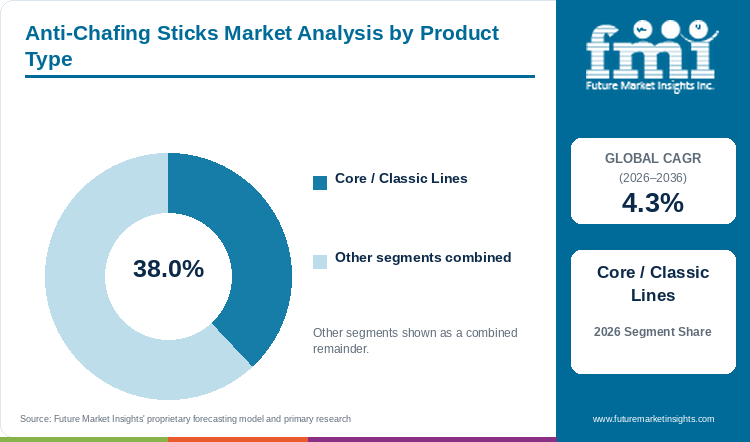
Core / Classic Lines are projected to hold 38.0% of product type demand in 2026. Their main use is straightforward friction prevention without requiring buyers to select a specialized formulation.
Table 3: Product Type Share for the Anti-Chafing Sticks Market (percentage share), 2026
| Product Type | Share (2026) |
|---|---|
| Core / Classic Lines | 38.0% |
| Other Product Types Combined | 62.0%* |
| Total | 100.0% |
In 2026, "Core" and "Classic" friction-prevention lines are projected to anchor the category with a 38.0% share of product type demand. The enduring success of these foundational products lies in their ability to address universal, everyday pain points, such as inner-thigh rubbing or clothing irritation, without forcing consumers to navigate complex, activity-specific formulations. Brands like Body Glide and Gold Bond capitalize on this simplicity, offering a straightforward value proposition that makes product selection intuitive and accessible for the everyday buyer.[1][2]
- Core / Classic Lines account for 38.0% of Product Type in 2026.
- Versatility Across Occasions: While standard sticks offer undeniable convenience, they are not inherently superior to alternative formats like jellies or creams. Their market strength instead stems from adaptability; offering varied pack sizes allows a single core product to seamlessly transition between daily athletic routines and occasional travel.
- Driving Retention Through Education: Because these products are highly functional, securing repeat purchases requires more than just initial trial. Brands must provide clear application instructions and ensure formulations are properly matched to specific skin areas, guaranteeing a positive user experience that encourages long-term replenishment.
Why does Conventional lead the nature category?
Conventional products represent 47.0% of nature-based demand in 2026. Nature classification is separate from claims about a stick’s effectiveness or skin suitability.
When evaluating friction-prevention products, broad binary classifications like "conventional" or "natural" often obscure the true complexity of individual formulations. While market estimates project that conventional products will retain a dominant 47.0% share in 2026, these macro-level labels fail to reflect the nuanced ingredient strategies used by leading brands. For instance, mainstream staples like Body Glide highlight plant-derived components in their original sticks, while First Aid Beauty focuses on targeted, skin-soothing ingredients like shea butter and colloidal oatmeal. Consequently, consumer acceptance is driven less by overarching category labels and more by specific formulation facts, such as the demand for fragrance-free options to mitigate the risk of contact reactions.[1][4]
- Skin Compatibility Drives Category Retention: Although conventional formulations are projected to hold 47.0% of the nature category in 2026, true commercial success relies heavily on consumer acceptance and skin tolerance. For frequent users, mitigating contact irritants and avoiding fragrances is often a more critical selection factor than a product's broad conventional or natural classification.
- The Necessity of Product-Level Assessment: Because macro-level market categories can be misleading, ingredients and efficacy claims must be evaluated on a strict product-by-product basis. Relying on broad market classifications is less effective than analyzing the specific ingredient deck and intended use to ensure the formulation aligns with a consumer's unique dermatological needs.
What are the drivers, restraints, and opportunities in the anti-chafing sticks market?
Regular friction-prevention use is the main driver. Inexpensive substitutes and product stability limit the value of stick convenience. More specific formulations and multipurpose products open new sales routes.
The anti-chafing stick market is fundamentally driven by the preventative nature of friction management, with consumers increasingly integrating these products into both athletic routines and daily body care to preempt discomfort. However, category growth faces distinct headwinds from low-cost, established substitutes like petroleum jelly and the physical vulnerabilities of balm formulations, which can melt in transit or cause contact irritation if misapplied. To overcome these barriers and secure long-term replenishment, brands are pivoting toward highly targeted innovation either by developing multifunctional products that consolidate daily routines or by introducing use-specific formulations with precise application guidelines to ensure efficacy and consumer trust.
Navigating Substitutes and Usage Dynamics: While petroleum jelly remains a formidable, low-cost alternative endorsed by dermatological bodies, specialist sticks must also overcome physical stability risks, such as heat-induced melting. Furthermore, driving repeat purchases requires brands to accurately track product exhaustion rates, as the longevity of a stick varies drastically between an occasional traveler using a mini-size and a daily runner consuming a standard pack.[15][3]
Innovation Through Consolidation and Specialization: To capture a wider audience and justify a premium over basic substitutes, brands are expanding their value propositions through targeted product development. Innovations range from multifunctional sticks such as Dove’s integration of odor control and friction protection to highly specialized formulations, like Pink Cheeks’ targeted solutions for fabric-rubbing, which help reduce unsuitable purchases and enhance overall user satisfaction.[22][13]
Which country CAGRs are profiled in the anti-chafing sticks market?
Table 4: Country CAGR Comparison for the Anti-Chafing Sticks Market (CAGR percentage), 2026 to 2036
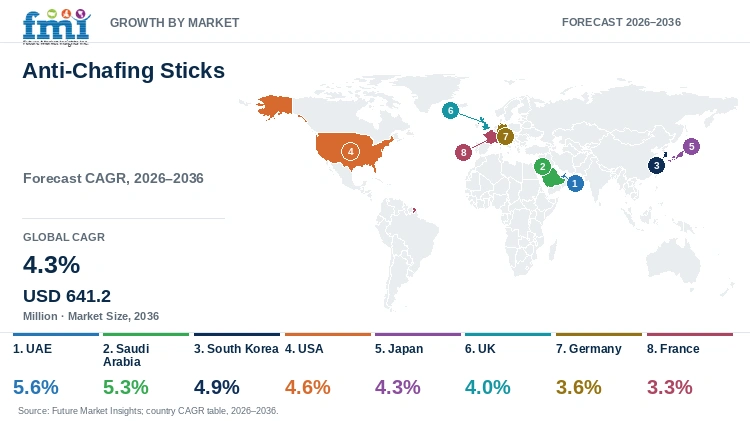
| Country | CAGR |
|---|---|
| UAE | 5.6% |
| Saudi Arabia | 5.3% |
| South Korea | 4.9% |
| USA | 4.6% |
| Japan | 4.3% |
| UK | 4.0% |
| Germany | 3.6% |
| France | 3.3% |
Country-wise Analysis
The United Arab Emirates is likely to grow at a 5.6% CAGR. Market access is currently driven by online marketplaces like Noon, which list imported specialist brands. However, long-term success requires navigating the Dubai Municipality Montaji system for product registration. Because high temperatures can compromise the physical stability of balm sticks, suppliers must ensure robust storage and logistics.[24][25][3]
Projected to grow at a 5.3% CAGR, the Saudi market relies on platforms like Noon to distribute imported friction-prevention products. Suppliers must carefully navigate the Saudi Food and Drug Authority guidelines, which strictly separate standard cosmetics from products making medical claims. The primary commercial opportunity lies in educating consumers on easy application and reapplication to displace traditional alternatives like petroleum jelly. Consequently, repeat purchase rates will serve as a much more accurate metric for category health than the sheer volume of imported offers.[26][27][28]
With a projected 4.9% CAGR, South Korea presents a unique landscape where imported products on platforms like Coupang demonstrate availability but not necessarily widespread retail penetration. Brands must comply with the Ministry of Food and Drug Safety, which enforces strict evidence requirements for functional cosmetics. Because cross-border imports can lead to high delivery costs and customer returns, establishing a stable local supply chain is critical. This localized infrastructure will allow brands to properly test and drive replenishment among existing users.[29][30]
The US market is forecast to expand at a 4.6% CAGR, characterized by intense competition between specialist brands and established skincare giants. Consumers can easily choose between dedicated sports sticks and multifunctional body care products, which raises the standard for a dedicated anti-chafing purchase. Brands must strictly adhere to Food and Drug Administration regulations by ensuring their marketing focuses on preventing ordinary rubbing rather than making unauthorized medical claims about treating skin diseases. Performance marketing must be carefully tested against actual substitutes and specific body areas.[1][2][23][18]
Expected to register a 4.3% CAGR, Japan's online listings include compact, locally developed formats. Domestic offerings, such as the 10 gram Medition Friction Zero Protect Balm found on Rakuten, highlight a different consumer use case centered on everyday clothing friction. Suppliers must ensure all packaging and claims comply with Japan's pharmaceutical and medical device laws. To prove genuine market expansion, brands must look beyond localized online listings and focus on unit sales and repeat purchase evidence.[31][32]
Growing at an estimated 4.0% CAGR, the UK market offers diverse retail routes ranging from beauty pharmacies stocking premium skincare brands to sports retailers selling accessible mass-market options. Both channels require strict adherence to Great Britain cosmetic notification rules and the maintenance of comprehensive product information files. The true test of commercial viability in the UK is whether consumers replenish their supply after an initial trial, rather than using proxy metrics like running event participation or ballot applications.[6][5][20]
Projected at a 3.6% CAGR, the German market benefits from strong sporting goods retail channels that demonstrate the direct application of anti-friction products. While the country boasts millions of sports club memberships, these figures do not automatically translate to product demand. Success requires providing consumers with highly specific guidance on product quantity and reapplication while complying with European cosmetic notification rules. Ultimately, tracking actual repeat purchasing behavior is far more informative than relying on general sporting participation statistics.[7][21]
Carrying the lowest profiled growth rate at a 3.3% CAGR, France features a mix of retailer-owned ranges and specialized local brands developing targeted formulas, such as fragrance-free summer variations. This local product development demonstrates market maturity but does not inherently prove a shift in total category volume. Suppliers must focus on whether consumers integrate these sticks into their daily routines beyond the initial purchase occasion. Long-term sales will depend heavily on driving repeat use and maintaining a clear functional distinction between body sticks and alternative anti-chafing formats.[9][10]
Who are the notable companies in the anti-chafing sticks market?
Body Glide, Gold Bond, Megababe, First Aid Beauty, Squirrel’s Nut Butter, Decathlon, Sallve, Pink Cheeks, Pee Safe and Dove are notable companies or brands with verified relevant stick offers.
Supply comes from friction-prevention specialists and established body-care brands. Retailer-owned offers form a third group. Body Glide and Squirrel’s Nut Butter focus on activity-related protection. Gold Bond and First Aid Beauty sell through wider skin-care positions while Decathlon competes with its own stick. Dove has added friction prevention to a deodorant product. These are verified product positions rather than market-share ranks. [1][2][4][5][11][23]
- Specialist anti-friction suppliers: Body Glide, Squirrel’s Nut Butter and Pink Cheeks.
- Skin-care and body-care brands: Gold Bond; Megababe; First Aid Beauty; Sallve; Pee Safe and Dove.
- Retailer-owned stick offers: Decathlon.
Competitive Benchmarking: Anti-Chafing Sticks Market
Table 5: Competitive Benchmarking for the Anti-Chafing Sticks Market (qualitative public-evidence coverage), 2026
| Company / Brand | Stick Range Evidence | Channel Evidence | Consumer Test Disclosure | International Listing |
|---|---|---|---|---|
| Body Glide | High | High | Low | High |
| Gold Bond | Medium | Medium | Low | Low |
| Megababe | High | High | High | Medium |
| First Aid Beauty | Medium | Medium | High | Low |
| Squirrel’s Nut Butter | Medium | Low | Low | Low |
| Decathlon | Medium | High | Low | High |
| Sallve | Medium | Low | Low | Low |
| Pink Cheeks | Medium | Low | Low | Low |
| Pee Safe | Medium | Medium | Low | Low |
| Dove | Medium | Medium | Low | Low |
High means stronger public documentation within the reviewed evidence. Medium means a narrower documented offer and Low means limited directly relevant disclosure. These ratings do not measure market share or product quality. A Low consumer-test rating does not imply poor protection.
Key Developments in the Anti-Chafing Sticks Market
- In November 2025, Dove published product guidance for its whole-body anti-friction deodorant stick. The product combines odor control and friction prevention. [22][23]
- Sloé describes a summer 2025 version of its Béal 50 ml anti-friction stick. The product page notes fragrance-free positioning. [10]
Key Players in the Anti-Chafing Sticks Market
Dedicated Friction-Prevention Products
- Body Glide
- Squirrel’s Nut Butter
- Pink Cheeks
Body Care and Personal Care Portfolios
- Gold Bond
- Megababe
- First Aid Beauty
- Sallve
- Pee Safe
- Dove
Retailer-Owned Offers
- Decathlon
Anti-Chafing Sticks Market - Report Scope
Table 6: Report Scope for the Anti-Chafing Sticks Market (coverage fields and definitions), 2026 to 2036
| Coverage field | Report scope |
|---|---|
| Market breakdown | Product Type; Nature; Format; Price Positioning; Sales Channel; Region |
| Quantitative units | USD million; percentage share; CAGR |
| Market definition | First-sale revenue from stick-format products explicitly positioned to prevent body chafing or repeated rubbing. Includes a cream or balm only when supplied in a direct-application stick format. Excludes jars and tubes of cream; sprays; loose powders; petroleum jelly not sold as an anti-chafe stick; garments; and foot-only blister sticks. |
| Regions covered | North America; Latin America; Western Europe; Eastern Europe; East Asia; South Asia and Pacific; Middle East and Africa |
| Countries with reported CAGRs | UAE; Saudi Arabia; South Korea; USA; Japan; UK; Germany; France |
| Key companies profiled | Body Glide; Gold Bond; Megababe; First Aid Beauty; Squirrel’s Nut Butter; Decathlon; Sallve; Pink Cheeks; Pee Safe; Dove |
| Forecast period | 2026 to 2036 |
| Approach | FMI proprietary forecast and shares combined with public product listings; company disclosures; regulatory references; dermatology guidance; and country-specific distribution checks. Retail listings are not used to estimate sell-through. |
Anti-Chafing Sticks Market - Research Methodology
Table 7: Research Methodology for the Anti-Chafing Sticks Market (research methods and approach), 2026 edition
| Method | Approach |
|---|---|
| Primary research framework | Primary interview work can test brand and retail statements against repeat purchasing; product depletion; returns and usage by body area. Product listings do not replace that verification. |
| Desk research | Review of brand product pages; retail listings; official regulations; dermatology references and publicly available product-test disclosures through 9 October 2026. |
| Market sizing and forecasting | FMI estimates determine the 2026 base and 2036 forecast. They also provide the global CAGR and the leading segment and country growth rates. The implied 2025 figure is derived by discounting 2026 one year at the 4.3% CAGR. |
| Data validation | Distinguish listed products from verified transactions. Avoid treating activity statistics as buyers. Count multifunction sticks within the defined market only once and exclude creams or powders that do not meet the stick definition. |
Anti-Chafing Sticks Market by Segments
Anti-Chafing Sticks Market segmented by Product Type:
- Core / Classic Lines
- Remaining Product Types Combined
Anti-Chafing Sticks Market segmented by Nature:
- Conventional
- Remaining Nature Positions Combined
Anti-Chafing Sticks Market segmented by Format:
- Cream & Balm Sticks
- Remaining Stick Formats Combined
Anti-Chafing Sticks Market segmented by Price Positioning:
- Mass
- Remaining Price Tiers Combined
Anti-Chafing Sticks Market segmented by Sales Channel:
- E-commerce & DTC
- Remaining Sales Channels Combined
Anti-Chafing Sticks Market by Region
- North America
- United States
- Canada
- Latin America
- Brazil
- Mexico
- Argentina
- Chile
- Western Europe
- Germany
- France
- United Kingdom
- Italy
- Spain
- Benelux
- Nordics
- Eastern Europe
- Poland
- Czech Republic
- Romania
- Hungary
- East Asia
- Japan
- South Korea
- South Asia and Pacific
- India
- ASEAN
- Australia and New Zealand
- Middle East and Africa
- United Arab Emirates
- Saudi Arabia
- Other GCC Countries
- South Africa
- Türkiye
- Israel
Research Sources and Bibliography
- [1] Body Glide. Original Body anti-chafe stick; variants and application guidance. https://bodyglide.com/product/body/
- [2] Gold Bond. Friction Defense Moisturizing Stick.
- [3] Megababe. Thigh Rescue Anti-Friction Stick; testing and storage precautions. https://megababebeauty.com/products/thigh-chafe
- [4] First Aid Beauty. Anti-Chafe Stick with Shea Butter + Colloidal Oatmeal; disclosed consumer study. https://www.firstaidbeauty.com/products/anti-chafe-stick-with-shea-butter-colloidal-oatmeal
- [5] Decathlon UK. 25 g anti-chafing cream stick.
- [6] Boots. Megababe Thigh Rescue 60 g UK product listing.
- [7] Decathlon Germany. Anti-friction product assortment.
- [8] German Olympic Sports Confederation (DOSB). Sports-club membership statistics; count as of 1 January 2025.
- [9] Decathlon France. Anti-friction stick assortment and marketplace offers.
- [10] Sloé. Béal 50 ml anti-friction stick; summer 2025 version.
- [11] Squirrel's Nut Butter. Original Anti-Chafe & Skin Repair Stick.
- [12] Sallve. Bastão Antiatrito body anti-friction stick.
- [13] Pink Cheeks. Redless anti-friction stick and use-case instructions.
- [14] Pee Safe. Anti-chafing stick, 75 g.
- [15] American Academy of Dermatology. 5 ways to use petroleum jelly for skin care. https://www.aad.org/public/everyday-care/skin-care-secrets/routine/petroleum-jelly
- [16] DermNet. Intertrigo: fold conditions and differential causes.
- [17] DermNet. Contact reactions to cosmetics.
- [18] U.S. Food and Drug Administration. Is It a Cosmetic, a Drug, or Both?.
- [19] U.S. Food and Drug Administration. Modernization of Cosmetics Regulation Act of 2022 (MoCRA).
- [20] UK Government. Making cosmetic products available to consumers in Great Britain.
- [21] European Commission. Cosmetic Products Notification Portal.
- [22] Dove. Q&A with Whole Body Anti-Friction Stick, 13 November 2025.
- [23] Dove. Berry Blush Anti-Chafe Whole Body Deodorant Stick.
- [24] Noon UAE. Body Glide Original anti-chafe stick, 0.8 oz listing.
- [25] Dubai Municipality. Montaji consumer products verification app, 28 April 2020.
- [26] Noon Saudi Arabia. Body Glide Original anti-chafe stick, 0.8 oz listing.
- [27] Saudi Food and Drug Authority. Overview: cosmetics, definitions and medical claims.
- [28] Saudi Food and Drug Authority. Guidance and requirements of cosmetic product notification.
- [29] Coupang South Korea. Body Glide Original Anti-Chafe Balm, 42 g listing.
- [30] Korea Ministry of Food and Drug Safety. Cosmetics approval process and functional-cosmetic assessment.
- [31] Andthings / Rakuten Japan. Medition Friction Zero Protect Balm, Japan-made 10 g stick.
- [32] Japan Ministry of Health, Labour and Welfare. Act on Securing Quality, Efficacy and Safety of Products Including Pharmaceuticals and Medical Devices; Article 61 on cosmetic labelling.
- [33] GCC Standardization Organization. GSO 1943:2024 Cosmetics and Personal Care Products: Safety Requirements.
- [34] Anti Monkey Butt. Chafing Defense Stick.
- [35] Nykaa. Pee Safe anti-chafing stick retail listing.
- [36] Sallve. Company archive on startup origins and investors, 29 May 2020.
- [37] Squirrel's Nut Butter. Our Difference: company history.
- [38] London Marathon Events. New ballot record for the 2026 TCS London Marathon.
- [39] Medition / Andthings. Manufacturer and seller information on Friction Zero stick on Japan product page.
This Report Answers
- How large is the anti-chafing sticks market in 2026?
- What sales value is projected for 2036?
- What CAGR is forecast between 2026 and 2036?
- Which product type holds the leading share?
- Which nature and format categories lead the market?
- Which price positioning and sales channels lead demand?
- Which eight countries are covered by the CAGR outlook?
- Which companies have verified anti-chafing stick offers?
Frequently Asked Questions
What is the anti-chafing sticks market size in 2026?
Future Market Insights values anti-chafing sticks at USD 420.9 million in 2026. The market is forecast to reach USD 641.2 million by 2036.
What CAGR is projected for the anti-chafing sticks market?
FMI projects a 4.3% CAGR from 2026 to 2036. The increase from the 2026 base to the 2036 forecast equals USD 220.3 million.
Which product type leads anti-chafing sticks sales?
Core / Classic Lines hold the largest product type share at 38.0% in 2026. These products address common skin and clothing friction.
What is the leading nature and format classification?
Conventional holds 47.0% of demand by nature. Cream & Balm leads the format category at 29.0% in 2026.
Which country has the fastest profiled growth?
The UAE leads the eight profiled countries at a 5.6% CAGR from 2026 to 2036. Saudi Arabia follows at 5.3%.
Who are the notable suppliers of anti-chafing sticks?
Examples include Body Glide; Gold Bond; Megababe; First Aid Beauty; Squirrel’s Nut Butter; Decathlon; Sallve; Pink Cheeks; Pee Safe and Dove. This list does not establish a market-share ranking.
Preview the report firsthand - request a free sample
Get SampleGet the brochure for pricing and purchase details.
Get PDFTable of Content
- Key Takeaways
- Market Size and CAGR
- Top Growth Driver
- Fastest Growing Segment
- Leading Region
- Key Companies
- Emerging Opportunities
- Executive Summary
- Global Market Outlook
- Demand-side Trends
- Supply-side Trends
- Technology Roadmap Analysis
- Analysis and Recommendations
- Analyst Perspective (What is happening? Why now? What should investors know?)
- Key Questions Answered
- How large is the market?
- What is the CAGR?
- What are key trends?
- Which region dominates?
- Who are the leaders?
- Market Overview
- Market Coverage / Taxonomy
- Market Definition / Scope / Limitations
- Research Methodology
- Chapter Orientation
- Analytical Lens and Working Hypotheses
- Market Structure, Signals, and Trend Drivers
- Benchmarking and Cross-market Comparability
- Market Sizing, Forecasting, and Opportunity Mapping
- Research Design and Evidence Framework
- Desk Research Programme (Secondary Evidence)
- Expert Input and Fieldwork (Primary Evidence)
- Tooling, Models, and Reference Databases
- Data Engineering and Model Build
- Quality Assurance and Audit Trail
- Market Background
- Market Dynamics (Drivers, Restraints, Opportunity, Trends)
- Scenario Forecast (Optimistic, Likely, Conservative)
- Impact Analysis
- AI Impact
- Sustainability Impact
- Regulatory Impact
- Technology Impact
- Consumer / Buyer Analysis
- Purchase Drivers
- Adoption Barriers
- Buyer Journey
- Opportunity Map Analysis
- Product Life Cycle Analysis
- Supply Chain Analysis
- Investment Feasibility Matrix
- Value Chain Analysis
- PESTLE and Porter's Analysis
- Regulatory Landscape
- Regional Parent Market Outlook
- Production and Consumption Statistics
- Import and Export Statistics
- Global Market Analysis and Forecast, 2021 to 2036
- Historical Market Size Value (USD Million) Analysis, 2021 to 2025
- Current and Future Market Size Value (USD Million) Projections, 2026 to 2036
- Y-o-Y Growth Trend Analysis
- Absolute $ Opportunity Analysis
- Global Market Pricing Analysis, 2021 to 2036
- Global Market Analysis and Forecast, By Product Type, 2021 to 2036
- Introduction / Key Findings
- Historical Market Size Value (USD Million) Analysis By Product Type, 2021 to 2025
- Current and Future Market Size Value (USD Million) Analysis and Forecast By Product Type, 2026 to 2036
- Core / Classic Lines
- Remaining Product Types Combined
- Y-o-Y Growth Trend Analysis By Product Type, 2021 to 2025
- Absolute $ Opportunity Analysis By Product Type, 2026 to 2036
- Global Market Analysis and Forecast, By Nature, 2021 to 2036
- Introduction / Key Findings
- Historical Market Size Value (USD Million) Analysis By Nature, 2021 to 2025
- Current and Future Market Size Value (USD Million) Analysis and Forecast By Nature, 2026 to 2036
- Conventional
- Remaining Nature Positions Combined
- Y-o-Y Growth Trend Analysis By Nature, 2021 to 2025
- Absolute $ Opportunity Analysis By Nature, 2026 to 2036
- Global Market Analysis and Forecast, By Format, 2021 to 2036
- Introduction / Key Findings
- Historical Market Size Value (USD Million) Analysis By Format, 2021 to 2025
- Current and Future Market Size Value (USD Million) Analysis and Forecast By Format, 2026 to 2036
- Cream & Balm Sticks
- Remaining Stick Formats Combined
- Y-o-Y Growth Trend Analysis By Format, 2021 to 2025
- Absolute $ Opportunity Analysis By Format, 2026 to 2036
- Global Market Analysis and Forecast, By Price Positioning, 2021 to 2036
- Introduction / Key Findings
- Historical Market Size Value (USD Million) Analysis By Price Positioning, 2021 to 2025
- Current and Future Market Size Value (USD Million) Analysis and Forecast By Price Positioning, 2026 to 2036
- Mass
- Remaining Price Tiers Combined
- Y-o-Y Growth Trend Analysis By Price Positioning, 2021 to 2025
- Absolute $ Opportunity Analysis By Price Positioning, 2026 to 2036
- Global Market Analysis and Forecast, By Sales Channel, 2021 to 2036
- Introduction / Key Findings
- Historical Market Size Value (USD Million) Analysis By Sales Channel, 2021 to 2025
- Current and Future Market Size Value (USD Million) Analysis and Forecast By Sales Channel, 2026 to 2036
- E-commerce & DTC
- Remaining Sales Channels Combined
- Y-o-Y Growth Trend Analysis By Sales Channel, 2021 to 2025
- Absolute $ Opportunity Analysis By Sales Channel, 2026 to 2036
- Global Market Analysis and Forecast, By Region, 2021 to 2036
- Introduction
- Historical Market Size Value (USD Million) Analysis By Region, 2021 to 2025
- Current Market Size Value (USD Million) Analysis and Forecast By Region, 2026 to 2036
- North America
- Latin America
- Western Europe
- Eastern Europe
- East Asia
- South Asia and Pacific
- Middle East and Africa
- Market Attractiveness Analysis By Region
- North America Market Analysis and Forecast, By Country, 2021 to 2036
- Historical Market Size Value (USD Million) Trend Analysis By Market Taxonomy, 2021 to 2025
- Market Size Value (USD Million) Forecast By Market Taxonomy, 2026 to 2036
- By Country
- United States
- Canada
- By Product Type
- By Nature
- By Format
- By Price Positioning
- By Sales Channel
- By Country
- Market Attractiveness Analysis
- By Country
- By Product Type
- By Nature
- By Format
- By Price Positioning
- By Sales Channel
- Key Takeaways
- Latin America Market Analysis and Forecast, By Country
- Historical Market Size Value (USD Million) Trend Analysis By Market Taxonomy, 2021 to 2025
- Market Size Value (USD Million) Forecast By Market Taxonomy, 2026 to 2036
- By Country
- Brazil
- Mexico
- Argentina
- Chile
- By Product Type
- By Nature
- By Format
- By Price Positioning
- By Sales Channel
- By Country
- Market Attractiveness Analysis
- By Country
- By Product Type
- By Nature
- By Format
- By Price Positioning
- By Sales Channel
- Key Takeaways
- Western Europe Market Analysis and Forecast, By Country
- Historical Market Size Value (USD Million) Trend Analysis By Market Taxonomy, 2021 to 2025
- Market Size Value (USD Million) Forecast By Market Taxonomy, 2026 to 2036
- By Country
- Germany
- France
- United Kingdom
- Italy
- Spain
- Benelux
- Nordics
- By Product Type
- By Nature
- By Format
- By Price Positioning
- By Sales Channel
- By Country
- Market Attractiveness Analysis
- By Country
- By Product Type
- By Nature
- By Format
- By Price Positioning
- By Sales Channel
- Key Takeaways
- Eastern Europe Market Analysis and Forecast, By Country
- Historical Market Size Value (USD Million) Trend Analysis By Market Taxonomy, 2021 to 2025
- Market Size Value (USD Million) Forecast By Market Taxonomy, 2026 to 2036
- By Country
- Poland
- Czech Republic
- Romania
- Hungary
- By Product Type
- By Nature
- By Format
- By Price Positioning
- By Sales Channel
- By Country
- Market Attractiveness Analysis
- By Country
- By Product Type
- By Nature
- By Format
- By Price Positioning
- By Sales Channel
- Key Takeaways
- East Asia Market Analysis and Forecast, By Country
- Historical Market Size Value (USD Million) Trend Analysis By Market Taxonomy, 2021 to 2025
- Market Size Value (USD Million) Forecast By Market Taxonomy, 2026 to 2036
- By Country
- Japan
- South Korea
- By Product Type
- By Nature
- By Format
- By Price Positioning
- By Sales Channel
- By Country
- Market Attractiveness Analysis
- By Country
- By Product Type
- By Nature
- By Format
- By Price Positioning
- By Sales Channel
- Key Takeaways
- South Asia and Pacific Market Analysis and Forecast, By Country
- Historical Market Size Value (USD Million) Trend Analysis By Market Taxonomy, 2021 to 2025
- Market Size Value (USD Million) Forecast By Market Taxonomy, 2026 to 2036
- By Country
- India
- ASEAN
- Australia and New Zealand
- By Product Type
- By Nature
- By Format
- By Price Positioning
- By Sales Channel
- By Country
- Market Attractiveness Analysis
- By Country
- By Product Type
- By Nature
- By Format
- By Price Positioning
- By Sales Channel
- Key Takeaways
- Middle East and Africa Market Analysis and Forecast, By Country
- Historical Market Size Value (USD Million) Trend Analysis By Market Taxonomy, 2021 to 2025
- Market Size Value (USD Million) Forecast By Market Taxonomy, 2026 to 2036
- By Country
- United Arab Emirates
- Saudi Arabia
- Other GCC Countries
- South Africa
- Türkiye
- Israel
- By Product Type
- By Nature
- By Format
- By Price Positioning
- By Sales Channel
- By Country
- Market Attractiveness Analysis
- By Country
- By Product Type
- By Nature
- By Format
- By Price Positioning
- By Sales Channel
- Key Takeaways
- Key Countries Market Analysis
- United States
- Pricing Analysis
- Market Share Analysis, 2025
- By Product Type
- By Nature
- By Format
- By Price Positioning
- By Sales Channel
- Canada
- Pricing Analysis
- Market Share Analysis, 2025
- By Product Type
- By Nature
- By Format
- By Price Positioning
- By Sales Channel
- Mexico
- Pricing Analysis
- Market Share Analysis, 2025
- By Product Type
- By Nature
- By Format
- By Price Positioning
- By Sales Channel
- Brazil
- Pricing Analysis
- Market Share Analysis, 2025
- By Product Type
- By Nature
- By Format
- By Price Positioning
- By Sales Channel
- Chile
- Pricing Analysis
- Market Share Analysis, 2025
- By Product Type
- By Nature
- By Format
- By Price Positioning
- By Sales Channel
- Germany
- Pricing Analysis
- Market Share Analysis, 2025
- By Product Type
- By Nature
- By Format
- By Price Positioning
- By Sales Channel
- United Kingdom
- Pricing Analysis
- Market Share Analysis, 2025
- By Product Type
- By Nature
- By Format
- By Price Positioning
- By Sales Channel
- Italy
- Pricing Analysis
- Market Share Analysis, 2025
- By Product Type
- By Nature
- By Format
- By Price Positioning
- By Sales Channel
- Spain
- Pricing Analysis
- Market Share Analysis, 2025
- By Product Type
- By Nature
- By Format
- By Price Positioning
- By Sales Channel
- France
- Pricing Analysis
- Market Share Analysis, 2025
- By Product Type
- By Nature
- By Format
- By Price Positioning
- By Sales Channel
- India
- Pricing Analysis
- Market Share Analysis, 2025
- By Product Type
- By Nature
- By Format
- By Price Positioning
- By Sales Channel
- ASEAN
- Pricing Analysis
- Market Share Analysis, 2025
- By Product Type
- By Nature
- By Format
- By Price Positioning
- By Sales Channel
- Australia and New Zealand
- Pricing Analysis
- Market Share Analysis, 2025
- By Product Type
- By Nature
- By Format
- By Price Positioning
- By Sales Channel
- Japan
- Pricing Analysis
- Market Share Analysis, 2025
- By Product Type
- By Nature
- By Format
- By Price Positioning
- By Sales Channel
- South Korea
- Pricing Analysis
- Market Share Analysis, 2025
- By Product Type
- By Nature
- By Format
- By Price Positioning
- By Sales Channel
- Poland
- Pricing Analysis
- Market Share Analysis, 2025
- By Product Type
- By Nature
- By Format
- By Price Positioning
- By Sales Channel
- Hungary
- Pricing Analysis
- Market Share Analysis, 2025
- By Product Type
- By Nature
- By Format
- By Price Positioning
- By Sales Channel
- Saudi Arabia
- Pricing Analysis
- Market Share Analysis, 2025
- By Product Type
- By Nature
- By Format
- By Price Positioning
- By Sales Channel
- Türkiye
- Pricing Analysis
- Market Share Analysis, 2025
- By Product Type
- By Nature
- By Format
- By Price Positioning
- By Sales Channel
- South Africa
- Pricing Analysis
- Market Share Analysis, 2025
- By Product Type
- By Nature
- By Format
- By Price Positioning
- By Sales Channel
- UAE
- Pricing Analysis
- Market Share Analysis, 2025
- By Product Type
- By Nature
- By Format
- By Price Positioning
- By Sales Channel
- United States
- Market Structure Analysis
- Competition Dashboard
- Competition Benchmarking
- Market Share Analysis of Top Players
- By Regional
- By Product Type
- By Nature
- By Format
- By Price Positioning
- By Sales Channel
- Emerging Startups
- Innovation Benchmarking
- Competition Analysis
- Competition Deep Dive
- Body Glide
- Overview
- Product Portfolio
- Profitability by Market Segments
- Sales Footprint
- Strategy Overview
- Marketing Strategy
- Product Strategy
- Channel Strategy
- Gold Bond
- Megababe
- First Aid Beauty
- Squirrel’s Nut Butter
- Decathlon
- Sallve
- Pink Cheeks
- Pee Safe
- Dove
- Body Glide
- Case Studies
- Success Stories
- Recent Developments
- Competition Deep Dive
- Assumptions & Acronyms Used


