

- Market Size (2026)
- USD 1295.5 Mn
- Forecast (2036)
- USD 2075.7 Mn
- CAGR (2026 to 2036)
- 4.8%
How big is Anti-Slip Mats Market in 2026?
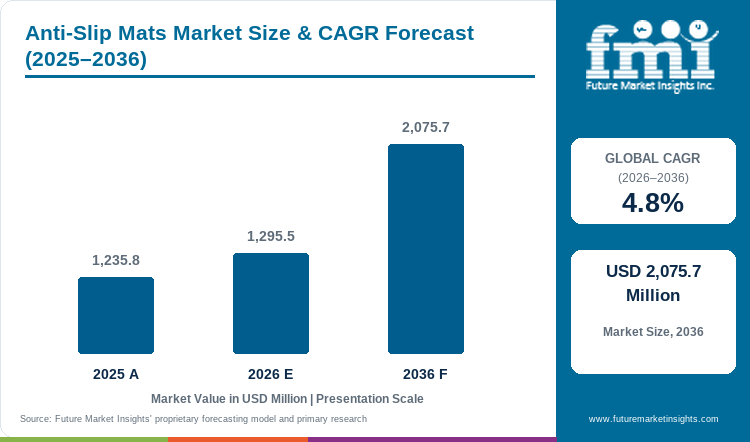
USD 1,295.5 million in 2026 and USD 2,075.7 million by 2036, expanding at 4.8% CAGR.
Sales of anti-slip mats are estimated to rise at 4.8% CAGR through 2036. Valuation rises from USD 1,235.8 million in 2025 to USD 1,295.5 million in 2026 and reaches USD 2,075.7 million by 2036. Facility teams are buying mats for wet floors, oily areas and standing work zones instead of replacing floor coverings on a fixed schedule. In March 2026, CDC/NIOSH listed spills, greasy floors and loose mats as common slip and trip hazards for young workers. The guidance links mat choice with grip, flat placement and housekeeping. It does not treat mats as a stand-alone control. Plant managers are matching material, edge design, drainage and cleaning method to each risk point before using the same mat at more sites.
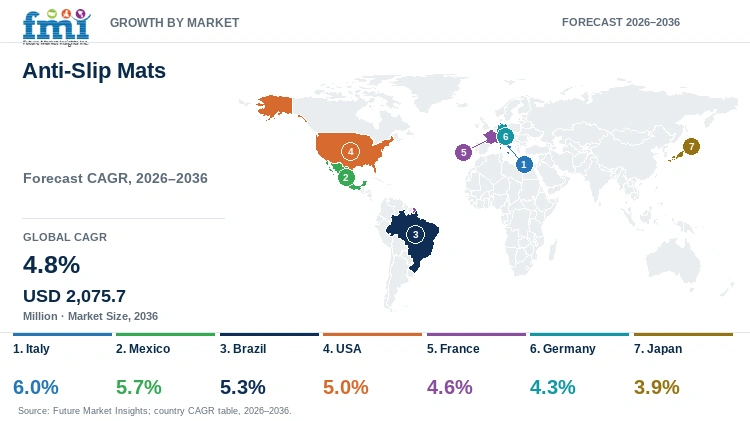
Countries turn floor-safety needs into purchases in different ways. Italy and Mexico have faster supplied CAGRs than Germany and Japan, but these rates show forecast speed, not current market size. In October 2025, Assurance Maladie reported about 150,000 fall-related workplace accidents each year in France. It also named same-level falls as the second-leading workplace accident type. This national focus supports spending on safer walkways, but each mat still must match local traffic and cleaning needs. Mature industrial countries often ask for more documents and planned replacement. Faster-growth countries depend more on local stock, installation help and quick repeat supply.
Key Takeaways
- Facility safety reviews are increasing purchases at wet areas, entrances, standing workstations and other known floor-risk points.
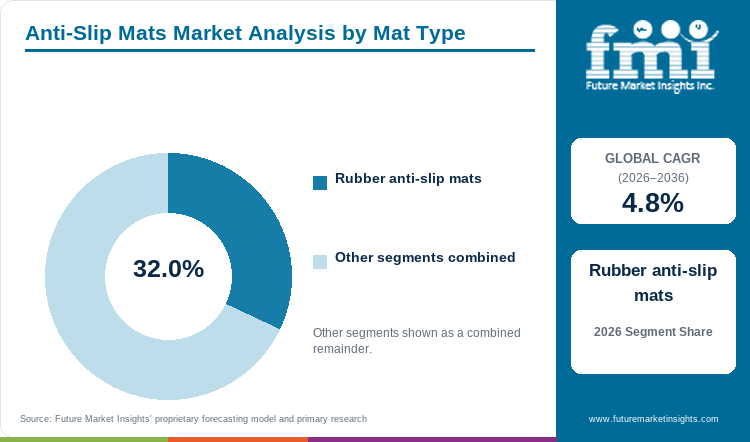
- By mat type, rubber anti-slip mats are projected to account for 32.0% in 2026, supported by use in wet and dry work areas.
- By material, natural rubber is estimated to hold 29.0% in 2026, supported by strong grip, flexibility and easy molding.
- In 2026, industrial workplaces are expected to lead end use with 31.0% share, driven by wet floors and long standing tasks.
- Poor material choice, loose edges, trapped dirt, or blocked cart paths can delay wider use.
- Some of the key players in this market include NoTrax / Justrite Safety Group, 3M, Crown Matting Technologies, COBA, Wearwell, M+A Matting, Turtle Plastics, Rubber-Cal, UniFirst and Cintas.
Analyst Perspective
"Facility teams make repeat purchases when a mat gives the right grip, drainage and edge control for a known floor risk. Suppliers build stronger accounts by making selection simple and replacing worn mats before they become unsafe."
- Nikhil Kaitwade, Principal Consultant, Future Market Insights
How is the anti-slip mats market segmented?
Anti-Slip Mats Market is segmented by Mat Type, Material, End Use, Surface, Sales Channel and Region. Forecast period from 2026 to 2036.
The market uses six main groups: mat type, material, end use, surface, sales channel and region. Mat type includes rubber anti-slip mats and drainage mats. It also includes anti-fatigue safety, entrance anti-slip and chemical-resistant mats. Material includes natural rubber, nitrile rubber, PVC, polyurethane and recycled rubber. End use includes industrial workplaces, commercial kitchens, warehouses, healthcare facilities and retail or entrance areas. Surface options are ribbed, perforated, studded, grit-coated and textured foam. Sales channels include janitorial or safety distributors, industrial catalog or e-commerce, direct manufacturer sales and facility service providers.
How do rubber anti-slip mats address varied floor hazards within the mat type category?
Rubber anti-slip mats give facility teams one base material for grip, drainage, or cushioning. These mats also use the same durable compounds found in industrial rubber products. Solid mats suit dry standing areas. Perforated grids move water away from the walking surface. Buyers can use one product family and change thickness, edges, or rubber mix for each workstation.
- Based on mat type, rubber anti-slip mats are projected to account for 32.0% in 2026, supported by use in wet and dry industrial areas.
- In April 2025, Wearwell added eight products to its 24/Seven LockSafe line. The interlocking rubber tiles cover anti-slip, anti-fatigue, chemical-resistant and heavy-duty uses.
What keeps natural rubber relevant within the material category?
Natural rubber gives mats strong grip and flexibility. It can be molded into ribs, studs and open-grid designs. The available natural rubber supply also supports common production methods for molded mats. In May 2025, India’s Rubber Board reported 875,000 tonnes of natural rubber production for 2024-25. Production was 2.1% higher than the prior year. Oils, solvents and harsh chemicals can still push buyers toward nitrile or other special compounds.
- By material, natural rubber is estimated to hold 29.0% in 2026, supported by strong grip, flexibility and easy molding.
- Natural rubber works well in dry and moderately wet areas. Oils and harsh chemicals can move buyers toward nitrile or other compounds.
How do industrial workplaces shape selection within the end use category?
Industrial workplaces have many risk points near machines, washdown areas, assembly lines and material-transfer zones. Facility teams connect mat purchases with workplace safety systems that define each hazard and control. In March 2026, DGUV reported that 53% of surveyed German workers and managers saw slips, trips and falls as a workplace risk. Removable mats stay useful because crews can clean, move, or replace them without changing the permanent floor.
- In 2026, industrial workplaces are expected to lead end use with 31.0% share, driven by wet floors and long standing tasks.
- Plant teams check the contaminant, traffic and cleaning method before approval. They also test whether mat edges stay stable under carts and foot traffic.
Why do ribbed surfaces remain practical within the surface category?
Ribbed surfaces have raised lines that help move light moisture and debris away from each step. The design also works beside durable commercial flooring without changing the permanent floor. Rib depth and direction still need to suit cleaning and cart movement. Deep ribs can hold dirt or slow small wheels. Facility teams often choose ribbed mats for moderate risks that need easy cleaning and steady grip.
- By surface, ribbed formats are forecast to represent 28.0% in 2026, supported by steady grip and routine cleaning.
- Ribbed mats work well at entrances and dry workstations. Deeper drainage or grit surfaces suit heavier water or oil exposure.
What supports janitorial and safety distributors within the sales channel category?
Choosing a mat takes more than size and price. Specialist distributors check the floor, spill type, traffic and replacement cycle. They also work with facility management services that inspect entrances, cleaning needs and repeat site problems. Local stock helps smaller facilities replace worn mats faster. Direct sales suit engineered systems. E-commerce works best for repeat orders with a known specification.
- Janitorial and safety distributors are projected to hold 38.0% of sales channel revenue in 2026, supported by product help and local stock.
- Distributors add value when samples, border options, setup advice and replacement stock make site approval easier.
What are the drivers, restraints and opportunities in the Anti-Slip Mats Market?
Defined floor hazards support targeted demand, poor application fit limits wider use and modular or service-backed programs expand repeat replacement opportunities.
- Driver: Facility teams are turning slip, contamination and long-standing risks into mat requirements for specific work areas.
- Restraint: Mats that move, curl, trap dirt, or block carts can create a new safety problem.
- Opportunity: Modular mats, site checks and planned replacement can turn one-time purchases into repeat programs at several sites.
Safety reviews are turning visible floor hazards into defined purchase specifications
Facility teams check risk one area at a time instead of treating every floor the same. In August 2026, OSHA renewed its warehouse and distribution National Emphasis Program. It includes walking-working surfaces, slips, trips and falls. Floor condition also affects industrial safety footwear and other site-safety choices. Washdown areas need drainage. Oily stations need compatible materials. Standing work areas may need cushioning. Repeat orders are more likely when the same mat works at several stations with the same risk and cleaning routine.
Application mistakes can turn a floor control into a new trip or cleaning problem
Site testing is the main restraint because a mat must stay stable under real traffic. A loose edge or sliding base can create a trip hazard. Deep channels can also hold dirt if cleaning cannot reach them. March 2026 CDC/NIOSH guidance lists loose mats and greasy floors among common slip and trip causes. Facilities using stronger institutional cleaning chemicals must also check that rubber or polymer mats can handle the wash process. Teams delay wider use if a trial blocks carts, shifts under turning loads, or adds cleaning work. Clear performance documents and a controlled trial lower this risk before several sites use the same mat.
Modular systems and scheduled service can extend revenue beyond one-time loose-mat orders
Interlocking tiles let maintenance crews replace one damaged section instead of the full floor area. Site surveys can also place mats near material handling equipment routes so borders and drain holes do not block carts. In May 2026, Assurance Maladie reported 21,745 ergonomic-prevention grants paid to French companies for 2025. Equipment purchases made up most funded requests. The program covers ergonomic risks and is not specific to anti-slip mats. It still shows that smaller employers use formal prevention budgets for workplace improvements. Mat suppliers can support this spending with clear workstation needs, modular layouts, replacement plans and maintenance rules.
Which country CAGRs are profiled in the Anti-Slip Mats Market?
| Country | CAGR |
|---|---|
| Italy | 6.0% |
| Mexico | 5.7% |
| Brazil | 5.3% |
| USA | 5.0% |
| France | 4.6% |
| Germany | 4.3% |
| Japan | 3.9% |
How do country-level CAGRs compare in the Anti-Slip Mats Market?
Italy and Mexico have the fastest supplied growth rates, followed by Brazil and the USA. France and Germany fall in the middle, while Japan grows more slowly. The 2.1 percentage-point gap shows forecast speed, not current revenue. Each country turns floor-safety needs into purchases through different industries, service networks and approval steps.
- Italy combines factory demand with distributor-led replacement in food-service sites.
- Mexico uses formal workplace-safety programs inside large industrial sites.
- Brazil relies on the right material choice and steady regional product supply.
- USA demand is shaped by warehouse inspections and multi-site safety programs.
- France combines fall prevention with equipment-support programs for smaller employers.
- Germany places more weight on documented risk checks and technical suitability.
- Japan favors compact, stable mats that do not block organized work areas.
Similar CAGRs can still create different needs for stock, service and product approval. The full report provides country-level CAGR analysis across North America, Latin America, Western Europe, Eastern Europe, East Asia, South Asia and Pacific and the Middle East and Africa.
Country-wise Analysis
- Italian factories and food-service sites run formal injury-prevention programs. Many buy mats through regional distributors. Anti-slip mat sales in Italy are forecast to expand at 6.0% CAGR by 2036, influenced by repeat replacement in factories and hospitality sites. INAIL reported in February 2026 that 597,710 workplace injuries were recorded during 2025. The national total keeps prevention spending visible, but it does not measure mat demand. Each order still needs a clear floor risk. Distributors serving foodservice equipment accounts can win repeat business by keeping wet-area mats in local stock and giving Italian-language cleaning and replacement guidance.
- Mexican manufacturers are using formal safety programs to improve work areas and cut incident exposure. Demand for anti-slip mats in Mexico is forecast to rise at 5.7% CAGR over the forecast period, supported by factory and warehouse spending on practical safety controls. In April 2026, IMSS reported that 2,522 work centers in its ELSSA strategy recorded 10,184 fewer work accidents in 2025 than a year earlier. Large plants can still make mistakes by using one mat type for water, oil and cart routes. Local stock and modular choices help safety teams match each floor risk and replace worn mats without long delays.
- Brazilian factories, processors and logistics sites must manage floor safety even when product access is weaker outside major industrial centers. Brazil is estimated to post 5.3% CAGR over the forecast period, shaped by floor hazards in manufacturing, transport and handling work. In May 2026, the Ministry of Labour and Employment published a national review with 806,011 work accidents during 2025. The national count shows the scale of workplace risk, but it does not measure mat demand. Suppliers still need to prove material resistance, cleaning fit and stable edges before one mat standard is used at several sites.
- US warehouse and distribution operators are reviewing floor controls as part of wider safety checks. Adoption of anti-slip mats in the USA is estimated to expand at 5.0% CAGR through 2036, reinforced by attention to walking-working surfaces in large logistics sites. In August 2026, OSHA said its renewed warehouse National Emphasis Program covers slips, trips, falls, material handling and other common hazards. Facility teams can use industrial floor mats at wet or standing work zones, but each site still needs the right mat. Multi-site programs favor suppliers that document grip, edge stability, cleaning method and replacement timing under the same work conditions.
- French employers pair risk checks with funding for safety equipment. The France anti-slip mats sector is projected to record 4.6% CAGR during the assessment period. National attention to same-level falls supports this outlook. In October 2025, Assurance Maladie reported about 150,000 fall-related workplace accidents each year. It also named same-level falls as the second-leading workplace accident type. The issue affects food processing, logistics, healthcare, retail and hospitality. Smaller employers may delay purchases if grant rules, documents, or maintenance needs are unclear. Suppliers can speed approval by linking each mat to a clear walkway or workstation risk.
- German plants often ask for clear technical proof before approving a mat for regular use. Anti-slip mat demand in Germany is forecast to rise at 4.3% CAGR over the forecast period, influenced by established risk checks and mature industrial buying. DGUV reported in March 2026 that 53% of surveyed workers and managers identified slips, trips and falls as a risk at their own workplace. The first sale can take longer because technical teams may ask for grip test results, cleaning instructions and edge details. Approved products can then use clear replacement rules to support steady repeat orders at similar workstations.
- Japanese workplaces favor compact and stable floor controls that do not block organized movement. Japan's anti-slip mats outlook is anticipated to advance at 3.9% CAGR over the assessment period, tied to ongoing fall risks and an older workforce. The Ministry of Health, Labour and Welfare reported in May 2026 that falls caused 37,195 injuries requiring at least four days away from work in 2025. Low-profile edges and simple cleaning routines are useful in factories, healthcare sites and commercial buildings. Suppliers need clear placement instructions because thick or shifting mats can create a new obstacle in narrow work areas.
Who are the notable companies in the Anti-Slip Mats Market?
NoTrax / Justrite Safety Group, 3M, Crown Matting Technologies, COBA, Wearwell, M+A Matting, Turtle Plastics, Rubber-Cal, UniFirst and Cintas are active within the defined anti-slip mats supply boundary.
Competition comes from industrial mat specialists, entrance-mat makers, material specialists and facility-service providers. Strong accounts depend on grip, drainage, comfort options, local stock and help with placement or replacement. A wide product range is not enough. Each mat still must match the spill type, traffic, cleaning method and edge condition at the site.
- Industrial safety and comfort mat systems include NoTrax / Justrite Safety Group, Crown Matting Technologies and COBA. Wearwell and M+A Matting are also in this group.
- Entrance and managed facility programs include 3M, UniFirst and Cintas. Turtle Plastics and Rubber-Cal serve special material and modular needs.
Competitive Benchmarking: Anti-Slip Mats Market
| Company | Wet-Area and Drainage Coverage | Ergonomic and Workstation Range | Specification and Service Support | Geographic Reach |
|---|---|---|---|---|
| NoTrax / Justrite Safety Group | High | High | High | North America, Europe and international distribution |
| 3M | High | Medium | High | Global |
| Crown Matting Technologies | High | High | High | North America with distributor support |
| COBA | High | High | High | Europe, Middle East and South Africa |
| Wearwell | High | High | High | North America with international distributors |
| M+A Matting | Medium | High | High | North America and Europe |
| Turtle Plastics | High | Medium | Medium | United States with export reach |
| Rubber-Cal | Medium | Medium | High | United States with online export reach |
| UniFirst | High | Medium | High | United States and Canada |
| Cintas | High | Medium | High | United States and Canada |
Scoring basis: High wet-area coverage means several current drainage or anti-slip formats. Medium means a smaller range. Low means little public evidence. High ergonomic range means several anti-fatigue or workstation formats. High support needs clear proof of product guidance, distributors, route service, or site help. Medium means narrower support. Low means little public proof.
Key Developments in the Anti-Slip Mats Market
- In August 2026, Mountville Mills acquired GelPro and said it would move the anti-fatigue mat brand's production to its LaGrange, Georgia plant.
- In April 2026, COBA launched several new matting products at the Health & Safety Event in Birmingham. It also showed anti-fatigue selection tools.
- In April 2025, Wearwell added eight products to its 24/Seven LockSafe rubber tile line. The new tiles cover slip control, fatigue relief and heavy industrial use.
Key Players in the Anti-Slip Mats Market
Industrial safety and ergonomic mat systems
- NoTrax / Justrite Safety Group
- Crown Matting Technologies
- COBA
- Wearwell
- M+A Matting
Entrance and managed facility programs
- 3M
- UniFirst
- Cintas
Specialty material and modular suppliers
- Turtle Plastics
- Rubber-Cal
Anti-Slip Mats Market - Report Scope
| Coverage field | Report scope |
|---|---|
| Market breakdown | By Mat Type, Material, End Use, Surface, Sales Channel and Region. |
| Quantitative Units | USD million. |
| Market Definition | Revenue includes standalone and modular anti-slip mats sold within the defined mat type, material, end use, surface and sales channel categories. Permanent safety flooring, coatings, tapes, stair nosings, decorative household mats and service revenue not attributable to the mat product are excluded. |
| Regions Covered | North America, Latin America, Western Europe, Eastern Europe, East Asia, South Asia and Pacific and Middle East and Africa. |
| Countries Covered | Italy, Mexico, Brazil, USA, France, Germany, Japan and 20+ countries included in the full report. |
| Key Companies Profiled | NoTrax / Justrite Safety Group, 3M, Crown Matting Technologies, COBA, Wearwell, M+A Matting, Turtle Plastics, Rubber-Cal, UniFirst, Cintas. |
| Forecast Period | 2026 to 2036. |
| Approach | Primary and secondary research with market triangulation. |
Anti-Slip Mats Market - Research Methodology
| Method | Approach |
|---|---|
| Primary Research | FMI analysts gathered input from manufacturers, service providers, technology developers, distributors, end users, procurement teams and subject-matter experts. Interviews examined purchasing decisions, product or service evaluation, adoption barriers, approval requirements, pricing considerations and expectations for technical or commercial support. Respondents were also asked what evidence is required before a trial, pilot, or initial order develops into regular purchasing. |
| Desk Research | Desk research covered government statistics, regulatory publications, trade data, industry associations, technical literature, standards, company filings, product information and official corporate announcements. Sources were reviewed for relevance, publication date, geographic coverage and consistency with the defined market scope. Claims relating to performance, applications, approvals, capacity, investment and commercial activity were retained only when supported by credible public evidence. |
| Market Sizing and Forecasting | The market model combined the baseline value with historical performance, segment structure, pricing and volume indicators, adoption levels, company participation and country-level demand conditions. Forecast assumptions considered economic activity, investment trends, regulatory developments, technology adoption, purchasing cycles, supply availability and barriers to wider market use. Segment and regional estimates were reconciled before the final market total was calculated. |
| Data Validation | Estimates were checked against multiple independent indicators, including public data, company activity, trade patterns, industry developments and findings from primary interviews. Validation also tested whether products, services, applications and company revenues fell within the defined market boundaries. Adjacent categories, unsupported claims, overlapping revenues and activities without direct market relevance were excluded to reduce double counting and maintain consistency across segments and countries. |
Anti-Slip Mats Market by Segments
Anti-Slip Mats Market segmented by Mat Type:
- Rubber anti-slip mats
- Drainage mats
- Anti-fatigue safety mats
- Entrance anti-slip mats
- Chemical-resistant mats
Anti-Slip Mats Market segmented by Material:
- Natural rubber
- Nitrile rubber
- PVC
- Polyurethane
- Recycled rubber
Anti-Slip Mats Market segmented by End Use:
- Industrial workplaces
- Commercial kitchens
- Warehouses
- Healthcare facilities
- Retail - entrance areas
Anti-Slip Mats Market segmented by Surface:
- Ribbed
- Perforated
- Studded
- Grit-coated
- Textured foam
Anti-Slip Mats Market segmented by Sales Channel:
- Janitorial - safety distributors
- Industrial catalog - e-commerce
- Direct manufacturer sales
- Facility service providers
Anti-Slip Mats Market by Region:
- North America
- United States
- Canada
- Latin America
- Brazil
- Mexico
- Chile
- Rest of Latin America
- Western Europe
- Germany
- United Kingdom
- Italy
- Spain
- France
- Nordics
- Benelux
- Rest of Western Europe
- Eastern Europe
- Russia
- Poland
- Hungary
- Balkan and Baltic States
- Rest of Eastern Europe
- East Asia
- China
- Japan
- South Korea
- South Asia and Pacific
- India
- ASEAN
- Australia and New Zealand
- Rest of South Asia and Pacific
- Middle East and Africa
- Kingdom of Saudi Arabia
- Other GCC Countries
- Türkiye
- South Africa
- Other African Union Countries
- Rest of Middle East and Africa
Research Sources and Bibliography
- Centers for Disease Control and Prevention, National Institute for Occupational Safety and Health. (2026, March 9). Young worker slips, trips and falls.
- Assurance Maladie - Occupational Risks. (2025, October 2). Falls do not give warning: Occupational Risks acts to prevent them. [France].
- Rubber Board, Government of India. (2025, May). Rubber Statistical News, Vol. 83, No. 12. [India].
- German Social Accident Insurance. (2026, March 25). Workplace Barometer 2026: Occupational safety and health strengthen crisis resilience. [Germany].
- Occupational Safety and Health Administration. (2026, August 6). Protecting warehouse workers. [United States].
- INAIL. (2026, February 13). Workplace injuries and occupational diseases: Provisional picture for 2025. [Italy].
- Mexican Social Security Institute. (2026, April). Companies participating in the ELSSA strategy reduce workplace accidents and diseases. [Mexico].
- Ministry of Labour and Employment. (2026, May). Work accidents in Brazil, 2016 to 2025. [Brazil].
- Ministry of Health, Labour and Welfare. (2026, May 27). Occupational accident occurrence in 2025. [Japan].
- Assurance Maladie - Occupational Risks. (2026, May 27). 2025 review of the ergonomic risk prevention grant. [France].
- Wearwell. (2025, April 2). Wearwell unveils eight additions to the 24/Seven LockSafe line.
- Wearwell. (2025, July 16). Solving the sliding mats problem.
- COBA. (2026, May). COBA takes on the Health & Safety Event 2026.
- M+A Matting. (2026, March 9). M+A Matting announces Enterprise Resource Planning system upgrade to strengthen customer experience.
- Mountville Mills. (2026, August 7). Mountville acquires GelPro, expanding its brand and anti-fatigue product portfolio.
- Cintas. (2026, March 11). Cintas to acquire UniFirst in transaction that expands service capabilities.
- UniFirst Corporation. (2026, June 12). UniFirst shareholders approve transaction with Cintas.
- Justrite Safety Group. (2025, April 25). NoTrax announces price increase on select product lines due to rising material costs.
- Justrite Safety Group. (2025, January 17). Justrite Safety Group acquires Global Spill and Safety.
- Turtle Plastics. (2026, February 25). Turtle Plastics, Haltec and AME join Bridgestone in an industry-wide safety action at ConExpo-Con/Agg 2026.
This bibliography is provided for reader reference and is not exhaustive. The full report contains the complete reference list and detailed citations
This Report Answers
- How large is the anti-slip mats market in 2026 and 2036?
- Which workplace safety conditions are supporting targeted anti-slip mat purchases?
- Which mat type accounts for the largest supplied share in 2026?
- Which material accounts for the largest supplied share in 2026?
- Why do industrial workplaces account for the largest supplied end-use share?
- How do supplied country growth rates differ between Italy, Mexico, Brazil, USA, France, Germany and Japan?
- Which companies supply industrial mat systems, entrance matting, specialty materials, or managed facility programs?
- Which application and maintenance problems can delay wider anti-slip mat deployment?
- What should facility and safety teams evaluate before standardizing an anti-slip mat across several sites?
Frequently Asked Questions
How big is the anti-slip mats market in 2026?
The anti-slip mats market is valued at USD 1,295.5 million in 2026 and is projected to reach USD 2,075.7 million by 2036. Floor-risk controls and repeat replacement at known hazard points support this forecast.
What is the CAGR of the anti-slip mats market from 2026 to 2036?
The anti-slip mats market is projected to grow at 4.8% CAGR between 2026 and 2036. Safety reviews and planned replacement support demand, while mats remain one part of wider floor-safety controls.
Which mat type leads the anti-slip mats market in 2026?
The rubber anti-slip mats segment is projected to account for 32.0% of mat type revenue in the anti-slip mats market in 2026. Durable rubber lets facilities use different surface designs for wet floors, dry zones and standing work areas.
Which material leads the anti-slip mats market in 2026?
The natural rubber segment is estimated to hold 29.0% of material revenue in the anti-slip mats market in 2026. Strong grip, flexibility and easy molding support use in routine areas with moderate chemical exposure.
Which companies are active in the anti-slip mats market?
Key companies operating in the anti-slip mats market include NoTrax / Justrite Safety Group, 3M, Crown Matting Technologies, COBA, Wearwell, M+A Matting, Turtle Plastics, Rubber-Cal, UniFirst and Cintas. Their offers cover wet areas, anti-fatigue use, product help, distribution and managed mat service.
What is driving growth in the Anti-Slip Mats Market?
Demand is rising when safety reviews find wet floors, busy walkways and standing work areas that need a safer surface. Facilities then choose drainage, grip and edge designs that match the floor risk and cleaning routine.
Who are the key players in the Anti-Slip Mats Market?
Key players include NoTrax / Justrite Safety Group, 3M, Crown Matting Technologies, COBA and Wearwell. M+A Matting, Turtle Plastics, Rubber-Cal, UniFirst and Cintas are also active. Their roles cover industrial mats, entrance control, special materials and managed mat service.
Preview the report firsthand - request a free sample
Get SampleGet the brochure for pricing and purchase details.
Get PDFTable of Content
- Key Takeaways
- Market Size and CAGR
- Top Growth Driver
- Fastest Growing Segment
- Leading Region
- Key Companies
- Emerging Opportunities
- Executive Summary
- Global Market Outlook
- Demand-side Trends
- Supply-side Trends
- Technology Roadmap Analysis
- Analysis and Recommendations
- Analyst Perspective (What is happening? Why now? What should investors know?)
- Key Questions Answered
- How large is the market?
- What is the CAGR?
- What are key trends?
- Which region dominates?
- Who are the leaders?
- Market Overview
- Market Coverage / Taxonomy
- Market Definition / Scope / Limitations
- Research Methodology
- Chapter Orientation
- Analytical Lens and Working Hypotheses
- Market Structure, Signals, and Trend Drivers
- Benchmarking and Cross-market Comparability
- Market Sizing, Forecasting, and Opportunity Mapping
- Research Design and Evidence Framework
- Desk Research Programme (Secondary Evidence)
- Expert Input and Fieldwork (Primary Evidence)
- Tooling, Models, and Reference Databases
- Data Engineering and Model Build
- Quality Assurance and Audit Trail
- Market Background
- Market Dynamics (Drivers, Restraints, Opportunity, Trends)
- Scenario Forecast (Optimistic, Likely, Conservative)
- Impact Analysis
- AI Impact
- Sustainability Impact
- Regulatory Impact
- Technology Impact
- Consumer / Buyer Analysis
- Purchase Drivers
- Adoption Barriers
- Buyer Journey
- Opportunity Map Analysis
- Product Life Cycle Analysis
- Supply Chain Analysis
- Investment Feasibility Matrix
- Value Chain Analysis
- PESTLE and Porter's Analysis
- Regulatory Landscape
- Regional Parent Market Outlook
- Production and Consumption Statistics
- Import and Export Statistics
- Global Market Analysis and Forecast, 2021 to 2036
- Historical Market Size Value (USD Million) Analysis, 2021 to 2025
- Current and Future Market Size Value (USD Million) Projections, 2026 to 2036
- Y-o-Y Growth Trend Analysis
- Absolute $ Opportunity Analysis
- Global Market Pricing Analysis, 2021 to 2036
- Global Market Analysis and Forecast, By Mat Type, 2021 to 2036
- Introduction / Key Findings
- Historical Market Size Value (USD Million) Analysis By Mat Type, 2021 to 2025
- Current and Future Market Size Value (USD Million) Analysis and Forecast By Mat Type, 2026 to 2036
- Rubber anti-slip mats
- Drainage mats
- Anti-fatigue safety mats
- Entrance anti-slip mats
- Chemical-resistant mats
- Y-o-Y Growth Trend Analysis By Mat Type, 2021 to 2025
- Absolute $ Opportunity Analysis By Mat Type, 2026 to 2036
- Global Market Analysis and Forecast, By Material, 2021 to 2036
- Introduction / Key Findings
- Historical Market Size Value (USD Million) Analysis By Material, 2021 to 2025
- Current and Future Market Size Value (USD Million) Analysis and Forecast By Material, 2026 to 2036
- Natural rubber
- Nitrile rubber
- PVC
- Polyurethane
- Recycled rubber
- Y-o-Y Growth Trend Analysis By Material, 2021 to 2025
- Absolute $ Opportunity Analysis By Material, 2026 to 2036
- Global Market Analysis and Forecast, By End Use, 2021 to 2036
- Introduction / Key Findings
- Historical Market Size Value (USD Million) Analysis By End Use, 2021 to 2025
- Current and Future Market Size Value (USD Million) Analysis and Forecast By End Use, 2026 to 2036
- Industrial workplaces
- Commercial kitchens
- Warehouses
- Healthcare facilities
- Retail - entrance areas
- Y-o-Y Growth Trend Analysis By End Use, 2021 to 2025
- Absolute $ Opportunity Analysis By End Use, 2026 to 2036
- Global Market Analysis and Forecast, By Surface, 2021 to 2036
- Introduction / Key Findings
- Historical Market Size Value (USD Million) Analysis By Surface, 2021 to 2025
- Current and Future Market Size Value (USD Million) Analysis and Forecast By Surface, 2026 to 2036
- Ribbed
- Perforated
- Studded
- Grit-coated
- Textured foam
- Y-o-Y Growth Trend Analysis By Surface, 2021 to 2025
- Absolute $ Opportunity Analysis By Surface, 2026 to 2036
- Global Market Analysis and Forecast, By Sales Channel, 2021 to 2036
- Introduction / Key Findings
- Historical Market Size Value (USD Million) Analysis By Sales Channel, 2021 to 2025
- Current and Future Market Size Value (USD Million) Analysis and Forecast By Sales Channel, 2026 to 2036
- Janitorial - safety distributors
- Industrial catalog - e-commerce
- Direct manufacturer sales
- Facility service providers
- Y-o-Y Growth Trend Analysis By Sales Channel, 2021 to 2025
- Absolute $ Opportunity Analysis By Sales Channel, 2026 to 2036
- Global Market Analysis and Forecast, By Region, 2021 to 2036
- Introduction
- Historical Market Size Value (USD Million) Analysis By Region, 2021 to 2025
- Current Market Size Value (USD Million) Analysis and Forecast By Region, 2026 to 2036
- North America
- Latin America
- Western Europe
- Eastern Europe
- East Asia
- South Asia and Pacific
- Middle East and Africa
- Market Attractiveness Analysis By Region
- North America Market Analysis and Forecast, By Country, 2021 to 2036
- Historical Market Size Value (USD Million) Trend Analysis By Market Taxonomy, 2021 to 2025
- Market Size Value (USD Million) Forecast By Market Taxonomy, 2026 to 2036
- By Country
- United States
- Canada
- By Mat Type
- By Material
- By End Use
- By Surface
- By Sales Channel
- By Country
- Market Attractiveness Analysis
- By Country
- By Mat Type
- By Material
- By End Use
- By Surface
- By Sales Channel
- Key Takeaways
- Latin America Market Analysis and Forecast, By Country
- Historical Market Size Value (USD Million) Trend Analysis By Market Taxonomy, 2021 to 2025
- Market Size Value (USD Million) Forecast By Market Taxonomy, 2026 to 2036
- By Country
- Brazil
- Mexico
- Chile
- Rest of Latin America
- By Mat Type
- By Material
- By End Use
- By Surface
- By Sales Channel
- By Country
- Market Attractiveness Analysis
- By Country
- By Mat Type
- By Material
- By End Use
- By Surface
- By Sales Channel
- Key Takeaways
- Western Europe Market Analysis and Forecast, By Country
- Historical Market Size Value (USD Million) Trend Analysis By Market Taxonomy, 2021 to 2025
- Market Size Value (USD Million) Forecast By Market Taxonomy, 2026 to 2036
- By Country
- Germany
- United Kingdom
- Italy
- Spain
- France
- Nordics
- Benelux
- Rest of Western Europe
- By Mat Type
- By Material
- By End Use
- By Surface
- By Sales Channel
- By Country
- Market Attractiveness Analysis
- By Country
- By Mat Type
- By Material
- By End Use
- By Surface
- By Sales Channel
- Key Takeaways
- Eastern Europe Market Analysis and Forecast, By Country
- Historical Market Size Value (USD Million) Trend Analysis By Market Taxonomy, 2021 to 2025
- Market Size Value (USD Million) Forecast By Market Taxonomy, 2026 to 2036
- By Country
- Russia
- Poland
- Hungary
- Balkan and Baltic States
- Rest of Eastern Europe
- By Mat Type
- By Material
- By End Use
- By Surface
- By Sales Channel
- By Country
- Market Attractiveness Analysis
- By Country
- By Mat Type
- By Material
- By End Use
- By Surface
- By Sales Channel
- Key Takeaways
- East Asia Market Analysis and Forecast, By Country
- Historical Market Size Value (USD Million) Trend Analysis By Market Taxonomy, 2021 to 2025
- Market Size Value (USD Million) Forecast By Market Taxonomy, 2026 to 2036
- By Country
- China
- Japan
- South Korea
- By Mat Type
- By Material
- By End Use
- By Surface
- By Sales Channel
- By Country
- Market Attractiveness Analysis
- By Country
- By Mat Type
- By Material
- By End Use
- By Surface
- By Sales Channel
- Key Takeaways
- South Asia and Pacific Market Analysis and Forecast, By Country
- Historical Market Size Value (USD Million) Trend Analysis By Market Taxonomy, 2021 to 2025
- Market Size Value (USD Million) Forecast By Market Taxonomy, 2026 to 2036
- By Country
- India
- ASEAN
- Australia and New Zealand
- Rest of South Asia and Pacific
- By Mat Type
- By Material
- By End Use
- By Surface
- By Sales Channel
- By Country
- Market Attractiveness Analysis
- By Country
- By Mat Type
- By Material
- By End Use
- By Surface
- By Sales Channel
- Key Takeaways
- Middle East and Africa Market Analysis and Forecast, By Country
- Historical Market Size Value (USD Million) Trend Analysis By Market Taxonomy, 2021 to 2025
- Market Size Value (USD Million) Forecast By Market Taxonomy, 2026 to 2036
- By Country
- Kingdom of Saudi Arabia
- Other GCC Countries
- Türkiye
- South Africa
- Other African Union Countries
- Rest of Middle East and Africa
- By Mat Type
- By Material
- By End Use
- By Surface
- By Sales Channel
- By Country
- Market Attractiveness Analysis
- By Country
- By Mat Type
- By Material
- By End Use
- By Surface
- By Sales Channel
- Key Takeaways
- Key Countries Market Analysis
- United States
- Pricing Analysis
- Market Share Analysis, 2025
- By Mat Type
- By Material
- By End Use
- By Surface
- By Sales Channel
- Canada
- Pricing Analysis
- Market Share Analysis, 2025
- By Mat Type
- By Material
- By End Use
- By Surface
- By Sales Channel
- Mexico
- Pricing Analysis
- Market Share Analysis, 2025
- By Mat Type
- By Material
- By End Use
- By Surface
- By Sales Channel
- Brazil
- Pricing Analysis
- Market Share Analysis, 2025
- By Mat Type
- By Material
- By End Use
- By Surface
- By Sales Channel
- Chile
- Pricing Analysis
- Market Share Analysis, 2025
- By Mat Type
- By Material
- By End Use
- By Surface
- By Sales Channel
- Germany
- Pricing Analysis
- Market Share Analysis, 2025
- By Mat Type
- By Material
- By End Use
- By Surface
- By Sales Channel
- United Kingdom
- Pricing Analysis
- Market Share Analysis, 2025
- By Mat Type
- By Material
- By End Use
- By Surface
- By Sales Channel
- Italy
- Pricing Analysis
- Market Share Analysis, 2025
- By Mat Type
- By Material
- By End Use
- By Surface
- By Sales Channel
- Spain
- Pricing Analysis
- Market Share Analysis, 2025
- By Mat Type
- By Material
- By End Use
- By Surface
- By Sales Channel
- France
- Pricing Analysis
- Market Share Analysis, 2025
- By Mat Type
- By Material
- By End Use
- By Surface
- By Sales Channel
- India
- Pricing Analysis
- Market Share Analysis, 2025
- By Mat Type
- By Material
- By End Use
- By Surface
- By Sales Channel
- ASEAN
- Pricing Analysis
- Market Share Analysis, 2025
- By Mat Type
- By Material
- By End Use
- By Surface
- By Sales Channel
- Australia and New Zealand
- Pricing Analysis
- Market Share Analysis, 2025
- By Mat Type
- By Material
- By End Use
- By Surface
- By Sales Channel
- China
- Pricing Analysis
- Market Share Analysis, 2025
- By Mat Type
- By Material
- By End Use
- By Surface
- By Sales Channel
- Japan
- Pricing Analysis
- Market Share Analysis, 2025
- By Mat Type
- By Material
- By End Use
- By Surface
- By Sales Channel
- South Korea
- Pricing Analysis
- Market Share Analysis, 2025
- By Mat Type
- By Material
- By End Use
- By Surface
- By Sales Channel
- Russia
- Pricing Analysis
- Market Share Analysis, 2025
- By Mat Type
- By Material
- By End Use
- By Surface
- By Sales Channel
- Poland
- Pricing Analysis
- Market Share Analysis, 2025
- By Mat Type
- By Material
- By End Use
- By Surface
- By Sales Channel
- Hungary
- Pricing Analysis
- Market Share Analysis, 2025
- By Mat Type
- By Material
- By End Use
- By Surface
- By Sales Channel
- Kingdom of Saudi Arabia
- Pricing Analysis
- Market Share Analysis, 2025
- By Mat Type
- By Material
- By End Use
- By Surface
- By Sales Channel
- Türkiye
- Pricing Analysis
- Market Share Analysis, 2025
- By Mat Type
- By Material
- By End Use
- By Surface
- By Sales Channel
- South Africa
- Pricing Analysis
- Market Share Analysis, 2025
- By Mat Type
- By Material
- By End Use
- By Surface
- By Sales Channel
- United States
- Market Structure Analysis
- Competition Dashboard
- Competition Benchmarking
- Market Share Analysis of Top Players
- By Regional
- By Mat Type
- By Material
- By End Use
- By Surface
- By Sales Channel
- Emerging Startups
- Innovation Benchmarking
- Competition Analysis
- Competition Deep Dive
- NoTrax / Justrite Safety Group
- Overview
- Product Portfolio
- Profitability by Market Segments
- Sales Footprint
- Strategy Overview
- Marketing Strategy
- Product Strategy
- Channel Strategy
- 3M
- Crown Matting Technologies
- COBA
- Wearwell
- M+A Matting
- Turtle Plastics
- Rubber-Cal
- UniFirst
- Cintas
- NoTrax / Justrite Safety Group
- Case Studies
- Success Stories
- Recent Developments
- Competition Deep Dive
- Assumptions & Acronyms Used


