

- Market Size (2026)
- USD 911.6 Mn
- Forecast (2036)
- USD 1776.6 Mn
- CAGR (2026 to 2036)
- 6.9%
How big is Multi-Use Tint Sticks Market in 2026?
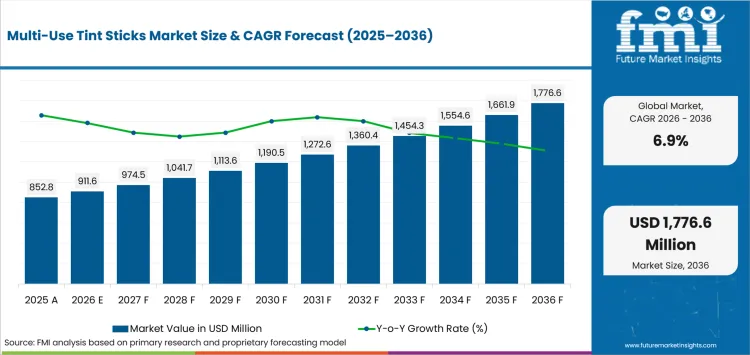
USD 911.6 million in 2026 and USD 1,776.6 million by 2036 at a 6.9% CAGR.
Sales of multi-use tint sticks are estimated to rise at 6.9% CAGR from 2026 to 2036, moving from USD 911.6 million in 2026 to USD 1,776.6 million by 2036. Multi-zone formulas need reliable color on several facial areas before the convenience claim can hold. FDA data dated June 30, 2026 recorded 1,298,361 active cosmetic product listings under MoCRA. The listing volume raises differentiation pressure for new color launches.
Regulatory fit limits how easily one tint can serve lips and the eye area. The FDA color-additive database was updated in August 2026 and separates permitted uses by application area. Ingredient choices must survive every claimed use. Repeat purchase then depends on shade performance.
Key Takeaways
- Simplified color routines support demand because one reliable tint can replace separate products during travel and quick daily application.
- Based on product type, core - classic lines are projected to account for 39.0% in 2026 due to familiar color propositions.
- By nature, conventional products are estimated to hold 57.0% in 2026 owing to wider freedom for pigment, glide, and wear.
- In 2026, liquid & serum formats are expected to lead format with 26.0% share because spreadability supports adjustable intensity.
- Cross-zone colorant rules can lengthen development because every claimed application area needs a defensible safety basis.
- Some of the key players in this market include L'Oreal, Unilever, Amorepacific, Shiseido, Procter & Gamble, e.l.f. Beauty, Coty, Estee Lauder Companies, Kao Corporation, and Beiersdorf.
Analyst Perspective
"Multi-use tint economics depend on repeat use after the first convenience-led purchase. Teams should compare shade payoff, transfer control, hygiene, and approved facial zones before assigning extra value."
- Rahul Pandita, Principal Consultant, Future Market Insights
How is the multi-use tint sticks market segmented?
The market is assessed by product type, nature, format, price positioning, and sales channel.
Product type covers core - classic lines, targeted treatment lines, sensitive & gentle lines, premium & clinical lines, and kits & sets. Nature covers conventional, vegan & cruelty-free, natural & organic, dermocosmetic - clinical, and fragrance-free & sensitive products. Format, price positioning, and sales channel complete the taxonomy used throughout the report.
What makes core - classic lines central to the product type category?
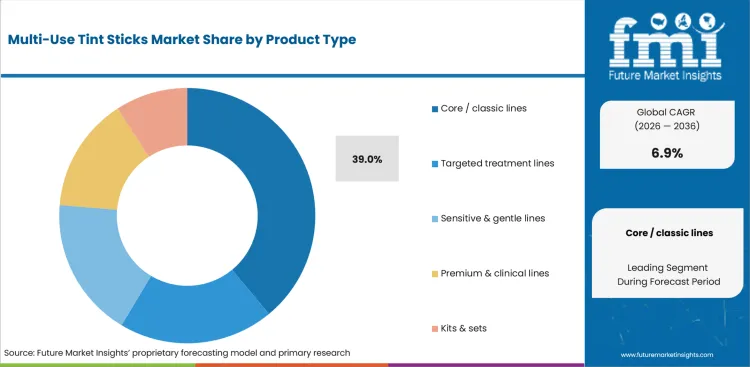
Core - classic lines carry the simplest multi-use proposition because color is the purchase reason. Familiar shade families also let brands extend existing colour cosmetics portfolios without teaching a treatment routine. The format works best when one recognizable shade can move between cheeks and other approved facial zones without changing finish.
- By product type, core - classic lines are forecast to represent 39.0% in 2026 due to familiar shade logic and low explanation risk.
- Kao scheduled the KATE Real Shading Stick for July 2026, giving a current example of portable color with controlled placement.
Why does conventional remain the largest nature segment?
Conventional formulations give developers more room to balance pigment, set, transfer, and sensory feel. Specialty claims narrow those choices in a product already spanning several uses. That distinction is relevant beside vegan cosmetics because each added formulation rule can restrict colorant, emollient, or preservative options before cross-zone testing begins.
- The conventional segment is likely to capture 57.0% share in 2026 attributable to broader ingredient and texture choices.
- Amorepacific introduced HERA Sensual Tinted Shine Lip Serum in January 2026, demonstrating continuing investment in tint texture and wear engineering.
How do liquid & serum formats support the format category?
Liquid & serum formats spread readily and let users change coverage with small dosage adjustments. That logic overlaps with lip care where oils and serums already normalize fluid application. The main risk is migration or uneven pickup, so dispensing control becomes part of product performance.
- Liquid & serum products are set to lead the format category with 26.0% share in 2026 due to adjustable intensity and easy layering within mixed makeup routines.
- L’Oréal reported in February 2026 that NYX Professional Makeup’s Lip IV was among the makeup innovations supporting 2025 consumer-products performance. The example keeps fluid tint development commercially relevant, but dispensing and migration control still gate wider facial use.
What supports mass leadership in price positioning?
Mass pricing lowers the cost of testing an unfamiliar shade and makes repeat experimentation easier. That purchasing logic benefits from scale in the cosmetics ODM field because frequent launches need stable formula transfer and packaging execution. Lower trial prices can widen discovery, but weak payoff or poor control quickly limits repeat purchase.
- Mass is projected to hold 42.0% share in 2026 owing to lower trial cost and wide access through high-traffic beauty and general retail channels.
- Coty linked new Rimmel and CoverGirl offerings to multi-use performance in August 2025, supporting continued mass-market experimentation with multifunctional color.
What drives specialty beauty retail in the sales channel category?
Specialty beauty retail gives color products dense assortment and guided comparison. Shoppers may compare a multi-use tint against natural cosmetics products or dedicated lip and cheek items. Shelf productivity therefore depends on a shade story that is easy to test and a texture that proves its wider-use claim during the same visit.
- Specialty beauty retail is projected to hold 27.0% share in 2026 because dense assortment improves shade and texture comparison.
- e.l.f. Beauty tied the proposed rhode transaction to prestige retail expansion in May 2025, showing why specialty access is an important discovery route.
What are the drivers, restraints and opportunities in the Multi-Use Tint Sticks Market?
Simplified color routines increase demand. Cross-zone formulation rules slow qualification. Hybrid texture and packaging execution provide the clearest route to repeat purchase.
- Driver: users gain practical utility when one color product covers several routine steps without lowering expected shade payoff or wear.
- Restraint: multi-zone claims require colorants and ingredients that are permitted and suitable for every intended facial application area.
- Opportunity: brands can raise repeat use by pairing adaptable color with controlled dispensing and clear instructions for each intended zone.
The demand is driven by routine compression that survives normal wear. Consumers already accept multifunctional ideas in adjacent skincare routines, so one tint must keep acceptable color and comfort on every claimed area. In April 2026, e.l.f. Beauty announced rhode’s Sephora Europe expansion after the brand moved from skincare into hybrid makeup. The retail move widens physical trial for products that cross routine categories. Repeat purchase still depends on finish and application control.
A notable challenge appears during formula and claim qualification. Commission Regulation (EU) 2025/877 amended the EU cosmetics rules for certain CMR-classified substances and applies from September 2025. Formula teams must recheck ingredient status before a multi-zone claim reaches retail. The beauty and cosmetic packaging field adds a second qualification route because dose control and cleanliness affect real use. A wider-use promise loses value if either formula or pack cannot support the claimed application areas.
Notable opportunity for players in the market is easier repeat use through controlled portable formats. Small-dose liquids and sticks reduce mess without sacrificing adjustable intensity. Those requirements overlap with cosmetic packaging development because the pack must protect formula quality and user control. In May 2026, Coty launched Marc Jacobs Beauty with color products for eyes and complexion plus lips and a Joystick Blush Stick. The launch shows where portable color can earn trial if each use is intuitive and well qualified.
Which country CAGRs are profiled in the Multi-Use Tint Sticks Market?
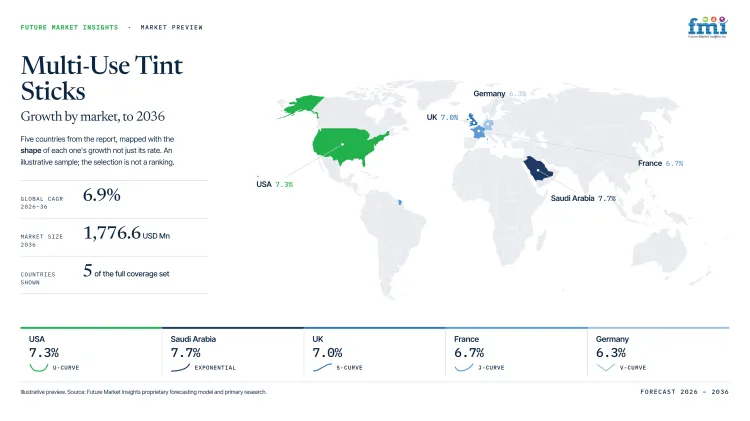
| Country | CAGR |
|---|---|
| UAE | 8.3% |
| South Korea | 8.0% |
| Saudi Arabia | 7.6% |
| USA | 7.3% |
| UK | 7.0% |
| France | 6.7% |
| Germany | 6.3% |
| Japan | 6.0% |
How do country-level CAGRs compare in the Multi-Use Tint Sticks Market?
The countries span a 2.3 percentage-point CAGR range. UAE and South Korea form the upper band before Saudi Arabia and the USA. The UK and France sit near the middle with Germany just below them. Japan advances more slowly. Registration speed and product fit can outweigh small forecast differences.
- South Korea’s rapid beauty innovation cycle rewards frequent shade updates and fast product refreshes.
- Saudi Arabia’s growing prestige retail and digital beauty channels are expanding access to first-time product trials.
- In the USA, intended-use regulations can restrict certain colorant applications across product categories.
- The UK’s strong online specialty beauty presence makes product discovery easier beyond traditional retail stores.
- France’s prestige beauty market favors distinctive shade portfolios supported by carefully managed launches.
- Germany’s extensive drugstore networks increase the importance of consistent replenishment and inventory performance.
CAGR measures forecast pace rather than absolute market value. The full report provides country-level CAGR analysis across North America, Latin America, Western Europe, Eastern Europe, East Asia, South Asia and Pacific, and the Middle East and Africa.
Country-wise Analysis
- Specialty chains and mass retailers give USA launches several discovery routes before repeat purchase is proven. In December 2025 FDA said mandatory listing data identified 51 PFAS in 1,744 cosmetic formulations. Multi-use tint demand is forecast to rise at 7.3% CAGR over the forecast period because frequent color refresh meets broad retail access. National distribution makes trial easier once a shade gains attention. Cross-zone qualification is the friction because wider facial claims need defensible ingredient choices. Brands with disciplined claims can scale faster once retail interest is proven. Clear instructions also reduce the risk that one color is applied outside its validated use area.
- Germany’s 2025 BVL monitoring plan specifically included elements in decorative cosmetics and face masks. German color programs also compete in a mature retail environment where finish and packaging quality face close comparison. Germany is expected to maintain 6.3% CAGR through 2036 because replacement demand meets strong premium beauty channels. The personal care packaging field is relevant because compact formats leave little tolerance for poor dose control. Formal EU documentation is the main friction. Drugstore reach and established beauty retail provide the enabler. Brands gain more from reliable replenishment and clear product files than from weakly supported multi-use claims.
- Selective beauty retail gives French launches strong visibility before distribution widens. The French multi-use tint sticks sector is projected to record 6.7% CAGR during the assessment period because prestige color demand keeps shade discovery active. In February 2026 DGCCRF said it inspected 147 cosmetics establishments and reviewed more than 200 product information files. Prestige channels provide the enabler. Product-file quality and responsible-person duties are the friction for smaller entrants. Companies that organize evidence before retailer onboarding can protect shelf timing and avoid preventable relaunch work. Documentation discipline therefore affects launch cost as directly as the appeal of the shade range itself.
- Great Britain operates its own cosmetic notification route so an EU launch package is not automatically complete for the UK. In July 2026 the Office for Product Safety and Standards published new data on UK cosmetic product safety notifications. Adoption of multi-use tint sticks is estimated to expand at 7.0% CAGR through 2036 because specialty beauty retail and online discovery widen trial. Local e-commerce is the direct enabler. Duplicated documentation raises costs for cross-border programs. Brands with synchronized product files can refresh shades faster without letting regional paperwork become the launch bottleneck. Retail replenishment is easier to protect once the first demand signal is proven.
- Saudi beauty distribution spans prestige malls and specialist retailers under a centralized cosmetic notification system. Saudi Arabia is set to post 7.6% CAGR over the forecast period because international color brands pair with expanding digital beauty access. Strong modern retail gives new shades a direct trial route. The SFDA 2026 listed-products database identifies notified cosmetics together with responsible companies. Local notification and importer coordination remain the friction. Brands entering with broad shade assortments need inventory discipline because a launch can lose momentum if registration and replenishment fall out of sequence. Channel checks become easier once the responsible company and notified product records are complete.
- Dubai concentrates international beauty retail in malls and travel-linked shopping locations that can move new color formats quickly. Dubai Municipality presented Montaji+ in October 2025 as the upgraded platform for cosmetic product evaluation and registration. Retail density gives imported brands a direct discovery route before wider Gulf expansion. Multi-use tint stick sales in UAE are forecast to expand at 8.3% CAGR by 2036 because fast product discovery meets strong imported-beauty demand. Documentation and release requirements set the main friction. Brands that align approved files with distributor inventory can convert social attention before novelty fades. Local stock coordination becomes especially important during synchronized regional campaigns.
- Japanese makeup programs are judged closely on texture and color control before a broader-use claim earns trust. PMDA keeps public recall information for cosmetics and lists 2025 cosmetic recalls by class. Japan is positioned to record 6.0% CAGR during the assessment period because a mature category rewards execution more than novelty. Domestic technical capability provides the enabler. The friction is a high performance benchmark set by leading local brands. New entrants need distinctive shade logic or useful format control because a generic multifunctional claim will not offset weaker sensory performance. Consistent wear and clean dispensing therefore carry more commercial weight than a broad claim by itself.
- In South Korea multi-use tint demand is predicted to advance at 8.0% CAGR through 2036 because local product development feeds a large export base. MFDS reported in May 2026 that 2025 cosmetics exports rose 11.8% to USD 11.4 billion. South Korea’s beauty market also refreshes tint textures quickly through specialty retail and digital launches. Discovery also overlaps with the beauty subscription category because digital sampling keeps new textures visible. Export manufacturing is the enabler. Intense domestic competition is the friction for foreign entrants. New products need distinctive texture and fast shade localization before distribution breadth becomes an advantage.
Who are the notable companies in the Multi-Use Tint Sticks Market?
L'Oreal, Unilever, Amorepacific, Shiseido, Procter & Gamble, e.l.f. Beauty, Coty, Estee Lauder Companies, Kao Corporation, and Beiersdorf are active within the broader beauty and color-cosmetics field considered in this market.
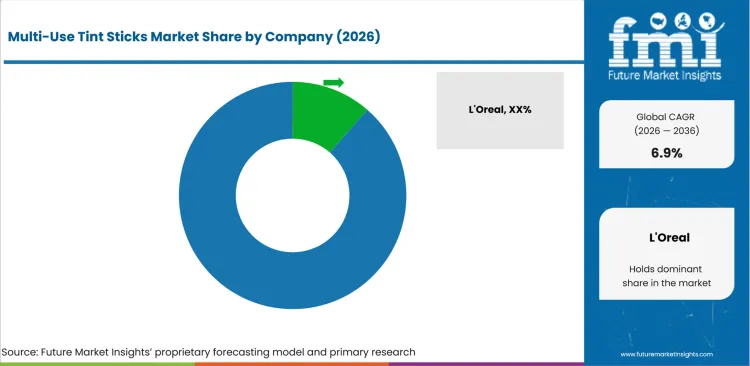
Direct color platforms carry stronger evidence than broader beauty portfolios. L'Oreal, Coty, e.l.f. Beauty, Amorepacific, Shiseido, Kao Corporation, and Estee Lauder Companies have clearer makeup relevance. Entry depends on color expertise, retailer access, and claims that survive local qualification.
- Scaled color and omnichannel platforms: L'Oreal, e.l.f. Beauty, Coty, and Estee Lauder Companies.
- Prestige and Asia-led makeup platforms: Amorepacific, Shiseido, and Kao Corporation.
- Broader beauty portfolios with selective direct tint exposure: Unilever, Procter & Gamble, and Beiersdorf.
Competitive Benchmarking: Multi-Use Tint Sticks Market
| Company | Cross-Zone Tint Relevance | Portable Tint Format Breadth | Omnichannel Beauty Activation | Geographic Reach |
|---|---|---|---|---|
| L'Oreal | Medium | High | High | Global |
| Unilever | Low | Medium | High | Global |
| Amorepacific | Medium | High | High | Asia, North America, selected global markets |
| Shiseido | High | High | High | Japan, North America, Europe, Asia |
| Procter & Gamble | Low | Low | Medium | Global beauty distribution |
| e.l.f. Beauty | High | High | High | North America, UK, selected international markets |
| Coty | Medium | High | High | North America, Europe, Asia |
| Estee Lauder Companies | High | High | High | North America, Europe, Asia, Middle East, travel retail |
| Kao Corporation | Medium | High | High | Japan and wider Asian markets |
| Beiersdorf | Low | Medium | Medium | Global skincare reach with selective makeup exposure |
Scoring basis: High cross-zone relevance requires documented use on several facial zones. Medium indicates narrower evidence and Low indicates limited direct evidence. Format breadth and omnichannel activation use the same scale.
Key Developments in the Multi-Use Tint Sticks Market
- In February 2026, Shiseido launched NARS Natural Matte Longwear Foundation at Sephora before expanding to Ulta in March. The rollout tests a new complexion formula through major specialty channels, where shade performance and retail execution can determine repeat purchase.
- In August 2025, Coty reported new Rimmel and CoverGirl cosmetics offerings with multi-use performance. The pipeline gives mass retailers more multifunctional color concepts and clearer use cases.
- In May 2025, e.l.f. Beauty announced an agreement to acquire rhode with planned Sephora expansion. The transaction broadens e.l.f. Beauty toward prestige distribution and hybrid beauty shoppers.
Key Players in the Multi-Use Tint Sticks Market
Scaled Color and Omnichannel Platforms
- L'Oreal
- e.l.f. Beauty
- Coty
- Estee Lauder Companies
Prestige and Asia-Led Makeup Platforms
- Amorepacific
- Shiseido
- Kao Corporation
Broader Beauty Portfolios with Selective Tint Exposure
- Unilever
- Procter & Gamble
- Beiersdorf
Multi-Use Tint Sticks Market - Report Scope
| Coverage field | Report scope |
|---|---|
| Market breakdown | By product type, nature, format, price positioning, sales channel, and region. |
| Quantitative Units | USD million |
| Market Definition | Revenue from cosmetic color products positioned for more than one facial zone or makeup function. Single-purpose cosmetics and non-color skincare are excluded unless multi-use tint revenue can be isolated. |
| Regions Covered | North America; Latin America; Western Europe; Eastern Europe; East Asia; South Asia and Pacific; Middle East and Africa |
| Countries Covered | UAE; South Korea; Saudi Arabia; USA; UK; France; Germany; Japan; 20+ countries included in the full report |
| Key Companies Profiled | L'Oreal; Unilever; Amorepacific; Shiseido; Procter & Gamble; e.l.f. Beauty; Coty; Estee Lauder Companies; Kao Corporation; Beiersdorf |
| Forecast Period | 2026 to 2036 |
| Approach | Primary and secondary research with market triangulation. |
Multi-Use Tint Sticks Market - Research Methodology
| Method | Approach |
|---|---|
| Primary Research | FMI analysts gathered input from manufacturers, service providers, technology developers, distributors, end users, procurement teams, and subject-matter experts. Interviews examined purchasing decisions, product or service evaluation, adoption barriers, approval requirements, pricing considerations, and expectations for technical or commercial support. Respondents were also asked what evidence is required before a trial, pilot, or initial order develops into regular purchasing. |
| Desk Research | Desk research covered government statistics, regulatory publications, trade data, industry associations, technical literature, standards, company filings, product information, and official corporate announcements. Sources were reviewed for relevance, publication date, geographic coverage, and consistency with the defined market scope. Claims relating to performance, applications, approvals, capacity, investment, and commercial activity were retained only when supported by credible public evidence. |
| Market Sizing and Forecasting | The market model combined the baseline value with historical performance, segment structure, pricing and volume indicators, adoption levels, company participation, and country-level demand conditions. Forecast assumptions considered economic activity, investment trends, regulatory developments, technology adoption, purchasing cycles, supply availability, and barriers to wider market use. Segment and regional estimates were reconciled before the final market total was calculated. |
| Data Validation | Estimates were checked against multiple independent indicators, including public data, company activity, trade patterns, industry developments, and findings from primary interviews. Validation also tested whether products, services, applications, and company revenues fell within the defined market boundaries. Adjacent categories, unsupported claims, overlapping revenues, and activities without direct market relevance were excluded to reduce double counting and maintain consistency across segments and countries. |
Multi-Use Tint Sticks Market by Segments
Multi-Use Tint Sticks Market segmented by Product Type:
- Core - classic lines
- Targeted treatment lines
- Sensitive & gentle lines
- Premium & clinical lines
- Kits & sets
Multi-Use Tint Sticks Market segmented by Nature:
- Conventional
- Vegan & cruelty-free
- Natural & organic
- Dermocosmetic - clinical
- Fragrance-free & sensitive
Multi-Use Tint Sticks Market segmented by Format:
- Liquid & serum
- Cream & balm
- Stick & solid
- Spray & mist
- Sheet & patch
- Powder
Multi-Use Tint Sticks Market segmented by Price Positioning:
- Mass
- Masstige
- Premium
- Professional
Multi-Use Tint Sticks Market segmented by Sales Channel:
- Specialty beauty retail
- E-commerce & DTC
- Pharmacies & drugstores
- Supermarkets & hypermarkets
- Salons & spas
Multi-Use Tint Sticks Market by Region:
- North America
- United States
- Canada
- Latin America
- Brazil
- Mexico
- Argentina
- Chile
- Rest of Latin America
- Western Europe
- Germany
- France
- United Kingdom
- Italy
- Spain
- Benelux
- Nordics
- Rest of Western Europe
- Eastern Europe
- Poland
- Czech Republic
- Romania
- Hungary
- Balkan and Baltic States
- Rest of Eastern Europe
- East Asia
- China
- Japan
- South Korea
- South Asia and Pacific
- India
- ASEAN
- Australia and New Zealand
- Rest of South Asia and Pacific
- Middle East and Africa
- Kingdom of Saudi Arabia
- Other GCC Countries
- Türkiye
- South Africa
- Other African Union Countries
- Rest of Middle East and Africa
Research Sources and Bibliography
- USA Food and Drug Administration. (2026, February 11). Registration & Listing of Cosmetic Product Facilities and Products
- USA Food and Drug Administration. (2026, August 14). Regulatory Status of Color Additives
- Direction générale de la concurrence, de la consommation et de la répression des fraudes. (2026, February 2). Cosmétiques : des TPE nouvelles dans le secteur qui méconnaissent trop souvent la réglementation
- Office for Product Safety and Standards. (2026, July 17). New data on UK cosmetic product safety notifications
- Saudi Food and Drug Authority. (2026, August 26). List of Notification of Marketing for Cosmetic Products (Listed Products)
- Dubai Municipality. (2025, October 27). Product safety at Beautyworld Middle East 2025
- Pharmaceuticals and Medical Devices Agency. (2026). Recall information for quasi-drugs and cosmetics
- Ministry of Food and Drug Safety, Republic of Korea. (2026, May 28). 2025 cosmetics trade surplus surpasses USD 10 billion for the first time
- Kao Corporation. (2026, July 8). KATE to Kick Off “KABUKE: Break Convention” International Campaign
- Amorepacific. (2026, January 15). HERA launches Sensual Tinted Shine Lip Serum
- e.l.f. Beauty. (2025, May 28). e.l.f. Beauty Announces Definitive Agreement to Acquire rhode in $1 Billion Deal
- Coty Inc. (2025, August 20). Coty Reports FY25 and Q4 Results
- The Estée Lauder Companies. (2025, October 21). Estée Lauder launches in the Amazon.mx Premium Beauty Store
- L’Oréal Finance. (2026, February 12). 2025 Annual Results
- Beiersdorf. (2026, March 3). Research and Development - Beiersdorf Annual Report 2025
- Shiseido Company, Limited. (2025, June 12). Shiseido Expands Beauty Showcase at Fukuoka Airport
- L’Oréal Finance. (2026, March 31). L’Oréal completes the acquisition of Kering Beauté within the framework of its strategic alliance with Kering
- European Commission. (2025, May 12). Commission Regulation (EU) 2025/877 of 12 May 2025 amending Regulation (EC) No 1223/2009 as regards certain CMR-classified substances
- e.l.f. Beauty. (2026, April 30). rhode Continues Its Global Retail Expansion Into Sephora Europe
- Coty Inc. (2026, May 20). Coty Launches Marc Jacobs Beauty: One Of The Most-requested Luxury Comebacks
- Shiseido Company, Limited. (2025, January 31). Marking 30 Years of Innovation: Perfect Cover’s Complete Renewal for Seamless and Natural-Looking Coverage
- The Estée Lauder Companies. (2026, August 14). The Estée Lauder Companies and University of Leeds Partner to Advance the Future of Complexion Shade Matching
- e.l.f. Beauty. (2025, May 15). e.l.f. Beauty Expands Presence in The Netherlands and Belgium with Entry into KRUIDVAT and TREKPLEISTER Drugstores
- Kao Corporation. (2025, July 14). KATE Kicks off International Campaign “LIGHTS ON SHADOW.”
- Amorepacific. (2025, August 14). HERA Appoints Felix of Stray Kids as New Global Ambassador
- USA Food and Drug Administration. (2025, December 29). FDA Finds Insufficient Data to Determine Safety of PFAS in Cosmetic Products
- Federal Office of Consumer Protection and Food Safety (BVL). (2025). Handbuch Monitoring 2025
- Shiseido Company, Limited. (2026, May 12). 2026 Q1 Results (January-March)
This bibliography is provided for reader reference and is not exhaustive. The full report contains the complete reference list and detailed citations.
This Report Answers
- What are the global Hair Color Corrector market values in 2026 and 2036?
- How does routine hair color correction and maintenance influence market demand?
- Which product type segment holds the largest share of the Hair Color Corrector market?
- How do conventional hair color correction formulations differ from newer product alternatives?
- Why do liquid and serum-based color correctors account for the leading share of market demand?
- How do market growth rates and adoption trends compare across key countries and regions?
- Which leading companies maintain strong positions in the direct hair color correction market?
- How do color-additive regulations, ingredient standards, and product approval requirements affect market qualification?
- Which consumer, product performance, and usage factors most strongly influence repeat purchases of hair color correctors?
Frequently Asked Questions
How big is the multi-use tint sticks market in 2026?
The multi-use tint sticks market is valued at USD 911.6 million in 2026 and is projected to reach USD 1,776.6 million by 2036. Growth depends on reliable color across several claimed facial zones.
What is the CAGR of the multi-use tint sticks market from 2026 to 2036?
The multi-use tint sticks market is projected to grow at a CAGR of 6.9% between 2026 and 2036. Expansion follows simplified routines, frequent color launches, and wider beauty access.
Which product type leads the multi-use tint sticks market?
The core - classic lines segment is expected to hold 39.0% of the multi-use tint sticks market in 2026, driven by familiar shade propositions. Existing color families reduce explanation before trial.
Which nature segment holds the largest share in the multi-use tint sticks market?
The conventional segment is expected to hold 57.0% of the multi-use tint sticks market in 2026, attributable to wider formulation freedom. Specialty claims add ingredient and documentation constraints.
Which companies are active in the multi-use tint sticks market?
Key companies operating in the market include L'Oreal, Unilever, Amorepacific, Shiseido, Procter & Gamble, e.l.f. Beauty, Coty, Estee Lauder Companies, Kao Corporation, and Beiersdorf. Competition centers on color expertise, retail reach, and validated claims.
Preview the report firsthand - request a free sample
Get SampleGet the brochure for pricing and purchase details.
Get PDFTable of Content
- Key Takeaways
- Market Size and CAGR
- Top Growth Driver
- Fastest Growing Segment
- Leading Region
- Key Companies
- Emerging Opportunities
- Executive Summary
- Global Market Outlook
- Demand-side Trends
- Supply-side Trends
- Technology Roadmap Analysis
- Analysis and Recommendations
- Analyst Perspective (What is happening? Why now? What should investors know?)
- Key Questions Answered
- How large is the market?
- What is the CAGR?
- What are key trends?
- Which region dominates?
- Who are the leaders?
- Market Overview
- Market Coverage / Taxonomy
- Market Definition / Scope / Limitations
- Research Methodology
- Chapter Orientation
- Analytical Lens and Working Hypotheses
- Market Structure, Signals, and Trend Drivers
- Benchmarking and Cross-market Comparability
- Market Sizing, Forecasting, and Opportunity Mapping
- Research Design and Evidence Framework
- Desk Research Programme (Secondary Evidence)
- Expert Input and Fieldwork (Primary Evidence)
- Tooling, Models, and Reference Databases
- Data Engineering and Model Build
- Quality Assurance and Audit Trail
- Market Background
- Market Dynamics (Drivers, Restraints, Opportunity, Trends)
- Scenario Forecast (Optimistic, Likely, Conservative)
- Impact Analysis
- AI Impact
- Sustainability Impact
- Regulatory Impact
- Technology Impact
- Consumer / Buyer Analysis
- Purchase Drivers
- Adoption Barriers
- Buyer Journey
- Opportunity Map Analysis
- Product Life Cycle Analysis
- Supply Chain Analysis
- Investment Feasibility Matrix
- Value Chain Analysis
- PESTLE and Porter's Analysis
- Regulatory Landscape
- Regional Parent Market Outlook
- Production and Consumption Statistics
- Import and Export Statistics
- Global Market Analysis and Forecast, 2021 to 2036
- Historical Market Size Value (USD Million) Analysis, 2021 to 2025
- Current and Future Market Size Value (USD Million) Projections, 2026 to 2036
- Y-o-Y Growth Trend Analysis
- Absolute $ Opportunity Analysis
- Global Market Pricing Analysis, 2021 to 2036
- Global Market Analysis and Forecast, By Product Type, 2021 to 2036
- Introduction / Key Findings
- Historical Market Size Value (USD Million) Analysis By Product Type, 2021 to 2025
- Current and Future Market Size Value (USD Million) Analysis and Forecast By Product Type, 2026 to 2036
- Core / classic lines
- Targeted treatment lines
- Sensitive & gentle lines
- Premium & clinical lines
- Kits & sets
- Core / classic lines
- Y-o-Y Growth Trend Analysis By Product Type, 2021 to 2025
- Absolute $ Opportunity Analysis By Product Type, 2026 to 2036
- Global Market Analysis and Forecast, By Nature, 2021 to 2036
- Introduction / Key Findings
- Historical Market Size Value (USD Million) Analysis By Nature, 2021 to 2025
- Current and Future Market Size Value (USD Million) Analysis and Forecast By Nature, 2026 to 2036
- Conventional
- Vegan & cruelty-free
- Natural & organic
- Dermocosmetic / clinical
- Fragrance-free & sensitive
- Conventional
- Y-o-Y Growth Trend Analysis By Nature, 2021 to 2025
- Absolute $ Opportunity Analysis By Nature, 2026 to 2036
- Global Market Analysis and Forecast, By Format, 2021 to 2036
- Introduction / Key Findings
- Historical Market Size Value (USD Million) Analysis By Format, 2021 to 2025
- Current and Future Market Size Value (USD Million) Analysis and Forecast By Format, 2026 to 2036
- Liquid & serum
- Cream & balm
- Stick & solid
- Spray & mist
- Sheet & patch
- Powder
- Liquid & serum
- Y-o-Y Growth Trend Analysis By Format, 2021 to 2025
- Absolute $ Opportunity Analysis By Format, 2026 to 2036
- Global Market Analysis and Forecast, By Price Positioning, 2021 to 2036
- Introduction / Key Findings
- Historical Market Size Value (USD Million) Analysis By Price Positioning, 2021 to 2025
- Current and Future Market Size Value (USD Million) Analysis and Forecast By Price Positioning, 2026 to 2036
- Mass
- Masstige
- Premium
- Professional
- Mass
- Y-o-Y Growth Trend Analysis By Price Positioning, 2021 to 2025
- Absolute $ Opportunity Analysis By Price Positioning, 2026 to 2036
- Global Market Analysis and Forecast, By Sales Channel, 2021 to 2036
- Introduction / Key Findings
- Historical Market Size Value (USD Million) Analysis By Sales Channel, 2021 to 2025
- Current and Future Market Size Value (USD Million) Analysis and Forecast By Sales Channel, 2026 to 2036
- Specialty beauty retail
- E-commerce & DTC
- Pharmacies & drugstores
- Supermarkets & hypermarkets
- Salons & spas
- Specialty beauty retail
- Y-o-Y Growth Trend Analysis By Sales Channel, 2021 to 2025
- Absolute $ Opportunity Analysis By Sales Channel, 2026 to 2036
- Global Market Analysis and Forecast, By Region, 2021 to 2036
- Introduction
- Historical Market Size Value (USD Million) Analysis By Region, 2021 to 2025
- Current Market Size Value (USD Million) Analysis and Forecast By Region, 2026 to 2036
- North America
- Latin America
- Western Europe
- Eastern Europe
- East Asia
- South Asia and Pacific
- Middle East & Africa
- Market Attractiveness Analysis By Region
- North America Market Analysis and Forecast, By Country, 2021 to 2036
- Historical Market Size Value (USD Million) Trend Analysis By Market Taxonomy, 2021 to 2025
- Market Size Value (USD Million) Forecast By Market Taxonomy, 2026 to 2036
- By Country
- USA
- Canada
- By Product Type
- By Nature
- By Format
- By Price Positioning
- By Sales Channel
- By Country
- Market Attractiveness Analysis
- By Country
- By Product Type
- By Nature
- By Format
- By Price Positioning
- By Sales Channel
- Key Takeaways
- Latin America Market Analysis and Forecast, By Country
- Historical Market Size Value (USD Million) Trend Analysis By Market Taxonomy, 2021 to 2025
- Market Size Value (USD Million) Forecast By Market Taxonomy, 2026 to 2036
- By Country
- Brazil
- Mexico
- Chile
- Rest of Latin America
- By Product Type
- By Nature
- By Format
- By Price Positioning
- By Sales Channel
- By Country
- Market Attractiveness Analysis
- By Country
- By Product Type
- By Nature
- By Format
- By Price Positioning
- By Sales Channel
- Key Takeaways
- Western Europe Market Analysis and Forecast, By Country
- Historical Market Size Value (USD Million) Trend Analysis By Market Taxonomy, 2021 to 2025
- Market Size Value (USD Million) Forecast By Market Taxonomy, 2026 to 2036
- By Country
- Germany
- UK
- Italy
- Spain
- France
- Nordic
- BENELUX
- Rest of Western Europe
- By Product Type
- By Nature
- By Format
- By Price Positioning
- By Sales Channel
- By Country
- Market Attractiveness Analysis
- By Country
- By Product Type
- By Nature
- By Format
- By Price Positioning
- By Sales Channel
- Key Takeaways
- Eastern Europe Market Analysis and Forecast, By Country
- Historical Market Size Value (USD Million) Trend Analysis By Market Taxonomy, 2021 to 2025
- Market Size Value (USD Million) Forecast By Market Taxonomy, 2026 to 2036
- By Country
- Russia
- Poland
- Hungary
- Balkan & Baltic
- Rest of Eastern Europe
- By Product Type
- By Nature
- By Format
- By Price Positioning
- By Sales Channel
- By Country
- Market Attractiveness Analysis
- By Country
- By Product Type
- By Nature
- By Format
- By Price Positioning
- By Sales Channel
- Key Takeaways
- East Asia Market Analysis and Forecast, By Country
- Historical Market Size Value (USD Million) Trend Analysis By Market Taxonomy, 2021 to 2025
- Market Size Value (USD Million) Forecast By Market Taxonomy, 2026 to 2036
- By Country
- China
- Japan
- South Korea
- By Product Type
- By Nature
- By Format
- By Price Positioning
- By Sales Channel
- By Country
- Market Attractiveness Analysis
- By Country
- By Product Type
- By Nature
- By Format
- By Price Positioning
- By Sales Channel
- Key Takeaways
- South Asia and Pacific Market Analysis and Forecast, By Country
- Historical Market Size Value (USD Million) Trend Analysis By Market Taxonomy, 2021 to 2025
- Market Size Value (USD Million) Forecast By Market Taxonomy, 2026 to 2036
- By Country
- India
- ASEAN
- Australia & New Zealand
- Rest of South Asia and Pacific
- By Product Type
- By Nature
- By Format
- By Price Positioning
- By Sales Channel
- By Country
- Market Attractiveness Analysis
- By Country
- By Product Type
- By Nature
- By Format
- By Price Positioning
- By Sales Channel
- Key Takeaways
- Middle East & Africa Market Analysis and Forecast, By Country
- Historical Market Size Value (USD Million) Trend Analysis By Market Taxonomy, 2021 to 2025
- Market Size Value (USD Million) Forecast By Market Taxonomy, 2026 to 2036
- By Country
- Kingdom of Saudi Arabia
- Other GCC Countries
- Türkiye
- South Africa
- Other African Union
- Rest of Middle East & Africa
- By Product Type
- By Nature
- By Format
- By Price Positioning
- By Sales Channel
- By Country
- Market Attractiveness Analysis
- By Country
- By Product Type
- By Nature
- By Format
- By Price Positioning
- By Sales Channel
- Key Takeaways
- Key Countries Market Analysis
- USA
- Pricing Analysis
- Market Share Analysis, 2025
- By Product Type
- By Nature
- By Format
- By Price Positioning
- By Sales Channel
- Canada
- Pricing Analysis
- Market Share Analysis, 2025
- By Product Type
- By Nature
- By Format
- By Price Positioning
- By Sales Channel
- Mexico
- Pricing Analysis
- Market Share Analysis, 2025
- By Product Type
- By Nature
- By Format
- By Price Positioning
- By Sales Channel
- Brazil
- Pricing Analysis
- Market Share Analysis, 2025
- By Product Type
- By Nature
- By Format
- By Price Positioning
- By Sales Channel
- Chile
- Pricing Analysis
- Market Share Analysis, 2025
- By Product Type
- By Nature
- By Format
- By Price Positioning
- By Sales Channel
- Germany
- Pricing Analysis
- Market Share Analysis, 2025
- By Product Type
- By Nature
- By Format
- By Price Positioning
- By Sales Channel
- UK
- Pricing Analysis
- Market Share Analysis, 2025
- By Product Type
- By Nature
- By Format
- By Price Positioning
- By Sales Channel
- Italy
- Pricing Analysis
- Market Share Analysis, 2025
- By Product Type
- By Nature
- By Format
- By Price Positioning
- By Sales Channel
- Spain
- Pricing Analysis
- Market Share Analysis, 2025
- By Product Type
- By Nature
- By Format
- By Price Positioning
- By Sales Channel
- France
- Pricing Analysis
- Market Share Analysis, 2025
- By Product Type
- By Nature
- By Format
- By Price Positioning
- By Sales Channel
- India
- Pricing Analysis
- Market Share Analysis, 2025
- By Product Type
- By Nature
- By Format
- By Price Positioning
- By Sales Channel
- ASEAN
- Pricing Analysis
- Market Share Analysis, 2025
- By Product Type
- By Nature
- By Format
- By Price Positioning
- By Sales Channel
- Australia & New Zealand
- Pricing Analysis
- Market Share Analysis, 2025
- By Product Type
- By Nature
- By Format
- By Price Positioning
- By Sales Channel
- China
- Pricing Analysis
- Market Share Analysis, 2025
- By Product Type
- By Nature
- By Format
- By Price Positioning
- By Sales Channel
- Japan
- Pricing Analysis
- Market Share Analysis, 2025
- By Product Type
- By Nature
- By Format
- By Price Positioning
- By Sales Channel
- South Korea
- Pricing Analysis
- Market Share Analysis, 2025
- By Product Type
- By Nature
- By Format
- By Price Positioning
- By Sales Channel
- Russia
- Pricing Analysis
- Market Share Analysis, 2025
- By Product Type
- By Nature
- By Format
- By Price Positioning
- By Sales Channel
- Poland
- Pricing Analysis
- Market Share Analysis, 2025
- By Product Type
- By Nature
- By Format
- By Price Positioning
- By Sales Channel
- Hungary
- Pricing Analysis
- Market Share Analysis, 2025
- By Product Type
- By Nature
- By Format
- By Price Positioning
- By Sales Channel
- Kingdom of Saudi Arabia
- Pricing Analysis
- Market Share Analysis, 2025
- By Product Type
- By Nature
- By Format
- By Price Positioning
- By Sales Channel
- Türkiye
- Pricing Analysis
- Market Share Analysis, 2025
- By Product Type
- By Nature
- By Format
- By Price Positioning
- By Sales Channel
- South Africa
- Pricing Analysis
- Market Share Analysis, 2025
- By Product Type
- By Nature
- By Format
- By Price Positioning
- By Sales Channel
- USA
- Market Structure Analysis
- Competition Dashboard
- Competition Benchmarking
- Market Share Analysis of Top Players
- By Regional
- By Product Type
- By Nature
- By Format
- By Price Positioning
- By Sales Channel
- Emerging Startups
- Innovation Benchmarking
- Competition Analysis
- Competition Deep Dive
- L'Oreal
- Overview
- Product Portfolio
- Profitability by Market Segments
- Sales Footprint
- Strategy Overview
- Marketing Strategy
- Product Strategy
- Channel Strategy
- Unilever
- Amorepacific
- Shiseido
- Procter & Gamble
- e.l.f. Beauty
- Coty
- Estee Lauder Companies
- Kao Corporation
- Beiersdorf
- L'Oreal
- Case Studies
- Success Stories
- Recent Developments
- Competition Deep Dive
- Assumptions & Acronyms Used


