

- Market Size (2026)
- USD 191.0 Mn
- Forecast (2036)
- USD 420.1 Mn
- CAGR (2026 to 2036)
- 8.2%
How big is Antimicrobial Produce Liners Market in 2026?
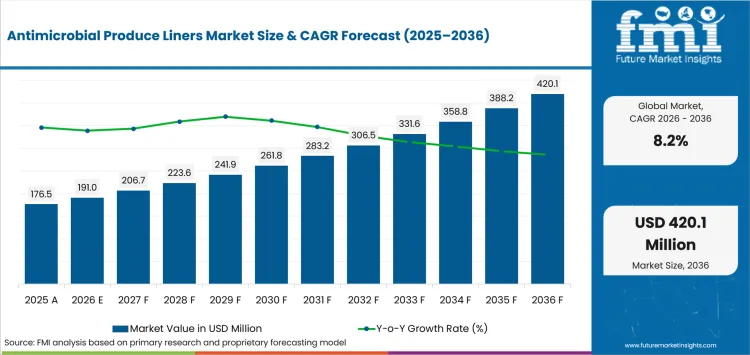
USD 191.0 million in 2026 and USD 420.1 million by 2036 at an 8.2% CAGR.
Sales of antimicrobial produce liners are projected to expand at an 8.2% CAGR between 2026 and 2036. Market value is forecast to rise from USD 191.0 million in 2026 to USD 420.1 million by 2036. Produce packers use active packaging systems to control free moisture and microbial pressure within sealed packs. In September 2025, the FDA published implementation guidance for pre-harvest agricultural-water requirements as large-farm compliance entered its first season. The guidance reinforces documented microbial-risk control without treating packaging as a substitute for sanitation or refrigeration. Commercial approval requires route trials that confirm crop efficacy, sensory neutrality and normal packing-line performance.
WRAP reported in March 2025 that UK households discard 2.5 million tonnes of fresh fruit and vegetables annually, including 1.7 million tonnes considered edible. UK retailers therefore have a visible waste-reduction case for antimicrobial packaging trials within established fresh-food programs. Brazil faces longer domestic routes and less uniform temperature control across regional fresh-produce distribution networks. Japanese produce programs apply a conservative validation cycle around presentation and sensory effects across tightly controlled package specifications. These conditions influence format selection and purchasing speed across food packaging programs in each national market.
Key Takeaways of Antimicrobial Produce Liners Market
- Demand for antimicrobial produce liners rises as packers connect package cost with lower shrink and fewer destination rejections.
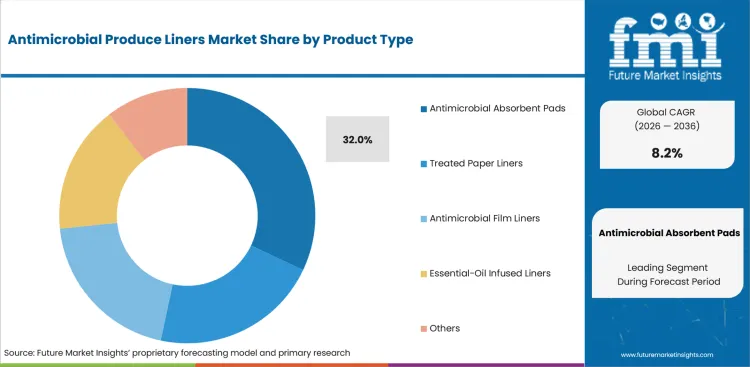
- Antimicrobial Absorbent Pads are projected to hold 32.0% of 2026 revenue due to one replaceable insert managing liquid and active protection.
- Silver-Ion is estimated at 26.0% in 2026 due to established integration routes across polymers, coatings and nonwoven structures.
- Mold & Fungal Control is anticipated to represent 36.0% in 2026 attributable to visible decay directly affecting acceptance and price realization.
- Food-contact review and crop-specific validation can delay conversion despite a clear loss-reduction case for each intended route.
- Sirane, Aptar CSP Technologies, Microban International, McAirlaid's, Cellcomb, Novipax, BioCote and StePac represent the profiled supplier field.
Analyst Perspective
"Antimicrobial produce liners should be qualified as crop-and-route systems instead of interchangeable packaging inserts during commercial evaluation. Strong programs connect food-contact evidence with pack-out yield and sensory neutrality while confirming line speed and an accepted destination-market recovery route."
- Nandini Roy Choudhury, Principal Consultant, Future Market Insights
How is the Antimicrobial Produce Liners Market segmented?
The antimicrobial produce liners market is segmented by product type, active technology, function, produce type, end use, sales channel and region.
Product type separates absorbent pads, treated paper liners, antimicrobial films, infused formats and other package architectures while active technology identifies silver-ion, organic-acid, botanical, chlorine-dioxide and zinc-based systems. Function distinguishes mold control, bacterial control, combined freshness systems and other claims while produce type covers berries, leafy greens, grapes, tomatoes and other crops. End use identifies growers and packers, retailers, exporters and other commercial users while sales channel separates direct OEM supply, packaging distributors, e-commerce and other routes.
Why do antimicrobial absorbent pads lead demand within the product type category?
Absorbent pads place moisture control beside the produce surface without requiring a complete container redesign. Packers can compare treated and untreated packs within the same tray or punnet during seasonal trials.
- Based on product type, antimicrobial absorbent pads are projected to account for 32.0% in 2026 due to combined moisture capture and active protection.
- Commercial adoption depends on absorbency under route temperatures, clean edge sealing and dimensions that fit existing produce punnets without slowing normal line speed.
Why does silver-ion lead demand within the active technology category?
Silver-ion systems enter polymers, coatings and nonwoven layers during material production under controlled additive concentrations. The established integration route can simplify converter handling but does not remove migration or food-contact review.
- In 2026, Silver-Ion is expected to lead active technology with 26.0% share supported by established additive routes for polymers and coatings.
- In February 2025, BioCote explained that manufacturers integrate silver additives into food-contact materials such as polymers and coatings during production. The evidence supports a practical route for antimicrobial ingredients but does not establish the modelled segment share or approval for every produce application.
Why does mold and fungal control lead demand within the function category?
Visible mold can trigger rejection of an entire punnet even when inspectors find a limited affected area at destination. The risk increases during temperature changes that place condensation against delicate produce surfaces inside closed packs.
- By function, Mold & Fungal Control is forecast to represent 36.0% in 2026 driven by the commercial cost of visible decay.
- Fresh food packaging trials should measure incidence at destination and remaining saleable days alongside laboratory inhibition results. The combined test links package performance with a commercial outcome that retail quality teams can verify.
Why do berries lead demand within the produce type category?
Berries have delicate surfaces and limited tolerance for free moisture during refrigerated storage and transport. Compact retail pack formats also accept a pad or liner without changing the consumer unit.
- Berries are set to lead the produce type category with 28.0% share in 2026 due to high shrink exposure and compact pack formats.
- The USDA Economic Research Service reported in July 2025 that cultivated blueberry output reached a record 789.5 million pounds during 2024. The figure measures crop scale and does not prove liner adoption, but it identifies a large commercial base for route-specific trials using verified food-grade materials.
What are the drivers, restraints and opportunities in the Antimicrobial Produce Liners Market?
Produce-loss economics support adoption, yet food-contact qualification slows conversion and recyclable crop-specific structures define the clearest commercial opening.
- Driver: Retailers and produce exporters need better control of condensate and visible decay across high-value crops and extended routes.
- Restraint: Active liners require food-contact documentation plus crop evidence covering migration, sensory effects and normal line performance.
- Opportunity: Cellulose-rich active pads can pair measurable produce protection with recovery routes accepted by intended destination markets.
Produce-Loss Economics Support Trial Budgets
Produce-loss economics give packers a measurable reason to fund controlled commercial trials across intended crops and routes. Defra estimated in February 2025 that about 330,000 tonnes of edible food are wasted or diverted before leaving UK farms each year. A liner earns recurring budget once recovered saleable units exceed the material and handling cost.
Food-Contact Review Slows Commercial Qualification
Food-contact review slows purchasing as active materials are designed to absorb or release substances within packaging. European Commission Regulation (EC) No 450/2009 requires safety and compliance controls for active and intelligent materials. Produce packers also need crop evidence that excludes adverse taste and odor effects across intended storage conditions.
Recyclable Active Structures Define the Clearest Opening
Recyclable active structures offer the clearest opening for commercial differentiation across moisture-sensitive produce packaging programs. Cellulose-rich pads or thinner active layers can reduce conflict with biodegradable food packaging goals across intended destination markets. Revenue depends on an accepted recovery route and a crop protocol, supported by a cost model tied to pack-out yield.
Which country CAGRs are profiled in the Antimicrobial Produce Liners Market?
| Country | CAGR |
|---|---|
| United States | 7.6% |
| Germany | 8.0% |
| Japan | 6.8% |
| United Kingdom | 8.1% |
| Brazil | 8.6% |
How do country-level CAGRs compare in the Antimicrobial Produce Liners Market?
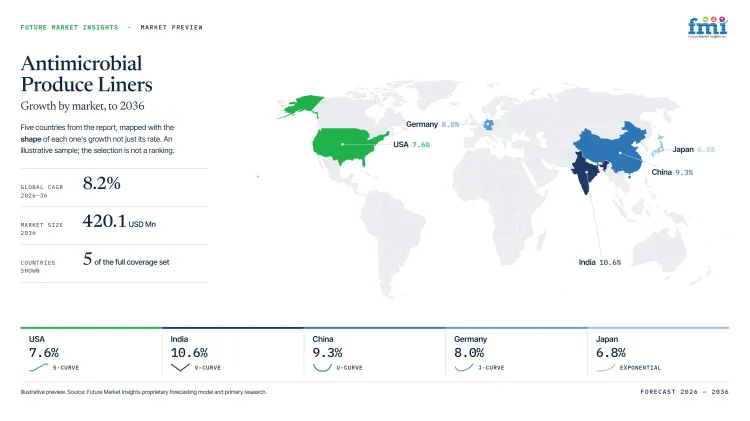
The five country forecasts span 1.8 percentage points from Brazil at 8.6% to Japan at 6.8%. Growth rates remain close, but conversion routes differ by waste visibility and retailer influence across national programs.
- Brazil's outlook is tied to long distribution distances, making moisture management and field-level technical support important differentiators.
- Retail waste-reduction commitments in the UK are encouraging growers and packers to evaluate liners through measurable reductions in produce losses.
- Germany places greater weight on documented food-contact compliance and verified shrink reduction during retailer qualification processes.
- The USA market is supported by large-scale produce operations that require dependable nationwide supply and consistent performance across growing seasons.
- Japan's adoption pathway remains closely linked to sensory acceptance, with appearance preservation and product neutrality carrying significant importance during validation.
Comparable CAGRs do not establish equivalent market size or service cost across these five national profiles. Market entry should combine forecast pace with account concentration and the expected length of commercial trials. Commercial planning must also account for distribution coverage and country-specific food-contact requirements during local resource planning.
Country-wise Analysis
- Large produce shippers can repeat packaging trials across established retail routes, while commercial fruit volume gives material developers substantial seasonal throughput for controlled comparisons and regional service planning across berry and orchard-fruit programs nationwide. The United States antimicrobial produce liners sector is projected to record 7.6% CAGR during the assessment period, although national programs require consistent supply plus plant-level support during qualification and replenishment. USDA reported in May 2025 that noncitrus fruit production reached about 15.9 million tons during 2024, supporting large trials that still require food-contact records and route-specific performance data before recurring orders.
- German apple programs combine concentrated commercial output with retailer-controlled specifications, giving material developers large seasonal batches for storage trials and repeatable comparisons across major growing regions for apples sold as table fruit today. Antimicrobial produce liner demand in Germany is forecast to rise at 8.0% CAGR over the forecast period, although detailed food-contact review under EU active-material rules can extend qualification across national grocery accounts. Destatis reported in December 2025 that farms harvested 1.138 million tonnes of apples and marketed 75.5% as table fruit, supporting retailer trials that require declarations of compliance and quantified storage results.
- Japanese produce programs place unusual weight on package appearance and sensory neutrality, while local technical partners coordinate variety-specific trials across small seasonal lots during refrigerated handling and retail display. Adoption of antimicrobial produce liners in Japan is estimated to expand at 6.8% CAGR through 2036, although selective validation and limited initial volumes can lengthen national conversion programs. The Ministry of Agriculture Forestry and Fisheries reported in June 2026 that business-sector food loss reached 2.37 million tonnes in fiscal 2024, reinforcing the need for crop evidence and stable package presentation during retail review.
- United Kingdom grocery programs give retailers substantial influence over waste targets and fresh-produce packaging specifications, supporting commercially visible liner trials across concentrated account networks during peak domestic harvest periods. Antimicrobial produce liner sales in the United Kingdom are forecast to expand at 8.1% CAGR by 2036, although premium formats need evidence expressed as recoverable saleable units for each crop and package format. Defra reported soft-fruit output of 134,000 tonnes worth GBP 776 million in June 2026, giving berry trials meaningful commercial stakes while food-contact records remain application-specific during annual sourcing reviews.
- Brazilian distributors serve long produce routes and dispersed wholesale markets, while large formal distribution volumes give regional technical teams a broad base for controlled liner trials near producing areas and export corridors. Antimicrobial produce liner sales in Brazil are forecast to expand at 8.6% CAGR by 2036, although variable refrigeration can obscure package performance and complicate comparisons across routes during seasonal peaks. Conab reported in July 2026 that 54 monitored wholesale markets handled 16.6 million tonnes during 2025, supporting broad trials that require Portuguese documentation and regional technical service for repeat orders.
Who are the notable companies in the Antimicrobial Produce Liners Market?
Sirane, Aptar CSP Technologies, Microban International, McAirlaid's, Cellcomb, Novipax, BioCote and StePac are the notable companies serving this market.
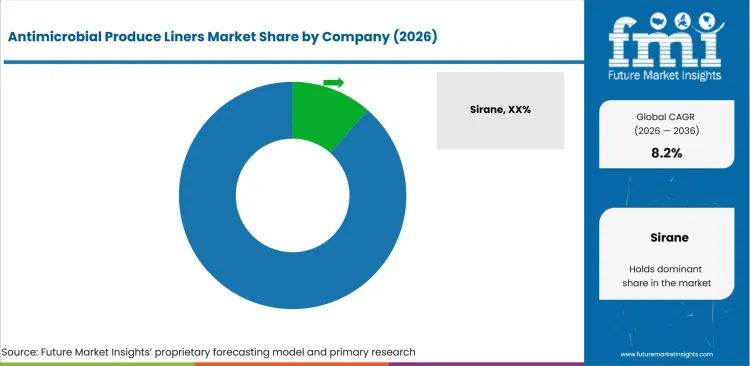
The competitive field is fragmented across produce-pad specialists, active-material developers and produce-atmosphere packaging providers with different qualification responsibilities and commercial sales cycles. Produce-pad manufacturers compete on absorbency and pack fit, while additive developers depend on packaging partners and application testing before commercial approval. Atmosphere-control companies combine active film design with route protocols, which raises entry barriers around crop evidence and destination-specific food-contact records. Reliable seasonal supply determines trial conversion into recurring specifications, and corporate scale cannot replace proof under the intended temperature and transport profile.
- Sirane, McAirlaid's, Cellcomb and Novipax compete with absorbent pads or liners designed for food and produce packages.
- Aptar CSP Technologies, Microban International and BioCote compete with active-material engineering or antimicrobial additive integration.
- StePac competes with produce-specific liners and films that manage humidity or package atmosphere during distribution.
Competitive Benchmarking: Antimicrobial Produce Liners Market
| Company | Produce-Specific Liner Depth | Antimicrobial Active Integration | Packing-Line and Commercialization Support | Geographic Reach |
|---|---|---|---|---|
| Sirane | High | High | Medium | UK, Europe, Mexico and export markets |
| Aptar CSP Technologies | Medium | High | High | North America, Europe and Asia-Pacific |
| Microban International | Unscored | High | High | Global ingredient-partner network |
| McAirlaid's | High | Medium | High | Germany, United States and international sales |
| Cellcomb | High | Unscored | Medium | Sweden, Finland and partner-led international markets |
| Novipax | High | Medium | High | Multiple USA plants and North American supply |
| BioCote | Unscored | High | High | United Kingdom and global partner network |
| StePac | High | Medium | High | Commercial activity in more than 40 countries |
Key Developments in the Antimicrobial Produce Liners Market
- In June 2025, Cellcomb completed its acquisition of Fatex and added Finnish production to its Nordic fiber-based food-pad platform. The combined group reported approximately EUR 30 million in annual turnover and about 90 employees across Sweden and Finland.
- In March 2025, Cellcomb secured European home-and-garden compost approval for Cellsorb Circular under NF T 51-800. The certification added an independently verified recovery route for a four-side-sealed cellulose food pad used in moisture-sensitive packaging programs.
- In February 2024, Aptar CSP Technologies and ProAmpac launched MP-1000 as moisture-adsorbing rollstock and premade pouches compatible with high-speed form-fill-seal equipment. The collaboration documents an active-film integration route within existing flexible packaging lines during commercial deployment.
Key Players in the Antimicrobial Produce Liners Market
Produce Liner and Absorbent Platform Specialists
- Sirane
- McAirlaid's
- Cellcomb
- Novipax
Active Material and Antimicrobial Additive Partners
- Aptar CSP Technologies
- Microban International
- BioCote
Produce Atmosphere-Control Specialist
- StePac
Antimicrobial Produce Liners Market - Report Scope
| Coverage field | Report scope |
|---|---|
| Market breakdown | By product type, active technology, function, produce type, end use, sales channel and region. |
| Quantitative Units | Revenue in USD million and CAGR in %. |
| Market Definition | Commercial pads, paper liners, films and inserts sold for produce packaging with a stated antimicrobial, antifungal or active microclimate function. |
| Regions Covered | North America, Latin America, Western Europe, Eastern Europe, East Asia, South Asia and Pacific and Middle East and Africa. |
| Countries Covered | United States, Germany, Japan, United Kingdom, Brazil and 25+ countries included in the full report. |
| Key Companies Profiled | Sirane, Aptar CSP Technologies, Microban International, McAirlaid's, Cellcomb, Novipax, BioCote and StePac. |
| Forecast Period | 2026 to 2036. |
| Approach | Primary and secondary research with market triangulation. |
Antimicrobial Produce Liners Market - Research Methodology
| Method | Approach |
|---|---|
| Primary Research | FMI analysts gathered input from manufacturers, service providers, technology developers, distributors, end users, procurement teams, and subject-matter experts. Interviews examined purchasing decisions, product or service evaluation, adoption barriers, approval requirements, pricing considerations, and expectations for technical or commercial support. Respondents were also asked what evidence is required before a trial, pilot, or initial order develops into regular purchasing. |
| Desk Research | Desk research covered government statistics, regulatory publications, trade data, industry associations, technical literature, standards, company filings, product information, and official corporate announcements. Sources were reviewed for relevance, publication date, geographic coverage, and consistency with the defined market scope. Claims relating to performance, applications, approvals, capacity, investment, and commercial activity were retained only when supported by credible public evidence. |
| Market Sizing and Forecasting | The market model combined the baseline value with historical performance, segment structure, pricing and volume indicators, adoption levels, company participation, and country-level demand conditions. Forecast assumptions considered economic activity, investment trends, regulatory developments, technology adoption, purchasing cycles, supply availability, and barriers to wider market use. Segment and regional estimates were reconciled before the final market total was calculated. |
| Data Validation | Estimates were checked against multiple independent indicators, including public data, company activity, trade patterns, industry developments, and findings from primary interviews. Validation also tested whether products, services, applications, and company revenues fell within the defined market boundaries. Adjacent categories, unsupported claims, overlapping revenues, and activities without direct market relevance were excluded to reduce double counting and maintain consistency across segments and countries. |
Antimicrobial Produce Liners Market by Segments
Antimicrobial Produce Liners Market segmented by Product Type:
- Antimicrobial Absorbent Pads
- Treated Paper Liners
- Antimicrobial Film Liners
- Essential-Oil Infused Liners
- Others
Antimicrobial Produce Liners Market segmented by Active Technology:
- Silver-Ion
- Organic Acids
- Essential Oils - Botanical
- Chlorine Dioxide
- Zinc-Based
- Others
Antimicrobial Produce Liners Market segmented by Function:
- Mold & Fungal Control
- Bacterial Control
- Combined Freshness + Antimicrobial
- Others
Antimicrobial Produce Liners Market segmented by Produce Type:
- Berries
- Leafy Greens
- Grapes
- Tomatoes
- Others
Antimicrobial Produce Liners Market segmented by End Use:
- Growers & Packers
- Grocery Retail
- Exporters - Long-Haul Shipping
- Others
Antimicrobial Produce Liners Market segmented by Sales Channel:
- Direct - OEM Supply
- Packaging Distributors
- Online - E-commerce
- Others
Antimicrobial Produce Liners Market by Region
- North America:
- United States
- Canada
- Latin America:
- Brazil
- Mexico
- Chile
- Rest of Latin America
- Western Europe:
- Germany
- United Kingdom
- Italy
- Spain
- France
- Nordics
- Benelux
- Rest of Western Europe
- Eastern Europe:
- Russia
- Poland
- Hungary
- Balkan and Baltic States
- Rest of Eastern Europe
- East Asia:
- China
- Japan
- South Korea
- South Asia and Pacific:
- India
- ASEAN
- Australia and New Zealand
- Rest of South Asia and Pacific
- Middle East and Africa:
- Kingdom of Saudi Arabia
- Other GCC Countries
- Türkiye
- South Africa
- Other African Union Countries
- Rest of Middle East and Africa
Bibliography
- USA Food and Drug Administration. (2025, September 30). FDA Publishes Agricultural Water FAQs and Information on FDA's Implementation of the Pre-Harvest Agricultural Water Requirements under the FSMA Produce Safety Rule.
- WRAP. (2025, March 19). UK bins thrive on a five-a-day diet of fruit & veg.
- Mullane, H. (2025, February 7). What are Antimicrobial Silver Additives?
- USA Department of Agriculture, Economic Research Service. (2025, July 24). Fruit and Tree Nuts Outlook: July 2025.
- Department for Environment, Food & Rural Affairs. (2025, February 7). £15 million food surplus fund now open for applications.
- European Commission. (2009, May 29). Commission Regulation (EC) No 450/2009 on active and intelligent materials and articles.
- USA Department of Agriculture, National Agricultural Statistics Service. (2025, May 2). Noncitrus Fruits and Nuts 2024 Summary.
- Statistisches Bundesamt. (2025, December 19). Apfelernte 2025: Mit 1 138 000 Tonnen zweithöchste Ernte der vergangenen zehn Jahre.
- Ministry of Agriculture, Forestry and Fisheries, Japan. (2026, June 30).
- Department for Environment, Food & Rural Affairs. (2026, June 25). Horticulture statistics 2025.
- Companhia Nacional de Abastecimento. (2026, July 21). Comercialização de frutas e de hortaliças nas Ceasas brasileiras totalizam 16,6 milhões de toneladas em 2025.
- Cellcomb. (2025, June 4). Cellcomb acquires Fatex.
- Cellcomb. (2025, March 12). Cellsorb Circular - now certified for your home-and garden compost!
- AptarGroup. (2024, March 4). Aptar CSP Technologies Collaborates with ProAmpac to Launch New Active Material Science Packaging Solution.
This bibliography is provided for reader reference and is not exhaustive. The full report contains the complete reference list and detailed citations.
This Report Answers
- What are the 2026 and 2036 values for the Antimicrobial Produce Liners Market?
- Which loss conditions and qualification requirements shape antimicrobial produce liner adoption?
- Why do antimicrobial absorbent pads lead the product-type category during 2026?
- How does silver-ion technology fit coating and polymer integration routes?
- Why does mold and fungal control lead the function category?
- How do entry conditions differ across the five profiled countries?
- Which companies provide liners, active materials or produce-atmosphere systems?
- Which evidence converts an antimicrobial produce liner trial into a recurring specification?
- Which recyclable active structures offer a defensible commercial route?
Frequently Asked Questions
What is the antimicrobial produce liners market size in 2026?
The antimicrobial produce liners market is estimated at USD 191.0 million in 2026 and is projected to reach USD 420.1 million by 2036. Growth is driven by increasing use of active packaging solutions to manage moisture and microbial contamination in fresh produce.
What CAGR is forecast for the antimicrobial produce liners market?
The antimicrobial produce liners market is projected to grow at a CAGR of 8.2% between 2026 and 2036. Expansion is supported by rising demand for food safety, shelf-life extension, and effective produce packaging technologies.
Which product type leads the antimicrobial produce liners market?
Antimicrobial absorbent pads are projected to account for 32.0% of the market in 2026. Their leading position is driven by their ability to combine moisture absorption and antimicrobial protection within a single packaging component.
How much incremental opportunity is forecast for the antimicrobial produce liners market?
The antimicrobial produce liners market is expected to create an incremental opportunity of USD 229.1 million between 2026 and 2036. This growth reflects increasing adoption of antimicrobial packaging across fresh produce supply chains.
Which companies are profiled in the antimicrobial produce liners market?
Key companies operating in the market include Sirane, Aptar CSP Technologies, Microban International, McAirlaid's, Cellcomb, Novipax, BioCote, and StePac. These companies provide antimicrobial pads, active packaging materials, and produce preservation solutions.
Preview the report firsthand - request a free sample
Get SampleGet the brochure for pricing and purchase details.
Get PDFTable of Content
- Key Takeaways
- Market Size and CAGR
- Top Growth Driver
- Fastest Growing Segment
- Leading Region
- Key Companies
- Emerging Opportunities
- Executive Summary
- Global Market Outlook
- Demand-side Trends
- Supply-side Trends
- Technology Roadmap Analysis
- Analysis and Recommendations
- Analyst Perspective (What is happening? Why now? What should investors know?)
- Key Questions Answered
- How large is the market?
- What is the CAGR?
- What are key trends?
- Which region dominates?
- Who are the leaders?
- Market Overview
- Market Coverage / Taxonomy
- Market Definition / Scope / Limitations
- Research Methodology
- Chapter Orientation
- Analytical Lens and Working Hypotheses
- Market Structure, Signals, and Trend Drivers
- Benchmarking and Cross-market Comparability
- Market Sizing, Forecasting, and Opportunity Mapping
- Research Design and Evidence Framework
- Desk Research Programme (Secondary Evidence)
- Expert Input and Fieldwork (Primary Evidence)
- Tooling, Models, and Reference Databases
- Data Engineering and Model Build
- Quality Assurance and Audit Trail
- Market Background
- Market Dynamics (Drivers, Restraints, Opportunity, Trends)
- Scenario Forecast (Optimistic, Likely, Conservative)
- Impact Analysis
- AI Impact
- Sustainability Impact
- Regulatory Impact
- Technology Impact
- Consumer / Buyer Analysis
- Purchase Drivers
- Adoption Barriers
- Buyer Journey
- Opportunity Map Analysis
- Product Life Cycle Analysis
- Supply Chain Analysis
- Investment Feasibility Matrix
- Value Chain Analysis
- PESTLE and Porter's Analysis
- Regulatory Landscape
- Regional Parent Market Outlook
- Production and Consumption Statistics
- Import and Export Statistics
- Global Market Analysis and Forecast, 2021 to 2036
- Historical Market Size Value (USD Million) Analysis, 2021 to 2025
- Current and Future Market Size Value (USD Million) Projections, 2026 to 2036
- Y-o-Y Growth Trend Analysis
- Absolute $ Opportunity Analysis
- Global Market Pricing Analysis, 2021 to 2036
- Global Market Analysis and Forecast, By Product Type, 2021 to 2036
- Introduction / Key Findings
- Historical Market Size Value (USD Million) Analysis By Product Type, 2021 to 2025
- Current and Future Market Size Value (USD Million) Analysis and Forecast By Product Type, 2026 to 2036
- Antimicrobial Absorbent Pads
- Treated Paper Liners
- Antimicrobial Film Liners
- Essential-Oil Infused Liners
- Others
- Antimicrobial Absorbent Pads
- Y-o-Y Growth Trend Analysis By Product Type, 2021 to 2025
- Absolute $ Opportunity Analysis By Product Type, 2026 to 2036
- Global Market Analysis and Forecast, By Active Technology, 2021 to 2036
- Introduction / Key Findings
- Historical Market Size Value (USD Million) Analysis By Active Technology, 2021 to 2025
- Current and Future Market Size Value (USD Million) Analysis and Forecast By Active Technology, 2026 to 2036
- Silver-Ion
- Organic Acids
- Essential Oils - Botanical
- Chlorine Dioxide
- Zinc-Based
- Others
- Silver-Ion
- Y-o-Y Growth Trend Analysis By Active Technology, 2021 to 2025
- Absolute $ Opportunity Analysis By Active Technology, 2026 to 2036
- Global Market Analysis and Forecast, By Function, 2021 to 2036
- Introduction / Key Findings
- Historical Market Size Value (USD Million) Analysis By Function, 2021 to 2025
- Current and Future Market Size Value (USD Million) Analysis and Forecast By Function, 2026 to 2036
- Mold & Fungal Control
- Bacterial Control
- Combined Freshness + Antimicrobial
- Others
- Mold & Fungal Control
- Y-o-Y Growth Trend Analysis By Function, 2021 to 2025
- Absolute $ Opportunity Analysis By Function, 2026 to 2036
- Global Market Analysis and Forecast, By Produce Type, 2021 to 2036
- Introduction / Key Findings
- Historical Market Size Value (USD Million) Analysis By Produce Type, 2021 to 2025
- Current and Future Market Size Value (USD Million) Analysis and Forecast By Produce Type, 2026 to 2036
- Berries
- Leafy Greens
- Others
- Grapes
- Tomatoes
- Berries
- Y-o-Y Growth Trend Analysis By Produce Type, 2021 to 2025
- Absolute $ Opportunity Analysis By Produce Type, 2026 to 2036
- Global Market Analysis and Forecast, By End Use, 2021 to 2036
- Introduction / Key Findings
- Historical Market Size Value (USD Million) Analysis By End Use, 2021 to 2025
- Current and Future Market Size Value (USD Million) Analysis and Forecast By End Use, 2026 to 2036
- Growers & Packers
- Grocery Retail
- Exporters - Long-Haul Shipping
- Others
- Growers & Packers
- Y-o-Y Growth Trend Analysis By End Use, 2021 to 2025
- Absolute $ Opportunity Analysis By End Use, 2026 to 2036
- Global Market Analysis and Forecast, By Sales Channel
- Introduction / Key Findings
- Historical Market Size Value (USD Million) Analysis By Sales Channel, 2021 to 2025
- Current and Future Market Size Value (USD Million) Analysis and Forecast By Sales Channel, 2026 to 2036
- Direct - OEM Supply
- Packaging Distributors
- Online - E-commerce
- Others
- Direct - OEM Supply
- Y-o-Y Growth Trend Analysis By Sales Channel, 2021 to 2025
- Absolute $ Opportunity Analysis By Sales Channel, 2026 to 2036
- Global Market Analysis and Forecast, By Region, 2021 to 2036
- Introduction
- Historical Market Size Value (USD Million) Analysis By Region, 2021 to 2025
- Current Market Size Value (USD Million) Analysis and Forecast By Region, 2026 to 2036
- North America
- Latin America
- Western Europe
- Eastern Europe
- East Asia
- South Asia and Pacific
- Middle East & Africa
- Market Attractiveness Analysis By Region
- North America Market Analysis and Forecast, By Country, 2021 to 2036
- Historical Market Size Value (USD Million) Trend Analysis By Market Taxonomy, 2021 to 2025
- Market Size Value (USD Million) Forecast By Market Taxonomy, 2026 to 2036
- By Country
- USA
- Canada
- By Product Type
- By Active Technology
- By Function
- By Produce Type
- By End Use
- By Sales Channel
- By Country
- Market Attractiveness Analysis
- By Country
- By Product Type
- By Active Technology
- By Function
- By Produce Type
- By End Use
- By Sales Channel
- Key Takeaways
- Latin America Market Analysis and Forecast, By Country
- Historical Market Size Value (USD Million) Trend Analysis By Market Taxonomy, 2021 to 2025
- Market Size Value (USD Million) Forecast By Market Taxonomy, 2026 to 2036
- By Country
- Brazil
- Mexico
- Chile
- Rest of Latin America
- By Product Type
- By Active Technology
- By Function
- By Produce Type
- By End Use
- By Sales Channel
- By Country
- Market Attractiveness Analysis
- By Country
- By Product Type
- By Active Technology
- By Function
- By Produce Type
- By End Use
- By Sales Channel
- Key Takeaways
- Western Europe Market Analysis and Forecast, By Country
- Historical Market Size Value (USD Million) Trend Analysis By Market Taxonomy, 2021 to 2025
- Market Size Value (USD Million) Forecast By Market Taxonomy, 2026 to 2036
- By Country
- Germany
- UK
- Italy
- Spain
- France
- Nordic
- BENELUX
- Rest of Western Europe
- By Product Type
- By Active Technology
- By Function
- By Produce Type
- By End Use
- By Sales Channel
- By Country
- Market Attractiveness Analysis
- By Country
- By Product Type
- By Active Technology
- By Function
- By Produce Type
- By End Use
- By Sales Channel
- Key Takeaways
- Eastern Europe Market Analysis and Forecast, By Country
- Historical Market Size Value (USD Million) Trend Analysis By Market Taxonomy, 2021 to 2025
- Market Size Value (USD Million) Forecast By Market Taxonomy, 2026 to 2036
- By Country
- Russia
- Poland
- Hungary
- Balkan & Baltic
- Rest of Eastern Europe
- By Product Type
- By Active Technology
- By Function
- By Produce Type
- By End Use
- By Sales Channel
- By Country
- Market Attractiveness Analysis
- By Country
- By Product Type
- By Active Technology
- By Function
- By Produce Type
- By End Use
- By Sales Channel
- Key Takeaways
- East Asia Market Analysis and Forecast, By Country
- Historical Market Size Value (USD Million) Trend Analysis By Market Taxonomy, 2021 to 2025
- Market Size Value (USD Million) Forecast By Market Taxonomy, 2026 to 2036
- By Country
- China
- Japan
- South Korea
- By Product Type
- By Active Technology
- By Function
- By Produce Type
- By End Use
- By Sales Channel
- By Country
- Market Attractiveness Analysis
- By Country
- By Product Type
- By Active Technology
- By Function
- By Produce Type
- By End Use
- By Sales Channel
- Key Takeaways
- South Asia and Pacific Market Analysis and Forecast, By Country
- Historical Market Size Value (USD Million) Trend Analysis By Market Taxonomy, 2021 to 2025
- Market Size Value (USD Million) Forecast By Market Taxonomy, 2026 to 2036
- By Country
- India
- ASEAN
- Australia & New Zealand
- Rest of South Asia and Pacific
- By Product Type
- By Active Technology
- By Function
- By Produce Type
- By End Use
- By Sales Channel
- By Country
- Market Attractiveness Analysis
- By Country
- By Product Type
- By Active Technology
- By Function
- By Produce Type
- By End Use
- By Sales Channel
- Key Takeaways
- Middle East & Africa Market Analysis and Forecast, By Country
- Historical Market Size Value (USD Million) Trend Analysis By Market Taxonomy, 2021 to 2025
- Market Size Value (USD Million) Forecast By Market Taxonomy, 2026 to 2036
- By Country
- Kingdom of Saudi Arabia
- Other GCC Countries
- Türkiye
- South Africa
- Other African Union
- Rest of Middle East & Africa
- By Product Type
- By Active Technology
- By Function
- By Produce Type
- By End Use
- By Sales Channel
- By Country
- Market Attractiveness Analysis
- By Country
- By Product Type
- By Active Technology
- By Function
- By Produce Type
- By End Use
- By Sales Channel
- Key Takeaways
- Key Countries Market Analysis
- USA
- Pricing Analysis
- Market Share Analysis, 2025
- By Product Type
- By Active Technology
- By Function
- By Produce Type
- By End Use
- By Sales Channel
- Canada
- Pricing Analysis
- Market Share Analysis, 2025
- By Product Type
- By Active Technology
- By Function
- By Produce Type
- By End Use
- By Sales Channel
- Mexico
- Pricing Analysis
- Market Share Analysis, 2025
- By Product Type
- By Active Technology
- By Function
- By Produce Type
- By End Use
- By Sales Channel
- Brazil
- Pricing Analysis
- Market Share Analysis, 2025
- By Product Type
- By Active Technology
- By Function
- By Produce Type
- By End Use
- By Sales Channel
- Chile
- Pricing Analysis
- Market Share Analysis, 2025
- By Product Type
- By Active Technology
- By Function
- By Produce Type
- By End Use
- By Sales Channel
- Germany
- Pricing Analysis
- Market Share Analysis, 2025
- By Product Type
- By Active Technology
- By Function
- By Produce Type
- By End Use
- By Sales Channel
- UK
- Pricing Analysis
- Market Share Analysis, 2025
- By Product Type
- By Active Technology
- By Function
- By Produce Type
- By End Use
- By Sales Channel
- Italy
- Pricing Analysis
- Market Share Analysis, 2025
- By Product Type
- By Active Technology
- By Function
- By Produce Type
- By End Use
- By Sales Channel
- Spain
- Pricing Analysis
- Market Share Analysis, 2025
- By Product Type
- By Active Technology
- By Function
- By Produce Type
- By End Use
- By Sales Channel
- France
- Pricing Analysis
- Market Share Analysis, 2025
- By Product Type
- By Active Technology
- By Function
- By Produce Type
- By End Use
- By Sales Channel
- India
- Pricing Analysis
- Market Share Analysis, 2025
- By Product Type
- By Active Technology
- By Function
- By Produce Type
- By End Use
- By Sales Channel
- ASEAN
- Pricing Analysis
- Market Share Analysis, 2025
- By Product Type
- By Active Technology
- By Function
- By Produce Type
- By End Use
- By Sales Channel
- Australia & New Zealand
- Pricing Analysis
- Market Share Analysis, 2025
- By Product Type
- By Active Technology
- By Function
- By Produce Type
- By End Use
- By Sales Channel
- China
- Pricing Analysis
- Market Share Analysis, 2025
- By Product Type
- By Active Technology
- By Function
- By Produce Type
- By End Use
- By Sales Channel
- Japan
- Pricing Analysis
- Market Share Analysis, 2025
- By Product Type
- By Active Technology
- By Function
- By Produce Type
- By End Use
- By Sales Channel
- South Korea
- Pricing Analysis
- Market Share Analysis, 2025
- By Product Type
- By Active Technology
- By Function
- By Produce Type
- By End Use
- By Sales Channel
- Russia
- Pricing Analysis
- Market Share Analysis, 2025
- By Product Type
- By Active Technology
- By Function
- By Produce Type
- By End Use
- By Sales Channel
- Poland
- Pricing Analysis
- Market Share Analysis, 2025
- By Product Type
- By Active Technology
- By Function
- By Produce Type
- By End Use
- By Sales Channel
- Hungary
- Pricing Analysis
- Market Share Analysis, 2025
- By Product Type
- By Active Technology
- By Function
- By Produce Type
- By End Use
- By Sales Channel
- Kingdom of Saudi Arabia
- Pricing Analysis
- Market Share Analysis, 2025
- By Product Type
- By Active Technology
- By Function
- By Produce Type
- By End Use
- By Sales Channel
- Türkiye
- Pricing Analysis
- Market Share Analysis, 2025
- By Product Type
- By Active Technology
- By Function
- By Produce Type
- By End Use
- By Sales Channel
- South Africa
- Pricing Analysis
- Market Share Analysis, 2025
- By Product Type
- By Active Technology
- By Function
- By Produce Type
- By End Use
- By Sales Channel
- USA
- Market Structure Analysis
- Competition Dashboard
- Competition Benchmarking
- Market Share Analysis of Top Players
- By Regional
- By Product Type
- By Active Technology
- By Function
- By Produce Type
- By End Use
- By Sales Channel
- Emerging Startups
- Innovation Benchmarking
- Competition Analysis
- Competition Deep Dive
- Sirane
- Overview
- Product Portfolio
- Profitability by Market Segments
- Sales Footprint
- Strategy Overview
- Marketing Strategy
- Product Strategy
- Channel Strategy
- Aptar CSP Technologies
- Microban International
- Polygiene Group
- McAirlaid's
- Cellcomb
- Maxwell Chase Technologies
- Novipax
- BioCote
- StePac
- Sirane
- Case Studies
- Success Stories
- Recent Developments
- Competition Deep Dive
- Assumptions & Acronyms Used


