

- Market Size (2026)
- USD 62.4 Bn
- Forecast (2036)
- USD 109.7 Bn
- CAGR (2026 to 2036)
- 5.8%
How big is Aquafeed & Alternative Aqua Protein Market in 2026?
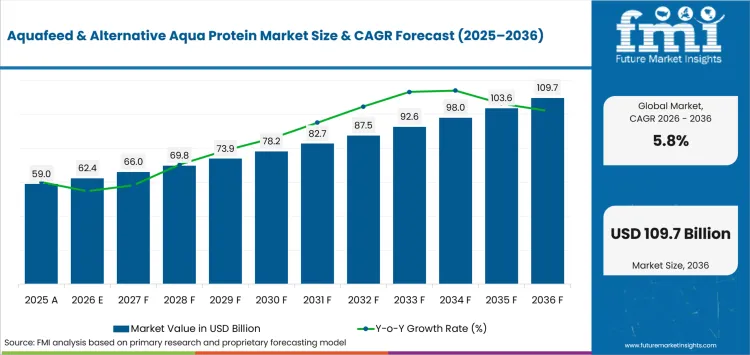
USD 62.4 billion in 2026 and USD 109.7 billion by 2036 at a 5.8% CAGR.
Demand for aquafeed & alternative aqua protein is projected to rise from USD 62.4 billion in 2026 to USD 109.7 billion by 2036 at a 5.8% CAGR. The forecast reflects recurring feed use across expanding farm output instead of a one-time replacement cycle. FAO reported in December 2025 that aquaculture was expected to contribute 104.2 million tonnes to 2025 global aquatic output. Recurring production at that scale links planned aquafeed formulations with protein purchases that feed mills can contract.
Country demand separates according to species concentration and the controls attached to commercial feed use. Norway’s salmon-heavy production system raises a different qualification requirement from feed systems serving broader shrimp markets. The Fisheries Directorate reported in May 2026 that salmon represented 93% of Norway’s 2025 aquaculture sales volume. Norway’s species concentration makes salmon feed qualification commercially important while India and Vietnam add traceability or conformity requirements to unfamiliar protein use.
Key Takeaways of Aquafeed & Alternative Aqua Protein Market
- Fed-aquaculture growth raises recurring protein requirements, and feed mills convert that need into orders once ingredients meet nutrition and supply specifications.
- By ingredient, fishmeal is estimated to hold 43.9% in 2026 owing to familiar nutrient performance that lowers reformulation risk for intensive feeds.
- In 2026, salmon is expected to lead species with 45.6% share because intensive farming rewards precise nutrition and repeatable feed performance.
- Powder is set to lead the form category with 41.3% share in 2026 due to bulk handling and controlled feed-mill dosing.
- Alternative proteins face slower commercial conversion if regulation or batch consistency remains unresolved and processing costs remain commercially unacceptable.
- The company set includes Skretting (Nutreco), Cargill (EWOS), BioMar, InnovaFeed, Calysta, Corbion, Veramaris, and Unibio across complete-feed and specialist protein models.
Analyst Perspective
"Aquafeed proteins should be judged first on digestible amino-acid delivery and legal inclusion limits for the target species. Feed mills gain more from a new protein when trials also prove pellet behavior, traceable sourcing and dependable tonnage under normal production schedules."
- Nandini Roy Choudhury, Principal Analyst, Future Market Insights
How is the Aquafeed & Alternative Aqua Protein Market segmented?
The aquafeed & alternative aqua protein market is segmented by ingredient, species, form, and region.
Market taxonomy covers ingredient, species, form, and region for analysis, with ingredients comprising fishmeal, insect, single-cell, algal, and plant proteins. Species cover salmon, shrimp, and tilapia, while forms include powder, liquid, granules, and paste and region adds the geographic classification used in later analysis.
What makes fishmeal central to the ingredient category?
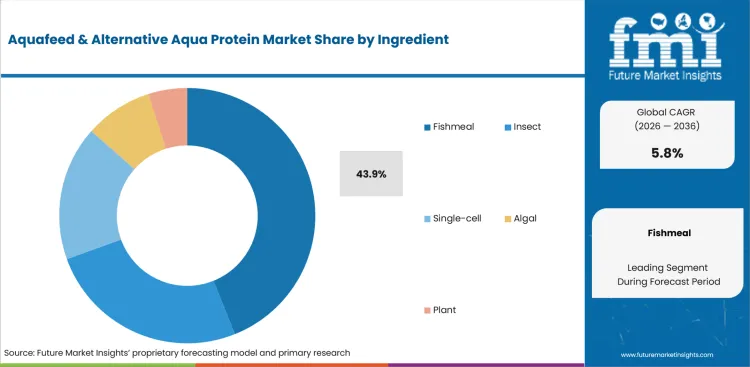
Fishmeal remains a nutritional benchmark for performance-sensitive feeds because formulation teams know its protein quality and palatability behavior across intensive species programs. IFFO reported in May 2026 that first-quarter fishmeal production fell 28% from the same 2025 period. That supply movement makes fishmeal supply planning relevant even when the ingredient remains biologically familiar.
- By ingredient, fishmeal is estimated to hold 43.9% in 2026 owing to established nutrient performance that lowers the reformulation burden for intensive feeds.
- Feed mills therefore qualify alternative proteins against digestibility and consistent availability instead of treating marine replacement as a simple one-for-one ingredient switch.
Why does salmon lead the species category?
Salmon farms reward precise nutrient delivery as feed conversion and growth consistency shape farm economics. New protein sources therefore face a demanding validation route that links mill processing behavior with repeatable biological performance in the target system.
- In 2026, salmon is expected to lead species with 45.6% share because intensive farming makes predictable biological performance commercially valuable.
- Skretting and Andfjord Salmon documented a July 2025 collaboration that tailored feed to Andfjord’s land-based salmon system and site-specific production conditions. The project gives feed teams a commercial reference for assessing new ingredients alongside feed additives that protect performance under specialized farm conditions.
How does powder support leadership in the form category?
BioMar and Innovafeed announced in September 2025 that insect meal would enter commercial shrimp feed in Ecuador at large scale. That route fits powdered insect protein because dry meals enter established receiving and dosing systems with controlled inclusion rates, allowing feed mills to test new inputs without rebuilding liquid-addition equipment.
- Powder is set to lead the form category with 41.3% share in 2026 due to bulk storage and controlled dosing in high-volume feed manufacturing.
- Repeat orders depend on consistent particle handling and nutrient contribution across scheduled batches because feed mills must preserve dosing accuracy and processing stability.
What are the drivers, restraints, and opportunities in the Aquafeed & Alternative Aqua Protein Market?
Fed-aquaculture output expands recurring protein demand, yet qualification rules constrain unfamiliar ingredients while industrial scale-up improves conversion into repeat commercial use.
- Driver: Fed-aquaculture production expands the recurring volume of qualified protein inputs required by commercial feed mills.
- Restraint: Novel ingredients face regulatory and formulation checks that can delay routine inclusion even after technical performance looks acceptable.
- Opportunity: Industrial protein platforms can convert successful qualification into repeat volume by pairing dependable output with feed-manufacturer partnerships.
Fed Aquaculture Expands Recurring Protein Demand
Fed aquaculture generates recurring protein demand because each production cycle requires new feed volumes for growing aquatic animals. FAO reported in June 2026 that aquaculture produced 103 million tonnes of aquatic animals during 2024. Greater farm output expands the addressable volume for qualified alternative feed proteins once feed mills can secure repeatable nutrition at contracted scale.
Qualification Rules Limit New Ingredient Routes
Insect-protein economics depend partly on which feed-grade substrates producers can legally use at commercial scale. Norway’s Food Safety Authority stated in January 2026 that insect substrates must comply with feed rules and exclude several waste-derived inputs. Restricted substrate choices can raise input costs and extend qualification work before feed mills approve routine purchasing.
Industrial Scale Improves Commercial Availability
Industrial output determines whether a promising alternative protein can progress from evaluation lots into scheduled feed-mill contracts. Innovafeed reported in June 2026 that its fully operational Nesle site had produced more than 15,000 tonnes of protein and oil over three years. Proven output gives feed formulators a stronger basis for negotiating repeat volumes around insect ingredients and other scalable protein routes.
Which country CAGRs are profiled in the Aquafeed & Alternative Aqua Protein Market?
| Country | CAGR |
|---|---|
| India | 6.8% |
| Vietnam | 6.4% |
| China | 6.0% |
| Chile | 5.6% |
| Norway | 5.2% |
How do country-level CAGRs compare in the Aquafeed & Alternative Aqua Protein Market?
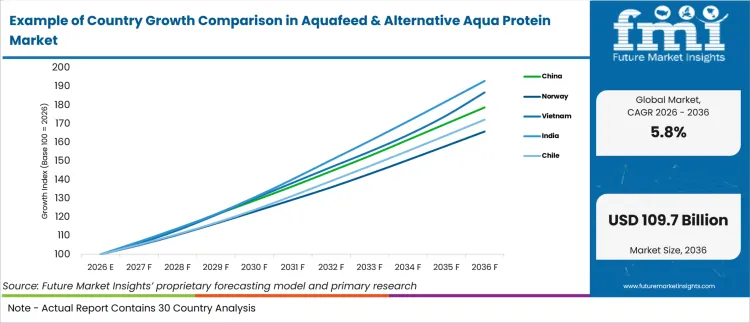
The country forecasts span 1.6 percentage points between India and Norway. India and Vietnam form an upper group with China between that band and the lower pair. Chile and Norway share a lower band shaped by salmon-feed qualification. The spread describes forecast pace rather than current market size.
- India combines export traceability with broad shrimp-feed distribution across major producing clusters.
- Vietnam adds national feed-conformity requirements to price-sensitive shrimp production and distributor-led qualification.
- China links large feed networks with a national push toward non-grain protein resources.
- Chile concentrates technical selling around salmon nutrition and production planning under health controls.
- Norway places exceptional weight on documented salmon performance and traceable feed sourcing across industrial farms.
Comparable CAGRs produce different entry conditions for ingredient developers. The full report provides country-level CAGR analysis across North America, Latin America, Europe, East Asia, South Asia, Oceania and the Middle East and Africa.
Country-wise Analysis
- Indian shrimp exporters rely on traceability systems that connect approved farm inputs with export quality records across major producing states and processing corridors during routine certification reviews and shipment preparation. India’s aquafeed & alternative aqua protein outlook is anticipated to advance at 6.8% CAGR over the assessment period, supported by MPEDA’s March 2025 SHAPHARI and Aqua Trace launch for farm enrollment and export traceability. Regional feed channels can use those systems to document unfamiliar proteins, but repeat orders still require dependable availability and complete records that limit extra approval work plus farm-performance risk during seasonal shrimp production cycles.
- Vietnamese shrimp-feed producers serve price-sensitive farms under national conformity rules that govern commercial aquaculture feed across domestic channels and export supply chains throughout major coastal farming provinces and distributor networks. Adoption of aquafeed & alternative aqua protein in Vietnam is estimated to expand at 6.4% CAGR through 2036, reinforced by Circular 67/2025/TT-BNNMT issued in November 2025 and effective May 2026. Local distributors can shorten qualification with compliant product files and species-specific performance data, but added conformity work raises switching costs when weak farm margins or incomplete documentation delay repeat purchasing across seasonal shrimp cycles and regional distribution networks.
- Chinese feed groups operate large manufacturing networks that can scale successful fish and shrimp formulations across high-throughput mills using coordinated technical review and consistent batch controls throughout major regional production clusters. The China aquafeed & alternative aqua protein sector is projected to record 6.0% CAGR during the assessment period, supported by an April 2025 goal for non-grain feed-resource capacity above 10 million tonnes by 2030. Domestic manufacturing improves access to commercial volumes of microbial and insect proteins, but routine inclusion still requires clear approvals plus competitive pricing and feed-conversion evidence across mills serving several aquatic species and regional production systems.
- Chilean salmon producers concentrate feed purchasing among professional farming groups that adjust production plans around health conditions and regulated operating limits across major southern farming zones during seasonal production and stocking cycles. By 2036 Chile is projected to grow at 5.6% CAGR, supported by Sernapesca’s March 2026 report that 2025 seawater salmon biomass increased 17% from the prior year across the national farming system. Established salmon nutrition expertise gives ingredient developers a defined qualification route, but health controls and changing farm schedules still require traceable raw-material supply plus flexible delivery before feed volumes become stable repeat orders across successive production cycles.
- Norwegian salmon producers assess feed against demanding biological performance targets and documentation requirements across highly industrialized farming systems with concentrated technical purchasing and established formulation expertise serving year-round commercial production programs across major farming regions nationwide. In Norway aquafeed & alternative aqua protein demand is predicted to advance at 5.2% CAGR through 2036, influenced by twenty sustainable-feed measures proposed by ministries in November 2025 for the mission ending in 2034. Strong technical capacity gives unfamiliar ingredients a clear testing route, but recurring contracts still require traceable volume and consistent species-specific performance evidence across industrial farms and year-round production plans nationwide.
Who are the notable companies in the Aquafeed & Alternative Aqua Protein Market?
Skretting (Nutreco), Cargill (EWOS), BioMar, InnovaFeed, Calysta, Corbion, Veramaris, and Unibio are the notable companies profiled in this market.
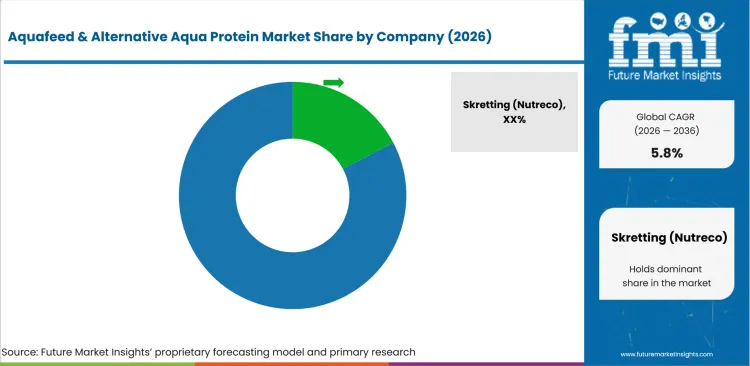
Competition is split between a small group of global feed formulators and a broader field of specialist protein platforms competing for recipe access. Complete-feed companies control formulation decisions and farm-facing technical support while ingredient specialists must earn approved inclusion inside existing recipes. Microalgae nutrients enter marine-lipid substitution routes within existing feeds where performance is measured against established marine inputs. Yeast proteins and other microbial inputs compete as defined protein components that require regulatory acceptance plus mill-scale consistency and application proof. Entry therefore depends on documented formulation fit and dependable supply rather than corporate size alone across commercial aquafeed programs.
- Skretting (Nutreco) and Cargill (EWOS) join BioMar in competing through full feed-formulation control plus direct technical access to aquaculture farms.
- InnovaFeed and Calysta join Unibio in competing through insect and single-cell proteins that require commercial inclusion inside partner feed recipes.
- Corbion and Veramaris compete through algal feed inputs that extend marine-nutrition options without requiring complete aquafeed manufacturing ownership.
Competitive Benchmarking: Aquafeed & Alternative Aqua Protein Market
| Company | Feed-Formulation Integration | Commercial Scale-Up Evidence | Species Validation Breadth | Geographic Reach |
|---|---|---|---|---|
| Skretting (Nutreco) | High | High | High | Production in 18+ countries on five continents |
| Cargill (EWOS) | High | High | High | Dedicated aquafeed mills across eight countries |
| BioMar | High | High | High | Europe, Latin America, Asia-Pacific and Australia |
| InnovaFeed | Medium | High | High | Europe with partner-led aquaculture deployment |
| Calysta | Medium | High | High | China production with international aquaculture approvals |
| Corbion | Medium | Medium | Low | International algae-ingredient business and aquafeed partnerships |
| Veramaris | Medium | High | Medium | North American production with international aquafeed markets |
| Unibio | Medium | Medium | Medium | European base with aquaculture approvals and planned Saudi scale-up |
Key Developments in the Aquafeed & Alternative Aqua Protein Market
- In February 2026, BioMar acquired the remaining 30% of BioMar Ecuador and took full ownership of the aquafeed business. The completed transaction strengthens direct control over a major shrimp-feed platform without treating the company’s separate capacity expansion plans as already operating.
- In January 2026, Innovafeed and NaturAlleva signed a commercial partnership for black soldier fly ingredients across Mediterranean aquafeed formulations. NaturAlleva began deploying the ingredients at meaningful commercial volumes in sea bass and sea bream feeds during the same month.
- In July 2025, Skretting received ASC Feed Standard certification for factories in Italy and Vietnam as well as Australia. The additions increased Skretting’s certified factory count to ten and widened documented feed-production coverage across fish and shrimp markets.
Key Players in the Aquafeed & Alternative Aqua Protein Market
Integrated Aquafeed Formulation Platforms
- Skretting (Nutreco)
- Cargill (EWOS)
- BioMar
Insect and Single-Cell Protein Platforms
- InnovaFeed
- Calysta
- Unibio
Algae-Derived Nutrition Platforms
- Corbion
- Veramaris
Aquafeed & Alternative Aqua Protein Market - Report Scope
| Coverage field | Report scope |
|---|---|
| Market breakdown | By ingredient, species, form, and region. |
| Quantitative Units | Revenue in USD billion and CAGR in %. |
| Market Definition | Commercial aquafeed and qualified marine, insect, single-cell, algal, and plant protein inputs used in feed formulations for farmed aquatic species. |
| Regions Covered | North America, Latin America, Europe, East Asia, South Asia and Pacific, and Middle East and Africa. |
| Countries Covered | India, Vietnam, China, Chile, Norway, and 20+ countries included in the full report. |
| Key Companies Profiled | Skretting (Nutreco), Cargill (EWOS), BioMar, InnovaFeed, Calysta, Corbion, Veramaris, and Unibio. |
| Forecast Period | 2026 to 2036. |
| Approach | Primary and secondary research with market triangulation. |
Aquafeed & Alternative Aqua Protein Market - Research Methodology
| Method | Approach |
|---|---|
| Primary Research | FMI analysts gathered input from manufacturers, service providers, technology developers, distributors, end users, procurement teams, and subject-matter experts. Interviews examined purchasing decisions, product or service evaluation, adoption barriers, approval requirements, pricing considerations, and expectations for technical or commercial support. Respondents were also asked what evidence is required before a trial, pilot, or initial order develops into regular purchasing. |
| Desk Research | Desk research covered government statistics, regulatory publications, trade data, industry associations, technical literature, standards, company filings, product information, and official corporate announcements. Sources were reviewed for relevance, publication date, geographic coverage, and consistency with the defined market scope. Claims relating to performance, applications, approvals, capacity, investment, and commercial activity were retained only when supported by credible public evidence. |
| Market Sizing and Forecasting | The market model combined the baseline value with historical performance, segment structure, pricing and volume indicators, adoption levels, company participation, and country-level demand conditions. Forecast assumptions considered economic activity, investment trends, regulatory developments, technology adoption, purchasing cycles, supply availability, and barriers to wider market use. Segment and regional estimates were reconciled before the final market total was calculated. |
| Data Validation | Estimates were checked against multiple independent indicators, including public data, company activity, trade patterns, industry developments, and findings from primary interviews. Validation also tested whether products, services, applications, and company revenues fell within the defined market boundaries. Adjacent categories, unsupported claims, overlapping revenues, and activities without direct market relevance were excluded to reduce double counting and maintain consistency across segments and countries. |
Aquafeed & Alternative Aqua Protein Market by Segments
Aquafeed & Alternative Aqua Protein Market segmented by Ingredient:
- Fishmeal
- Insect
- Single-Cell
- Algal
- Plant
Aquafeed & Alternative Aqua Protein Market segmented by Species:
- Salmon
- Shrimp
- Tilapia
Aquafeed & Alternative Aqua Protein Market segmented by Form:
- Powder
- Liquid
- Granules
- Paste
Aquafeed & Alternative Aqua Protein Market by Region:
- North America
- United States
- Canada
- Latin America
- Brazil
- Mexico
- Chile
- Rest of Latin America
- Western Europe
- Germany
- United Kingdom
- Italy
- Spain
- France
- Nordics
- Benelux
- Rest of Western Europe
- Eastern Europe
- Russia
- Poland
- Hungary
- Balkan and Baltic States
- Rest of Eastern Europe
- East Asia
- China
- Japan
- South Korea
- South Asia and Pacific
- India
- ASEAN
- Australia and New Zealand
- Rest of South Asia and Pacific
- Middle East and Africa
- Kingdom of Saudi Arabia
- Other GCC Countries
- Türkiye
- South Africa
- Other African Union Countries
- Rest of Middle East and Africa
Research Sources and Bibliography
- Food and Agriculture Organization of the United Nations. (2025, December 23). Aquatic products and the global economy.
- Fiskeridirektoratet. (2026, May 28). Økt salg for akvakulturnæringen i 2025.
- IFFO - The Marine Ingredients Organisation. (2026, May 7). Reduced fishmeal production, fish oil production shows more resilience.
- Skretting. (2025, July 3). Where biology meets technology: Skretting and Andfjord partner to innovate CAS feed.
- BioMar. (2025, September 2). BioMar, Innovafeed and Auchan announce landmark partnership to accelerate the commericialisation of insect meal.
- Food and Agriculture Organization of the United Nations. (2026, June 16). SOFIA 2026: Global fisheries and aquaculture production reaches new highs.
- Norwegian Food Safety Authority. (2026, January 19). Fôr/substrat til oppdrettsinsekter.
- Innovafeed. (2026, June 5). Innovafeed successfully scales up operations and enters a new phase of development backed by a €51 million funding round.
- Marine Products Export Development Authority. (2025, March 2). SHAPHARI & Aqua Trace Launched: MPEDA Unveils New Standard for Indian Shrimp Export Excellence
- Government of Viet Nam. (2025, November 24). Thông tư số 67/2025/TT-BNNMT của Bộ Nông nghiệp và Môi trường: Ban hành Quy chuẩn kỹ thuật Quốc gia về thức ăn thủy sản và sản phẩm xử lý môi trường nuôi trồng thủy sản.
- Ministry of Agriculture and Rural Affairs of the People’s Republic of China. (2025, April 25).
- Servicio Nacional de Pesca y Acuicultura. (2026, March 20). Sernapesca publica informes sanitarios y de uso de antimicrobianos y antiparasitarios en la salmonicultura.
- Norwegian Ministry of Trade, Industry and Fisheries & Ministry of Agriculture and Food. (2025, November 26). Foreslår 20 tiltak for bærekraftig fôrproduksjon.
- Skretting. (2026, May 27). Company facts.
- Cargill. (n.d.). Our performance in 2025. Retrieved August 10, 2026.
- BioMar. (2026, March 3). BioMar gains market share across all segments.
- Calysta. (n.d.). Who We Are. Retrieved August 10, 2026.
- Corbion. (2026). Annual Report 2025: Business performance.
- Veramaris. (2025, June 3). Veramaris delivers growth that sustains the future of seafood.
- Saudi Exchange. (2026, March 15). SIIG announces the development of a Bio-Protein production project with Unibio.
- BioMar. (2026, February 6). BioMar acquires the outstanding shares in Ecuador, maintaining strategic partnership.
- Innovafeed. (2026, January 21). NaturAlleva and Innovafeed announce a commercial partnership to further deploy insect-based ingredients in aquaculture.
- Skretting. (2025, July 31). Three more Skretting factories awarded with ASC certification.
- Unibio. (n.d.). Saudi Arabia approves Uniprotein® for aqua applications. Retrieved August 10, 2026.
- BioMar. (2026, February 11). BioMar builds new capacity in China.
- Veramaris. (2025, September 22). Veramaris partners with Merwetank to strengthen algae oil supply chain security.
- Corbion. (2026, April 20). Corbion advances algae innovation with new US patent for omega-3 fatty acids derived from algae.
- Cargill. (n.d.). Aquaculture Feed and Nutrition. Retrieved August 11, 2026.
- Cargill. (n.d.). Aquaculture Partnerships & Collaboration. Retrieved August 11, 2026.
- Skretting. (n.d.). A global provider of feed for aquaculture. Retrieved August 11, 2026.
- Calysta. (n.d.). Fish and Livestock. Retrieved August 11, 2026.
- Innovafeed. (n.d.). Our Hilucia™ Products. Retrieved August 11, 2026.
- Veramaris. (n.d.). Commercial farm trial. Retrieved August 11, 2026.
- Unibio. (n.d.). Partnerships. Retrieved August 11, 2026.
- BioMar. (2026, June 9). BioMar expands ASC-certified feed production capacity with BioMar Sagun certification.
This bibliography is provided for reader reference and is not exhaustive. The full report contains the complete reference list and detailed citations
This Report Answers
- How large is the aquafeed & alternative aqua protein market in 2026 and 2036?
- Which production conditions turn fed-aquaculture growth into recurring protein demand?
- Why does fishmeal retain the leading ingredient share despite alternative-protein development?
- How do salmon production systems shape qualification requirements for new feed proteins?
- Why does powder remain the leading form across commercial feed-mill workflows?
- How do country growth rates differ across the five profiled aquafeed markets?
- How do company models differ between complete feeds and insect or microbial proteins versus algae-derived nutrition?
- Which regulatory and supply conditions delay repeat purchasing of unfamiliar feed proteins?
Frequently Asked Questions
How big is the Aquafeed & Alternative Aqua Protein Market in 2026?
The aquafeed & alternative aqua protein market is expected to be valued at USD 62.4 billion in 2026. Recurring demand follows fed-aquaculture output as feed mills secure qualified protein inputs for planned production cycles.
What is the CAGR of the Aquafeed & Alternative Aqua Protein Market from 2026 to 2036?
The aquafeed & alternative aqua protein market is projected to grow at a CAGR of 5.8% between 2026 and 2036. Expansion depends on larger feed requirements plus commercial qualification of reliable marine and alternative protein sources.
Which ingredient segment is projected to account for 43.9% of the Aquafeed & Alternative Aqua Protein Market?
The aquafeed & alternative aqua protein market is led by fishmeal at 43.9% of the ingredient category in 2026. Familiar nutrient performance reduces reformulation uncertainty for feed mills producing intensive diets across commercial aquaculture systems.
Which species segment leads the Aquafeed & Alternative Aqua Protein Market in 2026?
The aquafeed & alternative aqua protein market is led by salmon at 45.6% of the species category in 2026. Intensive salmon production rewards precise nutrition and repeatable feed performance across tightly controlled commercial farming systems.
Which companies are active in the Aquafeed & Alternative Aqua Protein Market?
The aquafeed & alternative aqua protein market includes Skretting (Nutreco), Cargill (EWOS), BioMar, InnovaFeed, Calysta, Corbion, Veramaris, and Unibio. Their verified roles cover complete aquafeeds plus insect and microbial proteins alongside algae-derived nutrition across commercial farming systems.
Preview the report firsthand - request a free sample
Get SampleGet the brochure for pricing and purchase details.
Get PDFTable of Content
- Key Takeaways
- Market Size and CAGR
- Top Growth Driver
- Fastest Growing Segment
- Leading Region
- Key Companies
- Emerging Opportunities
- Executive Summary
- Global Market Outlook
- Demand-side Trends
- Supply-side Trends
- Technology Roadmap Analysis
- Analysis and Recommendations
- Analyst Perspective (What is happening? Why now? What should investors know?)
- Key Questions Answered
- How large is the market?
- What is the CAGR?
- What are key trends?
- Which region dominates?
- Who are the leaders?
- Market Overview
- Market Coverage / Taxonomy
- Market Definition / Scope / Limitations
- Research Methodology
- Chapter Orientation
- Analytical Lens and Working Hypotheses
- Market Structure, Signals, and Trend Drivers
- Benchmarking and Cross-market Comparability
- Market Sizing, Forecasting, and Opportunity Mapping
- Research Design and Evidence Framework
- Desk Research Programme (Secondary Evidence)
- Expert Input and Fieldwork (Primary Evidence)
- Tooling, Models, and Reference Databases
- Data Engineering and Model Build
- Quality Assurance and Audit Trail
- Market Background
- Market Dynamics (Drivers, Restraints, Opportunity, Trends)
- Scenario Forecast (Optimistic, Likely, Conservative)
- Impact Analysis
- AI Impact
- Sustainability Impact
- Regulatory Impact
- Technology Impact
- Consumer / Buyer Analysis
- Purchase Drivers
- Adoption Barriers
- Buyer Journey
- Opportunity Map Analysis
- Product Life Cycle Analysis
- Supply Chain Analysis
- Investment Feasibility Matrix
- Value Chain Analysis
- PESTLE and Porter's Analysis
- Regulatory Landscape
- Regional Parent Market Outlook
- Production and Consumption Statistics
- Import and Export Statistics
- Global Market Analysis and Forecast, 2021 to 2036
- Historical Market Size Value (USD Billion) Analysis, 2021 to 2025
- Current and Future Market Size Value (USD Billion) Projections, 2026 to 2036
- Y-o-Y Growth Trend Analysis
- Absolute $ Opportunity Analysis
- Global Market Pricing Analysis, 2021 to 2036
- Global Market Analysis and Forecast, By Ingredient, 2021 to 2036
- Introduction / Key Findings
- Historical Market Size Value (USD Billion) Analysis By Ingredient, 2021 to 2025
- Current and Future Market Size Value (USD Billion) Analysis and Forecast By Ingredient, 2026 to 2036
- Fishmeal
- Insect
- Single-cell
- Algal
- Plant
- Fishmeal
- Y-o-Y Growth Trend Analysis By Ingredient, 2021 to 2025
- Absolute $ Opportunity Analysis By Ingredient, 2026 to 2036
- Global Market Analysis and Forecast, By Species, 2021 to 2036
- Introduction / Key Findings
- Historical Market Size Value (USD Billion) Analysis By Species, 2021 to 2025
- Current and Future Market Size Value (USD Billion) Analysis and Forecast By Species, 2026 to 2036
- Salmon
- Shrimp
- Tilapia
- Salmon
- Y-o-Y Growth Trend Analysis By Species, 2021 to 2025
- Absolute $ Opportunity Analysis By Species, 2026 to 2036
- Global Market Analysis and Forecast, By Form, 2021 to 2036
- Introduction / Key Findings
- Historical Market Size Value (USD Billion) Analysis By Form, 2021 to 2025
- Current and Future Market Size Value (USD Billion) Analysis and Forecast By Form, 2026 to 2036
- Powder
- Liquid
- Granules
- Paste
- Powder
- Y-o-Y Growth Trend Analysis By Form, 2021 to 2025
- Absolute $ Opportunity Analysis By Form, 2026 to 2036
- Global Market Analysis and Forecast, By Region, 2021 to 2036
- Introduction
- Historical Market Size Value (USD Billion) Analysis By Region, 2021 to 2025
- Current Market Size Value (USD Billion) Analysis and Forecast By Region, 2026 to 2036
- North America
- Latin America
- Western Europe
- Eastern Europe
- East Asia
- South Asia and Pacific
- Middle East & Africa
- Market Attractiveness Analysis By Region
- North America Market Analysis and Forecast, By Country, 2021 to 2036
- Historical Market Size Value (USD Billion) Trend Analysis By Market Taxonomy, 2021 to 2025
- Market Size Value (USD Billion) Forecast By Market Taxonomy, 2026 to 2036
- By Country
- USA
- Canada
- By Ingredient
- By Species
- By Form
- By Country
- Market Attractiveness Analysis
- By Country
- By Ingredient
- By Species
- By Form
- Key Takeaways
- Latin America Market Analysis and Forecast, By Country
- Historical Market Size Value (USD Billion) Trend Analysis By Market Taxonomy, 2021 to 2025
- Market Size Value (USD Billion) Forecast By Market Taxonomy, 2026 to 2036
- By Country
- Brazil
- Mexico
- Chile
- Rest of Latin America
- By Ingredient
- By Species
- By Form
- By Country
- Market Attractiveness Analysis
- By Country
- By Ingredient
- By Species
- By Form
- Key Takeaways
- Western Europe Market Analysis and Forecast, By Country
- Historical Market Size Value (USD Billion) Trend Analysis By Market Taxonomy, 2021 to 2025
- Market Size Value (USD Billion) Forecast By Market Taxonomy, 2026 to 2036
- By Country
- Germany
- UK
- Italy
- Spain
- France
- Nordic
- BENELUX
- Rest of Western Europe
- By Ingredient
- By Species
- By Form
- By Country
- Market Attractiveness Analysis
- By Country
- By Ingredient
- By Species
- By Form
- Key Takeaways
- Eastern Europe Market Analysis and Forecast, By Country
- Historical Market Size Value (USD Billion) Trend Analysis By Market Taxonomy, 2021 to 2025
- Market Size Value (USD Billion) Forecast By Market Taxonomy, 2026 to 2036
- By Country
- Russia
- Poland
- Hungary
- Balkan & Baltic
- Rest of Eastern Europe
- By Ingredient
- By Species
- By Form
- By Country
- Market Attractiveness Analysis
- By Country
- By Ingredient
- By Species
- By Form
- Key Takeaways
- East Asia Market Analysis and Forecast, By Country
- Historical Market Size Value (USD Billion) Trend Analysis By Market Taxonomy, 2021 to 2025
- Market Size Value (USD Billion) Forecast By Market Taxonomy, 2026 to 2036
- By Country
- China
- Japan
- South Korea
- By Ingredient
- By Species
- By Form
- By Country
- Market Attractiveness Analysis
- By Country
- By Ingredient
- By Species
- By Form
- Key Takeaways
- South Asia and Pacific Market Analysis and Forecast, By Country
- Historical Market Size Value (USD Billion) Trend Analysis By Market Taxonomy, 2021 to 2025
- Market Size Value (USD Billion) Forecast By Market Taxonomy, 2026 to 2036
- By Country
- India
- ASEAN
- Australia & New Zealand
- Rest of South Asia and Pacific
- By Ingredient
- By Species
- By Form
- By Country
- Market Attractiveness Analysis
- By Country
- By Ingredient
- By Species
- By Form
- Key Takeaways
- Middle East & Africa Market Analysis and Forecast, By Country
- Historical Market Size Value (USD Billion) Trend Analysis By Market Taxonomy, 2021 to 2025
- Market Size Value (USD Billion) Forecast By Market Taxonomy, 2026 to 2036
- By Country
- Kingdom of Saudi Arabia
- Other GCC Countries
- Türkiye
- South Africa
- Other African Union
- Rest of Middle East & Africa
- By Ingredient
- By Species
- By Form
- By Country
- Market Attractiveness Analysis
- By Country
- By Ingredient
- By Species
- By Form
- Key Takeaways
- Key Countries Market Analysis
- USA
- Pricing Analysis
- Market Share Analysis, 2025
- By Ingredient
- By Species
- By Form
- Canada
- Pricing Analysis
- Market Share Analysis, 2025
- By Ingredient
- By Species
- By Form
- Mexico
- Pricing Analysis
- Market Share Analysis, 2025
- By Ingredient
- By Species
- By Form
- Brazil
- Pricing Analysis
- Market Share Analysis, 2025
- By Ingredient
- By Species
- By Form
- Chile
- Pricing Analysis
- Market Share Analysis, 2025
- By Ingredient
- By Species
- By Form
- Germany
- Pricing Analysis
- Market Share Analysis, 2025
- By Ingredient
- By Species
- By Form
- UK
- Pricing Analysis
- Market Share Analysis, 2025
- By Ingredient
- By Species
- By Form
- Italy
- Pricing Analysis
- Market Share Analysis, 2025
- By Ingredient
- By Species
- By Form
- Spain
- Pricing Analysis
- Market Share Analysis, 2025
- By Ingredient
- By Species
- By Form
- France
- Pricing Analysis
- Market Share Analysis, 2025
- By Ingredient
- By Species
- By Form
- India
- Pricing Analysis
- Market Share Analysis, 2025
- By Ingredient
- By Species
- By Form
- ASEAN
- Pricing Analysis
- Market Share Analysis, 2025
- By Ingredient
- By Species
- By Form
- Australia & New Zealand
- Pricing Analysis
- Market Share Analysis, 2025
- By Ingredient
- By Species
- By Form
- China
- Pricing Analysis
- Market Share Analysis, 2025
- By Ingredient
- By Species
- By Form
- Japan
- Pricing Analysis
- Market Share Analysis, 2025
- By Ingredient
- By Species
- By Form
- South Korea
- Pricing Analysis
- Market Share Analysis, 2025
- By Ingredient
- By Species
- By Form
- Russia
- Pricing Analysis
- Market Share Analysis, 2025
- By Ingredient
- By Species
- By Form
- Poland
- Pricing Analysis
- Market Share Analysis, 2025
- By Ingredient
- By Species
- By Form
- Hungary
- Pricing Analysis
- Market Share Analysis, 2025
- By Ingredient
- By Species
- By Form
- Kingdom of Saudi Arabia
- Pricing Analysis
- Market Share Analysis, 2025
- By Ingredient
- By Species
- By Form
- Türkiye
- Pricing Analysis
- Market Share Analysis, 2025
- By Ingredient
- By Species
- By Form
- South Africa
- Pricing Analysis
- Market Share Analysis, 2025
- By Ingredient
- By Species
- By Form
- USA
- Market Structure Analysis
- Competition Dashboard
- Competition Benchmarking
- Market Share Analysis of Top Players
- By Regional
- By Ingredient
- By Species
- By Form
- Emerging Startups
- Innovation Benchmarking
- Competition Analysis
- Competition Deep Dive
- Skretting (Nutreco)
- Overview
- Product Portfolio
- Profitability by Market Segments
- Sales Footprint
- Strategy Overview
- Marketing Strategy
- Product Strategy
- Channel Strategy
- Cargill (EWOS)
- BioMar
- InnovaFeed
- Calysta
- Corbion
- Veramaris
- Skretting (Nutreco)
- Case Studies
- Success Stories
- Recent Developments
- Competition Deep Dive
- Assumptions & Acronyms Used


