

- Industry Size (2026)
- USD 207 Mn
- Forecast (2036)
- USD 513.5 Mn
- CAGR (2026 to 2036)
- 9.5%
AR Headset Low Sparkle Optical Films Market Forecast and Outlook 2026 to 2036
The AR Headset Low Sparkle Optical Films Market is likely to be valued at USD 207 million in 2026 and is projected to reach USD 513.5 million by 2036, reflecting a CAGR of 9.5%. Market performance is shaped by concentration among suppliers capable of delivering precision optical films with minimal reflection and high transmissivity for augmented reality headsets. Regional manufacturing control affects raw material sourcing, cleanroom production, and quality verification. Adoption varies according to AR headset production volumes, display technology compatibility, and regional consumer demand. Smaller operators face challenges in scaling production while maintaining optical performance and multi-platform certification.
Margin concentration favors suppliers providing validated, low-reflection films integrated with headset assembly processes and display calibration services. Fragmentation persists among niche or regional producers, while leading companies capture concentrated value through production control, certified optical quality, and alignment with major AR OEM programs. Market outcomes are determined by optical performance, material reliability, and integration capability rather than unit output alone.
Quick Stats of the AR Headset Low-Sparkle Optical Films Market
- AR Headset Low Sparkle Optical Films Market Value (2026): USD 207 million
- AR Headset Low Sparkle Optical Films Forecast Value (2036): USD 513.5 million
- AR Headset Low Sparkle Optical Films Forecast CAGR 2026 to 2036: 9.5%
- Leading Display Type in AR Headset Low-Sparkle Optical Films Market: Micro-OLED (49 % share)
- Leading End Use in AR Headset Low Sparkle Optical Films Market: Enterprise and industrial applications (46 % share)
- Key Growth Regions in AR Headset Low Sparkle Optical Films Market: USA, China, South Korea, Japan
- Top Players in AR Headset Low Sparkle Optical Films Market: 3M, Nitto Denko, Toray Industries, LG Chem, Samsung SDI, Mitsubishi Chemical

What is the Growth Forecast for AR Headset Low Sparkle Optical Films Market through 2036?
Between 2026 and 2031, the AR Headset Low Sparkle Optical Films Market is projected to grow from USD 207 million to USD 297.7 million, generating an absolute increase of USD 90.7 million and reflecting a CAGR of 9.5%. Growth is driven by adoption of micro-OLED, LCoS, and waveguide hybrid displays across enterprise, industrial, defense, and consumer applications. Anti-sparkle and anti-reflection films enhance visual clarity and reduce glare in augmented reality headsets. Expansion is supported by increasing AR deployment, demand for high-performance optics, and adoption in industrial and defense environments. Suppliers focus on film quality, optical performance, and durability.
From 2031 to 2036, the market is expected to expand from USD 297.7 million to USD 513.5 million, adding USD 214.8 million. Growth is fueled by broader adoption of enterprise, industrial, and consumer AR headsets, improvements in display technology, and increasing demand for enhanced user experience. Market drivers include high visual fidelity, glare reduction, and integration with next-generation AR systems. Competitive advantage favors suppliers delivering validated optical performance, material consistency, and scalable production. Leading companies include 3M, Nitto Denko, Toray Industries, LG Chem, Samsung SDI, and Mitsubishi Chemical.
AR Headset Low Sparkle Optical Films Market Key Takeaways
| Metric | Value |
|---|---|
| Market Value (2026) | USD 207 million |
| Forecast Value (2036) | USD 513.5 million |
| Forecast CAGR 2026 to 2036 | 9.50% |
What Is Driving Demand for AR Headset Low-Sparkle Optical Films?
AR headset low-sparkle optical films are increasingly adopted to improve visual clarity, reduce glare, and enhance user comfort in augmented reality displays. Historically, optical components suffered from surface reflections and light scattering, which degraded image quality and caused eye strain. Modern low-sparkle films minimize micro-surface irregularities, optimize anti-reflective properties, and maintain high light transmission for immersive AR experiences. Headset manufacturers, display integrators, and consumer electronics companies prioritize optical performance, durability, and compatibility with display layers. Early adoption focused on high-end enterprise and industrial AR headsets, while current demand spans consumer electronics, gaming, and training applications driven by AR adoption growth, enhanced user experience requirements, and display quality expectations. Film uniformity, adhesion, and scratch resistance influence supplier selection.
Rising AR headset adoption, demand for improved visual fidelity, and user comfort standards are shaping market growth. Compared with conventional optical films, low-sparkle solutions emphasize reduced glare, high transmittance, and integration with complex waveguide displays. Cost structures depend on film manufacturing, coating processes, and quality control, concentrating margins among suppliers delivering consistent, high-performance materials. AR device manufacturers adopt these films to enhance display quality, reduce visual fatigue, and maintain durability in wearable devices. By 2036, low-sparkle optical films are expected to become standard in AR headsets across consumer, industrial, and enterprise applications, supporting immersive experiences and high-quality augmented reality visuals.
What Factors Are Shaping the Demand for AR Headset Low-Sparkle Optical Films in Terms of Display Type and End Use?
The demand for AR headset low-sparkle optical films is segmented by display type and end use. Display types include micro-OLED, LCoS, and waveguide hybrid systems. End-use segments cover enterprise and industrial applications, defense, and consumer devices. Adoption is influenced by optical performance requirements, user experience quality, and glare reduction. Uptake is driven by AR headset adoption in training, industrial inspection, and enterprise visualization. Display type and end-use selection depend on field-of-view requirements, device form factor, and operational environment, ensuring reliable, high-performance, and visually comfortable AR headset experiences across industrial, defense, and consumer markets.
Why Is Micro-OLED Leading the Display Type Segment in AR Headset Low-Sparkle Optical Films?
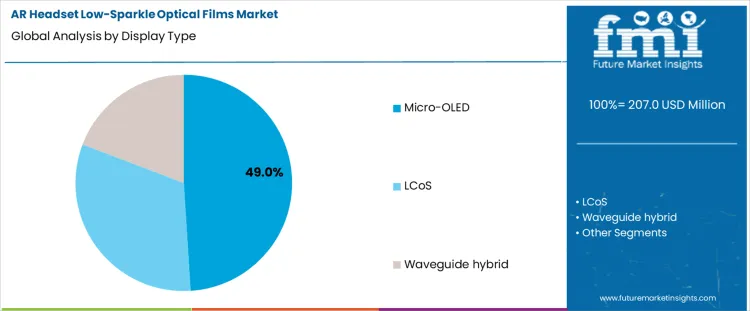
Micro-OLED accounts for approximately 49% of total display type demand, making it the leading category. These displays provide high brightness, wide color gamut, and excellent contrast for AR headsets. Adoption is driven by the need to minimize optical artifacts, reduce sparkle, and enhance visual clarity in both indoor and outdoor environments. Micro-OLED systems integrate with low-sparkle optical films to maintain image uniformity, brightness consistency, and minimal reflectance. Operational procedures include film lamination, optical alignment, and verification of uniformity across the display surface. Micro-OLED leads because it offers reliable performance, enhanced user experience, and compatibility with high-resolution AR content.
Operational factors further reinforce adoption. Optical films must maintain clarity, withstand repeated handling, and ensure low reflectance under various lighting conditions. Integration with headset optics and waveguides ensures minimal glare and accurate image rendering. Micro-OLED leads because it enables consistent visual performance, reduces eye strain, and supports precise AR content rendering for enterprise, industrial, and high-end consumer applications, providing scalable adoption across diverse headset designs.
Why Are Enterprise and Industrial Applications Representing the Largest End-Use Segment in AR Headset Low-Sparkle Optical Films?
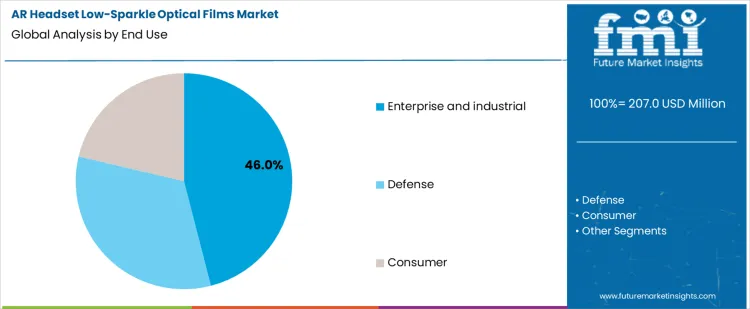
Enterprise and industrial applications account for approximately 46% of total end-use demand, making them the largest category. Adoption is driven by AR headset deployment in training, remote collaboration, equipment maintenance, and industrial inspection. Low-sparkle optical films enhance visibility in complex environments, reduce glare, and improve task accuracy. Operational procedures include film installation, headset calibration, and periodic performance verification. Enterprise applications require reliable optical performance to minimize user fatigue and maintain productivity.
Functional and operational factors further reinforce adoption. Films must resist scratches, maintain uniform brightness, and integrate with diverse headset optics. Enterprise and industrial applications lead because low-sparkle optical films provide dependable performance, enhanced ergonomics, and precise visual feedback, enabling safe, efficient, and accurate AR-assisted workflows across manufacturing, inspection, and operational environments.
How Are Low-Sparkle Optical Films Enhancing AR Headset Visual Performance?
Low-sparkle optical films are increasingly adopted in augmented reality (AR) headsets to reduce internal reflections, glare, and visual artifacts, improving user comfort and display clarity. Adoption is strongest in regions with high AR device production, advanced electronics manufacturing, and growing demand for immersive user experiences. Films are selected for optical uniformity, anti-reflective properties, and durability under repeated use. Growth is driven by rising AR adoption, consumer experience expectations, and device miniaturization requirements. Investment focuses on coating technology, substrate compatibility, and light management. Manufacturers prioritize films that enhance display clarity, maintain color fidelity, and integrate seamlessly into headset optics.
Why Are Regional AR Device Production and Display Quality Standards Driving Adoption?
Demand is influenced by local consumer electronics production, AR hardware innovation, and industry standards for optical performance. Manufacturers adopt low-sparkle films to reduce glare, improve image contrast, and maintain visual fidelity in head-mounted displays. Films offering consistent optical performance, scratch resistance, and integration ease gain preference. Adoption is concentrated in regions with strong AR development ecosystems and high consumer adoption. User comfort, display quality, and device reliability drive procurement rather than cost. Suppliers providing validated, high-performance optical films gain competitive advantage among AR headset OEMs and optical component manufacturers.
What Factors Limit Broader Deployment of Low-Sparkle Optical Films?
High material and processing costs, coating uniformity challenges, and substrate compatibility restrict adoption. Optical performance can degrade due to handling, environmental exposure, or repeated use. Integration with compact AR optics requires precision engineering. Smaller AR manufacturers or regions with limited optics fabrication infrastructure adopt solutions more slowly. These factors concentrate early deployment among premium AR headset OEMs, consumer electronics leaders, and regions with advanced display manufacturing capabilities.
How Are Technological Innovation and Collaborative Optics Development Shaping Market Growth?
Recent innovations include multi-layer anti-reflective coatings, nanostructured optical films, and enhanced durability substrates for long-term clarity. Collaboration between film manufacturers, AR headset OEMs, and optics research labs ensures performance validation, seamless integration, and compliance with display standards. Pilot testing evaluates sparkle reduction, light transmission, and durability before large-scale deployment. Quality monitoring, process standardization, and substrate compatibility maintain consistency. Focus is on visual performance, user experience, and integration reliability rather than cost or production volume. Collaborative initiatives enable broader adoption of low-sparkle optical films in AR headsets, enhancing display clarity and immersive experiences.
What is the Demand for AR Headset Low-Sparkle Optical Films by Country?

| Country | CAGR (%) |
|---|---|
| USA | 9.5% |
| China | 9.0% |
| South Korea | 8.8% |
| Japan | 8.5% |
Demand for AR headset low-sparkle optical films is rising as augmented reality device manufacturers adopt advanced optical components to enhance display clarity, reduce glare, and improve user experience. The USA leads with a 9.5% CAGR, driven by strong adoption of AR headsets in enterprise, gaming, and industrial applications, and investment in high-performance optical materials. China follows at 9.0%, supported by domestic AR device production and integration of low-glare films in consumer and industrial products. South Korea records 8.8% growth, shaped by electronics manufacturing and display technology innovation. Japan shows 8.5% CAGR, reflecting steady adoption of optical films in AR headsets for industrial, medical, and consumer applications.
How Is the United States Experiencing Growth in the AR Headset Low-Sparkle Optical Films Market?
United States is experiencing growth at a CAGR of 9.5%, supported by adoption of AR Headset Low Sparkle Optical Films Market solutions in augmented reality headsets to improve visual clarity, reduce glare, and enhance user experience. Manufacturers and technology providers are producing films optimized for low reflectivity, high durability, and compatibility with AR display systems. Demand is concentrated in consumer electronics hubs, AR device R&D centers, and manufacturing facilities. Investments focus on material performance, integration with optical assemblies, and compliance with electronic device standards rather than mass-scale deployment. Growth reflects increasing consumer adoption of AR devices, industrial focus on wearable technologies, and innovation in optical film materials.
- AR device adoption drives growth.
- Films optimize low reflectivity, durability, and visual clarity.
- Electronics hubs and R&D centers concentrate demand.
- Material performance and optical integration guide investment.
How Is China Witnessing Growth in the AR Headset Low-Sparkle Optical Films Market?
China is witnessing growth at a CAGR of 9%, fueled by adoption of AR Headset Low Sparkle Optical Films Market solutions in augmented reality headsets for consumer and industrial applications. Manufacturers and suppliers are deploying films optimized for glare reduction, high durability, and seamless integration with AR optics. Demand is concentrated in electronics manufacturing hubs, AR device R&D centers, and consumer electronics assembly facilities. Investments prioritize material performance, optical quality, and regulatory compliance rather than large-scale deployment. Growth reflects rising AR device adoption, industrial development of wearable technology, and government support for high-tech electronics manufacturing.
- AR headset adoption drives growth.
- Films enhance glare reduction and optical clarity.
- Electronics hubs and assembly facilities concentrate demand.
- Material performance and regulatory compliance guide investment.
How Is South Korea Experiencing Growth in the AR Headset Low-Sparkle Optical Films Market?
South Korea is experiencing growth at a CAGR of 8.8%, supported by adoption of AR Headset Low Sparkle Optical Films Market solutions to improve visual clarity, reduce reflections, and enhance AR headset performance. Manufacturers and technology providers are producing films optimized for low glare, durability, and integration with AR display systems. Demand is concentrated in electronics manufacturing hubs, R&D centers, and consumer device production facilities. Investments focus on material quality, optical system integration, and compliance with device standards rather than mass-scale deployment. Growth reflects industrial adoption of AR headsets, technological innovation in wearable optics, and rising consumer and enterprise AR applications.
- Visual clarity drives adoption.
- Films ensure low glare and high durability.
- Electronics hubs and R&D centers concentrate demand.
- Material quality and optical system integration guide investment.
How Is Japan Witnessing Growth in the AR Headset Low-Sparkle Optical Films Market?
Japan is witnessing growth at a CAGR of 8.5%, fueled by adoption of AR Headset Low Sparkle Optical Films Market solutions in consumer and industrial augmented reality devices to reduce reflections and improve image clarity. Manufacturers and suppliers are deploying films optimized for low reflectivity, durability, and seamless integration with AR optical assemblies. Demand is concentrated in electronics manufacturing hubs, AR R&D centers, and device production facilities. Investments prioritize material performance, optical integration, and compliance with industry standards rather than large-scale deployment. Growth reflects rising adoption of AR headsets, industrial focus on wearable technology, and innovation in low-glare optical films.
- Low-glare optics drive adoption.
- Films optimize reflectivity, durability, and clarity.
- Electronics hubs and R&D centers concentrate demand.
- Material performance and optical integration guide investment.
Who Competes in the AR Headset Low Sparkle Optical Films Market and What Defines Their Capabilities?

Competition in the AR Headset Low Sparkle Optical Films Market is defined by light transmission quality, anti-glare performance, and integration with wearable optics. 3M supplies optical films engineered to minimize sparkle and reflection in augmented reality displays while maintaining clarity and durability. Nitto Denko develops films optimized for AR headsets with high uniformity, low haze, and stable optical performance under varying light conditions. Toray Industries provides polymer films engineered for light diffusion and anti-glare properties suitable for wearable display applications. LG Chem delivers advanced optical substrates designed for AR devices requiring low sparkle and high transparency. Samsung SDI supplies functional optical films integrated into AR display modules.
Mitsubishi Chemical focuses on polymer films combining low reflectivity, durability, and compatibility with curved or complex optics for AR headsets. Other participants include regional specialty film manufacturers and optical component suppliers providing films engineered for low haze, anti-reflection, and consistent light transmission. Differentiation arises from optical clarity, sparkle reduction, environmental durability, coating uniformity, and compatibility with AR display assembly processes. Market adoption depends on the ability to deliver high-quality visual performance, reduce visual artifacts in AR devices, and meet mechanical and thermal specifications for wearable applications.
Key Players in the AR Headset Low-Sparkle Optical Films Market
- 3M
- Nitto Denko
- Toray Industries
- LG Chem
- Samsung SDI
- Mitsubishi Chemical
Scope of the Report
| Items | Values |
|---|---|
| Quantitative Units (2026) | USD million |
| Display Type | Micro-OLED, LCoS, Waveguide hybrid |
| End Use | Enterprise and industrial, Defense, Consumer |
| Film Function | Anti-sparkle, Anti-reflection |
| Region | Asia Pacific, Europe, North America, Latin America, Middle East & Africa |
| Key Countries Covered | USA, China, South Korea, Japan |
| Key Companies Profiled | 3M, Nitto Denko, Toray Industries, LG Chem, Samsung SDI, Mitsubishi Chemical |
| Additional Attributes | Dollar sales by display type, end use, and film function; regional CAGR, volume and value growth projections; adoption across enterprise, industrial, defense, and consumer AR headsets; validated low-sparkle optical performance, anti-reflective properties, and material durability; compatibility with micro-OLED, LCoS, and waveguide hybrid displays; integration with AR headset optical assemblies; focus on visual clarity, glare reduction, and user comfort; concentration of margins among suppliers offering validated, high-performance films with multi-platform certification and assembly support. |
AR Headset Low Sparkle Optical Films Market Segmentation
Display Type:
- Micro-OLED
- LCoS
- Waveguide hybrid
End Use:
- Enterprise and industrial
- Defense
- Consumer
Film Function:
- Anti-sparkle
- Anti-reflection
Region
- Asia Pacific
- China
- Japan
- South Korea
- India
- Australia & New Zealand
- ASEAN
- Rest of Asia Pacific
- Europe
- Germany
- United Kingdom
- France
- Italy
- Spain
- Nordic
- BENELUX
- Rest of Europe
- North America
- United States
- Canada
- Mexico
- Latin America
- Brazil
- Chile
- Rest of Latin America
- Middle East & Africa
- Kingdom of Saudi Arabia
- Other GCC Countries
- Turkey
- South Africa
- Other African Union
- Rest of Middle East & Africa
Bibliography
National Institute of Standards and Technology. (2022, January 4). Measuring up: Light reflection and transmission. NIST.
Chen, C. P. (2023). Introduction to the feature issue on augmented/virtual reality. Optics Express, 31(6), 10876. Optica Publishing Group.
International Organization for Standardization. (2024). ISO 9211-1:2024—Optics and photonics—Optical coatings—Part 1: Definitions and general requirements. ISO.
International Organization for Standardization. (2021). ISO 15368:2021—Optics and photonics—Spectral reflectance and spectral transmittance measurements of plane surfaces and plane parallel elements. ISO.
International Organization for Standardization. (2021). ISO 14782:2021—Plastics—Determination of haze for transparent materials. ISO
Frequently Asked Questions
How big is the ar headset low-sparkle optical films market in 2026?
The global ar headset low-sparkle optical films market is estimated to be valued at USD 207.0 million in 2026.
What will be the size of ar headset low-sparkle optical films market in 2036?
The market size for the ar headset low-sparkle optical films market is projected to reach USD 513.5 million by 2036.
How much will be the ar headset low-sparkle optical films market growth between 2026 and 2036?
The ar headset low-sparkle optical films market is expected to grow at a 9.5% CAGR between 2026 and 2036.
What are the key product types in the ar headset low-sparkle optical films market?
The key product types in ar headset low-sparkle optical films market are micro-oled, lcos and waveguide hybrid.
Which end use segment to contribute significant share in the ar headset low-sparkle optical films market in 2026?
In terms of end use, enterprise and industrial segment to command 46.0% share in the ar headset low-sparkle optical films market in 2026.
Preview the report firsthand - request a free sample
Get SampleGet the brochure for pricing and purchase details.
Get PDFTable of Content
- Executive Summary
- Global Market Outlook
- Demand-side Trends
- Supply-side Trends
- Technology Roadmap Analysis
- Analysis and Recommendations
- Market Overview
- Market Coverage / Taxonomy
- Market Definition / Scope / Limitations
- Market Background
- Market Dynamics
- Drivers
- Restraints
- Opportunity
- Trends
- Scenario Forecast
- Demand in Optimistic Scenario
- Demand in Likely Scenario
- Demand in Conservative Scenario
- Opportunity Map Analysis
- Product Life Cycle Analysis
- Supply Chain Analysis
- Investment Feasibility Matrix
- Value Chain Analysis
- PESTLE and Porter’s Analysis
- Regulatory Landscape
- Regional Parent Market Outlook
- Production and Consumption Statistics
- Import and Export Statistics
- Market Dynamics
- Global Market Analysis 2021 to 2025 and Forecast, 2026 to 2036
- Historical Market Size Value (USD Million) Analysis, 2021 to 2025
- Current and Future Market Size Value (USD Million) Projections, 2026 to 2036
- Y-o-Y Growth Trend Analysis
- Absolute $ Opportunity Analysis
- Global Market Pricing Analysis 2021 to 2025 and Forecast 2026 to 2036
- Global Market Analysis 2021 to 2025 and Forecast 2026 to 2036, By Display Type
- Introduction / Key Findings
- Historical Market Size Value (USD Million) Analysis By Display Type , 2021 to 2025
- Current and Future Market Size Value (USD Million) Analysis and Forecast By Display Type , 2026 to 2036
- Micro-OLED
- LCoS
- Waveguide hybrid
- Micro-OLED
- Y-o-Y Growth Trend Analysis By Display Type , 2021 to 2025
- Absolute $ Opportunity Analysis By Display Type , 2026 to 2036
- Global Market Analysis 2021 to 2025 and Forecast 2026 to 2036, By End Use
- Introduction / Key Findings
- Historical Market Size Value (USD Million) Analysis By End Use, 2021 to 2025
- Current and Future Market Size Value (USD Million) Analysis and Forecast By End Use, 2026 to 2036
- Enterprise and industrial
- Defense
- Consumer
- Enterprise and industrial
- Y-o-Y Growth Trend Analysis By End Use, 2021 to 2025
- Absolute $ Opportunity Analysis By End Use, 2026 to 2036
- Global Market Analysis 2021 to 2025 and Forecast 2026 to 2036, By Film Function
- Introduction / Key Findings
- Historical Market Size Value (USD Million) Analysis By Film Function, 2021 to 2025
- Current and Future Market Size Value (USD Million) Analysis and Forecast By Film Function, 2026 to 2036
- Anti-sparkle
- Anti-reflection
- Anti-sparkle
- Y-o-Y Growth Trend Analysis By Film Function, 2021 to 2025
- Absolute $ Opportunity Analysis By Film Function, 2026 to 2036
- Global Market Analysis 2021 to 2025 and Forecast 2026 to 2036, By Region
- Introduction
- Historical Market Size Value (USD Million) Analysis By Region, 2021 to 2025
- Current Market Size Value (USD Million) Analysis and Forecast By Region, 2026 to 2036
- North America
- Latin America
- Western Europe
- Eastern Europe
- East Asia
- South Asia and Pacific
- Middle East & Africa
- Market Attractiveness Analysis By Region
- North America Market Analysis 2021 to 2025 and Forecast 2026 to 2036, By Country
- Historical Market Size Value (USD Million) Trend Analysis By Market Taxonomy, 2021 to 2025
- Market Size Value (USD Million) Forecast By Market Taxonomy, 2026 to 2036
- By Country
- USA
- Canada
- Mexico
- By Display Type
- By End Use
- By Film Function
- By Country
- Market Attractiveness Analysis
- By Country
- By Display Type
- By End Use
- By Film Function
- Key Takeaways
- Latin America Market Analysis 2021 to 2025 and Forecast 2026 to 2036, By Country
- Historical Market Size Value (USD Million) Trend Analysis By Market Taxonomy, 2021 to 2025
- Market Size Value (USD Million) Forecast By Market Taxonomy, 2026 to 2036
- By Country
- Brazil
- Chile
- Rest of Latin America
- By Display Type
- By End Use
- By Film Function
- By Country
- Market Attractiveness Analysis
- By Country
- By Display Type
- By End Use
- By Film Function
- Key Takeaways
- Western Europe Market Analysis 2021 to 2025 and Forecast 2026 to 2036, By Country
- Historical Market Size Value (USD Million) Trend Analysis By Market Taxonomy, 2021 to 2025
- Market Size Value (USD Million) Forecast By Market Taxonomy, 2026 to 2036
- By Country
- Germany
- UK
- Italy
- Spain
- France
- Nordic
- BENELUX
- Rest of Western Europe
- By Display Type
- By End Use
- By Film Function
- By Country
- Market Attractiveness Analysis
- By Country
- By Display Type
- By End Use
- By Film Function
- Key Takeaways
- Eastern Europe Market Analysis 2021 to 2025 and Forecast 2026 to 2036, By Country
- Historical Market Size Value (USD Million) Trend Analysis By Market Taxonomy, 2021 to 2025
- Market Size Value (USD Million) Forecast By Market Taxonomy, 2026 to 2036
- By Country
- Russia
- Poland
- Hungary
- Balkan & Baltic
- Rest of Eastern Europe
- By Display Type
- By End Use
- By Film Function
- By Country
- Market Attractiveness Analysis
- By Country
- By Display Type
- By End Use
- By Film Function
- Key Takeaways
- East Asia Market Analysis 2021 to 2025 and Forecast 2026 to 2036, By Country
- Historical Market Size Value (USD Million) Trend Analysis By Market Taxonomy, 2021 to 2025
- Market Size Value (USD Million) Forecast By Market Taxonomy, 2026 to 2036
- By Country
- China
- Japan
- South Korea
- By Display Type
- By End Use
- By Film Function
- By Country
- Market Attractiveness Analysis
- By Country
- By Display Type
- By End Use
- By Film Function
- Key Takeaways
- South Asia and Pacific Market Analysis 2021 to 2025 and Forecast 2026 to 2036, By Country
- Historical Market Size Value (USD Million) Trend Analysis By Market Taxonomy, 2021 to 2025
- Market Size Value (USD Million) Forecast By Market Taxonomy, 2026 to 2036
- By Country
- India
- ASEAN
- Australia & New Zealand
- Rest of South Asia and Pacific
- By Display Type
- By End Use
- By Film Function
- By Country
- Market Attractiveness Analysis
- By Country
- By Display Type
- By End Use
- By Film Function
- Key Takeaways
- Middle East & Africa Market Analysis 2021 to 2025 and Forecast 2026 to 2036, By Country
- Historical Market Size Value (USD Million) Trend Analysis By Market Taxonomy, 2021 to 2025
- Market Size Value (USD Million) Forecast By Market Taxonomy, 2026 to 2036
- By Country
- Kingdom of Saudi Arabia
- Other GCC Countries
- Turkiye
- South Africa
- Other African Union
- Rest of Middle East & Africa
- By Display Type
- By End Use
- By Film Function
- By Country
- Market Attractiveness Analysis
- By Country
- By Display Type
- By End Use
- By Film Function
- Key Takeaways
- Key Countries Market Analysis
- USA
- Pricing Analysis
- Market Share Analysis, 2025
- By Display Type
- By End Use
- By Film Function
- Canada
- Pricing Analysis
- Market Share Analysis, 2025
- By Display Type
- By End Use
- By Film Function
- Mexico
- Pricing Analysis
- Market Share Analysis, 2025
- By Display Type
- By End Use
- By Film Function
- Brazil
- Pricing Analysis
- Market Share Analysis, 2025
- By Display Type
- By End Use
- By Film Function
- Chile
- Pricing Analysis
- Market Share Analysis, 2025
- By Display Type
- By End Use
- By Film Function
- Germany
- Pricing Analysis
- Market Share Analysis, 2025
- By Display Type
- By End Use
- By Film Function
- UK
- Pricing Analysis
- Market Share Analysis, 2025
- By Display Type
- By End Use
- By Film Function
- Italy
- Pricing Analysis
- Market Share Analysis, 2025
- By Display Type
- By End Use
- By Film Function
- Spain
- Pricing Analysis
- Market Share Analysis, 2025
- By Display Type
- By End Use
- By Film Function
- France
- Pricing Analysis
- Market Share Analysis, 2025
- By Display Type
- By End Use
- By Film Function
- India
- Pricing Analysis
- Market Share Analysis, 2025
- By Display Type
- By End Use
- By Film Function
- ASEAN
- Pricing Analysis
- Market Share Analysis, 2025
- By Display Type
- By End Use
- By Film Function
- Australia & New Zealand
- Pricing Analysis
- Market Share Analysis, 2025
- By Display Type
- By End Use
- By Film Function
- China
- Pricing Analysis
- Market Share Analysis, 2025
- By Display Type
- By End Use
- By Film Function
- Japan
- Pricing Analysis
- Market Share Analysis, 2025
- By Display Type
- By End Use
- By Film Function
- South Korea
- Pricing Analysis
- Market Share Analysis, 2025
- By Display Type
- By End Use
- By Film Function
- Russia
- Pricing Analysis
- Market Share Analysis, 2025
- By Display Type
- By End Use
- By Film Function
- Poland
- Pricing Analysis
- Market Share Analysis, 2025
- By Display Type
- By End Use
- By Film Function
- Hungary
- Pricing Analysis
- Market Share Analysis, 2025
- By Display Type
- By End Use
- By Film Function
- Kingdom of Saudi Arabia
- Pricing Analysis
- Market Share Analysis, 2025
- By Display Type
- By End Use
- By Film Function
- Turkiye
- Pricing Analysis
- Market Share Analysis, 2025
- By Display Type
- By End Use
- By Film Function
- South Africa
- Pricing Analysis
- Market Share Analysis, 2025
- By Display Type
- By End Use
- By Film Function
- USA
- Market Structure Analysis
- Competition Dashboard
- Competition Benchmarking
- Market Share Analysis of Top Players
- By Regional
- By Display Type
- By End Use
- By Film Function
- Competition Analysis
- Competition Deep Dive
- 3M
- Overview
- Product Portfolio
- Profitability by Market Segments (Product/Age /Sales Channel/Region)
- Sales Footprint
- Strategy Overview
- Marketing Strategy
- Product Strategy
- Channel Strategy
- Nitto Denko
- Toray Industries
- LG Chem
- Samsung SDI
- Mitsubishi Chemical
- 3M
- Competition Deep Dive
- Assumptions & Acronyms Used
- Research Methodology


