

- Industry Size (2026)
- USD 227.7 Mn
- Forecast (2036)
- USD 913.2 Mn
- CAGR (2026 to 2036)
- 14.9%
AR Windshield Photopolymer Holographic Films Market Forecast and Outlook 2026 to 2036
The AR windshield photopolymer holographic films market is projected to reach USD 913.2 million by 2036, growing at a CAGR of 14.9% from its 2026 valuation of USD 227.7 million. This market represents a pivotal area of growth for the automotive and augmented reality sectors, with strong commercial relevance driven by the increasing adoption of AR technologies in vehicles. Between 2026 and 2036, demand will be shaped by automakers and tech companies prioritizing advanced driver assistance systems (ADAS) and immersive experiences.
Buyers are expected to make decisions based on cost-effectiveness, regulatory compliance, and the potential to enhance vehicle safety and user experience. As the market matures, strategic investments in R&D and supply chain optimization will be critical. Companies that can adapt quickly to shifting consumer preference and integrate cutting-edge technologies into mass-market vehicles will gain a competitive edge, positioning themselves as leaders in a growing, high-demand market.
Quick Stats for the AR Windshield Photopolymer Holographic Films Market
- AR Windshield Photopolymer Holographic Films Market Value (2026): USD 227.7 million
- AR Windshield Photopolymer Holographic Films Market Forecast Value (2036): USD 913.2 million
- AR Windshield Photopolymer Holographic Films Market Global Forecast CAGR 2026 to 2036: 14.9%
- AR Windshield Photopolymer Holographic Films Market Leading Segment: Automotive Head-Up Displays (HUDs) (52%)
- Key Growth Regions in AR Windshield Photopolymer Holographic Films Market: USA
- Top Players in AR Windshield Photopolymer Holographic Films Market: HOLOEYE Photonics AG, Optinvent / Kopin Corporation, Luminit LLC, Zebra Imaging (HTA Group), HoloTech Switzerland
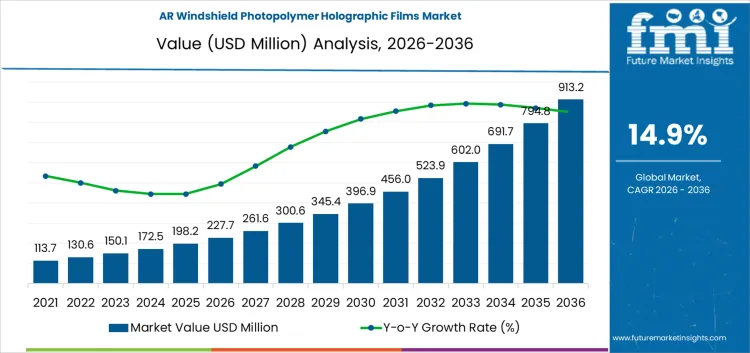
What is the Growth Rate Volatility Index for the AR Windshield Photopolymer Holographic Films Market through 2036?
The AR windshield photopolymer holographic films market is expected to experience moderate growth rate volatility over the forecast period. Initially, the market will experience steady growth, with values increasing from USD 227.7 million in 2026 to USD 261.8 million in 2027, and USD 300.7 million in 2028. These incremental increases reflect a stable market adoption as automotive manufacturers integrate AR technology into vehicle displays. However, the market will likely encounter slight volatility as new technologies and competing solutions emerge, particularly around the mid-forecast period.
The growth rate will likely stabilize after 2028, with more consistent annual increases, reaching USD 344.8 million in 2029, USD 395.8 million in 2030, and USD 453.9 million in 2031. By 2035, the market will be positioned at USD 787.2 million, demonstrating a more predictable growth trajectory. The final years of the forecast will see the market reach USD 913.2 million in 2036, with the volatility index decreasing as AR windshield technologies become mainstream. The overall market trend suggests consistent expansion, with some fluctuation in the earlier years, followed by more stable growth as the technology matures and widespread adoption takes place.
AR Windshield Photopolymer Holographic Films Market Key Takeaways
| Metric | Value |
|---|---|
| Industry Sales Value (2026) | USD 227.7 million |
| Industry Forecast Value (2036) | USD 913.2 million |
| Industry Forecast CAGR 2026 to 2036 | 14.9% |
What Is Driving the AR Windshield Photopolymer Holographic Films Market?
Historically, the AR windshield photopolymer holographic films market evolved from early efforts to enhance driver visibility and safety through optical coatings and laminated films on automotive glass. Traditional windshield technologies focused on anti reflective coatings, UV filters, and mechanical strength, enabling clear vision but offering limited functionality beyond glare reduction. Interest in holographic films emerged as vehicle electronics and heads up displays began to demand advanced optical interfaces that could overlay information without distracting the driver. Photopolymer holographic films offered the ability to diffract light in controlled ways, creating AR imagery directly on or within windshield substrates.
Initial research and development was concentrated in laboratory environments and concept vehicles where material scientists explored photopolymer stability, diffraction efficiency, and adhesion to curved glass surfaces. Early adopters in premium and concept automotive segments evaluated prototypes that demonstrated potential for projecting navigation cues, speed readouts, and safety alerts without bulky hardware. Performance challenges, such as ensuring durability under diverse environmental conditions and achieving uniform holographic effect on large curved surfaces, shaped early interest and constrained broader adoption.
Future demand for AR windshield photopolymer holographic films is expected to be driven by the rapid growth of advanced driver assistance systems (ADAS), demand for enhanced in vehicle information delivery, and the pursuit of seamless human machine interfaces in connected and autonomous vehicles. Automotive manufacturers will increasingly integrate photopolymer holographic films as part of AR HUD systems that can present navigation, hazard alerts, and sensor data directly in the driver’s line of sight. Growth factors include improvements in photopolymer formulations that provide higher diffraction efficiency, better environmental resistance, and lower production costs compatible with high volume automotive glass manufacturing.
Expansion of autonomous driving features and regulatory emphasis on safety systems is expected to incentivize the adoption of AR windshields that reduce driver distraction. Collaboration among glass suppliers, automotive OEMs, and electronics integrators will support standardization and scalability. Barriers include the technical complexity of mass production, integration with existing vehicle architectures, and ensuring consistent performance across vehicle models and climates. Long term market expansion will depend on demonstrable safety benefits, cost effective manufacturing processes, and alignment between automotive design priorities and next generation display technologies.
What are the Key Segments in the AR Windshield Photopolymer Holographic Films Market?
The AR Windshield Photopolymer Holographic Films market is divided into application segments and film types. The application segments include automotive head-up displays (HUDs), augmented reality windshields, passenger information systems, and others, with automotive HUDs taking the largest share at 52%. The film types are photopolymer holographic films, hybrid polymer-inorganic films, high-resolution diffractive films, and others, with photopolymer holographic films holding the leading market share at 46%. The market is driven by the increasing demand for advanced driver assistance systems (ADAS), improved user experience, and the growing integration of augmented reality (AR) in automotive technologies. The rise in consumer preference for enhanced in-car displays and the shift towards safer, more interactive driving experiences are further contributing to the growth of the market. Key regions, including North America, Europe, and Asia Pacific, are seeing rapid adoption of AR windshield technologies in automotive manufacturing.
What is Driving Growth in the Automotive Head-Up Displays (HUDs) Application?
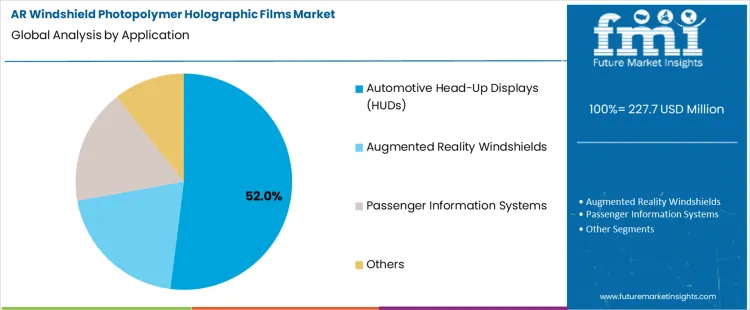
Automotive head-up displays (HUDs) represent the largest application segment in the AR Windshield Photopolymer Holographic Films market, accounting for 52% of the market share. The demand for HUDs in vehicles is driven by the increasing emphasis on driver safety, convenience, and enhanced user experience. HUDs provide critical driving information, such as speed, navigation, and safety alerts, directly onto the windshield, allowing drivers to access this information without taking their eyes off the road. This contributes to improved focus and reduced distractions, aligning with the automotive industry's goals of reducing accidents and enhancing safety.
As the automotive industry moves towards more advanced driver assistance systems (ADAS) and autonomous driving technologies, the need for more sophisticated HUDs that integrate AR features is growing. Photopolymer holographic films play a key role in this evolution, offering high-resolution and bright displays that enhance the effectiveness of HUDs. The adoption of HUDs is particularly high in premium and luxury vehicles, but as the technology becomes more cost-effective, it is expected to expand into mid-range and economy segments. Moreover, the increasing popularity of electric vehicles (EVs) and smart cars, which emphasize cutting-edge technology, is driving further demand for AR HUDs, making them a crucial component in the automotive sector's transformation.
What is Driving the Demand for Photopolymer Holographic Films in AR Windshields?
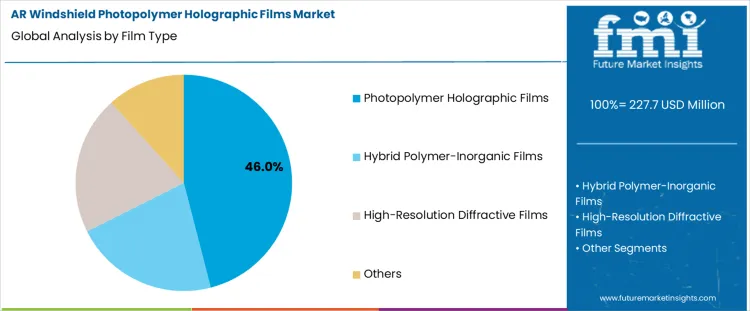
Photopolymer holographic films are the leading film type in the AR Windshield Photopolymer Holographic Films market, holding 46% of the market share. These films are essential in creating high-quality, bright, and highly visible augmented reality displays on windshields. Photopolymer holographic films are particularly favored in the automotive sector due to their ability to provide clear, sharp, and vivid visual elements, which are necessary for effective AR integration into windshields and HUDs. The growing trend of integrating AR technologies into automotive displays is driving the demand for photopolymer films, as they offer superior performance compared to traditional display technologies.
The increased use of photopolymer holographic films allows for more immersive and interactive driver experiences, displaying critical data such as navigation, vehicle status, and safety alerts directly on the windshield. The ability of these films to offer high resolution and light manipulation makes them ideal for use in vehicles with varying lighting conditions and complex visual displays. As automotive manufacturers continue to focus on enhancing driver safety and experience, the demand for photopolymer holographic films is expected to grow. The market is also benefiting from advancements in material science, making photopolymer films more cost-effective and efficient, driving further adoption across a range of vehicle types, including electric and autonomous vehicles.
What are the Key Dynamics in the AR Windshield Photopolymer Holographic Films Market?
The AR windshield photopolymer holographic films market is gaining traction as advancements in augmented reality (AR) and automotive technology drive new opportunities in the automotive sector. These holographic films are designed to be integrated into windshields, providing drivers with real-time, interactive data and visual enhancements, such as navigation instructions, speed displays, and hazard alerts, directly on the windshield. Photopolymer holographic films are used to create high-quality, transparent, and dynamic displays without compromising the vehicle’s visibility. The market is driven by the growing demand for in-car technologies that enhance driver safety, convenience, and the overall driving experience. As AR applications in the automotive industry continue to evolve, photopolymer holographic films provide an innovative solution that integrates seamlessly with advanced driver-assistance systems (ADAS) and heads-up displays (HUD).
What are the Key Drivers of Growth in the AR Windshield Photopolymer Holographic Films Market?
The key drivers of growth in the AR windshield photopolymer holographic films market include the increasing adoption of AR technology in the automotive sector, particularly for enhancing safety and driver assistance systems. The demand for AR-integrated displays is rising as automakers and consumers seek more advanced features that provide real-time, intuitive information without distractions. As automotive safety standards become stricter and vehicles are increasingly equipped with ADAS, there is a growing need for heads-up displays that offer better integration with the driving environment. Additionally, the development of photopolymer holographic films has advanced significantly, providing high-quality, durable solutions that meet the technical requirements for automotive use. The need for fuel-efficient, lightweight materials also supports the growth of holographic films, as they can provide these functions without adding significant weight to the vehicle. The rise of electric vehicles (EVs) with next-generation cockpit technologies further drives the market for AR windshield films, as automakers explore new ways to differentiate their EVs with innovative, driver-centric features.
What are the Key Restraints in the AR Windshield Photopolymer Holographic Films Market?
Despite its potential, the AR windshield photopolymer holographic films market faces several challenges. One of the key restraints is the high production cost associated with manufacturing advanced photopolymer films and integrating them into automotive windshields. The materials and technologies required for holographic films can be expensive, which may limit their adoption in lower-cost vehicles or in regions with price-sensitive markets. Additionally, ensuring the durability and clarity of these films under various environmental conditions, such as extreme temperatures, UV exposure, and wear from wipers, poses technical challenges. The need for precise manufacturing processes and strict quality control can further increase costs and manufacturing time. Another restraint is the limited infrastructure for widespread implementation, as not all vehicle manufacturers and suppliers may have the capability to produce or integrate these advanced films into their production lines. Finally, the potential regulatory hurdles related to AR technologies in vehicles, such as concerns over driver distraction or safety standards, may slow down the adoption of these technologies.
What are the Key Trends in the AR Windshield Photopolymer Holographic Films Market?
Several key trends are influencing the AR windshield photopolymer holographic films market. One of the major trends is the increasing focus on creating immersive and interactive driving experiences that blend seamlessly with in-vehicle technology. The automotive industry is increasingly integrating AR technology to enhance navigation, infotainment, and driver safety, with holographic films serving as an ideal medium for displaying relevant information without obstructing the driver’s line of sight. Another significant trend is the development of multi-functional windshield films, which not only provide AR displays but also incorporate features such as anti-glare coatings or enhanced optical clarity for improved visibility in various lighting conditions. As EVs and autonomous vehicles continue to evolve, automakers are looking for ways to differentiate their vehicles through next-generation interfaces and innovative cockpit technologies. This is fueling the demand for AR windshield films as part of the broader trend toward more sophisticated, interactive vehicle displays. Additionally, partnerships between automotive manufacturers and technology companies are fostering the rapid development of AR and holographic film solutions, further driving market growth.
What is the Country-Wise Analysis of the AR Windshield Photopolymer Holographic Films Market?
The AR (Augmented Reality) windshield photopolymer holographic films market is experiencing rapid growth globally, driven by the increasing adoption of advanced automotive technologies, including AR head-up displays and holographic films for windshields. These films enable drivers to see critical information projected onto their windshields in real time, enhancing safety and convenience. As the automotive industry focuses on improving the driving experience and embracing innovative technologies, countries such as the USA, Spain, Italy, Brazil, and China are seeing significant demand for AR windshield photopolymer holographic films. Each of these countries is influenced by its automotive industry size, technological advancements, and consumer preference for innovative features in vehicles.
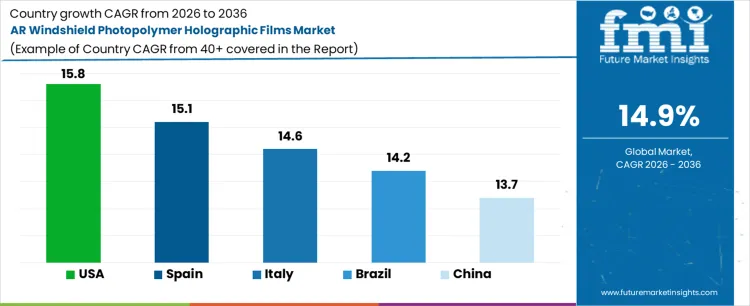
| Country | CAGR (%) |
|---|---|
| USA | 15.8 |
| Spain | 15.1 |
| Italy | 14.6 |
| Brazil | 14.2 |
| China | 13.7 |
What is Driving the Growth of the AR Windshield Photopolymer Holographic Films Market in the USA?
The AR windshield photopolymer holographic films market in the USA is growing at a CAGR of 15.8%. This growth is primarily driven by the increasing demand for advanced automotive technologies, such as augmented reality systems and heads-up displays, which are enhancing the in-car experience for consumers. The USA has a well-established automotive industry, and with the rise of electric vehicles (EVs) and autonomous vehicles, the demand for innovative technologies like AR windshield displays is expanding. Photopolymer holographic films, which allow for the seamless projection of AR content onto windshields, are gaining traction as they provide a safer and more interactive way for drivers to access information. Additionally, the growing consumer interest in smart automotive features is boosting the adoption of AR windshield holographic films in the USA.
How is the AR Windshield Photopolymer Holographic Films Market Performing in Spain?
Spain’s AR windshield photopolymer holographic films market is growing at a CAGR of 15.1%. Spain’s automotive sector is increasingly focusing on incorporating advanced technologies into vehicles to meet consumer demand for innovative, high-tech features. As automotive manufacturers in Spain push for safer, more efficient driving experiences, AR windshield displays are becoming a key part of this transformation. These holographic films offer real-time projections of critical information, reducing driver distraction and improving safety. Spain is also benefiting from Europe’s broader push toward sustainable transportation, where smart technologies are increasingly integrated into both traditional and electric vehicles. The combination of technological advances and regulatory support is driving the growth of AR windshield photopolymer holographic films in Spain.
What Factors are Shaping the AR Windshield Photopolymer Holographic Films Market in Italy?
The AR windshield photopolymer holographic films market in Italy is growing at a CAGR of 14.6%. Italy’s automotive industry, known for its innovation and high-quality design, is rapidly adopting AR technologies to enhance the driving experience. Italian automotive manufacturers are integrating AR systems into new vehicle models, aiming to improve safety and user experience. The adoption of photopolymer holographic films for windshields is increasing due to their ability to display AR content that can reduce distraction and enhance situational awareness. With Italy’s strong automotive presence, particularly in the luxury vehicle segment, there is significant demand for cutting-edge technologies like AR windshield films. Additionally, Italy’s commitment to sustainability in automotive design and manufacturing is accelerating the adoption of these advanced technologies.
How is the AR Windshield Photopolymer Holographic Films Market Performing in Brazil?
Brazil’s AR windshield photopolymer holographic films market is growing at a CAGR of 14.2%. As Brazil’s automotive industry modernizes and embraces more advanced technologies, the demand for innovative features like AR windshield displays is rising. AR systems can significantly improve safety by providing real-time information to drivers without the need to take their eyes off the road. Brazil is gradually shifting towards more high-tech vehicles, and the introduction of photopolymer holographic films for windshields is seen as a key step in enhancing the overall driving experience. Additionally, as the country adopts electric vehicles and other sustainable transportation solutions, the demand for AR technology in the automotive sector is expected to grow, contributing to the expansion of this market.
What is Contributing to the Growth of the AR Windshield Photopolymer Holographic Films Market in China?
China’s AR windshield photopolymer holographic films market is growing at a CAGR of 13.7%. As one of the largest automotive markets in the world, China is investing heavily in advanced technologies to enhance the driving experience, especially in the electric and autonomous vehicle sectors. AR windshield displays are becoming an essential feature in these vehicles, providing drivers with valuable real-time information projected directly onto the windshield. China’s focus on smart automotive technology, supported by both consumer demand and government incentives for innovation, is driving the adoption of AR windshield photopolymer holographic films. As China continues to lead in the development of electric and autonomous vehicles, the market for these advanced films is expected to expand.
What is the Competitive Landscape for the AR Windshield Photopolymer Holographic Films Market?
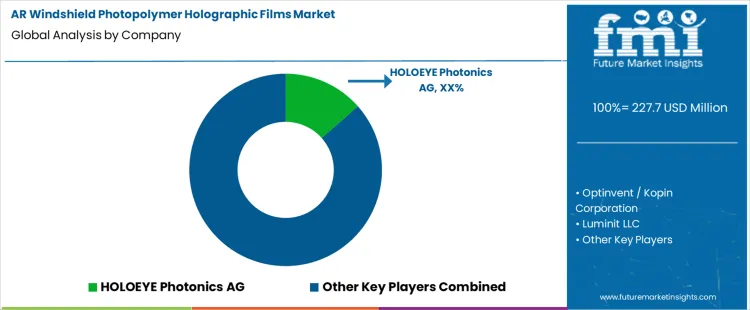
The AR windshield photopolymer holographic films market is driven by a growing demand for augmented reality (AR) technology in automotive applications, particularly for enhancing driving experiences. HOLOEYE Photonics AG leads the market, offering cutting-edge holographic films that enable advanced AR features for automotive windshields. Their proprietary technology enhances the visibility of critical information, making them a preferred choice for the integration of AR in vehicles. Optinvent, through its partnership with Kopin Corporation, is a significant player in the market, providing advanced display solutions, including photopolymer holographic films for AR windshields.
Luminit LLC also plays a crucial role, focusing on the development of optical films that enhance the performance and efficiency of AR displays. Zebra Imaging, part of the HTA Group, brings experience in 3D holography, offering innovative holographic solutions for AR integration into automotive applications. HoloTech Switzerland is another competitor, working on photopolymer holographic films that offer high-quality, high-resolution AR visual experiences for vehicles. These companies, with their unique technologies, are making substantial contributions to the advancement of AR in the automotive sector.
In the competitive landscape of AR windshield photopolymer holographic films, companies focus on continuous innovation, product differentiation, and strategic partnerships to maintain their position. HOLOEYE Photonics AG is expanding its product portfolio with advanced holographic film technologies that provide clear, bright, and accurate AR displays, tailored to the needs of modern vehicles. Optinvent and Kopin Corporation are collaborating to optimize their AR display solutions, improving transparency and performance in automotive windshields.
Luminit LLC is focusing on improving the optical properties of its films to offer superior viewing experiences in diverse lighting conditions. Zebra Imaging and HoloTech Switzerland are refining their holographic film products to enhance user experience and offer robust, durable solutions that withstand the demands of automotive environments. These companies are also exploring partnerships with automobile manufacturers and technology firms to drive the adoption of AR windshields in future vehicles. Their ongoing focus on innovation and collaboration ensures their continued competitiveness in the rapidly evolving market for AR windshield photopolymer holographic films.
Key Players of the AR Windshield Photopolymer Holographic Films Market
- HOLOEYE Photonics AG
- Optinvent / Kopin Corporation
- Luminit LLC
- Zebra Imaging (HTA Group)
- HoloTech Switzerland
- Others
Scope of the Report
| Items | Values |
|---|---|
| Quantitative Units (2026) | USD Million |
| Film Type | Photopolymer Holographic Films, Hybrid Polymer-Inorganic Films, High-Resolution Diffractive Films, Others |
| Technology | Transmission Holography, Reflection Holography, Hybrid Holography, Diffractive Optical Elements |
| Application | Automotive Head-Up Displays (HUDs), Augmented Reality Windshields, Passenger Information Systems, Others |
| Companies | HOLOEYE Photonics AG, Optinvent / Kopin Corporation, Luminit LLC, Zebra Imaging (HTA Group), HoloTech Switzerland, Others |
| Regions Covered | North America, Latin America, Western Europe, Eastern Europe, South Asia and Pacific, East Asia, Middle East & Africa |
| Countries Covered | United States, Canada, Mexico, Brazil, Argentina, Germany, France, United Kingdom, Italy, Spain, Netherlands, China, India, Japan, South Korea, ANZ, GCC Countries, South Africa |
| Additional Attributes | Dollar by sales by film type, technology, application, and region. Includes market trends towards advancements in augmented reality (AR) technologies, cost-effectiveness, regulatory compliance, impact on driving safety and experience, and the role of holographic films in the development of future automotive displays. |
AR Windshield Photopolymer Holographic Films Market Segmentation
Film Type
- Photopolymer Holographic Films
- Hybrid Polymer-Inorganic Films
- High-Resolution Diffractive Films
- Others
Technology
- Transmission Holography
- Reflection Holography
- Hybrid Holography
- Diffractive Optical Elements
- Others
Application
- Automotive Head-Up Displays (HUDs)
- Augmented Reality Windshields
- Passenger Information Systems
- Others
Region
- Asia Pacific
- China
- Japan
- India
- Australia & New Zealand
- ASEAN
- Rest of Asia Pacific
- Europe
- Germany
- United Kingdom
- France
- Italy
- Spain
- Nordic
- BENELUX
- Rest of Europe
- North America
- United States
- Canada
- Mexico
- Latin America
- Brazil
- Argentina
- Rest of Latin America
- Middle East & Africa
- Kingdom of Saudi Arabia
- Other GCC Countries
- South Africa
- Rest of Middle East & Africa
Bibliography
- USA Department of Transportation (USDOT). (2023). Augmented reality technologies in automotive displays: The evolution of AR head-up displays and photopolymer holographic films. USDOT Reports.
- International Telecommunication Union (ITU). (2023). Next-generation automotive interfaces: AR windshield technologies and holographic film integration in vehicle safety systems. ITU Publications.
- European Commission. (2023). Innovations in automotive HUD systems: The role of photopolymer holographic films in the next-generation vehicle displays. EC Research Papers.
- National Highway Traffic Safety Administration (NHTSA). (2023). Advancing driver safety with augmented reality in automotive displays: The impact of holographic films on road safety and user interaction. NHTSA Research Briefs.
- Society of Automotive Engineers (SAE). (2023). Photopolymer holographic films for AR windshield applications: A study of technological advancements and automotive integration. SAE Technical Papers.
Frequently Asked Questions
How big is the ar windshield photopolymer holographic films market in 2026?
The global ar windshield photopolymer holographic films market is estimated to be valued at USD 227.7 million in 2026.
What will be the size of ar windshield photopolymer holographic films market in 2036?
The market size for the ar windshield photopolymer holographic films market is projected to reach USD 913.2 million by 2036.
How much will be the ar windshield photopolymer holographic films market growth between 2026 and 2036?
The ar windshield photopolymer holographic films market is expected to grow at a 14.9% CAGR between 2026 and 2036.
What are the key product types in the ar windshield photopolymer holographic films market?
The key product types in ar windshield photopolymer holographic films market are photopolymer holographic films, hybrid polymer-inorganic films, high-resolution diffractive films and others.
Which technology segment to contribute significant share in the ar windshield photopolymer holographic films market in 2026?
In terms of technology, transmission holography segment to command 37.0% share in the ar windshield photopolymer holographic films market in 2026.
Preview the report firsthand - request a free sample
Get SampleGet the brochure for pricing and purchase details.
Get PDFTable of Content
- Executive Summary
- Global Market Outlook
- Demand-side Trends
- Supply-side Trends
- Technology Roadmap Analysis
- Analysis and Recommendations
- Market Overview
- Market Coverage / Taxonomy
- Market Definition / Scope / Limitations
- Market Background
- Market Dynamics
- Drivers
- Restraints
- Opportunity
- Trends
- Scenario Forecast
- Demand in Optimistic Scenario
- Demand in Likely Scenario
- Demand in Conservative Scenario
- Opportunity Map Analysis
- Product Life Cycle Analysis
- Supply Chain Analysis
- Investment Feasibility Matrix
- Value Chain Analysis
- PESTLE and Porter’s Analysis
- Regulatory Landscape
- Regional Parent Market Outlook
- Production and Consumption Statistics
- Import and Export Statistics
- Market Dynamics
- Global Market Analysis 2021 to 2025 and Forecast, 2026 to 2036
- Historical Market Size Value (USD Million) Analysis, 2021 to 2025
- Current and Future Market Size Value (USD Million) Projections, 2026 to 2036
- Y-o-Y Growth Trend Analysis
- Absolute $ Opportunity Analysis
- Global Market Pricing Analysis 2021 to 2025 and Forecast 2026 to 2036
- Global Market Analysis 2021 to 2025 and Forecast 2026 to 2036, By Film Type
- Introduction / Key Findings
- Historical Market Size Value (USD Million) Analysis By Film Type , 2021 to 2025
- Current and Future Market Size Value (USD Million) Analysis and Forecast By Film Type , 2026 to 2036
- Photopolymer Holographic Films
- Hybrid Polymer-Inorganic Films
- High-Resolution Diffractive Films
- Others
- Photopolymer Holographic Films
- Y-o-Y Growth Trend Analysis By Film Type , 2021 to 2025
- Absolute $ Opportunity Analysis By Film Type , 2026 to 2036
- Global Market Analysis 2021 to 2025 and Forecast 2026 to 2036, By Technology
- Introduction / Key Findings
- Historical Market Size Value (USD Million) Analysis By Technology, 2021 to 2025
- Current and Future Market Size Value (USD Million) Analysis and Forecast By Technology, 2026 to 2036
- Transmission Holography
- Reflection Holography
- Hybrid Holography
- Diffractive Optical Elements
- Transmission Holography
- Y-o-Y Growth Trend Analysis By Technology, 2021 to 2025
- Absolute $ Opportunity Analysis By Technology, 2026 to 2036
- Global Market Analysis 2021 to 2025 and Forecast 2026 to 2036, By Application
- Introduction / Key Findings
- Historical Market Size Value (USD Million) Analysis By Application, 2021 to 2025
- Current and Future Market Size Value (USD Million) Analysis and Forecast By Application, 2026 to 2036
- Automotive Head-Up Displays (HUDs)
- Augmented Reality Windshields
- Passenger Information Systems
- Others
- Automotive Head-Up Displays (HUDs)
- Y-o-Y Growth Trend Analysis By Application, 2021 to 2025
- Absolute $ Opportunity Analysis By Application, 2026 to 2036
- Global Market Analysis 2021 to 2025 and Forecast 2026 to 2036, By Region
- Introduction
- Historical Market Size Value (USD Million) Analysis By Region, 2021 to 2025
- Current Market Size Value (USD Million) Analysis and Forecast By Region, 2026 to 2036
- North America
- Latin America
- Western Europe
- Eastern Europe
- East Asia
- South Asia and Pacific
- Middle East & Africa
- Market Attractiveness Analysis By Region
- North America Market Analysis 2021 to 2025 and Forecast 2026 to 2036, By Country
- Historical Market Size Value (USD Million) Trend Analysis By Market Taxonomy, 2021 to 2025
- Market Size Value (USD Million) Forecast By Market Taxonomy, 2026 to 2036
- By Country
- USA
- Canada
- Mexico
- By Film Type
- By Technology
- By Application
- By Country
- Market Attractiveness Analysis
- By Country
- By Film Type
- By Technology
- By Application
- Key Takeaways
- Latin America Market Analysis 2021 to 2025 and Forecast 2026 to 2036, By Country
- Historical Market Size Value (USD Million) Trend Analysis By Market Taxonomy, 2021 to 2025
- Market Size Value (USD Million) Forecast By Market Taxonomy, 2026 to 2036
- By Country
- Brazil
- Chile
- Rest of Latin America
- By Film Type
- By Technology
- By Application
- By Country
- Market Attractiveness Analysis
- By Country
- By Film Type
- By Technology
- By Application
- Key Takeaways
- Western Europe Market Analysis 2021 to 2025 and Forecast 2026 to 2036, By Country
- Historical Market Size Value (USD Million) Trend Analysis By Market Taxonomy, 2021 to 2025
- Market Size Value (USD Million) Forecast By Market Taxonomy, 2026 to 2036
- By Country
- Germany
- UK
- Italy
- Spain
- France
- Nordic
- BENELUX
- Rest of Western Europe
- By Film Type
- By Technology
- By Application
- By Country
- Market Attractiveness Analysis
- By Country
- By Film Type
- By Technology
- By Application
- Key Takeaways
- Eastern Europe Market Analysis 2021 to 2025 and Forecast 2026 to 2036, By Country
- Historical Market Size Value (USD Million) Trend Analysis By Market Taxonomy, 2021 to 2025
- Market Size Value (USD Million) Forecast By Market Taxonomy, 2026 to 2036
- By Country
- Russia
- Poland
- Hungary
- Balkan & Baltic
- Rest of Eastern Europe
- By Film Type
- By Technology
- By Application
- By Country
- Market Attractiveness Analysis
- By Country
- By Film Type
- By Technology
- By Application
- Key Takeaways
- East Asia Market Analysis 2021 to 2025 and Forecast 2026 to 2036, By Country
- Historical Market Size Value (USD Million) Trend Analysis By Market Taxonomy, 2021 to 2025
- Market Size Value (USD Million) Forecast By Market Taxonomy, 2026 to 2036
- By Country
- China
- Japan
- South Korea
- By Film Type
- By Technology
- By Application
- By Country
- Market Attractiveness Analysis
- By Country
- By Film Type
- By Technology
- By Application
- Key Takeaways
- South Asia and Pacific Market Analysis 2021 to 2025 and Forecast 2026 to 2036, By Country
- Historical Market Size Value (USD Million) Trend Analysis By Market Taxonomy, 2021 to 2025
- Market Size Value (USD Million) Forecast By Market Taxonomy, 2026 to 2036
- By Country
- India
- ASEAN
- Australia & New Zealand
- Rest of South Asia and Pacific
- By Film Type
- By Technology
- By Application
- By Country
- Market Attractiveness Analysis
- By Country
- By Film Type
- By Technology
- By Application
- Key Takeaways
- Middle East & Africa Market Analysis 2021 to 2025 and Forecast 2026 to 2036, By Country
- Historical Market Size Value (USD Million) Trend Analysis By Market Taxonomy, 2021 to 2025
- Market Size Value (USD Million) Forecast By Market Taxonomy, 2026 to 2036
- By Country
- Kingdom of Saudi Arabia
- Other GCC Countries
- Turkiye
- South Africa
- Other African Union
- Rest of Middle East & Africa
- By Film Type
- By Technology
- By Application
- By Country
- Market Attractiveness Analysis
- By Country
- By Film Type
- By Technology
- By Application
- Key Takeaways
- Key Countries Market Analysis
- USA
- Pricing Analysis
- Market Share Analysis, 2025
- By Film Type
- By Technology
- By Application
- Canada
- Pricing Analysis
- Market Share Analysis, 2025
- By Film Type
- By Technology
- By Application
- Mexico
- Pricing Analysis
- Market Share Analysis, 2025
- By Film Type
- By Technology
- By Application
- Brazil
- Pricing Analysis
- Market Share Analysis, 2025
- By Film Type
- By Technology
- By Application
- Chile
- Pricing Analysis
- Market Share Analysis, 2025
- By Film Type
- By Technology
- By Application
- Germany
- Pricing Analysis
- Market Share Analysis, 2025
- By Film Type
- By Technology
- By Application
- UK
- Pricing Analysis
- Market Share Analysis, 2025
- By Film Type
- By Technology
- By Application
- Italy
- Pricing Analysis
- Market Share Analysis, 2025
- By Film Type
- By Technology
- By Application
- Spain
- Pricing Analysis
- Market Share Analysis, 2025
- By Film Type
- By Technology
- By Application
- France
- Pricing Analysis
- Market Share Analysis, 2025
- By Film Type
- By Technology
- By Application
- India
- Pricing Analysis
- Market Share Analysis, 2025
- By Film Type
- By Technology
- By Application
- ASEAN
- Pricing Analysis
- Market Share Analysis, 2025
- By Film Type
- By Technology
- By Application
- Australia & New Zealand
- Pricing Analysis
- Market Share Analysis, 2025
- By Film Type
- By Technology
- By Application
- China
- Pricing Analysis
- Market Share Analysis, 2025
- By Film Type
- By Technology
- By Application
- Japan
- Pricing Analysis
- Market Share Analysis, 2025
- By Film Type
- By Technology
- By Application
- South Korea
- Pricing Analysis
- Market Share Analysis, 2025
- By Film Type
- By Technology
- By Application
- Russia
- Pricing Analysis
- Market Share Analysis, 2025
- By Film Type
- By Technology
- By Application
- Poland
- Pricing Analysis
- Market Share Analysis, 2025
- By Film Type
- By Technology
- By Application
- Hungary
- Pricing Analysis
- Market Share Analysis, 2025
- By Film Type
- By Technology
- By Application
- Kingdom of Saudi Arabia
- Pricing Analysis
- Market Share Analysis, 2025
- By Film Type
- By Technology
- By Application
- Turkiye
- Pricing Analysis
- Market Share Analysis, 2025
- By Film Type
- By Technology
- By Application
- South Africa
- Pricing Analysis
- Market Share Analysis, 2025
- By Film Type
- By Technology
- By Application
- USA
- Market Structure Analysis
- Competition Dashboard
- Competition Benchmarking
- Market Share Analysis of Top Players
- By Regional
- By Film Type
- By Technology
- By Application
- Competition Analysis
- Competition Deep Dive
- HOLOEYE Photonics AG
- Overview
- Product Portfolio
- Profitability by Market Segments (Product/Age /Sales Channel/Region)
- Sales Footprint
- Strategy Overview
- Marketing Strategy
- Product Strategy
- Channel Strategy
- Optinvent / Kopin Corporation
- Luminit LLC
- Zebra Imaging (HTA Group)
- HoloTech Switzerland
- Others
- HOLOEYE Photonics AG
- Competition Deep Dive
- Assumptions & Acronyms Used
- Research Methodology


