

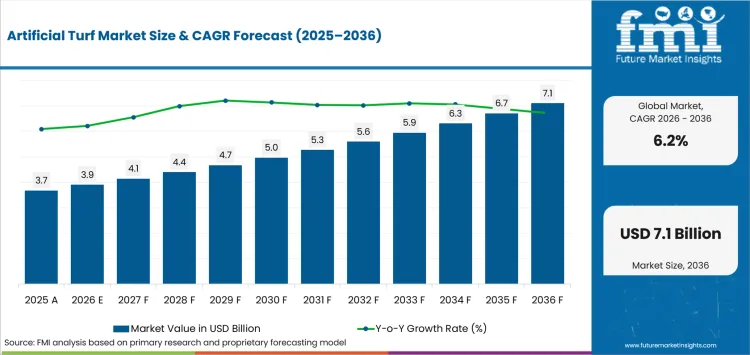
- Market Size (2026)
- USD 3.9 Bn
- Forecast (2036)
- USD 7.1 Bn
- CAGR (2026 to 2036)
- 6.2%
How big is Artificial Turf Market in 2026?
USD 3.9 billion in 2026 and USD 7.1 billion by 2036 at a 6.2% CAGR.
Demand for artificial turf is projected to expand at a 6.2% CAGR between 2026 and 2036. Valuation is forecast to rise from USD 3.9 billion in 2026 to USD 7.1 billion by 2036. Growth is being supported by the ability of synthetic surfaces to deliver significantly higher utilization rates than natural grass while reducing maintenance requirements and weather-related downtime. Sport England stated in June 2025 that a properly maintained artificial grass pitch can support up to 80 weekly playing hours compared with about six hours for quality grass. The capacity gap strengthens the economics of sports facility flooring at clubs that need more training slots from a fixed site.
The UK is projected at 6.7% CAGR compared with France at 3.8% as public funding gives British contractors a more visible project pipeline. The UK Department for Culture, Media and Sport recorded 991 funded grassroots projects in January 2026, including all-weather pitches and associated facility works. French replacements place greater weight on infill acceptance and lifecycle documentation, so project timing depends more heavily on material approval than new field funding.
Key Takeaways of Artificial Turf Market
- Artificial turf demand rises as sports operators seek more playable hours without expanding land used for training and competition.
- Contact sports are projected to hold 65.6% share in 2026 owing to high fixture density and federation performance requirements.
- By base material, polyethylene is forecast to represent 42.8% in 2026 driven by monofilament sports-turf designs and recycling compatibility.
- In 2026, sand infill is expected to lead infill material with 51.2% share because installers use it for ballast with several cushioning systems.
- Microplastic controls and lifecycle scrutiny can delay approvals by narrowing acceptable infill choices and increasing documentation requirements for replacement projects.
- Some of the key players in this market include Tarkett Sports (FieldTurf), Sport Group Holding (Polytan, edel grass), TenCate Grass, Shaw Sports Turf, SIS Pitches, GreenFields BV, CCGrass, and Controlled Products, LLC (SYNLawn).
Analyst Perspective
"Artificial turf economics depend on playable hours and the cost of keeping a field inside federation test limits over its service life. Drainage, infill, maintenance and recovery routes deserve comparison ahead of carpet price since they determine whether a resurfaced field stays available."
- Nikhil Kaitwade, Principal Consultant, Future Market Insights
How is the Artificial Turf Market segmented?
The artificial turf market is segmented by Application, Base Material, Infill Material and End-User.
Application includes contact sports, non-contact sports, leisure and landscaping. Base material covers polyethylene, polypropylene, polyamide and other materials. Infill material includes sand infill, rubber-based infills and plant-based infills. End-user categories comprise private sports, private landscaping, government landscaping and government sports.
What makes Contact Sports central to the Application category?
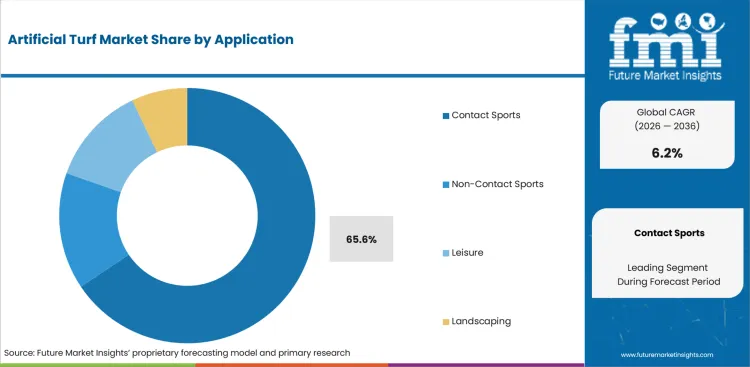
Football and rugby operators use artificial turf where fixture density exceeds the recovery capacity of natural grass. FIFA’s April 2026 football-turf manual evaluates FIFA Quality pitches for 40 to 60 weekly playing hours, so field qualification ties durability directly to scheduling while sports protective equipment follows a separate safety decision.
- By application, contact sports are estimated to hold 65.6% in 2026 owing to repeated training loads and federation-based performance requirements.
- High-use football operators review shock absorption and traction during qualification as daily training loads expose performance drift faster than low-use leisure surfaces during dense fixture periods.
Why does Polyethylene lead the Base Material category?
Polyethylene yarn suits sports turf because fibre recovery and surface feel must remain stable during repeated play and long training blocks. Single-polymer construction can simplify material separation at removal without changing the fibre function expected during qualification.
- Polyethylene is projected to hold 42.8% share in 2026 owing to its fit with common monofilament sports-turf designs.
- GreenFields installed Germany’s first ONE-DNA field in April 2025 using a 100% polyethylene construction that removes polymer separation during recycling. The project extends polyethylene materials from performance fibre into end-of-life planning during planned field resurfacing programmes without changing field qualification.
How does Sand Infill influence selection within the Infill Material category?
Sand infill provides ballast and fibre support without requiring a loose polymer performance granule. TenCate Grass documented a May 2025 Australian football project that paired sand with olive-pit natural infill and achieved FIFA certification, giving specifiers a tested alternative as reclaimed rubber faces closer lifecycle scrutiny.
- In 2026, sand infill is expected to lead infill material with 51.2% share as installers can retain familiar ballast while changing the cushioning layer.
- Mineral and plant-based performance layers can sit above sand, which lets installers change cushioning materials without rebuilding the full ballast approach at an existing site.
What supports Private Sports demand within the End-User category?
Private sports operators can turn additional playable hours into academy sessions, rentals and event capacity while the surface competes with sports and leisure equipment for the same facility capital budget.
- Private sports are set to lead the end-user category with 51.2% share in 2026 due to denser paid programming on fields that need less recovery time.
- SYNLawn announced its TGL partnership in March 2025 and supplied synthetic surfaces for a commercially operated golf competition environment. Comparable venues value predictable paid sessions during commercial booking cycles without the recovery periods required by intensively used natural grass.
What are the drivers, restraints and opportunities in the Artificial Turf Market?
Higher field utilization raises demand while stricter material scrutiny slows approvals and recyclable or lower-infill systems redirect resurfacing spending toward documented end-of-life routes.
- Driver: Sports facilities need more reliable playing hours from fixed sites as club and community schedules become denser.
- Restraint: Material testing and lifecycle requirements increase approval work for infill, fibre and backing choices in new and replacement fields.
- Opportunity: Recyclable mono-material and lower-infill systems can win resurfacing work where owners need certified performance with clearer end-of-life routes.
High-use clubs need more playable capacity without adding equivalent land at existing community sites. The Football Foundation opened the Derby Racecourse Hub in October 2025 with four 3G pitches, giving clubs a documented example of capacity expansion on one site. Surface manufacturers can use booking pressure to frame running track materials and other sports-surface investments against the hours each project makes available.
Public agencies now bring material disclosure into turf procurement since laboratories need repeatable methods for evaluating fibre and backing chemistry. The Synthetic Turf Council stated in May 2026 that ASTM F3782-26 standardized sampling and testing of synthetic turf fibre and fabric for PFAS. The standard lets specifiers compare polyurethane binders and other adjacent components against a clearer testing record prior to field approval.
Replacement work is the clearest commercial route for recyclable systems given facility owners already understand the operating value of artificial turf. Tarkett disclosed in April 2026 that its USA sports infill regeneration facilities recovered 14,100 tons for reuse in new projects during 2025. Manufacturers that pair tested field performance with collection and reprocessing can compete for resurfacing and landscaping services while keeping disposal planning inside the project contract.
Which country CAGRs are profiled in the Artificial Turf Market?
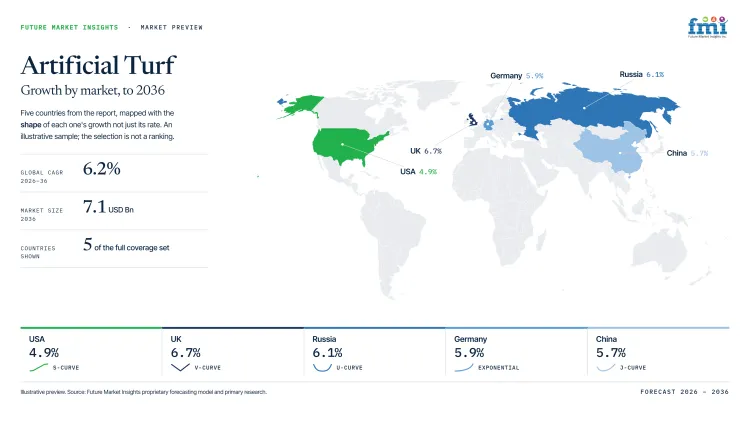
| Country | CAGR |
|---|---|
| UK | 6.7% |
| Russia | 6.1% |
| Germany | 5.9% |
| China | 5.7% |
| USA | 4.9% |
How do country-level CAGRs compare in the Artificial Turf Market?
The country range spans 1.8 percentage points, separating the UK at 6.7% from the USA at 4.9%, with Russia, Germany, and China positioned between them. The variation reflects differences in project-release cycles, procurement structures, and country-specific material requirements rather than current market size or a uniform demand pattern.
- UK resurfacing tenders emphasize pitch-register compliance and protected community access during construction.
- Russian projects depend on regional procurement cycles and contractor availability beyond major urban construction markets.
- German contractors use established sports-construction networks once material specifications clear municipal review.
- Chinese projects move through centralized planning and procurement for sports and public infrastructure facilities.
- USA projects fragment among school districts and universities with separate capital calendars.
Comparable CAGRs produce different sales cycles because each country releases projects through distinct acceptance routes. The full report provides country-level CAGR analysis across North America, Latin America, Europe, East Asia, South Asia, Oceania and the Middle East and Africa.
Country-wise Analysis
- UK school and community clubs operate heavily booked 3G pitches under established Football Foundation programmes, so resurfacing contractors must protect evening access and coordinate work around term breaks during capital renewals. Artificial turf demand in the UK is forecast to expand at 6.7% CAGR through 2036, supported by a mature installed base that creates recurring resurfacing opportunities while certification requirements and limited construction windows can delay replacement.
- Russian sports facilities rely on regional infrastructure programmes and municipal procurement, requiring contractors to coordinate turf installation with site preparation, drainage, and local construction schedules. Artificial turf demand in Russia is projected to grow at 6.1% CAGR through 2036, supported by continued sports and recreation investment, while regional differences in contractor availability and logistics can influence project costs beyond major urban markets.
- German municipalities increasingly evaluate artificial-turf systems based on material eligibility, recyclability, drainage performance, and intensive-use suitability before approving renovation projects. Artificial turf demand in Germany is expected to advance at 5.9% CAGR through 2036, supported by replacement activity and tighter requirements for synthetic surfaces, requiring contractors to demonstrate compliant materials while coordinating work around established club calendars.
- Chinese sports infrastructure projects increasingly incorporate artificial-turf fields into planned recreation and public-facility developments, allowing contractors to coordinate turf installation with broader construction packages. Artificial turf demand in China is forecast to rise at 5.7% CAGR through 2036, supported by organized sports development and continued investment in community facilities, while centralized procurement requires suppliers to align specifications and installation schedules with project requirements.
- USA school districts and universities typically schedule artificial-turf replacement within narrow summer construction windows, increasing the value of documented field performance and timely specification approvals. The USA artificial turf sector is estimated to grow at 4.9% CAGR through 2036, driven by replacement demand across institutional facilities, while differing local requirements can lengthen approvals and favor manufacturers with jurisdiction-specific performance records.f
Who are the notable companies in the Artificial Turf Market?
Tarkett Sports (FieldTurf), Sport Group Holding (Polytan, edel grass), TenCate Grass, Shaw Sports Turf, SIS Pitches, GreenFields BV, CCGrass, and Controlled Products, LLC (SYNLawn)
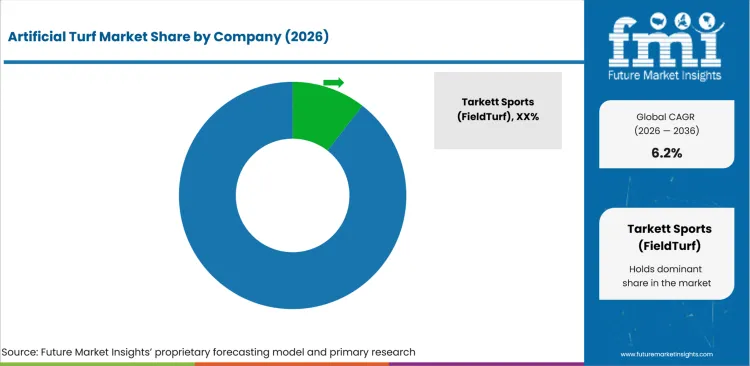
Competition separates integrated sports-surface groups from turf manufacturers that specialize in field systems or installation work for defined applications. Entry becomes harder once projects require federation qualification and construction support within one contract, which favors companies with broader sports-surface systems. Specialist brands also serve lawn and garden applications where local installers and distributor support carry more weight than stadium-scale construction capability.
- Integrated project platforms include Tarkett Sports (FieldTurf), Sport Group Holding (Polytan, edel grass) and TenCate Grass.
- Sports-turf manufacturers include Shaw Sports Turf, SIS Pitches, GreenFields BV and CCGrass.
- Controlled Products, LLC (SYNLawn) serves specialist synthetic-surface applications beyond full-size football and rugby fields.
Competitive Benchmarking: Artificial Turf Market
| Company | Sports Qualification Evidence | Technical Testing / Field Support | Integrated Project Delivery | Geographic Reach |
|---|---|---|---|---|
| Tarkett Sports (FieldTurf) | High | High | High | North America, Europe and international projects |
| Sport Group Holding (Polytan, edel grass) | High | Medium | High | Europe, North America and international projects |
| TenCate Grass | High | High | High | Europe, North America, Middle East and global group network |
| Shaw Sports Turf | Medium | High | Medium | Primarily North America |
| SIS Pitches | Medium | High | High | Europe, Middle East and selected international projects |
| GreenFields BV | High | Medium | Medium | Europe with international project reach |
| CCGrass | High | Medium | Medium | China, Southeast Asia and export markets |
| Controlled Products, LLC (SYNLawn) | Medium | Medium | Medium | North America with international distributor reach |
Scoring basis: High qualification requires FIFA Preferred Provider status or federation-level systems, while Medium requires elite competition deployment and Low reflects basic sports use. High technical support requires dedicated testing or several verified field-support functions, while Medium requires one support route and Low indicates product supply alone. High integrated delivery requires documented design, construction, installation and maintenance activity within the artificial turf project chain. Medium covers two or three verified delivery stages, while Low covers one documented stage under the same evidence standard.
Key Developments in the Artificial Turf Market
- In May 2026, Sport Group company Polytan partnered with Compograss for exclusive manufacture and distribution of FIFA-approved artificial turf systems in Spain.
- In June 2025, TenCate Grass acquired Sports & Leisure Group shares held by Sun Capital Partners and other shareholders, expanding its artificial turf manufacturing and installation footprint.
- In March 2025, Tarkett Sports acquired five USA construction businesses to expand design, construction and maintenance capacity for artificial turf and other sports surfaces.
Key Players in the Artificial Turf Market
Integrated Design-Build Sports Platforms
- Tarkett Sports (FieldTurf)
- Sport Group Holding (Polytan, edel grass)
- TenCate Grass
Large-Scale Turf Manufacturing and Certified Sports Systems
- Shaw Sports Turf
- SIS Pitches
- GreenFields BV
- CCGrass
Specialist Synthetic-Surface Brands
- Controlled Products, LLC (SYNLawn)
Artificial Turf Market - Report Scope
| Coverage field | Report scope |
|---|---|
| Market breakdown | By application, base material, infill material, end-user and region. |
| Quantitative Units | USD Billion. |
| Market Definition | Commercial artificial turf products and complete synthetic surfacing systems used in sports, leisure and landscaping applications within the stated taxonomy. |
| Regions Covered | North America, Latin America, Europe, East Asia, South Asia and Pacific, and Middle East and Africa. |
| Countries Covered | UK, Brazil, Germany, USA, France, and 20+ countries included in the full report. |
| Key Companies Profiled | Tarkett Sports (FieldTurf), Sport Group Holding (Polytan, edel grass), TenCate Grass, Shaw Sports Turf, SIS Pitches, GreenFields BV, CCGrass, and Controlled Products, LLC (SYNLawn). |
| Forecast Period | 2026 to 2036. |
| Approach | Primary and secondary research with market triangulation. |
Artificial Turf Market - Research Methodology
| Method | Approach |
|---|---|
| Primary Research | FMI analysts gathered input from manufacturers, service providers, technology developers, distributors, end users, procurement teams, and subject-matter experts. Interviews examined purchasing decisions, product or service evaluation, adoption barriers, approval requirements, pricing considerations, and expectations for technical or commercial support. Respondents were also asked what evidence is required before a trial, pilot, or initial order develops into regular purchasing. |
| Desk Research | Desk research covered government statistics, regulatory publications, trade data, industry associations, technical literature, standards, company filings, product information, and official corporate announcements. Sources were reviewed for relevance, publication date, geographic coverage, and consistency with the defined market scope. Claims relating to performance, applications, approvals, capacity, investment, and commercial activity were retained only when supported by credible public evidence. |
| Market Sizing and Forecasting | The market model combined the baseline value with historical performance, segment structure, pricing and volume indicators, adoption levels, company participation, and country-level demand conditions. Forecast assumptions considered economic activity, investment trends, regulatory developments, technology adoption, purchasing cycles, supply availability, and barriers to wider market use. Segment and regional estimates were reconciled before the final market total was calculated. |
| Data Validation | Estimates were checked against multiple independent indicators, including public data, company activity, trade patterns, industry developments, and findings from primary interviews. Validation also tested whether products, services, applications, and company revenues fell within the defined market boundaries. Adjacent categories, unsupported claims, overlapping revenues, and activities without direct market relevance were excluded to reduce double counting and maintain consistency across segments and countries. |
Artificial Turf Market by Segments
Artificial Turf Market segmented by Application:
- Contact Sports
- Non-Contact Sports
- Leisure
- Landscaping
Artificial Turf Market segmented by Base Material:
- Polyethylene
- Polypropylene
- Polyamide
- Others
Artificial Turf Market segmented by Infill Material:
- Sand Infill
- Rubber-based Infills
- Plant-based Infills
Artificial Turf Market segmented by End-User:
- Private Sports
- Private Landscaping
- Government Landscaping
- Government Sports
Artificial Turf Market by Region:
- North America
- United States
- Canada
- Latin America
- Brazil
- Mexico
- Argentina
- Chile
- Western Europe
- Germany
- France
- United Kingdom
- Italy
- Spain
- Benelux
- Nordics
- Eastern Europe
- Poland
- Czech Republic
- Romania
- Hungary
- Russia
- East Asia
- China
- Japan
- South Korea
- South Asia and Pacific
- India
- ASEAN
- Australia and New Zealand
- Middle East and Africa
- GCC Countries
- South Africa
- Türkiye
- Israel
Research Sources and Bibliography
- Sport England. (2025, June 30). Position statement on 3G pitches.
- Department for Culture, Media and Sport. (2026, January 27). New and upgraded grassroots sport facilities to get the UK active.
- FIFA. (2026, April). FIFA Quality Programme for Football Turf - Test Manual I: Test Methods, April 2026 edition.
- GreenFields. (2025, April 30). First ONE-DNA artificial turf field installed in Germany.
- TenCate Grass. (2025, May 9). Smart design with less impact: Partridge Street Reserve.
- SYNLawn. (2025, March 26). SYNLawn x TGL: The New Era of Golf.
- Football Foundation. (2025, October 8). Multi-million pound community sports hub unveiled at Derby Racecourse Playing Fields.
- Football Foundation. (2026, January 14). Let’s Go 2026!
- Synthetic Turf Council. (2026, May 11). New ASTM Standard Published for Sampling and Testing Synthetic Turf for PFAS.
- Tarkett. (2026, April 1). 2025 Sustainability Statement: Tarkett delivers concrete climate progress, cutting value-chain emissions by 27.
- Ministério do Esporte. (2025, November 25). Mais 260 municípios em todo o país são selecionados para receber Arenas Brasil.
- Federal Ministry for Housing, Urban Development and Building. (2026, April 23). Bund fördert Sanierung von 314 kommunalen Sportstätten.
- Agence nationale du Sport & Fédération Française de Football. (2025, April). Cahier des charges guichet unique AnS-FFF 2025.
- Shaw Industries. (2025, March 3). Shaw Sports Turf Opens State-of-the-Art PEAK Performance Lab, Revolutionizing Turf Innovation.
- Polytan. (2026, May 7). Polytan and Compograss Announce Strategic Partnership.
- TenCate Grass. (2025, June 5). TenCate Grass acquires a majority stake in Sports & Leisure Group.
- Tarkett Sports. (2025, March 4). Tarkett Sports Strengthens Design and Construction Capabilities Through Several Acquisitions.
- Tarkett Sports. (2025, April 28). Tarkett Sports Launches AMPERE, Enhancing Design Services to Tackle Evolving Customer Needs.
- Shaw Industries. (2025, October 8). Shaw Sports Turf to return in 2026 as The Official Synthetic Turf Provider of the College Football Playoff.
- TenCate Grass. (2025, October 10). TenCate Manufacturing Companies earn UL Zero Waste to Landfill Gold Validation.
- SYNLawn. (2025, April 29). SYNLawn welcomes SYNLawn Romania as a new partner to their network.
- Sprinturf. (2025, February 19). Sprinturf Healthy Spaces Council Meeting Brings Industry Leaders Together to Advance Recreation and Play Design.
- FIFA. (2025, July 22). FIFA Quality Programme announces companies as FIFA Preferred Providers for Football Turf.
- CCGrass. (2025, April 11). CCGrass Superb Crowned with Upgraded Standards under 2024 FIFA Quality Programme.
- British Universities and Colleges Sport. (2025, March 27). SIS Pitches Case Study: BUCS Big Wednesday.
- FieldTurf. (2025, July 15). FieldTurf Renews Sponsorship with NFHCA Through 2027.
- TenCate Grass. (2025, November 28). TenCate & PSV extend and intensify their successful partnership.
- SYNLawn. (2025, July 15). SYNLawn Chesapeake Bay Builds Custom Courts for Sports for Make-a-Wish® Recipient.
- GreenFields. (2026, June 10). Pure PT™ Play FIFA Certified Across Multiple Configurations.
- Sprinturf. (2026, January 16). Sprinturf Awards 2026 LEAP Grants to Expand Access to High Quality Sports and Recreation Spaces.
- AstroTurf Corporation. (2025, January 23). AstroTurf® Corporation Acquires Atlantic Sports Group.
This bibliography is provided for reader reference and is not exhaustive. The full report contains the complete reference list and detailed citations.
This Report Answers
- What is the artificial turf market size in 2026 and 2036?
- Which conditions increase demand for high-use sports fields?
- Why does contact sports lead the application category?
- Why does polyethylene lead the base material category?
- Why does sand infill lead the infill material category?
- How do growth rates differ among profiled countries?
- Which companies provide integrated or specialist turf systems?
- How do material tests affect project approval and replacement timing?
- What should operators compare before selecting an artificial turf system?
Frequently Asked Questions
How big is the Artificial Turf Market in 2026?
The artificial turf market is valued at USD 3.9 billion in 2026 and is projected to reach USD 7.1 billion by 2036. Sports facilities seek more playable hours without acquiring additional land for scheduled training sessions and competitions.
What is the CAGR of the Artificial Turf Market from 2026 to 2036?
The artificial turf market is projected to grow at a CAGR of 6.2% between 2026 and 2036. Replacement cycles and denser facility schedules support expansion as operators renew surfaces serving heavily booked venues.
Which application leads the Artificial Turf Market?
The contact sports segment is expected to hold 65.6% of the artificial turf market in 2026, driven by intensive football and rugby use. Federation testing lets operators schedule repeated training and competition while keeping surface performance within defined limits.
Which infill material leads the Artificial Turf Market?
The sand infill segment is expected to hold 51.2% of the artificial turf market in 2026, attributable to familiar ballast and fibre support. Plant-based performance layers can retain sand while changing the cushioning material used for player interaction and shock control.
Which countries are projected to record the highest growth in the Artificial Turf Market?
The UK and Brazil are each projected to grow at 6.7% CAGR, followed by Germany at 5.9% through 2036. Public construction pipelines and replacement specifications shape project timing differently in these three profiled countries.
Which companies are active in the Artificial Turf Market?
Key companies operating in the artificial turf market include Tarkett Sports (FieldTurf), Sport Group Holding (Polytan, edel grass), TenCate Grass, Shaw Sports Turf, SIS Pitches, GreenFields BV, CCGrass, and Controlled Products, LLC (SYNLawn). They compete on qualification evidence, field testing and project-delivery coverage.
Preview the report firsthand - request a free sample
Get SampleGet the brochure for pricing and purchase details.
Get PDFTable of Content
- Key Takeaways
- Market Size and CAGR
- Top Growth Driver
- Fastest Growing Segment
- Leading Region
- Key Companies
- Emerging Opportunities
- Executive Summary
- Global Market Outlook
- Demand-side Trends
- Supply-side Trends
- Technology Roadmap Analysis
- Analysis and Recommendations
- Analyst Perspective (What is happening? Why now? What should investors know?)
- Key Questions Answered
- How large is the market?
- What is the CAGR?
- What are key trends?
- Which region dominates?
- Who are the leaders?
- Market Overview
- Market Coverage / Taxonomy
- Market Definition / Scope / Limitations
- Research Methodology
- Chapter Orientation
- Analytical Lens and Working Hypotheses
- Market Structure, Signals, and Trend Drivers
- Benchmarking and Cross-market Comparability
- Market Sizing, Forecasting, and Opportunity Mapping
- Research Design and Evidence Framework
- Desk Research Programme (Secondary Evidence)
- Expert Input and Fieldwork (Primary Evidence)
- Tooling, Models, and Reference Databases
- Data Engineering and Model Build
- Quality Assurance and Audit Trail
- Market Background
- Market Dynamics (Drivers, Restraints, Opportunity, Trends)
- Scenario Forecast (Optimistic, Likely, Conservative)
- Impact Analysis
- AI Impact
- Sustainability Impact
- Regulatory Impact
- Technology Impact
- Consumer / Buyer Analysis
- Purchase Drivers
- Adoption Barriers
- Buyer Journey
- Opportunity Map Analysis
- Product Life Cycle Analysis
- Supply Chain Analysis
- Investment Feasibility Matrix
- Value Chain Analysis
- PESTLE and Porter's Analysis
- Regulatory Landscape
- Regional Parent Market Outlook
- Production and Consumption Statistics
- Import and Export Statistics
- Global Market Analysis and Forecast, 2021 to 2036
- Historical Market Size Value (USD Billion) Analysis, 2021 to 2025
- Current and Future Market Size Value (USD Billion) Projections, 2026 to 2036
- Y-o-Y Growth Trend Analysis
- Absolute $ Opportunity Analysis
- Global Market Pricing Analysis, 2021 to 2036
- Global Market Analysis and Forecast, By Application, 2021 to 2036
- Introduction / Key Findings
- Historical Market Size Value (USD Billion) Analysis By Application, 2021 to 2025
- Current and Future Market Size Value (USD Billion) Analysis and Forecast By Application, 2026 to 2036
- Contact Sports
- Non-Contact Sports
- Leisure
- Landscaping
- Contact Sports
- Y-o-Y Growth Trend Analysis By Application, 2021 to 2025
- Absolute $ Opportunity Analysis By Application, 2026 to 2036
- Global Market Analysis and Forecast, By Base Material, 2021 to 2036
- Introduction / Key Findings
- Historical Market Size Value (USD Billion) Analysis By Base Material, 2021 to 2025
- Current and Future Market Size Value (USD Billion) Analysis and Forecast By Base Material, 2026 to 2036
- Polyethylene
- Polypropylene
- Polyamide
- Others
- Polyethylene
- Y-o-Y Growth Trend Analysis By Base Material, 2021 to 2025
- Absolute $ Opportunity Analysis By Base Material, 2026 to 2036
- Global Market Analysis and Forecast, By Infill Material, 2021 to 2036
- Introduction / Key Findings
- Historical Market Size Value (USD Billion) Analysis By Infill Material, 2021 to 2025
- Current and Future Market Size Value (USD Billion) Analysis and Forecast By Infill Material, 2026 to 2036
- Sand Infill
- Rubber-based Infills
- Plant-based Infills
- Sand Infill
- Y-o-Y Growth Trend Analysis By Infill Material, 2021 to 2025
- Absolute $ Opportunity Analysis By Infill Material, 2026 to 2036
- Global Market Analysis and Forecast, By End-User, 2021 to 2036
- Introduction / Key Findings
- Historical Market Size Value (USD Billion) Analysis By End-User, 2021 to 2025
- Current and Future Market Size Value (USD Billion) Analysis and Forecast By End-User, 2026 to 2036
- Private Sports
- Private Landscaping
- Government Landscaping
- Government Sports
- Private Sports
- Y-o-Y Growth Trend Analysis By End-User, 2021 to 2025
- Absolute $ Opportunity Analysis By End-User, 2026 to 2036
- Global Market Analysis and Forecast, By Region, 2021 to 2036
- Introduction
- Historical Market Size Value (USD Billion) Analysis By Region, 2021 to 2025
- Current Market Size Value (USD Billion) Analysis and Forecast By Region, 2026 to 2036
- North America
- Latin America
- Western Europe
- Eastern Europe
- East Asia
- South Asia and Pacific
- Middle East & Africa
- Market Attractiveness Analysis By Region
- North America Market Analysis and Forecast, By Country, 2021 to 2036
- Historical Market Size Value (USD Billion) Trend Analysis By Market Taxonomy, 2021 to 2025
- Market Size Value (USD Billion) Forecast By Market Taxonomy, 2026 to 2036
- By Country
- USA
- Canada
- By Application
- By Base Material
- By Infill Material
- By End-User
- By Country
- Market Attractiveness Analysis
- By Country
- By Application
- By Base Material
- By Infill Material
- By End-User
- Key Takeaways
- Latin America Market Analysis and Forecast, By Country
- Historical Market Size Value (USD Billion) Trend Analysis By Market Taxonomy, 2021 to 2025
- Market Size Value (USD Billion) Forecast By Market Taxonomy, 2026 to 2036
- By Country
- Brazil
- Mexico
- Chile
- Rest of Latin America
- By Application
- By Base Material
- By Infill Material
- By End-User
- By Country
- Market Attractiveness Analysis
- By Country
- By Application
- By Base Material
- By Infill Material
- By End-User
- Key Takeaways
- Western Europe Market Analysis and Forecast, By Country
- Historical Market Size Value (USD Billion) Trend Analysis By Market Taxonomy, 2021 to 2025
- Market Size Value (USD Billion) Forecast By Market Taxonomy, 2026 to 2036
- By Country
- Germany
- UK
- Italy
- Spain
- France
- Nordic
- BENELUX
- Rest of Western Europe
- By Application
- By Base Material
- By Infill Material
- By End-User
- By Country
- Market Attractiveness Analysis
- By Country
- By Application
- By Base Material
- By Infill Material
- By End-User
- Key Takeaways
- Eastern Europe Market Analysis and Forecast, By Country
- Historical Market Size Value (USD Billion) Trend Analysis By Market Taxonomy, 2021 to 2025
- Market Size Value (USD Billion) Forecast By Market Taxonomy, 2026 to 2036
- By Country
- Russia
- Poland
- Hungary
- Balkan & Baltic
- Rest of Eastern Europe
- By Application
- By Base Material
- By Infill Material
- By End-User
- By Country
- Market Attractiveness Analysis
- By Country
- By Application
- By Base Material
- By Infill Material
- By End-User
- Key Takeaways
- East Asia Market Analysis and Forecast, By Country
- Historical Market Size Value (USD Billion) Trend Analysis By Market Taxonomy, 2021 to 2025
- Market Size Value (USD Billion) Forecast By Market Taxonomy, 2026 to 2036
- By Country
- China
- Japan
- South Korea
- By Application
- By Base Material
- By Infill Material
- By End-User
- By Country
- Market Attractiveness Analysis
- By Country
- By Application
- By Base Material
- By Infill Material
- By End-User
- Key Takeaways
- South Asia and Pacific Market Analysis and Forecast, By Country
- Historical Market Size Value (USD Billion) Trend Analysis By Market Taxonomy, 2021 to 2025
- Market Size Value (USD Billion) Forecast By Market Taxonomy, 2026 to 2036
- By Country
- India
- ASEAN
- Australia & New Zealand
- Rest of South Asia and Pacific
- By Application
- By Base Material
- By Infill Material
- By End-User
- By Country
- Market Attractiveness Analysis
- By Country
- By Application
- By Base Material
- By Infill Material
- By End-User
- Key Takeaways
- Middle East & Africa Market Analysis and Forecast, By Country
- Historical Market Size Value (USD Billion) Trend Analysis By Market Taxonomy, 2021 to 2025
- Market Size Value (USD Billion) Forecast By Market Taxonomy, 2026 to 2036
- By Country
- Kingdom of Saudi Arabia
- Other GCC Countries
- Türkiye
- South Africa
- Other African Union
- Rest of Middle East & Africa
- By Application
- By Base Material
- By Infill Material
- By End-User
- By Country
- Market Attractiveness Analysis
- By Country
- By Application
- By Base Material
- By Infill Material
- By End-User
- Key Takeaways
- Key Countries Market Analysis
- USA
- Pricing Analysis
- Market Share Analysis, 2025
- By Application
- By Base Material
- By Infill Material
- By End-User
- Canada
- Pricing Analysis
- Market Share Analysis, 2025
- By Application
- By Base Material
- By Infill Material
- By End-User
- Mexico
- Pricing Analysis
- Market Share Analysis, 2025
- By Application
- By Base Material
- By Infill Material
- By End-User
- Brazil
- Pricing Analysis
- Market Share Analysis, 2025
- By Application
- By Base Material
- By Infill Material
- By End-User
- Chile
- Pricing Analysis
- Market Share Analysis, 2025
- By Application
- By Base Material
- By Infill Material
- By End-User
- Germany
- Pricing Analysis
- Market Share Analysis, 2025
- By Application
- By Base Material
- By Infill Material
- By End-User
- UK
- Pricing Analysis
- Market Share Analysis, 2025
- By Application
- By Base Material
- By Infill Material
- By End-User
- Italy
- Pricing Analysis
- Market Share Analysis, 2025
- By Application
- By Base Material
- By Infill Material
- By End-User
- Spain
- Pricing Analysis
- Market Share Analysis, 2025
- By Application
- By Base Material
- By Infill Material
- By End-User
- France
- Pricing Analysis
- Market Share Analysis, 2025
- By Application
- By Base Material
- By Infill Material
- By End-User
- India
- Pricing Analysis
- Market Share Analysis, 2025
- By Application
- By Base Material
- By Infill Material
- By End-User
- ASEAN
- Pricing Analysis
- Market Share Analysis, 2025
- By Application
- By Base Material
- By Infill Material
- By End-User
- Australia & New Zealand
- Pricing Analysis
- Market Share Analysis, 2025
- By Application
- By Base Material
- By Infill Material
- By End-User
- China
- Pricing Analysis
- Market Share Analysis, 2025
- By Application
- By Base Material
- By Infill Material
- By End-User
- Japan
- Pricing Analysis
- Market Share Analysis, 2025
- By Application
- By Base Material
- By Infill Material
- By End-User
- South Korea
- Pricing Analysis
- Market Share Analysis, 2025
- By Application
- By Base Material
- By Infill Material
- By End-User
- Russia
- Pricing Analysis
- Market Share Analysis, 2025
- By Application
- By Base Material
- By Infill Material
- By End-User
- Poland
- Pricing Analysis
- Market Share Analysis, 2025
- By Application
- By Base Material
- By Infill Material
- By End-User
- Hungary
- Pricing Analysis
- Market Share Analysis, 2025
- By Application
- By Base Material
- By Infill Material
- By End-User
- Kingdom of Saudi Arabia
- Pricing Analysis
- Market Share Analysis, 2025
- By Application
- By Base Material
- By Infill Material
- By End-User
- Türkiye
- Pricing Analysis
- Market Share Analysis, 2025
- By Application
- By Base Material
- By Infill Material
- By End-User
- South Africa
- Pricing Analysis
- Market Share Analysis, 2025
- By Application
- By Base Material
- By Infill Material
- By End-User
- USA
- Market Structure Analysis
- Competition Dashboard
- Competition Benchmarking
- Market Share Analysis of Top Players
- By Regional
- By Application
- By Base Material
- By Infill Material
- By End-User
- Emerging Startups
- Innovation Benchmarking
- Competition Analysis
- Competition Deep Dive
- Tarkett Sports (FieldTurf)
- Overview
- Product Portfolio
- Profitability by Market Segments
- Sales Footprint
- Strategy Overview
- Marketing Strategy
- Product Strategy
- Channel Strategy
- Sport Group Holding (Polytan, edel grass)
- CoCreation Grass Co., Ltd.
- TenCate Grass
- Shaw Sports Turf
- SIS Pitches Group
- GreenFields BV
- Controlled Products, LLC (SYNLawn)
- CCGrass
- Domo Sports Grass
- Tarkett Sports (FieldTurf)
- Case Studies
- Success Stories
- Recent Developments
- Competition Deep Dive
- Assumptions & Acronyms Used


