

- Market Size (2026)
- USD 2.1 Bn
- Forecast (2036)
- USD 3.8 Bn
- CAGR (2026 to 2036)
- 6.2%
How big is Assembly Workstations Market in 2026?
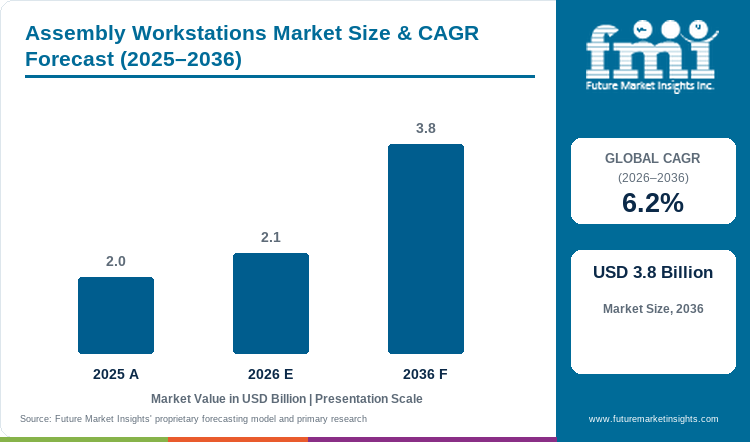
USD 2.1 Billion in 2026 and USD 3.8 Billion by 2036 at a 6.2% CAGR.
Sales of assembly workstations are estimated to grow at a 6.2% CAGR from USD 2.1 billion in 2026 to USD 3.8 billion in 2036. The market was valued at USD 2.0 billion in 2025. Demand is tied less to simple furniture replacement than to the need to make operator-led production easier to rebalance when products, staffing, tools, or takt times change. U.S. manufacturing employed more than 12.8 million people in 2024, while the U.S. Bureau of Labor Statistics projected nearly 1 million production-occupation openings per year on average from 2024 through 2034, largely because workers must be replaced. That labor turnover makes reach distance, tool positioning, working height, task lighting, and repeatable parts presentation more important to plant productivity.
Manual stations remain necessary within the factory automation and industrial controls market. Plants can automate transport or inspection while retaining operators for mixed-model assembly, repairs, cable routing and final fit. A bench must then accommodate changing tools, parts and instructions. Standard accessory interfaces let plants reconfigure these tasks and reproduce a successful station at another line.
Key Takeaways
- Manual assembly benches are projected to hold 27.0% of Workstation Type demand in 2026 because they can be re-equipped without committing a plant to a fixed automation architecture.
- Steel frame workstations are estimated at 31.0% of Material demand, supported by applications where rigidity, load capacity, and service life outweigh frequent structural rebuilding.
- Single operator configurations are expected to account for 34.0% in 2026 because they give industrial engineers a clear unit for task balancing, ergonomic adjustment, and redeployment.
- Project approval can slow when ESD surfaces, electrical services, lighting, storage, displays, and material presentation must be validated together before installation.
- Poland is profiled at 6.5% CAGR and Mexico at 6.1% from 2026 to 2036, reflecting different combinations of capital investment, line construction, and manufacturing expansion.
- Notable suppliers include Treston, Bosch Rexroth, item Industrietechnik, LISTA under Stanley Black & Decker Storage Solutions, Rousseau Metal, Formaspace, and Pro-Line.
Analyst Perspective
A workstation's useful life can exceed that of the product assembled on it. Height adjustment, ESD protection and interchangeable tool or parts supports allow the station to change with the task. Suppliers add value when the next configuration can be ordered from a clear bill of materials and installed with limited disruption to production.
- Nikhil Kaitwade, Principal Consultant, Future Market Insights
How is the assembly workstations market segmented?
The market is segmented by Workstation Type, Material, Configuration, End Use, and Sales Channel.
The Assembly Workstations Market is segmented by Workstation Type into Manual assembly benches, ESD workstations, Height-adjustable workstations, Modular lean workstations, and Digital guided workstations; by Material into Steel frame, Aluminum profile, Stainless steel, Wood / laminate top, and Composite / ESD laminate; by Configuration into Single operator, Multi-operator line, Cellular workstation, and Mobile workstation; by End Use into Electronics, Automotive components, Medical devices, Aerospace, and General manufacturing; and by Sales Channel into Industrial furniture distributors, Direct manufacturer, System integrators, and Catalog / e-commerce.
Why do Manual assembly benches lead demand within the Workstation Type category?
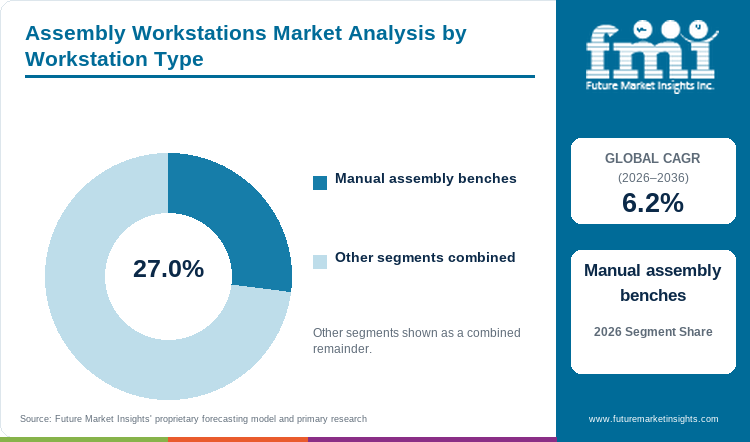
Manual assembly benches remain the broadest platform because they preserve human flexibility without forcing a plant into a fixed machine sequence. The bench can stay in place while tooling, shelves, displays, lighting, fixtures, and parts presentation change around the task. This is particularly useful in mixed-model production, service operations, pilot builds, and repair environments where product content changes faster than the floor layout. Manual benches also occupy the space below the investment threshold that would move a task into the assembly automation systems market. Plants can automate a bottleneck later without discarding the wider workstation architecture.
- Manual assembly benches are projected to account for 27.0% of Workstation Type demand in 2026, supported by broad use in manual and semi-manual production.
- Treston’s March 2026 QuickShip catalog lists Concept Ergo and IAC workstation families with height adjustment, accessories, electrical options, and ESD configurations that can be specified around different manual tasks.
Why does Steel frame lead demand within the Material category?
Steel frames carry fixtures, drawers and test equipment on a stiff base. This matters when operators apply force against a fixture or an overhead shelf supports instruments. For general industrial assembly, strength and durability can justify the frame's weight. Aluminum profiles offer easier reconfiguration, while stainless steel suits environments that require frequent cleaning or greater corrosion resistance.
- Steel frame workstations are estimated to hold 31.0% of Material demand in 2026 because many buyers prioritize rigidity and long service life.
- Treston’s 2026 QuickShip catalog lists IAC Workmaster benches with heavy-gauge steel construction and distributed load capacity up to 1,500 lb, illustrating the load-oriented use case for steel.
Why does Single operator lead demand within the Configuration category?
A single-operator station gives industrial engineering a defined unit for balancing one task. Working height, reach zones, tool positions, displays, component bins, and local utilities can be arranged around one operator without redesigning a connected line. That matters in cellular and high-mix manufacturing, where an operation may move between cells as volumes change. A standalone station is also easier to relocate or duplicate when a plant adds parallel capacity. Multi-operator and cellular systems can improve flow for stable processes, but the single station remains the most flexible building block for incremental capital changes.
- Single operator configurations are projected to hold 34.0% of Configuration demand in 2026 because they can be tuned to a defined task and redeployed with limited disruption.
- Current item Work Bench System offerings include height-adjustable industrial benches, material supply options, ESD configurations, lighting, information displays, and workbench interlinking, allowing individual stations to be standardized before they are linked into larger lines.
Why does Electronics lead demand within the End Use category?
Electronics assembly combines operator-intensive work with electrostatic control, precise small-parts handling, localized lighting, organized power, and clear visual information. A generic industrial table often lacks the grounding architecture and accessory integration needed for sensitive components. This makes the workstation part of the production-control environment rather than just a work surface. Demand also connects with the wider electronic manufacturing services market, where contract manufacturers must reconfigure stations as product families, customer requirements, and production volumes change. Automotive electronics, medical devices, and aerospace electronics share several of these requirements, but electronics creates the densest overlap of ESD protection and precision manual handling.
- Electronics is projected to account for 28.0% of End Use demand in 2026 because ESD control and precision handling increase the need for purpose-configured stations.
- Treston’s 2026 QuickShip range includes ESD work surfaces, grounding components, electrical channels, instrument shelves, and technical workstation accessories for sensitive production environments.
Why do Industrial furniture distributors lead demand within the Sales Channel category?
Industrial furniture distributors remain important because workstation purchases are often configuration projects rather than catalog transactions. Buyers may need a bench, overhead structure, drawers, shelving, electrical channels, ESD options, seating, and nearby storage to work as one package. Local distributors can survey the site, combine products, coordinate delivery, and help procurement standardize bills of material across departments. Their role also touches the line-side material handling equipment market when benches must interface with carts, racks, bins, or flow systems without turning the workstation purchase into a full automation project.
- Industrial furniture distributors are estimated to account for 36.0% of Sales Channel demand in 2026 because local specification support reduces the buyer’s configuration burden.
- Formaspace expanded its Configura CET presence in June 2025 with configurable industrial furniture and integrated pricing, giving contract furniture dealerships a more direct path from layout to quote.
What are the drivers, restraints and opportunities in the Assembly Workstations Market?
Labor and productivity pressure support investment in reconfigurable workstations, while project-specific engineering can delay approval and powered modular formats create retrofit opportunities.
- Driver: Labor replacement pressure and high-mix production make ergonomic, reconfigurable manual assembly stations a repeat capital priority.
- Restraint: Project-specific ESD, electrical, accessory, and line-integration requirements can lengthen specification and raise installed cost.
- Opportunity: Modular height-adjustable and powered mobile workstations can add digital tools and mobility to existing manual processes without rebuilding the full production line.
Manufacturing labor turnover changes the value calculation for manual work. Nearly 1 million production-occupation openings are projected each year on average in the United States from 2024 through 2034, largely because workers leave occupations and must be replaced. A station that places parts and tools consistently can reduce the amount of tacit knowledge needed to operate a task. Height adjustment can also make one position usable by a wider range of operators. The driver is strongest where product mix changes often enough to make dedicated automation difficult to justify, but output consistency still matters.
Workstation installation requires more decisions than the choice of a bench. Grounding and ESD surfaces must suit the process; electrical services must meet plant requirements; shelves and displays must stay within the operator's reach. Customizing every station separately increases engineering and purchasing effort. Predefined combinations and reusable layouts make later additions easier to specify and maintain.
Powered mobile formats create a separate source of demand. Treston introduced its PowerX series in January 2026 for industrial, logistics, laboratory, and ESD-protected environments, allowing computers, printers, barcode scanners, and other devices to operate away from fixed outlets. These stations can support scanning and digital instructions without duplicating the autonomous transport function served by the automated guided vehicles (AGV) market. The buyer pays for flexibility when the powered station removes extension cables, reduces fixed utility work, or moves the information point to the operator instead of moving the operator to a fixed terminal.
Which country CAGRs are profiled in the Assembly Workstations Market?
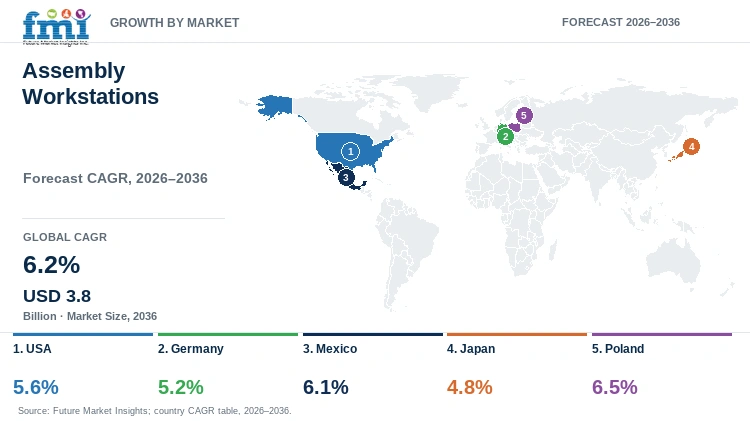
| Country | CAGR |
|---|---|
| USA | 5.6% |
| Germany | 5.2% |
| Mexico | 6.1% |
| Japan | 4.8% |
| Poland | 6.5% |
How do country-level CAGRs compare in the Assembly Workstations Market?
Poland leads the five profiled markets at 6.5% CAGR from 2026 to 2036, while Japan is at 4.8%, a 1.7 percentage-point spread. Plant expansion creates opportunities to specify complete stations. In mature facilities, investment is more likely to follow a product transfer, ergonomic change or revised material-flow layout. The task being changed determines the bench and accessories required.
- Poland at 6.5% is 0.4 percentage points above Mexico at 6.1%, supporting earlier channel investment where suppliers can follow capacity additions and capital-goods projects.
- Mexico at 6.1% is 0.5 percentage points above the USA at 5.6%, reflecting a faster line-build cycle even though the U.S. market benefits from a deeper installed manufacturing base.
- The USA at 5.6% is 0.4 percentage points above Germany at 5.2%, where weaker 2025 industrial production raises the hurdle for discretionary replacement.
- Germany at 5.2% is 0.4 percentage points above Japan at 4.8%; both reward technical fit, but Japan’s mature installed base makes phased replacement and labor utilization more important to approval.
Country-wise Analysis
- USA: U.S. demand is linked to line refreshes, facility changes, new product introductions, and operator-productivity programs inside a large installed manufacturing base. Assembly Workstations demand in the USA is forecast to expand at 5.6% CAGR from 2026 to 2036. The U.S. Bureau of Labor Statistics reported in May 2026 that manufacturing employed more than 12.8 million workers in 2024 and that production occupations are projected to generate nearly 1 million openings per year on average through 2034. This does not automatically trigger bench replacement, but it increases the value of workstation layouts that reduce unnecessary motion and simplify training. Suppliers need fast local fulfillment and configurations that can be repeated across plants without restarting engineering from zero.
- Germany: German plants often connect workstation upgrades with lean-production redesign, precise material presentation, and operator ergonomics rather than broad furniture replacement. Assembly Workstations demand in Germany is forecast to rise at 5.2% CAGR from 2026 to 2036. Destatis reported in February 2026 that industrial production fell 1.1% in 2025, including a 1.7% decline in automotive output and a 2.6% decline in machinery and equipment. That softer backdrop raises the payback threshold for discretionary capital. Suppliers therefore gain traction when a workstation can be tied to a measurable process change such as reduced reach, shorter replenishment time, safer ESD handling, or easier product changeover.
- Mexico: Workstation purchases in Mexico are frequently tied to automotive programs, electronics production, localization, and new supplier layouts that require repeatable operator stations. Assembly Workstations demand in Mexico is forecast to grow at 6.1% CAGR from 2026 to 2036. INEGI reported that Mexico produced 354,221 light vehicles in June 2026 and exported 301,009 units in the same month, showing the scale of manufacturing activity that supports line-side equipment demand. Workstations and their accessories must arrive before production starts. Suppliers need nearby configuration support and delivery capacity so benches, utilities, storage, and accessories arrive within compressed launch schedules.
- Japan: Japanese manufacturers are more likely to treat workstation investment as an incremental production-system improvement inside mature plants. Assembly Workstations demand in Japan is forecast to increase at 4.8% CAGR from 2026 to 2036. Japan’s Ministry of Health, Labour and Welfare reported in May 2026 that manufacturing employment declined from 10.55 million in 2023 to 10.33 million in 2025, while small and medium manufacturers continued to report worker shortages in early 2026. This favors compact retrofit paths and operator-fit improvements over wholesale line replacement. Suppliers must work within established production routines and limited floor space while showing why the new station improves the task rather than simply modernizing its appearance.
- Poland: Poland combines capacity expansion with production-system modernization, creating more greenfield and brownfield specification points for workstations. Assembly Workstations demand in Poland is forecast to expand at 6.5% CAGR from 2026 to 2036. Statistics Poland reported in June 2026 that May industrial output rose 4.1% year on year and capital-goods production increased 4.4%. Faster project cycles create a different requirement from Japan or Germany: buyers need modular configurations that can be duplicated quickly as cells are added. Distributor and integrator coverage therefore becomes important when multiple sites or supplier plants are scaling at the same time.
Who are the notable companies in the Assembly Workstations Market?
Treston, Bosch Rexroth, item Industrietechnik, LISTA under Stanley Black & Decker Storage Solutions, Rousseau Metal, Formaspace, and Pro-Line are the notable companies profiled in this market.
Competition is divided by how much engineering can be resolved before the workstation reaches the plant. Treston combines ergonomic, ESD, and technical workstation depth with a stronger U.S. operating structure after integrating the former IAC business under the Treston brand in 2026. Bosch Rexroth and item Industrietechnik connect the workstation to wider manual production systems, material presentation, and line linking. LISTA, Rousseau Metal, and Pro-Line compete from durable industrial furniture and storage platforms. Formaspace is differentiated by configurable project specification and dealer-facing digital quoting tools.
- Integrated workstation-system specialists: Treston, Bosch Rexroth, and item Industrietechnik compete through modular benches, ergonomic adjustment, ESD options, accessories, and production-system integration.
- Industrial furniture and storage-led suppliers: LISTA, Rousseau Metal, and Pro-Line emphasize durable bench structures, storage compatibility, adjustable formats, and distributor or catalog access.
- Project-specification specialist: Formaspace focuses on configurable industrial furniture, custom manufacturing, and digital specification routes for dealer-led projects.
Competitive Benchmarking: Assembly Workstations Market
| Company | Ergonomic & Height-Adjustable Depth | ESD & Precision Assembly Readiness | Modular Line / Material-Flow Integration | Geographic Reach |
|---|---|---|---|---|
| Treston | High | High | High | North America and Europe with broader international sales coverage |
| Bosch Rexroth | High | High | High | Global industrial sales and service network |
| item Industrietechnik | High | High | High | Europe, North America, and Asia through regional operations |
| LISTA / Stanley Black & Decker Storage Solutions | Medium | Medium | Medium | North American industrial-workbench and storage channels |
| Rousseau Metal | High | Medium | Medium | Canada and United States through specialized distributors |
| Formaspace | High | High | High | United States with dealer and project-based sales |
| Pro-Line | Medium | High | Medium | United States and broader North American industrial customers |
Scoring basis: Ergonomic & Height-Adjustable Depth considers the breadth of documented height adjustment and operator-fit options. ESD & Precision Assembly Readiness considers ESD work surfaces, grounding, electrical support, and technical-workstation features. Modular Line / Material-Flow Integration considers whether stations can connect with accessories, linked layouts, flow structures, or surrounding production systems. High indicates broad capability across the criterion; Medium indicates narrower coverage.
Key Developments in the Assembly Workstations Market
- In January 2026, Treston launched the PowerX powered mobile workstation series for industrial, logistics, laboratory, and ESD-protected environments. Battery-powered stations can support computers, printers, barcode scanners, and related devices away from fixed outlets, extending the workstation from a static bench into a mobile point-of-work platform.
- In April 2026, Treston announced the unification of its U.S. operations under one brand and legal structure, effective June 1, 2026. The former IAC operation in Goodyear, Arizona became part of the Treston brand and the U.S. headquarters, while Canton, Georgia remained a distribution location.
- In June 2025, Formaspace expanded its Configura CET presence with a broader configurable product library and integrated pricing. FLX adjustable workbenches were included, giving contract furniture dealerships a more direct specification path from layout through pricing and order preparation.
Key Players in the Assembly Workstations Market
Integrated Workstation-System Specialists
- Treston
- Bosch Rexroth
- item Industrietechnik
Industrial Furniture and Storage-Led Workstation Suppliers
- LISTA / Stanley Black & Decker Storage Solutions
- Rousseau Metal
- Pro-Line
Configurable Project Workstation Specialist
- Formaspace
Assembly Workstations Market - Report Scope
| Coverage field | Report scope |
|---|---|
| Market breakdown | Workstation Type; Material; Configuration; End Use; Sales Channel |
| Quantitative Units | USD Billion |
| Market Definition | Revenue includes assembly workstations and bench systems sold for manual or semi-manual industrial assembly within the stated segmentation. Standalone office furniture, general laboratory furniture not used for assembly, downstream finished-product revenue, and adjacent automation or material-handling equipment sold separately are outside the market boundary. |
| Regions Covered | North America; Latin America; Western Europe; Eastern Europe; East Asia; South Asia and Pacific; Middle East and Africa |
| Countries Covered | USA, Germany, Mexico, Japan, Poland, and more than twenty-five additional countries in the full report |
| Key Companies Profiled | Treston; Bosch Rexroth; item Industrietechnik; LISTA / Stanley Black & Decker Storage Solutions; Rousseau Metal; Formaspace; Pro-Line |
| Forecast Period | 2026 to 2036 |
| Approach | Hybrid bottom-up and top-down sizing that reconciles supplier activity, channel structure, end-use demand, installed-base dynamics, and country-level manufacturing conditions. |
Assembly Workstations Market - Research Methodology
| Method | Approach |
|---|---|
| Primary Research | Structured discussions with workstation manufacturers, industrial furniture distributors, system integrators, manufacturing engineers, procurement teams, and end users examine configuration priorities, price architecture, replacement cycles, purchasing criteria, and installation requirements. |
| Desk Research | Public company materials, national manufacturing statistics, government labor publications, current product catalogs, industrial standards where relevant, and channel documentation are reviewed within the stated market boundary. |
| Market Sizing and Forecasting | Supplier activity is reconciled with Workstation Type, Material, Configuration, End Use, Sales Channel, manufacturing investment, labor availability, installed-base replacement, and product-mix changes. |
| Data Validation | Primary and secondary findings are triangulated across supplier, channel, end-use, and country evidence, with consistent revenue boundaries used to avoid overlap with separately sold storage, conveyors, automation, mobile robots, or finished goods. |
Assembly Workstations Market by Segments
Assembly Workstations Market segmented by Workstation Type:
- Manual assembly benches
- ESD workstations
- Height-adjustable workstations
- Modular lean workstations
- Digital guided workstations
Assembly Workstations Market segmented by Material:
- Steel frame
- Aluminum profile
- Stainless steel
- Wood / laminate top
- Composite / ESD laminate
Assembly Workstations Market segmented by Configuration:
- Single operator
- Multi-operator line
- Cellular workstation
- Mobile workstation
Assembly Workstations Market segmented by End Use:
- Electronics
- Automotive components
- Medical devices
- Aerospace
- General manufacturing
Assembly Workstations Market segmented by Sales Channel:
- Industrial furniture distributors
- Direct manufacturer
- System integrators
- Catalog / e-commerce
Assembly Workstations Market by Region:
- North America
- United States
- Canada
- Latin America
- Brazil
- Mexico
- Argentina
- Chile
- Western Europe
- Germany
- France
- United Kingdom
- Italy
- Spain
- Benelux
- Nordics
- Eastern Europe
- Poland
- Czech Republic
- Romania
- Hungary
- East Asia
- China
- Japan
- South Korea
- South Asia and Pacific
- India
- ASEAN
- Australia and New Zealand
- Middle East and Africa
- GCC Countries
- South Africa
- Türkiye
- Israel
Research Sources and Bibliography
- U.S. Bureau of Labor Statistics. May 2026. Producing the goods of the future: Job opportunities in manufacturing.
- Federal Statistical Office of Germany. February 6, 2026. Production in December 2025: -1.9% on the previous month; production down 1.1% in 2025.
- Instituto Nacional de Estadística y Geografía. July 7, 2026. Registro administrativo de la industria automotriz de vehículos ligeros, June 2026.
- Ministry of Health, Labour and Welfare, Japan. May 29, 2026. 2026 White Paper on Manufacturing Industries: employment and human-resource points.
- Statistics Poland. June 19, 2026. Sold production of industry in May 2026.
- Treston. March 2026. QuickShip Catalog 03-2026: Treston and IAC workstations and accessories.
- Treston. January 21, 2026. Introducing Treston PowerX Powered Mobile Workstation Series.
- Treston. April 28, 2026. Treston Unifies U.S. Operations Under One Brand to Enhance Customer Experience.
- Bosch Rexroth. Accessed 2026. Manual Production Systems.
- item Industrietechnik. Accessed 2026. The item Work Bench System for manual production.
- Rousseau Metal. 2025-2026. General Catalog: E Series and ElevaTek Adjustable Workstations.
- Formaspace. June 3, 2025. Formaspace Expands Presence on CET with Complete Product Library and Integrated Pricing.
- Pro-Line. Accessed 2026. Modular Ergonomic Workbenches and Technical Stations.
- Stanley Black & Decker Storage Solutions. Accessed 2026. LISTA Workstations and Workbenches.
This bibliography is provided for reader reference and is not exhaustive. The full report contains the complete reference list and supporting citations.
This Report Answers
- What is the Assembly Workstations Market size in 2026 and what value is forecast for 2036?
- Which labor and production conditions support demand for assembly workstations?
- Why do Manual assembly benches lead the Workstation Type category?
- Why does Steel frame hold the leading Material position and Single operator lead Configuration demand?
- Why is Electronics the leading End Use and why do Industrial furniture distributors lead Sales Channel demand?
- How do Assembly Workstations Market growth rates compare across USA, Germany, Mexico, Japan, and Poland?
- Which companies provide modular workstation systems, industrial bench platforms, ESD-ready configurations, and project-specification support?
- What engineering and configuration requirements can delay workstation approval and reduce return on investment?
Frequently Asked Questions
What is driving growth in the Assembly Workstations Market?
Growth is supported by labor replacement pressure, high-mix manufacturing, and the need to reconfigure manual work without rebuilding a complete production line. Buyers place more value on ergonomic adjustment and modular accessories when these features shorten changeovers or standardize operator tasks.
Who are the key players in the Assembly Workstations Market?
Notable companies include Treston, Bosch Rexroth, item Industrietechnik, LISTA under Stanley Black & Decker Storage Solutions, Rousseau Metal, Formaspace, and Pro-Line. Their positions differ by modular system depth, ESD readiness, industrial furniture channels, customization, and line-integration capability.
What is a notable restraint in the Assembly Workstations Market?
Projects can slow when ESD surfaces, electrical services, lighting, storage, displays, and material presentation must be approved together. The base bench may be straightforward, but site-specific configuration can increase engineering time and total installed cost.
Why should executives track the Assembly Workstations Market?
Workstations sit between labor productivity and automation. They can improve manual production before a plant commits to a larger automation project, making them relevant to decisions about ergonomic upgrades, flexible cells, product transfers, and mixed-model capacity.
What should manufacturing engineers evaluate before purchasing assembly workstations?
Engineers should compare load capacity, adjustment range, ESD requirements, reach zones, electrical services, accessory architecture, material-flow interfaces, and the ease with which a configuration can be duplicated at another station.
What limits return on investment in assembly workstations?
Return weakens when customization adds cost without changing the operator task, when installation interrupts production longer than planned, or when too many one-off accessories make maintenance and replacement more complicated across plants.
Preview the report firsthand - request a free sample
Get SampleGet the brochure for pricing and purchase details.
Get PDFTable of Content
- Key Takeaways
- Market Size and CAGR
- Top Growth Driver
- Fastest Growing Segment
- Leading Region
- Key Companies
- Emerging Opportunities
- Executive Summary
- Global Market Outlook
- Demand-side Trends
- Supply-side Trends
- Technology Roadmap Analysis
- Analysis and Recommendations
- Analyst Perspective (What is happening? Why now? What should investors know?)
- Key Questions Answered
- How large is the market?
- What is the CAGR?
- What are key trends?
- Which region dominates?
- Who are the leaders?
- Market Overview
- Market Coverage / Taxonomy
- Market Definition / Scope / Limitations
- Research Methodology
- Chapter Orientation
- Analytical Lens and Working Hypotheses
- Market Structure, Signals, and Trend Drivers
- Benchmarking and Cross-market Comparability
- Market Sizing, Forecasting, and Opportunity Mapping
- Research Design and Evidence Framework
- Desk Research Programme (Secondary Evidence)
- Expert Input and Fieldwork (Primary Evidence)
- Tooling, Models, and Reference Databases
- Data Engineering and Model Build
- Quality Assurance and Audit Trail
- Market Background
- Market Dynamics (Drivers, Restraints, Opportunity, Trends)
- Scenario Forecast (Optimistic, Likely, Conservative)
- Impact Analysis
- AI Impact
- Sustainability Impact
- Regulatory Impact
- Technology Impact
- Consumer / Buyer Analysis
- Purchase Drivers
- Adoption Barriers
- Buyer Journey
- Opportunity Map Analysis
- Product Life Cycle Analysis
- Supply Chain Analysis
- Investment Feasibility Matrix
- Value Chain Analysis
- PESTLE and Porter's Analysis
- Regulatory Landscape
- Regional Parent Market Outlook
- Production and Consumption Statistics
- Import and Export Statistics
- Global Market Analysis and Forecast, 2021 to 2036
- Historical Market Size Value (USD Billion) Analysis, 2021 to 2025
- Current and Future Market Size Value (USD Billion) Projections, 2026 to 2036
- Y-o-Y Growth Trend Analysis
- Absolute $ Opportunity Analysis
- Global Market Pricing Analysis, 2021 to 2036
- Global Market Analysis and Forecast, By Workstation Type, 2021 to 2036
- Introduction / Key Findings
- Historical Market Size Value (USD Billion) Analysis By Workstation Type, 2021 to 2025
- Current and Future Market Size Value (USD Billion) Analysis and Forecast By Workstation Type, 2026 to 2036
- Manual assembly benches
- ESD workstations
- Height-adjustable workstations
- Modular lean workstations
- Digital guided workstations
- Y-o-Y Growth Trend Analysis By Workstation Type, 2021 to 2025
- Absolute $ Opportunity Analysis By Workstation Type, 2026 to 2036
- Global Market Analysis and Forecast, By Material, 2021 to 2036
- Introduction / Key Findings
- Historical Market Size Value (USD Billion) Analysis By Material, 2021 to 2025
- Current and Future Market Size Value (USD Billion) Analysis and Forecast By Material, 2026 to 2036
- Steel frame
- Aluminum profile
- Stainless steel
- Wood / laminate top
- Composite / ESD laminate
- Y-o-Y Growth Trend Analysis By Material, 2021 to 2025
- Absolute $ Opportunity Analysis By Material, 2026 to 2036
- Global Market Analysis and Forecast, By Configuration, 2021 to 2036
- Introduction / Key Findings
- Historical Market Size Value (USD Billion) Analysis By Configuration, 2021 to 2025
- Current and Future Market Size Value (USD Billion) Analysis and Forecast By Configuration, 2026 to 2036
- Single operator
- Multi-operator line
- Cellular workstation
- Mobile workstation
- Y-o-Y Growth Trend Analysis By Configuration, 2021 to 2025
- Absolute $ Opportunity Analysis By Configuration, 2026 to 2036
- Global Market Analysis and Forecast, By End Use, 2021 to 2036
- Introduction / Key Findings
- Historical Market Size Value (USD Billion) Analysis By End Use, 2021 to 2025
- Current and Future Market Size Value (USD Billion) Analysis and Forecast By End Use, 2026 to 2036
- Electronics
- Automotive components
- Medical devices
- Aerospace
- General manufacturing
- Y-o-Y Growth Trend Analysis By End Use, 2021 to 2025
- Absolute $ Opportunity Analysis By End Use, 2026 to 2036
- Global Market Analysis and Forecast, By Sales Channel, 2021 to 2036
- Introduction / Key Findings
- Historical Market Size Value (USD Billion) Analysis By Sales Channel, 2021 to 2025
- Current and Future Market Size Value (USD Billion) Analysis and Forecast By Sales Channel, 2026 to 2036
- Industrial furniture distributors
- Direct manufacturer
- System integrators
- Catalog / e-commerce
- Y-o-Y Growth Trend Analysis By Sales Channel, 2021 to 2025
- Absolute $ Opportunity Analysis By Sales Channel, 2026 to 2036
- Global Market Analysis and Forecast, By Region, 2021 to 2036
- Introduction
- Historical Market Size Value (USD Billion) Analysis By Region, 2021 to 2025
- Current Market Size Value (USD Billion) Analysis and Forecast By Region, 2026 to 2036
- North America
- Latin America
- Western Europe
- Eastern Europe
- East Asia
- South Asia and Pacific
- Middle East and Africa
- Market Attractiveness Analysis By Region
- North America Market Analysis and Forecast, By Country, 2021 to 2036
- Historical Market Size Value (USD Billion) Trend Analysis By Market Taxonomy, 2021 to 2025
- Market Size Value (USD Billion) Forecast By Market Taxonomy, 2026 to 2036
- By Country
- United States
- Canada
- By Workstation Type
- By Material
- By Configuration
- By End Use
- By Sales Channel
- By Country
- Market Attractiveness Analysis
- By Country
- By Workstation Type
- By Material
- By Configuration
- By End Use
- By Sales Channel
- Key Takeaways
- Latin America Market Analysis and Forecast, By Country
- Historical Market Size Value (USD Billion) Trend Analysis By Market Taxonomy, 2021 to 2025
- Market Size Value (USD Billion) Forecast By Market Taxonomy, 2026 to 2036
- By Country
- Brazil
- Mexico
- Argentina
- Chile
- By Workstation Type
- By Material
- By Configuration
- By End Use
- By Sales Channel
- By Country
- Market Attractiveness Analysis
- By Country
- By Workstation Type
- By Material
- By Configuration
- By End Use
- By Sales Channel
- Key Takeaways
- Western Europe Market Analysis and Forecast, By Country
- Historical Market Size Value (USD Billion) Trend Analysis By Market Taxonomy, 2021 to 2025
- Market Size Value (USD Billion) Forecast By Market Taxonomy, 2026 to 2036
- By Country
- Germany
- France
- United Kingdom
- Italy
- Spain
- Benelux
- Nordics
- By Workstation Type
- By Material
- By Configuration
- By End Use
- By Sales Channel
- By Country
- Market Attractiveness Analysis
- By Country
- By Workstation Type
- By Material
- By Configuration
- By End Use
- By Sales Channel
- Key Takeaways
- Eastern Europe Market Analysis and Forecast, By Country
- Historical Market Size Value (USD Billion) Trend Analysis By Market Taxonomy, 2021 to 2025
- Market Size Value (USD Billion) Forecast By Market Taxonomy, 2026 to 2036
- By Country
- Poland
- Czech Republic
- Romania
- Hungary
- By Workstation Type
- By Material
- By Configuration
- By End Use
- By Sales Channel
- By Country
- Market Attractiveness Analysis
- By Country
- By Workstation Type
- By Material
- By Configuration
- By End Use
- By Sales Channel
- Key Takeaways
- East Asia Market Analysis and Forecast, By Country
- Historical Market Size Value (USD Billion) Trend Analysis By Market Taxonomy, 2021 to 2025
- Market Size Value (USD Billion) Forecast By Market Taxonomy, 2026 to 2036
- By Country
- China
- Japan
- South Korea
- By Workstation Type
- By Material
- By Configuration
- By End Use
- By Sales Channel
- By Country
- Market Attractiveness Analysis
- By Country
- By Workstation Type
- By Material
- By Configuration
- By End Use
- By Sales Channel
- Key Takeaways
- South Asia and Pacific Market Analysis and Forecast, By Country
- Historical Market Size Value (USD Billion) Trend Analysis By Market Taxonomy, 2021 to 2025
- Market Size Value (USD Billion) Forecast By Market Taxonomy, 2026 to 2036
- By Country
- India
- ASEAN
- Australia and New Zealand
- By Workstation Type
- By Material
- By Configuration
- By End Use
- By Sales Channel
- By Country
- Market Attractiveness Analysis
- By Country
- By Workstation Type
- By Material
- By Configuration
- By End Use
- By Sales Channel
- Key Takeaways
- Middle East and Africa Market Analysis and Forecast, By Country
- Historical Market Size Value (USD Billion) Trend Analysis By Market Taxonomy, 2021 to 2025
- Market Size Value (USD Billion) Forecast By Market Taxonomy, 2026 to 2036
- By Country
- GCC Countries
- South Africa
- Türkiye
- Israel
- By Workstation Type
- By Material
- By Configuration
- By End Use
- By Sales Channel
- By Country
- Market Attractiveness Analysis
- By Country
- By Workstation Type
- By Material
- By Configuration
- By End Use
- By Sales Channel
- Key Takeaways
- Key Countries Market Analysis
- United States
- Pricing Analysis
- Market Share Analysis, 2025
- By Workstation Type
- By Material
- By Configuration
- By End Use
- By Sales Channel
- Canada
- Pricing Analysis
- Market Share Analysis, 2025
- By Workstation Type
- By Material
- By Configuration
- By End Use
- By Sales Channel
- Mexico
- Pricing Analysis
- Market Share Analysis, 2025
- By Workstation Type
- By Material
- By Configuration
- By End Use
- By Sales Channel
- Brazil
- Pricing Analysis
- Market Share Analysis, 2025
- By Workstation Type
- By Material
- By Configuration
- By End Use
- By Sales Channel
- Chile
- Pricing Analysis
- Market Share Analysis, 2025
- By Workstation Type
- By Material
- By Configuration
- By End Use
- By Sales Channel
- Germany
- Pricing Analysis
- Market Share Analysis, 2025
- By Workstation Type
- By Material
- By Configuration
- By End Use
- By Sales Channel
- United Kingdom
- Pricing Analysis
- Market Share Analysis, 2025
- By Workstation Type
- By Material
- By Configuration
- By End Use
- By Sales Channel
- Italy
- Pricing Analysis
- Market Share Analysis, 2025
- By Workstation Type
- By Material
- By Configuration
- By End Use
- By Sales Channel
- Spain
- Pricing Analysis
- Market Share Analysis, 2025
- By Workstation Type
- By Material
- By Configuration
- By End Use
- By Sales Channel
- France
- Pricing Analysis
- Market Share Analysis, 2025
- By Workstation Type
- By Material
- By Configuration
- By End Use
- By Sales Channel
- India
- Pricing Analysis
- Market Share Analysis, 2025
- By Workstation Type
- By Material
- By Configuration
- By End Use
- By Sales Channel
- ASEAN
- Pricing Analysis
- Market Share Analysis, 2025
- By Workstation Type
- By Material
- By Configuration
- By End Use
- By Sales Channel
- Australia and New Zealand
- Pricing Analysis
- Market Share Analysis, 2025
- By Workstation Type
- By Material
- By Configuration
- By End Use
- By Sales Channel
- China
- Pricing Analysis
- Market Share Analysis, 2025
- By Workstation Type
- By Material
- By Configuration
- By End Use
- By Sales Channel
- Japan
- Pricing Analysis
- Market Share Analysis, 2025
- By Workstation Type
- By Material
- By Configuration
- By End Use
- By Sales Channel
- South Korea
- Pricing Analysis
- Market Share Analysis, 2025
- By Workstation Type
- By Material
- By Configuration
- By End Use
- By Sales Channel
- Poland
- Pricing Analysis
- Market Share Analysis, 2025
- By Workstation Type
- By Material
- By Configuration
- By End Use
- By Sales Channel
- Hungary
- Pricing Analysis
- Market Share Analysis, 2025
- By Workstation Type
- By Material
- By Configuration
- By End Use
- By Sales Channel
- Türkiye
- Pricing Analysis
- Market Share Analysis, 2025
- By Workstation Type
- By Material
- By Configuration
- By End Use
- By Sales Channel
- South Africa
- Pricing Analysis
- Market Share Analysis, 2025
- By Workstation Type
- By Material
- By Configuration
- By End Use
- By Sales Channel
- United States
- Market Structure Analysis
- Competition Dashboard
- Competition Benchmarking
- Market Share Analysis of Top Players
- By Regional
- By Workstation Type
- By Material
- By Configuration
- By End Use
- By Sales Channel
- Emerging Startups
- Innovation Benchmarking
- Competition Analysis
- Competition Deep Dive
- Treston
- Overview
- Product Portfolio
- Profitability by Market Segments
- Sales Footprint
- Strategy Overview
- Marketing Strategy
- Product Strategy
- Channel Strategy
- Bosch Rexroth
- item Industrietechnik
- LISTA / Stanley Black & Decker Storage Solutions
- Rousseau Metal
- Formaspace
- Pro-Line
- Treston
- Case Studies
- Success Stories
- Recent Developments
- Competition Deep Dive
- Assumptions & Acronyms Used


