

- Market Size (2026)
- USD 7.9 Bn
- Forecast (2036)
- USD 21.4 Bn
- CAGR (2026 to 2036)
- 10.5%
How big is Automated Non-Destructive Testing Systems Market in 2026?
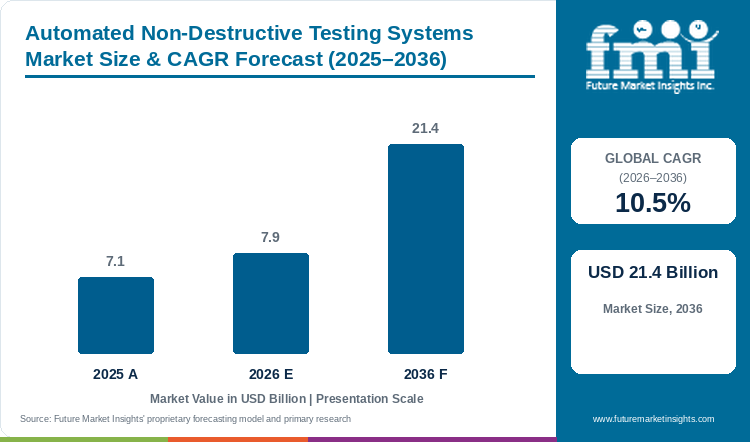
Demand for automated non-destructive testing systems is projected to expand at 10.5% CAGR between 2026 and 2036. Industry value grows from USD 7.1 billion in 2025 to USD 7.9 billion in 2026 and is projected to reach USD 21.4 billion by 2036.
As per FMI, automated non-destructive testing systems market value increased from USD 7.1 billion in 2025 to USD 7.9 billion in 2026 and is projected to reach USD 21.4 billion by 2036, exhibiting 10.5% CAGR. The growth outlook suggests that adoption of these systems is likely to expand as they are highly preferred for checking materials, components and installed assets without damaging the inspected part. Computed tomography and 3D X-ray systems accounts for 41.8% of inspection technology revenue in 2026, owing to internal defect visibility and dimensional measurement. In July 2025, Waygate Technologies introduced WheelStar RPS with a six-minute inspection cycle for one railway wheelset.[1] Faster inspection, wider component coverage and smaller defect measurement is anticipated to support automated non destructive testing and inspection demand through 2036.
Key Market Trends & Insights
- By inspection technology, computed tomography and 3D X-ray systems led with 41.8% share in 2026, supported by inspection of hidden geometry and internal defects.
- By automation level, fully automated in-line systems accounted for 38.3% in 2026, as programmed movement reduces manual handling between repeated inspections.
- By measurement resolution, sub-micron nanometrology represented 32.8% in 2026, driven by specialized automated X-ray and CT inspection for semiconductor interconnects, advanced packages, and precision micro-components.
- By end-use industry, aerospace and defense MRO held 41.3% share in 2026, supported by repeated inspection of engines, structures and electronic assemblies.
Regional Highlights
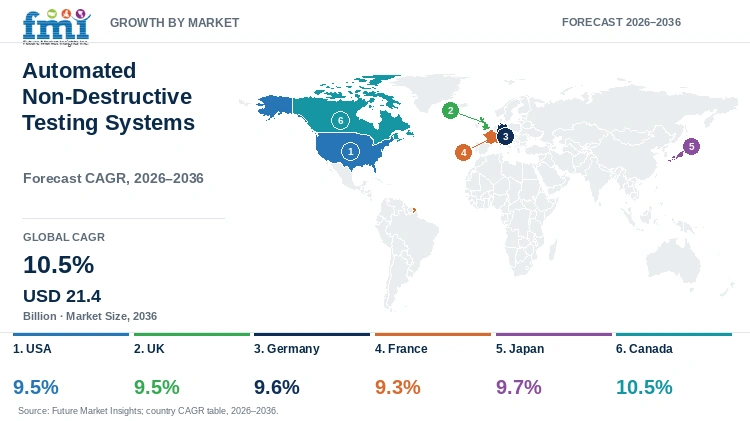
- Fastest-growing profiled country: Canada is projected at 10.5% CAGR from 2026 to 2036, supported by pipeline lifecycle inspection and field monitoring.
- Japan and Germany are projected at 9.7% and 9.6% CAGR, respectively, while France records the lowest profiled CAGR at 9.3%.
Market Size & Forecast
Table 1: Market Size and Forecast for the Automated Non-Destructive Testing Systems Market (USD billion), 2025 to 2036
| Metric | Value |
|---|---|
| 2025 Market Size | USD 7.1 billion |
| Estimated Market Size in 2026 | USD 7.9 billion |
| Projected Market Size by 2036 | USD 21.4 billion |
| CAGR, 2026 to 2036 | 10.5% |
| Added Revenue, 2026 to 2036 | USD 13.5 billion |
| Market Expansion Multiple | 2.7x |
Commercial conditions differ across countries owing to installed assets and repeated inspection cycles that create regular demand for automated NDT systems. Canada Energy Regulator updated its pipeline incident dataset through June 2026, recording ongoing verification and compliance oversight where automated pipeline monitoring systems support asset integrity.[2] These inspection requirements create demand for portable scanners, robotic systems and digital records which can be compared during every inspection cycle.
Installed Asset and Inspection Activity Indicators
Table 2: Installed Asset and Inspection Activity Indicators for the Automated Non-Destructive Testing Systems Market (assets, kilometres, cavities, and system specifications), mixed reporting years from 2025 to 2026
| Indicator | Data Point | Why It Matters | Source |
|---|---|---|---|
| Railway wheel inspection | One wheelset in six minutes | Shorter inspection cycle supports automated railway MRO. | [1] |
| Industrial CT inspection volume | 555 mm diameter and 759 mm height | Larger envelope allows inspection of wider components. | [3] |
| Sub-micron X-ray resolution | 400 nm resolution | Supports inspection of smaller semiconductor features. | [5] |
| Aging bridge stock in Japan | About 240,000 bridges older than 50 years | Large aging installed base supports repeated structural inspection. | [9] |
| Road-cavity survey activity | 2,788 km surveyed and 194 high-risk cavities | Field inspection converts detected defects into repair activity. | [9] |
| Canada pipeline oversight | Lifecycle verification through abandonment | Regulated assets require repeated field evidence and reporting. | [2] |
Analyst Perspective
“Automated inspection will move closer to production as manufacturers require defect evidence before completing expensive machining and assembly work. Systems reducing scan time without weakening calibration records will receive preference in regulated maintenance and component release.”
- Nikhil Kaitwade, Principal Consultant, Future Market Insights.
How is the automated non-destructive testing systems market segmented?
Automated non-destructive testing systems market is segmented by four primary commercial axes and region: inspection technology, automation level, measurement resolution, end-use industry, and region. In 2026, computed tomography and 3D X-ray is projected at 41.8%, fully automated in-line systems at 38.3%, sub-micron nanometrology at 32.8%, and aerospace and defense MRO at 41.3%.
As per the analysis from FMI, the market covers computed tomography and 3D X-ray, phased-array ultrasonic testing, digital optical metrology, and acoustic and eddy-current sensing.
By automation level: fully automated in-line systems, semi-automated cell stations, portable field inspection units, and laboratory systems.
By measurement resolution: sub-micron nanometrology, high-resolution micro-CT, standard dimensional tolerance, and macro-scale asset inspection.
By end-use industry: aerospace and defense MRO, semiconductor and SMT assembly, automotive powertrain and battery, power grid and pipeline infrastructure, rail and heavy manufacturing, and other industries.
By region: North America, Latin America, Western Europe, Eastern Europe, East Asia, South Asia and Pacific, and Middle East and Africa.
Why do CT and 3D X-ray systems retain inspection demand?
Based on inspection technology, CT and 3D X-ray is projected to account for 41.8% in 2026, owing to internal defect visibility.
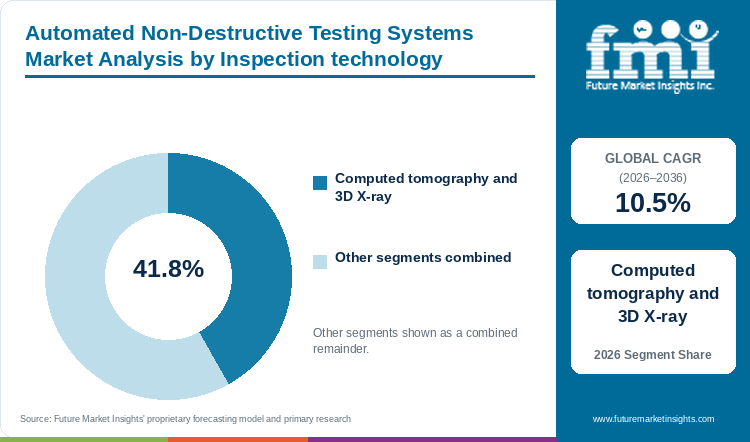
Table 3: Inspection Technology Share for the Automated Non-Destructive Testing Systems Market (percentage share), 2026
| Inspection Technology | Share (2026) |
|---|---|
| Computed Tomography and 3D X-Ray Systems | 41.8% |
| Other Segments Combined | 58.2%* |
| Total | 100.0% |
*Calculated as the balance remaining after deducting the leading segment's reported share from 100.0%.
Table 4: Inspection Technology Leadership and Market Growth for the Automated Non-Destructive Testing Systems Market (segment and CAGR percentage), 2026 to 2036
| Metric | Value |
|---|---|
| Global CAGR (2026 to 2036) | 10.5% |
| Leading Segment | Computed Tomography and 3D X-Ray Systems |
Computed tomography and 3D X-ray systems produce sectional images of a component and allow manufacturers to check internal geometry without cutting the sample. These systems are used for electronics, castings, additive parts and aerospace components where surface inspection cannot identify hidden defects. In April 2025, Nikon launched VOXLS 20 C 225 with an inspection volume of 555 mm diameter and 759 mm height.[3] Wider inspection area and dual-source operation is expected to increase the use of micro computed tomography and industrial CT platforms in quality laboratories and production environments.
- Computed tomography and 3D X-ray accounts for 41.8% of inspection technology revenue in 2026, owing to its use for internal structure and dimensional checking.
- Dual-source systems provide higher X-ray flux and finer resolution in one machine, which is expected to support laboratory and production demand.
What supports fully automated in-line systems as a preferred choice?
By automation level, fully automated in-line systems are estimated to hold 38.3% in 2026, supported by repeatable part handling.
Fully automated in-line systems inspect the component while it remains in the production sequence. The systems reduce manual part movement and provide similar inspection steps for every unit, due to which manufacturers can compare defect records with production changes. In February 2025, Nordson presented optical, X-ray, acoustic and metrology systems with factory-level statistical process control and reporting tools.[4] Increasing need for quick defect correction during electronics production is anticipated to support in-line quality control and automated optical inspection systems.
- Fully automated in-line systems hold 38.3% of automation-level revenue in 2026, attributed to programmed part movement and repeated evaluation.
- Factory-level statistical process control links defect records with yield changes, due to which manufacturers can correct the production process faster.
How is sub-micron nanometrology gaining use in production inspection?
In 2026, sub-micron nanometrology is expected to lead measurement resolution with 32.8% share, driven by advanced packaging inspection needs.
Sub-micron nanometrology is used for checking small solder bumps, interconnects and stacked semiconductor packages which cannot be inspected through normal surface measurement. In February 2025, Comet introduced FYNE X-ray source with 400 nm resolution and an emitter life stated to be ten times longer than its earlier open-tube technology.[5] Higher resolution along with longer operating time allows repeated inspection of advanced packages, complementing industrial digital radiography in high-density electronics.
- Sub-micron nanometrology contributes 32.8% of measurement-resolution revenue in 2026 as manufacturers are inspecting smaller hidden features.
- Stable X-ray output supports longer inspection sessions and repeated scans required for advanced semiconductor package evaluation.
Why does aerospace and defense MRO anchor end-use demand?
Aerospace and defense MRO is set to lead end-use industry with 41.3% share in 2026, underpinned by safety-critical inspection cycles.
Aircraft engines, structures and electronic assemblies require repeated inspection during production and maintenance because hidden defects can affect component release. FMI data suggests aerospace and defense MRO holds 41.3% of end-use revenue in 2026, supported by recurring inspection of safety-related parts. The FAA published its 2026 to 2046 aerospace forecast in July 2026 covering airline activity, commercial space and unmanned aircraft systems.[6] Expansion of these applications is anticipated to support automated non-destructive testing systems demand, where certified radiographic testing services verify structural integrity.
- Aerospace and defense MRO accounts for 41.3% of end-use revenue in 2026 owing to repeated inspection during maintenance and component release.
- Automated borescopes, ultrasonic arrays and CT systems reduce the time required for collecting inspection evidence from complex aircraft components.
What are the drivers, restraints, and opportunities in the automated non-destructive testing systems market?
In the automated non-destructive testing systems market, in-line quality control is the key driver, qualification cost is the key restraint, and aging infrastructure is the key opportunity.
- Driver: Automated systems place repeatable inspection beside production and maintenance steps, which shortens feedback between defect detection and correction.
- Restraint: Buyers must qualify sensors, software, calibration artifacts, motion paths, and acceptance rules before automated results can replace established procedures.
- Opportunity: Aging bridges, pipelines, rail systems, and power assets create recurring work for robotic, portable, and remotely operated inspection platforms.
In-Line Quality Control Expands Adoption
Increasing use of automated inspection in production lines is one of the primary factors driving market growth. These systems can inspect, sort or stop a part before additional production work is completed, which reduces the movement of defective components to the next process. In April 2026, Nikon began commercial deployment of APDIS MV5X laser radar for robotic factory inspection.[7] Availability of robot-mounted dimensional measurement and eddy current testing is expected to increase in-line inspection of large assemblies and support automated non-destructive testing systems market growth.
Qualification Cost Slows Replacement Cycles
High qualification cost is limiting replacement of established inspection systems. Buyers require reference standards, calibration records, fixture checks, approved scan paths and software control before automated results can be used for acceptance. BAM states that process validation supports quality management and that automation and digitalization are being used for improving NDT in civil engineering.[8] Longer validation periods increase installation cost and can restrict the adoption of new automated systems, particularly where approved procedures are already in use.
Aging Infrastructure Opens Field Demand
Aging bridges, tunnels, pipelines and rail assets are creating growth opportunities for portable and robotic NDT systems. Japan reported around 240,000 bridges older than 50 years at the end of fiscal 2025, while completing 2,788 km of subsurface road-cavity surveys that identified 194 high-risk cavities for repair.[9] Inspection of assets which cannot be dismantled is expected to support crawlers, portable scanners, connected inspection records, and bridge structural health monitoring solutions.
Which country CAGRs are profiled in the automated non-destructive testing systems market?
Table 5: Country CAGR Comparison for the Automated Non-Destructive Testing Systems Market (CAGR percentage), 2026 to 2036
| Country | CAGR |
|---|---|
| USA | 9.5% |
| UK | 9.5% |
| Germany | 9.6% |
| France | 9.3% |
| Japan | 9.7% |
| Canada | 10.5% |
How do country-level CAGRs compare in the automated non-destructive testing systems market?
Country demand is supported by different inspection routes. An FMI analyst notes that Canada is projected at 10.5% CAGR through 2036, while Japan and Germany are estimated at 9.7% and 9.6%, respectively. Canada is benefiting from pipeline integrity work, whereas Japan and Germany are supported by infrastructure inspection and industrial automation. The USA is supported by aerospace and factory inspection, while the UK and France are driven by rail replacement and nuclear maintenance requirements.
- USA demand is tied to aerospace production, maintenance, commercial space activity, and inspection of complex components.
- UK demand benefits from rail renewal and formal procurement of ultrasonic equipment used to detect internal rail flaws.
- Germany combines industrial automation with NDT research for concrete, nuclear waste disposal, and new construction materials.
- France maintains recurring inspection work around nuclear installations, where operating feedback and component condition remain controlled.
- Japan uses periodic road inspection and new inspection technologies to manage bridges, tunnels, and hidden structural damage.
- Canada links field inspection to risk-based oversight of pipelines throughout construction, operation, decommissioning, and abandonment.
Full report country CAGRs cover: North America; Latin America; Western Europe; Eastern Europe; East Asia; South Asia and Pacific; Middle East and Africa.
Country-wise Analysis
- Automated non-destructive testing systems demand in the USA is forecast to rise at 9.5% CAGR over the forecast period, supported by aerospace and factory inspection. In May 2025, NASA Marshall Space Flight Center published its nondestructive evaluation capabilities, highlighting large-scale automated inspection and advanced computed tomography for mission-critical structures.[10] These activities require inspection of engines, structures, propulsion parts and electronic assemblies. CT and ultrasonic arrays are used where internal defects cannot be identified by surface measurement. Expansion of aerospace production and maintenance is expected to fuel demand for calibrated scanning systems and digital inspection records in the USA.
- The UK automated non-destructive testing systems sector is projected to record 9.5% CAGR during the assessment period, owing to rail and process-plant inspection. Network Rail published a 2025 award notice for replacing and upgrading ultrasonic rail testing sticks used in Wales and Western routes.[11] The planned contract covers equipment from April 2026 through March 2028, with an extension option to March 2029. Existing instruments were reaching the end of operating life and new equipment was required for detecting internal rail flaws. Replacement of field instruments is anticipated to support portable ultrasonic systems and connected reporting in the UK.
- Adoption of automated non-destructive testing systems in Germany is estimated to expand at 9.6% CAGR through 2036, aided by industrial automation and infrastructure research. In 2026, Fraunhofer IKTS demonstrated automated testing technologies based on ultrasonics and eddy current for inline quality control of composite pressure vessels.[12] Wider use of ultrasonic, electromagnetic, radiological and optical methods requires equipment validated for defined industrial tasks, driving integration with automated condition monitoring systems. This is expected to support automated NDT systems in German manufacturing and infrastructure inspection.
- Sales of automated non-destructive testing systems in France are forecast to expand at 9.3% CAGR through 2036, attributed to nuclear inspection and aerospace manufacturing. In August 2025, the French nuclear safety authority published findings from inspection of the Flamanville 3 EPR after more than one year of operation.[13] The inspection covered operating experience and corrective actions used by the control service. Nuclear components require traceable records throughout long operating periods. Continuing inspection during planned outages is anticipated to support ultrasonic, radiographic, visual and dimensional systems in France.
- Japan is estimated to post 9.7% CAGR over the forecast period, underpinned by recurring infrastructure inspection and aging asset maintenance. In November 2025, NEDO allocated JPY 160 million under its Deep-Tech program to advance autonomous inspection AI robots for social infrastructure maintenance.[14] Drones, crawlers, ultrasonic arrays, and image analysis are increasingly used to detect hidden defects without dismantling structures. Increasing requirements for repeated digital records are likely to propel automated NDT demand in Japan.
- By 2036, Canada is projected to grow at 10.5% CAGR, driven by pipeline integrity work and risk-based regulatory oversight. In November 2025, Transport Canada updated its rail safety oversight and brake inspection rules for automated testing, while pipeline operators maintain compliance verification across regulated networks.[15] Long transport and energy routes require portable ultrasonic arrays, magnetic-flux tools, crawlers and remote visual systems. Repeated field inspection is expected to support instruments, software and inspection services in Canada during the forecast period.
Who are the notable companies in the automated non-destructive testing systems market?
Evident Inspection Technologies, Waygate Technologies, Comet Yxlon, Nordson Corporation, Nikon Metrology, ZEISS Industrial Quality Solutions, Mistras Group, Eddyfi Technologies, Sonatest, and Sonotron NDT are notable companies profiled in this market.
Automated non-destructive testing systems market is moderately fragmented with the presence of global instrument companies and application-based suppliers. As noted by FMI, Waygate Technologies, Evident Inspection Technologies and Eddyfi Technologies are focusing on ultrasonic and field inspection products. Comet Yxlon, Nikon Metrology, ZEISS and Nordson offer CT, X-ray, optical metrology and factory inspection systems. Mistras Group also provides asset-integrity services, whereas Sonatest and Sonotron NDT are active in portable ultrasonic inspection. Expansion of product portfolios and connected inspection software is expected to increase competition during the forecast period.
- Multi-technology inspection platforms: Evident Inspection Technologies, Waygate Technologies, Eddyfi Technologies, Mistras Group, Sonatest, and Sonotron NDT.
- Industrial X-ray and CT systems: Comet Yxlon, Nikon Metrology, Waygate Technologies, and ZEISS Industrial Quality Solutions.
- Electronics and semiconductor inspection: Nordson Corporation, Comet Yxlon, Nikon Metrology, and ZEISS Industrial Quality Solutions.
- Factory metrology and automation: Nikon Metrology, ZEISS Industrial Quality Solutions, Nordson Corporation, and Waygate Technologies.
Competitive Benchmarking: Automated Non-Destructive Testing Systems Market
Table 6: Competitive Benchmarking for the Automated Non-Destructive Testing Systems Market (qualitative capability ratings), 2026
| Company | Technology breadth | Automation depth | Current activity | Geographic reach |
|---|---|---|---|---|
| Evident Inspection Technologies | High | High | Medium | High |
| Waygate Technologies | High | High | High | High |
| Comet Yxlon | High | High | High | High |
| Nordson Corporation | High | High | High | High |
| Nikon Metrology | High | High | High | High |
| ZEISS Industrial Quality Solutions | High | High | High | High |
| Mistras Group | Medium | High | Medium | High |
| Eddyfi Technologies | High | High | High | High |
| Sonatest | High | Medium | Medium | High |
| Sonotron NDT | High | Medium | Medium | Medium |
Scoring basis: High represents broad product range, automation activity and geographic presence. Medium represents application-based participation, whereas Low represents limited public activity. These ratings do not indicate product quality or market-share ranking.
Key Developments in the Automated Non-Destructive Testing Systems Market
- In June 2026, ESAB completed its acquisition of Eddyfi Technologies, adding advanced inspection and monitoring technologies to the group.[16]
- In April 2026, Baker Hughes agreed to sell Waygate Technologies to Hexagon for approximately USD 1.45 billion, subject to customary closing conditions.[17]
- In July 2025, Wabtec completed the acquisition of Evident’s Inspection Technologies division, including ultrasonic and remote visual inspection products.[18]
- In June 2025, Eddyfi Technologies launched Cypher, a portable ultrasonic platform with a 307 mm display, automatic probe detection, and IP65 protection.[19]
Key Players in the Automated Non-Destructive Testing Systems Market
Multi-technology Inspection Platforms
- Evident Inspection Technologies
- Waygate Technologies
- Eddyfi Technologies
- Mistras Group
- Sonatest
- Sonotron NDT
X-ray, CT, and Factory Metrology Providers
- Comet Yxlon
- Nikon Metrology
- ZEISS Industrial Quality Solutions
- Nordson Corporation
Automated Non-Destructive Testing Systems Market - Report Scope
Table 7: Report Scope for the Automated Non-Destructive Testing Systems Market (coverage fields and definitions), 2026 to 2036
| Coverage field | Report scope |
|---|---|
| Market breakdown | Inspection technology; automation level; measurement resolution; end-use industry; region |
| Quantitative units | USD billion |
| Market definition | Revenue from automated equipment, integrated inspection cells, sensors, scanners, and directly bundled software used to inspect materials, components, or assets without damaging them. Standalone destructive testing, unrelated lab instruments, and general-purpose robots are excluded. |
| Regions covered | North America; Latin America; Western Europe; Eastern Europe; East Asia; South Asia and Pacific; Middle East and Africa |
| Countries covered | USA; UK; Germany; France; Japan; Canada |
| Key companies profiled | Evident Inspection Technologies, Waygate Technologies, Comet Yxlon, Nordson Corporation, Nikon Metrology, ZEISS Industrial Quality Solutions, Mistras Group, Eddyfi Technologies, Sonatest, Sonotron NDT |
| Forecast period | 2026 to 2036 |
| Approach | Hybrid bottom-up and top-down sizing that reconciles installed systems, replacement demand, inspection-cell integration, company participation, end-use activity, and country conditions within the defined revenue boundary. |
Automated Non-Destructive Testing Systems Market - Research Methodology
Table 8: Research Methodology for the Automated Non-Destructive Testing Systems Market (research methods and approach), 2026 edition
| Method | Approach |
|---|---|
| Primary Research | The research study includes interviews with manufacturers, service providers, technology developers, distributors, end users, procurement teams and industry experts. Interviews cover purchasing decisions, product evaluation, pricing, adoption barriers, approval requirements and technical support. Respondents were also asked what evidence is required before a trial or initial order develops into regular purchasing. |
| Desk Research | Desk research includes government statistics, regulatory publications, trade data, industry associations, technical literature, standards, company filings, product information and official announcements. Sources were checked for date, geography and relevance with the market definition. Unsupported claims and activities outside the market boundary were excluded. |
| Market Sizing and Forecasting | Market sizing combines the baseline value with historical performance, segment structure, pricing, volume indicators, adoption level, company participation and country demand. Forecasting considers economic activity, investment, regulation, technology adoption, purchasing cycle, supply availability and barriers affecting wider use. Segment and regional estimates were reconciled with the market total. |
| Data Validation | Estimates were checked with public data, company activity, trade patterns, industry developments and primary interview findings. Products, services, applications and company revenues were checked against the market definition. Overlapping revenue, adjacent categories and activities without direct market relevance were removed to reduce double counting. |
Automated Non-Destructive Testing Systems Market by Segments
Inspection technology
- Computed tomography and 3D X-ray
- Phased-array and high-frequency ultrasonic testing
- Digital optical and confocal metrology
- Acoustic and eddy-current sensing
- Other inspection technologies
Automation level
- Fully automated in-line systems
- Semi-automated cell stations
- Portable field inspection units
- Laboratory systems
Measurement resolution
- Sub-micron nanometrology
- High-resolution micro-CT
- Standard dimensional tolerance
- Macro-scale asset inspection
End-use industry
- Aerospace and defense MRO
- Semiconductor and SMT assembly
- Automotive powertrain and battery
- Power grid and pipeline infrastructure
- Rail and heavy manufacturing
- Other industries
Automated Non-Destructive Testing Systems Market by Region
- North America
- United States
- Canada
- Latin America
- Brazil
- Mexico
- Argentina
- Chile
- Western Europe
- Germany
- France
- United Kingdom
- Italy
- Spain
- Benelux
- Nordics
- Eastern Europe
- Poland
- Czech Republic
- Romania
- Hungary
- East Asia
- Japan
- South Korea
- South Asia and Pacific
- ASEAN
- Australia and New Zealand
- Middle East and Africa
- GCC Countries
- South Africa
- Türkiye
- Israel
Research Sources and Bibliography
- [1] Waygate Technologies. (2025, July 2). Waygate Technologies introduces robotic inspection solution Krautkrämer WheelStar RPS.
- [2] Canada Energy Regulator. (2026, June 30). Pipeline incidents dataset and safety oversight.
- [3] Nikon Metrology. (2025, April 30). Nikon launches VOXLS 20 C 225 X-ray and CT system.
- [4] Nordson Corporation. (2025, February 28). Nordson Test & Inspection to unveil next-generation inspection and metrology technology at APEX.
- [5] Comet X-ray. (2025, February 3). Introducing FYNE: The high-end solution.
- [6] Federal Aviation Administration. (2026, July 22). FAA aerospace forecasts, FY 2026-2046.
- [7] Nikon Metrology. (2026, April 30). Nikon begins commercial deployment of next-generation APDIS MV5X laser radar system.
- [8] Bundesanstalt für Materialforschung und -prüfung. (2026). Non-destructive testing methods for civil engineering.
- [9] Ministry of Land, Infrastructure, Transport and Tourism. (2026, August 26). Road maintenance annual report for fiscal 2025.
- [10] National Aeronautics and Space Administration. (2025, May). Materials & processes laboratory nondestructive evaluation capabilities.
- [11] Network Rail Infrastructure Limited. (2025, October 29). Ultrasonic rail testing sticks: Contract award notice.
- [12] Fraunhofer-Institut für Keramische Technologien und Systeme IKTS. (2026). Non-destructive testing and inline quality control of composite pressure vessels.
- [13] Autorité de sûreté nucléaire et de radioprotection. (2025, August 1). Inspection follow-up: Flamanville 3 operating experience.
- [14] New Energy and Industrial Technology Development Organization. (2025, November 14). Development of an inspection AI robot to solve social infrastructure maintenance issues.
- [15] Transport Canada. (2025, November 13). Rail safety and security: Oversight program description and delivery.
- [16] Eddyfi Technologies. (2026, June 2). ESAB Corporation completes acquisition of Eddyfi Technologies.
- [17] Baker Hughes. (2026, April 13). Baker Hughes announces sale of Waygate Technologies to Hexagon.
- [18] Evident Inspection Technologies. (2025, July 1). Wabtec finalizes acquisition of Evident’s Inspection Technologies division.
- [19] Eddyfi Technologies. (2025, June 19). Eddyfi Technologies introduces Cypher.
This bibliography is provided for reader reference. The full report contains the complete reference list and detailed citations.
This Report Answers
- How large is the automated NDT systems market during 2026?
- What value is projected for the automated NDT systems market by 2036?
- Which inspection technology holds a notable market share during 2026?
- Which automation level holds a notable market share during 2026?
- Which countries show notable automated inspection systems growth through 2036?
- Which companies are notable in automated non-destructive testing systems?
Frequently Asked Questions
How large is the automated NDT systems market expected to be in 2026?
Future Market Insights estimates that the automated non-destructive testing systems market will reach USD 7.9 billion in 2026. The market is projected to expand further and reach USD 21.4 billion by 2036.
What CAGR is projected for automated NDT systems through 2036?
As per FMI analysis, the automated non-destructive testing systems market is projected to expand at a 10.5% CAGR from 2026 to 2036. Growth is supported by faster defect detection, automated part handling, and connected inspection records.
Which inspection technology holds a notable share in 2026?
Industry analysis projects computed tomography and 3D X-ray systems to hold 41.8% of inspection technology revenue in 2026. Internal defect visibility, non-destructive slicing, and dimensional verification support segment demand.
Which automation level holds a notable share in 2026?
Market assessment estimates that fully automated in-line systems will hold 38.3% of automation-level revenue in 2026. Programmed part handling, standardized scan cycles, and statistical process control increase segment adoption.
Which country has a notable expansion outlook through 2036?
Assessment projections indicate that Canada will expand at a 10.5% CAGR during the 2026 to 2036 forecast period. Pipeline lifecycle verification, energy infrastructure oversight, and field integrity monitoring support country demand.
Which companies are active in the automated non-destructive testing systems market?
Notable companies profiled in the market include Evident Inspection Technologies, Waygate Technologies, Comet Yxlon, Nordson Corporation, Nikon Metrology, ZEISS Industrial Quality Solutions, Mistras Group, Eddyfi Technologies, Sonatest, and Sonotron NDT. These companies are expanding multi-technology inspection hardware, automation software, and field service support.
Preview the report firsthand - request a free sample
Get SampleGet the brochure for pricing and purchase details.
Get PDFTable of Content
- Key Takeaways
- Market Size and CAGR
- Top Growth Driver
- Fastest Growing Segment
- Leading Region
- Key Companies
- Emerging Opportunities
- Executive Summary
- Global Market Outlook
- Demand-side Trends
- Supply-side Trends
- Technology Roadmap Analysis
- Analysis and Recommendations
- Analyst Perspective (What is happening? Why now? What should investors know?)
- Key Questions Answered
- How large is the market?
- What is the CAGR?
- What are key trends?
- Which region dominates?
- Who are the leaders?
- Market Overview
- Market Coverage / Taxonomy
- Market Definition / Scope / Limitations
- Research Methodology
- Chapter Orientation
- Analytical Lens and Working Hypotheses
- Market Structure, Signals, and Trend Drivers
- Benchmarking and Cross-market Comparability
- Market Sizing, Forecasting, and Opportunity Mapping
- Research Design and Evidence Framework
- Desk Research Programme (Secondary Evidence)
- Expert Input and Fieldwork (Primary Evidence)
- Tooling, Models, and Reference Databases
- Data Engineering and Model Build
- Quality Assurance and Audit Trail
- Market Background
- Market Dynamics (Drivers, Restraints, Opportunity, Trends)
- Scenario Forecast (Optimistic, Likely, Conservative)
- Impact Analysis
- AI Impact
- Sustainability Impact
- Regulatory Impact
- Technology Impact
- Consumer / Buyer Analysis
- Purchase Drivers
- Adoption Barriers
- Buyer Journey
- Opportunity Map Analysis
- Product Life Cycle Analysis
- Supply Chain Analysis
- Investment Feasibility Matrix
- Value Chain Analysis
- PESTLE and Porter's Analysis
- Regulatory Landscape
- Regional Parent Market Outlook
- Production and Consumption Statistics
- Import and Export Statistics
- Global Market Analysis and Forecast, 2021 to 2036
- Historical Market Size Value (USD Billion) Analysis, 2021 to 2025
- Current and Future Market Size Value (USD Billion) Projections, 2026 to 2036
- Y-o-Y Growth Trend Analysis
- Absolute $ Opportunity Analysis
- Global Market Pricing Analysis, 2021 to 2036
- Global Market Analysis and Forecast, By Inspection technology, 2021 to 2036
- Introduction / Key Findings
- Historical Market Size Value (USD Billion) Analysis By Inspection technology, 2021 to 2025
- Current and Future Market Size Value (USD Billion) Analysis and Forecast By Inspection technology, 2026 to 2036
- Computed tomography and 3D X-ray
- Phased-array and high-frequency ultrasonic testing
- Digital optical and confocal metrology
- Acoustic and eddy-current sensing
- Other inspection technologies
- Y-o-Y Growth Trend Analysis By Inspection technology, 2021 to 2025
- Absolute $ Opportunity Analysis By Inspection technology, 2026 to 2036
- Global Market Analysis and Forecast, By Automation level, 2021 to 2036
- Introduction / Key Findings
- Historical Market Size Value (USD Billion) Analysis By Automation level, 2021 to 2025
- Current and Future Market Size Value (USD Billion) Analysis and Forecast By Automation level, 2026 to 2036
- Fully automated in-line systems
- Semi-automated cell stations
- Portable field inspection units
- Laboratory systems
- Y-o-Y Growth Trend Analysis By Automation level, 2021 to 2025
- Absolute $ Opportunity Analysis By Automation level, 2026 to 2036
- Global Market Analysis and Forecast, By Measurement resolution, 2021 to 2036
- Introduction / Key Findings
- Historical Market Size Value (USD Billion) Analysis By Measurement resolution, 2021 to 2025
- Current and Future Market Size Value (USD Billion) Analysis and Forecast By Measurement resolution, 2026 to 2036
- Sub-micron nanometrology
- High-resolution micro-CT
- Standard dimensional tolerance
- Macro-scale asset inspection
- Y-o-Y Growth Trend Analysis By Measurement resolution, 2021 to 2025
- Absolute $ Opportunity Analysis By Measurement resolution, 2026 to 2036
- Global Market Analysis and Forecast, By End-use industry, 2021 to 2036
- Introduction / Key Findings
- Historical Market Size Value (USD Billion) Analysis By End-use industry, 2021 to 2025
- Current and Future Market Size Value (USD Billion) Analysis and Forecast By End-use industry, 2026 to 2036
- Aerospace and defense MRO
- Semiconductor and SMT assembly
- Automotive powertrain and battery
- Power grid and pipeline infrastructure
- Rail and heavy manufacturing
- Other industries
- Y-o-Y Growth Trend Analysis By End-use industry, 2021 to 2025
- Absolute $ Opportunity Analysis By End-use industry, 2026 to 2036
- Global Market Analysis and Forecast, By Region, 2021 to 2036
- Introduction
- Historical Market Size Value (USD Billion) Analysis By Region, 2021 to 2025
- Current Market Size Value (USD Billion) Analysis and Forecast By Region, 2026 to 2036
- North America
- Latin America
- Western Europe
- Eastern Europe
- East Asia
- South Asia and Pacific
- Middle East and Africa
- Market Attractiveness Analysis By Region
- North America Market Analysis and Forecast, By Country, 2021 to 2036
- Historical Market Size Value (USD Billion) Trend Analysis By Market Taxonomy, 2021 to 2025
- Market Size Value (USD Billion) Forecast By Market Taxonomy, 2026 to 2036
- By Country
- United States
- Canada
- By Inspection technology
- By Automation level
- By Measurement resolution
- By End-use industry
- By Country
- Market Attractiveness Analysis
- By Country
- By Inspection technology
- By Automation level
- By Measurement resolution
- By End-use industry
- Key Takeaways
- Latin America Market Analysis and Forecast, By Country
- Historical Market Size Value (USD Billion) Trend Analysis By Market Taxonomy, 2021 to 2025
- Market Size Value (USD Billion) Forecast By Market Taxonomy, 2026 to 2036
- By Country
- Brazil
- Mexico
- Argentina
- Chile
- By Inspection technology
- By Automation level
- By Measurement resolution
- By End-use industry
- By Country
- Market Attractiveness Analysis
- By Country
- By Inspection technology
- By Automation level
- By Measurement resolution
- By End-use industry
- Key Takeaways
- Western Europe Market Analysis and Forecast, By Country
- Historical Market Size Value (USD Billion) Trend Analysis By Market Taxonomy, 2021 to 2025
- Market Size Value (USD Billion) Forecast By Market Taxonomy, 2026 to 2036
- By Country
- Germany
- France
- United Kingdom
- Italy
- Spain
- Benelux
- Nordics
- By Inspection technology
- By Automation level
- By Measurement resolution
- By End-use industry
- By Country
- Market Attractiveness Analysis
- By Country
- By Inspection technology
- By Automation level
- By Measurement resolution
- By End-use industry
- Key Takeaways
- Eastern Europe Market Analysis and Forecast, By Country
- Historical Market Size Value (USD Billion) Trend Analysis By Market Taxonomy, 2021 to 2025
- Market Size Value (USD Billion) Forecast By Market Taxonomy, 2026 to 2036
- By Country
- Poland
- Czech Republic
- Romania
- Hungary
- By Inspection technology
- By Automation level
- By Measurement resolution
- By End-use industry
- By Country
- Market Attractiveness Analysis
- By Country
- By Inspection technology
- By Automation level
- By Measurement resolution
- By End-use industry
- Key Takeaways
- East Asia Market Analysis and Forecast, By Country
- Historical Market Size Value (USD Billion) Trend Analysis By Market Taxonomy, 2021 to 2025
- Market Size Value (USD Billion) Forecast By Market Taxonomy, 2026 to 2036
- By Country
- Japan
- South Korea
- By Inspection technology
- By Automation level
- By Measurement resolution
- By End-use industry
- By Country
- Market Attractiveness Analysis
- By Country
- By Inspection technology
- By Automation level
- By Measurement resolution
- By End-use industry
- Key Takeaways
- South Asia and Pacific Market Analysis and Forecast, By Country
- Historical Market Size Value (USD Billion) Trend Analysis By Market Taxonomy, 2021 to 2025
- Market Size Value (USD Billion) Forecast By Market Taxonomy, 2026 to 2036
- By Country
- ASEAN
- Australia and New Zealand
- By Inspection technology
- By Automation level
- By Measurement resolution
- By End-use industry
- By Country
- Market Attractiveness Analysis
- By Country
- By Inspection technology
- By Automation level
- By Measurement resolution
- By End-use industry
- Key Takeaways
- Middle East and Africa Market Analysis and Forecast, By Country
- Historical Market Size Value (USD Billion) Trend Analysis By Market Taxonomy, 2021 to 2025
- Market Size Value (USD Billion) Forecast By Market Taxonomy, 2026 to 2036
- By Country
- GCC Countries
- South Africa
- Türkiye
- Israel
- By Inspection technology
- By Automation level
- By Measurement resolution
- By End-use industry
- By Country
- Market Attractiveness Analysis
- By Country
- By Inspection technology
- By Automation level
- By Measurement resolution
- By End-use industry
- Key Takeaways
- Key Countries Market Analysis
- United States
- Pricing Analysis
- Market Share Analysis, 2025
- By Inspection technology
- By Automation level
- By Measurement resolution
- By End-use industry
- Canada
- Pricing Analysis
- Market Share Analysis, 2025
- By Inspection technology
- By Automation level
- By Measurement resolution
- By End-use industry
- Mexico
- Pricing Analysis
- Market Share Analysis, 2025
- By Inspection technology
- By Automation level
- By Measurement resolution
- By End-use industry
- Brazil
- Pricing Analysis
- Market Share Analysis, 2025
- By Inspection technology
- By Automation level
- By Measurement resolution
- By End-use industry
- Chile
- Pricing Analysis
- Market Share Analysis, 2025
- By Inspection technology
- By Automation level
- By Measurement resolution
- By End-use industry
- Germany
- Pricing Analysis
- Market Share Analysis, 2025
- By Inspection technology
- By Automation level
- By Measurement resolution
- By End-use industry
- United Kingdom
- Pricing Analysis
- Market Share Analysis, 2025
- By Inspection technology
- By Automation level
- By Measurement resolution
- By End-use industry
- Italy
- Pricing Analysis
- Market Share Analysis, 2025
- By Inspection technology
- By Automation level
- By Measurement resolution
- By End-use industry
- Spain
- Pricing Analysis
- Market Share Analysis, 2025
- By Inspection technology
- By Automation level
- By Measurement resolution
- By End-use industry
- France
- Pricing Analysis
- Market Share Analysis, 2025
- By Inspection technology
- By Automation level
- By Measurement resolution
- By End-use industry
- ASEAN
- Pricing Analysis
- Market Share Analysis, 2025
- By Inspection technology
- By Automation level
- By Measurement resolution
- By End-use industry
- Australia and New Zealand
- Pricing Analysis
- Market Share Analysis, 2025
- By Inspection technology
- By Automation level
- By Measurement resolution
- By End-use industry
- Japan
- Pricing Analysis
- Market Share Analysis, 2025
- By Inspection technology
- By Automation level
- By Measurement resolution
- By End-use industry
- South Korea
- Pricing Analysis
- Market Share Analysis, 2025
- By Inspection technology
- By Automation level
- By Measurement resolution
- By End-use industry
- Poland
- Pricing Analysis
- Market Share Analysis, 2025
- By Inspection technology
- By Automation level
- By Measurement resolution
- By End-use industry
- Hungary
- Pricing Analysis
- Market Share Analysis, 2025
- By Inspection technology
- By Automation level
- By Measurement resolution
- By End-use industry
- Türkiye
- Pricing Analysis
- Market Share Analysis, 2025
- By Inspection technology
- By Automation level
- By Measurement resolution
- By End-use industry
- South Africa
- Pricing Analysis
- Market Share Analysis, 2025
- By Inspection technology
- By Automation level
- By Measurement resolution
- By End-use industry
- United States
- Market Structure Analysis
- Competition Dashboard
- Competition Benchmarking
- Market Share Analysis of Top Players
- By Regional
- By Inspection technology
- By Automation level
- By Measurement resolution
- By End-use industry
- Emerging Startups
- Innovation Benchmarking
- Competition Analysis
- Competition Deep Dive
- Evident Inspection Technologies
- Overview
- Product Portfolio
- Profitability by Market Segments
- Sales Footprint
- Strategy Overview
- Marketing Strategy
- Product Strategy
- Channel Strategy
- Waygate Technologies
- Comet Yxlon
- Nordson Corporation
- Nikon Metrology
- ZEISS Industrial Quality Solutions
- Mistras Group
- Eddyfi Technologies
- Sonatest
- Sonotron NDT
- Evident Inspection Technologies
- Case Studies
- Success Stories
- Recent Developments
- Competition Deep Dive
- Assumptions & Acronyms Used


